tt
tt
tt
tt
tt
tt
Civilization
•
You've Got Mail!
Jmail and the deciphering of an American mystery.

A great deal of ‘intelligence work,’ whether for the three-letter agencies or run-of-the-mill knowledge work, has to do with looking for the signal in the noise. Lawyers look for damning evidence within a mountain of files. Financial analysts look for fraudulent numbers within thousands of spreadsheet cells. CIA analysts try to find obscured information in unreliable interview transcripts, intercepted communications, and wiretaps. In all intelligence work, the first step is not interpreting, but sorting — taking a disordered pile of information and trying to find the smoking gun. The opposite of information is not mis- or dis-information, or even no information at all. The opposite of information is illegibility.
This past holiday season, conspiracy theorists around America rejoiced when what may be the greatest conspiracy theory of our lifetimes had, at long last, been made hyper-legible: the saga of Jeffrey Epstein. Epstein, a financier of murky origins who cultivated relationships with the rich and powerful, was arrested and indicted on federal sex trafficking charges in July 2019. But he died by (apparent) suicide in jail before his trial on August 10 of that year, denying the public answers to questions that theoretically would have been answered in a court of law in a public trial — like how Epstein made his money, and the nature of the involvement of his network of princes and presidents. In the absence of a trial, much of what the public knows comes from the “Epstein Files,” a collection of documents released through lawsuits, court orders, and investigative reporting. These files are the documentary residue of his life (emails, flight logs, photos) that were kept under lock and key by lawyers and government bureaucrats.
The Epstein Files Transparency Act, signed into law by President Trump on November 19, required the Attorney General “to release all documents and records in possession of the Department of Justice relating to Jeffrey Epstein” by December 19, 2025. The Department of Justice did not meet this deadline, though the first wave of these Epstein Files hit the internet on November 12, when the House Oversight Committee released over 20,000 pages of files from the Epstein estate. But although the full scope of the files remains unavailable to the public, a large fraction of the Epstein Files has been released, including a new drop of about 3.5 million pages of material on January 30, 2026.
Technically, all of the information in the first tranche of files was “public” following the November release. But these 20,000 pages — dumped into Google Drive nesting dolls of folders, .txt and zip files — were extremely difficult to navigate. (My Google Drive froze when I tried to scroll through subfolder 001 in the TEXT folder just to gauge how many documents it contained.) Legibility was not the first priority when these documents were uploaded; the sheer amount of files, combined with the government’s lack of technical finesse, made them nearly impossible to parse.
For Your Eyes Only.
Spies. Satellites. State secrets. Inside the technologies and intelligence contests shaping American power.
Subscribe + Issue 007
But these files were once hyper-legible: the ordinary emails, receipts, and other digital detritus of a man who, despite the extreme nature of his “work,” used the same software to run his life as everyone else. So, what better way to make Epstein’s emails legible than to log in to his inbox as Epstein himself? A group of San Francisco twenty-somethings, led by 26-year-old Luke Igel and 24-year-old Riley Walz, are now allowing users to do just that.
Luke and Riley call their project “Jmail”; swapping Google’s ‘G’ for Epstein’s ‘J.’ Luke, Jmail’s ringleader and the CEO of Kino AI, told me over a 6pm iced coffee that he and Riley made Jmail overnight. “We just stayed up on Wednesday night [November 19], and Riley and I made it in Cursor. We ended up being completely correct that this is what the world wanted to see.”
Back in the mid-2000s, part of Gmail’s original novelty was making email searchable, which was impossible in the early days of email because there was no central system that stored and indexed all emails. Today, Jmail’s novelty is making Epstein’s emails — and now, his documents, photos, and flight logs, to name a few of the features of the extended Jmail “suite” — searchable and intuitive to view. The government’s declassification of the Epstein Files did the bare minimum of what was required to make these documents legally “public.” Jmail, by contrast, is actually designed to make these documents legible, and understandable, to a general audience.
Luke had been following the Epstein case since August 2019, after his freshman year at MIT, when he heard the news that Epstein died. “I was at the Formula Student driverless competition in Hockenheim, Germany, living in a military tent for a week.” Immediately after the news broke, Luke’s friend burst into their tent while he and his teammates were eating canned soup, and asked “‘Did you guys hear that that coward Epstein just killed himself? It’s like he just got away with it!’ And then the mystique just grew and grew and grew.”
Ever since Epstein died in jail, many people have wanted authoritative proof that Epstein was killed by a shadowy network of powerbrokers to protect their own reputations, believing that the circumstances of his “suicide” are just too perfect to believe otherwise. And it seems obscene that, if Epstein was killed, those who orchestrated his death should be able to get away with such an obvious crime.
For those who believe Epstein’s death was not a suicide, the files may offer a set of clues to solve the mystery of whether some of the elites in Epstein’s network wanted him dead, and succeeded in killing him. And for everyone else, these files are a record of how the ultra-elite communicate when they don’t think anyone is reading: struggling to get a reservation at Gary Danko, recommending private chefs, or arranging meetings with Vladimir Putin. And now, the details of what is likely the greatest crime of the 21st century are available for anyone to read, in bright, Googley technicolor.
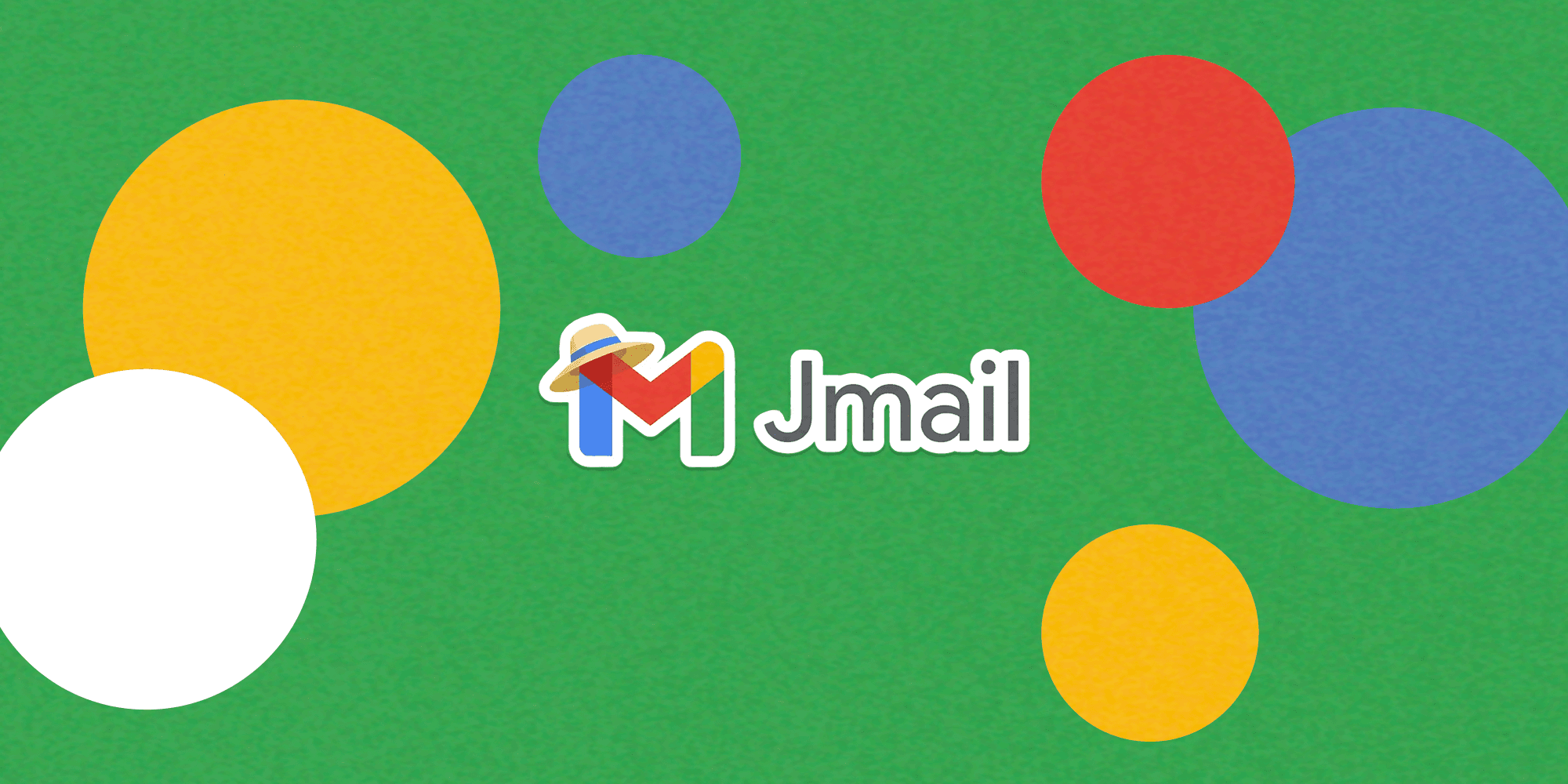
When I open Jmail, I get stressed out because I have over seven thousand unread emails. Of course, these are not my own emails, but Jeffrey Epstein’s; still, the prospect of reading them all is overwhelming, a task I have not yet attempted. The logo for Jmail is the classic Gmail ‘M’ envelope, except with a beachy hat on top — colorful and irreverent. What makes Jmail so captivating is that it breaks down the mystique of the Epstein case with its friendliness. The question “what if your Gmail was on vacation?” was the “creative inspiration” for the logo, Luke told me. He used Nano Banana Pro, Google Gemini’s AI image generator, to create the logo. And so Jmail was born.
Jmail.world went live on November 21 with an X post from Riley Walz: “We cloned Gmail, except you’re logged in as Epstein and can see his emails.” The pickup was immediate; Riley’s original post has 134,000 likes and 22 million views (and counting). The same day, the San Francisco Standard described the website as “the easiest way to read all the Jeffrey Epstein emails.”
For the Jmail team, getting access to the most recent files in the first place is an uphill battle. “We were able to really quickly trudge through tens of thousands of distinct documents that we had from the White House’s December release. But this one is over a million, and it is in the hundreds of gigabytes, whereas the one in December was less than ten gigabytes. But everyone, all journalists, everyone who is into data hoarding, everyone on Reddit is pointing out that those downloads just get cancelled,” Luke told me. “Riley joked about this last time: it feels like you’re on Ticketmaster, because there’s a queue. If there’s too many people visiting justice.gov, there’s like a queue that says your turn is ready.” When I talked to Luke about the January 30 release shortly after it went live, he told me that the Jmail team had spent dozens of hours chasing access to the new files, “sourcing really sketchy download links” and “cross-examining everything.”
Together, Luke and Riley have a long track record of making inscrutable information legible. In San Francisco, Riley is already notorious for his Find My Parking Cops app, which tracked San Francisco’s parking cops using (then) publicly available data from recent tickets, allowing users to evade them, since locations of newly issued tickets inadvertently revealed where the parking cops were. San Francisco’s Municipal Transportation Agency soon turned off the tap for the real-time data feed, which stopped the app in its tracks. But, Riley — who also leaked JD Vance’s Spotify and opened a fake steakhouse in New York for one night — remains legendary in San Francisco for his shenanigans. Luke often spoke about the “Riley Walz touch” in his stunts: “the whole point of the great Riley stunts is that they’re polished.” The duo behind Jmail were obsessed with the elegance of their product; if their interface were clumsy or coarse, it wouldn’t have caught on. “We’re getting 10,000 people using the Jsuite every single day, which translates to quite a few million users per month. And we peaked at well over a million people visiting in a single day” — that was December 23, soon after the Jsuite expanded following the statutory deadline on the files’ release.
Thanks to Luke and Riley’s work, many “Epstein heads,” as Luke calls these somewhat-redeemed conspiracy theorists, who spent years insisting that there was more to the Epstein story than the official narrative allowed, share information largely via Jmail and other Jsuite products.
As more and more information became available following the December 19 statutory release deadline for the Epstein Files, Luke and Riley kept hard at work. So came the “Jmail suite,” or what Luke refers to as “Jmail 2.” He explained: “Jmail 2 is what happened after Will Depue” — an engineer at OpenAI with a popular presence on X — “was like, ‘is anyone gonna do a build?’” after the Epstein Files Transparency Act’s first tranche was released. “And I was kind of offended by it. And I was like, ‘Fuck you. We already did a build.’” Right as the startup offices of San Francisco were emptying out before Christmas, Luke found himself with a group of hackers who wanted to do something with the newly released files. “And then a bunch of people invited themselves to my house. This happened the day of December 19.”
Aside from the December 19 batch of files, the success of Jmail 1.0 led to access to even more documents: the login to a previously unknown Epstein email, jeeproject@yahoo.com, was added to the Jmail interface after “some guy figured out Epstein’s password — the word ‘Ghislaine’ in all lowercase.”
With some time, Luke’s expanded team managed to display the litany of documents in a full suite of Epstein-themed tools, each mimicking a familiar Google product. “Jdrive” organizes court files and photos by their origin (folders are titled “doj-disclosures,” “house_oversight,” and “estate-production”) and allows users to search by person mentioned in each document. Jdrive also links to Kino, Luke’s AI video editing startup, where government footage of Epstein’s cell is available for viewing. “Jflights” visually tracks Epstein’s private jet and uses manifest records to list who was on each flight. (For obvious reasons, you can’t book flights on Jflights like you can on Google Flights). “Jemini” is an AI chatbot that answers questions about the Epstein Files. (When I asked “How many flights did I take with Ghislaine Maxwell?” Jemini responded: “There were 13 flights that Ghislaine Maxwell was a passenger on. Would you like to see them displayed?”) “Jamazon,” though technically not under the Google umbrella, tracks Epstein’s Amazon orders via his receipts: some of his most recent purchases in the months before his death included The Annotated Lolita, delivered on May 24, 2019, and “Kidoozie Musical Stack & Learn Rainbow - Stacking Activity Toy for Infants and Toddlers 6-24M,” delivered on June 2, 2019.
Of course, there is something uncomfortable about logging into any of these Epstein-flavored apps, but this discomfort is downstream of the evil of Epstein’s crimes — evil that is now legible to anyone with a browser.
When I spoke with Luke about building the Jsuite, it was evident that the project wouldn’t have been possible in such a short time a year ago (or even months ago). Much of the Jsuite was “vibe coded,” meaning AI was heavily used to program the different applications. Luke also used Reducto — his MIT fraternity brothers’ startup — to convert “ugly, handwritten PDFs” to parsable files ready for data analysis. “This is technology that has only been around for a very short amount of time, as in, completely open-ended PDF extraction being used to populate an app that you just made with thousands of actual data points in whatever format you want.” Additionally, Igel’s co-conspirator Diego Rodriguez, the CEO of an AI imaging startup, made use of Apple’s new AI model that “came out the day that the Epstein Files came out.” “Diego was like, I love Apple. I have an overpowered Mac Studio. I’m going to use the new Apple algorithm.” And so he used the model to create EpsteinVR, “A full 3D model of Jeffrey’s Upper East Side mansion” which was generated using Apple’s new SHARP Gaussian Splat model. “Every single startup that could have been involved, we tried to include them and give them a shout out” on the Jmail website, Luke said. “The less vibe coded stuff,” which included manual redacting, “was the stuff we were able to release in the days and weeks afterwards.”
Luke used his own proprietary software from Kino to render the images in Jphotos to “render really large amounts of footage really quickly. It was really nontrivial to be able to render this many photos.” The fast pace of development — often overnight — allowed the Jmail team to quickly react to and publicize new documents and news events, keeping them on the bleeding edge of the news cycle. What once required a team of engineers and weeks, if not months, of work can be built by a hacker or two in hours.
In building Jmail, Luke took pride in “being punkish in a way that is very technically elegant and technically elaborate.” And by punk, Luke doesn’t mean wearing plaid or blasting the Dead Kennedys. Being “punk” means embodying a spirit of anti-institutional irreverence: sticking it to “the man” (whatever or whoever “the man” may be at your particular place in history) without letting your sense of humor be crushed in the process. When I asked Luke whether he got any flak from Google for associating their product with the largest scandal of the 21st century, he laughed. “I respect the hell out of Google. You can really mess with them.”
Conspiracy theorists may be decidedly anti-institutional, but by and large, they don’t have a sense of humor about themselves or the objects of their conspiracies — perhaps because the standard topics that make up conspiracy theories are so horrifying (child sex trafficking rings, manmade pandemics, mass censorship, secret networks of anti-democratic bureaucrats). But while the Epstein case may be a true deep-internet conspiracy theory come to life, there is also something deeply satisfying, and fitting, about making the details of the Epstein case so easily accessible to the masses. When I asked Luke if he had made any tradeoffs when designing a product that could go viral (accessible to “the median voter,” as Luke put it), while also trying to make meaningful “punk” art in software, he told me he was happy with Jmail’s reception. “Punkishness that goes viral has always, always been very close to my heart.” This case study of elite excess and inscrutability can now be viewed by anyone, in primary-colored, user-friendly graphic design.
One of my favorite films about the escapes of elites after hours is the legendary director Stanley Kubrick’s final film, Eyes Wide Shut (1999), in which a doctor in his thirties (played by Tom Cruise) finds himself at a masked psycho-sexual ritual at a mansion outside of New York City. The gathering is populated by the city’s ultra-elite, who engage in secretive, anonymous sexual rites. (It has long been theorized that Kubrick’s death soon before Eyes Wide Shut’s release was the work of Hollywood executives who did not want the contents of their own masked rituals to be revealed.) Part of the film’s appeal is its voyeurism: Cruise’s character, while successful by any normal standards, is squarely upper-middle-class, and only hears of the gathering through an ultra-wealthy patient, after which he succeeds at sneaking in. Through his eyes, the audience is able to gaze at a private world otherwise sealed off. Jmail may be Eyes Wide Shut for the digital age: a brief glimpse into the private activities of the ultra-elite, shown through the eyes of an unlikely intermediary. But the reality of elite conspiracy is far less glamorous than Hollywood fantasy. Scrolling through the Jsuite, one can’t help but be a bit disappointed by the banality of Epstein’s day-to-day life: Amazon receipts for rugs and headphones, daily Quora digests, and, like any modern executive, a mountain of unread emails.
Civilization
•
You've Got Mail!
Jmail and the deciphering of an American mystery.
A great deal of ‘intelligence work,’ whether for the three-letter agencies or run-of-the-mill knowledge work, has to do with looking for the signal in the noise. Lawyers look for damning evidence within a mountain of files. Financial analysts look for fraudulent numbers within thousands of spreadsheet cells. CIA analysts try to find obscured information in unreliable interview transcripts, intercepted communications, and wiretaps. In all intelligence work, the first step is not interpreting, but sorting — taking a disordered pile of information and trying to find the smoking gun. The opposite of information is not mis- or dis-information, or even no information at all. The opposite of information is illegibility.
This past holiday season, conspiracy theorists around America rejoiced when what may be the greatest conspiracy theory of our lifetimes had, at long last, been made hyper-legible: the saga of Jeffrey Epstein. Epstein, a financier of murky origins who cultivated relationships with the rich and powerful, was arrested and indicted on federal sex trafficking charges in July 2019. But he died by (apparent) suicide in jail before his trial on August 10 of that year, denying the public answers to questions that theoretically would have been answered in a court of law in a public trial — like how Epstein made his money, and the nature of the involvement of his network of princes and presidents. In the absence of a trial, much of what the public knows comes from the “Epstein Files,” a collection of documents released through lawsuits, court orders, and investigative reporting. These files are the documentary residue of his life (emails, flight logs, photos) that were kept under lock and key by lawyers and government bureaucrats.
The Epstein Files Transparency Act, signed into law by President Trump on November 19, required the Attorney General “to release all documents and records in possession of the Department of Justice relating to Jeffrey Epstein” by December 19, 2025. The Department of Justice did not meet this deadline, though the first wave of these Epstein Files hit the internet on November 12, when the House Oversight Committee released over 20,000 pages of files from the Epstein estate. But although the full scope of the files remains unavailable to the public, a large fraction of the Epstein Files has been released, including a new drop of about 3.5 million pages of material on January 30, 2026.
Technically, all of the information in the first tranche of files was “public” following the November release. But these 20,000 pages — dumped into Google Drive nesting dolls of folders, .txt and zip files — were extremely difficult to navigate. (My Google Drive froze when I tried to scroll through subfolder 001 in the TEXT folder just to gauge how many documents it contained.) Legibility was not the first priority when these documents were uploaded; the sheer amount of files, combined with the government’s lack of technical finesse, made them nearly impossible to parse.
For Your Eyes Only.
Spies. Satellites. State secrets. Inside the technologies and intelligence contests shaping American power.
Subscribe + Issue 007
But these files were once hyper-legible: the ordinary emails, receipts, and other digital detritus of a man who, despite the extreme nature of his “work,” used the same software to run his life as everyone else. So, what better way to make Epstein’s emails legible than to log in to his inbox as Epstein himself? A group of San Francisco twenty-somethings, led by 26-year-old Luke Igel and 24-year-old Riley Walz, are now allowing users to do just that.
Luke and Riley call their project “Jmail”; swapping Google’s ‘G’ for Epstein’s ‘J.’ Luke, Jmail’s ringleader and the CEO of Kino AI, told me over a 6pm iced coffee that he and Riley made Jmail overnight. “We just stayed up on Wednesday night [November 19], and Riley and I made it in Cursor. We ended up being completely correct that this is what the world wanted to see.”
Back in the mid-2000s, part of Gmail’s original novelty was making email searchable, which was impossible in the early days of email because there was no central system that stored and indexed all emails. Today, Jmail’s novelty is making Epstein’s emails — and now, his documents, photos, and flight logs, to name a few of the features of the extended Jmail “suite” — searchable and intuitive to view. The government’s declassification of the Epstein Files did the bare minimum of what was required to make these documents legally “public.” Jmail, by contrast, is actually designed to make these documents legible, and understandable, to a general audience.
Luke had been following the Epstein case since August 2019, after his freshman year at MIT, when he heard the news that Epstein died. “I was at the Formula Student driverless competition in Hockenheim, Germany, living in a military tent for a week.” Immediately after the news broke, Luke’s friend burst into their tent while he and his teammates were eating canned soup, and asked “‘Did you guys hear that that coward Epstein just killed himself? It’s like he just got away with it!’ And then the mystique just grew and grew and grew.”
Ever since Epstein died in jail, many people have wanted authoritative proof that Epstein was killed by a shadowy network of powerbrokers to protect their own reputations, believing that the circumstances of his “suicide” are just too perfect to believe otherwise. And it seems obscene that, if Epstein was killed, those who orchestrated his death should be able to get away with such an obvious crime.
For those who believe Epstein’s death was not a suicide, the files may offer a set of clues to solve the mystery of whether some of the elites in Epstein’s network wanted him dead, and succeeded in killing him. And for everyone else, these files are a record of how the ultra-elite communicate when they don’t think anyone is reading: struggling to get a reservation at Gary Danko, recommending private chefs, or arranging meetings with Vladimir Putin. And now, the details of what is likely the greatest crime of the 21st century are available for anyone to read, in bright, Googley technicolor.
When I open Jmail, I get stressed out because I have over seven thousand unread emails. Of course, these are not my own emails, but Jeffrey Epstein’s; still, the prospect of reading them all is overwhelming, a task I have not yet attempted. The logo for Jmail is the classic Gmail ‘M’ envelope, except with a beachy hat on top — colorful and irreverent. What makes Jmail so captivating is that it breaks down the mystique of the Epstein case with its friendliness. The question “what if your Gmail was on vacation?” was the “creative inspiration” for the logo, Luke told me. He used Nano Banana Pro, Google Gemini’s AI image generator, to create the logo. And so Jmail was born.
Jmail.world went live on November 21 with an X post from Riley Walz: “We cloned Gmail, except you’re logged in as Epstein and can see his emails.” The pickup was immediate; Riley’s original post has 134,000 likes and 22 million views (and counting). The same day, the San Francisco Standard described the website as “the easiest way to read all the Jeffrey Epstein emails.”
For the Jmail team, getting access to the most recent files in the first place is an uphill battle. “We were able to really quickly trudge through tens of thousands of distinct documents that we had from the White House’s December release. But this one is over a million, and it is in the hundreds of gigabytes, whereas the one in December was less than ten gigabytes. But everyone, all journalists, everyone who is into data hoarding, everyone on Reddit is pointing out that those downloads just get cancelled,” Luke told me. “Riley joked about this last time: it feels like you’re on Ticketmaster, because there’s a queue. If there’s too many people visiting justice.gov, there’s like a queue that says your turn is ready.” When I talked to Luke about the January 30 release shortly after it went live, he told me that the Jmail team had spent dozens of hours chasing access to the new files, “sourcing really sketchy download links” and “cross-examining everything.”
Together, Luke and Riley have a long track record of making inscrutable information legible. In San Francisco, Riley is already notorious for his Find My Parking Cops app, which tracked San Francisco’s parking cops using (then) publicly available data from recent tickets, allowing users to evade them, since locations of newly issued tickets inadvertently revealed where the parking cops were. San Francisco’s Municipal Transportation Agency soon turned off the tap for the real-time data feed, which stopped the app in its tracks. But, Riley — who also leaked JD Vance’s Spotify and opened a fake steakhouse in New York for one night — remains legendary in San Francisco for his shenanigans. Luke often spoke about the “Riley Walz touch” in his stunts: “the whole point of the great Riley stunts is that they’re polished.” The duo behind Jmail were obsessed with the elegance of their product; if their interface were clumsy or coarse, it wouldn’t have caught on. “We’re getting 10,000 people using the Jsuite every single day, which translates to quite a few million users per month. And we peaked at well over a million people visiting in a single day” — that was December 23, soon after the Jsuite expanded following the statutory deadline on the files’ release.
Thanks to Luke and Riley’s work, many “Epstein heads,” as Luke calls these somewhat-redeemed conspiracy theorists, who spent years insisting that there was more to the Epstein story than the official narrative allowed, share information largely via Jmail and other Jsuite products.
As more and more information became available following the December 19 statutory release deadline for the Epstein Files, Luke and Riley kept hard at work. So came the “Jmail suite,” or what Luke refers to as “Jmail 2.” He explained: “Jmail 2 is what happened after Will Depue” — an engineer at OpenAI with a popular presence on X — “was like, ‘is anyone gonna do a build?’” after the Epstein Files Transparency Act’s first tranche was released. “And I was kind of offended by it. And I was like, ‘Fuck you. We already did a build.’” Right as the startup offices of San Francisco were emptying out before Christmas, Luke found himself with a group of hackers who wanted to do something with the newly released files. “And then a bunch of people invited themselves to my house. This happened the day of December 19.”
Aside from the December 19 batch of files, the success of Jmail 1.0 led to access to even more documents: the login to a previously unknown Epstein email, jeeproject@yahoo.com, was added to the Jmail interface after “some guy figured out Epstein’s password — the word ‘Ghislaine’ in all lowercase.”
With some time, Luke’s expanded team managed to display the litany of documents in a full suite of Epstein-themed tools, each mimicking a familiar Google product. “Jdrive” organizes court files and photos by their origin (folders are titled “doj-disclosures,” “house_oversight,” and “estate-production”) and allows users to search by person mentioned in each document. Jdrive also links to Kino, Luke’s AI video editing startup, where government footage of Epstein’s cell is available for viewing. “Jflights” visually tracks Epstein’s private jet and uses manifest records to list who was on each flight. (For obvious reasons, you can’t book flights on Jflights like you can on Google Flights). “Jemini” is an AI chatbot that answers questions about the Epstein Files. (When I asked “How many flights did I take with Ghislaine Maxwell?” Jemini responded: “There were 13 flights that Ghislaine Maxwell was a passenger on. Would you like to see them displayed?”) “Jamazon,” though technically not under the Google umbrella, tracks Epstein’s Amazon orders via his receipts: some of his most recent purchases in the months before his death included The Annotated Lolita, delivered on May 24, 2019, and “Kidoozie Musical Stack & Learn Rainbow - Stacking Activity Toy for Infants and Toddlers 6-24M,” delivered on June 2, 2019.
Of course, there is something uncomfortable about logging into any of these Epstein-flavored apps, but this discomfort is downstream of the evil of Epstein’s crimes — evil that is now legible to anyone with a browser.
When I spoke with Luke about building the Jsuite, it was evident that the project wouldn’t have been possible in such a short time a year ago (or even months ago). Much of the Jsuite was “vibe coded,” meaning AI was heavily used to program the different applications. Luke also used Reducto — his MIT fraternity brothers’ startup — to convert “ugly, handwritten PDFs” to parsable files ready for data analysis. “This is technology that has only been around for a very short amount of time, as in, completely open-ended PDF extraction being used to populate an app that you just made with thousands of actual data points in whatever format you want.” Additionally, Igel’s co-conspirator Diego Rodriguez, the CEO of an AI imaging startup, made use of Apple’s new AI model that “came out the day that the Epstein Files came out.” “Diego was like, I love Apple. I have an overpowered Mac Studio. I’m going to use the new Apple algorithm.” And so he used the model to create EpsteinVR, “A full 3D model of Jeffrey’s Upper East Side mansion” which was generated using Apple’s new SHARP Gaussian Splat model. “Every single startup that could have been involved, we tried to include them and give them a shout out” on the Jmail website, Luke said. “The less vibe coded stuff,” which included manual redacting, “was the stuff we were able to release in the days and weeks afterwards.”
Luke used his own proprietary software from Kino to render the images in Jphotos to “render really large amounts of footage really quickly. It was really nontrivial to be able to render this many photos.” The fast pace of development — often overnight — allowed the Jmail team to quickly react to and publicize new documents and news events, keeping them on the bleeding edge of the news cycle. What once required a team of engineers and weeks, if not months, of work can be built by a hacker or two in hours.
In building Jmail, Luke took pride in “being punkish in a way that is very technically elegant and technically elaborate.” And by punk, Luke doesn’t mean wearing plaid or blasting the Dead Kennedys. Being “punk” means embodying a spirit of anti-institutional irreverence: sticking it to “the man” (whatever or whoever “the man” may be at your particular place in history) without letting your sense of humor be crushed in the process. When I asked Luke whether he got any flak from Google for associating their product with the largest scandal of the 21st century, he laughed. “I respect the hell out of Google. You can really mess with them.”
Conspiracy theorists may be decidedly anti-institutional, but by and large, they don’t have a sense of humor about themselves or the objects of their conspiracies — perhaps because the standard topics that make up conspiracy theories are so horrifying (child sex trafficking rings, manmade pandemics, mass censorship, secret networks of anti-democratic bureaucrats). But while the Epstein case may be a true deep-internet conspiracy theory come to life, there is also something deeply satisfying, and fitting, about making the details of the Epstein case so easily accessible to the masses. When I asked Luke if he had made any tradeoffs when designing a product that could go viral (accessible to “the median voter,” as Luke put it), while also trying to make meaningful “punk” art in software, he told me he was happy with Jmail’s reception. “Punkishness that goes viral has always, always been very close to my heart.” This case study of elite excess and inscrutability can now be viewed by anyone, in primary-colored, user-friendly graphic design.
One of my favorite films about the escapes of elites after hours is the legendary director Stanley Kubrick’s final film, Eyes Wide Shut (1999), in which a doctor in his thirties (played by Tom Cruise) finds himself at a masked psycho-sexual ritual at a mansion outside of New York City. The gathering is populated by the city’s ultra-elite, who engage in secretive, anonymous sexual rites. (It has long been theorized that Kubrick’s death soon before Eyes Wide Shut’s release was the work of Hollywood executives who did not want the contents of their own masked rituals to be revealed.) Part of the film’s appeal is its voyeurism: Cruise’s character, while successful by any normal standards, is squarely upper-middle-class, and only hears of the gathering through an ultra-wealthy patient, after which he succeeds at sneaking in. Through his eyes, the audience is able to gaze at a private world otherwise sealed off. Jmail may be Eyes Wide Shut for the digital age: a brief glimpse into the private activities of the ultra-elite, shown through the eyes of an unlikely intermediary. But the reality of elite conspiracy is far less glamorous than Hollywood fantasy. Scrolling through the Jsuite, one can’t help but be a bit disappointed by the banality of Epstein’s day-to-day life: Amazon receipts for rugs and headphones, daily Quora digests, and, like any modern executive, a mountain of unread emails.
Civilization
•
You've Got Mail!
Jmail and the deciphering of an American mystery.
A great deal of ‘intelligence work,’ whether for the three-letter agencies or run-of-the-mill knowledge work, has to do with looking for the signal in the noise. Lawyers look for damning evidence within a mountain of files. Financial analysts look for fraudulent numbers within thousands of spreadsheet cells. CIA analysts try to find obscured information in unreliable interview transcripts, intercepted communications, and wiretaps. In all intelligence work, the first step is not interpreting, but sorting — taking a disordered pile of information and trying to find the smoking gun. The opposite of information is not mis- or dis-information, or even no information at all. The opposite of information is illegibility.
This past holiday season, conspiracy theorists around America rejoiced when what may be the greatest conspiracy theory of our lifetimes had, at long last, been made hyper-legible: the saga of Jeffrey Epstein. Epstein, a financier of murky origins who cultivated relationships with the rich and powerful, was arrested and indicted on federal sex trafficking charges in July 2019. But he died by (apparent) suicide in jail before his trial on August 10 of that year, denying the public answers to questions that theoretically would have been answered in a court of law in a public trial — like how Epstein made his money, and the nature of the involvement of his network of princes and presidents. In the absence of a trial, much of what the public knows comes from the “Epstein Files,” a collection of documents released through lawsuits, court orders, and investigative reporting. These files are the documentary residue of his life (emails, flight logs, photos) that were kept under lock and key by lawyers and government bureaucrats.
The Epstein Files Transparency Act, signed into law by President Trump on November 19, required the Attorney General “to release all documents and records in possession of the Department of Justice relating to Jeffrey Epstein” by December 19, 2025. The Department of Justice did not meet this deadline, though the first wave of these Epstein Files hit the internet on November 12, when the House Oversight Committee released over 20,000 pages of files from the Epstein estate. But although the full scope of the files remains unavailable to the public, a large fraction of the Epstein Files has been released, including a new drop of about 3.5 million pages of material on January 30, 2026.
Technically, all of the information in the first tranche of files was “public” following the November release. But these 20,000 pages — dumped into Google Drive nesting dolls of folders, .txt and zip files — were extremely difficult to navigate. (My Google Drive froze when I tried to scroll through subfolder 001 in the TEXT folder just to gauge how many documents it contained.) Legibility was not the first priority when these documents were uploaded; the sheer amount of files, combined with the government’s lack of technical finesse, made them nearly impossible to parse.
For Your Eyes Only.
Spies. Satellites. State secrets. Inside the technologies and intelligence contests shaping American power.
Subscribe + Issue 007
But these files were once hyper-legible: the ordinary emails, receipts, and other digital detritus of a man who, despite the extreme nature of his “work,” used the same software to run his life as everyone else. So, what better way to make Epstein’s emails legible than to log in to his inbox as Epstein himself? A group of San Francisco twenty-somethings, led by 26-year-old Luke Igel and 24-year-old Riley Walz, are now allowing users to do just that.
Luke and Riley call their project “Jmail”; swapping Google’s ‘G’ for Epstein’s ‘J.’ Luke, Jmail’s ringleader and the CEO of Kino AI, told me over a 6pm iced coffee that he and Riley made Jmail overnight. “We just stayed up on Wednesday night [November 19], and Riley and I made it in Cursor. We ended up being completely correct that this is what the world wanted to see.”
Back in the mid-2000s, part of Gmail’s original novelty was making email searchable, which was impossible in the early days of email because there was no central system that stored and indexed all emails. Today, Jmail’s novelty is making Epstein’s emails — and now, his documents, photos, and flight logs, to name a few of the features of the extended Jmail “suite” — searchable and intuitive to view. The government’s declassification of the Epstein Files did the bare minimum of what was required to make these documents legally “public.” Jmail, by contrast, is actually designed to make these documents legible, and understandable, to a general audience.
Luke had been following the Epstein case since August 2019, after his freshman year at MIT, when he heard the news that Epstein died. “I was at the Formula Student driverless competition in Hockenheim, Germany, living in a military tent for a week.” Immediately after the news broke, Luke’s friend burst into their tent while he and his teammates were eating canned soup, and asked “‘Did you guys hear that that coward Epstein just killed himself? It’s like he just got away with it!’ And then the mystique just grew and grew and grew.”
Ever since Epstein died in jail, many people have wanted authoritative proof that Epstein was killed by a shadowy network of powerbrokers to protect their own reputations, believing that the circumstances of his “suicide” are just too perfect to believe otherwise. And it seems obscene that, if Epstein was killed, those who orchestrated his death should be able to get away with such an obvious crime.
For those who believe Epstein’s death was not a suicide, the files may offer a set of clues to solve the mystery of whether some of the elites in Epstein’s network wanted him dead, and succeeded in killing him. And for everyone else, these files are a record of how the ultra-elite communicate when they don’t think anyone is reading: struggling to get a reservation at Gary Danko, recommending private chefs, or arranging meetings with Vladimir Putin. And now, the details of what is likely the greatest crime of the 21st century are available for anyone to read, in bright, Googley technicolor.
When I open Jmail, I get stressed out because I have over seven thousand unread emails. Of course, these are not my own emails, but Jeffrey Epstein’s; still, the prospect of reading them all is overwhelming, a task I have not yet attempted. The logo for Jmail is the classic Gmail ‘M’ envelope, except with a beachy hat on top — colorful and irreverent. What makes Jmail so captivating is that it breaks down the mystique of the Epstein case with its friendliness. The question “what if your Gmail was on vacation?” was the “creative inspiration” for the logo, Luke told me. He used Nano Banana Pro, Google Gemini’s AI image generator, to create the logo. And so Jmail was born.
Jmail.world went live on November 21 with an X post from Riley Walz: “We cloned Gmail, except you’re logged in as Epstein and can see his emails.” The pickup was immediate; Riley’s original post has 134,000 likes and 22 million views (and counting). The same day, the San Francisco Standard described the website as “the easiest way to read all the Jeffrey Epstein emails.”
For the Jmail team, getting access to the most recent files in the first place is an uphill battle. “We were able to really quickly trudge through tens of thousands of distinct documents that we had from the White House’s December release. But this one is over a million, and it is in the hundreds of gigabytes, whereas the one in December was less than ten gigabytes. But everyone, all journalists, everyone who is into data hoarding, everyone on Reddit is pointing out that those downloads just get cancelled,” Luke told me. “Riley joked about this last time: it feels like you’re on Ticketmaster, because there’s a queue. If there’s too many people visiting justice.gov, there’s like a queue that says your turn is ready.” When I talked to Luke about the January 30 release shortly after it went live, he told me that the Jmail team had spent dozens of hours chasing access to the new files, “sourcing really sketchy download links” and “cross-examining everything.”
Together, Luke and Riley have a long track record of making inscrutable information legible. In San Francisco, Riley is already notorious for his Find My Parking Cops app, which tracked San Francisco’s parking cops using (then) publicly available data from recent tickets, allowing users to evade them, since locations of newly issued tickets inadvertently revealed where the parking cops were. San Francisco’s Municipal Transportation Agency soon turned off the tap for the real-time data feed, which stopped the app in its tracks. But, Riley — who also leaked JD Vance’s Spotify and opened a fake steakhouse in New York for one night — remains legendary in San Francisco for his shenanigans. Luke often spoke about the “Riley Walz touch” in his stunts: “the whole point of the great Riley stunts is that they’re polished.” The duo behind Jmail were obsessed with the elegance of their product; if their interface were clumsy or coarse, it wouldn’t have caught on. “We’re getting 10,000 people using the Jsuite every single day, which translates to quite a few million users per month. And we peaked at well over a million people visiting in a single day” — that was December 23, soon after the Jsuite expanded following the statutory deadline on the files’ release.
Thanks to Luke and Riley’s work, many “Epstein heads,” as Luke calls these somewhat-redeemed conspiracy theorists, who spent years insisting that there was more to the Epstein story than the official narrative allowed, share information largely via Jmail and other Jsuite products.
As more and more information became available following the December 19 statutory release deadline for the Epstein Files, Luke and Riley kept hard at work. So came the “Jmail suite,” or what Luke refers to as “Jmail 2.” He explained: “Jmail 2 is what happened after Will Depue” — an engineer at OpenAI with a popular presence on X — “was like, ‘is anyone gonna do a build?’” after the Epstein Files Transparency Act’s first tranche was released. “And I was kind of offended by it. And I was like, ‘Fuck you. We already did a build.’” Right as the startup offices of San Francisco were emptying out before Christmas, Luke found himself with a group of hackers who wanted to do something with the newly released files. “And then a bunch of people invited themselves to my house. This happened the day of December 19.”
Aside from the December 19 batch of files, the success of Jmail 1.0 led to access to even more documents: the login to a previously unknown Epstein email, jeeproject@yahoo.com, was added to the Jmail interface after “some guy figured out Epstein’s password — the word ‘Ghislaine’ in all lowercase.”
With some time, Luke’s expanded team managed to display the litany of documents in a full suite of Epstein-themed tools, each mimicking a familiar Google product. “Jdrive” organizes court files and photos by their origin (folders are titled “doj-disclosures,” “house_oversight,” and “estate-production”) and allows users to search by person mentioned in each document. Jdrive also links to Kino, Luke’s AI video editing startup, where government footage of Epstein’s cell is available for viewing. “Jflights” visually tracks Epstein’s private jet and uses manifest records to list who was on each flight. (For obvious reasons, you can’t book flights on Jflights like you can on Google Flights). “Jemini” is an AI chatbot that answers questions about the Epstein Files. (When I asked “How many flights did I take with Ghislaine Maxwell?” Jemini responded: “There were 13 flights that Ghislaine Maxwell was a passenger on. Would you like to see them displayed?”) “Jamazon,” though technically not under the Google umbrella, tracks Epstein’s Amazon orders via his receipts: some of his most recent purchases in the months before his death included The Annotated Lolita, delivered on May 24, 2019, and “Kidoozie Musical Stack & Learn Rainbow - Stacking Activity Toy for Infants and Toddlers 6-24M,” delivered on June 2, 2019.
Of course, there is something uncomfortable about logging into any of these Epstein-flavored apps, but this discomfort is downstream of the evil of Epstein’s crimes — evil that is now legible to anyone with a browser.
When I spoke with Luke about building the Jsuite, it was evident that the project wouldn’t have been possible in such a short time a year ago (or even months ago). Much of the Jsuite was “vibe coded,” meaning AI was heavily used to program the different applications. Luke also used Reducto — his MIT fraternity brothers’ startup — to convert “ugly, handwritten PDFs” to parsable files ready for data analysis. “This is technology that has only been around for a very short amount of time, as in, completely open-ended PDF extraction being used to populate an app that you just made with thousands of actual data points in whatever format you want.” Additionally, Igel’s co-conspirator Diego Rodriguez, the CEO of an AI imaging startup, made use of Apple’s new AI model that “came out the day that the Epstein Files came out.” “Diego was like, I love Apple. I have an overpowered Mac Studio. I’m going to use the new Apple algorithm.” And so he used the model to create EpsteinVR, “A full 3D model of Jeffrey’s Upper East Side mansion” which was generated using Apple’s new SHARP Gaussian Splat model. “Every single startup that could have been involved, we tried to include them and give them a shout out” on the Jmail website, Luke said. “The less vibe coded stuff,” which included manual redacting, “was the stuff we were able to release in the days and weeks afterwards.”
Luke used his own proprietary software from Kino to render the images in Jphotos to “render really large amounts of footage really quickly. It was really nontrivial to be able to render this many photos.” The fast pace of development — often overnight — allowed the Jmail team to quickly react to and publicize new documents and news events, keeping them on the bleeding edge of the news cycle. What once required a team of engineers and weeks, if not months, of work can be built by a hacker or two in hours.
In building Jmail, Luke took pride in “being punkish in a way that is very technically elegant and technically elaborate.” And by punk, Luke doesn’t mean wearing plaid or blasting the Dead Kennedys. Being “punk” means embodying a spirit of anti-institutional irreverence: sticking it to “the man” (whatever or whoever “the man” may be at your particular place in history) without letting your sense of humor be crushed in the process. When I asked Luke whether he got any flak from Google for associating their product with the largest scandal of the 21st century, he laughed. “I respect the hell out of Google. You can really mess with them.”
Conspiracy theorists may be decidedly anti-institutional, but by and large, they don’t have a sense of humor about themselves or the objects of their conspiracies — perhaps because the standard topics that make up conspiracy theories are so horrifying (child sex trafficking rings, manmade pandemics, mass censorship, secret networks of anti-democratic bureaucrats). But while the Epstein case may be a true deep-internet conspiracy theory come to life, there is also something deeply satisfying, and fitting, about making the details of the Epstein case so easily accessible to the masses. When I asked Luke if he had made any tradeoffs when designing a product that could go viral (accessible to “the median voter,” as Luke put it), while also trying to make meaningful “punk” art in software, he told me he was happy with Jmail’s reception. “Punkishness that goes viral has always, always been very close to my heart.” This case study of elite excess and inscrutability can now be viewed by anyone, in primary-colored, user-friendly graphic design.
One of my favorite films about the escapes of elites after hours is the legendary director Stanley Kubrick’s final film, Eyes Wide Shut (1999), in which a doctor in his thirties (played by Tom Cruise) finds himself at a masked psycho-sexual ritual at a mansion outside of New York City. The gathering is populated by the city’s ultra-elite, who engage in secretive, anonymous sexual rites. (It has long been theorized that Kubrick’s death soon before Eyes Wide Shut’s release was the work of Hollywood executives who did not want the contents of their own masked rituals to be revealed.) Part of the film’s appeal is its voyeurism: Cruise’s character, while successful by any normal standards, is squarely upper-middle-class, and only hears of the gathering through an ultra-wealthy patient, after which he succeeds at sneaking in. Through his eyes, the audience is able to gaze at a private world otherwise sealed off. Jmail may be Eyes Wide Shut for the digital age: a brief glimpse into the private activities of the ultra-elite, shown through the eyes of an unlikely intermediary. But the reality of elite conspiracy is far less glamorous than Hollywood fantasy. Scrolling through the Jsuite, one can’t help but be a bit disappointed by the banality of Epstein’s day-to-day life: Amazon receipts for rugs and headphones, daily Quora digests, and, like any modern executive, a mountain of unread emails.
About the Author
Julia Steinberg is General Manager of Books and an editor at Arena. She can be found on X at @juliasteinberg.