tt
tt
tt
tt
tt
tt
Technology
•
A Matic Home Story
Can vacuums lead a robot revolution?

Clean homes are all alike; each messy home is messy in its own way.
In 2017, Navneet Dalal and Mehul Nariyawala - veterans of Nest and Flutter - looked around and saw over 200 self-driving car startups, yet not a single serious effort aimed at automating the most repetitive, time-consuming tasks inside our homes. Families were spending three to four times more time doing chores than driving, and yet all we had were disk-shaped bots that bumped into furniture. Inspired by a different vision, one closer to Rosie the Robot from The Jetsons, they set out to build Matic: a home robot that could understand, navigate, and clean the chaotic, cluttered, and deeply personal spaces we live in.
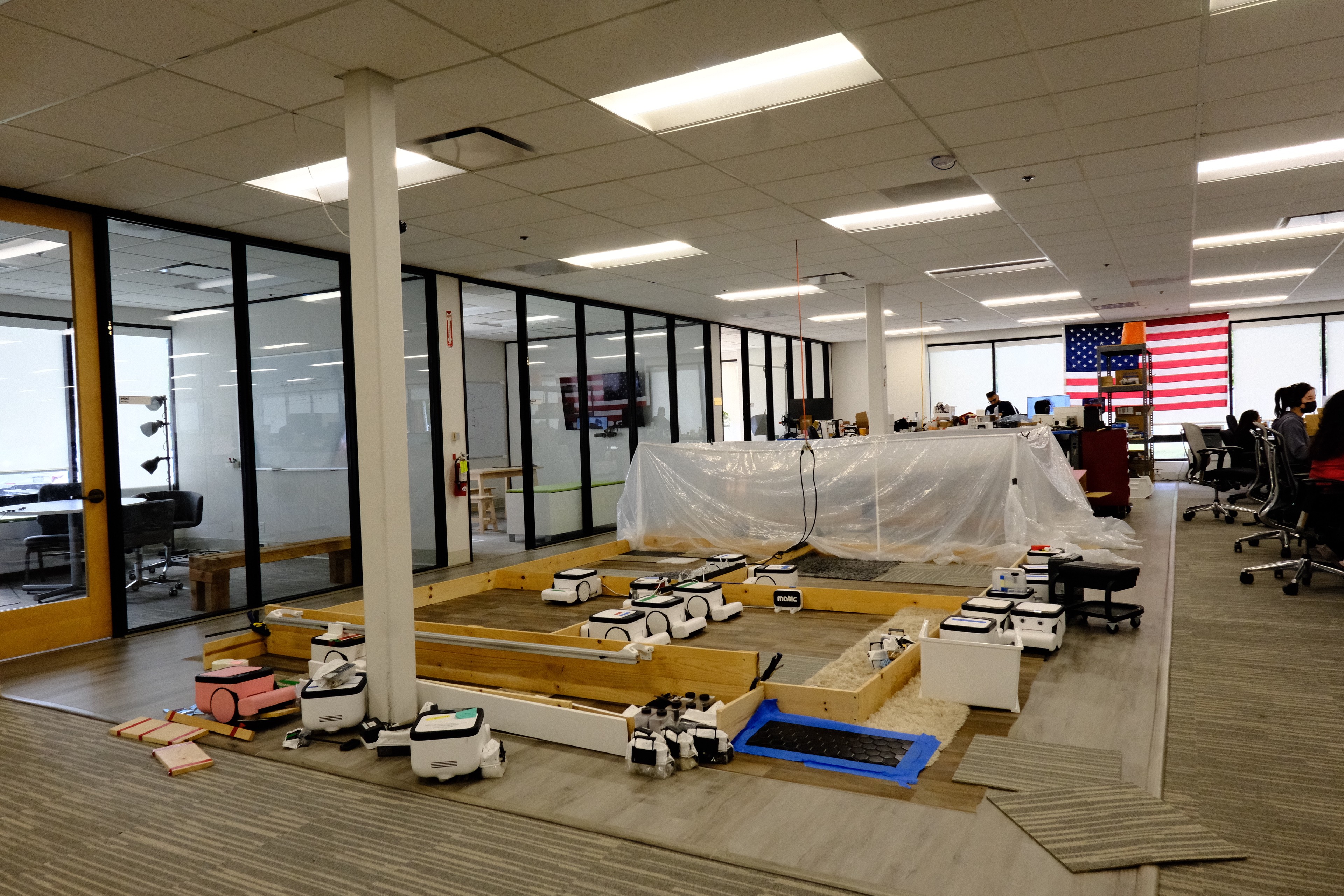
As you enter the Matic HQ in Mountain View, CA, you are met with first, the American flag, and then, a sprawl of 70 or so desktops, teeming with engineers, interns and production associates. Here and there on the floor are multiple trial and demonstration stations for their 7-inch floor robots, divided into irregular rectangles with plywood, assorted with carpets and other household obstacles. On the wall there is a big television screen displaying Total Area Cleaned (million sqft) : 54.0, Active Robots (Last Week) : 2160, etc. There are also boards of testimonials from happy customers. Mehul points to the children and pets that have helped shape Matic; one child was afraid of the robots until they sent her a smaller, toy version, which she decorated with stickers. Matic now comes with decorative, “cute” stickers.
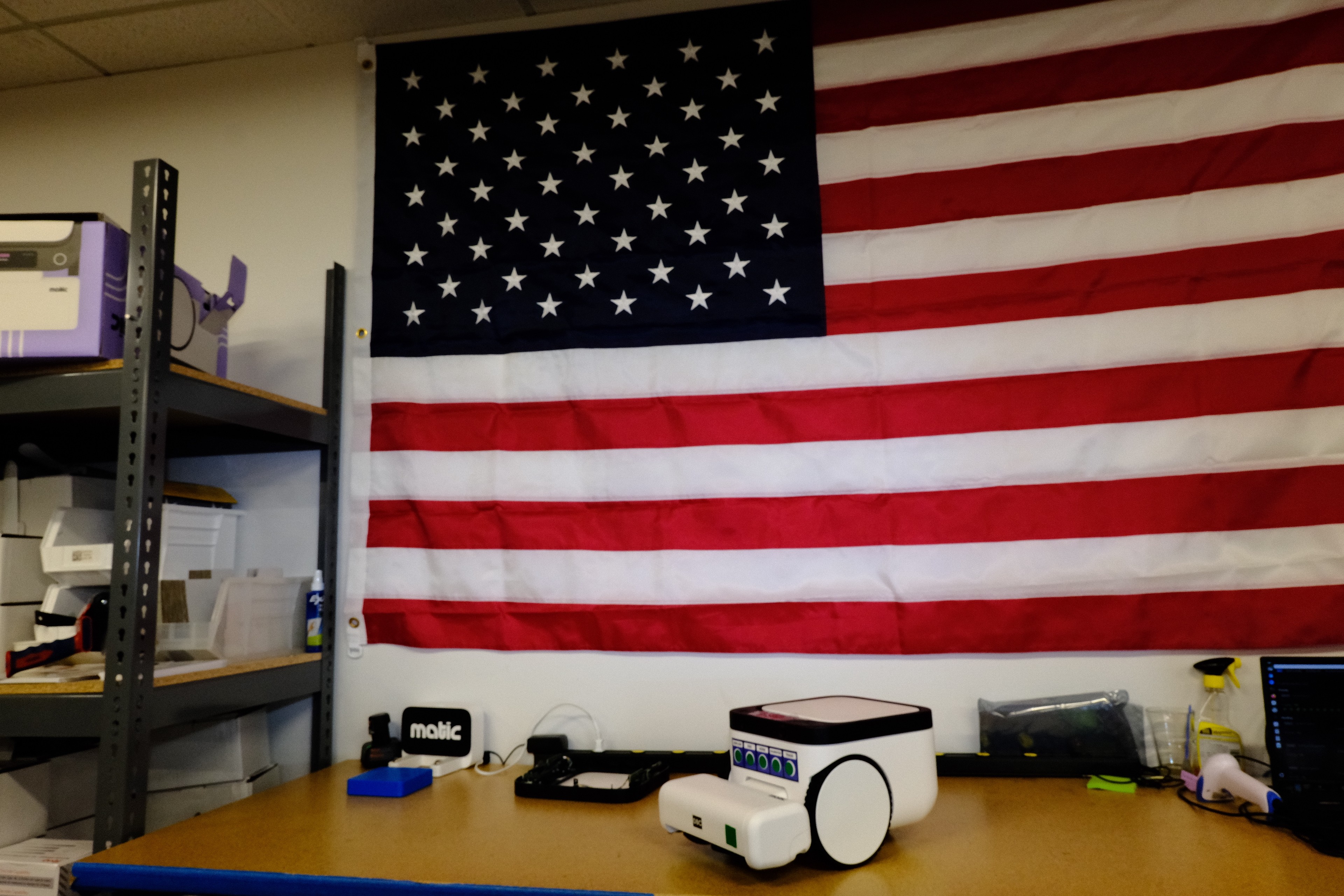
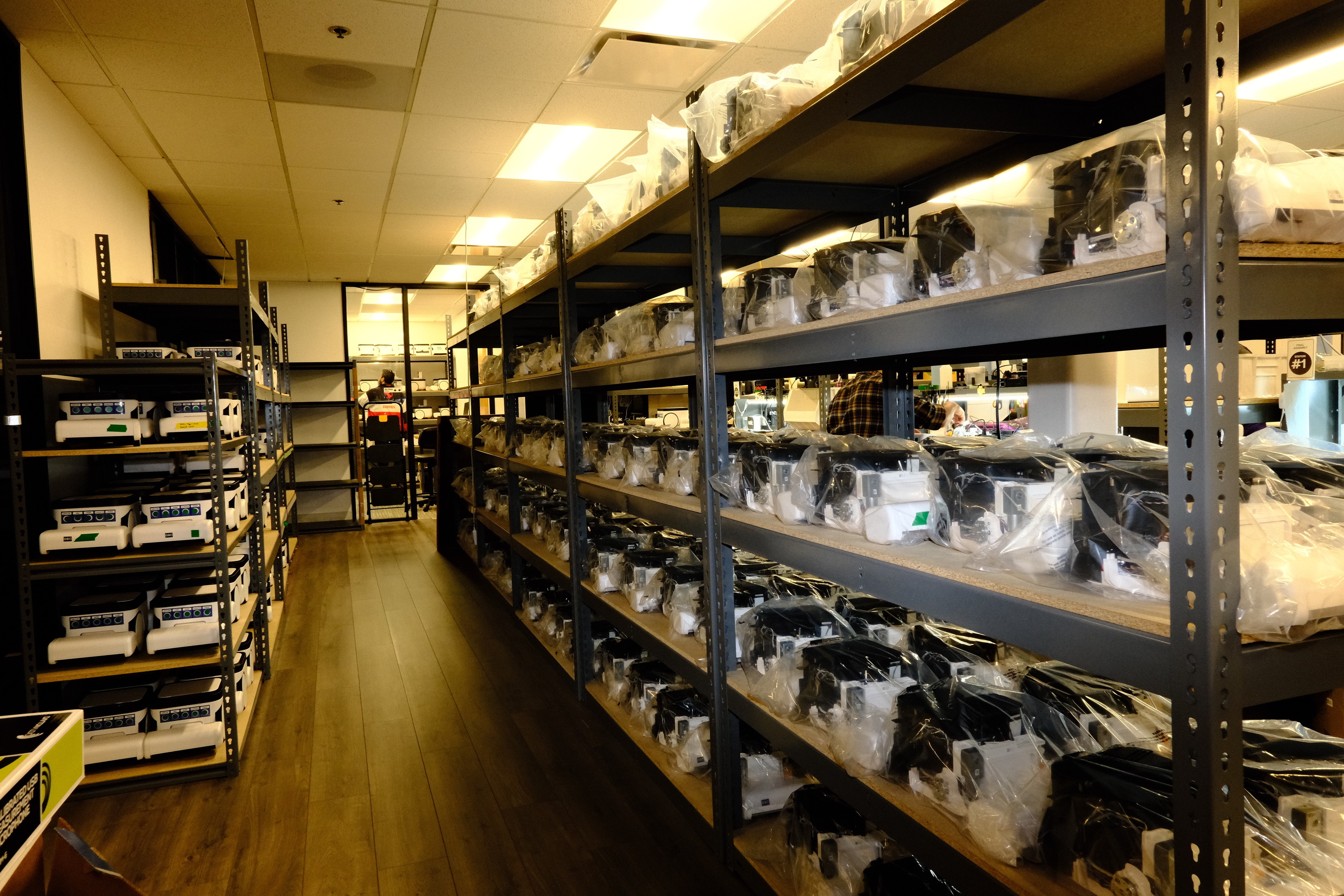
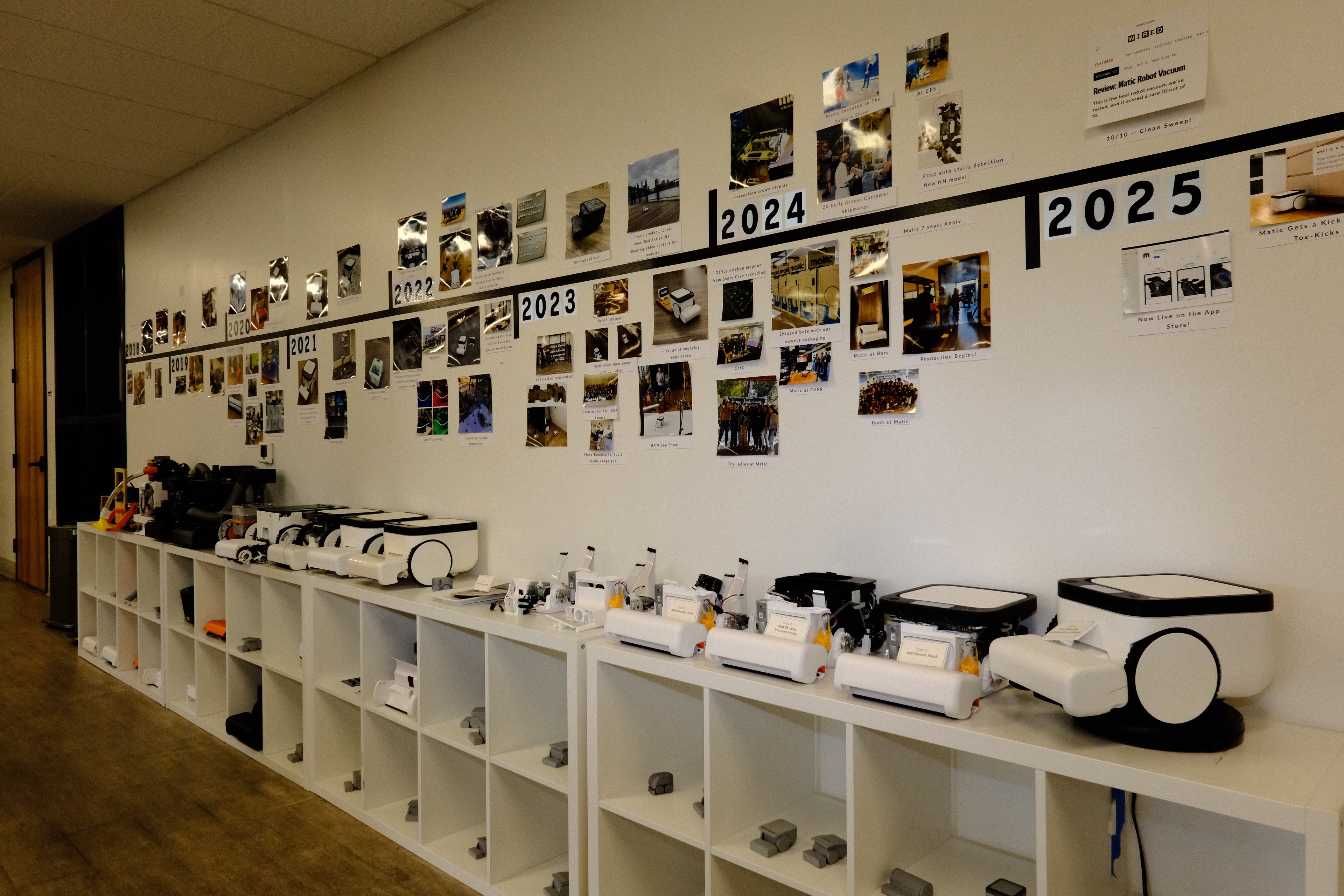
If you take a right, you enter the cafeteria where a side hosts their ‘Timeline Wall’, displaying prototypes and photos from 2018 to 2025. “We are running out of space, we might have to turn the room into a timeline wall”, says Mehul. If you go further back in, you enter the production space. Here, too, you find a wall adorned with the American flag. Most of the work here is on foot. There are rows of defunct, ready to go, and mid assembly Matics. Rooms in this part of the building are testing for different terrains (hot, humid, cold), quietness, and lens adjustments. There is a busy room conducting an interview that Mehul shows me from the outside only, hosting NVIDIA computers that are used to host 1500 simulations of homes in all kinds of situations. There are a thousand Matics in the single story building in rows in different rooms stalled at step four because camera shipments for the month have been delayed.

Three Martini Lunch.
Follow the money: from Wall Street’s great ’80s boom to the energy traders and builders financing what comes next.
Subscribe + Issue 006
The Matic Experience
When a customer orders Matic, they don’t have to lift it out of the box, it rolls itself out. It greets you: “Hello, Arena Mag,” or whatever your last name is.
The robot begins by exploring, just like a person might do when visiting a new house. You use an app to control it. It takes about 15–20 minutes to build a detailed 3D map of a typical 3,000-square-foot home, learning room layouts, floor types, rugs, wires, and common obstacles. You can even label rooms - kitchen, living room, bedroom. Once that’s done, you can use the app to tell it exactly what to do: clean these three rooms, sweep here, mop there. If there’s carpet, Matic knows not to mop it. You don’t need to micromanage.
The mapping isn’t a one-time process either. Like a human houseguest becoming more familiar with your space over time, Matic continuously updates its understanding. Moving houses? No problem. You can reset Matic or just tell it to remap in a new location. It knows when it’s in a completely new environment, and it can manage multiple floors in the same home with ease.
Perhaps most impressively, it works in the dark. The robot is equipped with RGB-IR cameras and a custom infrared headlight, invisible to humans. You can run a full clean at 2 AM, sleep soundly and wake up to a clean house, Matic calls this a ‘Zen Rise’.
“Since launching, Matic has cleaned over 50 million square feet across real homes, saving customers more than 10,000 hours and traveling nearly 25,000 miles within domestic spaces, in just six months”, discloses Navneet, “we are ramping up quickly”. The floor-cleaning robot market has been growing at a compound annual growth rate of 16% over the past eight years. In the last year alone, 20.6 million robots were sold globally in this category, “but still, no one says “oh, I love my floor cleaning robot”. We don’t think this should be the state of affairs”.
The mission was never about just cleaner floors. Mehul and Navneet, both familymen, saw firsthand how modern domestic life drains time and energy. It takes a village to raise a child, but in today’s world, we live far from villages. The burden on parents has grown, and support has shrunk. Matic is their response. A way to give people back time, so they can be “better parents, better sons, better artists”, says Mehul. “We all have this intense desire to do creative things because we are a creative species, not a repetitive one.”
As Mehul puts it, “If Matic succeeds, then it means we have gotten rid of the drudgery of home chores from our family lives. It means we are saving people time, their energy, and allowing them to pursue things that are wondrous to us as humans”.
When Mehul and Navneet set out to create Matic, no one in Silicon Valley believed in Machine Learning, a branch of Artificial Intelligence concerned with teaching a system to learn through vast amounts of data. That was 2012. “It was like the Dark Ages for us”.
Investors and engineers alike had lived through multiple hype cycles and burnouts, and to most, the field was a graveyard of unfulfilled promise. But the duo saw something different. Flutter, their gesture-recognition startup, quickly became the number one app in 72 countries on the Mac App Store and was selected by Apple as one of the best apps of the year. The product was a hit, but their instinct told them something was missing. Flutter was pure software, novel and delightful, but not essential. No one wakes up in the morning thinking, “Today, I need gesture detection.” After the acquisition by Google, they moved into hardware through Nest, where they gained a crash course in building for the physical world. Mehul led the Nest Cam portfolio, shipping three flagship products and helping generate over $250 million in revenue. Navneet worked on the algorithm side, launching the first on-device deep learning model for a Nest camera, contributing to what would later become the Google Coral TPU. These were foundational lessons: iconic products solve real problems, and great products can’t afford a hardware/software divide - they just have to work.
By the time Matic was conceived, the vision was clear. They didn’t want to build a cool demo. They wanted to create a tool people couldn’t imagine living without. Something as revolutionary as the microwave. Mehul’s own home had welcomed a golden retriever and hair was everywhere.
The timing was beginning to be right. AI algorithms were evolving rapidly, and for the first time, compute power, especially on-device AI chips, was advanced enough to unlock real-time autonomy in physical environments. What struck Mehul and Navneet was how little progress had been made in robotic floor cleaning, despite years of market presence. Most products still relied on outdated navigation, simple bump sensors, and static routines. They saw it as a space completely underserved, and ripe for reinvention.
One of their core beliefs is that the most successful companies are the ones that can iterate quickly - in front of the customer. Matic was designed from the ground up to support that principle. Shipping early, observing behavior, learning from real homes, not labs, and refining constantly. And while nearly every robotics veteran warned them not to build a consumer hardware company (“Do everything, just don’t do that”), Mehul and Navneet felt this was the only way to do it right.
They also made a decision early on: Matic would be a long-term company, solving a hard problem in a space they could work on for decades. After going through two acquisitions, they decided this time would be different. In one of his first acts as co-Founder, Navneet declared “Not for Sale” on a piece of paper.
In their view, the home is one of the last great frontiers of machine learning; noisy, dynamic, intimate, full of ambiguity and edge cases. They don’t necessarily agree it’s harder, but it’s certainly a different kind of hard.
Navneet’s journey began at the end of high school in India, where he excelled in math, physics, and chemistry. Having grown up painting, he funneled that creativity into computer graphics, largely teaching himself during his undergraduate years pursuing computer science. After graduating, he joined a software company but quickly grew bored of fixing bugs. He applied to several computer graphics master’s programs in the U.S., but was rejected. Around the same time, a friend started a computer vision startup in 2000. “No one knew anything,” Navneet recalls, “but we wanted to build this product, so let’s learn.” His approach was rigorous: he read master’s and PhD textbooks from start to finish, wrote code alongside, and repeated the process until the knowledge was fully absorbed. “There is no teacher, no professor, just read until it’s absorbed in your head”. This discipline led him to Inria in France, where, despite not speaking French, he earned a PhD in 2005.
Mehul’s path to innovation was shaped by adaptability. He moved from India to the U.S. in 1994, staying with his uncle and navigating a new education system. He didn’t even know what the SATs were until his senior year of high school. Unable to finance a traditional four-year university, he began at a community college in Washington, D.C., before transferring to the University of Chicago for an MBA.
Their long view is shaped by historical analogies. In the early ’90s, a group of brilliant engineers at General Magic tried to build the iPhone, but were decades too early. “The world wasn’t ready, and consumers weren’t either. Instead, we saw a progression: feature phones, PDAs, Blackberries, iPods… and then finally, the iPhone”, explains Mehul. Similarly, Mehul and Navneet believe the road to multipurpose home robots isn’t a straight shot. “The first step isn’t a humanoid robot that does everything, it is a purpose-built machine that earns trust by doing one thing exceptionally well.” For Matic, that’s floor cleaning. Next might be tidying, then maybe pet cleanup or laundry. But eventually they believe it will all converge into a single, ubiquitous robot platform.
Unlike legacy disc robots, Matic was built from first principles for today’s homes, where hardwood floors suddenly meet thick rugs, where thresholds, cords, and toys disrupt path-following logic. Large wheels help it scale obstacles, and its brush roll was designed from scratch to prevent hair tangling. Even the mopping is reengineered, not a soggy pad dragging across the floor, but a rotating mop roll that self-cleans with every pass, extracting dirty water and collecting it in a dock no larger than a shoebox. That dock’s bag captures both dry debris and wet waste in one sealed container, which locks on removal and includes a built-in HEPA filter, so disposal is hygienic, quick, and never gross.
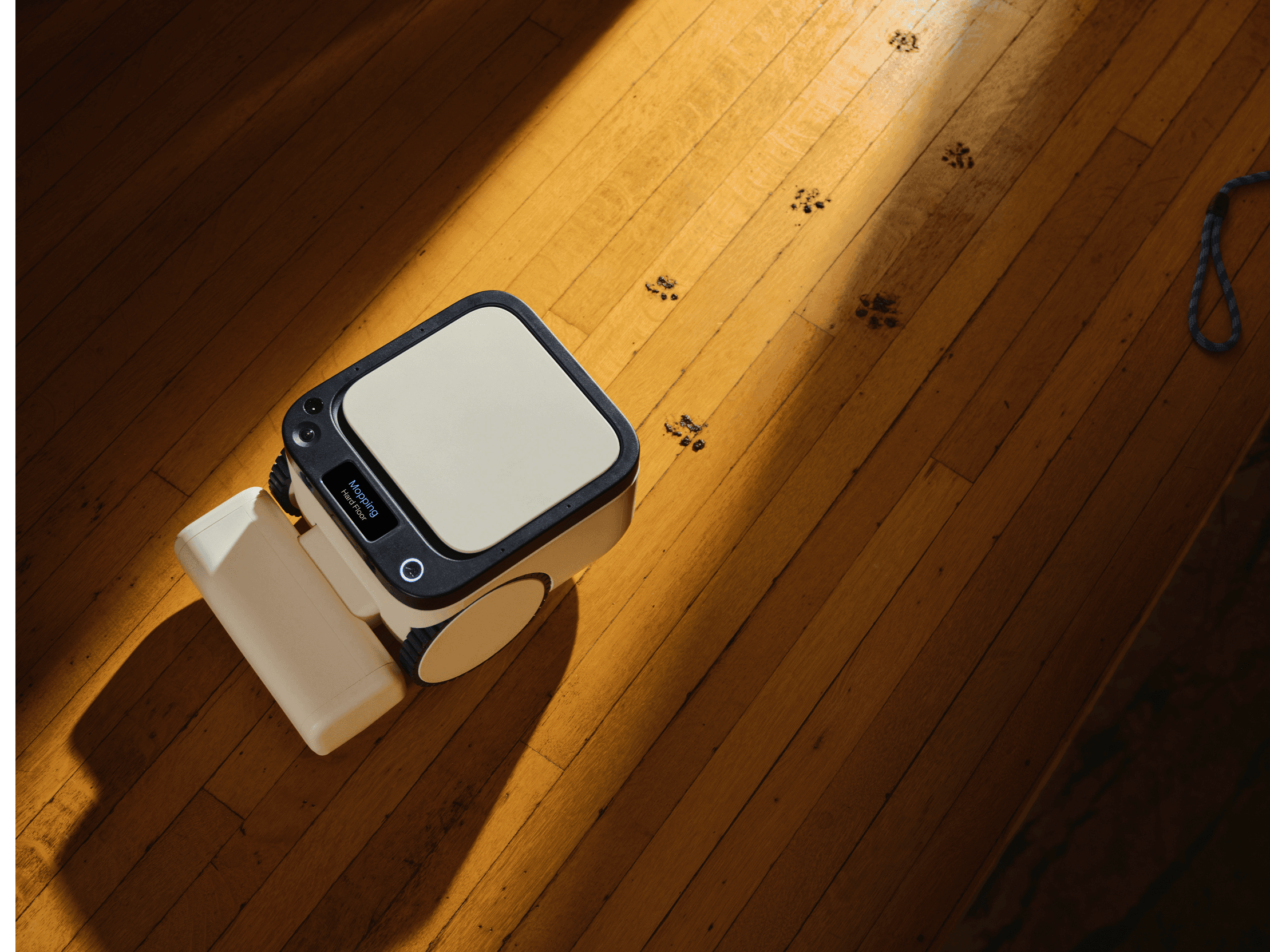
Every sensory detail of Matic has been deliberately considered. It cleans quietly, at just 55 decibels, nearly 6.5x quieter than a traditional robot vacuum. You can carry on a phone call or stream a show while it works nearby. A first-of-its-kind onboard screen displays the robot’s current status, eliminating the need to check your phone just to know if it’s stuck, charging, or cleaning. Each disposable bag serves as both a dirt reservoir and air filter, capturing fine particles and allergens, so you’re also effectively purifying the air while cleaning the floor. And you never have to touch a wet filter or remember to clean it.
And, crucially, Matic was designed from day one with privacy in mind: no invasive cameras, no offloading your home’s data to the cloud. As the Founders put it, “homes are a sanctuary where families feel safe, where families have their tender moments”, this guiding philosophy informed every product decision, particularly the insistence that no one should have to “jeopardize our privacy to have your floors clean.”
Drawing on lessons from Nest and personal experience at Google (one of the more privacy-conscious tech giants, according to Mehul and Navneet), Matic’s team made a firm commitment: no customer data would ever be taken for granted. This extended beyond just camera footage; Matic is engineered to have everything on-devic. Even seemingly innocuous usage analytics are opt-in only, and absolutely no audio, video, or map data leaves the walls of a home without clear consent. This stance is critical as we undergo a cultural shift from a “default trust” to a “default skepticism” society. People no longer automatically trust big tech or media. Just as a friend or domestic helper can learn your home’s layout without broadcasting it, so too must robots. This human-centric privacy model is opposite to the norm in Silicon Valley, where consumer data is often the fuel for “smarter” products. Matic insists that intelligence shouldn’t come at the cost of dignity.
While determining whether privacy breaches are “accidental or malicious remains the government’s responsibility, it is up to Silicon Valley to uphold ethical standards”, Mehul states. Matic’s leadership stresses that reliance on foreign robotics, whether Chinese or Indian, is incompatible with the American expectation of privacy and legal accountability; protecting this liberty requires domestic leadership.
“In order to bring manufacturing back to America, we need to bring back the ability to scale,” Mehul explains. “And scale can only happen through consumer devices.” While iRobot has produced over 50 million robots, and Amazon Robotics 1 million, Boston Dynamics never surpassed ten thousand units. Home robotics, Matic argues, is a category capable of rapid scale, and in doing so, it has the potential to elevate the entire industry while preserving privacy, trust, and consumer confidence.
Matic was made to belong in homes. As the founders point out, whenever Hollywood imagines robots we love, they aren’t loud or menacing, they’re Wall-E, R2-D2, small, helpful, and expressive. “One thing which we are very very proud of is that kids love Matics and pets absolutely are ambivalent about Matic,” says Mehul. Customers frequently send in photos of their cats dozing on the carpet while Matic silently cleans around their paws, completely undisturbed. Dogs barely lift an ear. “Even pets are aware that this is a different class of a robot,” Navneet notes.
What is next for Matic? A fleet of Matic Droids, a bit taller than the original Matic, equipped with arms and pincers. No more leaving stuff lying around.
Technology
•
A Matic Home Story
Can vacuums lead a robot revolution?
Clean homes are all alike; each messy home is messy in its own way.
In 2017, Navneet Dalal and Mehul Nariyawala - veterans of Nest and Flutter - looked around and saw over 200 self-driving car startups, yet not a single serious effort aimed at automating the most repetitive, time-consuming tasks inside our homes. Families were spending three to four times more time doing chores than driving, and yet all we had were disk-shaped bots that bumped into furniture. Inspired by a different vision, one closer to Rosie the Robot from The Jetsons, they set out to build Matic: a home robot that could understand, navigate, and clean the chaotic, cluttered, and deeply personal spaces we live in.
As you enter the Matic HQ in Mountain View, CA, you are met with first, the American flag, and then, a sprawl of 70 or so desktops, teeming with engineers, interns and production associates. Here and there on the floor are multiple trial and demonstration stations for their 7-inch floor robots, divided into irregular rectangles with plywood, assorted with carpets and other household obstacles. On the wall there is a big television screen displaying Total Area Cleaned (million sqft) : 54.0, Active Robots (Last Week) : 2160, etc. There are also boards of testimonials from happy customers. Mehul points to the children and pets that have helped shape Matic; one child was afraid of the robots until they sent her a smaller, toy version, which she decorated with stickers. Matic now comes with decorative, “cute” stickers.
If you take a right, you enter the cafeteria where a side hosts their ‘Timeline Wall’, displaying prototypes and photos from 2018 to 2025. “We are running out of space, we might have to turn the room into a timeline wall”, says Mehul. If you go further back in, you enter the production space. Here, too, you find a wall adorned with the American flag. Most of the work here is on foot. There are rows of defunct, ready to go, and mid assembly Matics. Rooms in this part of the building are testing for different terrains (hot, humid, cold), quietness, and lens adjustments. There is a busy room conducting an interview that Mehul shows me from the outside only, hosting NVIDIA computers that are used to host 1500 simulations of homes in all kinds of situations. There are a thousand Matics in the single story building in rows in different rooms stalled at step four because camera shipments for the month have been delayed.
Three Martini Lunch.
Follow the money: from Wall Street’s great ’80s boom to the energy traders and builders financing what comes next.
Subscribe + Issue 006
The Matic Experience
When a customer orders Matic, they don’t have to lift it out of the box, it rolls itself out. It greets you: “Hello, Arena Mag,” or whatever your last name is.
The robot begins by exploring, just like a person might do when visiting a new house. You use an app to control it. It takes about 15–20 minutes to build a detailed 3D map of a typical 3,000-square-foot home, learning room layouts, floor types, rugs, wires, and common obstacles. You can even label rooms - kitchen, living room, bedroom. Once that’s done, you can use the app to tell it exactly what to do: clean these three rooms, sweep here, mop there. If there’s carpet, Matic knows not to mop it. You don’t need to micromanage.
The mapping isn’t a one-time process either. Like a human houseguest becoming more familiar with your space over time, Matic continuously updates its understanding. Moving houses? No problem. You can reset Matic or just tell it to remap in a new location. It knows when it’s in a completely new environment, and it can manage multiple floors in the same home with ease.
Perhaps most impressively, it works in the dark. The robot is equipped with RGB-IR cameras and a custom infrared headlight, invisible to humans. You can run a full clean at 2 AM, sleep soundly and wake up to a clean house, Matic calls this a ‘Zen Rise’.
“Since launching, Matic has cleaned over 50 million square feet across real homes, saving customers more than 10,000 hours and traveling nearly 25,000 miles within domestic spaces, in just six months”, discloses Navneet, “we are ramping up quickly”. The floor-cleaning robot market has been growing at a compound annual growth rate of 16% over the past eight years. In the last year alone, 20.6 million robots were sold globally in this category, “but still, no one says “oh, I love my floor cleaning robot”. We don’t think this should be the state of affairs”.
The mission was never about just cleaner floors. Mehul and Navneet, both familymen, saw firsthand how modern domestic life drains time and energy. It takes a village to raise a child, but in today’s world, we live far from villages. The burden on parents has grown, and support has shrunk. Matic is their response. A way to give people back time, so they can be “better parents, better sons, better artists”, says Mehul. “We all have this intense desire to do creative things because we are a creative species, not a repetitive one.”
As Mehul puts it, “If Matic succeeds, then it means we have gotten rid of the drudgery of home chores from our family lives. It means we are saving people time, their energy, and allowing them to pursue things that are wondrous to us as humans”.
When Mehul and Navneet set out to create Matic, no one in Silicon Valley believed in Machine Learning, a branch of Artificial Intelligence concerned with teaching a system to learn through vast amounts of data. That was 2012. “It was like the Dark Ages for us”.
Investors and engineers alike had lived through multiple hype cycles and burnouts, and to most, the field was a graveyard of unfulfilled promise. But the duo saw something different. Flutter, their gesture-recognition startup, quickly became the number one app in 72 countries on the Mac App Store and was selected by Apple as one of the best apps of the year. The product was a hit, but their instinct told them something was missing. Flutter was pure software, novel and delightful, but not essential. No one wakes up in the morning thinking, “Today, I need gesture detection.” After the acquisition by Google, they moved into hardware through Nest, where they gained a crash course in building for the physical world. Mehul led the Nest Cam portfolio, shipping three flagship products and helping generate over $250 million in revenue. Navneet worked on the algorithm side, launching the first on-device deep learning model for a Nest camera, contributing to what would later become the Google Coral TPU. These were foundational lessons: iconic products solve real problems, and great products can’t afford a hardware/software divide - they just have to work.
By the time Matic was conceived, the vision was clear. They didn’t want to build a cool demo. They wanted to create a tool people couldn’t imagine living without. Something as revolutionary as the microwave. Mehul’s own home had welcomed a golden retriever and hair was everywhere.
The timing was beginning to be right. AI algorithms were evolving rapidly, and for the first time, compute power, especially on-device AI chips, was advanced enough to unlock real-time autonomy in physical environments. What struck Mehul and Navneet was how little progress had been made in robotic floor cleaning, despite years of market presence. Most products still relied on outdated navigation, simple bump sensors, and static routines. They saw it as a space completely underserved, and ripe for reinvention.
One of their core beliefs is that the most successful companies are the ones that can iterate quickly - in front of the customer. Matic was designed from the ground up to support that principle. Shipping early, observing behavior, learning from real homes, not labs, and refining constantly. And while nearly every robotics veteran warned them not to build a consumer hardware company (“Do everything, just don’t do that”), Mehul and Navneet felt this was the only way to do it right.
They also made a decision early on: Matic would be a long-term company, solving a hard problem in a space they could work on for decades. After going through two acquisitions, they decided this time would be different. In one of his first acts as co-Founder, Navneet declared “Not for Sale” on a piece of paper.
In their view, the home is one of the last great frontiers of machine learning; noisy, dynamic, intimate, full of ambiguity and edge cases. They don’t necessarily agree it’s harder, but it’s certainly a different kind of hard.
Navneet’s journey began at the end of high school in India, where he excelled in math, physics, and chemistry. Having grown up painting, he funneled that creativity into computer graphics, largely teaching himself during his undergraduate years pursuing computer science. After graduating, he joined a software company but quickly grew bored of fixing bugs. He applied to several computer graphics master’s programs in the U.S., but was rejected. Around the same time, a friend started a computer vision startup in 2000. “No one knew anything,” Navneet recalls, “but we wanted to build this product, so let’s learn.” His approach was rigorous: he read master’s and PhD textbooks from start to finish, wrote code alongside, and repeated the process until the knowledge was fully absorbed. “There is no teacher, no professor, just read until it’s absorbed in your head”. This discipline led him to Inria in France, where, despite not speaking French, he earned a PhD in 2005.
Mehul’s path to innovation was shaped by adaptability. He moved from India to the U.S. in 1994, staying with his uncle and navigating a new education system. He didn’t even know what the SATs were until his senior year of high school. Unable to finance a traditional four-year university, he began at a community college in Washington, D.C., before transferring to the University of Chicago for an MBA.
Their long view is shaped by historical analogies. In the early ’90s, a group of brilliant engineers at General Magic tried to build the iPhone, but were decades too early. “The world wasn’t ready, and consumers weren’t either. Instead, we saw a progression: feature phones, PDAs, Blackberries, iPods… and then finally, the iPhone”, explains Mehul. Similarly, Mehul and Navneet believe the road to multipurpose home robots isn’t a straight shot. “The first step isn’t a humanoid robot that does everything, it is a purpose-built machine that earns trust by doing one thing exceptionally well.” For Matic, that’s floor cleaning. Next might be tidying, then maybe pet cleanup or laundry. But eventually they believe it will all converge into a single, ubiquitous robot platform.
Unlike legacy disc robots, Matic was built from first principles for today’s homes, where hardwood floors suddenly meet thick rugs, where thresholds, cords, and toys disrupt path-following logic. Large wheels help it scale obstacles, and its brush roll was designed from scratch to prevent hair tangling. Even the mopping is reengineered, not a soggy pad dragging across the floor, but a rotating mop roll that self-cleans with every pass, extracting dirty water and collecting it in a dock no larger than a shoebox. That dock’s bag captures both dry debris and wet waste in one sealed container, which locks on removal and includes a built-in HEPA filter, so disposal is hygienic, quick, and never gross.
Every sensory detail of Matic has been deliberately considered. It cleans quietly, at just 55 decibels, nearly 6.5x quieter than a traditional robot vacuum. You can carry on a phone call or stream a show while it works nearby. A first-of-its-kind onboard screen displays the robot’s current status, eliminating the need to check your phone just to know if it’s stuck, charging, or cleaning. Each disposable bag serves as both a dirt reservoir and air filter, capturing fine particles and allergens, so you’re also effectively purifying the air while cleaning the floor. And you never have to touch a wet filter or remember to clean it.
And, crucially, Matic was designed from day one with privacy in mind: no invasive cameras, no offloading your home’s data to the cloud. As the Founders put it, “homes are a sanctuary where families feel safe, where families have their tender moments”, this guiding philosophy informed every product decision, particularly the insistence that no one should have to “jeopardize our privacy to have your floors clean.”
Drawing on lessons from Nest and personal experience at Google (one of the more privacy-conscious tech giants, according to Mehul and Navneet), Matic’s team made a firm commitment: no customer data would ever be taken for granted. This extended beyond just camera footage; Matic is engineered to have everything on-devic. Even seemingly innocuous usage analytics are opt-in only, and absolutely no audio, video, or map data leaves the walls of a home without clear consent. This stance is critical as we undergo a cultural shift from a “default trust” to a “default skepticism” society. People no longer automatically trust big tech or media. Just as a friend or domestic helper can learn your home’s layout without broadcasting it, so too must robots. This human-centric privacy model is opposite to the norm in Silicon Valley, where consumer data is often the fuel for “smarter” products. Matic insists that intelligence shouldn’t come at the cost of dignity.
While determining whether privacy breaches are “accidental or malicious remains the government’s responsibility, it is up to Silicon Valley to uphold ethical standards”, Mehul states. Matic’s leadership stresses that reliance on foreign robotics, whether Chinese or Indian, is incompatible with the American expectation of privacy and legal accountability; protecting this liberty requires domestic leadership.
“In order to bring manufacturing back to America, we need to bring back the ability to scale,” Mehul explains. “And scale can only happen through consumer devices.” While iRobot has produced over 50 million robots, and Amazon Robotics 1 million, Boston Dynamics never surpassed ten thousand units. Home robotics, Matic argues, is a category capable of rapid scale, and in doing so, it has the potential to elevate the entire industry while preserving privacy, trust, and consumer confidence.
Matic was made to belong in homes. As the founders point out, whenever Hollywood imagines robots we love, they aren’t loud or menacing, they’re Wall-E, R2-D2, small, helpful, and expressive. “One thing which we are very very proud of is that kids love Matics and pets absolutely are ambivalent about Matic,” says Mehul. Customers frequently send in photos of their cats dozing on the carpet while Matic silently cleans around their paws, completely undisturbed. Dogs barely lift an ear. “Even pets are aware that this is a different class of a robot,” Navneet notes.
What is next for Matic? A fleet of Matic Droids, a bit taller than the original Matic, equipped with arms and pincers. No more leaving stuff lying around.
Technology
•
A Matic Home Story
Can vacuums lead a robot revolution?
Clean homes are all alike; each messy home is messy in its own way.
In 2017, Navneet Dalal and Mehul Nariyawala - veterans of Nest and Flutter - looked around and saw over 200 self-driving car startups, yet not a single serious effort aimed at automating the most repetitive, time-consuming tasks inside our homes. Families were spending three to four times more time doing chores than driving, and yet all we had were disk-shaped bots that bumped into furniture. Inspired by a different vision, one closer to Rosie the Robot from The Jetsons, they set out to build Matic: a home robot that could understand, navigate, and clean the chaotic, cluttered, and deeply personal spaces we live in.
As you enter the Matic HQ in Mountain View, CA, you are met with first, the American flag, and then, a sprawl of 70 or so desktops, teeming with engineers, interns and production associates. Here and there on the floor are multiple trial and demonstration stations for their 7-inch floor robots, divided into irregular rectangles with plywood, assorted with carpets and other household obstacles. On the wall there is a big television screen displaying Total Area Cleaned (million sqft) : 54.0, Active Robots (Last Week) : 2160, etc. There are also boards of testimonials from happy customers. Mehul points to the children and pets that have helped shape Matic; one child was afraid of the robots until they sent her a smaller, toy version, which she decorated with stickers. Matic now comes with decorative, “cute” stickers.
If you take a right, you enter the cafeteria where a side hosts their ‘Timeline Wall’, displaying prototypes and photos from 2018 to 2025. “We are running out of space, we might have to turn the room into a timeline wall”, says Mehul. If you go further back in, you enter the production space. Here, too, you find a wall adorned with the American flag. Most of the work here is on foot. There are rows of defunct, ready to go, and mid assembly Matics. Rooms in this part of the building are testing for different terrains (hot, humid, cold), quietness, and lens adjustments. There is a busy room conducting an interview that Mehul shows me from the outside only, hosting NVIDIA computers that are used to host 1500 simulations of homes in all kinds of situations. There are a thousand Matics in the single story building in rows in different rooms stalled at step four because camera shipments for the month have been delayed.
Three Martini Lunch.
Follow the money: from Wall Street’s great ’80s boom to the energy traders and builders financing what comes next.
Subscribe + Issue 006
The Matic Experience
When a customer orders Matic, they don’t have to lift it out of the box, it rolls itself out. It greets you: “Hello, Arena Mag,” or whatever your last name is.
The robot begins by exploring, just like a person might do when visiting a new house. You use an app to control it. It takes about 15–20 minutes to build a detailed 3D map of a typical 3,000-square-foot home, learning room layouts, floor types, rugs, wires, and common obstacles. You can even label rooms - kitchen, living room, bedroom. Once that’s done, you can use the app to tell it exactly what to do: clean these three rooms, sweep here, mop there. If there’s carpet, Matic knows not to mop it. You don’t need to micromanage.
The mapping isn’t a one-time process either. Like a human houseguest becoming more familiar with your space over time, Matic continuously updates its understanding. Moving houses? No problem. You can reset Matic or just tell it to remap in a new location. It knows when it’s in a completely new environment, and it can manage multiple floors in the same home with ease.
Perhaps most impressively, it works in the dark. The robot is equipped with RGB-IR cameras and a custom infrared headlight, invisible to humans. You can run a full clean at 2 AM, sleep soundly and wake up to a clean house, Matic calls this a ‘Zen Rise’.
“Since launching, Matic has cleaned over 50 million square feet across real homes, saving customers more than 10,000 hours and traveling nearly 25,000 miles within domestic spaces, in just six months”, discloses Navneet, “we are ramping up quickly”. The floor-cleaning robot market has been growing at a compound annual growth rate of 16% over the past eight years. In the last year alone, 20.6 million robots were sold globally in this category, “but still, no one says “oh, I love my floor cleaning robot”. We don’t think this should be the state of affairs”.
The mission was never about just cleaner floors. Mehul and Navneet, both familymen, saw firsthand how modern domestic life drains time and energy. It takes a village to raise a child, but in today’s world, we live far from villages. The burden on parents has grown, and support has shrunk. Matic is their response. A way to give people back time, so they can be “better parents, better sons, better artists”, says Mehul. “We all have this intense desire to do creative things because we are a creative species, not a repetitive one.”
As Mehul puts it, “If Matic succeeds, then it means we have gotten rid of the drudgery of home chores from our family lives. It means we are saving people time, their energy, and allowing them to pursue things that are wondrous to us as humans”.
When Mehul and Navneet set out to create Matic, no one in Silicon Valley believed in Machine Learning, a branch of Artificial Intelligence concerned with teaching a system to learn through vast amounts of data. That was 2012. “It was like the Dark Ages for us”.
Investors and engineers alike had lived through multiple hype cycles and burnouts, and to most, the field was a graveyard of unfulfilled promise. But the duo saw something different. Flutter, their gesture-recognition startup, quickly became the number one app in 72 countries on the Mac App Store and was selected by Apple as one of the best apps of the year. The product was a hit, but their instinct told them something was missing. Flutter was pure software, novel and delightful, but not essential. No one wakes up in the morning thinking, “Today, I need gesture detection.” After the acquisition by Google, they moved into hardware through Nest, where they gained a crash course in building for the physical world. Mehul led the Nest Cam portfolio, shipping three flagship products and helping generate over $250 million in revenue. Navneet worked on the algorithm side, launching the first on-device deep learning model for a Nest camera, contributing to what would later become the Google Coral TPU. These were foundational lessons: iconic products solve real problems, and great products can’t afford a hardware/software divide - they just have to work.
By the time Matic was conceived, the vision was clear. They didn’t want to build a cool demo. They wanted to create a tool people couldn’t imagine living without. Something as revolutionary as the microwave. Mehul’s own home had welcomed a golden retriever and hair was everywhere.
The timing was beginning to be right. AI algorithms were evolving rapidly, and for the first time, compute power, especially on-device AI chips, was advanced enough to unlock real-time autonomy in physical environments. What struck Mehul and Navneet was how little progress had been made in robotic floor cleaning, despite years of market presence. Most products still relied on outdated navigation, simple bump sensors, and static routines. They saw it as a space completely underserved, and ripe for reinvention.
One of their core beliefs is that the most successful companies are the ones that can iterate quickly - in front of the customer. Matic was designed from the ground up to support that principle. Shipping early, observing behavior, learning from real homes, not labs, and refining constantly. And while nearly every robotics veteran warned them not to build a consumer hardware company (“Do everything, just don’t do that”), Mehul and Navneet felt this was the only way to do it right.
They also made a decision early on: Matic would be a long-term company, solving a hard problem in a space they could work on for decades. After going through two acquisitions, they decided this time would be different. In one of his first acts as co-Founder, Navneet declared “Not for Sale” on a piece of paper.
In their view, the home is one of the last great frontiers of machine learning; noisy, dynamic, intimate, full of ambiguity and edge cases. They don’t necessarily agree it’s harder, but it’s certainly a different kind of hard.
Navneet’s journey began at the end of high school in India, where he excelled in math, physics, and chemistry. Having grown up painting, he funneled that creativity into computer graphics, largely teaching himself during his undergraduate years pursuing computer science. After graduating, he joined a software company but quickly grew bored of fixing bugs. He applied to several computer graphics master’s programs in the U.S., but was rejected. Around the same time, a friend started a computer vision startup in 2000. “No one knew anything,” Navneet recalls, “but we wanted to build this product, so let’s learn.” His approach was rigorous: he read master’s and PhD textbooks from start to finish, wrote code alongside, and repeated the process until the knowledge was fully absorbed. “There is no teacher, no professor, just read until it’s absorbed in your head”. This discipline led him to Inria in France, where, despite not speaking French, he earned a PhD in 2005.
Mehul’s path to innovation was shaped by adaptability. He moved from India to the U.S. in 1994, staying with his uncle and navigating a new education system. He didn’t even know what the SATs were until his senior year of high school. Unable to finance a traditional four-year university, he began at a community college in Washington, D.C., before transferring to the University of Chicago for an MBA.
Their long view is shaped by historical analogies. In the early ’90s, a group of brilliant engineers at General Magic tried to build the iPhone, but were decades too early. “The world wasn’t ready, and consumers weren’t either. Instead, we saw a progression: feature phones, PDAs, Blackberries, iPods… and then finally, the iPhone”, explains Mehul. Similarly, Mehul and Navneet believe the road to multipurpose home robots isn’t a straight shot. “The first step isn’t a humanoid robot that does everything, it is a purpose-built machine that earns trust by doing one thing exceptionally well.” For Matic, that’s floor cleaning. Next might be tidying, then maybe pet cleanup or laundry. But eventually they believe it will all converge into a single, ubiquitous robot platform.
Unlike legacy disc robots, Matic was built from first principles for today’s homes, where hardwood floors suddenly meet thick rugs, where thresholds, cords, and toys disrupt path-following logic. Large wheels help it scale obstacles, and its brush roll was designed from scratch to prevent hair tangling. Even the mopping is reengineered, not a soggy pad dragging across the floor, but a rotating mop roll that self-cleans with every pass, extracting dirty water and collecting it in a dock no larger than a shoebox. That dock’s bag captures both dry debris and wet waste in one sealed container, which locks on removal and includes a built-in HEPA filter, so disposal is hygienic, quick, and never gross.
Every sensory detail of Matic has been deliberately considered. It cleans quietly, at just 55 decibels, nearly 6.5x quieter than a traditional robot vacuum. You can carry on a phone call or stream a show while it works nearby. A first-of-its-kind onboard screen displays the robot’s current status, eliminating the need to check your phone just to know if it’s stuck, charging, or cleaning. Each disposable bag serves as both a dirt reservoir and air filter, capturing fine particles and allergens, so you’re also effectively purifying the air while cleaning the floor. And you never have to touch a wet filter or remember to clean it.
And, crucially, Matic was designed from day one with privacy in mind: no invasive cameras, no offloading your home’s data to the cloud. As the Founders put it, “homes are a sanctuary where families feel safe, where families have their tender moments”, this guiding philosophy informed every product decision, particularly the insistence that no one should have to “jeopardize our privacy to have your floors clean.”
Drawing on lessons from Nest and personal experience at Google (one of the more privacy-conscious tech giants, according to Mehul and Navneet), Matic’s team made a firm commitment: no customer data would ever be taken for granted. This extended beyond just camera footage; Matic is engineered to have everything on-devic. Even seemingly innocuous usage analytics are opt-in only, and absolutely no audio, video, or map data leaves the walls of a home without clear consent. This stance is critical as we undergo a cultural shift from a “default trust” to a “default skepticism” society. People no longer automatically trust big tech or media. Just as a friend or domestic helper can learn your home’s layout without broadcasting it, so too must robots. This human-centric privacy model is opposite to the norm in Silicon Valley, where consumer data is often the fuel for “smarter” products. Matic insists that intelligence shouldn’t come at the cost of dignity.
While determining whether privacy breaches are “accidental or malicious remains the government’s responsibility, it is up to Silicon Valley to uphold ethical standards”, Mehul states. Matic’s leadership stresses that reliance on foreign robotics, whether Chinese or Indian, is incompatible with the American expectation of privacy and legal accountability; protecting this liberty requires domestic leadership.
“In order to bring manufacturing back to America, we need to bring back the ability to scale,” Mehul explains. “And scale can only happen through consumer devices.” While iRobot has produced over 50 million robots, and Amazon Robotics 1 million, Boston Dynamics never surpassed ten thousand units. Home robotics, Matic argues, is a category capable of rapid scale, and in doing so, it has the potential to elevate the entire industry while preserving privacy, trust, and consumer confidence.
Matic was made to belong in homes. As the founders point out, whenever Hollywood imagines robots we love, they aren’t loud or menacing, they’re Wall-E, R2-D2, small, helpful, and expressive. “One thing which we are very very proud of is that kids love Matics and pets absolutely are ambivalent about Matic,” says Mehul. Customers frequently send in photos of their cats dozing on the carpet while Matic silently cleans around their paws, completely undisturbed. Dogs barely lift an ear. “Even pets are aware that this is a different class of a robot,” Navneet notes.
What is next for Matic? A fleet of Matic Droids, a bit taller than the original Matic, equipped with arms and pincers. No more leaving stuff lying around.
About the Author
Zaitoon Zafar is a junior editor at Arena Magazine. She can be found on X at: @zaitoonx.