tt
tt
tt
tt
tt
tt
Civilization
•
The Man Who Caught Che
An interview with former CIA paramilitary operative Félix Rodriguez.

For five centuries the Western Hemisphere has been contested by successive imperial orders. Iberian dominance gave way in the eighteenth century to Anglo-French rivalry, culminating in Britain’s victory at Quebec in 1759 and the fall of New France. British primacy was in turn undone by the American Revolution, won by the colonists with decisive French and Spanish backing. In 1823, the United States proclaimed the Monroe Doctrine, asserting hemispheric dominance even before the young republic had the means to enforce it.
European powers continued to intrude, most dramatically France, which imposed a short-lived puppet monarchy in Mexico during the American Civil War. Meanwhile, Britain retained naval predominance in the Caribbean and Spain held Cuba and Puerto Rico. Only with the rise of American sea power in the late nineteenth century did doctrine meet capability. The defeat of Spain in 1898 announced American hegemony, and after European powers blockaded and bombarded Venezuela over delayed debt repayments, the Roosevelt Corollary of 1904 formalized Washington’s claim to police the hemisphere, legitimizing repeated American interventions in Caribbean and Central American countries to secure political order, credit, and trade.
This order more or less persisted through World War II when hemispheric priorities shifted to area denial against Axis forces and securing the maritime approaches to North America. The 1947 Rio Treaty was conceived as a codification of this logic, a hemispheric counterpart to NATO’s principle of collective defense. Its purpose was to keep the Americans in, non-hemispheric powers out, and Latin America stable, preventing its long tradition of revolutions, coups, and debt crises from inviting outside intervention.
In 1959, the very scenario that the treaty was meant to prevent came to pass when Fidel Castro toppled the Cuban strongman Fulgencio Batista. Cuba has sought to undermine American primacy in the Western Hemisphere for over six decades since. It used its real estate to host the Soviet Union’s nuclear-armed IRBMs, along with naval and air assets. Its SIGINT bases at Lourdes hosted the Soviet (later Russian) intelligence services from 1962 to 2002, while a similar facility at Bejucal is rumored to operate with the help of China’s PLA. Cuba’s formidable intelligence apparatus has dealt numerous blows to American security by recruiting well placed spies, like Ambassador Manuel Rocha and the Defense Intelligence Agency’s Ana Montes, and has trained and supplied revolutionary leftist groups across Latin America, from Nicaragua to Bolivia and Colombia.
For Your Eyes Only.
Spies. Satellites. State secrets. Inside the technologies and intelligence contests shaping American power.
Subscribe + Issue 007
After a long period of relative inactivity, the conflict between the United States and Cuba reached a crescendo on January 3, 2026, in Caracas, Venezuela, where dozens of troops representing Cuba’s armed forces and Ministry of the Interior were killed by Delta Force in the raid that captured Nicolás Maduro. The Cubans were providing personal security to the Venezuelan president, whose oil revenues and exports were a crucial element of Cuba’s hemispheric strategy. Now, with its key oil supplier gone and its principal line of regional influence severed, Cuba’s government faces a more uncertain future than at any time in the last half century.
For nearly three decades, Félix Rodriguez served on the front lines of the covert war waged between the United States and Cuba. Born in Havana in 1941, Rodriguez went into exile after Castro’s revolution and later took up arms against the communists. Throughout the 1960s he served as a CIA paramilitary in Latin America. In 1967, Rodriguez took part in the capture of the Argentine revolutionary Che Guevara, later serving in Vietnam and volunteering with the Salvadoran Air Force during that country’s civil war. In light of the escalating tensions between the United States and Cuba, I decided to reach out to Félix, now 84 years old, to discuss his life.
What follows is a transcript of our conversations, which took place on January 9 and 29, 2026. The transcript has been edited for length and clarity.
✺
Carson Becker: Could you tell me a bit about your family history in Cuba? I understand you’re related to Alejandro Rodríguez Velasco, the first elected mayor of Havana.
Félix Rodriguez: That’s correct. Alejandro fought with Máximo Gómez. He was a two-star general in the Cuban War of Independence. And then he became the first mayor elected in the city of Havana.
CB: What are your most striking memories of Cuba before the revolution?
FR: I enjoyed my youth in Sancti Spíritus, my hometown. We used to have a recreational farm for the whole family that I used to visit. I enjoyed having breakfast at four o’clock in the morning, bringing my coffee and getting the milk directly from the cow and adding some sugar and everything, you know, it was happy. I used to ride horses and do hunting and fishing on the farm.
CB: Are there any noticeable differences between Espirituanos and Habaneros? Do they have a different kind of culture in those two cities?
FR: Santi Spíritus was more traditional. It was founded even before Havana, so it was a very traditional city in the middle of the island. I really, really enjoy being considered an Espirituano. I was born in Havana because there were problems with my birth, so they had to get the best doctor for my mother, and that was the one in Havana, so I was born there. But the following day, I went back to Santi Spíritus, so I consider myself lucky to be an Espirituano. And I really enjoyed living there. Every family knew each other. It was a fantastic feeling.
CB: I believe your uncle was a minister for Batista. You wrote in your memoir you actually met Batista as a child.
FR: My uncle was a senator in Cuba. He helped Batista assume his senatorship in our province, even though Batista was not from my province. So they became very close friends, and when he went and took over Cuba, he made my uncle the Secretary of Public Works. And then later they made my uncle the president of a government institution which owned a lot of the equipment to build roads. It was a combination of the people and the government in building roads in Cuba. The government would provide the equipment, and the people would supply the labor. They did a fantastic job all over the island, and it was very effective. It opened the roads to trade for the farmers, so they could take their goods to market.
CB: What was Batista like when you met him?
FR: When I was a little kid, I think four or five years old, he came to our farm with my uncle, near Santi Spíritus. That was when I first met him.
CB: How was Cuba doing in the 1950s? There were clearly some social problems, but it also seemed like it was on track to become a much more prosperous country thanks to tourism and development.
FR: Oh yes, communism destroyed the whole thing. But in 1958 we were probably one of the most developed countries in the hemisphere. We had sugar, which dominated the world market, and we had tobacco. We were way ahead of many Latin American countries, including Argentina. Everything communism touches, it destroys. And that’s exactly what it did. Look at Venezuela, for example, formerly the richest country on the continent. Now, fortunately, they got Maduro out, but Venezuela was destroyed when communism took over the country.
CB: Why do you think the revolution had so much support from working-class people? What do you think was the key to Castro’s success?
FR: Being up in the mountains, all of that created a real charisma. And he was a charismatic guy. We cannot deny that. A lot of people thought that they could do better and supported him. And then everything that he promised, he didn’t go through with it — he actually destroyed. And the first thing was democracy. He disappeared people in Cuba. He became a dictator. That was sad, and that explains the downfall of the economy of Cuba; all of that was due to his regime.
CB: What inspired you to potentially risk your life by joining the Anti-Communist League of Trujillo? You were quite young at the time, and yet you chose to do that.
FR: Well, I was in boarding school at the time, in Pennsylvania, and the first thing that impacted me was the firing squads. Cuba didn’t even have the death penalty. One guy was executed during World War II for being a spy for Germany. That was the only death by firing squad. And then Castro comes in and kills thousands of Cubans who opposed him. That would inspire anybody to try to save their homeland, the place where I was born. So that’s why I dedicated my life to it.
CB: The Cuban diaspora in South Florida at that time was full of people spying on behalf of Castro. Why so many infiltrators?
FR: Well, they didn’t know who he really was. He promoted one thing and then did something else when he came to power. He gave people hope that things were going to get better. He promised a free and democratic election within a year. People had faith in him at the beginning, and thought he was going to be the savior. It turned out to be the other way around.
CB: What was it like for you in the Dominican Republic, where you had a lot of anti-communist fighters from all over the world?
FR: I was in Mexico at the time because my parents had moved in 1958 from Cuba to Mexico. That was the homeland of my maternal grandmother. I used to visit them from school back and forth. And one time there was this captain who was recruiting people for the Dominican Republic, where they had the Anti-Communist Legion of the Caribbean. I thought that was what I should do. I had already been accepted to the University of Miami for engineering. Instead of doing that that year, Captain Cortez recruited me, and then I went to the Dominican Republic. We were training and all of that.
CB: What kind of people were signing up for this adventure?
FR: We had like 150 Spaniards, over 100 Cubans. There were about 50 Yugoslavians, and then 50 from different countries all over the world that Trujillo got into the country. It was interesting. I was only about 15, 16 years old when I went there.
CB: When did you first make contact with the CIA?
FR: I had been accepted to the University of Miami for engineering. When I came to Miami, that’s when I learned they were training people in Guatemala to liberate Cuba, and it turned out to be the operation that later on became the Bay of Pigs. That was started under the Eisenhower administration, after he saw how much influence the communists had in Cuba. We had no idea it was the CIA. We were told they were rich people from Cuba financing the operation.
CB: What year was this?
FR: Late 1960.
CB: How did you get to Guatemala from Miami?
FR: They sent us to Opa Locka. And from there they sent a plane to pick us up. They flew us in a C-54 plane from there to Guatemala. Before we arrived in Guatemala, because our runway didn’t have any lights, we had to stop in an area called San José. It was a Guatemalan paratrooper base. We had to wait there until daylight, and then from there we flew to our destination in the C-54.
CB: How were you received upon arrival?
FR: When we arrived, they had already completed the base. The group that arrived before us had to participate in building the base, making the barracks, and all of those things.
CB: What went wrong with the Bay of Pigs?
FR: The Eisenhower administration started this operation with the idea of guerrilla warfare in the Escambray Mountains, and having enough people in arms to go and announce a provisional government on the radio station, and then be recognized by the OAS [Organization of American States] and the United States. And that would be the end of Castro. That was the original concept. Eisenhower had a great idea to take over the city of Trinidad. The city was very much anti-Castro; it was right next to the Escambray Mountains.
When Kennedy came to power, he decided differently. And when they ran the Bay of Pigs, the only way that we could really be successful was if we controlled the air. They started under those assumptions. There was an initial air attack that destroyed 90% of Castro’s air force. But then the second one was stopped because of Adlai Stevenson. He wasn’t briefed properly.
CB: During the period leading up to the Bay of Pigs, you were inserted into Cuba. Could you tell me the full scope of this mission?
FR: Well, first of all, we trained in Guatemala, along with everybody else. They took a selected group called the Grey Teams, infiltration teams, and took us to Panama for additional training. Then we went inside Cuba to resupply the resistance, and then support the invasion.
CB: How close did you come to being captured on this mission?
FR: I was lucky. There was only one time we were going in a car, and it was stopped by soldiers. They were doing a search, and we were all there. Three of us had participated in blowing up some oil trucks. But they stopped us, and I put my head out and said “pasar con compañeros” [passing with friends] in a very strong way. I guess they thought we were one of them, so they let us go. That was a close call. This was at one o’ clock in the morning, coming back from trying to exfiltrate from Cuba, but nobody came to pick us up.
CB: How did exfiltration work?
FR: We had a radio operator inside Cuba, and they would tell us time and date and location to be able to exfiltrate.
CB: You were picked up by boat?
FR: Yes, by boat.
CB: You made a couple of different trips to Cuba to try to assassinate Fidel Castro. What was the closest you ever got?
FR: Not even close. He had a very secure perimeter around him. I understand from one of his bodyguards that I talked after the fact that he had a security group numbering up to 10,000 people. For example, if he visited a square in some town, there would be two of their security people in every single window facing that area. So there was no possibility of anybody shooting him from anywhere. He had some of the best security, even better than the President of the United States. It was almost impossible to get him.
CB: What kind of weapons did you bring with you to Cuba?
FR: We would bring machine guns, hand grenades, and other rifles.
CB: Why did the United States adopt the policy of assassinating Fidel Castro, and what role did you play in that?
FR: It was never meant to be. They talked about it, but they never approved it.
CB: The United States never approved his assassination?
FR: Right.
CB: But Cuban exiles organized independent efforts?
FR: There were, but they were not professional.
CB: What was the last attempt on Castro from the exile community that you’re aware of?
FR: One time they claimed they were going to go to an island nearby; they were going to have a boat with a .50 caliber machine gun to shoot him, but he never came through.
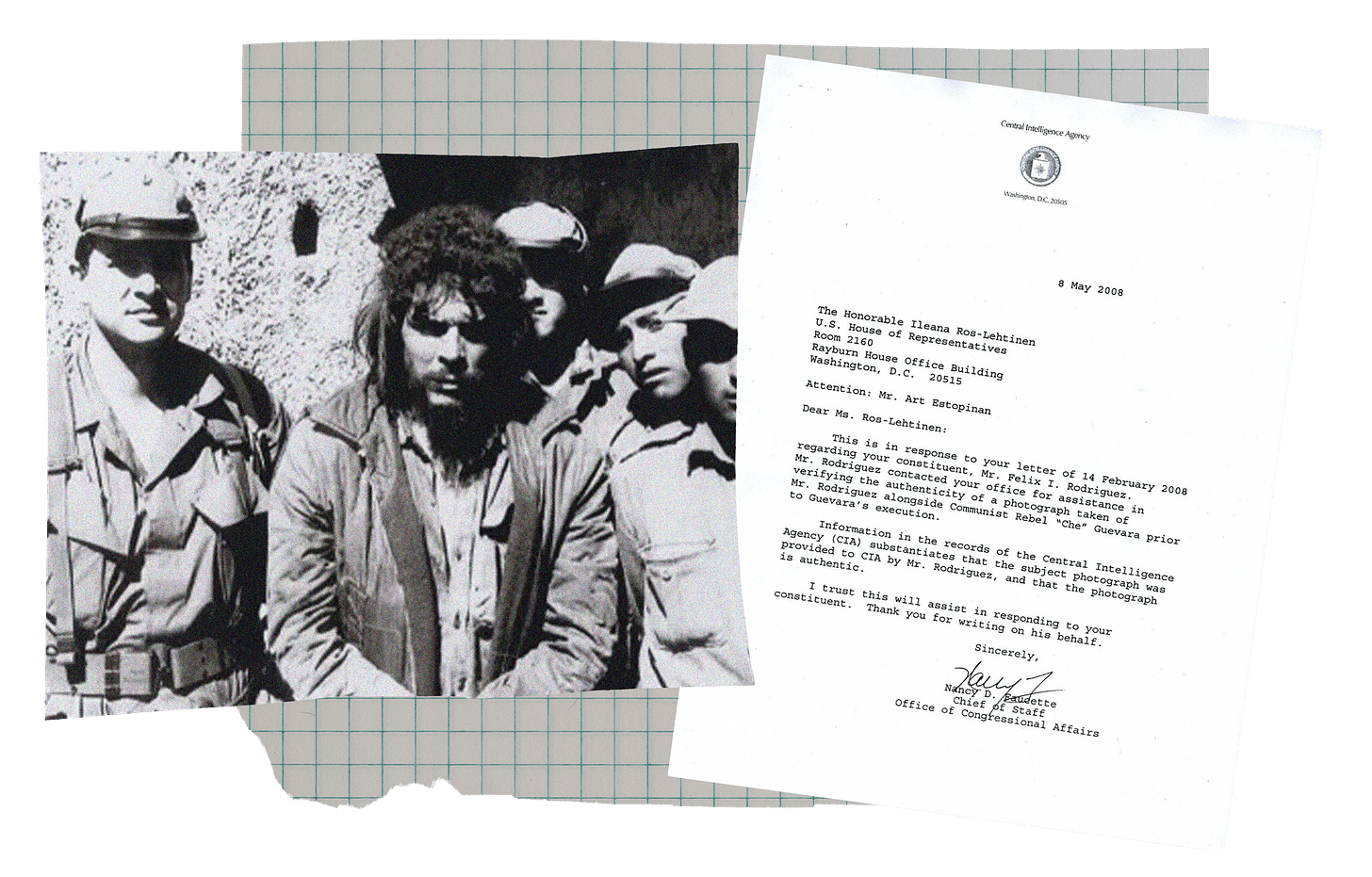
CB: In 1967 you got the call for the Che Guevara mission.
FR: We got a call from an Agency guy by the name of Larry Sternfield. He met with several of us, like 16 of us, and he selected two of us. The reason was they knew Che Guevara was in Bolivia, and there was a prohibition from the US ambassador, Henderson, that no US citizen could participate in combat there, because there were so many bodies coming back from Vietnam. They didn’t want to start having that in Latin America. Since we were not even residents, we were selected for that operation, because we didn’t violate that restriction from the ambassador. They selected us to participate directly with the Bolivian troops to track down Che Guevara.
CB: How did you find Che’s location?
FR: At that time, a lot of people believed, including in the Agency, that he had been killed in Africa, when he was in the Congo. When they were able to verify that he was in Latin America, they immediately prepared a training team from Panama to train the Second Ranger Battalion of the Bolivian Army, because they had no expertise. The Bolivian Army had no idea how to combat the guerrillas. And Poppy Shelton was the major from the US Special Forces in Panama who started training the battalion. At the same time, they sent two of us to help with intelligence.
We were lucky then because we had already captured one guy, who told us how Che was moving around. He told us, for example, that when Che moved from point A to point B, he would send a vanguard of ten men about one kilometer ahead of him. He would go in the middle with the majority of the troops, and then one kilometer behind would be the rear guard. In case there was an ambush from any place, he would be protected in the middle. One time, there was an encounter between the regular Bolivian Army and Che’s group, and they killed three members of the vanguard, and when they checked out the names, they knew that Che was in the area. That’s when we were able to convince Colonel Zenteno, the commander of the division, to go ahead and release the special second Ranger Battalion to the operation.
There was a captain of one company who sent people, always in civilian clothes, to talk to the farmers, because sometimes farmers are afraid of the uniform. They found out where Che was hiding, and that’s when they surrounded that area with one company, and that’s where the fight took place, and they immediately captured him.
CB: What was Che like when you met him?
FR: I had this image that was created about him. Then, when I saw him the way he was, sometimes I wasn’t even paying attention to what he was talking about. I just remember a picture of him when he visited the Soviet Union, where he visited Mao in China. And then to see him the way he was, he looked like a beggar. His clothes were torn. He didn’t even have a pair of boots. He wore some kind of sandal. He was in deplorable physical condition. I really felt sorry for him as a human being.
CB: Tell me about your conversation with Che.
FR: At the beginning, Che said nobody would interrogate him. Seeing that attitude, I told him that I didn’t come to interrogate, I just wanted to talk to him, that I admired him. He was a leader of a state, and yet he’s here fighting because he believed in his ideals, even though I know they are mistaken. We started talking about different subjects. He really didn’t want to talk about Cuba or anything like that. He said that Bolivia was an excellent place for a revolution because you have boundaries with five countries. If you take Bolivia, it would be easy to export the revolution across the borders. They had a very poor army, and he thought the United States was not going to be too concerned, because Bolivia was a very poor country. If it were a rich country like Venezuela, the United States would be much more involved than in Bolivia. They always have that fascination about: if it’s a rich country, the v will defend it; if it’s a poor country they won’t.
CB: Were you able to get any meaningful intelligence out of him?
FR: He was very depressed because he was captured.
CB: Was he afraid?
FR: I guess at that point in time, people are, but he conducted himself well. I came and told him he was going to be executed. He said, “It’s better that way. I should have never been captured.” And then he gave me a message for his widow, to tell her to remarry and try to be happy.
CB: He was wearing a watch, right? He was wearing a Rolex GMT at the time.
FR: Every single Cuban had a Rolex. When he was captured, Che had his Rolex and another Rolex of a Cuban who had died in combat, and he was saving it to give it to the widow in Cuba whenever he returned. But that was taken by the captain of the Bolivian Army who captured him. He kept Che’s Rolex and the other guy’s Rolex. There were all kinds of Rolexes there, because every single Cuban that was there had a Rolex. I had my own Rolex, and I exchanged it with one of the soldiers who told me he had Che’s, but it turns out it wasn’t Che’s at all.
CB: What happened to his body after he was executed?
FR: Well, after the execution, there was a meeting, and they decided, first of all, they were going to cut off his head to prove that he was dead. And I told the general, you cannot do that. I said I would cut one finger, and we had a fingerprint from the Argentine Federal Police, so it could be checked. He ordered both hands to be cut. At about three o’clock in the morning, when there was no press, they went with a doctor, and they cut off both hands, and then they took his body and two others. He was buried at the end of the Valle Grande runway, where they had a bulldozer that was expanding the runway. They dug a big, big hole in there, and they dropped the bodies of Che and two of his soldiers. He stayed there for a long, long time.
CB: What kind of world was it that you think Che wanted?
FR: He wanted to be his own man. In Cuba he was always going to be number two, Fidel number one. Che wanted to have his own revolution, but it was a total failure.
CB: Why do you say that?
FR: Because he was the worst guerrilla you could find. He could not even recruit a single guy the whole time he was in the field.
CB: Was he relying mainly on Cubans who were accompanying him?
FR: Some Cubans accompanied him, but he was the main individual in the whole thing. But he didn’t have the support of Cuba, because Castro was told by the Soviet Union — they didn’t want him to succeed — because Che was pro-Chinese and Cuba depended solely on the Soviet Union.
CB: Across all of your missions, from Cuba to Latin America to Vietnam, what would you say was the most dangerous?
FR: Well, in Vietnam I was shot down five times in helicopters, and that’s why my back got all screwed up, and then finally they evacuated me for medical disability.
CB: How long was it before you were able to fly again?
FR: I flew with the Salvadoran Air Force from 1985 to 1988.
CB: In El Salvador, were you there on your own business, or on behalf of the US?
FR: I went as a volunteer. Nobody was paying me.
CB: Not even the Salvadorans?
FR: The only thing that I got was a place to stay and food to eat.
CB: When you were in Nicaragua and El Salvador in the 1980s, what kind of Cuban involvement did you encounter?
FR: Cubans were involved, and they were supporting them with weapons. All the Salvadorans had M16s from Vietnam, and Cuba was the one who channeled those rifles to them.
CB: Were they active on the ground?
FR: Yes, they sent some mortar experts.
CB: How are Cuban operatives influencing things in Latin America? Is it all directed by Havana, or is Havana sometimes taking orders from Moscow and Beijing?
FR: Havana runs itself, even though they may have requests from Russia and China. But Cuba controls the whole thing, and they have a good intelligence service. We cannot deny that.
CB: Even recently, a former US Ambassador was arrested for spying for Cuba.
FR: Yeah, I know. He was a friend of mine.
CB: Interesting.
FR: I think he was working with them for a long time. I didn’t realize that because we had him down as a strong anti-communist. Manuel Rocha. And I met him because at one time he was in charge of the US Interests Section in Havana at the Swiss Embassy. He was supposed to be very, very much anti-communist. He was probably recruited in Chile a long time ago. He surprised the hell out of me when I found out because he’s a very, very intelligent man. I can’t understand how he could cooperate with those people. Knowing what they have done to the Cuban people, they destroyed our economy and everything, it really surprised the hell out of me when I learned that Rocha was doing that.
CB: Are there any portions of your career that you are unable to ever disclose?
FR: Yes.
CB: If Cuba’s regime were to change, what would be the first thing you would want to go back and do?
FR: I’d like to go back and see my hometown before I die.
Civilization
•
The Man Who Caught Che
An interview with former CIA paramilitary operative Félix Rodriguez.
For five centuries the Western Hemisphere has been contested by successive imperial orders. Iberian dominance gave way in the eighteenth century to Anglo-French rivalry, culminating in Britain’s victory at Quebec in 1759 and the fall of New France. British primacy was in turn undone by the American Revolution, won by the colonists with decisive French and Spanish backing. In 1823, the United States proclaimed the Monroe Doctrine, asserting hemispheric dominance even before the young republic had the means to enforce it.
European powers continued to intrude, most dramatically France, which imposed a short-lived puppet monarchy in Mexico during the American Civil War. Meanwhile, Britain retained naval predominance in the Caribbean and Spain held Cuba and Puerto Rico. Only with the rise of American sea power in the late nineteenth century did doctrine meet capability. The defeat of Spain in 1898 announced American hegemony, and after European powers blockaded and bombarded Venezuela over delayed debt repayments, the Roosevelt Corollary of 1904 formalized Washington’s claim to police the hemisphere, legitimizing repeated American interventions in Caribbean and Central American countries to secure political order, credit, and trade.
This order more or less persisted through World War II when hemispheric priorities shifted to area denial against Axis forces and securing the maritime approaches to North America. The 1947 Rio Treaty was conceived as a codification of this logic, a hemispheric counterpart to NATO’s principle of collective defense. Its purpose was to keep the Americans in, non-hemispheric powers out, and Latin America stable, preventing its long tradition of revolutions, coups, and debt crises from inviting outside intervention.
In 1959, the very scenario that the treaty was meant to prevent came to pass when Fidel Castro toppled the Cuban strongman Fulgencio Batista. Cuba has sought to undermine American primacy in the Western Hemisphere for over six decades since. It used its real estate to host the Soviet Union’s nuclear-armed IRBMs, along with naval and air assets. Its SIGINT bases at Lourdes hosted the Soviet (later Russian) intelligence services from 1962 to 2002, while a similar facility at Bejucal is rumored to operate with the help of China’s PLA. Cuba’s formidable intelligence apparatus has dealt numerous blows to American security by recruiting well placed spies, like Ambassador Manuel Rocha and the Defense Intelligence Agency’s Ana Montes, and has trained and supplied revolutionary leftist groups across Latin America, from Nicaragua to Bolivia and Colombia.
For Your Eyes Only.
Spies. Satellites. State secrets. Inside the technologies and intelligence contests shaping American power.
Subscribe + Issue 007
After a long period of relative inactivity, the conflict between the United States and Cuba reached a crescendo on January 3, 2026, in Caracas, Venezuela, where dozens of troops representing Cuba’s armed forces and Ministry of the Interior were killed by Delta Force in the raid that captured Nicolás Maduro. The Cubans were providing personal security to the Venezuelan president, whose oil revenues and exports were a crucial element of Cuba’s hemispheric strategy. Now, with its key oil supplier gone and its principal line of regional influence severed, Cuba’s government faces a more uncertain future than at any time in the last half century.
For nearly three decades, Félix Rodriguez served on the front lines of the covert war waged between the United States and Cuba. Born in Havana in 1941, Rodriguez went into exile after Castro’s revolution and later took up arms against the communists. Throughout the 1960s he served as a CIA paramilitary in Latin America. In 1967, Rodriguez took part in the capture of the Argentine revolutionary Che Guevara, later serving in Vietnam and volunteering with the Salvadoran Air Force during that country’s civil war. In light of the escalating tensions between the United States and Cuba, I decided to reach out to Félix, now 84 years old, to discuss his life.
What follows is a transcript of our conversations, which took place on January 9 and 29, 2026. The transcript has been edited for length and clarity.
✺
Carson Becker: Could you tell me a bit about your family history in Cuba? I understand you’re related to Alejandro Rodríguez Velasco, the first elected mayor of Havana.
Félix Rodriguez: That’s correct. Alejandro fought with Máximo Gómez. He was a two-star general in the Cuban War of Independence. And then he became the first mayor elected in the city of Havana.
CB: What are your most striking memories of Cuba before the revolution?
FR: I enjoyed my youth in Sancti Spíritus, my hometown. We used to have a recreational farm for the whole family that I used to visit. I enjoyed having breakfast at four o’clock in the morning, bringing my coffee and getting the milk directly from the cow and adding some sugar and everything, you know, it was happy. I used to ride horses and do hunting and fishing on the farm.
CB: Are there any noticeable differences between Espirituanos and Habaneros? Do they have a different kind of culture in those two cities?
FR: Santi Spíritus was more traditional. It was founded even before Havana, so it was a very traditional city in the middle of the island. I really, really enjoy being considered an Espirituano. I was born in Havana because there were problems with my birth, so they had to get the best doctor for my mother, and that was the one in Havana, so I was born there. But the following day, I went back to Santi Spíritus, so I consider myself lucky to be an Espirituano. And I really enjoyed living there. Every family knew each other. It was a fantastic feeling.
CB: I believe your uncle was a minister for Batista. You wrote in your memoir you actually met Batista as a child.
FR: My uncle was a senator in Cuba. He helped Batista assume his senatorship in our province, even though Batista was not from my province. So they became very close friends, and when he went and took over Cuba, he made my uncle the Secretary of Public Works. And then later they made my uncle the president of a government institution which owned a lot of the equipment to build roads. It was a combination of the people and the government in building roads in Cuba. The government would provide the equipment, and the people would supply the labor. They did a fantastic job all over the island, and it was very effective. It opened the roads to trade for the farmers, so they could take their goods to market.
CB: What was Batista like when you met him?
FR: When I was a little kid, I think four or five years old, he came to our farm with my uncle, near Santi Spíritus. That was when I first met him.
CB: How was Cuba doing in the 1950s? There were clearly some social problems, but it also seemed like it was on track to become a much more prosperous country thanks to tourism and development.
FR: Oh yes, communism destroyed the whole thing. But in 1958 we were probably one of the most developed countries in the hemisphere. We had sugar, which dominated the world market, and we had tobacco. We were way ahead of many Latin American countries, including Argentina. Everything communism touches, it destroys. And that’s exactly what it did. Look at Venezuela, for example, formerly the richest country on the continent. Now, fortunately, they got Maduro out, but Venezuela was destroyed when communism took over the country.
CB: Why do you think the revolution had so much support from working-class people? What do you think was the key to Castro’s success?
FR: Being up in the mountains, all of that created a real charisma. And he was a charismatic guy. We cannot deny that. A lot of people thought that they could do better and supported him. And then everything that he promised, he didn’t go through with it — he actually destroyed. And the first thing was democracy. He disappeared people in Cuba. He became a dictator. That was sad, and that explains the downfall of the economy of Cuba; all of that was due to his regime.
CB: What inspired you to potentially risk your life by joining the Anti-Communist League of Trujillo? You were quite young at the time, and yet you chose to do that.
FR: Well, I was in boarding school at the time, in Pennsylvania, and the first thing that impacted me was the firing squads. Cuba didn’t even have the death penalty. One guy was executed during World War II for being a spy for Germany. That was the only death by firing squad. And then Castro comes in and kills thousands of Cubans who opposed him. That would inspire anybody to try to save their homeland, the place where I was born. So that’s why I dedicated my life to it.
CB: The Cuban diaspora in South Florida at that time was full of people spying on behalf of Castro. Why so many infiltrators?
FR: Well, they didn’t know who he really was. He promoted one thing and then did something else when he came to power. He gave people hope that things were going to get better. He promised a free and democratic election within a year. People had faith in him at the beginning, and thought he was going to be the savior. It turned out to be the other way around.
CB: What was it like for you in the Dominican Republic, where you had a lot of anti-communist fighters from all over the world?
FR: I was in Mexico at the time because my parents had moved in 1958 from Cuba to Mexico. That was the homeland of my maternal grandmother. I used to visit them from school back and forth. And one time there was this captain who was recruiting people for the Dominican Republic, where they had the Anti-Communist Legion of the Caribbean. I thought that was what I should do. I had already been accepted to the University of Miami for engineering. Instead of doing that that year, Captain Cortez recruited me, and then I went to the Dominican Republic. We were training and all of that.
CB: What kind of people were signing up for this adventure?
FR: We had like 150 Spaniards, over 100 Cubans. There were about 50 Yugoslavians, and then 50 from different countries all over the world that Trujillo got into the country. It was interesting. I was only about 15, 16 years old when I went there.
CB: When did you first make contact with the CIA?
FR: I had been accepted to the University of Miami for engineering. When I came to Miami, that’s when I learned they were training people in Guatemala to liberate Cuba, and it turned out to be the operation that later on became the Bay of Pigs. That was started under the Eisenhower administration, after he saw how much influence the communists had in Cuba. We had no idea it was the CIA. We were told they were rich people from Cuba financing the operation.
CB: What year was this?
FR: Late 1960.
CB: How did you get to Guatemala from Miami?
FR: They sent us to Opa Locka. And from there they sent a plane to pick us up. They flew us in a C-54 plane from there to Guatemala. Before we arrived in Guatemala, because our runway didn’t have any lights, we had to stop in an area called San José. It was a Guatemalan paratrooper base. We had to wait there until daylight, and then from there we flew to our destination in the C-54.
CB: How were you received upon arrival?
FR: When we arrived, they had already completed the base. The group that arrived before us had to participate in building the base, making the barracks, and all of those things.
CB: What went wrong with the Bay of Pigs?
FR: The Eisenhower administration started this operation with the idea of guerrilla warfare in the Escambray Mountains, and having enough people in arms to go and announce a provisional government on the radio station, and then be recognized by the OAS [Organization of American States] and the United States. And that would be the end of Castro. That was the original concept. Eisenhower had a great idea to take over the city of Trinidad. The city was very much anti-Castro; it was right next to the Escambray Mountains.
When Kennedy came to power, he decided differently. And when they ran the Bay of Pigs, the only way that we could really be successful was if we controlled the air. They started under those assumptions. There was an initial air attack that destroyed 90% of Castro’s air force. But then the second one was stopped because of Adlai Stevenson. He wasn’t briefed properly.
CB: During the period leading up to the Bay of Pigs, you were inserted into Cuba. Could you tell me the full scope of this mission?
FR: Well, first of all, we trained in Guatemala, along with everybody else. They took a selected group called the Grey Teams, infiltration teams, and took us to Panama for additional training. Then we went inside Cuba to resupply the resistance, and then support the invasion.
CB: How close did you come to being captured on this mission?
FR: I was lucky. There was only one time we were going in a car, and it was stopped by soldiers. They were doing a search, and we were all there. Three of us had participated in blowing up some oil trucks. But they stopped us, and I put my head out and said “pasar con compañeros” [passing with friends] in a very strong way. I guess they thought we were one of them, so they let us go. That was a close call. This was at one o’ clock in the morning, coming back from trying to exfiltrate from Cuba, but nobody came to pick us up.
CB: How did exfiltration work?
FR: We had a radio operator inside Cuba, and they would tell us time and date and location to be able to exfiltrate.
CB: You were picked up by boat?
FR: Yes, by boat.
CB: You made a couple of different trips to Cuba to try to assassinate Fidel Castro. What was the closest you ever got?
FR: Not even close. He had a very secure perimeter around him. I understand from one of his bodyguards that I talked after the fact that he had a security group numbering up to 10,000 people. For example, if he visited a square in some town, there would be two of their security people in every single window facing that area. So there was no possibility of anybody shooting him from anywhere. He had some of the best security, even better than the President of the United States. It was almost impossible to get him.
CB: What kind of weapons did you bring with you to Cuba?
FR: We would bring machine guns, hand grenades, and other rifles.
CB: Why did the United States adopt the policy of assassinating Fidel Castro, and what role did you play in that?
FR: It was never meant to be. They talked about it, but they never approved it.
CB: The United States never approved his assassination?
FR: Right.
CB: But Cuban exiles organized independent efforts?
FR: There were, but they were not professional.
CB: What was the last attempt on Castro from the exile community that you’re aware of?
FR: One time they claimed they were going to go to an island nearby; they were going to have a boat with a .50 caliber machine gun to shoot him, but he never came through.
CB: In 1967 you got the call for the Che Guevara mission.
FR: We got a call from an Agency guy by the name of Larry Sternfield. He met with several of us, like 16 of us, and he selected two of us. The reason was they knew Che Guevara was in Bolivia, and there was a prohibition from the US ambassador, Henderson, that no US citizen could participate in combat there, because there were so many bodies coming back from Vietnam. They didn’t want to start having that in Latin America. Since we were not even residents, we were selected for that operation, because we didn’t violate that restriction from the ambassador. They selected us to participate directly with the Bolivian troops to track down Che Guevara.
CB: How did you find Che’s location?
FR: At that time, a lot of people believed, including in the Agency, that he had been killed in Africa, when he was in the Congo. When they were able to verify that he was in Latin America, they immediately prepared a training team from Panama to train the Second Ranger Battalion of the Bolivian Army, because they had no expertise. The Bolivian Army had no idea how to combat the guerrillas. And Poppy Shelton was the major from the US Special Forces in Panama who started training the battalion. At the same time, they sent two of us to help with intelligence.
We were lucky then because we had already captured one guy, who told us how Che was moving around. He told us, for example, that when Che moved from point A to point B, he would send a vanguard of ten men about one kilometer ahead of him. He would go in the middle with the majority of the troops, and then one kilometer behind would be the rear guard. In case there was an ambush from any place, he would be protected in the middle. One time, there was an encounter between the regular Bolivian Army and Che’s group, and they killed three members of the vanguard, and when they checked out the names, they knew that Che was in the area. That’s when we were able to convince Colonel Zenteno, the commander of the division, to go ahead and release the special second Ranger Battalion to the operation.
There was a captain of one company who sent people, always in civilian clothes, to talk to the farmers, because sometimes farmers are afraid of the uniform. They found out where Che was hiding, and that’s when they surrounded that area with one company, and that’s where the fight took place, and they immediately captured him.
CB: What was Che like when you met him?
FR: I had this image that was created about him. Then, when I saw him the way he was, sometimes I wasn’t even paying attention to what he was talking about. I just remember a picture of him when he visited the Soviet Union, where he visited Mao in China. And then to see him the way he was, he looked like a beggar. His clothes were torn. He didn’t even have a pair of boots. He wore some kind of sandal. He was in deplorable physical condition. I really felt sorry for him as a human being.
CB: Tell me about your conversation with Che.
FR: At the beginning, Che said nobody would interrogate him. Seeing that attitude, I told him that I didn’t come to interrogate, I just wanted to talk to him, that I admired him. He was a leader of a state, and yet he’s here fighting because he believed in his ideals, even though I know they are mistaken. We started talking about different subjects. He really didn’t want to talk about Cuba or anything like that. He said that Bolivia was an excellent place for a revolution because you have boundaries with five countries. If you take Bolivia, it would be easy to export the revolution across the borders. They had a very poor army, and he thought the United States was not going to be too concerned, because Bolivia was a very poor country. If it were a rich country like Venezuela, the United States would be much more involved than in Bolivia. They always have that fascination about: if it’s a rich country, the v will defend it; if it’s a poor country they won’t.
CB: Were you able to get any meaningful intelligence out of him?
FR: He was very depressed because he was captured.
CB: Was he afraid?
FR: I guess at that point in time, people are, but he conducted himself well. I came and told him he was going to be executed. He said, “It’s better that way. I should have never been captured.” And then he gave me a message for his widow, to tell her to remarry and try to be happy.
CB: He was wearing a watch, right? He was wearing a Rolex GMT at the time.
FR: Every single Cuban had a Rolex. When he was captured, Che had his Rolex and another Rolex of a Cuban who had died in combat, and he was saving it to give it to the widow in Cuba whenever he returned. But that was taken by the captain of the Bolivian Army who captured him. He kept Che’s Rolex and the other guy’s Rolex. There were all kinds of Rolexes there, because every single Cuban that was there had a Rolex. I had my own Rolex, and I exchanged it with one of the soldiers who told me he had Che’s, but it turns out it wasn’t Che’s at all.
CB: What happened to his body after he was executed?
FR: Well, after the execution, there was a meeting, and they decided, first of all, they were going to cut off his head to prove that he was dead. And I told the general, you cannot do that. I said I would cut one finger, and we had a fingerprint from the Argentine Federal Police, so it could be checked. He ordered both hands to be cut. At about three o’clock in the morning, when there was no press, they went with a doctor, and they cut off both hands, and then they took his body and two others. He was buried at the end of the Valle Grande runway, where they had a bulldozer that was expanding the runway. They dug a big, big hole in there, and they dropped the bodies of Che and two of his soldiers. He stayed there for a long, long time.
CB: What kind of world was it that you think Che wanted?
FR: He wanted to be his own man. In Cuba he was always going to be number two, Fidel number one. Che wanted to have his own revolution, but it was a total failure.
CB: Why do you say that?
FR: Because he was the worst guerrilla you could find. He could not even recruit a single guy the whole time he was in the field.
CB: Was he relying mainly on Cubans who were accompanying him?
FR: Some Cubans accompanied him, but he was the main individual in the whole thing. But he didn’t have the support of Cuba, because Castro was told by the Soviet Union — they didn’t want him to succeed — because Che was pro-Chinese and Cuba depended solely on the Soviet Union.
CB: Across all of your missions, from Cuba to Latin America to Vietnam, what would you say was the most dangerous?
FR: Well, in Vietnam I was shot down five times in helicopters, and that’s why my back got all screwed up, and then finally they evacuated me for medical disability.
CB: How long was it before you were able to fly again?
FR: I flew with the Salvadoran Air Force from 1985 to 1988.
CB: In El Salvador, were you there on your own business, or on behalf of the US?
FR: I went as a volunteer. Nobody was paying me.
CB: Not even the Salvadorans?
FR: The only thing that I got was a place to stay and food to eat.
CB: When you were in Nicaragua and El Salvador in the 1980s, what kind of Cuban involvement did you encounter?
FR: Cubans were involved, and they were supporting them with weapons. All the Salvadorans had M16s from Vietnam, and Cuba was the one who channeled those rifles to them.
CB: Were they active on the ground?
FR: Yes, they sent some mortar experts.
CB: How are Cuban operatives influencing things in Latin America? Is it all directed by Havana, or is Havana sometimes taking orders from Moscow and Beijing?
FR: Havana runs itself, even though they may have requests from Russia and China. But Cuba controls the whole thing, and they have a good intelligence service. We cannot deny that.
CB: Even recently, a former US Ambassador was arrested for spying for Cuba.
FR: Yeah, I know. He was a friend of mine.
CB: Interesting.
FR: I think he was working with them for a long time. I didn’t realize that because we had him down as a strong anti-communist. Manuel Rocha. And I met him because at one time he was in charge of the US Interests Section in Havana at the Swiss Embassy. He was supposed to be very, very much anti-communist. He was probably recruited in Chile a long time ago. He surprised the hell out of me when I found out because he’s a very, very intelligent man. I can’t understand how he could cooperate with those people. Knowing what they have done to the Cuban people, they destroyed our economy and everything, it really surprised the hell out of me when I learned that Rocha was doing that.
CB: Are there any portions of your career that you are unable to ever disclose?
FR: Yes.
CB: If Cuba’s regime were to change, what would be the first thing you would want to go back and do?
FR: I’d like to go back and see my hometown before I die.
Civilization
•
The Man Who Caught Che
An interview with former CIA paramilitary operative Félix Rodriguez.
For five centuries the Western Hemisphere has been contested by successive imperial orders. Iberian dominance gave way in the eighteenth century to Anglo-French rivalry, culminating in Britain’s victory at Quebec in 1759 and the fall of New France. British primacy was in turn undone by the American Revolution, won by the colonists with decisive French and Spanish backing. In 1823, the United States proclaimed the Monroe Doctrine, asserting hemispheric dominance even before the young republic had the means to enforce it.
European powers continued to intrude, most dramatically France, which imposed a short-lived puppet monarchy in Mexico during the American Civil War. Meanwhile, Britain retained naval predominance in the Caribbean and Spain held Cuba and Puerto Rico. Only with the rise of American sea power in the late nineteenth century did doctrine meet capability. The defeat of Spain in 1898 announced American hegemony, and after European powers blockaded and bombarded Venezuela over delayed debt repayments, the Roosevelt Corollary of 1904 formalized Washington’s claim to police the hemisphere, legitimizing repeated American interventions in Caribbean and Central American countries to secure political order, credit, and trade.
This order more or less persisted through World War II when hemispheric priorities shifted to area denial against Axis forces and securing the maritime approaches to North America. The 1947 Rio Treaty was conceived as a codification of this logic, a hemispheric counterpart to NATO’s principle of collective defense. Its purpose was to keep the Americans in, non-hemispheric powers out, and Latin America stable, preventing its long tradition of revolutions, coups, and debt crises from inviting outside intervention.
In 1959, the very scenario that the treaty was meant to prevent came to pass when Fidel Castro toppled the Cuban strongman Fulgencio Batista. Cuba has sought to undermine American primacy in the Western Hemisphere for over six decades since. It used its real estate to host the Soviet Union’s nuclear-armed IRBMs, along with naval and air assets. Its SIGINT bases at Lourdes hosted the Soviet (later Russian) intelligence services from 1962 to 2002, while a similar facility at Bejucal is rumored to operate with the help of China’s PLA. Cuba’s formidable intelligence apparatus has dealt numerous blows to American security by recruiting well placed spies, like Ambassador Manuel Rocha and the Defense Intelligence Agency’s Ana Montes, and has trained and supplied revolutionary leftist groups across Latin America, from Nicaragua to Bolivia and Colombia.
For Your Eyes Only.
Spies. Satellites. State secrets. Inside the technologies and intelligence contests shaping American power.
Subscribe + Issue 007
After a long period of relative inactivity, the conflict between the United States and Cuba reached a crescendo on January 3, 2026, in Caracas, Venezuela, where dozens of troops representing Cuba’s armed forces and Ministry of the Interior were killed by Delta Force in the raid that captured Nicolás Maduro. The Cubans were providing personal security to the Venezuelan president, whose oil revenues and exports were a crucial element of Cuba’s hemispheric strategy. Now, with its key oil supplier gone and its principal line of regional influence severed, Cuba’s government faces a more uncertain future than at any time in the last half century.
For nearly three decades, Félix Rodriguez served on the front lines of the covert war waged between the United States and Cuba. Born in Havana in 1941, Rodriguez went into exile after Castro’s revolution and later took up arms against the communists. Throughout the 1960s he served as a CIA paramilitary in Latin America. In 1967, Rodriguez took part in the capture of the Argentine revolutionary Che Guevara, later serving in Vietnam and volunteering with the Salvadoran Air Force during that country’s civil war. In light of the escalating tensions between the United States and Cuba, I decided to reach out to Félix, now 84 years old, to discuss his life.
What follows is a transcript of our conversations, which took place on January 9 and 29, 2026. The transcript has been edited for length and clarity.
✺
Carson Becker: Could you tell me a bit about your family history in Cuba? I understand you’re related to Alejandro Rodríguez Velasco, the first elected mayor of Havana.
Félix Rodriguez: That’s correct. Alejandro fought with Máximo Gómez. He was a two-star general in the Cuban War of Independence. And then he became the first mayor elected in the city of Havana.
CB: What are your most striking memories of Cuba before the revolution?
FR: I enjoyed my youth in Sancti Spíritus, my hometown. We used to have a recreational farm for the whole family that I used to visit. I enjoyed having breakfast at four o’clock in the morning, bringing my coffee and getting the milk directly from the cow and adding some sugar and everything, you know, it was happy. I used to ride horses and do hunting and fishing on the farm.
CB: Are there any noticeable differences between Espirituanos and Habaneros? Do they have a different kind of culture in those two cities?
FR: Santi Spíritus was more traditional. It was founded even before Havana, so it was a very traditional city in the middle of the island. I really, really enjoy being considered an Espirituano. I was born in Havana because there were problems with my birth, so they had to get the best doctor for my mother, and that was the one in Havana, so I was born there. But the following day, I went back to Santi Spíritus, so I consider myself lucky to be an Espirituano. And I really enjoyed living there. Every family knew each other. It was a fantastic feeling.
CB: I believe your uncle was a minister for Batista. You wrote in your memoir you actually met Batista as a child.
FR: My uncle was a senator in Cuba. He helped Batista assume his senatorship in our province, even though Batista was not from my province. So they became very close friends, and when he went and took over Cuba, he made my uncle the Secretary of Public Works. And then later they made my uncle the president of a government institution which owned a lot of the equipment to build roads. It was a combination of the people and the government in building roads in Cuba. The government would provide the equipment, and the people would supply the labor. They did a fantastic job all over the island, and it was very effective. It opened the roads to trade for the farmers, so they could take their goods to market.
CB: What was Batista like when you met him?
FR: When I was a little kid, I think four or five years old, he came to our farm with my uncle, near Santi Spíritus. That was when I first met him.
CB: How was Cuba doing in the 1950s? There were clearly some social problems, but it also seemed like it was on track to become a much more prosperous country thanks to tourism and development.
FR: Oh yes, communism destroyed the whole thing. But in 1958 we were probably one of the most developed countries in the hemisphere. We had sugar, which dominated the world market, and we had tobacco. We were way ahead of many Latin American countries, including Argentina. Everything communism touches, it destroys. And that’s exactly what it did. Look at Venezuela, for example, formerly the richest country on the continent. Now, fortunately, they got Maduro out, but Venezuela was destroyed when communism took over the country.
CB: Why do you think the revolution had so much support from working-class people? What do you think was the key to Castro’s success?
FR: Being up in the mountains, all of that created a real charisma. And he was a charismatic guy. We cannot deny that. A lot of people thought that they could do better and supported him. And then everything that he promised, he didn’t go through with it — he actually destroyed. And the first thing was democracy. He disappeared people in Cuba. He became a dictator. That was sad, and that explains the downfall of the economy of Cuba; all of that was due to his regime.
CB: What inspired you to potentially risk your life by joining the Anti-Communist League of Trujillo? You were quite young at the time, and yet you chose to do that.
FR: Well, I was in boarding school at the time, in Pennsylvania, and the first thing that impacted me was the firing squads. Cuba didn’t even have the death penalty. One guy was executed during World War II for being a spy for Germany. That was the only death by firing squad. And then Castro comes in and kills thousands of Cubans who opposed him. That would inspire anybody to try to save their homeland, the place where I was born. So that’s why I dedicated my life to it.
CB: The Cuban diaspora in South Florida at that time was full of people spying on behalf of Castro. Why so many infiltrators?
FR: Well, they didn’t know who he really was. He promoted one thing and then did something else when he came to power. He gave people hope that things were going to get better. He promised a free and democratic election within a year. People had faith in him at the beginning, and thought he was going to be the savior. It turned out to be the other way around.
CB: What was it like for you in the Dominican Republic, where you had a lot of anti-communist fighters from all over the world?
FR: I was in Mexico at the time because my parents had moved in 1958 from Cuba to Mexico. That was the homeland of my maternal grandmother. I used to visit them from school back and forth. And one time there was this captain who was recruiting people for the Dominican Republic, where they had the Anti-Communist Legion of the Caribbean. I thought that was what I should do. I had already been accepted to the University of Miami for engineering. Instead of doing that that year, Captain Cortez recruited me, and then I went to the Dominican Republic. We were training and all of that.
CB: What kind of people were signing up for this adventure?
FR: We had like 150 Spaniards, over 100 Cubans. There were about 50 Yugoslavians, and then 50 from different countries all over the world that Trujillo got into the country. It was interesting. I was only about 15, 16 years old when I went there.
CB: When did you first make contact with the CIA?
FR: I had been accepted to the University of Miami for engineering. When I came to Miami, that’s when I learned they were training people in Guatemala to liberate Cuba, and it turned out to be the operation that later on became the Bay of Pigs. That was started under the Eisenhower administration, after he saw how much influence the communists had in Cuba. We had no idea it was the CIA. We were told they were rich people from Cuba financing the operation.
CB: What year was this?
FR: Late 1960.
CB: How did you get to Guatemala from Miami?
FR: They sent us to Opa Locka. And from there they sent a plane to pick us up. They flew us in a C-54 plane from there to Guatemala. Before we arrived in Guatemala, because our runway didn’t have any lights, we had to stop in an area called San José. It was a Guatemalan paratrooper base. We had to wait there until daylight, and then from there we flew to our destination in the C-54.
CB: How were you received upon arrival?
FR: When we arrived, they had already completed the base. The group that arrived before us had to participate in building the base, making the barracks, and all of those things.
CB: What went wrong with the Bay of Pigs?
FR: The Eisenhower administration started this operation with the idea of guerrilla warfare in the Escambray Mountains, and having enough people in arms to go and announce a provisional government on the radio station, and then be recognized by the OAS [Organization of American States] and the United States. And that would be the end of Castro. That was the original concept. Eisenhower had a great idea to take over the city of Trinidad. The city was very much anti-Castro; it was right next to the Escambray Mountains.
When Kennedy came to power, he decided differently. And when they ran the Bay of Pigs, the only way that we could really be successful was if we controlled the air. They started under those assumptions. There was an initial air attack that destroyed 90% of Castro’s air force. But then the second one was stopped because of Adlai Stevenson. He wasn’t briefed properly.
CB: During the period leading up to the Bay of Pigs, you were inserted into Cuba. Could you tell me the full scope of this mission?
FR: Well, first of all, we trained in Guatemala, along with everybody else. They took a selected group called the Grey Teams, infiltration teams, and took us to Panama for additional training. Then we went inside Cuba to resupply the resistance, and then support the invasion.
CB: How close did you come to being captured on this mission?
FR: I was lucky. There was only one time we were going in a car, and it was stopped by soldiers. They were doing a search, and we were all there. Three of us had participated in blowing up some oil trucks. But they stopped us, and I put my head out and said “pasar con compañeros” [passing with friends] in a very strong way. I guess they thought we were one of them, so they let us go. That was a close call. This was at one o’ clock in the morning, coming back from trying to exfiltrate from Cuba, but nobody came to pick us up.
CB: How did exfiltration work?
FR: We had a radio operator inside Cuba, and they would tell us time and date and location to be able to exfiltrate.
CB: You were picked up by boat?
FR: Yes, by boat.
CB: You made a couple of different trips to Cuba to try to assassinate Fidel Castro. What was the closest you ever got?
FR: Not even close. He had a very secure perimeter around him. I understand from one of his bodyguards that I talked after the fact that he had a security group numbering up to 10,000 people. For example, if he visited a square in some town, there would be two of their security people in every single window facing that area. So there was no possibility of anybody shooting him from anywhere. He had some of the best security, even better than the President of the United States. It was almost impossible to get him.
CB: What kind of weapons did you bring with you to Cuba?
FR: We would bring machine guns, hand grenades, and other rifles.
CB: Why did the United States adopt the policy of assassinating Fidel Castro, and what role did you play in that?
FR: It was never meant to be. They talked about it, but they never approved it.
CB: The United States never approved his assassination?
FR: Right.
CB: But Cuban exiles organized independent efforts?
FR: There were, but they were not professional.
CB: What was the last attempt on Castro from the exile community that you’re aware of?
FR: One time they claimed they were going to go to an island nearby; they were going to have a boat with a .50 caliber machine gun to shoot him, but he never came through.
CB: In 1967 you got the call for the Che Guevara mission.
FR: We got a call from an Agency guy by the name of Larry Sternfield. He met with several of us, like 16 of us, and he selected two of us. The reason was they knew Che Guevara was in Bolivia, and there was a prohibition from the US ambassador, Henderson, that no US citizen could participate in combat there, because there were so many bodies coming back from Vietnam. They didn’t want to start having that in Latin America. Since we were not even residents, we were selected for that operation, because we didn’t violate that restriction from the ambassador. They selected us to participate directly with the Bolivian troops to track down Che Guevara.
CB: How did you find Che’s location?
FR: At that time, a lot of people believed, including in the Agency, that he had been killed in Africa, when he was in the Congo. When they were able to verify that he was in Latin America, they immediately prepared a training team from Panama to train the Second Ranger Battalion of the Bolivian Army, because they had no expertise. The Bolivian Army had no idea how to combat the guerrillas. And Poppy Shelton was the major from the US Special Forces in Panama who started training the battalion. At the same time, they sent two of us to help with intelligence.
We were lucky then because we had already captured one guy, who told us how Che was moving around. He told us, for example, that when Che moved from point A to point B, he would send a vanguard of ten men about one kilometer ahead of him. He would go in the middle with the majority of the troops, and then one kilometer behind would be the rear guard. In case there was an ambush from any place, he would be protected in the middle. One time, there was an encounter between the regular Bolivian Army and Che’s group, and they killed three members of the vanguard, and when they checked out the names, they knew that Che was in the area. That’s when we were able to convince Colonel Zenteno, the commander of the division, to go ahead and release the special second Ranger Battalion to the operation.
There was a captain of one company who sent people, always in civilian clothes, to talk to the farmers, because sometimes farmers are afraid of the uniform. They found out where Che was hiding, and that’s when they surrounded that area with one company, and that’s where the fight took place, and they immediately captured him.
CB: What was Che like when you met him?
FR: I had this image that was created about him. Then, when I saw him the way he was, sometimes I wasn’t even paying attention to what he was talking about. I just remember a picture of him when he visited the Soviet Union, where he visited Mao in China. And then to see him the way he was, he looked like a beggar. His clothes were torn. He didn’t even have a pair of boots. He wore some kind of sandal. He was in deplorable physical condition. I really felt sorry for him as a human being.
CB: Tell me about your conversation with Che.
FR: At the beginning, Che said nobody would interrogate him. Seeing that attitude, I told him that I didn’t come to interrogate, I just wanted to talk to him, that I admired him. He was a leader of a state, and yet he’s here fighting because he believed in his ideals, even though I know they are mistaken. We started talking about different subjects. He really didn’t want to talk about Cuba or anything like that. He said that Bolivia was an excellent place for a revolution because you have boundaries with five countries. If you take Bolivia, it would be easy to export the revolution across the borders. They had a very poor army, and he thought the United States was not going to be too concerned, because Bolivia was a very poor country. If it were a rich country like Venezuela, the United States would be much more involved than in Bolivia. They always have that fascination about: if it’s a rich country, the v will defend it; if it’s a poor country they won’t.
CB: Were you able to get any meaningful intelligence out of him?
FR: He was very depressed because he was captured.
CB: Was he afraid?
FR: I guess at that point in time, people are, but he conducted himself well. I came and told him he was going to be executed. He said, “It’s better that way. I should have never been captured.” And then he gave me a message for his widow, to tell her to remarry and try to be happy.
CB: He was wearing a watch, right? He was wearing a Rolex GMT at the time.
FR: Every single Cuban had a Rolex. When he was captured, Che had his Rolex and another Rolex of a Cuban who had died in combat, and he was saving it to give it to the widow in Cuba whenever he returned. But that was taken by the captain of the Bolivian Army who captured him. He kept Che’s Rolex and the other guy’s Rolex. There were all kinds of Rolexes there, because every single Cuban that was there had a Rolex. I had my own Rolex, and I exchanged it with one of the soldiers who told me he had Che’s, but it turns out it wasn’t Che’s at all.
CB: What happened to his body after he was executed?
FR: Well, after the execution, there was a meeting, and they decided, first of all, they were going to cut off his head to prove that he was dead. And I told the general, you cannot do that. I said I would cut one finger, and we had a fingerprint from the Argentine Federal Police, so it could be checked. He ordered both hands to be cut. At about three o’clock in the morning, when there was no press, they went with a doctor, and they cut off both hands, and then they took his body and two others. He was buried at the end of the Valle Grande runway, where they had a bulldozer that was expanding the runway. They dug a big, big hole in there, and they dropped the bodies of Che and two of his soldiers. He stayed there for a long, long time.
CB: What kind of world was it that you think Che wanted?
FR: He wanted to be his own man. In Cuba he was always going to be number two, Fidel number one. Che wanted to have his own revolution, but it was a total failure.
CB: Why do you say that?
FR: Because he was the worst guerrilla you could find. He could not even recruit a single guy the whole time he was in the field.
CB: Was he relying mainly on Cubans who were accompanying him?
FR: Some Cubans accompanied him, but he was the main individual in the whole thing. But he didn’t have the support of Cuba, because Castro was told by the Soviet Union — they didn’t want him to succeed — because Che was pro-Chinese and Cuba depended solely on the Soviet Union.
CB: Across all of your missions, from Cuba to Latin America to Vietnam, what would you say was the most dangerous?
FR: Well, in Vietnam I was shot down five times in helicopters, and that’s why my back got all screwed up, and then finally they evacuated me for medical disability.
CB: How long was it before you were able to fly again?
FR: I flew with the Salvadoran Air Force from 1985 to 1988.
CB: In El Salvador, were you there on your own business, or on behalf of the US?
FR: I went as a volunteer. Nobody was paying me.
CB: Not even the Salvadorans?
FR: The only thing that I got was a place to stay and food to eat.
CB: When you were in Nicaragua and El Salvador in the 1980s, what kind of Cuban involvement did you encounter?
FR: Cubans were involved, and they were supporting them with weapons. All the Salvadorans had M16s from Vietnam, and Cuba was the one who channeled those rifles to them.
CB: Were they active on the ground?
FR: Yes, they sent some mortar experts.
CB: How are Cuban operatives influencing things in Latin America? Is it all directed by Havana, or is Havana sometimes taking orders from Moscow and Beijing?
FR: Havana runs itself, even though they may have requests from Russia and China. But Cuba controls the whole thing, and they have a good intelligence service. We cannot deny that.
CB: Even recently, a former US Ambassador was arrested for spying for Cuba.
FR: Yeah, I know. He was a friend of mine.
CB: Interesting.
FR: I think he was working with them for a long time. I didn’t realize that because we had him down as a strong anti-communist. Manuel Rocha. And I met him because at one time he was in charge of the US Interests Section in Havana at the Swiss Embassy. He was supposed to be very, very much anti-communist. He was probably recruited in Chile a long time ago. He surprised the hell out of me when I found out because he’s a very, very intelligent man. I can’t understand how he could cooperate with those people. Knowing what they have done to the Cuban people, they destroyed our economy and everything, it really surprised the hell out of me when I learned that Rocha was doing that.
CB: Are there any portions of your career that you are unable to ever disclose?
FR: Yes.
CB: If Cuba’s regime were to change, what would be the first thing you would want to go back and do?
FR: I’d like to go back and see my hometown before I die.
About the Author
Carson Becker is an American writer. He is on X @carsonjbecker