tt
tt
tt
tt
tt
tt

Technology
•
The Man With The Golden Satellite
James Bond and the Future of Space Warfare.

Long before the United States Space Force was created in 2019, the James Bond franchise accurately predicted that space would become a battlefield. They got the technology somewhat correct.
Most people think of space as the domain of pure science and exploration, a story that began with the 1960s Space Race to the moon. But from the start, space has been a military priority, given that it represents what military officials often call “the ultimate high ground” — the strategic advantage that comes from occupying the highest possible vantage point in a conflict. Today, space is a critical warfighting domain: essential space-based capabilities like GPS (Global Positioning System), satellite communications, and satellite-based earth observation underpin modern military power.
The Bond films’ space plots are campy, yes. But they blend fantasy with real insight, thanks to 007’s creator, Ian Fleming, a British intelligence officer in World War II with a personal fascination with space technology. Seven Bond movies feature space technology: Dr. No (1962), You Only Live Twice (1967), Diamonds Are Forever (1971), Moonraker (1979), GoldenEye (1995), Tomorrow Never Dies (1997), and Die Another Day (2002) — and, in each case, the technology depicted either exists today or is actively in development for space warfare.
Directed-Energy Weapons
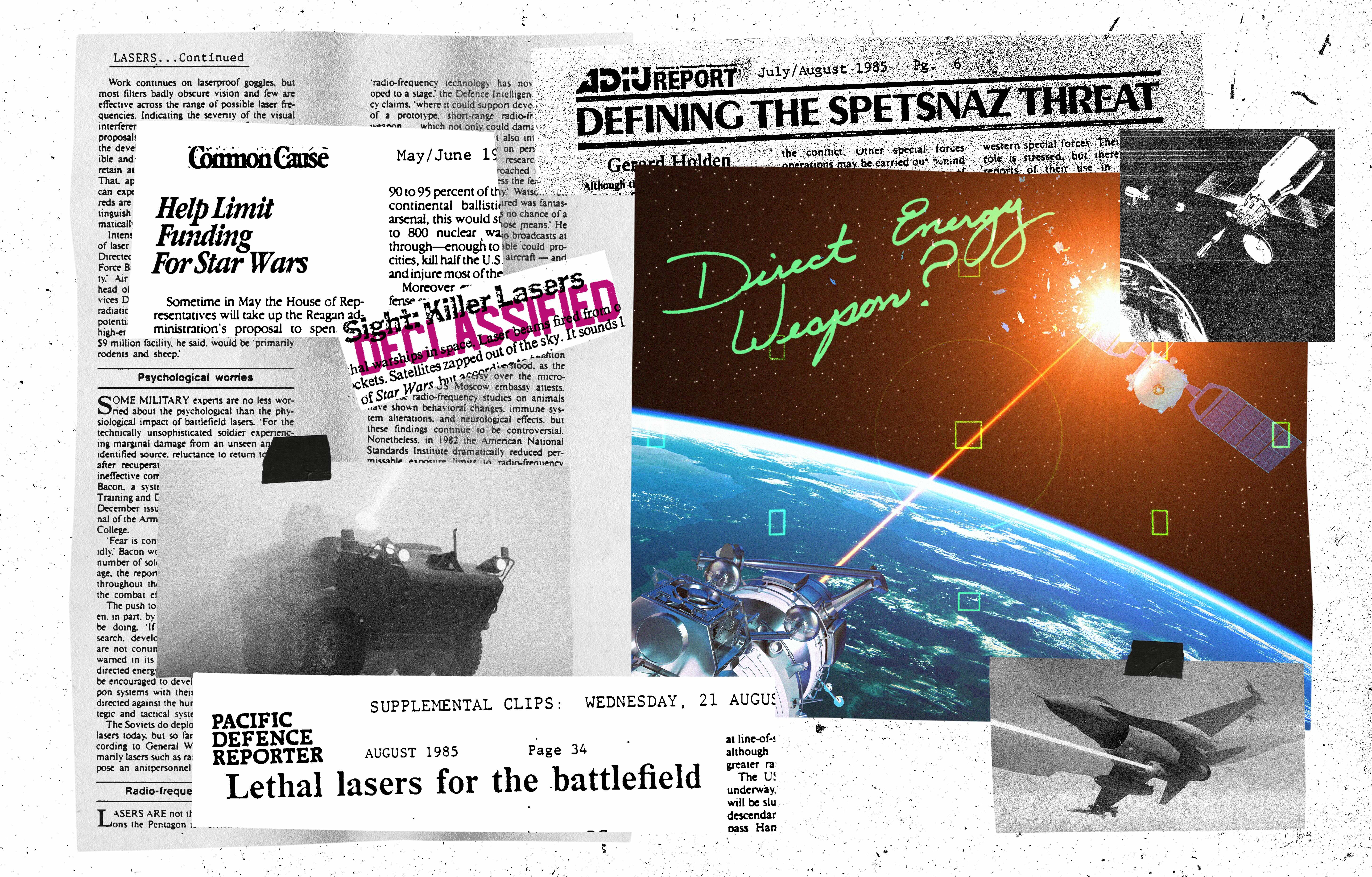
A directed energy weapon uses focused electromagnetic energy to disable, damage, or destroy a target. There are two general types: lasers (higher-frequency visible, infrared, or violet waves) used to heat or burn through surfaces or blind sensors, and masers (lower-frequency microwaves) used to damage electronics.

For Your Eyes Only.
Spies. Satellites. State secrets. Inside the technologies and intelligence contests shaping American power.
Subscribe + Issue 007
Three Bond movies feature laser-based directed energy weapons:
Diamonds Are Forever (1971): Bond stops Blofeld’s plan to use diamonds in a space-based laser weapon capable of destroying ground targets anywhere on earth (The diamonds make the laser more powerful, obviously.)
Die Another Day (2002): Bond stops Gustav Graves’s space-based “Icarus” mirror satellite — billed as an agricultural tool that could provide year-round sunshine to crops, but actually designed to help North Korea invade its southern neighbor.
Moonraker (1979): The infamous battle at Hugo Drax’s private space station, featuring space marines and laser blasters
The Bond films’ space-based directed energy weapons vary in how closely they match real-world technology:
Anti-Satellite / Defense: Bond villains favor space-to-earth weapons, but today’s highest profile directed energy space weapons are ground-based. Both China and Russia have developed ground-to-space laser technology powerful enough to disrupt, degrade, or damage satellite sensors. U.S. Space Force officials expect space-based anti-satellite lasers to emerge in the coming years, given that space-to-space enables more precise targeting and sidesteps atmospheric distortion challenges from occur when firing the laser from the ground.
Space-Based Solar: Satellites that collect sunlight and beam it back to Earth — via mirrors or microwave/infrared lasers — are the closest real-world analog to Bond villain superweapons. But instead of using diamonds to concentrate energy for global destruction, early applications focus on power generation, agriculture, and defense.
Optical Communications: Space lasers are already critical to modern space systems, but they are generally used for communication — moving data — not combat. Just as fiber optic cables transmit data as pulses of light through glass or plastic strands, OCTs do the same in free space, using lasers to send information through the air or the vacuum of space instead of through a cable. This allows for very high bandwidth and lower end-to-end latency because you can route data more directly from satellite-to-satellite and because light travels faster in vacuum than in fiber.
OCTs can be used for several types of communication depending on where the data is being sent: Earth-to-space (from a ground station to a satellite), space-to-Earth (from a satellite back to the ground), and space-to-space (directly between satellites). Of these, space-to-space links are currently the most common, since they avoid atmospheric interference and offer major advantages in bandwidth, latency, and security. SpaceX’s Starlink network, for example, already utilizes a mesh network of roughly 24,000 OCTs (as of late 2025), allowing satellites to pass data to one another using lasers and deliver internet speeds and latency comparable to terrestrial networks, and in January 2026 the company filed with the FCC for up 1 million orbital datacenter satellites that would be connected via OCTs.
The Moonraker Gap: As gloriously absurd as the Space Marines battle in Moonraker is, we don’t have laser rifles in orbit just yet. But the possibility of armed human conflict in space grows more plausible as lunar and Martian settlement inches closer.
Nuclear Weapons
GoldenEye (1995) features a pair of satellites armed with nuclear devices. Detonated in orbit, the weapons generate an electromagnetic pulse that fries electronics in a precise target zone on Earth below. It’s a terrifying concept, and today, this technology would be even more destructive than the film depicts.
First, yes, we have detonated nukes in space. The 1967 Outer Space Treaty prohibits nuclear weapons or other weapons of mass destruction in orbit, but that treaty didn’t exist until after the U.S. and Soviet Union conducted a series of high-altitude and space-based nuclear tests between 1958 and 1962. Those Cold War-era nuclear tests demonstrated that a nuclear detonation in space creates a powerful EMP capable of damaging both terrestrial and space-based electronics, though with nowhere near the level of precision shown in GoldenEye, where the villains can program specific targets. In reality, U.S. and Soviet tests unintentionally fried electronics and electrical infrastructure near the detonation sites and as far as 930 miles away.
What GoldenEye didn’t explore was the aftermath. Radiation from a space-based nuclear bomb gets trapped in the earth’s magnetic field, creating an artificial radiation belt capable of destroying satellites en masse. One 1962 U.S. orbital nuclear test, Starfish Prime, knocked out a third of the roughly two dozen satellites in orbit at the time — largely due to the radiation field it created.
Now imagine the damage of a nuclear detonation in today’s orbital environment: more than 14,000 active satellites, plus around ten humans aboard the International Space Station and China’s Tiangong. The immediate EMP would destroy some portion of those satellites; the radiation belt could persist for months, destroying another portion. The resulting cloud of dead satellites would generate a debris field rendering portions of orbit unusable for years, a phenomenon known as Kessler Syndrome. And the astronauts overhead would face grave danger from both radiation and debris.
Given how much the U.S. military relies on space assets to shoot, move, communicate, navigate and track adversaries, it shouldn’t be surprising to hear that Russia is reportedly developing a space-based nuclear capability. The news broke in 2024 and caused quite the stir, as such a weapon would violate the Outer Space Treaty. It would also give Russia an asymmetric option to cripple U.S. military infrastructure by damaging GPS, communication, and observation satellites, degrading the Department of War’s ability to shoot, move, communicate, navigate and track adversaries. (Though, we can assume that some portion of the Department of War’s satellites are built with materials and components meant to withstand a nuclear blast.) But as Derek Tournear, former director of the Space Development Agency, put it, detonating a nuclear weapon in space wouldn’t just be an attack on the U.S. military but “an attack on the world” — a nuclear blast in space would have lasting effects on global travel, shipping, banking, communications, and financial markets, and more.
Electronic Warfare
The electromagnetic spectrum is vital for modern communications, radar, and navigation. Electronic warfare (EW) uses the spectrum to disrupt, deceive, or deny an adversary’s access to it — while protecting friendly forces’ ability to operate freely.
The Bond films feature the two main methods of EW: jamming, which uses high powered signals to overwhelm enemy receivers and render them useless; and spoofing, which transmits fake signals that mimic real ones.
Dr. No (1962): Jamming is central to the plot. The titular villain plans to disrupt a Project Mercury space launch from Cape Canaveral using high powered radio signals.
Tomorrow Never Dies (1997): Media mogul and Bond villain Elliot Carver uses a stolen GPS encoder to spoof the British frigate HMS Devonshire, sending it off-course into Chinese-controlled waters in the South China Sea. When the ship encounters two Chinese MiG fighter jets, Carver sinks the Devonshire and shoots down one of the jets, intending to spark a war between the UK and China.
EW isn’t as flashy as nukes or space lasers, but it’s a critical aspect of modern warfare — depicted by the Bond films with surprising accuracy.
Dr. No made jamming seem like an unavoidable threat. But in reality, jamming and the countermeasures to defeat it are routine aspects of modern conflicts. In Ukraine, EW plays out like a cat-and-mouse game, with Ukraine and Russia racing to degrade the other’s use of the spectrum while hardening their own systems. SpaceX’s Starlink has given Ukraine a robust, EW-resistant communications platform, with Ukrainian ingenuity and SpaceX’s technical updates working in tandem to counter Russia’s persistent electronic warfare efforts.
GPS jamming and spoofing has become so common that hundreds to thousands of flights are affected daily — particularly in Eastern Europe and the Middle East, where proximity to armed conflicts creates spillover effects. And unlike in Tomorrow Never Dies, where Carver needed a stolen military encoder, GPS spoofing today doesn’t require sophisticated technology. It can be done with cheap, off-the-shelf devices. The Department of War has been pushing a long-delayed GPS upgrade, and a handful of startups are working on alternative position and navigation systems. But for now, civilians and military alike remain vulnerable to GPS spoofing.
Rendezvous and Proximity Operations
Rendezvous and proximity operations (RPO) are the maneuvers spacecraft use to intentionally approach another object in space — whether for inspection, docking, servicing, or offensive action. Depending on their orbit, satellites travel between 7,000 and 17,000 miles per hour. If two airplanes flying near each other sounds dangerous, two satellites operating in close proximity is arguably worse. Even getting within a few dozen miles of another satellite is considered risky.
The Bond movies generally demonstrate hostile RPO
You Only Live Twice (1967): SPECTRE’s massive “Bird One” spacecraft hijacks US and Soviet spacecraft by swallowing them whole, Hungry Hippo-style.
Moonraker (1979): The U.S. Space Marines execute a hostile boarding of Hugo Drax’s space station
Compared to the Bond films, real-world RPO is still in its early days.
The most common example today is spacecraft approaching and docking with the International Space Station (or China’s space station, Tiangong). Unlike the docking scenes in the Bond movies, these are slow, careful processes that can take hours.
But we’re starting to see more aggressive maneuvering. In geostationary orbit, U.S. and Chinese satellites have reportedly engaged in “dogfighting,” jockeying for position to observe or evade one another. This is a relatively new phenomenon, driven by the militarization of space. It also demands new technology: most legacy satellites were built for static positioning and lack the fuel for extra maneuvering. The U.S. Space Force has made the ability to “maneuver without regret,” so that dynamic space operations (the ability to continuously and quickly maneuver in space over long periods of time and distance) aren’t executed at the expense of satellite lifespans. Orbital refueling, more efficient propulsion, and satellites purpose-built for RPO are all solutions under development by governments and their commercial partners
Space Domain Awareness
Space domain awareness (SDA) is the ability to maintain an accurate, real-time understanding of what’s happening in orbit in a way that supports real decisions. It combines tracking satellites, debris, and launches with higher-level analysis: spotting unusual behavior, identifying what an object is and what it can do, assessing intent, and issuing timely warnings so operators can protect assets, avoid collisions, and respond to threats.
In the Bond films, lack of SDA is a recurring theme: In both You Only Live Twice (1967) and Moonraker (1979), the government is initially clueless as to what is going on. Spacecraft are vanishing in You Only Live Twice; a space shuttle is hijacked in Moonraker—but the governments can’t see it, and they don’t know who is responsible.
Modern SDA is far more advanced, but still has room to improve.
The Bond films struggled with the basic question of “what’s where”. Today, U.S. Space Command (USSPACECOM) operates the Space Surveillance Network (SSN), a combination of ground-based radar, optical telescopes, and space-based sensors that maintains a public catalog of objects in Earth orbit — active satellites, dead satellites, space debris — down to about 10 centimeters. Commercial startups are building complementary systems with their own ground- and space-based sensors, offering faster and more detailed data, particularly in low Earth orbit.
But SDA is under strain. The number of active satellites in Earth orbit has grown tenfold in the past decade to more than 14,000. Earth orbit is vast, but it’s getting more crowded and more dynamic; the growth of satellite megaconstellations will only accelerate the trend. Starlink alone now has over 9,000 satellites in orbit. Over a six-month stretch in 2025, it conducted over 144,000 collision-avoidance maneuvers, a 200% increase from the prior six months. In January 2026, the company was approved by the FCC to deploy up to 19,400 satellites, and it also filed to deploy up to one million satellites for development on-orbit datacenter capabilities.
The space industry is in a transition period. Both commercial operators and the U.S. government are working to manage the increasingly complex “traffic control” that space now demands. USSPACECOM is partnering with the Department of Commerce to develop a Traffic Coordination System for Space (TraCSS), which will combine military tracking data with commercially procured data and analytics to manage commercial space collision risk.
Commercial Space Capabilities Exceeding Those of Nation-States
The Bond series accurately predicted that commercial space capabilities might one day exceed those of governments, with private companies controlling critical infrastructure that can decide the fate of ground wars and set the pace for space exploration. Elon Musk’s SpaceX is the most capable space organization in the world, period. It dominates launch, carrying 80 to 90 percent of all mass to orbit in 2025, including the majority of U.S. government satellites and astronauts. It dominates satellite manufacturing, producing several thousand satellites per year — an order of magnitude more than the rest of the world combined. It dominates the largest commercial market in the space industry, satellite communications, with Starlink generating the majority of SpaceX’s $15-16 billion revenue in 2025, serving over 9 million customers worldwide, far more than any competitor. And it dominates movement in space, with its Dragon capsule serving as the primary vehicle for both cargo and crew to and from the International Space Station.
The villain of Moonraker, billionaire Hugo Drax, runs a similarly powerful commercial space empire. Drax Industries is an aerospace contractor that supplies Space Shuttle-like vehicles for governments. Secretly, it has also developed a private launch site in Brazil and a private space station the size of a small city.
In reality, Musk and SpaceX are even more powerful than Drax and Drax Industries: Drax had his own rockets and space station, and supplied rockets to international governments. But SpaceX has more complete end-to-end space capabilities — and a deeper relationship with the U.S. government. The leading space powers — the U.S., China, and Russia — all have arguably more exquisite space technology than SpaceX and have accomplished numerous incredible feats SpaceX hasn’t. But it’s hard to say any single government organization matches SpaceX’s breadth or scale of capabilities. The U.S. government is now almost completely reliant on SpaceX for a variety of services: satellite launches (SpaceX wins the majority of national security satellite contracts these days), astronaut transportation (SpaceX’s Falcon 9 is the primary human-rated U.S. rocket to the ISS, and NASA has contracted SpaceX to develop a lunar lander for the 2027-28 return to the Moon), and satellite communications (Starshield, SpaceX’s government offering, provides speed and latency comparable to terrestrial fiber — significantly better than legacy government satellites).
SpaceX demonstrates that when a private entity applies first principles to manufacturing and vertical integration, it can outpace the collective bureaucracy of nation-states through sheer economic efficiency and innovation. Musk isn’t a Bond villain, but rather the ultimate industrialist who transformed space from a high-stakes prestige project into a global (and someday multiplanetary) commercial platform.
✺
From space lasers to nuclear EMPs, GPS spoofing, and the rise of commercial space superpowers, the Bond franchise’s “goofy” space plots has proven remarkably prescient. The weapons 007’s villains wielded are now the focus of actual military programs and international concern. We may not have laser-rifle battles in orbit yet, but the space battlefield Fleming imagined is very much becoming reality.
Technology
•
The Man With The Golden Satellite
James Bond and the Future of Space Warfare.
Long before the United States Space Force was created in 2019, the James Bond franchise accurately predicted that space would become a battlefield. They got the technology somewhat correct.
Most people think of space as the domain of pure science and exploration, a story that began with the 1960s Space Race to the moon. But from the start, space has been a military priority, given that it represents what military officials often call “the ultimate high ground” — the strategic advantage that comes from occupying the highest possible vantage point in a conflict. Today, space is a critical warfighting domain: essential space-based capabilities like GPS (Global Positioning System), satellite communications, and satellite-based earth observation underpin modern military power.
The Bond films’ space plots are campy, yes. But they blend fantasy with real insight, thanks to 007’s creator, Ian Fleming, a British intelligence officer in World War II with a personal fascination with space technology. Seven Bond movies feature space technology: Dr. No (1962), You Only Live Twice (1967), Diamonds Are Forever (1971), Moonraker (1979), GoldenEye (1995), Tomorrow Never Dies (1997), and Die Another Day (2002) — and, in each case, the technology depicted either exists today or is actively in development for space warfare.
Directed-Energy Weapons
A directed energy weapon uses focused electromagnetic energy to disable, damage, or destroy a target. There are two general types: lasers (higher-frequency visible, infrared, or violet waves) used to heat or burn through surfaces or blind sensors, and masers (lower-frequency microwaves) used to damage electronics.
For Your Eyes Only.
Spies. Satellites. State secrets. Inside the technologies and intelligence contests shaping American power.
Subscribe + Issue 007
Three Bond movies feature laser-based directed energy weapons:
Diamonds Are Forever (1971): Bond stops Blofeld’s plan to use diamonds in a space-based laser weapon capable of destroying ground targets anywhere on earth (The diamonds make the laser more powerful, obviously.)
Die Another Day (2002): Bond stops Gustav Graves’s space-based “Icarus” mirror satellite — billed as an agricultural tool that could provide year-round sunshine to crops, but actually designed to help North Korea invade its southern neighbor.
Moonraker (1979): The infamous battle at Hugo Drax’s private space station, featuring space marines and laser blasters
The Bond films’ space-based directed energy weapons vary in how closely they match real-world technology:
Anti-Satellite / Defense: Bond villains favor space-to-earth weapons, but today’s highest profile directed energy space weapons are ground-based. Both China and Russia have developed ground-to-space laser technology powerful enough to disrupt, degrade, or damage satellite sensors. U.S. Space Force officials expect space-based anti-satellite lasers to emerge in the coming years, given that space-to-space enables more precise targeting and sidesteps atmospheric distortion challenges from occur when firing the laser from the ground.
Space-Based Solar: Satellites that collect sunlight and beam it back to Earth — via mirrors or microwave/infrared lasers — are the closest real-world analog to Bond villain superweapons. But instead of using diamonds to concentrate energy for global destruction, early applications focus on power generation, agriculture, and defense.
Optical Communications: Space lasers are already critical to modern space systems, but they are generally used for communication — moving data — not combat. Just as fiber optic cables transmit data as pulses of light through glass or plastic strands, OCTs do the same in free space, using lasers to send information through the air or the vacuum of space instead of through a cable. This allows for very high bandwidth and lower end-to-end latency because you can route data more directly from satellite-to-satellite and because light travels faster in vacuum than in fiber.
OCTs can be used for several types of communication depending on where the data is being sent: Earth-to-space (from a ground station to a satellite), space-to-Earth (from a satellite back to the ground), and space-to-space (directly between satellites). Of these, space-to-space links are currently the most common, since they avoid atmospheric interference and offer major advantages in bandwidth, latency, and security. SpaceX’s Starlink network, for example, already utilizes a mesh network of roughly 24,000 OCTs (as of late 2025), allowing satellites to pass data to one another using lasers and deliver internet speeds and latency comparable to terrestrial networks, and in January 2026 the company filed with the FCC for up 1 million orbital datacenter satellites that would be connected via OCTs.
The Moonraker Gap: As gloriously absurd as the Space Marines battle in Moonraker is, we don’t have laser rifles in orbit just yet. But the possibility of armed human conflict in space grows more plausible as lunar and Martian settlement inches closer.
Nuclear Weapons
GoldenEye (1995) features a pair of satellites armed with nuclear devices. Detonated in orbit, the weapons generate an electromagnetic pulse that fries electronics in a precise target zone on Earth below. It’s a terrifying concept, and today, this technology would be even more destructive than the film depicts.
First, yes, we have detonated nukes in space. The 1967 Outer Space Treaty prohibits nuclear weapons or other weapons of mass destruction in orbit, but that treaty didn’t exist until after the U.S. and Soviet Union conducted a series of high-altitude and space-based nuclear tests between 1958 and 1962. Those Cold War-era nuclear tests demonstrated that a nuclear detonation in space creates a powerful EMP capable of damaging both terrestrial and space-based electronics, though with nowhere near the level of precision shown in GoldenEye, where the villains can program specific targets. In reality, U.S. and Soviet tests unintentionally fried electronics and electrical infrastructure near the detonation sites and as far as 930 miles away.
What GoldenEye didn’t explore was the aftermath. Radiation from a space-based nuclear bomb gets trapped in the earth’s magnetic field, creating an artificial radiation belt capable of destroying satellites en masse. One 1962 U.S. orbital nuclear test, Starfish Prime, knocked out a third of the roughly two dozen satellites in orbit at the time — largely due to the radiation field it created.
Now imagine the damage of a nuclear detonation in today’s orbital environment: more than 14,000 active satellites, plus around ten humans aboard the International Space Station and China’s Tiangong. The immediate EMP would destroy some portion of those satellites; the radiation belt could persist for months, destroying another portion. The resulting cloud of dead satellites would generate a debris field rendering portions of orbit unusable for years, a phenomenon known as Kessler Syndrome. And the astronauts overhead would face grave danger from both radiation and debris.
Given how much the U.S. military relies on space assets to shoot, move, communicate, navigate and track adversaries, it shouldn’t be surprising to hear that Russia is reportedly developing a space-based nuclear capability. The news broke in 2024 and caused quite the stir, as such a weapon would violate the Outer Space Treaty. It would also give Russia an asymmetric option to cripple U.S. military infrastructure by damaging GPS, communication, and observation satellites, degrading the Department of War’s ability to shoot, move, communicate, navigate and track adversaries. (Though, we can assume that some portion of the Department of War’s satellites are built with materials and components meant to withstand a nuclear blast.) But as Derek Tournear, former director of the Space Development Agency, put it, detonating a nuclear weapon in space wouldn’t just be an attack on the U.S. military but “an attack on the world” — a nuclear blast in space would have lasting effects on global travel, shipping, banking, communications, and financial markets, and more.
Electronic Warfare
The electromagnetic spectrum is vital for modern communications, radar, and navigation. Electronic warfare (EW) uses the spectrum to disrupt, deceive, or deny an adversary’s access to it — while protecting friendly forces’ ability to operate freely.
The Bond films feature the two main methods of EW: jamming, which uses high powered signals to overwhelm enemy receivers and render them useless; and spoofing, which transmits fake signals that mimic real ones.
Dr. No (1962): Jamming is central to the plot. The titular villain plans to disrupt a Project Mercury space launch from Cape Canaveral using high powered radio signals.
Tomorrow Never Dies (1997): Media mogul and Bond villain Elliot Carver uses a stolen GPS encoder to spoof the British frigate HMS Devonshire, sending it off-course into Chinese-controlled waters in the South China Sea. When the ship encounters two Chinese MiG fighter jets, Carver sinks the Devonshire and shoots down one of the jets, intending to spark a war between the UK and China.
EW isn’t as flashy as nukes or space lasers, but it’s a critical aspect of modern warfare — depicted by the Bond films with surprising accuracy.
Dr. No made jamming seem like an unavoidable threat. But in reality, jamming and the countermeasures to defeat it are routine aspects of modern conflicts. In Ukraine, EW plays out like a cat-and-mouse game, with Ukraine and Russia racing to degrade the other’s use of the spectrum while hardening their own systems. SpaceX’s Starlink has given Ukraine a robust, EW-resistant communications platform, with Ukrainian ingenuity and SpaceX’s technical updates working in tandem to counter Russia’s persistent electronic warfare efforts.
GPS jamming and spoofing has become so common that hundreds to thousands of flights are affected daily — particularly in Eastern Europe and the Middle East, where proximity to armed conflicts creates spillover effects. And unlike in Tomorrow Never Dies, where Carver needed a stolen military encoder, GPS spoofing today doesn’t require sophisticated technology. It can be done with cheap, off-the-shelf devices. The Department of War has been pushing a long-delayed GPS upgrade, and a handful of startups are working on alternative position and navigation systems. But for now, civilians and military alike remain vulnerable to GPS spoofing.
Rendezvous and Proximity Operations
Rendezvous and proximity operations (RPO) are the maneuvers spacecraft use to intentionally approach another object in space — whether for inspection, docking, servicing, or offensive action. Depending on their orbit, satellites travel between 7,000 and 17,000 miles per hour. If two airplanes flying near each other sounds dangerous, two satellites operating in close proximity is arguably worse. Even getting within a few dozen miles of another satellite is considered risky.
The Bond movies generally demonstrate hostile RPO
You Only Live Twice (1967): SPECTRE’s massive “Bird One” spacecraft hijacks US and Soviet spacecraft by swallowing them whole, Hungry Hippo-style.
Moonraker (1979): The U.S. Space Marines execute a hostile boarding of Hugo Drax’s space station
Compared to the Bond films, real-world RPO is still in its early days.
The most common example today is spacecraft approaching and docking with the International Space Station (or China’s space station, Tiangong). Unlike the docking scenes in the Bond movies, these are slow, careful processes that can take hours.
But we’re starting to see more aggressive maneuvering. In geostationary orbit, U.S. and Chinese satellites have reportedly engaged in “dogfighting,” jockeying for position to observe or evade one another. This is a relatively new phenomenon, driven by the militarization of space. It also demands new technology: most legacy satellites were built for static positioning and lack the fuel for extra maneuvering. The U.S. Space Force has made the ability to “maneuver without regret,” so that dynamic space operations (the ability to continuously and quickly maneuver in space over long periods of time and distance) aren’t executed at the expense of satellite lifespans. Orbital refueling, more efficient propulsion, and satellites purpose-built for RPO are all solutions under development by governments and their commercial partners
Space Domain Awareness
Space domain awareness (SDA) is the ability to maintain an accurate, real-time understanding of what’s happening in orbit in a way that supports real decisions. It combines tracking satellites, debris, and launches with higher-level analysis: spotting unusual behavior, identifying what an object is and what it can do, assessing intent, and issuing timely warnings so operators can protect assets, avoid collisions, and respond to threats.
In the Bond films, lack of SDA is a recurring theme: In both You Only Live Twice (1967) and Moonraker (1979), the government is initially clueless as to what is going on. Spacecraft are vanishing in You Only Live Twice; a space shuttle is hijacked in Moonraker—but the governments can’t see it, and they don’t know who is responsible.
Modern SDA is far more advanced, but still has room to improve.
The Bond films struggled with the basic question of “what’s where”. Today, U.S. Space Command (USSPACECOM) operates the Space Surveillance Network (SSN), a combination of ground-based radar, optical telescopes, and space-based sensors that maintains a public catalog of objects in Earth orbit — active satellites, dead satellites, space debris — down to about 10 centimeters. Commercial startups are building complementary systems with their own ground- and space-based sensors, offering faster and more detailed data, particularly in low Earth orbit.
But SDA is under strain. The number of active satellites in Earth orbit has grown tenfold in the past decade to more than 14,000. Earth orbit is vast, but it’s getting more crowded and more dynamic; the growth of satellite megaconstellations will only accelerate the trend. Starlink alone now has over 9,000 satellites in orbit. Over a six-month stretch in 2025, it conducted over 144,000 collision-avoidance maneuvers, a 200% increase from the prior six months. In January 2026, the company was approved by the FCC to deploy up to 19,400 satellites, and it also filed to deploy up to one million satellites for development on-orbit datacenter capabilities.
The space industry is in a transition period. Both commercial operators and the U.S. government are working to manage the increasingly complex “traffic control” that space now demands. USSPACECOM is partnering with the Department of Commerce to develop a Traffic Coordination System for Space (TraCSS), which will combine military tracking data with commercially procured data and analytics to manage commercial space collision risk.
Commercial Space Capabilities Exceeding Those of Nation-States
The Bond series accurately predicted that commercial space capabilities might one day exceed those of governments, with private companies controlling critical infrastructure that can decide the fate of ground wars and set the pace for space exploration. Elon Musk’s SpaceX is the most capable space organization in the world, period. It dominates launch, carrying 80 to 90 percent of all mass to orbit in 2025, including the majority of U.S. government satellites and astronauts. It dominates satellite manufacturing, producing several thousand satellites per year — an order of magnitude more than the rest of the world combined. It dominates the largest commercial market in the space industry, satellite communications, with Starlink generating the majority of SpaceX’s $15-16 billion revenue in 2025, serving over 9 million customers worldwide, far more than any competitor. And it dominates movement in space, with its Dragon capsule serving as the primary vehicle for both cargo and crew to and from the International Space Station.
The villain of Moonraker, billionaire Hugo Drax, runs a similarly powerful commercial space empire. Drax Industries is an aerospace contractor that supplies Space Shuttle-like vehicles for governments. Secretly, it has also developed a private launch site in Brazil and a private space station the size of a small city.
In reality, Musk and SpaceX are even more powerful than Drax and Drax Industries: Drax had his own rockets and space station, and supplied rockets to international governments. But SpaceX has more complete end-to-end space capabilities — and a deeper relationship with the U.S. government. The leading space powers — the U.S., China, and Russia — all have arguably more exquisite space technology than SpaceX and have accomplished numerous incredible feats SpaceX hasn’t. But it’s hard to say any single government organization matches SpaceX’s breadth or scale of capabilities. The U.S. government is now almost completely reliant on SpaceX for a variety of services: satellite launches (SpaceX wins the majority of national security satellite contracts these days), astronaut transportation (SpaceX’s Falcon 9 is the primary human-rated U.S. rocket to the ISS, and NASA has contracted SpaceX to develop a lunar lander for the 2027-28 return to the Moon), and satellite communications (Starshield, SpaceX’s government offering, provides speed and latency comparable to terrestrial fiber — significantly better than legacy government satellites).
SpaceX demonstrates that when a private entity applies first principles to manufacturing and vertical integration, it can outpace the collective bureaucracy of nation-states through sheer economic efficiency and innovation. Musk isn’t a Bond villain, but rather the ultimate industrialist who transformed space from a high-stakes prestige project into a global (and someday multiplanetary) commercial platform.
✺
From space lasers to nuclear EMPs, GPS spoofing, and the rise of commercial space superpowers, the Bond franchise’s “goofy” space plots has proven remarkably prescient. The weapons 007’s villains wielded are now the focus of actual military programs and international concern. We may not have laser-rifle battles in orbit yet, but the space battlefield Fleming imagined is very much becoming reality.
Technology
•
The Man With The Golden Satellite
James Bond and the Future of Space Warfare.
Long before the United States Space Force was created in 2019, the James Bond franchise accurately predicted that space would become a battlefield. They got the technology somewhat correct.
Most people think of space as the domain of pure science and exploration, a story that began with the 1960s Space Race to the moon. But from the start, space has been a military priority, given that it represents what military officials often call “the ultimate high ground” — the strategic advantage that comes from occupying the highest possible vantage point in a conflict. Today, space is a critical warfighting domain: essential space-based capabilities like GPS (Global Positioning System), satellite communications, and satellite-based earth observation underpin modern military power.
The Bond films’ space plots are campy, yes. But they blend fantasy with real insight, thanks to 007’s creator, Ian Fleming, a British intelligence officer in World War II with a personal fascination with space technology. Seven Bond movies feature space technology: Dr. No (1962), You Only Live Twice (1967), Diamonds Are Forever (1971), Moonraker (1979), GoldenEye (1995), Tomorrow Never Dies (1997), and Die Another Day (2002) — and, in each case, the technology depicted either exists today or is actively in development for space warfare.
Directed-Energy Weapons
A directed energy weapon uses focused electromagnetic energy to disable, damage, or destroy a target. There are two general types: lasers (higher-frequency visible, infrared, or violet waves) used to heat or burn through surfaces or blind sensors, and masers (lower-frequency microwaves) used to damage electronics.
For Your Eyes Only.
Spies. Satellites. State secrets. Inside the technologies and intelligence contests shaping American power.
Subscribe + Issue 007
Three Bond movies feature laser-based directed energy weapons:
Diamonds Are Forever (1971): Bond stops Blofeld’s plan to use diamonds in a space-based laser weapon capable of destroying ground targets anywhere on earth (The diamonds make the laser more powerful, obviously.)
Die Another Day (2002): Bond stops Gustav Graves’s space-based “Icarus” mirror satellite — billed as an agricultural tool that could provide year-round sunshine to crops, but actually designed to help North Korea invade its southern neighbor.
Moonraker (1979): The infamous battle at Hugo Drax’s private space station, featuring space marines and laser blasters
The Bond films’ space-based directed energy weapons vary in how closely they match real-world technology:
Anti-Satellite / Defense: Bond villains favor space-to-earth weapons, but today’s highest profile directed energy space weapons are ground-based. Both China and Russia have developed ground-to-space laser technology powerful enough to disrupt, degrade, or damage satellite sensors. U.S. Space Force officials expect space-based anti-satellite lasers to emerge in the coming years, given that space-to-space enables more precise targeting and sidesteps atmospheric distortion challenges from occur when firing the laser from the ground.
Space-Based Solar: Satellites that collect sunlight and beam it back to Earth — via mirrors or microwave/infrared lasers — are the closest real-world analog to Bond villain superweapons. But instead of using diamonds to concentrate energy for global destruction, early applications focus on power generation, agriculture, and defense.
Optical Communications: Space lasers are already critical to modern space systems, but they are generally used for communication — moving data — not combat. Just as fiber optic cables transmit data as pulses of light through glass or plastic strands, OCTs do the same in free space, using lasers to send information through the air or the vacuum of space instead of through a cable. This allows for very high bandwidth and lower end-to-end latency because you can route data more directly from satellite-to-satellite and because light travels faster in vacuum than in fiber.
OCTs can be used for several types of communication depending on where the data is being sent: Earth-to-space (from a ground station to a satellite), space-to-Earth (from a satellite back to the ground), and space-to-space (directly between satellites). Of these, space-to-space links are currently the most common, since they avoid atmospheric interference and offer major advantages in bandwidth, latency, and security. SpaceX’s Starlink network, for example, already utilizes a mesh network of roughly 24,000 OCTs (as of late 2025), allowing satellites to pass data to one another using lasers and deliver internet speeds and latency comparable to terrestrial networks, and in January 2026 the company filed with the FCC for up 1 million orbital datacenter satellites that would be connected via OCTs.
The Moonraker Gap: As gloriously absurd as the Space Marines battle in Moonraker is, we don’t have laser rifles in orbit just yet. But the possibility of armed human conflict in space grows more plausible as lunar and Martian settlement inches closer.
Nuclear Weapons
GoldenEye (1995) features a pair of satellites armed with nuclear devices. Detonated in orbit, the weapons generate an electromagnetic pulse that fries electronics in a precise target zone on Earth below. It’s a terrifying concept, and today, this technology would be even more destructive than the film depicts.
First, yes, we have detonated nukes in space. The 1967 Outer Space Treaty prohibits nuclear weapons or other weapons of mass destruction in orbit, but that treaty didn’t exist until after the U.S. and Soviet Union conducted a series of high-altitude and space-based nuclear tests between 1958 and 1962. Those Cold War-era nuclear tests demonstrated that a nuclear detonation in space creates a powerful EMP capable of damaging both terrestrial and space-based electronics, though with nowhere near the level of precision shown in GoldenEye, where the villains can program specific targets. In reality, U.S. and Soviet tests unintentionally fried electronics and electrical infrastructure near the detonation sites and as far as 930 miles away.
What GoldenEye didn’t explore was the aftermath. Radiation from a space-based nuclear bomb gets trapped in the earth’s magnetic field, creating an artificial radiation belt capable of destroying satellites en masse. One 1962 U.S. orbital nuclear test, Starfish Prime, knocked out a third of the roughly two dozen satellites in orbit at the time — largely due to the radiation field it created.
Now imagine the damage of a nuclear detonation in today’s orbital environment: more than 14,000 active satellites, plus around ten humans aboard the International Space Station and China’s Tiangong. The immediate EMP would destroy some portion of those satellites; the radiation belt could persist for months, destroying another portion. The resulting cloud of dead satellites would generate a debris field rendering portions of orbit unusable for years, a phenomenon known as Kessler Syndrome. And the astronauts overhead would face grave danger from both radiation and debris.
Given how much the U.S. military relies on space assets to shoot, move, communicate, navigate and track adversaries, it shouldn’t be surprising to hear that Russia is reportedly developing a space-based nuclear capability. The news broke in 2024 and caused quite the stir, as such a weapon would violate the Outer Space Treaty. It would also give Russia an asymmetric option to cripple U.S. military infrastructure by damaging GPS, communication, and observation satellites, degrading the Department of War’s ability to shoot, move, communicate, navigate and track adversaries. (Though, we can assume that some portion of the Department of War’s satellites are built with materials and components meant to withstand a nuclear blast.) But as Derek Tournear, former director of the Space Development Agency, put it, detonating a nuclear weapon in space wouldn’t just be an attack on the U.S. military but “an attack on the world” — a nuclear blast in space would have lasting effects on global travel, shipping, banking, communications, and financial markets, and more.
Electronic Warfare
The electromagnetic spectrum is vital for modern communications, radar, and navigation. Electronic warfare (EW) uses the spectrum to disrupt, deceive, or deny an adversary’s access to it — while protecting friendly forces’ ability to operate freely.
The Bond films feature the two main methods of EW: jamming, which uses high powered signals to overwhelm enemy receivers and render them useless; and spoofing, which transmits fake signals that mimic real ones.
Dr. No (1962): Jamming is central to the plot. The titular villain plans to disrupt a Project Mercury space launch from Cape Canaveral using high powered radio signals.
Tomorrow Never Dies (1997): Media mogul and Bond villain Elliot Carver uses a stolen GPS encoder to spoof the British frigate HMS Devonshire, sending it off-course into Chinese-controlled waters in the South China Sea. When the ship encounters two Chinese MiG fighter jets, Carver sinks the Devonshire and shoots down one of the jets, intending to spark a war between the UK and China.
EW isn’t as flashy as nukes or space lasers, but it’s a critical aspect of modern warfare — depicted by the Bond films with surprising accuracy.
Dr. No made jamming seem like an unavoidable threat. But in reality, jamming and the countermeasures to defeat it are routine aspects of modern conflicts. In Ukraine, EW plays out like a cat-and-mouse game, with Ukraine and Russia racing to degrade the other’s use of the spectrum while hardening their own systems. SpaceX’s Starlink has given Ukraine a robust, EW-resistant communications platform, with Ukrainian ingenuity and SpaceX’s technical updates working in tandem to counter Russia’s persistent electronic warfare efforts.
GPS jamming and spoofing has become so common that hundreds to thousands of flights are affected daily — particularly in Eastern Europe and the Middle East, where proximity to armed conflicts creates spillover effects. And unlike in Tomorrow Never Dies, where Carver needed a stolen military encoder, GPS spoofing today doesn’t require sophisticated technology. It can be done with cheap, off-the-shelf devices. The Department of War has been pushing a long-delayed GPS upgrade, and a handful of startups are working on alternative position and navigation systems. But for now, civilians and military alike remain vulnerable to GPS spoofing.
Rendezvous and Proximity Operations
Rendezvous and proximity operations (RPO) are the maneuvers spacecraft use to intentionally approach another object in space — whether for inspection, docking, servicing, or offensive action. Depending on their orbit, satellites travel between 7,000 and 17,000 miles per hour. If two airplanes flying near each other sounds dangerous, two satellites operating in close proximity is arguably worse. Even getting within a few dozen miles of another satellite is considered risky.
The Bond movies generally demonstrate hostile RPO
You Only Live Twice (1967): SPECTRE’s massive “Bird One” spacecraft hijacks US and Soviet spacecraft by swallowing them whole, Hungry Hippo-style.
Moonraker (1979): The U.S. Space Marines execute a hostile boarding of Hugo Drax’s space station
Compared to the Bond films, real-world RPO is still in its early days.
The most common example today is spacecraft approaching and docking with the International Space Station (or China’s space station, Tiangong). Unlike the docking scenes in the Bond movies, these are slow, careful processes that can take hours.
But we’re starting to see more aggressive maneuvering. In geostationary orbit, U.S. and Chinese satellites have reportedly engaged in “dogfighting,” jockeying for position to observe or evade one another. This is a relatively new phenomenon, driven by the militarization of space. It also demands new technology: most legacy satellites were built for static positioning and lack the fuel for extra maneuvering. The U.S. Space Force has made the ability to “maneuver without regret,” so that dynamic space operations (the ability to continuously and quickly maneuver in space over long periods of time and distance) aren’t executed at the expense of satellite lifespans. Orbital refueling, more efficient propulsion, and satellites purpose-built for RPO are all solutions under development by governments and their commercial partners
Space Domain Awareness
Space domain awareness (SDA) is the ability to maintain an accurate, real-time understanding of what’s happening in orbit in a way that supports real decisions. It combines tracking satellites, debris, and launches with higher-level analysis: spotting unusual behavior, identifying what an object is and what it can do, assessing intent, and issuing timely warnings so operators can protect assets, avoid collisions, and respond to threats.
In the Bond films, lack of SDA is a recurring theme: In both You Only Live Twice (1967) and Moonraker (1979), the government is initially clueless as to what is going on. Spacecraft are vanishing in You Only Live Twice; a space shuttle is hijacked in Moonraker—but the governments can’t see it, and they don’t know who is responsible.
Modern SDA is far more advanced, but still has room to improve.
The Bond films struggled with the basic question of “what’s where”. Today, U.S. Space Command (USSPACECOM) operates the Space Surveillance Network (SSN), a combination of ground-based radar, optical telescopes, and space-based sensors that maintains a public catalog of objects in Earth orbit — active satellites, dead satellites, space debris — down to about 10 centimeters. Commercial startups are building complementary systems with their own ground- and space-based sensors, offering faster and more detailed data, particularly in low Earth orbit.
But SDA is under strain. The number of active satellites in Earth orbit has grown tenfold in the past decade to more than 14,000. Earth orbit is vast, but it’s getting more crowded and more dynamic; the growth of satellite megaconstellations will only accelerate the trend. Starlink alone now has over 9,000 satellites in orbit. Over a six-month stretch in 2025, it conducted over 144,000 collision-avoidance maneuvers, a 200% increase from the prior six months. In January 2026, the company was approved by the FCC to deploy up to 19,400 satellites, and it also filed to deploy up to one million satellites for development on-orbit datacenter capabilities.
The space industry is in a transition period. Both commercial operators and the U.S. government are working to manage the increasingly complex “traffic control” that space now demands. USSPACECOM is partnering with the Department of Commerce to develop a Traffic Coordination System for Space (TraCSS), which will combine military tracking data with commercially procured data and analytics to manage commercial space collision risk.
Commercial Space Capabilities Exceeding Those of Nation-States
The Bond series accurately predicted that commercial space capabilities might one day exceed those of governments, with private companies controlling critical infrastructure that can decide the fate of ground wars and set the pace for space exploration. Elon Musk’s SpaceX is the most capable space organization in the world, period. It dominates launch, carrying 80 to 90 percent of all mass to orbit in 2025, including the majority of U.S. government satellites and astronauts. It dominates satellite manufacturing, producing several thousand satellites per year — an order of magnitude more than the rest of the world combined. It dominates the largest commercial market in the space industry, satellite communications, with Starlink generating the majority of SpaceX’s $15-16 billion revenue in 2025, serving over 9 million customers worldwide, far more than any competitor. And it dominates movement in space, with its Dragon capsule serving as the primary vehicle for both cargo and crew to and from the International Space Station.
The villain of Moonraker, billionaire Hugo Drax, runs a similarly powerful commercial space empire. Drax Industries is an aerospace contractor that supplies Space Shuttle-like vehicles for governments. Secretly, it has also developed a private launch site in Brazil and a private space station the size of a small city.
In reality, Musk and SpaceX are even more powerful than Drax and Drax Industries: Drax had his own rockets and space station, and supplied rockets to international governments. But SpaceX has more complete end-to-end space capabilities — and a deeper relationship with the U.S. government. The leading space powers — the U.S., China, and Russia — all have arguably more exquisite space technology than SpaceX and have accomplished numerous incredible feats SpaceX hasn’t. But it’s hard to say any single government organization matches SpaceX’s breadth or scale of capabilities. The U.S. government is now almost completely reliant on SpaceX for a variety of services: satellite launches (SpaceX wins the majority of national security satellite contracts these days), astronaut transportation (SpaceX’s Falcon 9 is the primary human-rated U.S. rocket to the ISS, and NASA has contracted SpaceX to develop a lunar lander for the 2027-28 return to the Moon), and satellite communications (Starshield, SpaceX’s government offering, provides speed and latency comparable to terrestrial fiber — significantly better than legacy government satellites).
SpaceX demonstrates that when a private entity applies first principles to manufacturing and vertical integration, it can outpace the collective bureaucracy of nation-states through sheer economic efficiency and innovation. Musk isn’t a Bond villain, but rather the ultimate industrialist who transformed space from a high-stakes prestige project into a global (and someday multiplanetary) commercial platform.
✺
From space lasers to nuclear EMPs, GPS spoofing, and the rise of commercial space superpowers, the Bond franchise’s “goofy” space plots has proven remarkably prescient. The weapons 007’s villains wielded are now the focus of actual military programs and international concern. We may not have laser-rifle battles in orbit yet, but the space battlefield Fleming imagined is very much becoming reality.
About the Author
Case Taylor is an investor at United States Innovative Technology Fund (USIT). He is on X @spacecasetayl0r