tt
tt
tt
tt
tt
tt

Technology
•
All Aboard the Satellite Bus!
Apex Space wants to make satellites like Detroit makes cars.
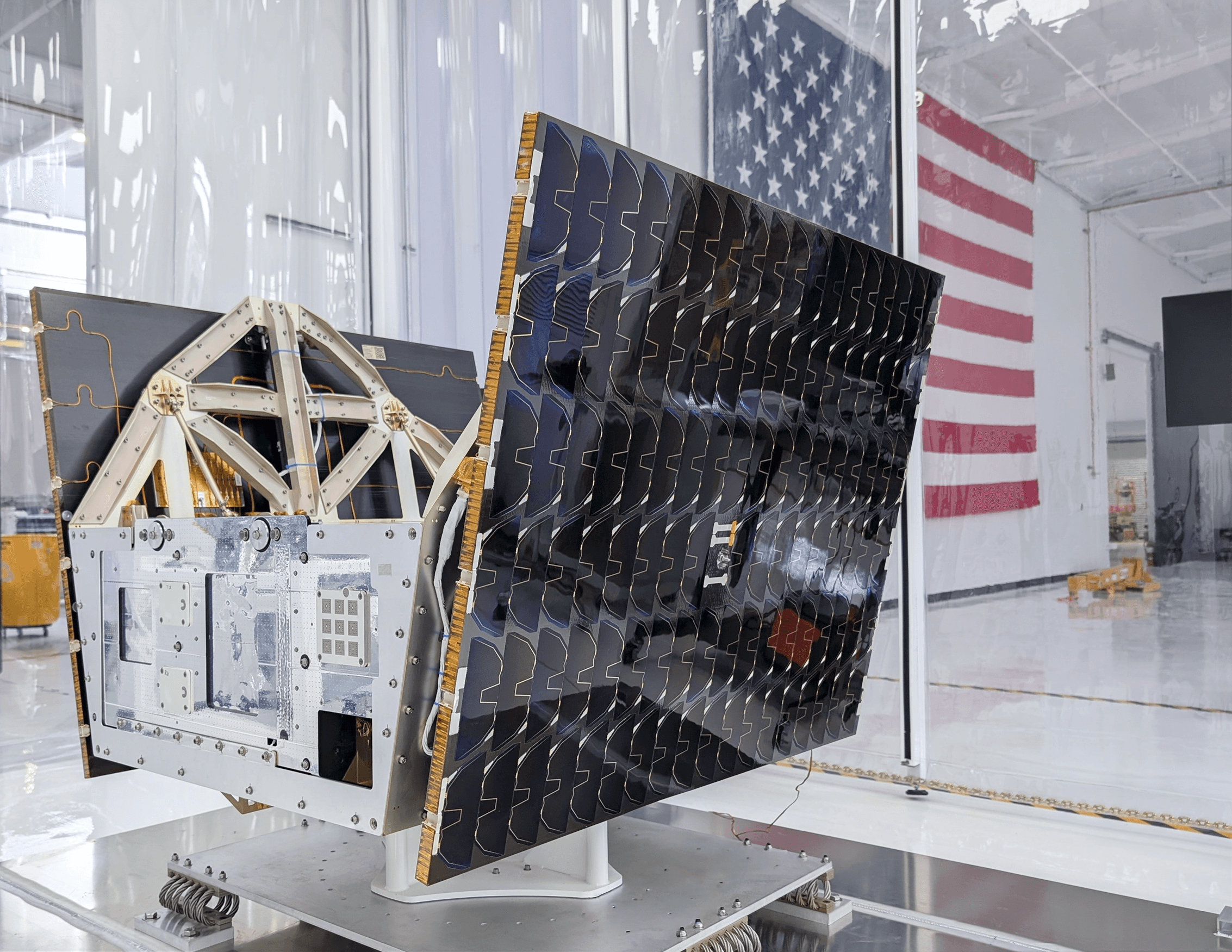

In a very unassuming facility near Los Angeles International Airport, satellite buses are being manufactured. As you arrive, there is a yard sign, “APEX,” in front of a fenced garage and a low rise building. We are greeted in a galaxy-themed lobby (complete with purple coloring and milky way illustrations) by CEO Ian Cinnamon and Head of Marketing Neil Presicci. The two lead us from the lobby into an office space with multiple rows of desks and computers, all occupied. From here we are led into a gargantuan hangar, which is crisply lit, and sprawling with hardware tools and cabinets, and a lot of steel and monitors. Rooms here are named after apex predators, like ‘T-Rex.’ A little further in, behind clear cleanroom containment film, everyone is working donned in protective suits. Satellites are being manufactured and assembled, to be shipped to customers and then sent up to space.
Apex Space was founded by Ian Cinnamon and Max Benassi in September of 2022 with a grand goal: to enable industrial-scale standardized assembly-line production of satellites.
Cinnamon founded Apex soon after selling his previous project, a defense startup called Synapse. Synapse, which was founded in 2016, was a startup specializing in developing artificial intelligence to detect weapons and narcotics in X-ray scans. In 2020, Synapse was acquired and absorbed by Palantir. “The moment the deal closed. I had this immediate sense of emptiness”, expresses Cinnamon, “The void now was something where it was like, I need to start something, and this time I don’t ever want to let it go. I’ll never sell it. I want to build something that will last forever.”
As an employee at Palantir, Cinnamon had been tasked with working with satellite data. Through his work he realized that access to space was slowly becoming commonplace. “Space access is nothing new, right? We’ve been flying satellites for 70 years,” he says, trying to convey his Eureka moment. “There have been satellites up there for decades. But what happened around 2019, 2020 was the way that we get to space fundamentally changed. SpaceX started increasing the reliability of their rockets. They started reusing the rockets.”

For Your Eyes Only.
Spies. Satellites. State secrets. Inside the technologies and intelligence contests shaping American power.
Subscribe + Issue 007
This, according to Cinnamon, removed the main bottleneck of getting to space.
Reusable rockets were a breakthrough because they reduced launch costs to low Earth orbit (LEO) from over $30,000 per pound of payload in 2011 to as low as $1,200 today. Private companies also helped compress timelines by turning rockets into recoverable infrastructure, ushering in an era of routine access to orbit.
Simultaneously, Cinnamon noted, satellite production had evolved, but not sped up. Satellites used to be “giant, the size of like three of these rooms,” with individual satellites having a functional lifetime of 20–30 years. This paradigm of high cost, low production meant slow and rare launches, with a single point of failure. Additionally, the new world demands smaller and more specialized satellites, and near constant updates and monitoring. The shift is toward launching “100 satellites or a 1000 satellites,” for multiple purposes including observation, weather tracking, navigation, and biological research. Multiple satellites also create a “resilient mesh system” where losing one means you only lose “1% of your capability instead of a 100%”.
But with this new trend towards smaller, more frequent satellite launches, the bottleneck now, as Cinnamon sees it, is manufacturing: when “normally a satellite takes five to ten years to build,” but the new demand is “50 satellites in one year,” no existing organization can keep up, leading to Apex: “we gotta go figure out how to build satellites quickly.”
“So, how do you actually make that [high rate production of satellite platforms] happen?”
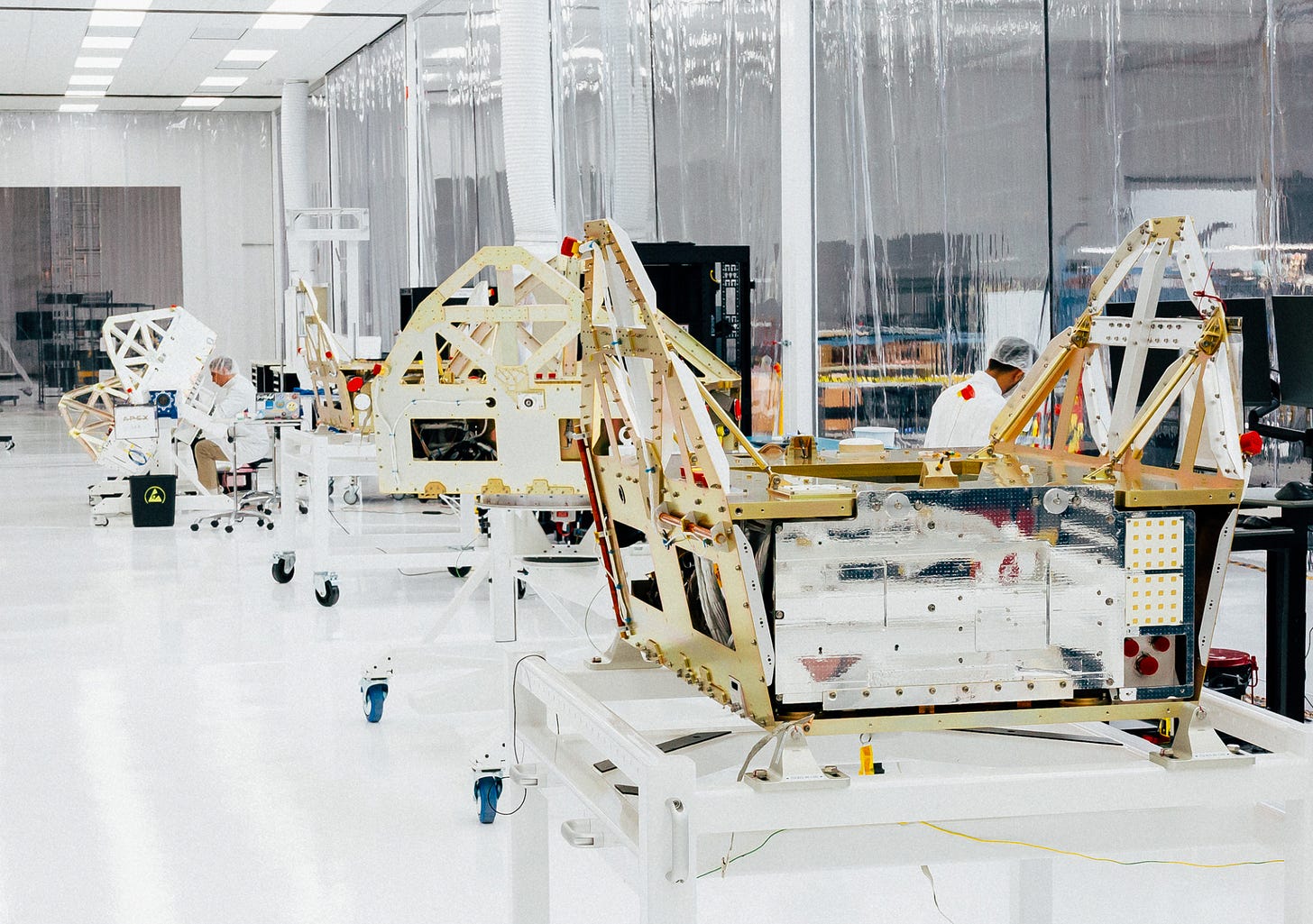
Traditionally, satellites have been custom designed and built for each launch mission, which meant very slow production timelines and very high costs (usually upwards of $10M per unit). “The way satellites are made today is: you have an engineer design them, they test the design, they kind of play with it for a year or two. And then they go build it.” explains Cinnamon, “And if a customer wants a different one, they start over. And so every satellite, you’re redesigning from scratch”.
“But what if we treat the satellite much more like a car? You don’t go saying ‘Toyota. I’m ready to buy a car, can you design me one?’ They say ‘pick one on the dot.’ You could drive away in this one or that one.”
By recognizing that highly specified satellites are not needed, Apex has reduced manufacturing to core platforms which can be easily integrated with mission-specific payloads and subsystems. This is their proposed pathway to a future of high-volume, high-access production. Apex builds satellites the way Ford builds cars: they create standardized, off-the-shelf satellite platforms that are available for purchase any time, and shipped as soon as possible.
“We build [satellites] before anybody buys them. We are the highest rate manufacturer of satellite platforms to ever exist. It’s only been three years, and it’s been a wild ride. We’ve raised over $500 million. The company is over 250 people now. By about the first half of this year, we’ll have about half a dozen in orbit.”
Apex currently offers three satellite “bus” platforms that are available for immediate purchase. They range in size and payload capacity: ‘Aries’ is small, carrying payloads up to 150kg, while ‘Nova’ is medium, carrying payloads up to 300kg, and ‘Comet’ is large, carrying payload above 500 kg. (Aries and Nova are named after the pet dogs of the CEO and CTO)
“That was one of the early signs that it was going to be a really, really good fit working together,” says Cinnamon, speaking of the fact that the co-founders had both given their dogs space names, even before embarking on this venture together.
The satellites Apex makes are also highly customizable. Customers can have their own camera systems, research protocol apparatuses, and communication tools installed on demand.
Apex is also aggressively positioning itself as a key enabler of President Donald Trump’s Golden Dome defense system. Under the Golden Dome, any physical threat to the United States will be detected and responded to by an orbital architecture, which will consist of monitoring satellite constellations (up to a 1000 satellites, as some have proposed) operating alongside space-based interceptors, or “SBIs.” SBIs are proliferated kinetic interceptors (i.e., missiles or kill vehicles) hosted on satellites. Apex’s internal self funded program, called “Project Shadow”, is planned to launch “America’s First Commercially-Led, On-Orbit Space-Based Interceptor Demonstration” in June 2026.
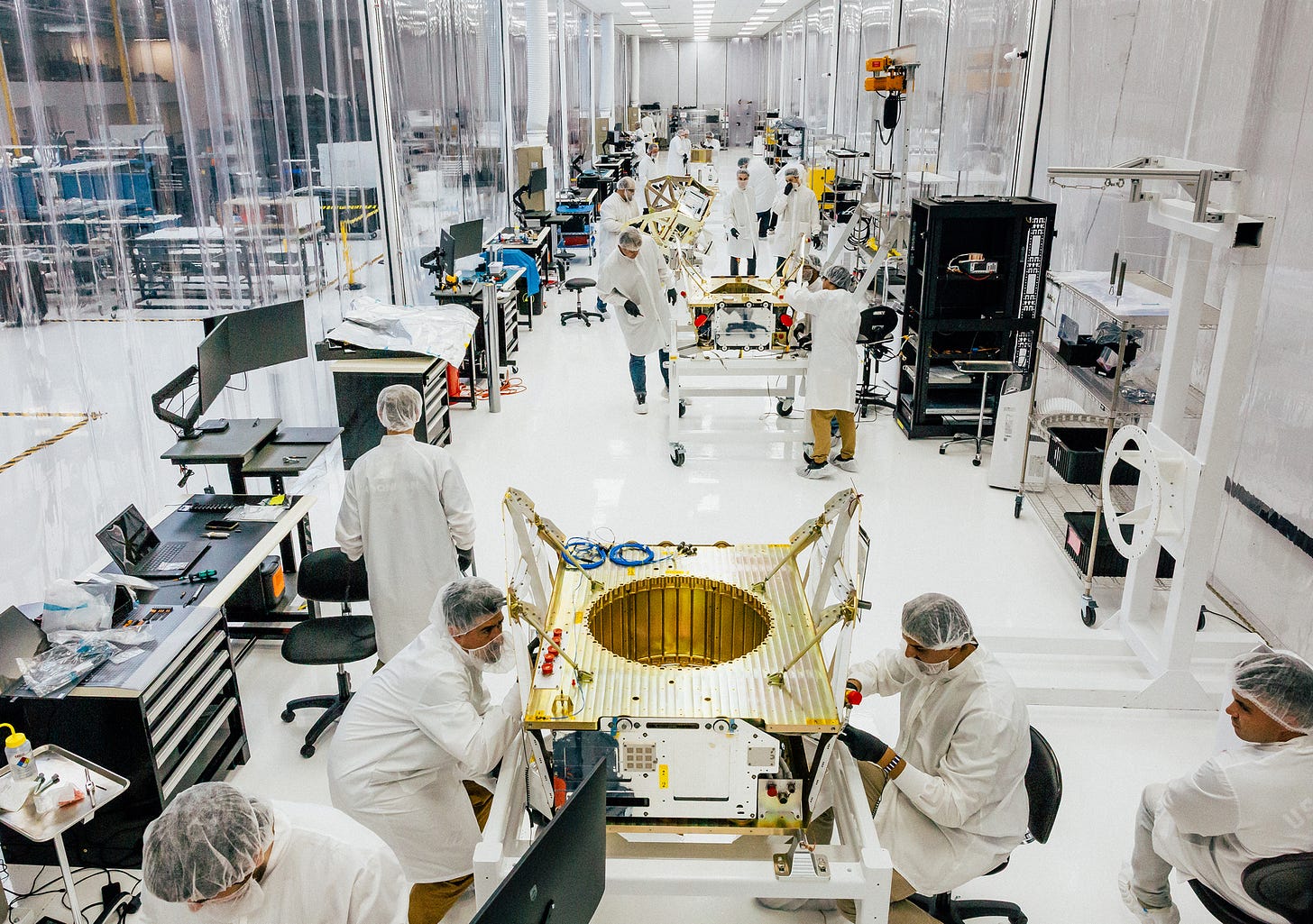
The goal of Apex’s Project Shadow is to validate their proprietary technology, the Orbital Magazines. The Orbital Magazine is an “advanced host platform,” which is purpose-built on Apex’s existing satellite buses — primarily the medium Nova class for Project Shadow, although the larger Comet may be used for larger payloads — which allows the staging of thousands of SBIs, “ready to combat large-scale missile attacks”. Apex states they are developing this Orbital Magazine technology on their own dime, and that their existing manufacturing infrastructure can already scale Orbital Magazine production to hundreds of units annually.
Cinnamon wants Apex to be around for the next 100 years — a truly “generational” company. “I want to be running this company until I am too old and they wheel me out of here, and the next generation takes over”.
Apex has landed upon something so simple, and so obvious, one is forced to wonder why this wasn’t done earlier. While the vision isn’t about putting a satellite in every backyard (individual ownership remains impractical due to size, cost, regulations, and orbital realities), Apex’s success is concerned with manufacturing the infrastructure for humanity’s impending expansion into orbit.
Simultaneously, Apex is ensuring that the United States — and its allies — can deploy capable systems at the speed our modern space era demands. “The U.S. government, last year, launched about 150 satellites. The Chinese government wants to launch 12,000 in the next two years,” Cinnamon informs me, appreciating that the Chinese government can pull it off since the public and commercial spheres there work as one. “The U.S. government needs companies like Apex. That’s what keeps me up at night.”
Technology
•
All Aboard the Satellite Bus!
Apex Space wants to make satellites like Detroit makes cars.
In a very unassuming facility near Los Angeles International Airport, satellite buses are being manufactured. As you arrive, there is a yard sign, “APEX,” in front of a fenced garage and a low rise building. We are greeted in a galaxy-themed lobby (complete with purple coloring and milky way illustrations) by CEO Ian Cinnamon and Head of Marketing Neil Presicci. The two lead us from the lobby into an office space with multiple rows of desks and computers, all occupied. From here we are led into a gargantuan hangar, which is crisply lit, and sprawling with hardware tools and cabinets, and a lot of steel and monitors. Rooms here are named after apex predators, like ‘T-Rex.’ A little further in, behind clear cleanroom containment film, everyone is working donned in protective suits. Satellites are being manufactured and assembled, to be shipped to customers and then sent up to space.
Apex Space was founded by Ian Cinnamon and Max Benassi in September of 2022 with a grand goal: to enable industrial-scale standardized assembly-line production of satellites.
Cinnamon founded Apex soon after selling his previous project, a defense startup called Synapse. Synapse, which was founded in 2016, was a startup specializing in developing artificial intelligence to detect weapons and narcotics in X-ray scans. In 2020, Synapse was acquired and absorbed by Palantir. “The moment the deal closed. I had this immediate sense of emptiness”, expresses Cinnamon, “The void now was something where it was like, I need to start something, and this time I don’t ever want to let it go. I’ll never sell it. I want to build something that will last forever.”
As an employee at Palantir, Cinnamon had been tasked with working with satellite data. Through his work he realized that access to space was slowly becoming commonplace. “Space access is nothing new, right? We’ve been flying satellites for 70 years,” he says, trying to convey his Eureka moment. “There have been satellites up there for decades. But what happened around 2019, 2020 was the way that we get to space fundamentally changed. SpaceX started increasing the reliability of their rockets. They started reusing the rockets.”
For Your Eyes Only.
Spies. Satellites. State secrets. Inside the technologies and intelligence contests shaping American power.
Subscribe + Issue 007
This, according to Cinnamon, removed the main bottleneck of getting to space.
Reusable rockets were a breakthrough because they reduced launch costs to low Earth orbit (LEO) from over $30,000 per pound of payload in 2011 to as low as $1,200 today. Private companies also helped compress timelines by turning rockets into recoverable infrastructure, ushering in an era of routine access to orbit.
Simultaneously, Cinnamon noted, satellite production had evolved, but not sped up. Satellites used to be “giant, the size of like three of these rooms,” with individual satellites having a functional lifetime of 20–30 years. This paradigm of high cost, low production meant slow and rare launches, with a single point of failure. Additionally, the new world demands smaller and more specialized satellites, and near constant updates and monitoring. The shift is toward launching “100 satellites or a 1000 satellites,” for multiple purposes including observation, weather tracking, navigation, and biological research. Multiple satellites also create a “resilient mesh system” where losing one means you only lose “1% of your capability instead of a 100%”.
But with this new trend towards smaller, more frequent satellite launches, the bottleneck now, as Cinnamon sees it, is manufacturing: when “normally a satellite takes five to ten years to build,” but the new demand is “50 satellites in one year,” no existing organization can keep up, leading to Apex: “we gotta go figure out how to build satellites quickly.”
“So, how do you actually make that [high rate production of satellite platforms] happen?”
Traditionally, satellites have been custom designed and built for each launch mission, which meant very slow production timelines and very high costs (usually upwards of $10M per unit). “The way satellites are made today is: you have an engineer design them, they test the design, they kind of play with it for a year or two. And then they go build it.” explains Cinnamon, “And if a customer wants a different one, they start over. And so every satellite, you’re redesigning from scratch”.
“But what if we treat the satellite much more like a car? You don’t go saying ‘Toyota. I’m ready to buy a car, can you design me one?’ They say ‘pick one on the dot.’ You could drive away in this one or that one.”
By recognizing that highly specified satellites are not needed, Apex has reduced manufacturing to core platforms which can be easily integrated with mission-specific payloads and subsystems. This is their proposed pathway to a future of high-volume, high-access production. Apex builds satellites the way Ford builds cars: they create standardized, off-the-shelf satellite platforms that are available for purchase any time, and shipped as soon as possible.
“We build [satellites] before anybody buys them. We are the highest rate manufacturer of satellite platforms to ever exist. It’s only been three years, and it’s been a wild ride. We’ve raised over $500 million. The company is over 250 people now. By about the first half of this year, we’ll have about half a dozen in orbit.”
Apex currently offers three satellite “bus” platforms that are available for immediate purchase. They range in size and payload capacity: ‘Aries’ is small, carrying payloads up to 150kg, while ‘Nova’ is medium, carrying payloads up to 300kg, and ‘Comet’ is large, carrying payload above 500 kg. (Aries and Nova are named after the pet dogs of the CEO and CTO)
“That was one of the early signs that it was going to be a really, really good fit working together,” says Cinnamon, speaking of the fact that the co-founders had both given their dogs space names, even before embarking on this venture together.
The satellites Apex makes are also highly customizable. Customers can have their own camera systems, research protocol apparatuses, and communication tools installed on demand.
Apex is also aggressively positioning itself as a key enabler of President Donald Trump’s Golden Dome defense system. Under the Golden Dome, any physical threat to the United States will be detected and responded to by an orbital architecture, which will consist of monitoring satellite constellations (up to a 1000 satellites, as some have proposed) operating alongside space-based interceptors, or “SBIs.” SBIs are proliferated kinetic interceptors (i.e., missiles or kill vehicles) hosted on satellites. Apex’s internal self funded program, called “Project Shadow”, is planned to launch “America’s First Commercially-Led, On-Orbit Space-Based Interceptor Demonstration” in June 2026.
The goal of Apex’s Project Shadow is to validate their proprietary technology, the Orbital Magazines. The Orbital Magazine is an “advanced host platform,” which is purpose-built on Apex’s existing satellite buses — primarily the medium Nova class for Project Shadow, although the larger Comet may be used for larger payloads — which allows the staging of thousands of SBIs, “ready to combat large-scale missile attacks”. Apex states they are developing this Orbital Magazine technology on their own dime, and that their existing manufacturing infrastructure can already scale Orbital Magazine production to hundreds of units annually.
Cinnamon wants Apex to be around for the next 100 years — a truly “generational” company. “I want to be running this company until I am too old and they wheel me out of here, and the next generation takes over”.
Apex has landed upon something so simple, and so obvious, one is forced to wonder why this wasn’t done earlier. While the vision isn’t about putting a satellite in every backyard (individual ownership remains impractical due to size, cost, regulations, and orbital realities), Apex’s success is concerned with manufacturing the infrastructure for humanity’s impending expansion into orbit.
Simultaneously, Apex is ensuring that the United States — and its allies — can deploy capable systems at the speed our modern space era demands. “The U.S. government, last year, launched about 150 satellites. The Chinese government wants to launch 12,000 in the next two years,” Cinnamon informs me, appreciating that the Chinese government can pull it off since the public and commercial spheres there work as one. “The U.S. government needs companies like Apex. That’s what keeps me up at night.”
Technology
•
All Aboard the Satellite Bus!
Apex Space wants to make satellites like Detroit makes cars.
In a very unassuming facility near Los Angeles International Airport, satellite buses are being manufactured. As you arrive, there is a yard sign, “APEX,” in front of a fenced garage and a low rise building. We are greeted in a galaxy-themed lobby (complete with purple coloring and milky way illustrations) by CEO Ian Cinnamon and Head of Marketing Neil Presicci. The two lead us from the lobby into an office space with multiple rows of desks and computers, all occupied. From here we are led into a gargantuan hangar, which is crisply lit, and sprawling with hardware tools and cabinets, and a lot of steel and monitors. Rooms here are named after apex predators, like ‘T-Rex.’ A little further in, behind clear cleanroom containment film, everyone is working donned in protective suits. Satellites are being manufactured and assembled, to be shipped to customers and then sent up to space.
Apex Space was founded by Ian Cinnamon and Max Benassi in September of 2022 with a grand goal: to enable industrial-scale standardized assembly-line production of satellites.
Cinnamon founded Apex soon after selling his previous project, a defense startup called Synapse. Synapse, which was founded in 2016, was a startup specializing in developing artificial intelligence to detect weapons and narcotics in X-ray scans. In 2020, Synapse was acquired and absorbed by Palantir. “The moment the deal closed. I had this immediate sense of emptiness”, expresses Cinnamon, “The void now was something where it was like, I need to start something, and this time I don’t ever want to let it go. I’ll never sell it. I want to build something that will last forever.”
As an employee at Palantir, Cinnamon had been tasked with working with satellite data. Through his work he realized that access to space was slowly becoming commonplace. “Space access is nothing new, right? We’ve been flying satellites for 70 years,” he says, trying to convey his Eureka moment. “There have been satellites up there for decades. But what happened around 2019, 2020 was the way that we get to space fundamentally changed. SpaceX started increasing the reliability of their rockets. They started reusing the rockets.”
For Your Eyes Only.
Spies. Satellites. State secrets. Inside the technologies and intelligence contests shaping American power.
Subscribe + Issue 007
This, according to Cinnamon, removed the main bottleneck of getting to space.
Reusable rockets were a breakthrough because they reduced launch costs to low Earth orbit (LEO) from over $30,000 per pound of payload in 2011 to as low as $1,200 today. Private companies also helped compress timelines by turning rockets into recoverable infrastructure, ushering in an era of routine access to orbit.
Simultaneously, Cinnamon noted, satellite production had evolved, but not sped up. Satellites used to be “giant, the size of like three of these rooms,” with individual satellites having a functional lifetime of 20–30 years. This paradigm of high cost, low production meant slow and rare launches, with a single point of failure. Additionally, the new world demands smaller and more specialized satellites, and near constant updates and monitoring. The shift is toward launching “100 satellites or a 1000 satellites,” for multiple purposes including observation, weather tracking, navigation, and biological research. Multiple satellites also create a “resilient mesh system” where losing one means you only lose “1% of your capability instead of a 100%”.
But with this new trend towards smaller, more frequent satellite launches, the bottleneck now, as Cinnamon sees it, is manufacturing: when “normally a satellite takes five to ten years to build,” but the new demand is “50 satellites in one year,” no existing organization can keep up, leading to Apex: “we gotta go figure out how to build satellites quickly.”
“So, how do you actually make that [high rate production of satellite platforms] happen?”
Traditionally, satellites have been custom designed and built for each launch mission, which meant very slow production timelines and very high costs (usually upwards of $10M per unit). “The way satellites are made today is: you have an engineer design them, they test the design, they kind of play with it for a year or two. And then they go build it.” explains Cinnamon, “And if a customer wants a different one, they start over. And so every satellite, you’re redesigning from scratch”.
“But what if we treat the satellite much more like a car? You don’t go saying ‘Toyota. I’m ready to buy a car, can you design me one?’ They say ‘pick one on the dot.’ You could drive away in this one or that one.”
By recognizing that highly specified satellites are not needed, Apex has reduced manufacturing to core platforms which can be easily integrated with mission-specific payloads and subsystems. This is their proposed pathway to a future of high-volume, high-access production. Apex builds satellites the way Ford builds cars: they create standardized, off-the-shelf satellite platforms that are available for purchase any time, and shipped as soon as possible.
“We build [satellites] before anybody buys them. We are the highest rate manufacturer of satellite platforms to ever exist. It’s only been three years, and it’s been a wild ride. We’ve raised over $500 million. The company is over 250 people now. By about the first half of this year, we’ll have about half a dozen in orbit.”
Apex currently offers three satellite “bus” platforms that are available for immediate purchase. They range in size and payload capacity: ‘Aries’ is small, carrying payloads up to 150kg, while ‘Nova’ is medium, carrying payloads up to 300kg, and ‘Comet’ is large, carrying payload above 500 kg. (Aries and Nova are named after the pet dogs of the CEO and CTO)
“That was one of the early signs that it was going to be a really, really good fit working together,” says Cinnamon, speaking of the fact that the co-founders had both given their dogs space names, even before embarking on this venture together.
The satellites Apex makes are also highly customizable. Customers can have their own camera systems, research protocol apparatuses, and communication tools installed on demand.
Apex is also aggressively positioning itself as a key enabler of President Donald Trump’s Golden Dome defense system. Under the Golden Dome, any physical threat to the United States will be detected and responded to by an orbital architecture, which will consist of monitoring satellite constellations (up to a 1000 satellites, as some have proposed) operating alongside space-based interceptors, or “SBIs.” SBIs are proliferated kinetic interceptors (i.e., missiles or kill vehicles) hosted on satellites. Apex’s internal self funded program, called “Project Shadow”, is planned to launch “America’s First Commercially-Led, On-Orbit Space-Based Interceptor Demonstration” in June 2026.
The goal of Apex’s Project Shadow is to validate their proprietary technology, the Orbital Magazines. The Orbital Magazine is an “advanced host platform,” which is purpose-built on Apex’s existing satellite buses — primarily the medium Nova class for Project Shadow, although the larger Comet may be used for larger payloads — which allows the staging of thousands of SBIs, “ready to combat large-scale missile attacks”. Apex states they are developing this Orbital Magazine technology on their own dime, and that their existing manufacturing infrastructure can already scale Orbital Magazine production to hundreds of units annually.
Cinnamon wants Apex to be around for the next 100 years — a truly “generational” company. “I want to be running this company until I am too old and they wheel me out of here, and the next generation takes over”.
Apex has landed upon something so simple, and so obvious, one is forced to wonder why this wasn’t done earlier. While the vision isn’t about putting a satellite in every backyard (individual ownership remains impractical due to size, cost, regulations, and orbital realities), Apex’s success is concerned with manufacturing the infrastructure for humanity’s impending expansion into orbit.
Simultaneously, Apex is ensuring that the United States — and its allies — can deploy capable systems at the speed our modern space era demands. “The U.S. government, last year, launched about 150 satellites. The Chinese government wants to launch 12,000 in the next two years,” Cinnamon informs me, appreciating that the Chinese government can pull it off since the public and commercial spheres there work as one. “The U.S. government needs companies like Apex. That’s what keeps me up at night.”
About the Author
Zaitoon Zafar is a junior editor at Arena Magazine. She can be found on X at: @zaitoonx.