tt
tt
tt
tt
tt
tt
Technology
•
Recycling Uranium: A Practical Guide
The Case for Nuclear Waste Reprocessing

Mr. Burns Lied to You
Like many Americans of my generation (I’m a Millennial, mea culpa), I grew up watching The Simpsons. Nuclear power, per the show, was lorded over by Mr. Burns, a business tycoon-cum-Nosferatu figure so old his social security number was a single digit. The waste that oozed from Mr. Burns’s plant eddied in Springfield’s waterways like a green, day-glo goo, spawning the town’s mutant three-eyed fish. Mr. Burns is a caricature as evocative as it is divorced from reality.
In truth, high-level civilian nuclear waste — the kind that most people worry about giving them an extra ear or seven fingers — has never harmed anyone in the nuclear industry’s entire history. (And, civilian nuclear waste is not a liquid, it’s a solid.)
Nuclear energy is often demonized, but it’s the best shot we have at powering our upcoming technological revolution. As the grid groans under the dual strain of increasing power demand and diminishing 24/7/365 power generation, nuclear’s firm, clean, reliable power offers the most coherent medium and long-term solution. In fact, nuclear is the most reliable source of power on the grid by a wide margin, boasting an average capacity factor of 92.3%. Compare that to geothermal (65%), combined cycle natural gas (59.9%), coal (42.6%), hydro (34.5%), wind (34.4%), and solar (23.4%). Nuclear is also the most energy dense source of power we have available; nuclear fuel is 2 million times more energy dense than any other chemical.
There’s only one problem: our fuel supply. Currently, we consume more uranium than we produce. At present, the US is reliant on imports for 90 percent of its uranium needs. Over the last few decades, we have ceded uranium production to other countries, primarily Canada, Australia, Russia, Kazakhstan, and Uzbekistan. And in May 2024, we banned uranium imports from Russia. The geopolitical supply risk has discouraged utilities from inking long term fuel contracts. As a result, the spot price of uranium has shot through the roof.

For Your Eyes Only.
Spies. Satellites. State secrets. Inside the technologies and intelligence contests shaping American power.
Subscribe + Issue 007
Before we dive into how to use our spent fuel, we need to understand what it is.
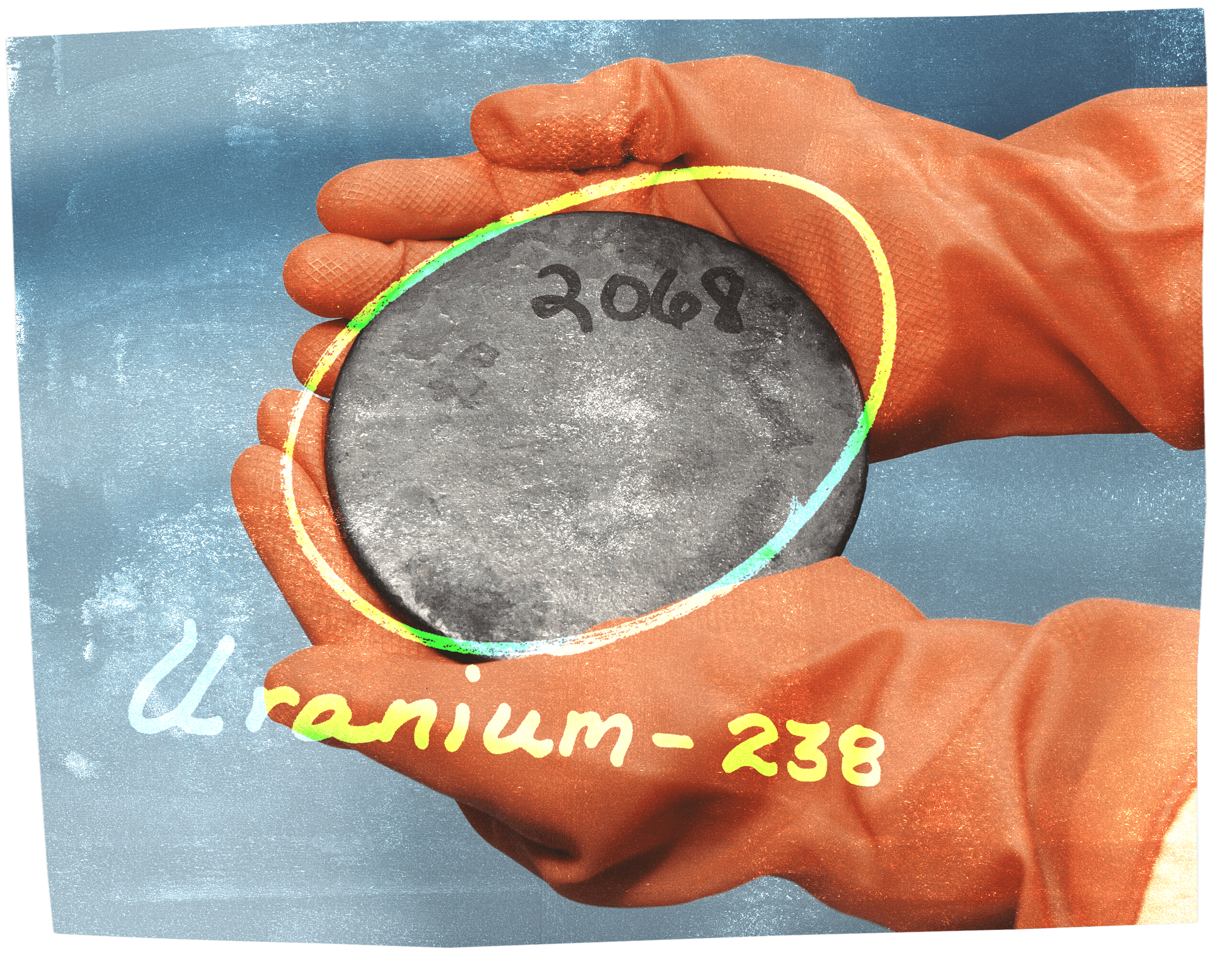
Nuclear fuel is made from low-enriched uranium (LEU) that is formed into gummy-bear-sized ceramic pellets of uranium oxide — the form of uranium we use for reactor fuel. The pellets are packed into hollow fuel rods that reach as long as fifteen feet, which are bound together into a larger fuel assembly, a fuel assembly being a bundle of fuel rods. As per the Government Accountability Office in 2021, “When operating, a typical reactor holds about 100 metric tons of fuel that are generally stored in roughly 200 to 800 fuel assemblies.”
Once stored in a fuel assembly, the uranium in them undergoes fission, whereby atoms split and collide, triggering a sustainable chain reaction within the fuel pellets, which is thus contained inside the fuel rods. This reaction has two effects: it creates nuclear isotopes and other radioactive materials (more on that later) and it generates heat. With that heat, the reactor boils water, which produces steam that spins a turbine to generate electricity.
Once the assemblies are “spent,” i.e., used up, they are moved into pools while they cool off — a process that takes about five years. After that, the fuel assemblies, while continuing to cool in the pool, are loaded into steel canisters. Once removed from the pool, the steel canisters are drained of water, welded shut, and dried off. From there, they are loaded into a steel and concrete cask about 20 feet tall, which sits on a concrete slab outdoors so it can be monitored by safety and security systems. It is physically impossible for the waste to “leak” out of these casks. The fuel assemblies and the uranium pellets inside remain solid, and solids cannot leak through other solids — especially solid steel. Think of nuclear waste as big metal straws, filled with uranium pellets, dropped into the center of giant steel and concrete empty water bottles.
So, how much nuclear waste is there? According to the Government Accountability Office, America has about 90,000 metric tons of spent fuel that are stored “on-site at 75 operating or shutdown nuclear power plants in 33 states.” This inventory grows by roughly 2,000 metric tons each year. To put this in perspective: If you gathered every cask containing America’s civilian nuclear waste and arranged them side by side, they would fit on a single football field.
Nuclear is the only power source that takes full responsibility for its waste. Wind turbine blades and solar panels end up in landfills. Fossil fuel plants “store” their waste in the atmosphere. Nuclear accounts for every ounce, stores it securely, and monitors it indefinitely. That’s why the waste is, in many ways, the best part about nuclear power.
But there’s one major problem with nuclear waste: we waste it. What we call “spent fuel” is actually 95 percent reusable. The fission process leaves behind isotopes and other radioactive materials which can be harvested to produce resources like medical isotopes and more nuclear fuel. It’s more accurate to think of nuclear waste as “lightly used fuel” rather than “waste” or “spent fuel.”
If we reprocessed our civilian waste, we would reduce its volume by 90 percent while extracting energy equivalent to five times greater than Saudi Arabia’s oil reserves. We would also save a massive amount of money. The Department of Energy (DOE) estimates that the cost for federal liability for storing nuclear waste will amount to around $40 billion. Beat here about how reprocessing would turn that waste into an asset. To take advantage of our waste’s left over material, we could reprocess it, which involves taking the spent fuel as described above and chemically treating or heating it to separate out useful material. That material could then be repackaged into pellets, fuel rods, and assemblies and loaded into reactors — or it could be harvested for materials to make batteries for lunar rovers or cancer curing isotopes, like Actinium 225.
But the US doesn’t currently have a waste reprocessing policy or a waste reprocessing industry. Why?
The Painful History of Nuclear Waste
What began as a technical engineering problem — how to safely dispose of nuclear waste — devolved into a political morass that would haunt the nuclear industry for decades. During the Manhattan Project, scientists developed ad hoc methods for handling radioactive waste — much of it liquid — at the Hanford site in Washington State. But when the Atomic Energy Commission (AEC) inherited these operations in 1946, internal reports flagged inadequate waste management practices.
The acceleration of the Cold War put greater urgency on handling the waste problem.
President Eisenhower, in an attempt to find a silver lining in the mushroom cloud, began pushing for civilian nuclear technology that could deliver abundant, clean power. The result of his vision, the Atomic Energy Act of 1954, laid the groundwork for America’s commercial nuclear fleet. Three years later, the first civilian nuclear reactor came online at Shippingport, Pennsylvania. Within a few years, utilities were rushing to build nuclear plants to meet electricity demand that was increasing 5-10% annually — a pace that would double consumption every decade. This boom would generate unprecedented volumes of commercial nuclear waste, and the AEC had no plan for managing it.
So, in 1956, the AEC made the reprocessing technology pioneered by national labs available to private industry, provided facilities and workforce development, and called for proposals for commercial reprocessing facilities. But reprocessing never achieved commercial viability due to technical challenges, uncertain worker safety, and a lack of waste to use as a feedstock for their activities.
As the reprocessing industry struggled to get off the ground, the AEC cast about for both waste storage methods and a waste repository, and struck a solution. Their initial experiments with salt storage were, as one Oak Ridge scientist said, “outstandingly successful,” as the salt could handle massive amounts of heat and radiation without melting. Early experiments at the mine in Lyons met with results that researchers found “most encouraging.” The AEC began to consider Lyons as a potential national repository site.
At first, the Lyons community was open to Project Salt Vault. But the Kansas Geological Survey (KGS) was not convinced that the AEC had done its homework. In 1971, Otto Rueschhoff, a local oil driller and salt miner, got wind of the AEC’s plans and raised an alarm: the mine they were looking at, Rueschhoff explained to KGS, was riddled with pockets liable to leak waste into the water table. When Kansas Governor Joe Skubitz found out that “the Lyons site is a bit like a piece of Swiss cheese, and the possibility for the entrance of fluids is great,” he announced that the “Lyons site is dead as a dodo for waste burial.” The AEC quietly abandoned the Lyons project, but the damage was done.
Challenges to the AEC’s authority continued to dog the commission as it pursued reprocessing and waste storage. By the 1960s, public fears of low-level atmospheric radiation exposure from atmospheric weapons testing ballooned, just as commercial nuclear power was expanding rapidly. Americans found themselves living closer to reactors, downwind from test sites, and increasingly aware of radiation in their food and water. This new proximity transformed abstract nuclear anxiety into concrete dread, and nuclear waste grew in totemic stature as an embodiment of these concerns.
These public anxieties entwined with a broader shift in American society, both cultural and institutional. The cultural aspect was marked by the emergence of the modern environmental movement, which repatterned American assumptions about big government, big business, and consumer society. A generation who came of age with Rachel Carson’s Silent Spring (1962) and witnessed oil spills, smog, and polluted rivers rejected the postwar consensus that economic growth should be pursued at all costs. The AEC found itself in the crosshairs of a movement that equated economic growth with civilizational suicide. This movement also produced a wave of environmental legislation — the birth of the Environmental Protection Agency, the Clean Air and Water Acts, and the National Environmental Policy Act — empowering citizens to challenge government and industry through litigation.
This new body of law provoked institutional change. While the AEC had accustomed itself to broad leeway, it now found itself subject to outside actors hostile to all of its activities. Indeed, both the West Valley reprocessing plant and the Lyons storage project encountered substantial environmental impact statements and other permitting challenges that the AEC had never encountered before. Eventually, the political challenges to nuclear became near-insurmountable. Though civilian reactors had roared onto the scene to meet grid demand over the 1950s and 1960s, the bumper crop of designs meant that reactors themselves struggled to come down the cost curve as well. This resulted in expensive delays, betraying nuclear’s promise of power “too cheap to meter.” Then the economic and energy crises of the 1970s flatlined power demand growth, robbing utilities of the business case for new reactors. Dozens of nuclear plants were canceled, leaving some customers footing the bill for power that never came online.
The travails of nuclear power impacted the viability of a sensible waste management program, especially as public hostility towards nuclear increased. Consumer rights advocates, non-proliferation hawks, and environmental crusaders all succeeded in painting nuclear as a villainous technology. Any radiation was seen as poisonous and hazardous to human health.
These trying times pushed the AEC to adopt cask storage — our current approach to waste management — as a stopgap until it could straighten out reprocessing. But the AEC wouldn’t live long enough to solve the waste issue. In 1974, the AEC was dissolved and replaced with the Nuclear Regulatory Commission, which was shorn of the AEC’s mission to promote nuclear power. Then, in 1977, nuclear’s main defender in Congress, the Joint Committee on Atomic Energy, was dissolved. The curtain fell on reprocessing that same year. President Jimmy Carter indefinitely suspended commercial reprocessing in the United States. By the close of the decade, the few reprocessing sites that had made a go of it all shuttered their doors.
But if not reprocessing, then what? The nuclear power industry had spent decades expecting reprocessing to handle their waste, and now that hope was over. The search began for a national repository for the large casks that had been sitting around at nuclear power plants. The Nuclear Waste Policy Act of 1982 revived geological storage as the official solution, prompting the DOE to issue guidelines for two permanent repositories. But the Act had no answer for the hardest question: where would the nuclear waste go?
The answer came five years later. The Nuclear Waste Policy Amendments Act of 1987 designated Yucca Mountain, Nevada, as the sole site for the nation’s permanent waste repository. Originally, the plan for waste management involved burden sharing, with a sister waste repository to be located on the East Coast. Instead, the project fell on Nevada, in part because officials became convinced that there was no need for another site.
Resistance to the Yucca Mountain site was immediate. Local tribes, environmental groups, and Nevada Senator Harry Reid opposed the project, calling the 1987 amendments the “Screw Nevada Bill.” Tribes cited concerns about the use of sacred lands, while environmentalists opposed the project on principle. Reid’s motivations were more political: why should Nevada shoulder this burden alone? It seemed quite convenient for eastern congressmen to foist Yucca on his constituents alone. Reid wielded incredible power in the Democratic Party and in Congress, enough to sandbag Yucca for decades.
The environmental and permitting challenges also plagued the project, making it harder and harder to license Yucca for use. DOE drilling and tunnel-making also revealed that, like at Lyons, Yucca’s geology was more complex than expected. In 2010, with $15 billion down the tubes and nothing to show for it, the Obama administration defunded Yucca. Today, civilian nuclear waste sits in dry casks at over 70 sites nation-wide. Utilities collect money from the government in damages since Washington never delivered on a national waste repository. The downfall of Yucca, coupled with the post-Cold War glut of cheap uranium fuel from Russia, sent all hopes of reprocessing nuclear fuel into hibernation.
We live in the boring present where lightly used nuclear fuel sits in big concrete casks scattered across the country bothering no one. It’s not a crisis, but it is a huge missed opportunity.
Why Now Is the Time
Nuclear enjoys more bipartisan support than it has seen since the late 1940s. Recent polling shows that “Support for nuclear energy outweighs opposition by 1.5 times,” and the partisan support gap for nuclear power is smaller than that of wind and solar. If ever there was a time to resolve the waste issue, it’s now.
We can make reprocessing a reality today. A burgeoning industry already exists, including companies like Oklo, Exodys, SHINE, and Curio. These aren’t brand new start-ups; some of these firms are over 15 years old. Some plan to use pyroprocessing, a technique developed by Argonne National Lab in Illinois that heats spent fuel to high temperatures to harvest useful materials like fresh fuel and medical isotopes. Pyroprocessing is expected to be cheaper and more efficient than waste recycling methods used in France or Japan. With a reprocessing industry in full swing, America could power a new wave of reactor technology, spur advancements in medical isotopes, and develop new battery technologies — just to name a few.
To put this future within reach, the government needs to behave like a market catalyst, clarifying regulatory routes to make the path toward commercial reprocessing reliable, explicit, and safe. Congress has begun adjusting the regulatory framework for reprocessing with the bipartisan Nuclear REFUEL Act. And President Trump has signalled his support for reprocessing in one of the four executive orders he signed on nuclear power. His Reinvigorating the Nuclear Industrial Base order calls for building supply chains that “maximize the efficiency and effectiveness of nuclear fuel through recycling, reprocessing, and reinvigorating the commercial sector.” This is one of the strongest signals a president has sent in favor of reprocessing since Ronald Reagan.
More can be done. President Trump must also modify National Security Memo 19, issued by the Biden administration in 2023. NSM-19 merely restated the pause on commercial reprocessing that has been in place since the Carter administration, though it did create programs under ARPA-e, the self-styled “disruption wing of the DOE,” to investigate cheaper methods of reprocessing. Trump could amend the memo to finally greenlight commercial reprocessing — but the details matter. The amendment should focus on uranium and transuranic separations that can be licensed under Part 70, the NRC’s nuclear materials licensing framework. This would dovetail with the bipartisan REFUEL Act and open the door to a closed fuel cycle in the United States.
Moreover the national labs could start qualifying fuels for recycled materials. Qualification is the process by which we subject various nuclear fuels to a variety of tests — putting them through wild heat swings, stress testing their cladding, etc. These tests then establish the regulatory standards for what qualifies as commercial grade fuel that can be loaded and unloaded from reactors. This is a laborious process because it needs to be. The DOE also provides a path toward fuel qualification through fueling test reactors, a process that could synergize reprocess and new reactor technology. Whichever way, the sooner we get started on qualifying reprocessed material for commercial reactor fuel, the easier it will be for reprocessing companies to create products that reactor operators can buy.
Similarly, establishing clear regulatory guidance for workforce training standards, licensing fees for reprocessing, and decommissioning requirements would map out the full life cycle of reprocessing. Companies could then cultivate a competent workforce with uniform skills. Secondly, they could smoothly begin operations with explicit, consistent, annual licenses in place. Lastly, they would also know how to break down and remediate their work sites should they ever close their doors. While all fuel qualification and other guidance may appear “in the weeds,” it’s nailing down these kinds of issues before they become problems that can make or break a nascent industry.
But that still leaves the hardest part: finding a place to put the waste. Even after reprocessing, some waste will need to find a permanent home. The Trump administration has signaled that it wants to cut deals with states to host waste. According to recent reporting, the DOE “will invite interest from states on deals for nuclear power that would also offer incentives for nuclear waste reprocessing and uranium enrichment.” Several states have already expressed interest. Additionally, the DOE is soliciting interest for Nuclear Lifecycle Innovation Campuses. Imagine nuclear innovation hubs that power data centers and advanced manufacturing while supporting nuclear from cradle to grave — from enrichment, to reactor construction, to waste reprocessing.
All wealthy societies use incredible amounts of energy. This tight coupling suggests that wealth and stability track closely with how well a society harnesses thermodynamics. To reprocess our lightly used nuclear fuel innovation in energy, medicine, and exploration would mean climbing up the energy ladder. It would mean true, lasting energy dominance.
Technology
•
Recycling Uranium: A Practical Guide
The Case for Nuclear Waste Reprocessing
Mr. Burns Lied to You
Like many Americans of my generation (I’m a Millennial, mea culpa), I grew up watching The Simpsons. Nuclear power, per the show, was lorded over by Mr. Burns, a business tycoon-cum-Nosferatu figure so old his social security number was a single digit. The waste that oozed from Mr. Burns’s plant eddied in Springfield’s waterways like a green, day-glo goo, spawning the town’s mutant three-eyed fish. Mr. Burns is a caricature as evocative as it is divorced from reality.
In truth, high-level civilian nuclear waste — the kind that most people worry about giving them an extra ear or seven fingers — has never harmed anyone in the nuclear industry’s entire history. (And, civilian nuclear waste is not a liquid, it’s a solid.)
Nuclear energy is often demonized, but it’s the best shot we have at powering our upcoming technological revolution. As the grid groans under the dual strain of increasing power demand and diminishing 24/7/365 power generation, nuclear’s firm, clean, reliable power offers the most coherent medium and long-term solution. In fact, nuclear is the most reliable source of power on the grid by a wide margin, boasting an average capacity factor of 92.3%. Compare that to geothermal (65%), combined cycle natural gas (59.9%), coal (42.6%), hydro (34.5%), wind (34.4%), and solar (23.4%). Nuclear is also the most energy dense source of power we have available; nuclear fuel is 2 million times more energy dense than any other chemical.
There’s only one problem: our fuel supply. Currently, we consume more uranium than we produce. At present, the US is reliant on imports for 90 percent of its uranium needs. Over the last few decades, we have ceded uranium production to other countries, primarily Canada, Australia, Russia, Kazakhstan, and Uzbekistan. And in May 2024, we banned uranium imports from Russia. The geopolitical supply risk has discouraged utilities from inking long term fuel contracts. As a result, the spot price of uranium has shot through the roof.
For Your Eyes Only.
Spies. Satellites. State secrets. Inside the technologies and intelligence contests shaping American power.
Subscribe + Issue 007
Before we dive into how to use our spent fuel, we need to understand what it is.
Nuclear fuel is made from low-enriched uranium (LEU) that is formed into gummy-bear-sized ceramic pellets of uranium oxide — the form of uranium we use for reactor fuel. The pellets are packed into hollow fuel rods that reach as long as fifteen feet, which are bound together into a larger fuel assembly, a fuel assembly being a bundle of fuel rods. As per the Government Accountability Office in 2021, “When operating, a typical reactor holds about 100 metric tons of fuel that are generally stored in roughly 200 to 800 fuel assemblies.”
Once stored in a fuel assembly, the uranium in them undergoes fission, whereby atoms split and collide, triggering a sustainable chain reaction within the fuel pellets, which is thus contained inside the fuel rods. This reaction has two effects: it creates nuclear isotopes and other radioactive materials (more on that later) and it generates heat. With that heat, the reactor boils water, which produces steam that spins a turbine to generate electricity.
Once the assemblies are “spent,” i.e., used up, they are moved into pools while they cool off — a process that takes about five years. After that, the fuel assemblies, while continuing to cool in the pool, are loaded into steel canisters. Once removed from the pool, the steel canisters are drained of water, welded shut, and dried off. From there, they are loaded into a steel and concrete cask about 20 feet tall, which sits on a concrete slab outdoors so it can be monitored by safety and security systems. It is physically impossible for the waste to “leak” out of these casks. The fuel assemblies and the uranium pellets inside remain solid, and solids cannot leak through other solids — especially solid steel. Think of nuclear waste as big metal straws, filled with uranium pellets, dropped into the center of giant steel and concrete empty water bottles.
So, how much nuclear waste is there? According to the Government Accountability Office, America has about 90,000 metric tons of spent fuel that are stored “on-site at 75 operating or shutdown nuclear power plants in 33 states.” This inventory grows by roughly 2,000 metric tons each year. To put this in perspective: If you gathered every cask containing America’s civilian nuclear waste and arranged them side by side, they would fit on a single football field.
Nuclear is the only power source that takes full responsibility for its waste. Wind turbine blades and solar panels end up in landfills. Fossil fuel plants “store” their waste in the atmosphere. Nuclear accounts for every ounce, stores it securely, and monitors it indefinitely. That’s why the waste is, in many ways, the best part about nuclear power.
But there’s one major problem with nuclear waste: we waste it. What we call “spent fuel” is actually 95 percent reusable. The fission process leaves behind isotopes and other radioactive materials which can be harvested to produce resources like medical isotopes and more nuclear fuel. It’s more accurate to think of nuclear waste as “lightly used fuel” rather than “waste” or “spent fuel.”
If we reprocessed our civilian waste, we would reduce its volume by 90 percent while extracting energy equivalent to five times greater than Saudi Arabia’s oil reserves. We would also save a massive amount of money. The Department of Energy (DOE) estimates that the cost for federal liability for storing nuclear waste will amount to around $40 billion. Beat here about how reprocessing would turn that waste into an asset. To take advantage of our waste’s left over material, we could reprocess it, which involves taking the spent fuel as described above and chemically treating or heating it to separate out useful material. That material could then be repackaged into pellets, fuel rods, and assemblies and loaded into reactors — or it could be harvested for materials to make batteries for lunar rovers or cancer curing isotopes, like Actinium 225.
But the US doesn’t currently have a waste reprocessing policy or a waste reprocessing industry. Why?
The Painful History of Nuclear Waste
What began as a technical engineering problem — how to safely dispose of nuclear waste — devolved into a political morass that would haunt the nuclear industry for decades. During the Manhattan Project, scientists developed ad hoc methods for handling radioactive waste — much of it liquid — at the Hanford site in Washington State. But when the Atomic Energy Commission (AEC) inherited these operations in 1946, internal reports flagged inadequate waste management practices.
The acceleration of the Cold War put greater urgency on handling the waste problem.
President Eisenhower, in an attempt to find a silver lining in the mushroom cloud, began pushing for civilian nuclear technology that could deliver abundant, clean power. The result of his vision, the Atomic Energy Act of 1954, laid the groundwork for America’s commercial nuclear fleet. Three years later, the first civilian nuclear reactor came online at Shippingport, Pennsylvania. Within a few years, utilities were rushing to build nuclear plants to meet electricity demand that was increasing 5-10% annually — a pace that would double consumption every decade. This boom would generate unprecedented volumes of commercial nuclear waste, and the AEC had no plan for managing it.
So, in 1956, the AEC made the reprocessing technology pioneered by national labs available to private industry, provided facilities and workforce development, and called for proposals for commercial reprocessing facilities. But reprocessing never achieved commercial viability due to technical challenges, uncertain worker safety, and a lack of waste to use as a feedstock for their activities.
As the reprocessing industry struggled to get off the ground, the AEC cast about for both waste storage methods and a waste repository, and struck a solution. Their initial experiments with salt storage were, as one Oak Ridge scientist said, “outstandingly successful,” as the salt could handle massive amounts of heat and radiation without melting. Early experiments at the mine in Lyons met with results that researchers found “most encouraging.” The AEC began to consider Lyons as a potential national repository site.
At first, the Lyons community was open to Project Salt Vault. But the Kansas Geological Survey (KGS) was not convinced that the AEC had done its homework. In 1971, Otto Rueschhoff, a local oil driller and salt miner, got wind of the AEC’s plans and raised an alarm: the mine they were looking at, Rueschhoff explained to KGS, was riddled with pockets liable to leak waste into the water table. When Kansas Governor Joe Skubitz found out that “the Lyons site is a bit like a piece of Swiss cheese, and the possibility for the entrance of fluids is great,” he announced that the “Lyons site is dead as a dodo for waste burial.” The AEC quietly abandoned the Lyons project, but the damage was done.
Challenges to the AEC’s authority continued to dog the commission as it pursued reprocessing and waste storage. By the 1960s, public fears of low-level atmospheric radiation exposure from atmospheric weapons testing ballooned, just as commercial nuclear power was expanding rapidly. Americans found themselves living closer to reactors, downwind from test sites, and increasingly aware of radiation in their food and water. This new proximity transformed abstract nuclear anxiety into concrete dread, and nuclear waste grew in totemic stature as an embodiment of these concerns.
These public anxieties entwined with a broader shift in American society, both cultural and institutional. The cultural aspect was marked by the emergence of the modern environmental movement, which repatterned American assumptions about big government, big business, and consumer society. A generation who came of age with Rachel Carson’s Silent Spring (1962) and witnessed oil spills, smog, and polluted rivers rejected the postwar consensus that economic growth should be pursued at all costs. The AEC found itself in the crosshairs of a movement that equated economic growth with civilizational suicide. This movement also produced a wave of environmental legislation — the birth of the Environmental Protection Agency, the Clean Air and Water Acts, and the National Environmental Policy Act — empowering citizens to challenge government and industry through litigation.
This new body of law provoked institutional change. While the AEC had accustomed itself to broad leeway, it now found itself subject to outside actors hostile to all of its activities. Indeed, both the West Valley reprocessing plant and the Lyons storage project encountered substantial environmental impact statements and other permitting challenges that the AEC had never encountered before. Eventually, the political challenges to nuclear became near-insurmountable. Though civilian reactors had roared onto the scene to meet grid demand over the 1950s and 1960s, the bumper crop of designs meant that reactors themselves struggled to come down the cost curve as well. This resulted in expensive delays, betraying nuclear’s promise of power “too cheap to meter.” Then the economic and energy crises of the 1970s flatlined power demand growth, robbing utilities of the business case for new reactors. Dozens of nuclear plants were canceled, leaving some customers footing the bill for power that never came online.
The travails of nuclear power impacted the viability of a sensible waste management program, especially as public hostility towards nuclear increased. Consumer rights advocates, non-proliferation hawks, and environmental crusaders all succeeded in painting nuclear as a villainous technology. Any radiation was seen as poisonous and hazardous to human health.
These trying times pushed the AEC to adopt cask storage — our current approach to waste management — as a stopgap until it could straighten out reprocessing. But the AEC wouldn’t live long enough to solve the waste issue. In 1974, the AEC was dissolved and replaced with the Nuclear Regulatory Commission, which was shorn of the AEC’s mission to promote nuclear power. Then, in 1977, nuclear’s main defender in Congress, the Joint Committee on Atomic Energy, was dissolved. The curtain fell on reprocessing that same year. President Jimmy Carter indefinitely suspended commercial reprocessing in the United States. By the close of the decade, the few reprocessing sites that had made a go of it all shuttered their doors.
But if not reprocessing, then what? The nuclear power industry had spent decades expecting reprocessing to handle their waste, and now that hope was over. The search began for a national repository for the large casks that had been sitting around at nuclear power plants. The Nuclear Waste Policy Act of 1982 revived geological storage as the official solution, prompting the DOE to issue guidelines for two permanent repositories. But the Act had no answer for the hardest question: where would the nuclear waste go?
The answer came five years later. The Nuclear Waste Policy Amendments Act of 1987 designated Yucca Mountain, Nevada, as the sole site for the nation’s permanent waste repository. Originally, the plan for waste management involved burden sharing, with a sister waste repository to be located on the East Coast. Instead, the project fell on Nevada, in part because officials became convinced that there was no need for another site.
Resistance to the Yucca Mountain site was immediate. Local tribes, environmental groups, and Nevada Senator Harry Reid opposed the project, calling the 1987 amendments the “Screw Nevada Bill.” Tribes cited concerns about the use of sacred lands, while environmentalists opposed the project on principle. Reid’s motivations were more political: why should Nevada shoulder this burden alone? It seemed quite convenient for eastern congressmen to foist Yucca on his constituents alone. Reid wielded incredible power in the Democratic Party and in Congress, enough to sandbag Yucca for decades.
The environmental and permitting challenges also plagued the project, making it harder and harder to license Yucca for use. DOE drilling and tunnel-making also revealed that, like at Lyons, Yucca’s geology was more complex than expected. In 2010, with $15 billion down the tubes and nothing to show for it, the Obama administration defunded Yucca. Today, civilian nuclear waste sits in dry casks at over 70 sites nation-wide. Utilities collect money from the government in damages since Washington never delivered on a national waste repository. The downfall of Yucca, coupled with the post-Cold War glut of cheap uranium fuel from Russia, sent all hopes of reprocessing nuclear fuel into hibernation.
We live in the boring present where lightly used nuclear fuel sits in big concrete casks scattered across the country bothering no one. It’s not a crisis, but it is a huge missed opportunity.
Why Now Is the Time
Nuclear enjoys more bipartisan support than it has seen since the late 1940s. Recent polling shows that “Support for nuclear energy outweighs opposition by 1.5 times,” and the partisan support gap for nuclear power is smaller than that of wind and solar. If ever there was a time to resolve the waste issue, it’s now.
We can make reprocessing a reality today. A burgeoning industry already exists, including companies like Oklo, Exodys, SHINE, and Curio. These aren’t brand new start-ups; some of these firms are over 15 years old. Some plan to use pyroprocessing, a technique developed by Argonne National Lab in Illinois that heats spent fuel to high temperatures to harvest useful materials like fresh fuel and medical isotopes. Pyroprocessing is expected to be cheaper and more efficient than waste recycling methods used in France or Japan. With a reprocessing industry in full swing, America could power a new wave of reactor technology, spur advancements in medical isotopes, and develop new battery technologies — just to name a few.
To put this future within reach, the government needs to behave like a market catalyst, clarifying regulatory routes to make the path toward commercial reprocessing reliable, explicit, and safe. Congress has begun adjusting the regulatory framework for reprocessing with the bipartisan Nuclear REFUEL Act. And President Trump has signalled his support for reprocessing in one of the four executive orders he signed on nuclear power. His Reinvigorating the Nuclear Industrial Base order calls for building supply chains that “maximize the efficiency and effectiveness of nuclear fuel through recycling, reprocessing, and reinvigorating the commercial sector.” This is one of the strongest signals a president has sent in favor of reprocessing since Ronald Reagan.
More can be done. President Trump must also modify National Security Memo 19, issued by the Biden administration in 2023. NSM-19 merely restated the pause on commercial reprocessing that has been in place since the Carter administration, though it did create programs under ARPA-e, the self-styled “disruption wing of the DOE,” to investigate cheaper methods of reprocessing. Trump could amend the memo to finally greenlight commercial reprocessing — but the details matter. The amendment should focus on uranium and transuranic separations that can be licensed under Part 70, the NRC’s nuclear materials licensing framework. This would dovetail with the bipartisan REFUEL Act and open the door to a closed fuel cycle in the United States.
Moreover the national labs could start qualifying fuels for recycled materials. Qualification is the process by which we subject various nuclear fuels to a variety of tests — putting them through wild heat swings, stress testing their cladding, etc. These tests then establish the regulatory standards for what qualifies as commercial grade fuel that can be loaded and unloaded from reactors. This is a laborious process because it needs to be. The DOE also provides a path toward fuel qualification through fueling test reactors, a process that could synergize reprocess and new reactor technology. Whichever way, the sooner we get started on qualifying reprocessed material for commercial reactor fuel, the easier it will be for reprocessing companies to create products that reactor operators can buy.
Similarly, establishing clear regulatory guidance for workforce training standards, licensing fees for reprocessing, and decommissioning requirements would map out the full life cycle of reprocessing. Companies could then cultivate a competent workforce with uniform skills. Secondly, they could smoothly begin operations with explicit, consistent, annual licenses in place. Lastly, they would also know how to break down and remediate their work sites should they ever close their doors. While all fuel qualification and other guidance may appear “in the weeds,” it’s nailing down these kinds of issues before they become problems that can make or break a nascent industry.
But that still leaves the hardest part: finding a place to put the waste. Even after reprocessing, some waste will need to find a permanent home. The Trump administration has signaled that it wants to cut deals with states to host waste. According to recent reporting, the DOE “will invite interest from states on deals for nuclear power that would also offer incentives for nuclear waste reprocessing and uranium enrichment.” Several states have already expressed interest. Additionally, the DOE is soliciting interest for Nuclear Lifecycle Innovation Campuses. Imagine nuclear innovation hubs that power data centers and advanced manufacturing while supporting nuclear from cradle to grave — from enrichment, to reactor construction, to waste reprocessing.
All wealthy societies use incredible amounts of energy. This tight coupling suggests that wealth and stability track closely with how well a society harnesses thermodynamics. To reprocess our lightly used nuclear fuel innovation in energy, medicine, and exploration would mean climbing up the energy ladder. It would mean true, lasting energy dominance.
Technology
•
Recycling Uranium: A Practical Guide
The Case for Nuclear Waste Reprocessing
Mr. Burns Lied to You
Like many Americans of my generation (I’m a Millennial, mea culpa), I grew up watching The Simpsons. Nuclear power, per the show, was lorded over by Mr. Burns, a business tycoon-cum-Nosferatu figure so old his social security number was a single digit. The waste that oozed from Mr. Burns’s plant eddied in Springfield’s waterways like a green, day-glo goo, spawning the town’s mutant three-eyed fish. Mr. Burns is a caricature as evocative as it is divorced from reality.
In truth, high-level civilian nuclear waste — the kind that most people worry about giving them an extra ear or seven fingers — has never harmed anyone in the nuclear industry’s entire history. (And, civilian nuclear waste is not a liquid, it’s a solid.)
Nuclear energy is often demonized, but it’s the best shot we have at powering our upcoming technological revolution. As the grid groans under the dual strain of increasing power demand and diminishing 24/7/365 power generation, nuclear’s firm, clean, reliable power offers the most coherent medium and long-term solution. In fact, nuclear is the most reliable source of power on the grid by a wide margin, boasting an average capacity factor of 92.3%. Compare that to geothermal (65%), combined cycle natural gas (59.9%), coal (42.6%), hydro (34.5%), wind (34.4%), and solar (23.4%). Nuclear is also the most energy dense source of power we have available; nuclear fuel is 2 million times more energy dense than any other chemical.
There’s only one problem: our fuel supply. Currently, we consume more uranium than we produce. At present, the US is reliant on imports for 90 percent of its uranium needs. Over the last few decades, we have ceded uranium production to other countries, primarily Canada, Australia, Russia, Kazakhstan, and Uzbekistan. And in May 2024, we banned uranium imports from Russia. The geopolitical supply risk has discouraged utilities from inking long term fuel contracts. As a result, the spot price of uranium has shot through the roof.
For Your Eyes Only.
Spies. Satellites. State secrets. Inside the technologies and intelligence contests shaping American power.
Subscribe + Issue 007
Before we dive into how to use our spent fuel, we need to understand what it is.
Nuclear fuel is made from low-enriched uranium (LEU) that is formed into gummy-bear-sized ceramic pellets of uranium oxide — the form of uranium we use for reactor fuel. The pellets are packed into hollow fuel rods that reach as long as fifteen feet, which are bound together into a larger fuel assembly, a fuel assembly being a bundle of fuel rods. As per the Government Accountability Office in 2021, “When operating, a typical reactor holds about 100 metric tons of fuel that are generally stored in roughly 200 to 800 fuel assemblies.”
Once stored in a fuel assembly, the uranium in them undergoes fission, whereby atoms split and collide, triggering a sustainable chain reaction within the fuel pellets, which is thus contained inside the fuel rods. This reaction has two effects: it creates nuclear isotopes and other radioactive materials (more on that later) and it generates heat. With that heat, the reactor boils water, which produces steam that spins a turbine to generate electricity.
Once the assemblies are “spent,” i.e., used up, they are moved into pools while they cool off — a process that takes about five years. After that, the fuel assemblies, while continuing to cool in the pool, are loaded into steel canisters. Once removed from the pool, the steel canisters are drained of water, welded shut, and dried off. From there, they are loaded into a steel and concrete cask about 20 feet tall, which sits on a concrete slab outdoors so it can be monitored by safety and security systems. It is physically impossible for the waste to “leak” out of these casks. The fuel assemblies and the uranium pellets inside remain solid, and solids cannot leak through other solids — especially solid steel. Think of nuclear waste as big metal straws, filled with uranium pellets, dropped into the center of giant steel and concrete empty water bottles.
So, how much nuclear waste is there? According to the Government Accountability Office, America has about 90,000 metric tons of spent fuel that are stored “on-site at 75 operating or shutdown nuclear power plants in 33 states.” This inventory grows by roughly 2,000 metric tons each year. To put this in perspective: If you gathered every cask containing America’s civilian nuclear waste and arranged them side by side, they would fit on a single football field.
Nuclear is the only power source that takes full responsibility for its waste. Wind turbine blades and solar panels end up in landfills. Fossil fuel plants “store” their waste in the atmosphere. Nuclear accounts for every ounce, stores it securely, and monitors it indefinitely. That’s why the waste is, in many ways, the best part about nuclear power.
But there’s one major problem with nuclear waste: we waste it. What we call “spent fuel” is actually 95 percent reusable. The fission process leaves behind isotopes and other radioactive materials which can be harvested to produce resources like medical isotopes and more nuclear fuel. It’s more accurate to think of nuclear waste as “lightly used fuel” rather than “waste” or “spent fuel.”
If we reprocessed our civilian waste, we would reduce its volume by 90 percent while extracting energy equivalent to five times greater than Saudi Arabia’s oil reserves. We would also save a massive amount of money. The Department of Energy (DOE) estimates that the cost for federal liability for storing nuclear waste will amount to around $40 billion. Beat here about how reprocessing would turn that waste into an asset. To take advantage of our waste’s left over material, we could reprocess it, which involves taking the spent fuel as described above and chemically treating or heating it to separate out useful material. That material could then be repackaged into pellets, fuel rods, and assemblies and loaded into reactors — or it could be harvested for materials to make batteries for lunar rovers or cancer curing isotopes, like Actinium 225.
But the US doesn’t currently have a waste reprocessing policy or a waste reprocessing industry. Why?
The Painful History of Nuclear Waste
What began as a technical engineering problem — how to safely dispose of nuclear waste — devolved into a political morass that would haunt the nuclear industry for decades. During the Manhattan Project, scientists developed ad hoc methods for handling radioactive waste — much of it liquid — at the Hanford site in Washington State. But when the Atomic Energy Commission (AEC) inherited these operations in 1946, internal reports flagged inadequate waste management practices.
The acceleration of the Cold War put greater urgency on handling the waste problem.
President Eisenhower, in an attempt to find a silver lining in the mushroom cloud, began pushing for civilian nuclear technology that could deliver abundant, clean power. The result of his vision, the Atomic Energy Act of 1954, laid the groundwork for America’s commercial nuclear fleet. Three years later, the first civilian nuclear reactor came online at Shippingport, Pennsylvania. Within a few years, utilities were rushing to build nuclear plants to meet electricity demand that was increasing 5-10% annually — a pace that would double consumption every decade. This boom would generate unprecedented volumes of commercial nuclear waste, and the AEC had no plan for managing it.
So, in 1956, the AEC made the reprocessing technology pioneered by national labs available to private industry, provided facilities and workforce development, and called for proposals for commercial reprocessing facilities. But reprocessing never achieved commercial viability due to technical challenges, uncertain worker safety, and a lack of waste to use as a feedstock for their activities.
As the reprocessing industry struggled to get off the ground, the AEC cast about for both waste storage methods and a waste repository, and struck a solution. Their initial experiments with salt storage were, as one Oak Ridge scientist said, “outstandingly successful,” as the salt could handle massive amounts of heat and radiation without melting. Early experiments at the mine in Lyons met with results that researchers found “most encouraging.” The AEC began to consider Lyons as a potential national repository site.
At first, the Lyons community was open to Project Salt Vault. But the Kansas Geological Survey (KGS) was not convinced that the AEC had done its homework. In 1971, Otto Rueschhoff, a local oil driller and salt miner, got wind of the AEC’s plans and raised an alarm: the mine they were looking at, Rueschhoff explained to KGS, was riddled with pockets liable to leak waste into the water table. When Kansas Governor Joe Skubitz found out that “the Lyons site is a bit like a piece of Swiss cheese, and the possibility for the entrance of fluids is great,” he announced that the “Lyons site is dead as a dodo for waste burial.” The AEC quietly abandoned the Lyons project, but the damage was done.
Challenges to the AEC’s authority continued to dog the commission as it pursued reprocessing and waste storage. By the 1960s, public fears of low-level atmospheric radiation exposure from atmospheric weapons testing ballooned, just as commercial nuclear power was expanding rapidly. Americans found themselves living closer to reactors, downwind from test sites, and increasingly aware of radiation in their food and water. This new proximity transformed abstract nuclear anxiety into concrete dread, and nuclear waste grew in totemic stature as an embodiment of these concerns.
These public anxieties entwined with a broader shift in American society, both cultural and institutional. The cultural aspect was marked by the emergence of the modern environmental movement, which repatterned American assumptions about big government, big business, and consumer society. A generation who came of age with Rachel Carson’s Silent Spring (1962) and witnessed oil spills, smog, and polluted rivers rejected the postwar consensus that economic growth should be pursued at all costs. The AEC found itself in the crosshairs of a movement that equated economic growth with civilizational suicide. This movement also produced a wave of environmental legislation — the birth of the Environmental Protection Agency, the Clean Air and Water Acts, and the National Environmental Policy Act — empowering citizens to challenge government and industry through litigation.
This new body of law provoked institutional change. While the AEC had accustomed itself to broad leeway, it now found itself subject to outside actors hostile to all of its activities. Indeed, both the West Valley reprocessing plant and the Lyons storage project encountered substantial environmental impact statements and other permitting challenges that the AEC had never encountered before. Eventually, the political challenges to nuclear became near-insurmountable. Though civilian reactors had roared onto the scene to meet grid demand over the 1950s and 1960s, the bumper crop of designs meant that reactors themselves struggled to come down the cost curve as well. This resulted in expensive delays, betraying nuclear’s promise of power “too cheap to meter.” Then the economic and energy crises of the 1970s flatlined power demand growth, robbing utilities of the business case for new reactors. Dozens of nuclear plants were canceled, leaving some customers footing the bill for power that never came online.
The travails of nuclear power impacted the viability of a sensible waste management program, especially as public hostility towards nuclear increased. Consumer rights advocates, non-proliferation hawks, and environmental crusaders all succeeded in painting nuclear as a villainous technology. Any radiation was seen as poisonous and hazardous to human health.
These trying times pushed the AEC to adopt cask storage — our current approach to waste management — as a stopgap until it could straighten out reprocessing. But the AEC wouldn’t live long enough to solve the waste issue. In 1974, the AEC was dissolved and replaced with the Nuclear Regulatory Commission, which was shorn of the AEC’s mission to promote nuclear power. Then, in 1977, nuclear’s main defender in Congress, the Joint Committee on Atomic Energy, was dissolved. The curtain fell on reprocessing that same year. President Jimmy Carter indefinitely suspended commercial reprocessing in the United States. By the close of the decade, the few reprocessing sites that had made a go of it all shuttered their doors.
But if not reprocessing, then what? The nuclear power industry had spent decades expecting reprocessing to handle their waste, and now that hope was over. The search began for a national repository for the large casks that had been sitting around at nuclear power plants. The Nuclear Waste Policy Act of 1982 revived geological storage as the official solution, prompting the DOE to issue guidelines for two permanent repositories. But the Act had no answer for the hardest question: where would the nuclear waste go?
The answer came five years later. The Nuclear Waste Policy Amendments Act of 1987 designated Yucca Mountain, Nevada, as the sole site for the nation’s permanent waste repository. Originally, the plan for waste management involved burden sharing, with a sister waste repository to be located on the East Coast. Instead, the project fell on Nevada, in part because officials became convinced that there was no need for another site.
Resistance to the Yucca Mountain site was immediate. Local tribes, environmental groups, and Nevada Senator Harry Reid opposed the project, calling the 1987 amendments the “Screw Nevada Bill.” Tribes cited concerns about the use of sacred lands, while environmentalists opposed the project on principle. Reid’s motivations were more political: why should Nevada shoulder this burden alone? It seemed quite convenient for eastern congressmen to foist Yucca on his constituents alone. Reid wielded incredible power in the Democratic Party and in Congress, enough to sandbag Yucca for decades.
The environmental and permitting challenges also plagued the project, making it harder and harder to license Yucca for use. DOE drilling and tunnel-making also revealed that, like at Lyons, Yucca’s geology was more complex than expected. In 2010, with $15 billion down the tubes and nothing to show for it, the Obama administration defunded Yucca. Today, civilian nuclear waste sits in dry casks at over 70 sites nation-wide. Utilities collect money from the government in damages since Washington never delivered on a national waste repository. The downfall of Yucca, coupled with the post-Cold War glut of cheap uranium fuel from Russia, sent all hopes of reprocessing nuclear fuel into hibernation.
We live in the boring present where lightly used nuclear fuel sits in big concrete casks scattered across the country bothering no one. It’s not a crisis, but it is a huge missed opportunity.
Why Now Is the Time
Nuclear enjoys more bipartisan support than it has seen since the late 1940s. Recent polling shows that “Support for nuclear energy outweighs opposition by 1.5 times,” and the partisan support gap for nuclear power is smaller than that of wind and solar. If ever there was a time to resolve the waste issue, it’s now.
We can make reprocessing a reality today. A burgeoning industry already exists, including companies like Oklo, Exodys, SHINE, and Curio. These aren’t brand new start-ups; some of these firms are over 15 years old. Some plan to use pyroprocessing, a technique developed by Argonne National Lab in Illinois that heats spent fuel to high temperatures to harvest useful materials like fresh fuel and medical isotopes. Pyroprocessing is expected to be cheaper and more efficient than waste recycling methods used in France or Japan. With a reprocessing industry in full swing, America could power a new wave of reactor technology, spur advancements in medical isotopes, and develop new battery technologies — just to name a few.
To put this future within reach, the government needs to behave like a market catalyst, clarifying regulatory routes to make the path toward commercial reprocessing reliable, explicit, and safe. Congress has begun adjusting the regulatory framework for reprocessing with the bipartisan Nuclear REFUEL Act. And President Trump has signalled his support for reprocessing in one of the four executive orders he signed on nuclear power. His Reinvigorating the Nuclear Industrial Base order calls for building supply chains that “maximize the efficiency and effectiveness of nuclear fuel through recycling, reprocessing, and reinvigorating the commercial sector.” This is one of the strongest signals a president has sent in favor of reprocessing since Ronald Reagan.
More can be done. President Trump must also modify National Security Memo 19, issued by the Biden administration in 2023. NSM-19 merely restated the pause on commercial reprocessing that has been in place since the Carter administration, though it did create programs under ARPA-e, the self-styled “disruption wing of the DOE,” to investigate cheaper methods of reprocessing. Trump could amend the memo to finally greenlight commercial reprocessing — but the details matter. The amendment should focus on uranium and transuranic separations that can be licensed under Part 70, the NRC’s nuclear materials licensing framework. This would dovetail with the bipartisan REFUEL Act and open the door to a closed fuel cycle in the United States.
Moreover the national labs could start qualifying fuels for recycled materials. Qualification is the process by which we subject various nuclear fuels to a variety of tests — putting them through wild heat swings, stress testing their cladding, etc. These tests then establish the regulatory standards for what qualifies as commercial grade fuel that can be loaded and unloaded from reactors. This is a laborious process because it needs to be. The DOE also provides a path toward fuel qualification through fueling test reactors, a process that could synergize reprocess and new reactor technology. Whichever way, the sooner we get started on qualifying reprocessed material for commercial reactor fuel, the easier it will be for reprocessing companies to create products that reactor operators can buy.
Similarly, establishing clear regulatory guidance for workforce training standards, licensing fees for reprocessing, and decommissioning requirements would map out the full life cycle of reprocessing. Companies could then cultivate a competent workforce with uniform skills. Secondly, they could smoothly begin operations with explicit, consistent, annual licenses in place. Lastly, they would also know how to break down and remediate their work sites should they ever close their doors. While all fuel qualification and other guidance may appear “in the weeds,” it’s nailing down these kinds of issues before they become problems that can make or break a nascent industry.
But that still leaves the hardest part: finding a place to put the waste. Even after reprocessing, some waste will need to find a permanent home. The Trump administration has signaled that it wants to cut deals with states to host waste. According to recent reporting, the DOE “will invite interest from states on deals for nuclear power that would also offer incentives for nuclear waste reprocessing and uranium enrichment.” Several states have already expressed interest. Additionally, the DOE is soliciting interest for Nuclear Lifecycle Innovation Campuses. Imagine nuclear innovation hubs that power data centers and advanced manufacturing while supporting nuclear from cradle to grave — from enrichment, to reactor construction, to waste reprocessing.
All wealthy societies use incredible amounts of energy. This tight coupling suggests that wealth and stability track closely with how well a society harnesses thermodynamics. To reprocess our lightly used nuclear fuel innovation in energy, medicine, and exploration would mean climbing up the energy ladder. It would mean true, lasting energy dominance.
About the Author
Emmet Penney is a Senior Fellow at the Foundation for American Innovation and contributing editor at Compact Magazine. He is on X @nukebarbarian