tt
tt
tt
tt
tt
tt
Civilization
•
An American Moon Economy?
Property rights and international law in a Lunar colony.
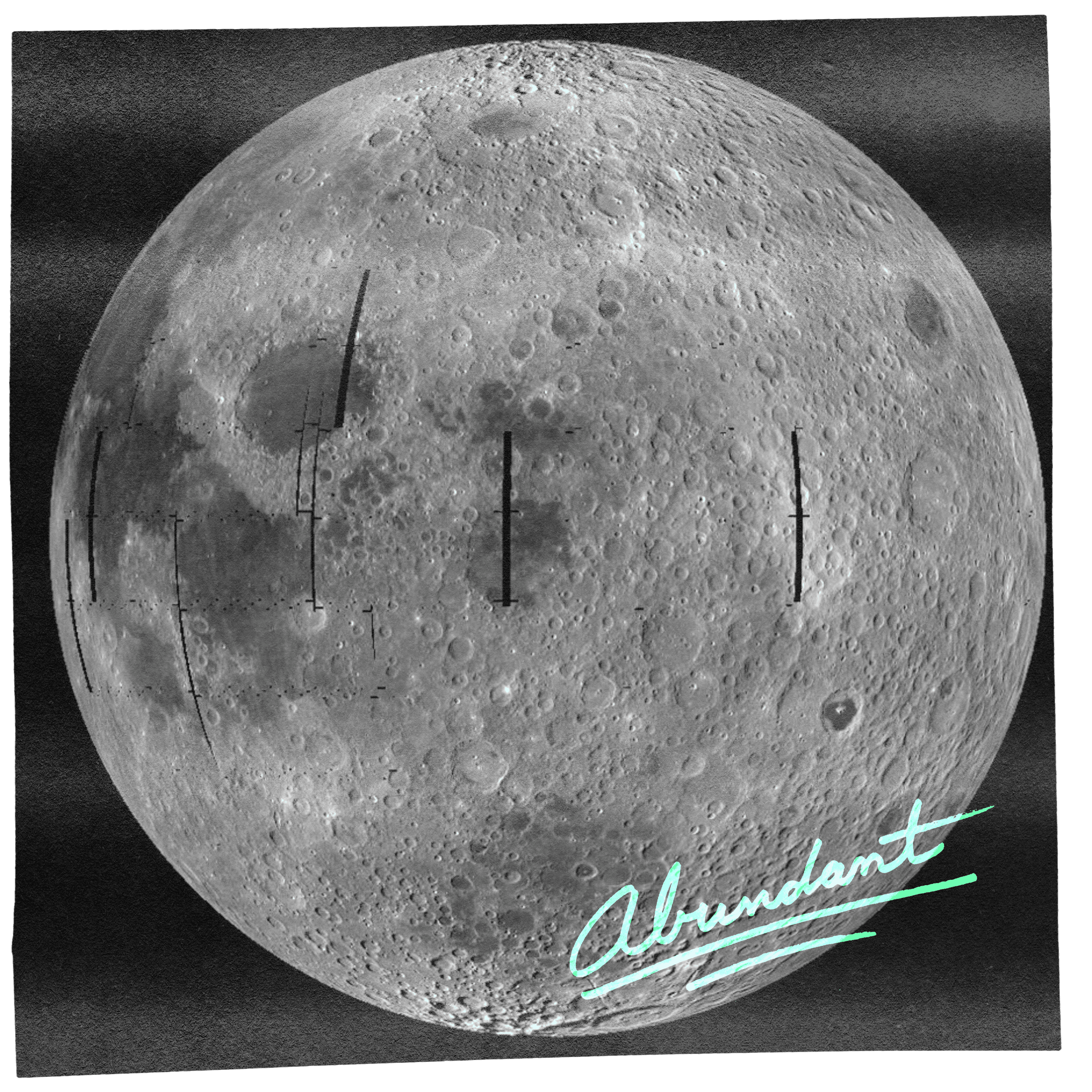

The government has already opened the skies to astrocapitalism. In May of 2025, the Department of Energy ordered three liters of lunar helium — in particular, helium-3 (3He), a stable isotope with applications in nuclear fusion and quantum computing. Delivery is currently slated for 2029; the merchant, a company called Interlune, will have to retrieve this particular helium from the Moon. 3He, while rare on Earth, is abundant in lunar soil: billions of years of solar winds have deposited it on the atmosphere-less Moon. Pegging the value of 3He at $20 million a kilogram, Interlune has staked its future on extracting this isotopic gold with autonomous equipment.
The United States is not the only major government to recognize the Moon’s economic potential. Russia and China have agreed to jointly build a research station on the Moon’s south pole, where 3He has a “comparative abundance.” They seem to view a presence on the Moon as a type of first-mover advantage, securing access not only to the isotope but also to water ice (critical for on-site fuel production) and even rare minerals.
A contest over lunar resources could drive the first permanent human presence outside of near-Earth orbit. As the engineer and author Robert Zubrin argues, Earth’s closest satellite will be key to any strategy involving further bodies like Mars. The White House even calls for the “initial elements” of a lunar “outpost” by 2030. Space colonization has transformed from science fiction into a strategic imperative.
However, before rockets reach our nearest neighbor to initiate lunar mining or settlement, they will have to escape the gravity well of international law. Neither capital nor pioneers will flow to a Moon ‘owned by everyone’ — with colonies legally murky, hard to defend, and ungoverned. There must be an extrinsic factor that accompanies American migration to the stars: public backing that provides legal stability, prudent defense, and responsible governance. These are the foundations of sovereignty. Without a way to exercise it in the no man’s land of space, there will not be an American Moon economy.
The Property Problem
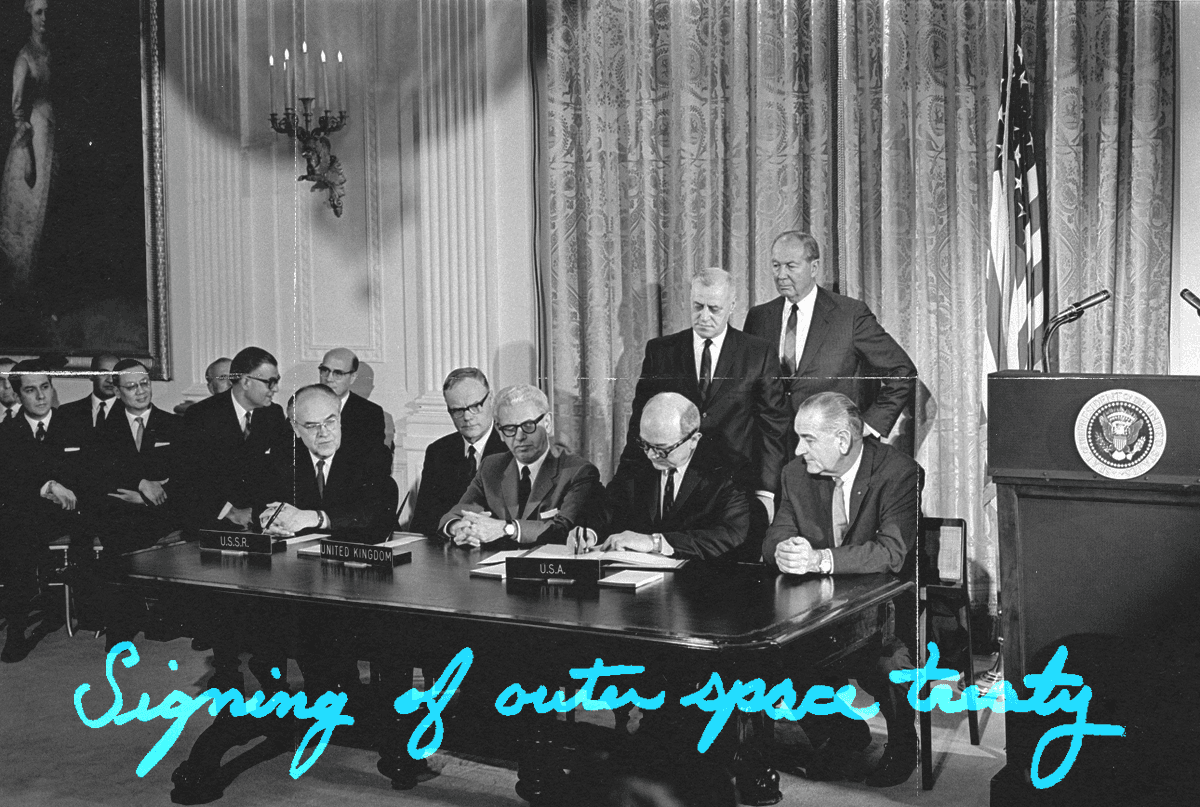
The 1967 Outer Space Treaty banned sovereign territorial claims on the non-Earth celestial bodies (for all intents and purposes, the Moon and the planets in our Solar System). At a time when only a few nation states had the capacity to leave Earth — and two years before Apollo 11 astronauts set foot on the Moon — the treaty drafters never considered that private corporations might operate in orbit. In 2015, Congress codified the right of private actors to own and sell space resources. That seems to have motivated the startup Interlune, founded in 2020, but American law still stops short of grounding rights to extracted lunar materials in the formal right to mine them.
For Your Eyes Only.
Spies. Satellites. State secrets. Inside the technologies and intelligence contests shaping American power.
Subscribe + Issue 007
The capital-intensive business of mining requires a measure of exclusivity. On Earth, holders of real estate assign that exclusivity, guaranteed by the jurisdiction the property falls under. But property presupposes prior governmental ownership, either retained or transferred to private hands. Governments cannot claim celestial territory or own it. How, then, can they grant or secure exclusive use? Without the full protection and enforcement of property rights, private Moon development becomes more impractical than it already is.
After all, the basis for the bull case is a loophole in a Cold War-era treaty. China has shown its willingness to create territory in supposedly non-claimable areas. Should China attempt to similarly encroach upon American Moon installations, the United States may not have a clear international legal basis to respond in kind. The lack of sovereignty in space complicates workers’ rights too — it is unlikely the highest-value human capital will still commit itself to the stars when its freedoms and protections are an open question. Any private settlement or mining endeavor must underwrite billion-dollar expenditures and reputational and moral liability just to make a productive Moon possible. The status quo asks them to do that amid geopolitical tensions, in a hostile physical environment, and with an ambiguous legal justification 239,000 miles from Earth.
Optimists might argue that pioneering companies are able to pan for gold in the wilderness of uncertainty, that success is only a matter of will. Nonetheless, when it comes to international waters, American deep-sea mining operators have floundered. In the case of the oceans, international law has not necessarily bound the country (the Senate never ratified the United Nations Convention on the Law of the Sea). The government has even created a licensing regime for American companies to engage in commercial recovery. Yet, that regime sits barely used: operators struggle to raise capital. Many of the same dynamics that define the space frontier apply here: geopolitical competition, technical challenges, and enormous risk. The potential of the deep seas has not been enough to generate economic activity in spite of those barriers. In the even more complex realm of space, then, loopholes — like licensing in contravention to international law — will not be enough.
Dreams of American space colonies require sovereignty to exist where international law forbids formal state ownership. Call it quasi- or de facto sovereignty: in the context of space, a mechanism that allows the government to coordinate and constrain private sector activities, defend national interests, and enforce public welfare where de jure sovereignty is proscribed. History might provide the model.
In the Age of Exploration, international law did not exist to restrict far-flung land grabs, but state balance sheets did. Commercial actors could step in where the government could not afford the endeavor at hand. Accordingly, European monarchs chartered corporations to “pursue long-distance commerce and conquest without direct government finance or control.” Where third parties engineered, administered, and profited from far-flung supply chains, the government could focus on strategic interests: tax revenues, geopolitics, national influence.
There were excesses in the quasi-sovereignty exercised by charter-holders, of course, such as the British East India Company’s private military operations. However, chartered companies allowed the notion of sovereignty to function at scale and across oceans, and they brought order to the settlement of what Europeans understood as terra nullius (‘nobody’s land’). In North America, the British Crown granted charters to “specif[y] the land that an individual or corporation had the right to settle.” Famously, the Massachusetts Bay Company charter stipulated local lawmaking authority. Such colonies were the infancy of self-rule in America: corporate charters grew into the actual sovereignty of the state and federal governments.
Of course, the charter colony is not directly transferable to space. A modern charter cannot grant territory that the state does not own. However, the precedent transfers: public-private partnership to establish settlements at scale and at distance, when the government alone cannot. The charters combined private profit with public legitimacy, and private space colonization requires some manner of governmental backing to succeed. Like Massachusetts Bay received from the king, American lunar settlements need legal standing, defensive backing, and a governance structure to be viable. Public equity stakes could provide them.
The Space Settlement Corporation
The “Space Settlement Corporation” (SSC) could fill the legal void in space with de facto sovereignty. Congress would endow the government corporation with the funds and standing authority to buy preferred shares in any corporation seeking to mine or settle the Moon. This preferred stock would guarantee board seats, reflecting the SSC’s status as proxy for the American people. Statute would ban majority stakes, and appropriations would prevent overweighted public ownership. In effect, the American people would become a stakeholder in and beneficiary of any lunar mining or settlement project.
If adversaries threatened the public’s bottom line, the United States would have clear justification to defend burgeoning colonies. Board representation would enforce the public interest in labor rights, responsible extraction, and relations with foreign-aligned facilities. Further, the government would assume some of the inherent risk in space mining or settlement. The SSC would coordinate rival American operations, preempting competition and introducing exclusivity. This vote of confidence in corporate space pioneers would unlock greater private investment and accelerate Moon development.
The SSC would not just vote by proxy, however. If established to clarify the chaos of space settlement, it must be an active governor of American activities in space. As a condition of its backing, the SSC would require veto authority over actions that compromise the national interest or colonists’ welfare and the power to remove corporate officers who disregard the same. Its ultimate teeth would be removing the legitimacy it provides. If a mining enterprise 239,000 miles from Earth decided to flout federal law, the SSC could liquidate its stake in the operator. ‘Rogue’ colonies could no longer expect governmental support against rival claimants, defense from foreign interference, or mediation with their workforce. No operation could survive long in such a Wild West.
It is not unprecedented for the government to demand equity when an industry is vulnerable. When General Motors went bankrupt in the late 2000s, the Obama Administration converted over $50 billion in federal loans to a majority stake in the “New GM.” Despite “hands-off” pledges, the Administration reserved the right to “set up-front conditions to protect taxpayers, promote financial stability, and encourage growth.” Whereas the “Old GM” died in a hospital bed, the nascent Moon economy may suffocate in its cradle if not nurtured by industrial policy. As America’s deep-sea mining struggles show, the free market stalls when asked to singlehandedly develop a frontier. When it stalls on the lunar frontier, American space superiority suffers. The SSC is a moderate response: government intervention without nationalization.
This strategy would follow the trail blazed by the second Trump Administration. In June 2025, the government finalized approval of the partnership between U.S. Steel and Nippon Steel. As part of the agreement the companies entered into with the government, the public retained a “golden share,” providing “special say in how the partnership is run.” The strategic and economic importance of maintaining domestic steel production justified the involvement. Likewise, gilded stakes are necessary in space colonies. Emerging economic competition on the Moon could soon veer into military competition. Government involvement is crucial to preventing and mitigating that possibility. Moreover, partial public ownership would recognize the people’s already vested interest in colonization while securing the majority of upside for the private sector. Taxpayers alone underwrote the early exploration of the cosmos. Should it become a back-pocket sovereign wealth fund, the SSC would deliver a return on that investment.
The expansion of the United States was often a victory of private individuals who sought out new opportunities. Before Texas became an independent republic or the nation’s second-largest state, it was a sparsely settled expanse where Americans laid the agricultural foundations of a powerhouse. The Union is stronger today because the private sector stepped in where the public sector alone could not. An English-speaking Moon might make the Union stronger still.
The Space Settlement Corporation would lay the groundwork for the future integration of the Moon into America proper. Future reform or replacement of the Outer Space Treaty may establish official methods to claim territorial sovereignty. In that scenario, the United States would need a viable footprint on lunar soil. Current law creates deadly ambiguity for dreams of space settlement. Public-private partnership would clarify and order that murkiness until the treaty regime can finally catch up to space realities.
The same dynamics are playing out in Antarctica, where treaties ban territorial claims and the Madrid Protocol restricts minerals development until 2048. But China has been building a growing network of research stations on the continent. Even if treaties do not allow true sovereignty in Antarctica, the People’s Republic recognizes that “presence equals power.” If international law were to change, settlements would provide leverage for territorial and resource claims.
The age of astropolitical competition has arrived. Helium-3 may solve the most important technological problems of our time, and a stable supply chain of lunar resources may grant America another century of terrestrial and extraterrestrial dominance. For our spice to flow, perhaps the government needs to take a stake.
Civilization
•
An American Moon Economy?
Property rights and international law in a Lunar colony.
The government has already opened the skies to astrocapitalism. In May of 2025, the Department of Energy ordered three liters of lunar helium — in particular, helium-3 (3He), a stable isotope with applications in nuclear fusion and quantum computing. Delivery is currently slated for 2029; the merchant, a company called Interlune, will have to retrieve this particular helium from the Moon. 3He, while rare on Earth, is abundant in lunar soil: billions of years of solar winds have deposited it on the atmosphere-less Moon. Pegging the value of 3He at $20 million a kilogram, Interlune has staked its future on extracting this isotopic gold with autonomous equipment.
The United States is not the only major government to recognize the Moon’s economic potential. Russia and China have agreed to jointly build a research station on the Moon’s south pole, where 3He has a “comparative abundance.” They seem to view a presence on the Moon as a type of first-mover advantage, securing access not only to the isotope but also to water ice (critical for on-site fuel production) and even rare minerals.
A contest over lunar resources could drive the first permanent human presence outside of near-Earth orbit. As the engineer and author Robert Zubrin argues, Earth’s closest satellite will be key to any strategy involving further bodies like Mars. The White House even calls for the “initial elements” of a lunar “outpost” by 2030. Space colonization has transformed from science fiction into a strategic imperative.
However, before rockets reach our nearest neighbor to initiate lunar mining or settlement, they will have to escape the gravity well of international law. Neither capital nor pioneers will flow to a Moon ‘owned by everyone’ — with colonies legally murky, hard to defend, and ungoverned. There must be an extrinsic factor that accompanies American migration to the stars: public backing that provides legal stability, prudent defense, and responsible governance. These are the foundations of sovereignty. Without a way to exercise it in the no man’s land of space, there will not be an American Moon economy.
The Property Problem
The 1967 Outer Space Treaty banned sovereign territorial claims on the non-Earth celestial bodies (for all intents and purposes, the Moon and the planets in our Solar System). At a time when only a few nation states had the capacity to leave Earth — and two years before Apollo 11 astronauts set foot on the Moon — the treaty drafters never considered that private corporations might operate in orbit. In 2015, Congress codified the right of private actors to own and sell space resources. That seems to have motivated the startup Interlune, founded in 2020, but American law still stops short of grounding rights to extracted lunar materials in the formal right to mine them.
For Your Eyes Only.
Spies. Satellites. State secrets. Inside the technologies and intelligence contests shaping American power.
Subscribe + Issue 007
The capital-intensive business of mining requires a measure of exclusivity. On Earth, holders of real estate assign that exclusivity, guaranteed by the jurisdiction the property falls under. But property presupposes prior governmental ownership, either retained or transferred to private hands. Governments cannot claim celestial territory or own it. How, then, can they grant or secure exclusive use? Without the full protection and enforcement of property rights, private Moon development becomes more impractical than it already is.
After all, the basis for the bull case is a loophole in a Cold War-era treaty. China has shown its willingness to create territory in supposedly non-claimable areas. Should China attempt to similarly encroach upon American Moon installations, the United States may not have a clear international legal basis to respond in kind. The lack of sovereignty in space complicates workers’ rights too — it is unlikely the highest-value human capital will still commit itself to the stars when its freedoms and protections are an open question. Any private settlement or mining endeavor must underwrite billion-dollar expenditures and reputational and moral liability just to make a productive Moon possible. The status quo asks them to do that amid geopolitical tensions, in a hostile physical environment, and with an ambiguous legal justification 239,000 miles from Earth.
Optimists might argue that pioneering companies are able to pan for gold in the wilderness of uncertainty, that success is only a matter of will. Nonetheless, when it comes to international waters, American deep-sea mining operators have floundered. In the case of the oceans, international law has not necessarily bound the country (the Senate never ratified the United Nations Convention on the Law of the Sea). The government has even created a licensing regime for American companies to engage in commercial recovery. Yet, that regime sits barely used: operators struggle to raise capital. Many of the same dynamics that define the space frontier apply here: geopolitical competition, technical challenges, and enormous risk. The potential of the deep seas has not been enough to generate economic activity in spite of those barriers. In the even more complex realm of space, then, loopholes — like licensing in contravention to international law — will not be enough.
Dreams of American space colonies require sovereignty to exist where international law forbids formal state ownership. Call it quasi- or de facto sovereignty: in the context of space, a mechanism that allows the government to coordinate and constrain private sector activities, defend national interests, and enforce public welfare where de jure sovereignty is proscribed. History might provide the model.
In the Age of Exploration, international law did not exist to restrict far-flung land grabs, but state balance sheets did. Commercial actors could step in where the government could not afford the endeavor at hand. Accordingly, European monarchs chartered corporations to “pursue long-distance commerce and conquest without direct government finance or control.” Where third parties engineered, administered, and profited from far-flung supply chains, the government could focus on strategic interests: tax revenues, geopolitics, national influence.
There were excesses in the quasi-sovereignty exercised by charter-holders, of course, such as the British East India Company’s private military operations. However, chartered companies allowed the notion of sovereignty to function at scale and across oceans, and they brought order to the settlement of what Europeans understood as terra nullius (‘nobody’s land’). In North America, the British Crown granted charters to “specif[y] the land that an individual or corporation had the right to settle.” Famously, the Massachusetts Bay Company charter stipulated local lawmaking authority. Such colonies were the infancy of self-rule in America: corporate charters grew into the actual sovereignty of the state and federal governments.
Of course, the charter colony is not directly transferable to space. A modern charter cannot grant territory that the state does not own. However, the precedent transfers: public-private partnership to establish settlements at scale and at distance, when the government alone cannot. The charters combined private profit with public legitimacy, and private space colonization requires some manner of governmental backing to succeed. Like Massachusetts Bay received from the king, American lunar settlements need legal standing, defensive backing, and a governance structure to be viable. Public equity stakes could provide them.
The Space Settlement Corporation
The “Space Settlement Corporation” (SSC) could fill the legal void in space with de facto sovereignty. Congress would endow the government corporation with the funds and standing authority to buy preferred shares in any corporation seeking to mine or settle the Moon. This preferred stock would guarantee board seats, reflecting the SSC’s status as proxy for the American people. Statute would ban majority stakes, and appropriations would prevent overweighted public ownership. In effect, the American people would become a stakeholder in and beneficiary of any lunar mining or settlement project.
If adversaries threatened the public’s bottom line, the United States would have clear justification to defend burgeoning colonies. Board representation would enforce the public interest in labor rights, responsible extraction, and relations with foreign-aligned facilities. Further, the government would assume some of the inherent risk in space mining or settlement. The SSC would coordinate rival American operations, preempting competition and introducing exclusivity. This vote of confidence in corporate space pioneers would unlock greater private investment and accelerate Moon development.
The SSC would not just vote by proxy, however. If established to clarify the chaos of space settlement, it must be an active governor of American activities in space. As a condition of its backing, the SSC would require veto authority over actions that compromise the national interest or colonists’ welfare and the power to remove corporate officers who disregard the same. Its ultimate teeth would be removing the legitimacy it provides. If a mining enterprise 239,000 miles from Earth decided to flout federal law, the SSC could liquidate its stake in the operator. ‘Rogue’ colonies could no longer expect governmental support against rival claimants, defense from foreign interference, or mediation with their workforce. No operation could survive long in such a Wild West.
It is not unprecedented for the government to demand equity when an industry is vulnerable. When General Motors went bankrupt in the late 2000s, the Obama Administration converted over $50 billion in federal loans to a majority stake in the “New GM.” Despite “hands-off” pledges, the Administration reserved the right to “set up-front conditions to protect taxpayers, promote financial stability, and encourage growth.” Whereas the “Old GM” died in a hospital bed, the nascent Moon economy may suffocate in its cradle if not nurtured by industrial policy. As America’s deep-sea mining struggles show, the free market stalls when asked to singlehandedly develop a frontier. When it stalls on the lunar frontier, American space superiority suffers. The SSC is a moderate response: government intervention without nationalization.
This strategy would follow the trail blazed by the second Trump Administration. In June 2025, the government finalized approval of the partnership between U.S. Steel and Nippon Steel. As part of the agreement the companies entered into with the government, the public retained a “golden share,” providing “special say in how the partnership is run.” The strategic and economic importance of maintaining domestic steel production justified the involvement. Likewise, gilded stakes are necessary in space colonies. Emerging economic competition on the Moon could soon veer into military competition. Government involvement is crucial to preventing and mitigating that possibility. Moreover, partial public ownership would recognize the people’s already vested interest in colonization while securing the majority of upside for the private sector. Taxpayers alone underwrote the early exploration of the cosmos. Should it become a back-pocket sovereign wealth fund, the SSC would deliver a return on that investment.
The expansion of the United States was often a victory of private individuals who sought out new opportunities. Before Texas became an independent republic or the nation’s second-largest state, it was a sparsely settled expanse where Americans laid the agricultural foundations of a powerhouse. The Union is stronger today because the private sector stepped in where the public sector alone could not. An English-speaking Moon might make the Union stronger still.
The Space Settlement Corporation would lay the groundwork for the future integration of the Moon into America proper. Future reform or replacement of the Outer Space Treaty may establish official methods to claim territorial sovereignty. In that scenario, the United States would need a viable footprint on lunar soil. Current law creates deadly ambiguity for dreams of space settlement. Public-private partnership would clarify and order that murkiness until the treaty regime can finally catch up to space realities.
The same dynamics are playing out in Antarctica, where treaties ban territorial claims and the Madrid Protocol restricts minerals development until 2048. But China has been building a growing network of research stations on the continent. Even if treaties do not allow true sovereignty in Antarctica, the People’s Republic recognizes that “presence equals power.” If international law were to change, settlements would provide leverage for territorial and resource claims.
The age of astropolitical competition has arrived. Helium-3 may solve the most important technological problems of our time, and a stable supply chain of lunar resources may grant America another century of terrestrial and extraterrestrial dominance. For our spice to flow, perhaps the government needs to take a stake.
Civilization
•
An American Moon Economy?
Property rights and international law in a Lunar colony.
The government has already opened the skies to astrocapitalism. In May of 2025, the Department of Energy ordered three liters of lunar helium — in particular, helium-3 (3He), a stable isotope with applications in nuclear fusion and quantum computing. Delivery is currently slated for 2029; the merchant, a company called Interlune, will have to retrieve this particular helium from the Moon. 3He, while rare on Earth, is abundant in lunar soil: billions of years of solar winds have deposited it on the atmosphere-less Moon. Pegging the value of 3He at $20 million a kilogram, Interlune has staked its future on extracting this isotopic gold with autonomous equipment.
The United States is not the only major government to recognize the Moon’s economic potential. Russia and China have agreed to jointly build a research station on the Moon’s south pole, where 3He has a “comparative abundance.” They seem to view a presence on the Moon as a type of first-mover advantage, securing access not only to the isotope but also to water ice (critical for on-site fuel production) and even rare minerals.
A contest over lunar resources could drive the first permanent human presence outside of near-Earth orbit. As the engineer and author Robert Zubrin argues, Earth’s closest satellite will be key to any strategy involving further bodies like Mars. The White House even calls for the “initial elements” of a lunar “outpost” by 2030. Space colonization has transformed from science fiction into a strategic imperative.
However, before rockets reach our nearest neighbor to initiate lunar mining or settlement, they will have to escape the gravity well of international law. Neither capital nor pioneers will flow to a Moon ‘owned by everyone’ — with colonies legally murky, hard to defend, and ungoverned. There must be an extrinsic factor that accompanies American migration to the stars: public backing that provides legal stability, prudent defense, and responsible governance. These are the foundations of sovereignty. Without a way to exercise it in the no man’s land of space, there will not be an American Moon economy.
The Property Problem
The 1967 Outer Space Treaty banned sovereign territorial claims on the non-Earth celestial bodies (for all intents and purposes, the Moon and the planets in our Solar System). At a time when only a few nation states had the capacity to leave Earth — and two years before Apollo 11 astronauts set foot on the Moon — the treaty drafters never considered that private corporations might operate in orbit. In 2015, Congress codified the right of private actors to own and sell space resources. That seems to have motivated the startup Interlune, founded in 2020, but American law still stops short of grounding rights to extracted lunar materials in the formal right to mine them.
For Your Eyes Only.
Spies. Satellites. State secrets. Inside the technologies and intelligence contests shaping American power.
Subscribe + Issue 007
The capital-intensive business of mining requires a measure of exclusivity. On Earth, holders of real estate assign that exclusivity, guaranteed by the jurisdiction the property falls under. But property presupposes prior governmental ownership, either retained or transferred to private hands. Governments cannot claim celestial territory or own it. How, then, can they grant or secure exclusive use? Without the full protection and enforcement of property rights, private Moon development becomes more impractical than it already is.
After all, the basis for the bull case is a loophole in a Cold War-era treaty. China has shown its willingness to create territory in supposedly non-claimable areas. Should China attempt to similarly encroach upon American Moon installations, the United States may not have a clear international legal basis to respond in kind. The lack of sovereignty in space complicates workers’ rights too — it is unlikely the highest-value human capital will still commit itself to the stars when its freedoms and protections are an open question. Any private settlement or mining endeavor must underwrite billion-dollar expenditures and reputational and moral liability just to make a productive Moon possible. The status quo asks them to do that amid geopolitical tensions, in a hostile physical environment, and with an ambiguous legal justification 239,000 miles from Earth.
Optimists might argue that pioneering companies are able to pan for gold in the wilderness of uncertainty, that success is only a matter of will. Nonetheless, when it comes to international waters, American deep-sea mining operators have floundered. In the case of the oceans, international law has not necessarily bound the country (the Senate never ratified the United Nations Convention on the Law of the Sea). The government has even created a licensing regime for American companies to engage in commercial recovery. Yet, that regime sits barely used: operators struggle to raise capital. Many of the same dynamics that define the space frontier apply here: geopolitical competition, technical challenges, and enormous risk. The potential of the deep seas has not been enough to generate economic activity in spite of those barriers. In the even more complex realm of space, then, loopholes — like licensing in contravention to international law — will not be enough.
Dreams of American space colonies require sovereignty to exist where international law forbids formal state ownership. Call it quasi- or de facto sovereignty: in the context of space, a mechanism that allows the government to coordinate and constrain private sector activities, defend national interests, and enforce public welfare where de jure sovereignty is proscribed. History might provide the model.
In the Age of Exploration, international law did not exist to restrict far-flung land grabs, but state balance sheets did. Commercial actors could step in where the government could not afford the endeavor at hand. Accordingly, European monarchs chartered corporations to “pursue long-distance commerce and conquest without direct government finance or control.” Where third parties engineered, administered, and profited from far-flung supply chains, the government could focus on strategic interests: tax revenues, geopolitics, national influence.
There were excesses in the quasi-sovereignty exercised by charter-holders, of course, such as the British East India Company’s private military operations. However, chartered companies allowed the notion of sovereignty to function at scale and across oceans, and they brought order to the settlement of what Europeans understood as terra nullius (‘nobody’s land’). In North America, the British Crown granted charters to “specif[y] the land that an individual or corporation had the right to settle.” Famously, the Massachusetts Bay Company charter stipulated local lawmaking authority. Such colonies were the infancy of self-rule in America: corporate charters grew into the actual sovereignty of the state and federal governments.
Of course, the charter colony is not directly transferable to space. A modern charter cannot grant territory that the state does not own. However, the precedent transfers: public-private partnership to establish settlements at scale and at distance, when the government alone cannot. The charters combined private profit with public legitimacy, and private space colonization requires some manner of governmental backing to succeed. Like Massachusetts Bay received from the king, American lunar settlements need legal standing, defensive backing, and a governance structure to be viable. Public equity stakes could provide them.
The Space Settlement Corporation
The “Space Settlement Corporation” (SSC) could fill the legal void in space with de facto sovereignty. Congress would endow the government corporation with the funds and standing authority to buy preferred shares in any corporation seeking to mine or settle the Moon. This preferred stock would guarantee board seats, reflecting the SSC’s status as proxy for the American people. Statute would ban majority stakes, and appropriations would prevent overweighted public ownership. In effect, the American people would become a stakeholder in and beneficiary of any lunar mining or settlement project.
If adversaries threatened the public’s bottom line, the United States would have clear justification to defend burgeoning colonies. Board representation would enforce the public interest in labor rights, responsible extraction, and relations with foreign-aligned facilities. Further, the government would assume some of the inherent risk in space mining or settlement. The SSC would coordinate rival American operations, preempting competition and introducing exclusivity. This vote of confidence in corporate space pioneers would unlock greater private investment and accelerate Moon development.
The SSC would not just vote by proxy, however. If established to clarify the chaos of space settlement, it must be an active governor of American activities in space. As a condition of its backing, the SSC would require veto authority over actions that compromise the national interest or colonists’ welfare and the power to remove corporate officers who disregard the same. Its ultimate teeth would be removing the legitimacy it provides. If a mining enterprise 239,000 miles from Earth decided to flout federal law, the SSC could liquidate its stake in the operator. ‘Rogue’ colonies could no longer expect governmental support against rival claimants, defense from foreign interference, or mediation with their workforce. No operation could survive long in such a Wild West.
It is not unprecedented for the government to demand equity when an industry is vulnerable. When General Motors went bankrupt in the late 2000s, the Obama Administration converted over $50 billion in federal loans to a majority stake in the “New GM.” Despite “hands-off” pledges, the Administration reserved the right to “set up-front conditions to protect taxpayers, promote financial stability, and encourage growth.” Whereas the “Old GM” died in a hospital bed, the nascent Moon economy may suffocate in its cradle if not nurtured by industrial policy. As America’s deep-sea mining struggles show, the free market stalls when asked to singlehandedly develop a frontier. When it stalls on the lunar frontier, American space superiority suffers. The SSC is a moderate response: government intervention without nationalization.
This strategy would follow the trail blazed by the second Trump Administration. In June 2025, the government finalized approval of the partnership between U.S. Steel and Nippon Steel. As part of the agreement the companies entered into with the government, the public retained a “golden share,” providing “special say in how the partnership is run.” The strategic and economic importance of maintaining domestic steel production justified the involvement. Likewise, gilded stakes are necessary in space colonies. Emerging economic competition on the Moon could soon veer into military competition. Government involvement is crucial to preventing and mitigating that possibility. Moreover, partial public ownership would recognize the people’s already vested interest in colonization while securing the majority of upside for the private sector. Taxpayers alone underwrote the early exploration of the cosmos. Should it become a back-pocket sovereign wealth fund, the SSC would deliver a return on that investment.
The expansion of the United States was often a victory of private individuals who sought out new opportunities. Before Texas became an independent republic or the nation’s second-largest state, it was a sparsely settled expanse where Americans laid the agricultural foundations of a powerhouse. The Union is stronger today because the private sector stepped in where the public sector alone could not. An English-speaking Moon might make the Union stronger still.
The Space Settlement Corporation would lay the groundwork for the future integration of the Moon into America proper. Future reform or replacement of the Outer Space Treaty may establish official methods to claim territorial sovereignty. In that scenario, the United States would need a viable footprint on lunar soil. Current law creates deadly ambiguity for dreams of space settlement. Public-private partnership would clarify and order that murkiness until the treaty regime can finally catch up to space realities.
The same dynamics are playing out in Antarctica, where treaties ban territorial claims and the Madrid Protocol restricts minerals development until 2048. But China has been building a growing network of research stations on the continent. Even if treaties do not allow true sovereignty in Antarctica, the People’s Republic recognizes that “presence equals power.” If international law were to change, settlements would provide leverage for territorial and resource claims.
The age of astropolitical competition has arrived. Helium-3 may solve the most important technological problems of our time, and a stable supply chain of lunar resources may grant America another century of terrestrial and extraterrestrial dominance. For our spice to flow, perhaps the government needs to take a stake.
About the Author
Lintaro Donovan is a graduate of Dartmouth College. The views expressed in this article are solely those of the author and do not represent any government agency, institution, or employer.