tt
tt
tt
tt
tt
tt
Civilization
•
Stealing Like a State
Industrial Espionage and the Course of Empire.

For more than a decade, China has sought to steal the technology behind ASML’s extreme ultraviolet (EUV) lithography technology. According to a Reuters report published in December 2025, Chinese engineers may have partially succeeded. They assembled a prototype EUV system in a secret Shenzhen facility using parts salvaged from older ASML machines obtained through undisclosed means, as part of a state-backed effort insiders have dubbed China’s Manhattan Project.
China’s commitment to this ambitious project reflects a strategic vulnerability. The country imports more than $300 billion annually in semiconductors and semiconductor manufacturing equipment. This figure exceeds its spending on imported oil and gas. An American export ban on foreign-made microchips would cripple China’s industrial base. And if China can’t develop its own EUV machines, it will lack the advanced chips needed for AI model development if the U.S. decides to impose strong export controls.
Many analysts believed it would take far longer for China to assemble even a prototype. The task requires recreating an extraordinarily complex supply chain. ASML draws on more than 5,000 specialized suppliers to build close to 100,000 components for a single machine, which is roughly the size of a school bus. Many suppliers occupy narrow niches with no real substitutes.
EUV lithography depends on a light source created by firing a high-power carbon-dioxide laser built by TRUMPF at microscopic droplets of molten tin inside a plasma generator developed by Cymer, an American firm acquired by ASML. Each droplet vaporizes into plasma heated to temperatures hotter than the surface of the sun, which emits light at a wavelength of 13.5 nanometers. That light must then travel through an ultra-high-vacuum system supplied by Pfeiffer Vacuum. Even trace amounts of air would absorb the beam entirely. The light then reflects off a handful of mirrors polished and multilayer-coated to sub-atomic precision by Carl Zeiss SMT.
For Your Eyes Only.
Spies. Satellites. State secrets. Inside the technologies and intelligence contests shaping American power.
Subscribe + Issue 007
At the tolerances EUV lithography requires, the machine proves so sensitive that minute variations in gravity across its length, effects traceable to the curvature of the Earth itself, introduce measurable error. Every step in the process introduces noise and randomness that ASML’s control systems must model these variations in advance, correct them in real time, and mathematically cancel them before they corrupt the pattern. The machines are a statistical miracle.
Industrial espionage has been central to China’s EUV project. U.S. courts found that former ASML engineers at startup XTAL stole more than 2 million lines of the control software required to work these statistical miracles before its leadership fled to China. According to a 2023 report by the Center for Strategic and International Studies, Chinese intelligence services employ up to 100,000 open-source intelligence analysts who harvest publicly available information about technology of interest to China. These analysts map EUV supply chains and help identify recruitable technical talent. China lures these specialists to China as part of recruitment programs with promises of signing bonuses of up to 5 million yuan (roughly $700,000) and subsidies to purchase homes. Once in China, they work in secret facilities under aliases to conceal their involvement in the EUV initiative.
But recruited talent isn’t just copying. Lin Nan, a leading optical scientist, left ASML’s light-source technology group for the Shanghai Institute of Optics and abandoned the company’s approach entirely. His team developed solid-state lasers achieving 3.42% conversion efficiency, meaning that more than three percent of the input laser energy is converted into usable extreme-ultraviolet light. That performance reaches half of ASML’s commercial standard but exceeds what major Western labs have achieved. In other experiments, his team reportedly hit 50% efficiency. Solid-state systems are smaller, cheaper, and on a trajectory to surpass the CO2 lasers ASML relies on.
Industrial espionage has always accompanied shifts in technological power. The dominant power guards its critical technology. The challenger steals it, then tries to build something better. But as China has discovered with its EUV project, what matters most is not access to stolen designs or even intact subsystems. What matters is whether substitute or copied subsystems can be made to function together reliably and at scale. Western firms spent decades building that capacity, beginning with the assembly of the first EUV machine at Sandia National Laboratories in Livermore, California in 2001.
The Chinese EUV prototype, even if successful, addresses only one bottleneck in the supply chain. China would still face challenges in photoresist chemicals, where Japanese firms dominate. Ultra-pure fluoropolymers come from German and American suppliers. Dozens of other specialized inputs remain out of reach, with Zeiss optical systems being the most difficult to replicate. Building a prototype differs categorically from manufacturing at scale with acceptable yield rates. ASML took fifteen years to move from its first EUV prototype to reliable production. China’s timeline depends not just on technical capability but on whether it can compress this scaling process.
China’s EUV effort is not historically unique. What it exposes is a recurring feature of technological competition between great powers where industrial espionage helps accelerate development, but is seldom decisive. A survey of the history of industrial espionage is instructive as to why that is the case.
The Historical Pattern of Technology Transfer and Power
The world’s first great industrial power began with a great theft. Spain controlled the Atlantic in the 16th century through navigation secrets. Spanish pilots combined magnetic compasses, astrolabes, and celestial observations to cross the open ocean. The Spanish crown guarded this knowledge as a state secret while English mariners lacked this expertise and stuck to coastal waters.
That changed when an English spy obtained Martín Cortés de Albacar’s Art of Navigation. The book appeared in London in 1561 and England immediately invested in applying the stolen knowledge. John Dee taught mathematical navigation to sea captains. The English crown funded exploration voyages such as Frobisher’s Northwest Passage attempts in the 1570s and Drake’s circumnavigation starting in 1577. Thames shipwrights spent two decades developing “race-built” galleons with superior maneuverability.
In 1588, an outnumbered English fleet faced a 130-ship Spanish Armada escorting an invasion force intended to overthrow the English regime. English captains used superior maneuverability to hold windward positions through the Channel battle, firing from ranges beyond which Spanish guns couldn’t respond. About half the Armada never returned to Spain while England lost almost no ships. Stealing Cortés’s manual took one spy. Building a navy that could beat Spain took 30 years.
After England’s civil war ended in 1651, the country lagged its Dutch rivals in shipbuilding and finance, German states in metallurgy, and French competitors in luxury manufacturing. Over the next 150 years, Britain smuggled in machines and experts with the process knowledge needed to help them catch up, such as French silk weavers and German metallurgists, despite export bans imposed by rival nations.
But stolen knowledge alone didn’t create British dominance. Industrial growth fed the Royal Navy, which became the world’s largest industrial consumer. This created a cycle. Naval demand drove industrial capacity while stolen techniques became British innovations. Growing production led to ever greater state and maritime power, which enabled Britain to expand outward and control 25% of the world’s landmass at the peak of its empire.
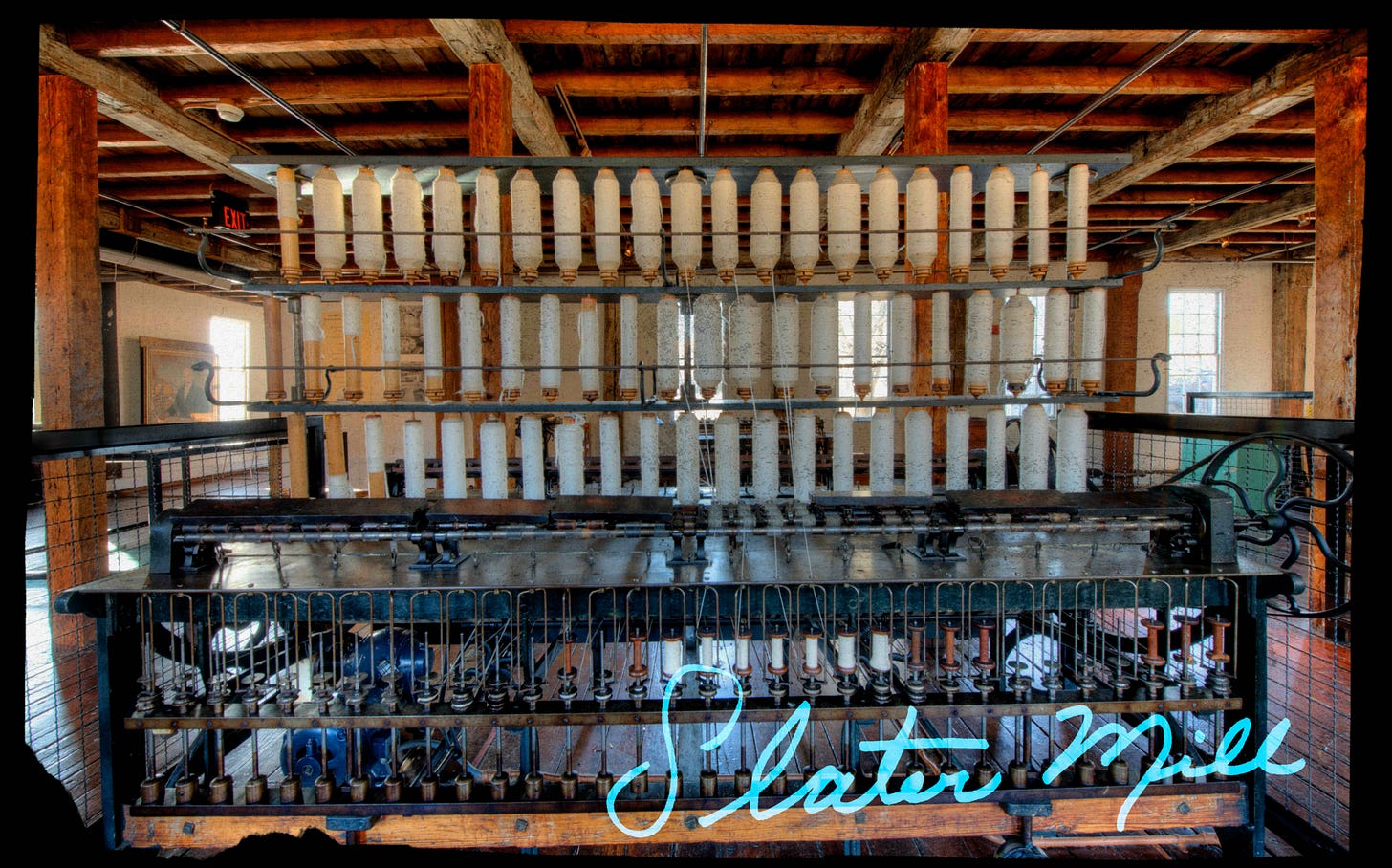
It was the arrival of the United States on the world stage, with its heretofore unimaginable advantages, that would break the British model. The newly independent United States ignored Britain’s export bands and patent laws entirely. One of America’s first great industrialists, Samuel Slater, memorized designs of British spinning frames, emigrated illegally, and rebuilt them from memory. American agents recruited British workers, reverse-engineered machinery, and systematically acquired foreign technology.
Carroll Quigley argued in The Evolution of Civilizations that nations rise when their institutions expand productive capacity. He defined this as the ability to turn labor, resources, and knowledge into usable goods and services. Britain developed powerful instruments of expansion, but the United States inherited that instrument without Europe’s constraints. Vast natural resources, navigable rivers, a large mobile low-cost labor force, and a continent-sized internal market removed material bottlenecks.
American manufacturers pioneered the “American System of Manufacture,” which relied on standardization, interchangeable parts, and precision machining to compensate for a lack of craft expertise. By 1916, the U.S. had 30-50% higher output per worker than Western Europe and its economy exceeded the entire British Empire in size. By the 1930s, U.S. labor productivity was 50-90% higher than Western Europe.
The WWII Acceleration
Its higher productivity rates enabled the U.S. to become the largest airplane manufacturer in the world during World War II, producing more planes in 1944 than Japan did during the entire war. But it still lagged behind German and British aerospace technology until the war enabled the Americans to access their secrets.
Through the Tizard Mission in 1940, Britain transferred its most advanced technology to the U.S. because it lacked the industrial strength to develop this technology at scale and it wanted to entangle U.S. industry in its war effort. This technology included the first practical realization of jet propulsion, the Whittle W.2B engine. General Electric (GE) copied this engine design, enabling Lockheed to build America’s first jet fighter plane in only 180 days in the closing days of World War II.
As the war reached its endgame, the Americans and British would join together in their pursuit of Nazi “wonder weapons,” such as the V-2 missile and ME-262 jet fighter. Over 3,000 British and American technical experts accompanied Allied forces in their push towards Berlin in 1944. On the British side, Ian Fleming, who would go on to author the James Bond novels, led top-secret missions as commander of the 30 Assault Unit. The U.S. Air Technical Intelligence unit combed through rocket factories carved into mountains and secret Luftwaffe wind tunnels where experimental plane designs had broken the sound barrier.
After Berlin fell in spring of 1945, the Air Technical Intelligence unit sent recruited elite Luftwaffe aerospace engineers and test pilots to a luxury German mountain spa where they stayed until they could join Operation Lusty (Luftwaffe Secret Technology) at an Army Air Force base in Ohio. There, the Germans helped accelerate U.S. aerospace R&D by four or more years through wind tunnel design, jet engine reverse-engineering, and swept-wing development.
GE and Pratt & Whitney engineers synthesized British centrifugal jet engines with German axial-flow compressor research, creating jet designs that went from 2,000 pounds of thrust with tens-of-hours lifespans during the war to over 10,000 pounds of thrust with 1,000+ hour service lives, enabling a generation of supersonic fighters and long-range bombers. Other GE engineers were in the deserts of west Texas as part of Operation Fireball, where they made major improvements to the V-2 missile’s guidance and control systems, subsystem performance, and system integration. Engineers from Rocketdyne improved the V-2 engine design, ultimately building the F-1 engine which remains the most powerful single-chamber liquid rocket engine ever flown, reliable at 1.5 million lbf (pound-force) while the German engine could only generate 25 tons of thrust and routinely destroyed itself via pressure oscillation. The V-2 rocket failed more than 30% of the time it was launched during the war; American engineers brought the frequency down to under 5%.
By the mid-1960s, approximately 5% of the U.S. GDP funded new weapon systems and NASA’s Apollo Program, transforming U.S. industrial capacity. The Atlas Intercontinental Ballistic Missile was deployed in five years and required simultaneous breakthroughs in rocket engines, lightweight structures, inertial guidance, and reentry physics. The Apollo moon landing came eight years after zero human spaceflight capability. The Archangel spy plane program went from concept to the first flight of a plane that could fly 85,000 feet in the air at speeds exceeding Mach 3 in four years. Boeing took the 747, the largest and most advanced commercial aircraft ever built, from initial concept in 1965 to planes rolling off production lines 28 months later in a project that required building a factory that remains the largest building by volume in the world today.
The English novelist J.G. Ballard would later compare the 747 to the Parthenon, stating that both gave physical shape to “mathematics, aesthetics and an entire geopolitical worldview.” The geopolitical dominance the U.S. gained through aerospace and the semiconductor and technology industries that emerged from space and defense spending proved extremely difficult for rival nations to duplicate.
In an attempt to catch up, the KGB’s Directorate T coordinated deep-penetration espionage through Line X into Western R&D programs, scientific institutions, and high-tech industries. The scale was substantial and often effective. Soviet intelligence obtained detailed designs, manufacturing processes, and software for advanced computing, aerospace, and industrial control systems.
The difficulty faced by the Soviets lay not in collection but in application. Soviet industry lacked production flexibility, precision tooling, and institutional incentives to improve foreign designs. For example, despite extensive intelligence on Western semiconductor design, Soviet chip fabrication suffered low yields, high defect rates, and an inability to scale down transistor size.
Directorate T suffered a decisive disruption in 1981, when one of its senior officers, Vladimir Vetrov, provided French intelligence with thousands of classified KGB documents. The material, later known as the Farewell Dossier, revealed the extent of Soviet industrial espionage and enabled Western intelligence services to dismantle networks and exploit Soviet dependence by allowing compromised designs to be acquired. In the early 1980s, sabotaged industrial control software used by the Soviets for a Siberian gas pipeline resulted in the largest non-nuclear explosion ever observed from space.
Britain and the U.S. built industrial power on stolen knowledge. But their ability to incorporate this knowledge into powerful instruments of expansion enabled superpower status. Soviet inability to do the same led to technological stagnation. China’s rise matters because it appears to have solved the institutional problem that defeated the Soviet Union.

Why China Is Not the Soviet Union
According to Dan Wang, author of Breakneck (2025), the Chinese Communist Party has closely studied the history of two countries as it planned China’s rise: Japan and the Soviet Union. Much of its industrial policy playbook, including strategic state investment, industrial espionage, and forced IP transfers, is a supercharged version of the playbook used by Japan in the post-war era. From the Soviet Union, China learned how not to run an authoritarian state and where market forces could produce better outcomes than central planning achieved.
China’s hybrid system combines state direction with market discipline. The country provides a firehose of cheap capital to companies in strategic industries and removes regulatory barriers, but it forces them to engage in a brutal survival-of-the-fittest competition. There are 137 electric vehicle companies in China, but only a few of them are currently profitable.
Huawei illustrates the Chinese developmental model. Over three decades, China provided Huawei with an estimated $75 billion in state support. This support took several forms. State-owned banks extended preferential loans to Huawei at below-market interest rates, while government procurement contracts for China’s $1 trillion national telecom infrastructure buildout — which began a few years after Huawei’s 1987 founding — favored domestic firms. This support allowed Huawei to dominate its home market by replicating stolen Western IP. Domestic profits then funded R&D that produced incremental improvements to this technology. Within just over a decade of its founding, these refinements enabled Huawei to offer a full range of network infrastructure products that matched or exceeded Western alternatives in capability while undercutting them by around 40% on price.
Huawei distributes its $22 billion annual R&D budget across more than 15 research centers globally with nearly 100,000 people working in R&D roles, which has enabled it to hold over 110,000 patents and create arguably the best 5G technology in the world. Its progression from equipment reseller in the early 1990s to the largest telecom equipment provider globally by 2012 demonstrates its institutional capacity.
Chinese Premier Xi Jinping wants to duplicate Huawei’s success in every major industrial sector where the West, Japan, South Korea, and Taiwan currently lead. He identified using scientific and technical innovation to create “new productive forces” as the central development goal of his administration in 2023. This meant transforming traditional industries through automation while nurturing ten strategic sectors ranging from electric vehicles and robotics to aerospace and medical devices. China identified these sectors in 2015 as part of its “Made in China 2025” plan, which was an attempt to formalize a state-directed strategy of technological catch-up, substitution, and eventual dominance in high-value manufacturing.
The only realistic way to collapse R&D timelines that quickly is through industrial espionage. In the two years before announcing Made in China 2025, China’s primary intelligence service, the Ministry of State Security, doubled in size in preparation. In July 2020 testimony before the Senate Judiciary Committee, FBI Director Christopher Wray stated the Bureau was opening a new China-related counterintelligence case approximately every ten hours. Almost all of them involved economic espionage or technology theft.

The American Institutional Challenge
Preventing Chinese industrial espionage and denying access is important, but rebuilding the institutions that once allowed rapid industrial scaling is more important.
Boeing’s aircraft development timeline illustrates the transformation of American industrial capacity. The 747 program was delivered in 28 months. The company’s next clean-sheet commercial design won’t arrive until the middle of the next decade, roughly 30 years after its last clean-sheet design, the 787 Dreamliner, entered production. The problem isn’t lost technical knowledge. American engineers still understand how to design aircraft. The problem is institutions that no longer function as they once did.
In stark contrast, the Chinese semiconductor equipment firm SiCarrier formed in 2021. Four years later, it unveiled over 30 products named after Chinese mountains that covered most wafer fabrication processes except lithography, each representing decades of accumulated Western and Japanese process knowledge that China collapsed into a single developmental push. The disparity in commitment shows in the numbers: per the IMF, China invests 4.0% of GDP on industrial policy while America invests 0.39%. Compounded over decades, that gap built manufacturing ecosystems that cannot be replicated on demand.
It should be acknowledged that China’s developmental model contains flaws. China’s province-level industrial policy has generated what economists call “involution,” or destructive competition that produces massive overcapacity. Political economist Victor Shih estimates China’s debt-to-GDP ratio at 200%, while the Financial Times found 12% of Chinese firms are “zombies” unable to service debt. China now produces 14 million more cars than its market absorbs annually and manufactures double the solar panels global demand requires, which has resulted in its solar manufacturers suffering $60 billion in losses. There are unsustainable features of both Chinese and American developmental models and it’s unclear whose dysfunctions will be harder to fix and whose will end up being fatal.
Many current U.S. policies reflect assumptions formed during a period of uncontested technological dominance by the United States that followed World War II. The United States built a coordinated system, including research universities, national laboratories, DARPA, and a defense industrial base supported by almost unlimited spending. That system degraded after the Cold War ended in 1991, when the United States no longer faced a peer rival and it allowed its defense industrial base to contract while other manufacturing moved offshore.
The U.S. still has time to recover many of the capabilities it lost, but its assumption of technological advantage needs to be abandoned now that it faces a Chinese rival that has organized its state systems around systematic technological catch-up. Institutional reform matters most, rebuilding or developing new institutions, companies, and industrial policies that create new instruments of expansion. These instruments could include greatly increased spending on industrial policy, requiring IP transfers as part of joint venture agreements for firms wanting to build factories in the U.S., applying AI to industrial problems, developing entirely new R&D systems, or even engaging in industrial espionage for commercial advantage using the same talent recruitment, cyber espionage, and human intelligence methods China does.
China hasn’t just stolen technology; it’s rebuilt the American system of the 1960s while America dismantled its own. The Chinese EUV “Manhattan Project” reveals a competitor treating technological supremacy as existential while America treats it as one priority among many.
The U.S. built its first ICBM in five years because doing so was viewed as a matter of national survival. If the U.S. wants to remain a superpower that controls its own destiny, it must recover that intensity.
Civilization
•
Stealing Like a State
Industrial Espionage and the Course of Empire.
For more than a decade, China has sought to steal the technology behind ASML’s extreme ultraviolet (EUV) lithography technology. According to a Reuters report published in December 2025, Chinese engineers may have partially succeeded. They assembled a prototype EUV system in a secret Shenzhen facility using parts salvaged from older ASML machines obtained through undisclosed means, as part of a state-backed effort insiders have dubbed China’s Manhattan Project.
China’s commitment to this ambitious project reflects a strategic vulnerability. The country imports more than $300 billion annually in semiconductors and semiconductor manufacturing equipment. This figure exceeds its spending on imported oil and gas. An American export ban on foreign-made microchips would cripple China’s industrial base. And if China can’t develop its own EUV machines, it will lack the advanced chips needed for AI model development if the U.S. decides to impose strong export controls.
Many analysts believed it would take far longer for China to assemble even a prototype. The task requires recreating an extraordinarily complex supply chain. ASML draws on more than 5,000 specialized suppliers to build close to 100,000 components for a single machine, which is roughly the size of a school bus. Many suppliers occupy narrow niches with no real substitutes.
EUV lithography depends on a light source created by firing a high-power carbon-dioxide laser built by TRUMPF at microscopic droplets of molten tin inside a plasma generator developed by Cymer, an American firm acquired by ASML. Each droplet vaporizes into plasma heated to temperatures hotter than the surface of the sun, which emits light at a wavelength of 13.5 nanometers. That light must then travel through an ultra-high-vacuum system supplied by Pfeiffer Vacuum. Even trace amounts of air would absorb the beam entirely. The light then reflects off a handful of mirrors polished and multilayer-coated to sub-atomic precision by Carl Zeiss SMT.
For Your Eyes Only.
Spies. Satellites. State secrets. Inside the technologies and intelligence contests shaping American power.
Subscribe + Issue 007
At the tolerances EUV lithography requires, the machine proves so sensitive that minute variations in gravity across its length, effects traceable to the curvature of the Earth itself, introduce measurable error. Every step in the process introduces noise and randomness that ASML’s control systems must model these variations in advance, correct them in real time, and mathematically cancel them before they corrupt the pattern. The machines are a statistical miracle.
Industrial espionage has been central to China’s EUV project. U.S. courts found that former ASML engineers at startup XTAL stole more than 2 million lines of the control software required to work these statistical miracles before its leadership fled to China. According to a 2023 report by the Center for Strategic and International Studies, Chinese intelligence services employ up to 100,000 open-source intelligence analysts who harvest publicly available information about technology of interest to China. These analysts map EUV supply chains and help identify recruitable technical talent. China lures these specialists to China as part of recruitment programs with promises of signing bonuses of up to 5 million yuan (roughly $700,000) and subsidies to purchase homes. Once in China, they work in secret facilities under aliases to conceal their involvement in the EUV initiative.
But recruited talent isn’t just copying. Lin Nan, a leading optical scientist, left ASML’s light-source technology group for the Shanghai Institute of Optics and abandoned the company’s approach entirely. His team developed solid-state lasers achieving 3.42% conversion efficiency, meaning that more than three percent of the input laser energy is converted into usable extreme-ultraviolet light. That performance reaches half of ASML’s commercial standard but exceeds what major Western labs have achieved. In other experiments, his team reportedly hit 50% efficiency. Solid-state systems are smaller, cheaper, and on a trajectory to surpass the CO2 lasers ASML relies on.
Industrial espionage has always accompanied shifts in technological power. The dominant power guards its critical technology. The challenger steals it, then tries to build something better. But as China has discovered with its EUV project, what matters most is not access to stolen designs or even intact subsystems. What matters is whether substitute or copied subsystems can be made to function together reliably and at scale. Western firms spent decades building that capacity, beginning with the assembly of the first EUV machine at Sandia National Laboratories in Livermore, California in 2001.
The Chinese EUV prototype, even if successful, addresses only one bottleneck in the supply chain. China would still face challenges in photoresist chemicals, where Japanese firms dominate. Ultra-pure fluoropolymers come from German and American suppliers. Dozens of other specialized inputs remain out of reach, with Zeiss optical systems being the most difficult to replicate. Building a prototype differs categorically from manufacturing at scale with acceptable yield rates. ASML took fifteen years to move from its first EUV prototype to reliable production. China’s timeline depends not just on technical capability but on whether it can compress this scaling process.
China’s EUV effort is not historically unique. What it exposes is a recurring feature of technological competition between great powers where industrial espionage helps accelerate development, but is seldom decisive. A survey of the history of industrial espionage is instructive as to why that is the case.
The Historical Pattern of Technology Transfer and Power
The world’s first great industrial power began with a great theft. Spain controlled the Atlantic in the 16th century through navigation secrets. Spanish pilots combined magnetic compasses, astrolabes, and celestial observations to cross the open ocean. The Spanish crown guarded this knowledge as a state secret while English mariners lacked this expertise and stuck to coastal waters.
That changed when an English spy obtained Martín Cortés de Albacar’s Art of Navigation. The book appeared in London in 1561 and England immediately invested in applying the stolen knowledge. John Dee taught mathematical navigation to sea captains. The English crown funded exploration voyages such as Frobisher’s Northwest Passage attempts in the 1570s and Drake’s circumnavigation starting in 1577. Thames shipwrights spent two decades developing “race-built” galleons with superior maneuverability.
In 1588, an outnumbered English fleet faced a 130-ship Spanish Armada escorting an invasion force intended to overthrow the English regime. English captains used superior maneuverability to hold windward positions through the Channel battle, firing from ranges beyond which Spanish guns couldn’t respond. About half the Armada never returned to Spain while England lost almost no ships. Stealing Cortés’s manual took one spy. Building a navy that could beat Spain took 30 years.
After England’s civil war ended in 1651, the country lagged its Dutch rivals in shipbuilding and finance, German states in metallurgy, and French competitors in luxury manufacturing. Over the next 150 years, Britain smuggled in machines and experts with the process knowledge needed to help them catch up, such as French silk weavers and German metallurgists, despite export bans imposed by rival nations.
But stolen knowledge alone didn’t create British dominance. Industrial growth fed the Royal Navy, which became the world’s largest industrial consumer. This created a cycle. Naval demand drove industrial capacity while stolen techniques became British innovations. Growing production led to ever greater state and maritime power, which enabled Britain to expand outward and control 25% of the world’s landmass at the peak of its empire.
It was the arrival of the United States on the world stage, with its heretofore unimaginable advantages, that would break the British model. The newly independent United States ignored Britain’s export bands and patent laws entirely. One of America’s first great industrialists, Samuel Slater, memorized designs of British spinning frames, emigrated illegally, and rebuilt them from memory. American agents recruited British workers, reverse-engineered machinery, and systematically acquired foreign technology.
Carroll Quigley argued in The Evolution of Civilizations that nations rise when their institutions expand productive capacity. He defined this as the ability to turn labor, resources, and knowledge into usable goods and services. Britain developed powerful instruments of expansion, but the United States inherited that instrument without Europe’s constraints. Vast natural resources, navigable rivers, a large mobile low-cost labor force, and a continent-sized internal market removed material bottlenecks.
American manufacturers pioneered the “American System of Manufacture,” which relied on standardization, interchangeable parts, and precision machining to compensate for a lack of craft expertise. By 1916, the U.S. had 30-50% higher output per worker than Western Europe and its economy exceeded the entire British Empire in size. By the 1930s, U.S. labor productivity was 50-90% higher than Western Europe.
The WWII Acceleration
Its higher productivity rates enabled the U.S. to become the largest airplane manufacturer in the world during World War II, producing more planes in 1944 than Japan did during the entire war. But it still lagged behind German and British aerospace technology until the war enabled the Americans to access their secrets.
Through the Tizard Mission in 1940, Britain transferred its most advanced technology to the U.S. because it lacked the industrial strength to develop this technology at scale and it wanted to entangle U.S. industry in its war effort. This technology included the first practical realization of jet propulsion, the Whittle W.2B engine. General Electric (GE) copied this engine design, enabling Lockheed to build America’s first jet fighter plane in only 180 days in the closing days of World War II.
As the war reached its endgame, the Americans and British would join together in their pursuit of Nazi “wonder weapons,” such as the V-2 missile and ME-262 jet fighter. Over 3,000 British and American technical experts accompanied Allied forces in their push towards Berlin in 1944. On the British side, Ian Fleming, who would go on to author the James Bond novels, led top-secret missions as commander of the 30 Assault Unit. The U.S. Air Technical Intelligence unit combed through rocket factories carved into mountains and secret Luftwaffe wind tunnels where experimental plane designs had broken the sound barrier.
After Berlin fell in spring of 1945, the Air Technical Intelligence unit sent recruited elite Luftwaffe aerospace engineers and test pilots to a luxury German mountain spa where they stayed until they could join Operation Lusty (Luftwaffe Secret Technology) at an Army Air Force base in Ohio. There, the Germans helped accelerate U.S. aerospace R&D by four or more years through wind tunnel design, jet engine reverse-engineering, and swept-wing development.
GE and Pratt & Whitney engineers synthesized British centrifugal jet engines with German axial-flow compressor research, creating jet designs that went from 2,000 pounds of thrust with tens-of-hours lifespans during the war to over 10,000 pounds of thrust with 1,000+ hour service lives, enabling a generation of supersonic fighters and long-range bombers. Other GE engineers were in the deserts of west Texas as part of Operation Fireball, where they made major improvements to the V-2 missile’s guidance and control systems, subsystem performance, and system integration. Engineers from Rocketdyne improved the V-2 engine design, ultimately building the F-1 engine which remains the most powerful single-chamber liquid rocket engine ever flown, reliable at 1.5 million lbf (pound-force) while the German engine could only generate 25 tons of thrust and routinely destroyed itself via pressure oscillation. The V-2 rocket failed more than 30% of the time it was launched during the war; American engineers brought the frequency down to under 5%.
By the mid-1960s, approximately 5% of the U.S. GDP funded new weapon systems and NASA’s Apollo Program, transforming U.S. industrial capacity. The Atlas Intercontinental Ballistic Missile was deployed in five years and required simultaneous breakthroughs in rocket engines, lightweight structures, inertial guidance, and reentry physics. The Apollo moon landing came eight years after zero human spaceflight capability. The Archangel spy plane program went from concept to the first flight of a plane that could fly 85,000 feet in the air at speeds exceeding Mach 3 in four years. Boeing took the 747, the largest and most advanced commercial aircraft ever built, from initial concept in 1965 to planes rolling off production lines 28 months later in a project that required building a factory that remains the largest building by volume in the world today.
The English novelist J.G. Ballard would later compare the 747 to the Parthenon, stating that both gave physical shape to “mathematics, aesthetics and an entire geopolitical worldview.” The geopolitical dominance the U.S. gained through aerospace and the semiconductor and technology industries that emerged from space and defense spending proved extremely difficult for rival nations to duplicate.
In an attempt to catch up, the KGB’s Directorate T coordinated deep-penetration espionage through Line X into Western R&D programs, scientific institutions, and high-tech industries. The scale was substantial and often effective. Soviet intelligence obtained detailed designs, manufacturing processes, and software for advanced computing, aerospace, and industrial control systems.
The difficulty faced by the Soviets lay not in collection but in application. Soviet industry lacked production flexibility, precision tooling, and institutional incentives to improve foreign designs. For example, despite extensive intelligence on Western semiconductor design, Soviet chip fabrication suffered low yields, high defect rates, and an inability to scale down transistor size.
Directorate T suffered a decisive disruption in 1981, when one of its senior officers, Vladimir Vetrov, provided French intelligence with thousands of classified KGB documents. The material, later known as the Farewell Dossier, revealed the extent of Soviet industrial espionage and enabled Western intelligence services to dismantle networks and exploit Soviet dependence by allowing compromised designs to be acquired. In the early 1980s, sabotaged industrial control software used by the Soviets for a Siberian gas pipeline resulted in the largest non-nuclear explosion ever observed from space.
Britain and the U.S. built industrial power on stolen knowledge. But their ability to incorporate this knowledge into powerful instruments of expansion enabled superpower status. Soviet inability to do the same led to technological stagnation. China’s rise matters because it appears to have solved the institutional problem that defeated the Soviet Union.
Why China Is Not the Soviet Union
According to Dan Wang, author of Breakneck (2025), the Chinese Communist Party has closely studied the history of two countries as it planned China’s rise: Japan and the Soviet Union. Much of its industrial policy playbook, including strategic state investment, industrial espionage, and forced IP transfers, is a supercharged version of the playbook used by Japan in the post-war era. From the Soviet Union, China learned how not to run an authoritarian state and where market forces could produce better outcomes than central planning achieved.
China’s hybrid system combines state direction with market discipline. The country provides a firehose of cheap capital to companies in strategic industries and removes regulatory barriers, but it forces them to engage in a brutal survival-of-the-fittest competition. There are 137 electric vehicle companies in China, but only a few of them are currently profitable.
Huawei illustrates the Chinese developmental model. Over three decades, China provided Huawei with an estimated $75 billion in state support. This support took several forms. State-owned banks extended preferential loans to Huawei at below-market interest rates, while government procurement contracts for China’s $1 trillion national telecom infrastructure buildout — which began a few years after Huawei’s 1987 founding — favored domestic firms. This support allowed Huawei to dominate its home market by replicating stolen Western IP. Domestic profits then funded R&D that produced incremental improvements to this technology. Within just over a decade of its founding, these refinements enabled Huawei to offer a full range of network infrastructure products that matched or exceeded Western alternatives in capability while undercutting them by around 40% on price.
Huawei distributes its $22 billion annual R&D budget across more than 15 research centers globally with nearly 100,000 people working in R&D roles, which has enabled it to hold over 110,000 patents and create arguably the best 5G technology in the world. Its progression from equipment reseller in the early 1990s to the largest telecom equipment provider globally by 2012 demonstrates its institutional capacity.
Chinese Premier Xi Jinping wants to duplicate Huawei’s success in every major industrial sector where the West, Japan, South Korea, and Taiwan currently lead. He identified using scientific and technical innovation to create “new productive forces” as the central development goal of his administration in 2023. This meant transforming traditional industries through automation while nurturing ten strategic sectors ranging from electric vehicles and robotics to aerospace and medical devices. China identified these sectors in 2015 as part of its “Made in China 2025” plan, which was an attempt to formalize a state-directed strategy of technological catch-up, substitution, and eventual dominance in high-value manufacturing.
The only realistic way to collapse R&D timelines that quickly is through industrial espionage. In the two years before announcing Made in China 2025, China’s primary intelligence service, the Ministry of State Security, doubled in size in preparation. In July 2020 testimony before the Senate Judiciary Committee, FBI Director Christopher Wray stated the Bureau was opening a new China-related counterintelligence case approximately every ten hours. Almost all of them involved economic espionage or technology theft.
The American Institutional Challenge
Preventing Chinese industrial espionage and denying access is important, but rebuilding the institutions that once allowed rapid industrial scaling is more important.
Boeing’s aircraft development timeline illustrates the transformation of American industrial capacity. The 747 program was delivered in 28 months. The company’s next clean-sheet commercial design won’t arrive until the middle of the next decade, roughly 30 years after its last clean-sheet design, the 787 Dreamliner, entered production. The problem isn’t lost technical knowledge. American engineers still understand how to design aircraft. The problem is institutions that no longer function as they once did.
In stark contrast, the Chinese semiconductor equipment firm SiCarrier formed in 2021. Four years later, it unveiled over 30 products named after Chinese mountains that covered most wafer fabrication processes except lithography, each representing decades of accumulated Western and Japanese process knowledge that China collapsed into a single developmental push. The disparity in commitment shows in the numbers: per the IMF, China invests 4.0% of GDP on industrial policy while America invests 0.39%. Compounded over decades, that gap built manufacturing ecosystems that cannot be replicated on demand.
It should be acknowledged that China’s developmental model contains flaws. China’s province-level industrial policy has generated what economists call “involution,” or destructive competition that produces massive overcapacity. Political economist Victor Shih estimates China’s debt-to-GDP ratio at 200%, while the Financial Times found 12% of Chinese firms are “zombies” unable to service debt. China now produces 14 million more cars than its market absorbs annually and manufactures double the solar panels global demand requires, which has resulted in its solar manufacturers suffering $60 billion in losses. There are unsustainable features of both Chinese and American developmental models and it’s unclear whose dysfunctions will be harder to fix and whose will end up being fatal.
Many current U.S. policies reflect assumptions formed during a period of uncontested technological dominance by the United States that followed World War II. The United States built a coordinated system, including research universities, national laboratories, DARPA, and a defense industrial base supported by almost unlimited spending. That system degraded after the Cold War ended in 1991, when the United States no longer faced a peer rival and it allowed its defense industrial base to contract while other manufacturing moved offshore.
The U.S. still has time to recover many of the capabilities it lost, but its assumption of technological advantage needs to be abandoned now that it faces a Chinese rival that has organized its state systems around systematic technological catch-up. Institutional reform matters most, rebuilding or developing new institutions, companies, and industrial policies that create new instruments of expansion. These instruments could include greatly increased spending on industrial policy, requiring IP transfers as part of joint venture agreements for firms wanting to build factories in the U.S., applying AI to industrial problems, developing entirely new R&D systems, or even engaging in industrial espionage for commercial advantage using the same talent recruitment, cyber espionage, and human intelligence methods China does.
China hasn’t just stolen technology; it’s rebuilt the American system of the 1960s while America dismantled its own. The Chinese EUV “Manhattan Project” reveals a competitor treating technological supremacy as existential while America treats it as one priority among many.
The U.S. built its first ICBM in five years because doing so was viewed as a matter of national survival. If the U.S. wants to remain a superpower that controls its own destiny, it must recover that intensity.
Civilization
•
Stealing Like a State
Industrial Espionage and the Course of Empire.
For more than a decade, China has sought to steal the technology behind ASML’s extreme ultraviolet (EUV) lithography technology. According to a Reuters report published in December 2025, Chinese engineers may have partially succeeded. They assembled a prototype EUV system in a secret Shenzhen facility using parts salvaged from older ASML machines obtained through undisclosed means, as part of a state-backed effort insiders have dubbed China’s Manhattan Project.
China’s commitment to this ambitious project reflects a strategic vulnerability. The country imports more than $300 billion annually in semiconductors and semiconductor manufacturing equipment. This figure exceeds its spending on imported oil and gas. An American export ban on foreign-made microchips would cripple China’s industrial base. And if China can’t develop its own EUV machines, it will lack the advanced chips needed for AI model development if the U.S. decides to impose strong export controls.
Many analysts believed it would take far longer for China to assemble even a prototype. The task requires recreating an extraordinarily complex supply chain. ASML draws on more than 5,000 specialized suppliers to build close to 100,000 components for a single machine, which is roughly the size of a school bus. Many suppliers occupy narrow niches with no real substitutes.
EUV lithography depends on a light source created by firing a high-power carbon-dioxide laser built by TRUMPF at microscopic droplets of molten tin inside a plasma generator developed by Cymer, an American firm acquired by ASML. Each droplet vaporizes into plasma heated to temperatures hotter than the surface of the sun, which emits light at a wavelength of 13.5 nanometers. That light must then travel through an ultra-high-vacuum system supplied by Pfeiffer Vacuum. Even trace amounts of air would absorb the beam entirely. The light then reflects off a handful of mirrors polished and multilayer-coated to sub-atomic precision by Carl Zeiss SMT.
For Your Eyes Only.
Spies. Satellites. State secrets. Inside the technologies and intelligence contests shaping American power.
Subscribe + Issue 007
At the tolerances EUV lithography requires, the machine proves so sensitive that minute variations in gravity across its length, effects traceable to the curvature of the Earth itself, introduce measurable error. Every step in the process introduces noise and randomness that ASML’s control systems must model these variations in advance, correct them in real time, and mathematically cancel them before they corrupt the pattern. The machines are a statistical miracle.
Industrial espionage has been central to China’s EUV project. U.S. courts found that former ASML engineers at startup XTAL stole more than 2 million lines of the control software required to work these statistical miracles before its leadership fled to China. According to a 2023 report by the Center for Strategic and International Studies, Chinese intelligence services employ up to 100,000 open-source intelligence analysts who harvest publicly available information about technology of interest to China. These analysts map EUV supply chains and help identify recruitable technical talent. China lures these specialists to China as part of recruitment programs with promises of signing bonuses of up to 5 million yuan (roughly $700,000) and subsidies to purchase homes. Once in China, they work in secret facilities under aliases to conceal their involvement in the EUV initiative.
But recruited talent isn’t just copying. Lin Nan, a leading optical scientist, left ASML’s light-source technology group for the Shanghai Institute of Optics and abandoned the company’s approach entirely. His team developed solid-state lasers achieving 3.42% conversion efficiency, meaning that more than three percent of the input laser energy is converted into usable extreme-ultraviolet light. That performance reaches half of ASML’s commercial standard but exceeds what major Western labs have achieved. In other experiments, his team reportedly hit 50% efficiency. Solid-state systems are smaller, cheaper, and on a trajectory to surpass the CO2 lasers ASML relies on.
Industrial espionage has always accompanied shifts in technological power. The dominant power guards its critical technology. The challenger steals it, then tries to build something better. But as China has discovered with its EUV project, what matters most is not access to stolen designs or even intact subsystems. What matters is whether substitute or copied subsystems can be made to function together reliably and at scale. Western firms spent decades building that capacity, beginning with the assembly of the first EUV machine at Sandia National Laboratories in Livermore, California in 2001.
The Chinese EUV prototype, even if successful, addresses only one bottleneck in the supply chain. China would still face challenges in photoresist chemicals, where Japanese firms dominate. Ultra-pure fluoropolymers come from German and American suppliers. Dozens of other specialized inputs remain out of reach, with Zeiss optical systems being the most difficult to replicate. Building a prototype differs categorically from manufacturing at scale with acceptable yield rates. ASML took fifteen years to move from its first EUV prototype to reliable production. China’s timeline depends not just on technical capability but on whether it can compress this scaling process.
China’s EUV effort is not historically unique. What it exposes is a recurring feature of technological competition between great powers where industrial espionage helps accelerate development, but is seldom decisive. A survey of the history of industrial espionage is instructive as to why that is the case.
The Historical Pattern of Technology Transfer and Power
The world’s first great industrial power began with a great theft. Spain controlled the Atlantic in the 16th century through navigation secrets. Spanish pilots combined magnetic compasses, astrolabes, and celestial observations to cross the open ocean. The Spanish crown guarded this knowledge as a state secret while English mariners lacked this expertise and stuck to coastal waters.
That changed when an English spy obtained Martín Cortés de Albacar’s Art of Navigation. The book appeared in London in 1561 and England immediately invested in applying the stolen knowledge. John Dee taught mathematical navigation to sea captains. The English crown funded exploration voyages such as Frobisher’s Northwest Passage attempts in the 1570s and Drake’s circumnavigation starting in 1577. Thames shipwrights spent two decades developing “race-built” galleons with superior maneuverability.
In 1588, an outnumbered English fleet faced a 130-ship Spanish Armada escorting an invasion force intended to overthrow the English regime. English captains used superior maneuverability to hold windward positions through the Channel battle, firing from ranges beyond which Spanish guns couldn’t respond. About half the Armada never returned to Spain while England lost almost no ships. Stealing Cortés’s manual took one spy. Building a navy that could beat Spain took 30 years.
After England’s civil war ended in 1651, the country lagged its Dutch rivals in shipbuilding and finance, German states in metallurgy, and French competitors in luxury manufacturing. Over the next 150 years, Britain smuggled in machines and experts with the process knowledge needed to help them catch up, such as French silk weavers and German metallurgists, despite export bans imposed by rival nations.
But stolen knowledge alone didn’t create British dominance. Industrial growth fed the Royal Navy, which became the world’s largest industrial consumer. This created a cycle. Naval demand drove industrial capacity while stolen techniques became British innovations. Growing production led to ever greater state and maritime power, which enabled Britain to expand outward and control 25% of the world’s landmass at the peak of its empire.
It was the arrival of the United States on the world stage, with its heretofore unimaginable advantages, that would break the British model. The newly independent United States ignored Britain’s export bands and patent laws entirely. One of America’s first great industrialists, Samuel Slater, memorized designs of British spinning frames, emigrated illegally, and rebuilt them from memory. American agents recruited British workers, reverse-engineered machinery, and systematically acquired foreign technology.
Carroll Quigley argued in The Evolution of Civilizations that nations rise when their institutions expand productive capacity. He defined this as the ability to turn labor, resources, and knowledge into usable goods and services. Britain developed powerful instruments of expansion, but the United States inherited that instrument without Europe’s constraints. Vast natural resources, navigable rivers, a large mobile low-cost labor force, and a continent-sized internal market removed material bottlenecks.
American manufacturers pioneered the “American System of Manufacture,” which relied on standardization, interchangeable parts, and precision machining to compensate for a lack of craft expertise. By 1916, the U.S. had 30-50% higher output per worker than Western Europe and its economy exceeded the entire British Empire in size. By the 1930s, U.S. labor productivity was 50-90% higher than Western Europe.
The WWII Acceleration
Its higher productivity rates enabled the U.S. to become the largest airplane manufacturer in the world during World War II, producing more planes in 1944 than Japan did during the entire war. But it still lagged behind German and British aerospace technology until the war enabled the Americans to access their secrets.
Through the Tizard Mission in 1940, Britain transferred its most advanced technology to the U.S. because it lacked the industrial strength to develop this technology at scale and it wanted to entangle U.S. industry in its war effort. This technology included the first practical realization of jet propulsion, the Whittle W.2B engine. General Electric (GE) copied this engine design, enabling Lockheed to build America’s first jet fighter plane in only 180 days in the closing days of World War II.
As the war reached its endgame, the Americans and British would join together in their pursuit of Nazi “wonder weapons,” such as the V-2 missile and ME-262 jet fighter. Over 3,000 British and American technical experts accompanied Allied forces in their push towards Berlin in 1944. On the British side, Ian Fleming, who would go on to author the James Bond novels, led top-secret missions as commander of the 30 Assault Unit. The U.S. Air Technical Intelligence unit combed through rocket factories carved into mountains and secret Luftwaffe wind tunnels where experimental plane designs had broken the sound barrier.
After Berlin fell in spring of 1945, the Air Technical Intelligence unit sent recruited elite Luftwaffe aerospace engineers and test pilots to a luxury German mountain spa where they stayed until they could join Operation Lusty (Luftwaffe Secret Technology) at an Army Air Force base in Ohio. There, the Germans helped accelerate U.S. aerospace R&D by four or more years through wind tunnel design, jet engine reverse-engineering, and swept-wing development.
GE and Pratt & Whitney engineers synthesized British centrifugal jet engines with German axial-flow compressor research, creating jet designs that went from 2,000 pounds of thrust with tens-of-hours lifespans during the war to over 10,000 pounds of thrust with 1,000+ hour service lives, enabling a generation of supersonic fighters and long-range bombers. Other GE engineers were in the deserts of west Texas as part of Operation Fireball, where they made major improvements to the V-2 missile’s guidance and control systems, subsystem performance, and system integration. Engineers from Rocketdyne improved the V-2 engine design, ultimately building the F-1 engine which remains the most powerful single-chamber liquid rocket engine ever flown, reliable at 1.5 million lbf (pound-force) while the German engine could only generate 25 tons of thrust and routinely destroyed itself via pressure oscillation. The V-2 rocket failed more than 30% of the time it was launched during the war; American engineers brought the frequency down to under 5%.
By the mid-1960s, approximately 5% of the U.S. GDP funded new weapon systems and NASA’s Apollo Program, transforming U.S. industrial capacity. The Atlas Intercontinental Ballistic Missile was deployed in five years and required simultaneous breakthroughs in rocket engines, lightweight structures, inertial guidance, and reentry physics. The Apollo moon landing came eight years after zero human spaceflight capability. The Archangel spy plane program went from concept to the first flight of a plane that could fly 85,000 feet in the air at speeds exceeding Mach 3 in four years. Boeing took the 747, the largest and most advanced commercial aircraft ever built, from initial concept in 1965 to planes rolling off production lines 28 months later in a project that required building a factory that remains the largest building by volume in the world today.
The English novelist J.G. Ballard would later compare the 747 to the Parthenon, stating that both gave physical shape to “mathematics, aesthetics and an entire geopolitical worldview.” The geopolitical dominance the U.S. gained through aerospace and the semiconductor and technology industries that emerged from space and defense spending proved extremely difficult for rival nations to duplicate.
In an attempt to catch up, the KGB’s Directorate T coordinated deep-penetration espionage through Line X into Western R&D programs, scientific institutions, and high-tech industries. The scale was substantial and often effective. Soviet intelligence obtained detailed designs, manufacturing processes, and software for advanced computing, aerospace, and industrial control systems.
The difficulty faced by the Soviets lay not in collection but in application. Soviet industry lacked production flexibility, precision tooling, and institutional incentives to improve foreign designs. For example, despite extensive intelligence on Western semiconductor design, Soviet chip fabrication suffered low yields, high defect rates, and an inability to scale down transistor size.
Directorate T suffered a decisive disruption in 1981, when one of its senior officers, Vladimir Vetrov, provided French intelligence with thousands of classified KGB documents. The material, later known as the Farewell Dossier, revealed the extent of Soviet industrial espionage and enabled Western intelligence services to dismantle networks and exploit Soviet dependence by allowing compromised designs to be acquired. In the early 1980s, sabotaged industrial control software used by the Soviets for a Siberian gas pipeline resulted in the largest non-nuclear explosion ever observed from space.
Britain and the U.S. built industrial power on stolen knowledge. But their ability to incorporate this knowledge into powerful instruments of expansion enabled superpower status. Soviet inability to do the same led to technological stagnation. China’s rise matters because it appears to have solved the institutional problem that defeated the Soviet Union.
Why China Is Not the Soviet Union
According to Dan Wang, author of Breakneck (2025), the Chinese Communist Party has closely studied the history of two countries as it planned China’s rise: Japan and the Soviet Union. Much of its industrial policy playbook, including strategic state investment, industrial espionage, and forced IP transfers, is a supercharged version of the playbook used by Japan in the post-war era. From the Soviet Union, China learned how not to run an authoritarian state and where market forces could produce better outcomes than central planning achieved.
China’s hybrid system combines state direction with market discipline. The country provides a firehose of cheap capital to companies in strategic industries and removes regulatory barriers, but it forces them to engage in a brutal survival-of-the-fittest competition. There are 137 electric vehicle companies in China, but only a few of them are currently profitable.
Huawei illustrates the Chinese developmental model. Over three decades, China provided Huawei with an estimated $75 billion in state support. This support took several forms. State-owned banks extended preferential loans to Huawei at below-market interest rates, while government procurement contracts for China’s $1 trillion national telecom infrastructure buildout — which began a few years after Huawei’s 1987 founding — favored domestic firms. This support allowed Huawei to dominate its home market by replicating stolen Western IP. Domestic profits then funded R&D that produced incremental improvements to this technology. Within just over a decade of its founding, these refinements enabled Huawei to offer a full range of network infrastructure products that matched or exceeded Western alternatives in capability while undercutting them by around 40% on price.
Huawei distributes its $22 billion annual R&D budget across more than 15 research centers globally with nearly 100,000 people working in R&D roles, which has enabled it to hold over 110,000 patents and create arguably the best 5G technology in the world. Its progression from equipment reseller in the early 1990s to the largest telecom equipment provider globally by 2012 demonstrates its institutional capacity.
Chinese Premier Xi Jinping wants to duplicate Huawei’s success in every major industrial sector where the West, Japan, South Korea, and Taiwan currently lead. He identified using scientific and technical innovation to create “new productive forces” as the central development goal of his administration in 2023. This meant transforming traditional industries through automation while nurturing ten strategic sectors ranging from electric vehicles and robotics to aerospace and medical devices. China identified these sectors in 2015 as part of its “Made in China 2025” plan, which was an attempt to formalize a state-directed strategy of technological catch-up, substitution, and eventual dominance in high-value manufacturing.
The only realistic way to collapse R&D timelines that quickly is through industrial espionage. In the two years before announcing Made in China 2025, China’s primary intelligence service, the Ministry of State Security, doubled in size in preparation. In July 2020 testimony before the Senate Judiciary Committee, FBI Director Christopher Wray stated the Bureau was opening a new China-related counterintelligence case approximately every ten hours. Almost all of them involved economic espionage or technology theft.
The American Institutional Challenge
Preventing Chinese industrial espionage and denying access is important, but rebuilding the institutions that once allowed rapid industrial scaling is more important.
Boeing’s aircraft development timeline illustrates the transformation of American industrial capacity. The 747 program was delivered in 28 months. The company’s next clean-sheet commercial design won’t arrive until the middle of the next decade, roughly 30 years after its last clean-sheet design, the 787 Dreamliner, entered production. The problem isn’t lost technical knowledge. American engineers still understand how to design aircraft. The problem is institutions that no longer function as they once did.
In stark contrast, the Chinese semiconductor equipment firm SiCarrier formed in 2021. Four years later, it unveiled over 30 products named after Chinese mountains that covered most wafer fabrication processes except lithography, each representing decades of accumulated Western and Japanese process knowledge that China collapsed into a single developmental push. The disparity in commitment shows in the numbers: per the IMF, China invests 4.0% of GDP on industrial policy while America invests 0.39%. Compounded over decades, that gap built manufacturing ecosystems that cannot be replicated on demand.
It should be acknowledged that China’s developmental model contains flaws. China’s province-level industrial policy has generated what economists call “involution,” or destructive competition that produces massive overcapacity. Political economist Victor Shih estimates China’s debt-to-GDP ratio at 200%, while the Financial Times found 12% of Chinese firms are “zombies” unable to service debt. China now produces 14 million more cars than its market absorbs annually and manufactures double the solar panels global demand requires, which has resulted in its solar manufacturers suffering $60 billion in losses. There are unsustainable features of both Chinese and American developmental models and it’s unclear whose dysfunctions will be harder to fix and whose will end up being fatal.
Many current U.S. policies reflect assumptions formed during a period of uncontested technological dominance by the United States that followed World War II. The United States built a coordinated system, including research universities, national laboratories, DARPA, and a defense industrial base supported by almost unlimited spending. That system degraded after the Cold War ended in 1991, when the United States no longer faced a peer rival and it allowed its defense industrial base to contract while other manufacturing moved offshore.
The U.S. still has time to recover many of the capabilities it lost, but its assumption of technological advantage needs to be abandoned now that it faces a Chinese rival that has organized its state systems around systematic technological catch-up. Institutional reform matters most, rebuilding or developing new institutions, companies, and industrial policies that create new instruments of expansion. These instruments could include greatly increased spending on industrial policy, requiring IP transfers as part of joint venture agreements for firms wanting to build factories in the U.S., applying AI to industrial problems, developing entirely new R&D systems, or even engaging in industrial espionage for commercial advantage using the same talent recruitment, cyber espionage, and human intelligence methods China does.
China hasn’t just stolen technology; it’s rebuilt the American system of the 1960s while America dismantled its own. The Chinese EUV “Manhattan Project” reveals a competitor treating technological supremacy as existential while America treats it as one priority among many.
The U.S. built its first ICBM in five years because doing so was viewed as a matter of national survival. If the U.S. wants to remain a superpower that controls its own destiny, it must recover that intensity.
About the Author
Brian Balkus is a senior director of strategy at a power construction company. He can be found on X at: @bbalkus.