tt
tt
tt
tt
tt
tt

Civilization
•
Our Greatest Task
A venture capitalist visits Gettysburg with a group of Navy SEALs to learn the lessons of the battlefield.
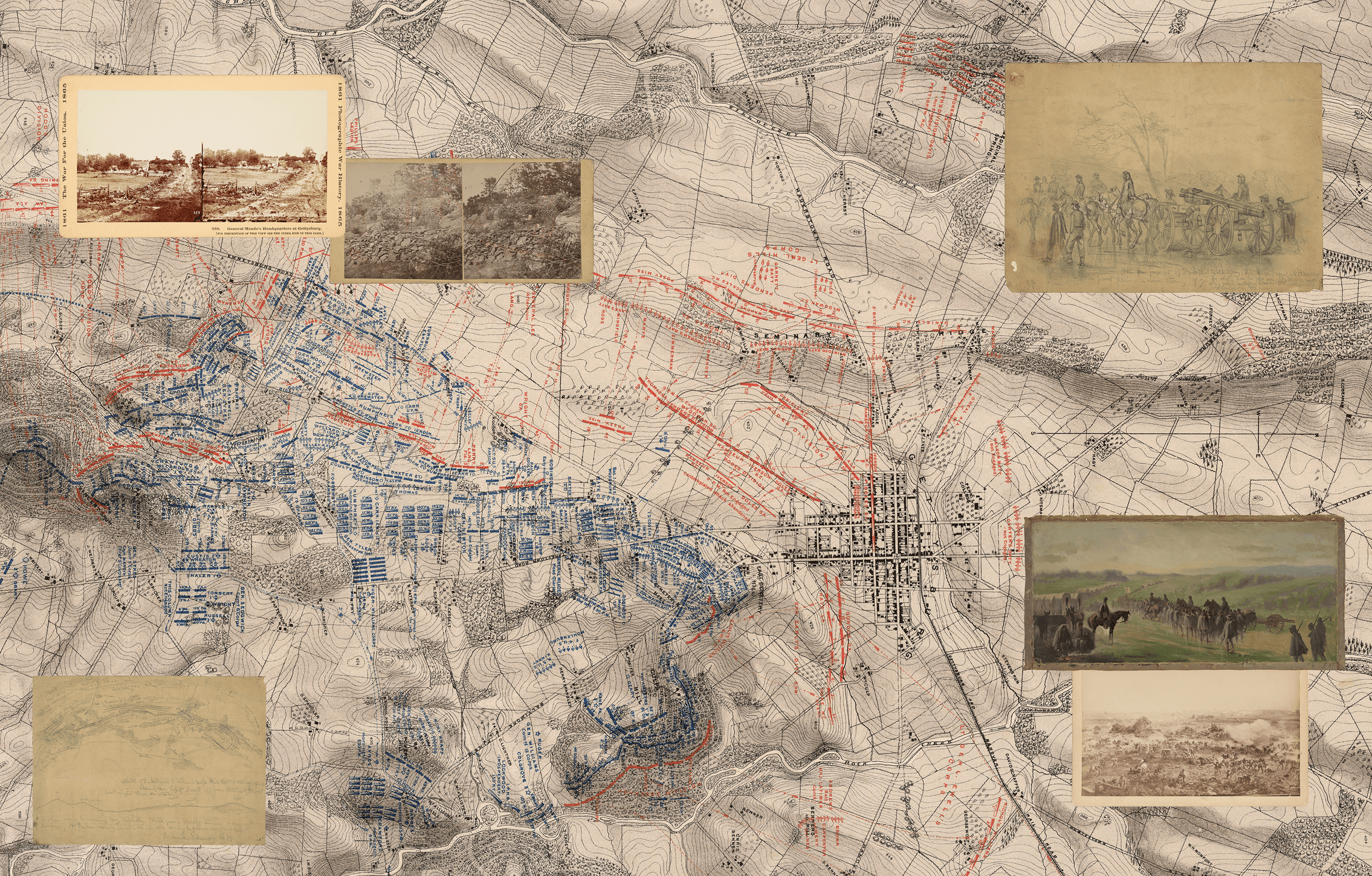

“The past and the future meet in the memory of the dead. The sweetest and brightest link in the chain that stretches over the past, binds us to the dead.” – from the diary of George B. Taylor, Virginia, 1863.
The road from Northern Virginia to Gettysburg in the springtime is a parade of white dogwoods, purple serviceberries, and endless miles of grass waving in the wind. Brick homes with proud classical columns and big red barns dot the landscape. The orchards are in full blossom, and it’s hard to imagine that this bucolic, bountiful quarter was once the crucible of the worst violence our nation has ever seen. I was traveling to Gettysburg to tour the battlefield with a group of Navy SEALs, and try to learn from the Civil War’s pivotal battle, the bloodiest three days of our nation’s worst conflict. Our spring visit was 160 years, almost to the day, since the end of that war.
I run a venture capital fund out of Silicon Valley. I live in the young West, far from the old battlefields of the East. I almost never visit cemeteries. My trade is really about the future. But I wanted to visit Gettysburg because of that link in the chain that George Taylor described, and that in learning deeply about a critical moment of the past, I’d have some new knowledge about how we might get past our present disunion.
America is in a discordant moment. Our politics are deeply polarized, even deranged at times, with hatred of the opposing party intensifying all the time. Political violence has been sadly normalized. Talk of anything from impeachment and prosecution to outright war is not uncommon as a response to the crisis of the week, whatever that happens to be. So often it feels like we’re walking a tightrope over a precipice. And at the same time, we try constantly to avoid reckoning with serious crises, like our ballooning national debt. Our cities are not a point of pride for our civilization, but are often embarrassing messes.
In Gettysburg’s quiet fields, the unseriousness of our day stings badly. If there is one seminal lesson from the past, it is that we have an important job to do. All we possess—our freedom, our wealth, our long lives, our ease—was passed on to us, not earned. We have to do justice to these gifts. It is that “great task remaining before us” that Lincoln spoke of when he visited Gettysburg in November 1863.

Three Martini Lunch.
Follow the money: from Wall Street’s great ’80s boom to the energy traders and builders financing what comes next.
Subscribe + Issue 006
Now as then, the place of the dead can be made a school for the living.
***
Jocko Willink served in the SEALs for twenty years. His unit, Task Unit Bruiser, is the Iraq War’s most highly decorated Special Operations unit. Together with the “Ready First” Brigade of the U.S. Army’s First Armored Division, Willink commanded operations against insurgents and al-Qaeda in Iraq that helped win the Battle of Ramadi in 2006. Willink and his colleague Leif Babin brought their battle-tested lessons from Ramadi back to Coronado, California — the West Coast SEAL headquarters — where they created a leadership training program for SEALs who would soon be deployed.
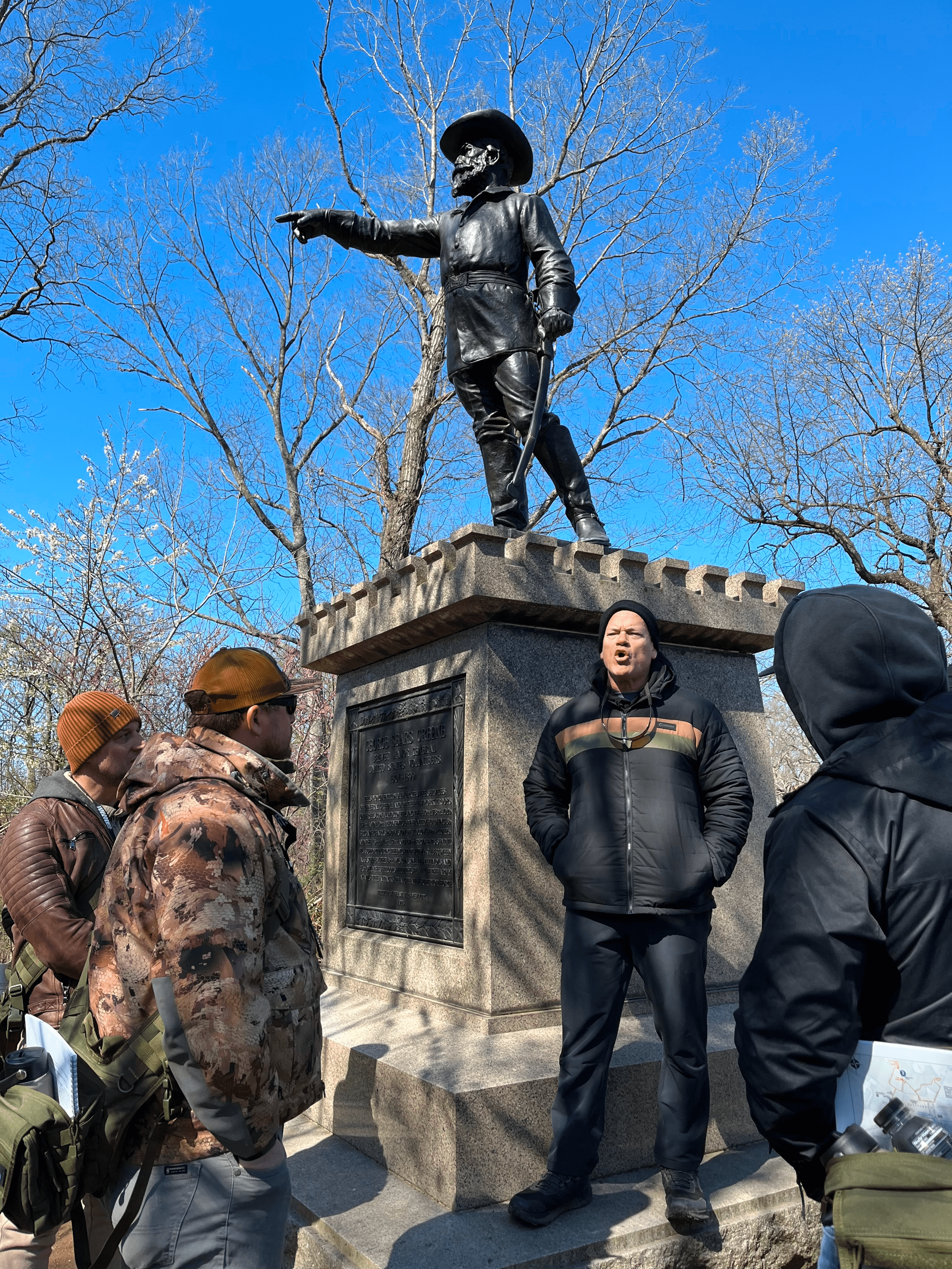
Since hanging up their Navy uniforms, Willink and Babin have taken those hard-won lessons to the wider world. They’ve penned a #1 New York Times bestseller, launched a popular podcast, and started a consultancy called Echelon Front. Willink’s most watched clip on YouTube – with 14 million views – is a monologue called “Good” in which he expresses his resolute optimism by saying “good” like a manic mantra in response to any setback. “Didn’t get promoted? Good. More time to get better.” Some can’t help but chuckle at the masochistic fervor, but for most listeners, it has become a defiant staredown with fate, a way to turn loss into learning. “Didn’t get the job you wanted? Got injured? Sprained your ankle? Got tapped out? Good. Got beat? Good. You learned.”
The first night of our meeting, we gathered in a private dining hall at the 1863 Inn of Gettysburg, located in the heart of the town’s historic district. There were about 35 of us, and our seats were assigned by group. Most of the tables were filled by whole teams from firms who had come to learn how to become better leaders. They tended to be mostly male and from industries like construction and even milk production. My table was the island of the miscellaneous.
Willink has a crew cut and broad shoulders; he is just shy of six feet tall, with hands that could dislocate your shoulders. He is a black belt in Jiu Jitsu, a booming voice, and a soldier’s eyes etched with lines. Willink’s colleague Babin writes in one of their books that “Even among SEALs, Jocko was a big, mean-looking, intimidating guy.” He is clearly not your average leadership guru, having really been to the edge of violence and endured.
He opened the night by talking about the challenges of leadership and the labyrinth of the human heart. “Welcome to Gettysburg, everybody. Y’all traveled a long way.” He scanned the room, taking everyone in.
“I was flying out here, and I was sitting on the plane,” he began. “I have a really chaotic brain sometimes, and I’m thinking…what is leadership? You can look it up in the dictionary, and you’ll see a bunch of very academic and cerebral definitions of what leadership is. I had all these very verbose definitions floating around in my head. But I don’t really like verbose definitions very much. And so I broke it down as simply as I possibly could. It’s getting people to do things. That’s all it is. It’s just getting people to do things. So it shouldn’t be that big of a deal, right?”
The room chuckled, half nodding in recognition, half at the glaring obviousness of it.
“I’m glad some of you chuckled at that. Because getting people to do things is so complicated. I think it might be the most complicated thing that there is. And the reason it’s so complicated is because human beings are so complicated. Leadership is the ultimate challenge.”
Willink is at his best, his most humorous, and most insightful, I find, when he riffs his way into a monologue. In this case, it was about how getting your children to clean their room or getting a Navy SEAL platoon to secure a hill are all really the same problem. The plan of action is clear, but getting people to act on it is hard.
“You have to do what I tell you to do because I outrank you” doesn’t work in the military, and it doesn’t work with your kids. It doesn’t even work with yourself! We fail to lead ourselves to do the right thing all the time. If all it took were reading the right business book or the right self-help manual, the world would be full of billionaires, sages, and happy families. But it’s not. Because even if the principles of leadership are written down, even if the best piece of advice is a billboard-sized slogan right in your face at the moment you need it, it is how we act our principles in the moment that really matters. Not to mention that we’re lazy, weak willed, and our egos get in the way.
Adding other people to the mix complicates it even more. The same error patterns within teams occur again and again. Principles, rules of thumb, and standards that are supposed to reduce these errors are often simple but not always easy to follow. This became a recurring motif for the next two days. “Simple, but not easy.” The other main theme was ownership (hence the name of Willink’s book, Extreme Ownership). Willink told us the best-performing SEAL units had leaders who accepted responsibility for everything: every mistake, every failure, every shortfall. The worst performers blamed others.
It was a lot to digest, let alone commit to memory, but we would walk the battlefield tomorrow to see where those principles won the day, or where ignoring them left bodies in the earth.
***
In the Spring of 1863, the Confederacy needed a big victory in the East to balance its impending loss in besieged Vicksburg, the last major Confederate stronghold on the Mississippi River. That loss was a big threat. (When Ulysses S. Grant’s siege at Vicksburg was complete on the morning of July 4, it cut the Confederacy in two, and gave the Union control of the Mississippi River, a strategic and logistical boon). But if Robert E. Lee could win a decisive battle in the East, it wouldn’t matter what happened in the West. Lee had decided it was time, in own words, to “assume the aggressive.”
The war had been dragging on for two years. For Lincoln, the disastrous battles of the last year made him seem a failure as commander-in-chief. The Confederate Army under Lee was on a roll. The Union had lost at Fredericksburg, Virginia in December. And in May, it lost again at nearby Chancellorsville. The Union was on its third chief general in less than two years. As a result, the coalition supporting Lincoln was fraying. Republicans who lost their seats in Congress blamed Lincoln. Moderates in border states like Maryland and Kentucky bitterly regretted the Emancipation Proclamation while abolitionists in Massachusetts cursed Lincoln’s hesitation to end slavery outright. In Maryland, Lincoln censored the press, suppressed freedom of speech, and put political dissidents in jail. They are controversial moves to this day that had little to show for the sacrifice.
The Election of 1864 was approaching fast. Support for the war in the border states had plummeted, and the peace platform of the Democratic Party was gaining ground. General Lee thought a Confederate victory in the heart of the Union — Pennsylvania — would convince voters that the war was going on too long, at too high a price. Lincoln would have to come to the negotiating table.
Then there was a simple brute fact. Armies at that time were like locusts, eating anything and everything in their environs. Lee’s army had been stationary for so long that all the farms and orchards in Virginia were stripped bare. His men needed food and there was plenty of it in the North. So on June 3, 1863, Lee broke the calm of the spring and invaded the North.
The three days of July 1, 2, and 3 in 1863 at Gettysburg marked a turning point in the Civil War, the beginning of the end of the Confederacy, and with it, slavery in the United States. The two armies had 57,000 casualties total, with 9,600 dead and the rest wounded or missing. To this day it remains the bloodiest battle in the history of the United States.
***
What can we learn from the past?
Willink and his team were telling us that, at a minimum, history can illuminate the pitfalls, by revealing the common mistakes we repeat and what we could have done differently. But so many academic historians, those guardians of serious opinion, recoil at the thought of “What if?” questions, the idea that things might have been different, if only significant actors had made different, better decisions. E.H. Carr, in What is History?, a classic book from 1961 that has sold hundreds of thousands of copies, captures the disdain of professional historians when he dismisses attempts to ponder “What if?” questions as a mere “parlour game” and a “red herring.” His colleague E.P. Thompson goes further, calling the whole enterprise “Geschichtswissenschlopff, unhistorical shit.”
History, Carr concludes, “is a record of what people did, not what they failed to do.”
That spirit continues today, slightly altered, in the work of historians like Jill Lepore, a professor at Harvard and a writer for The New Yorker whose book, These Truths: A History of the United States, ascended the bestseller lists amid critical genuflections. There, she exalts the anonymous swell of social movements over the isolated gestures of individuals. In a 2019 Rolling Stone interview to promote the book, she derided vulgar histories fixated on battles or presidential action, stating “Most popular history is either military or presidential and has little sense of the incredible force and political power of social movements and protest movements…” As if individuals could ever bend the arc of events. (Incidentally, Harvard claims its mission is to educate “citizen-leaders for our society” but doesn’t offer a single undergraduate class in leadership. Maybe Lepore convinced them it didn’t matter.)
And not only academics, but even Tolstoy, in his great novel, War and Peace, was possessed by the idea, quite monomaniacally towards the end of his sprawling masterpiece, that examining decisions and action is a futile pastime. For Tolstoy, the act of decision-making on a battlefield was delusional. Actually, in fact, it was worse than that. He saw a tragic irony in action: the more you strove, the worse you did. So the fatalistic Russian concludes, “Those, however, who tried to understand the general course of things and wanted to take part in it with self-sacrifice and heroism, were the most useless members of society…”
It’s fair to say that we live in a post-heroic age, heirs to the disenchantment of Carr, Lepore, Tolstoy, and other futilitarians and determinists. Our contemporary philosophy of history centers on the idea that history is largely unpredictable and driven by countless chaotic individual actions. We are involuntary instruments of larger forces we cannot comprehend, nor ever dream of leading. “Such is the inevitable fate of all men of action,” Tolstoy writes, “The higher they stand in the human hierarchy, the less free they are.”
But here in the dining room at the Inn, far from the academic chatter, we were examining the role individuals and teams play in shaping the destiny of a battle, a war, and a nation.
There is an old tradition in the U.S. military, going back to the aftermath of the Civil War, where younger commanders were teamed with Civil War veterans to tour a battlefield. It was called a staff ride because they would ride horses, get off at significant locations, stand around, and have discussions over what took place and why certain leaders may have made the decisions that they made. They discussed “What if?” questions to understand how they might improve their performance on the field. The past was a guide to the future. For the next two days, ignoring Harvard historians and Tolstoy, we would be doing the same.
There would be four sections to each stop on the battlefield. The first bit would be led by Colonel Rob Abbott, a retired Marine and licensed Gettysburg tour guide. He’d explain what had happened in the battle up until that point and the overall strategic context. Abbott has a wry sense of humor and would salt his narrative with colorful anecdotes. The second section, led by J.D. Baker, would relate in greater detail the leaders, their personalities, and the key decision they faced in that moment. Baker is also a retired Marine and the former director of the Marines’ scout-sniper program. He is a real cut up who turns it up to eleven in his animated delivery and comedic role playing. The next section would open up into a group discussion, both about how leadership could have made better decisions in this moment, and how we might apply the same principle in our own work. During the last section of a stop, Willink, the guides, and the other SEALs would offer their insights and takeaways in a roundup.
Willink closed out the night by informing us he’d be in the hotel parking lot at 4:30am for a workout of burpees–squats, push-ups, and jumps. We were free to join. It was our choice. Buses would depart for the battlefield at 6:30am.
July 1, 1863
I did not make it to the 4:30am workout. Breakfast at the hotel was a soggy array of waffles, eggs, and sausages. Waiting for a weak toaster to brown my bagel on its third time through, I sipped tepid coffee. Last night, for no apparent reason, I was appointed leader of my table, now called a fire team, which meant that I had to make sure five strangers were always accounted for and on the bus. Every time one of the SEALS asked me for a headcount, I froze a bit, worried I had missed someone.
The first stop on our battlefield review was to McPherson’s Ridge, a small hill half a mile west of Gettysburg from which John Buford, a Union cavalry officer, commanded his forces on the morning of July 1, 1863. The sun was starting to rise as our bus made its way to the ridge, and the statues placed near the roads were dark silhouettes in the early light. We disembarked, walked across a wet field, and formed a half circle around Willink, Abbott, Baker and the others.
“Listen up,” Willink said. We were starting our first discussion.
After peeling off from the battlelines of Virginia, Lee had concealed the movement of his army behind parallel mountain ranges and ridges, running north by northeast, slanting through Virginia, across the Potomac River, through Maryland, and up into Pennsylvania. His warpath was close to the route I had taken driving from Dulles International Airport, the key difference being that Lee hid his army behind the Allegheny Mountains further to the West (and what today takes 90 minutes was a many-day affair on foot).
The Union Army couldn’t see beyond the mountains and was at a complete loss as to Lee’s whereabouts. The Grey Fox had invaded the North, and no one really knew where he was.
Lincoln wanted to crush Lee, of course, but his primary strategic objective was to defend Baltimore, with its vital port, and Washington. The Army of the Potomac, therefore, had to position itself between Lee and the Capital. Adding to the chaos was the fact that Lincoln had sacked General Hooker and replaced him with General Meade, knowing full well that Lee had already invaded and that a battle was imminent. The Army of the Potomac began its march north, but when and where they would meet Lee was only a guess.
A guess, that is, until Union cavalryman John Buford’s brigade spotted and identified three southern infantry corps coming down through the mountain pass west of Gettysburg. After three weeks, Lee had concentrated his forces and had turned east through the mountains at last. Buford was staring down the tip of the spear of a 72,000 man army. Some 50,000 men would be coming down the road in front of him. And to his right, from the northern road, another 20,000 or so Confederates were approaching. Standing on McPherson Ridge, we were looking out from the same vantage point as Buford did that morning of July 1st, 1863.
The previous evening, Buford had rushed a note to General Meade: “We need help now.” Meade and the bulk of the Northern Army were 14 miles away. The closest army corps of a few thousand men was five miles away and led by John Reynolds. It would take time for the army to get to Buford. His staff recalled later they “had never seen him so apprehensive, so uneasy about a situation as he was at this time.”
As the night went on, Buford had a difficult decision to make. Generals on both sides were desperate to fight battles on grounds of their choosing. Terrain and elevation were often decisive factors. Even invading armies preferred a defensive battle, if they could manage it through maneuvers, where they could pick a position on the high ground and wait for an attack. In fact, Meade had devised a plan to try to lure Lee down to Pipe Creek and Parr’s Ridge, and make a stand about 15 miles south of Gettysburg, where he thought the terrain was most to their advantage.
Buford saw that to surrender the high ground just south of Gettysburg—the now famous topography of Little Round Top and Cemetery Ridge—would be a massive strategic blunder. But the odds were not in his favor. His two brigades, just 2,950 men, would have to hold off tens of thousands of Confederates until reinforcements led by Reynolds and then Meade could arrive and secure the heights. He’d have to hold them off for at least three hours in the morning of July 1st.
Buford was a hard man and, by many accounts, arguably the best cavalryman in the whole army. Nevertheless, he had little direct guidance from headquarters. He was only in Gettysburg on a scouting mission. His orders were to “cover and protect the front, and communicate all information of the enemy rapidly and surely.” So what was Buford to do? Retreat and let the Confederates seize Gettysburg? Or fight and skirmish? His best hope was to delay them. If he couldn’t, they’d take the town and claim the high ground from which it would be lethal to dislodge them.
Willink split us into our fire teams to discuss Buford’s decision. If Lee took the high ground, he could flank the Army of the Potomac, and the road to Baltimore and its port would be wide open. (J.D. Baker made this point for us by pointing his whole arm towards Baltimore like a frantic human semaphore, as if to emphasize that Baltimore lay somewhere just beyond the town of Gettysburg.) Buford had to have confidence that his improvised tactical plan would move up from the front lines to the top of the chain of command.
Think about that, one of the SEALs marveled: the top general had a plan, and a subordinate had to have the confidence that he could change the general’s mind to adopt a new course of action.
This, we learned, was one of the first principles of combat for the SEALs, what Willink called decentralized command. No soul has a full grasp of everything happening across the battlefield; the fog of war and distance blind all. Leaders who are remote, listening to radios, and staring at maps can’t monitor the actions of multiple units in a chaotic environment. Decentralized command pushes choice downwards, to the line’s edge, where fighters can shift tactics with new information.
Reciprocal trust is key. Those on the frontline have to trust that their senior leaders have made good strategic plans. And then those leaders in turn must place great trust in their subordinates, empowering them to take improvised tactical action. For that to work, subordinates need to know why, and understand the mission’s North Star. The opposite is to micromanage without explanation, to dictate every X on the map from on high: a general, hunched over his desk, trying to puppeteer every soldier, every regiment like a marionettist, yanking strings till they snap. It doesn’t work.
“Keep that in mind,” Willink said. “Meade had a good plan. Directly from the president. Protect these areas. And then he goes, okay, I heard from my front line troops that there’s a better option. Can you confirm there’s a better option? Nope. But it seems like a better option, I’m going to trust my guy. Let’s go. How do you think that made these guys here on McPherson Ridge feel? How do you think that made Reynolds feel? The boss listens…how much is that worth?”
As luck would have it, Meade and Reynolds were longtime friends who respected and trusted each other. Both respected Buford by reputation. One staff officer noted, “Buford and Reynolds were soldiers of the same order, and each found in the other just the qualities that were most needed to perfect and complete the task entrusted to them.” Buford sent a note up the chain of command saying he would “entertain” the enemy until Reynolds could reach the battle. The entire battleplan of the Union army shifted at that moment. Now Buford just had to pull off a miracle.
Buford devised a defense in depth, i.e. one with multiple layers. The intelligence Buford had collected suggested that the Confederates were massed in a small town down the road our bus had come in on, the Chambersburg Pike. From the elevated terrain of McPherson’s ridge, we could see the road going to the mountains in the west. Buford scattered his men in arcs from where we were standing — behind posts and rail fences, spaced in intervals like a series of ripples widening out to the west and north.
His men were cavalry, not infantry. They kept their horses a short distance behind their posts; a quarter of the men were stationed in the rear to hold the others’ horses. Buford wanted them to act like infantry in order to fool the southern commanders into thinking that there were more men than there actually were. Their orders were to fire their carbines at the enemy as they approached to vex and slow them down. The order was not to hold their ground. When the Southerners were close enough, a picket of men should peel off, hightail it on horses back to a new post, and delay the Confederate advance further.
Sometime just after 6am, two privates from the 8th Illinois Cavalry, Thomas B. Kelly and James O. Hall, saw a prodigious cloud of dust rising from the road ahead, about three miles down. Something massive was moving their way. They sent word back to a commanding officer. Lieutenant Marcellus E. Jones came to check it out. Eventually they could make out a Confederate flag and the men carrying it in the lead column. Jones asked one of the soldiers for his carbine, which had a range of about 800 yards. He propped it up on a rail fence and aimed at a soldier on horseback near the flag. At about 7:30am, Jones fired the first shot in the Battle of Gettysburg.
The fighting that morning was intense, and the Confederates drove Buford’s line further and further back. But the defense in depth had stalled long enough for Reynolds’ reinforcements to arrive.
The general consensus is that the South won the first day of the battle. Over the rest of the day, their forces would overwhelm the Union Army, push them back, and ultimately seize the town of Gettysburg. Lee himself declared that his opponents “were entirely routed.” When Reynolds arrived on the scene that morning, he had ordered reserves of infantry and artillery to hold Cemetery Hill, just south of the town that Lee now held. Shortly after giving these orders, Reynolds would be shot and killed, a Minié ball right through his neck, but the high ground had been secured.
Below, Lee would soon learn the price of his error.
Little Round Top, July 2nd, 1863
I slept through the 4:30am burpee workout again. With another half-toasted bagel and headcount, we were off on the bus at 6:30am to visit our first two locations in the morning, the Peach Orchard and Little Round Top. The fight for Little Round Top was the hinge in the three day battle, a rock that stood against wave after crashing wave of attack. By defending this otherwise unremarkable hill, a few Northern brigades blocked Lee’s army from flanking the entire line of the Army of the Potomac.
Victory would constrain Lee’s options for the next day. With no way to flank the Union, Lee was left with a thrust straight at the heart of the Union line, Pickett’s doomed charge into the maw of Northern guns firing down from the high ground. Winning the fight for Little Round Top was critical for the Northern victory at Gettysburg. It is the high water mark from which the South would recede forever. But it was almost lost.
We gathered on the highest ridge at Little Round Top, in a semi-circle around Willink, Abbott, Baker, and the other SEALs. It had started to rain. Some pulled out umbrellas. I put on a rain poncho some young technologists had given me, a world away in California. It says “Dyson Sphere Maintenance Crew” across the back. A Dyson Sphere is a sci-fi dream to harness all the power of the sun. I can’t think of a more remote concept from what I was looking down upon.
In the fields below us, in an area called the Devil’s Den, and near it the Wheat Field, by the afternoon of July 2nd, the bullets had cut the wheat down and painted it red. There were 6,000 dead or wounded in the Wheat Field that day and they were packed in so tight soldiers later said you could walk from one end of the field to the other without ever touching the ground. The farmers had fled the area, but their hogs stuck around, and had started eating on the dead and wounded men. Soldiers wrote in their journals that they stayed up all night with swords and bayonets trying to keep the hogs at bay in the dark.
The slaughter on both sides that day was horrific. The action, sharp and at close quarters. Human masses would teem, move, get destroyed, and then crop up again. The most common image used by soldiers in their diaries is of a scythe reaping a harvest of death. Bursting shells, firefights, clouds of flash and thunder, volleys, canisters exploding into a hailstorm of shot, men screaming, sweeping enfilades fired down lines of men, killing five or seven soldiers at a time. It was a mowing.
From where we stood, the elevated ridge lines clearly provided superior shooting positions, rocks for cover, and ravines for exit. Abbott had set the scene for us, and now Baker was reflecting on how it came to this, the storm of violent chaos below and the desperate attempt by the North to protect its exposed side on this hill.
“We are dealing with the repercussions of one individual who decides that he doesn’t like his position on the Union line. He disobeys orders six times. Six times. Paddy O’Rorke, the 20th Maine, Pennsylvania and New York–they’re all struggling on Little Round Top because of one individual,” Baker said. “It only takes one to make sense of where we are.”
That man was a character named Daniel Sickles. Sickles was a notorious figure. A former congressman from New York, and a New York City power broker, Sickles shot and killed his 15-year-old wife’s lover, and was acquitted on the murder charge, making his case the first successful use of the temporary insanity defense in U.S. history.
Sickles commanded the Third Corps, and he didn’t exactly follow orders well. He was not a soldier by training; he had not attended West Point, nor had he served in the military prior to the war. He had earned his position as a general through political influence. At the end of the first day of fighting, thanks to Buford’s and Reynolds’ delaying action, the Union had formed a defensive line on the high ground in the shape of a fish hook. That hook began south of downtown Gettysburg at Culp’s Hill, curved northwest to Cemetery Hill, then turned south, running two miles along Cemetery Ridge all the way to Little Round Top. Meade had positioned Sickles towards the end of Cemetery Ridge near the bottom of the fish hook, just north of Little Round Top.
For reasons unknown, on the morning of July 2nd, Sickles decided to position his men out on a limb, extended far from where he should be in a peach orchard, nearly a mile away from the main defensive line on Cemetery Ridge. Sickles didn’t even notify headquarters he did this. (One major who served with Sickles later said he and Sickles both agreed the peach orchard was more advantageous for meeting the anticipated Southern attack. Sickles claimed his artillery would be better situated on the flatter ground. Another account reported that Sickles thought his men were more vulnerable on the ridge thanks to Buford’s cavalry being relieved and no one replacing them. And yet another account stresses that Sickles was a friend of Joe Hooker, the man General Meade replaced, and that Sickles, a Democrat, resented Lincoln’s choice, and that he despised the cliquish and cautious West Pointers).
At any rate, Sickles ignored Meade’s orders to return to the defensive line on the ridge six times. After the fifth act of insubordination, Meade mounted on his horse and rode out to the peach orchard to deliver the order himself, telling Sickles to return to his position on Cemetery Ridge. But Sickles refused to leave. Meade’s aide had never seen Meade so angry. Sickles’ corps was exposed, isolated, and on flat ground. But by this point, it was already too late. Sickle’s men were soon hit by the first wave of Confederate attack.
Meade then had to order thousands of men out to the fields and down from the high ground to bail Sickles out. These were the men who fought and died in great numbers in the Wheat Field. And because Sickles had moved his corps to the peach orchard, he had left Little Round Top defenseless. Save for a few men waving flags to communicate, the hill was now unprotected, exposed, and inviting an attack.
Willink used this opportunity to raise a difficult problem for leadership. What do you do when the people below you do not follow orders? We broke up into our fire teams, and he had us run a role playing scenario where one of us would play Meade and the other Sickles, trying to convince one another.
The people who played Sickles asked, wasn’t Sickles like Buford? Shouldn’t we see decentralized command as a virtue? It worked the day before. What was different here? Maybe Sickles had discovered some new information about the topography that Meade and the others were unaware of.
Willink jumped in with his perspective during the recap. “There is absolutely going to be risk with decentralized command. And so you, as a leader, have to pay attention,” he offered. Compared to Buford, who communicated clearly and often, Sickles was an unresponsive scoundrel.
Another SEAL suggested that Meade might have taken ownership of the situation earlier, based on Sickles’ already demonstrated recalcitrance. Meade might have had a face to face meeting with Sickles in the Peach Orchard much earlier in the day than he did. He could have better explained to Sickles in the morning that he didn’t have a full understanding of the enemy’s position or movements. Whatever the case may be, it was on Meade to make sure Sickles understood the overall strategy and to train him up. Leadership is a skill, Willink and his colleagues would remind us.
Any principle can be taken too far. In the case of decentralization, it only works if the constituent parts — in this case, men — are aligned in purpose. Buford, Meade, and Reynolds had strong relationships. Sickles was an antagonistic outsider. And as Baker put it, “If you disobey an order, you better win.” Tragically, Sickles did not. Meade’s men paid the price.
A year later Sickles would testify against Meade before a Congressional committee, saying that his actions in the Peach Orchard set the Union up for victory at Gettysburg, and that Meade had been trying to retreat to Pipe Creek. In a darkly funny twist, Sickles was awarded the Medal of Honor in 1897.
Back on the ridge, Baker closed out our session by reading aloud from Elijah Hunt Rhodes’s journal, now a book called All for the Union. Rhodes started the war as a private; by the end, he was the colonel of his regiment. Rhodes and his fellow men marched thirty-four miles non-stop to join the battle at Gettysburg that day. The soldiers, though exhausted, quickly prepared to engage and entered the fray below us on this ridge.
“So as you’re looking over these fields, and you’re trying to imagine what it was like on July 2nd, 1863,” Baker said, before stopping for a moment. “You know, I was with some Marines and they questioned the training and education that I was giving, and they’re like, ‘What are you preparing your men for?’ And I would read them this chapter. This is what I’m preparing for. It’s why you get up at 4:45am in the morning. Because I’ve got to be ready to go this distance, to enter these fields, all for the Union.”
It made me question my decision to skip burpees with Willink at 4:30am.
***
One Alabama brigade started July 2nd on the other side of the mountains to the west in New Guilford. They were awakened at 3 o’clock in the morning and ordered to march thirty miles in 11 hours. As the Alabamians approached the front line, they sent a group to go fetch some water. But Union sharpshooters captured the twenty-two guys carrying all of the canteens. So they didn’t have any water. Then they lost four of their five colonels, one wounded, three down with heat stroke. The rest made it to Little Round Top, and they were going to unleash an assault upon the hill.
The Alabamians hit a wall. They kept probing, looking for a gap, trying to feel out where the utmost left flank of the Union was, because they wanted, in the words of Baker, to flank’em and spank’em.
The force they hit was put in place by a Union colonel named Strong Vincent and the soldiers manning the line were the 20th Maine, led by Joshua L. Chamberlain. The Union was lucky these 500 men were there. Their presence as a defensive line at this moment hung on the most unlikely chain of competent, daring men finding each other and taking action.
Here, again and again, they pushed back Alabama’s attacks; Alabama renewed their attacks. It was a bitter struggle of diminishing numbers, low to no ammunition, and hand to hand combat. On top of that, diarrhea, heatstroke, and hunger. The short distance between the men from Alabama and the men from Maine produced some of the most terrifying carnage, and also the most inspiring heroism of the war.
Our group made its way down from the high ridge, and walked down to the southern back side of Little Round Top, to the point where the 20th Maine held its ground. A slight incline, it was full of bushes, trees, stumps and large boulders, but there was still a clear view to the rising slope where the action took place in the late afternoon of July 2nd. Abbott set the scene for us.
Meade had mounted his horse, and was on his way to get Sickles’ corps out of the Peach Orchard and repair his defensive line. Along the way, he and one of his staff, a man named Gouverneur Warren, noticed that Little Round Top was undefended. Meade told Warren to check it out and report back to him. He had to go rip into Sickles for not obeying orders. So Warren peeled off. When he got to the ridge, his anxiety deepened. There were no Union soldiers there. Rifle bullets zipped by and tore through the trees around him. If he didn’t get reinforcements quickly, the Confederates would take the hill.
Warren immediately sent handwritten notes off to rustle up some brigades to the hilltop. The unlikely, fragile chain began to form. He gave a note to a teenage soldier-courier, telling him to find a commanding officer named General Sykes. Then Sykes told one of his captains to tell General Barnes, and now that captain was riding around, trying to find General Barnes…but he couldn’t find him in the confusion. Suddenly Strong Vincent of the 20th Maine saw the captain looking lost and hopeless. He asked to see the note. Vincent was supposed to be heading to the Wheat Field, to help save Sickle’s corps. But now he was alerted that Little Round Top was vacant. He had to change his plans.
Taking action, not waiting for permission, Vincent marched his men to the top of the hill, and ordered other brigades to join him. It was the right thing to do, but his action was so quick that he made one mistake that would come back to hurt the brigades that defended Little Round Top. Vincent forgot to tell his logs chief, the man in charge of supplies, to redirect their supplies to Little Round Top, instead of the Wheat Field. The brigades that fought on the hilltop had limited ammunition, limited water, and limited food.
Once on the hilltop, Vincent began to place the regiments in an arc stretched the line all the way around the hill to its rocky western face where we had been. The left most point was the extreme end of the Union line. It would become the point of maximum conflict. To Colonel Joshua L. Chamberlain of the 20th Maine, Vincent said, “I place you here! This is the left of the Union line. You understand? You are to hold this ground at all costs!”
Chamberlain was a professor of rhetoric at Bowdoin College in Maine. Major Ellis Spear, a former student of Chamberlain’s who served under him, described Chamberlain as “a gentleman and a scholar, and although he was also without military knowledge or experience, he was a man of such intelligence and urbanity and kindliness of feeling that he exerted a useful influence.”
Bowdoin College thought Chamberlain was departing to Europe to conduct research, on paid leave no less. Teachers were exempt from mandatory military service. Instead, Chamberlain snuck off and joined the Union Army. And now he was holding the line, fending off hit after hit from a ferocious Southern attack. After hours of the onslaught, his brigade had nearly run out of ammunition. His line had thinned. Wounded men lay around screaming in agony. The dead scattered everywhere.
“I want to give you a sense of Chamberlain, in his memories, of what he did here at Little Round Top,” Baker said to us. “Chamberlain is right here where you are standing. He’s got this young officer who comes up to him and says, ‘Something’s happening down there out in front that we can’t see.’ So Chamberlain runs back, and he mounts a great rock.”
Baker acted out Chamberlain’s action. He moved from where we were standing in our semi-circle back to a rock no one had really noticed before.
“This is the rock that Chamberlain mounted. So Chamberlain rises up on the rock and sees something going on down there. He’s elevated himself, and he’s up here.” Then Baker began to read aloud from Chamberlain’s war memoir, Bayonet! Forward, a section that is his report written to his superiors three days after the battle:
“Mounting a large rock, I was able to see a considerable body of the enemy moving by the flank in rear of their line engaged, and passing from the direction of the foot of Great Round Top through the valley toward the front of my left…We opened a brisk fire at close range, which was so sudden and effective that they soon fell back among the rocks and low trees in the valley, only to burst forth again with a shout, and rapidly advanced, firing as they came. They pushed up to within a dozen yards of us before the terrible effectiveness of our fire compelled them to break and take shelter. They renewed the assault on our whole front, and for an hour the fighting was severe. Squads of the enemy broke through our line in several places, and the fight was literally hand-to-hand. The edge of the fight rolled forward and backward like a wave. The dead and wounded were now in front and then in our rear. Forced from our position, we desperately recovered it, and pushed the enemy down to the foot of the slope.”
Baker continued to read out loud: “It did not seem possible to withstand another shock like this now coming on. Our loss had been severe. One-half of my left wing had fallen and a third of my regiment lay just behind us dead or badly wounded. At this moment my anxiety was increased by a great roar of musketry in my rear, on the farther or northerly slope of Little Round Top, apparently on the flank of the regular brigade, which was in support of Hazlett’s battery on the crest behind us. The bullets from this attack struck into my left rear, and I feared the enemy might have nearly surrounded the Little Round Top, and only a desperate chance was left for us. My ammunition was soon exhausted. My men were firing their last shot…It was imperative to strike before we were struck by this overwhelming force in a hand-to-hand fight, which we could not probably have withstood or survived. At that crisis, I ordered the bayonet. The word was enough. It ran like fire along the line from man to man, and rose into a shout, with which they sprang forward upon the enemy, now not thirty yards away. The effect was surprising; many of the enemy’s first line threw down their arms and surrendered. An officer fired his pistol at my head with one hand while he handed me his sword with the other.”
The bayonet charge of the 20th Maine was the turning point of the battle and possibly the war. That could be a claim taken too far, but I am prepared to defend it. Academic historians in our anti-heroic age tend to downplay the importance of Little Round Top, largely I think because in the decades after Gettysburg, it took on the stature of a legend. It was just too heroic to be true. It was too self-serving.
Now granted, it is true that Warren, Vincent, and others deserve their fair share of credit; and that Chamberlain was his own best promoter in the decades that followed (he was a gifted writer). And it also must be said that there were other critical fights taking place that day, first in the center of the Union’s line and then at the top of the fish hook at Culp’s Hill. And there was another day of battle ahead. I can grant all of this, but the counterfactuals these historians present to make the case just aren’t convincing.
It’s hard to imagine a scenario where the Confederates take Little Round Top, roll up the Union left flank, cut them off from their supply chain, and flank the rest of the defensive line, and yet somehow, we are then to believe this wouldn’t matter to the outcome of the battle as a whole. In his Gettysburg: The Last Invasion, Princeton professor Allen C. Guelzo suggests that reinforcing Little Round Top may have weakened Sickles position in the Peach Orchard and thus caused the Union more trouble, which one look at the topography could have refuted. The best the Union could do there was limit their losses. Even less credible are Southern officers who later wrote they had already decided to retreat before Chamberlain and his men charged. There is no getting around the fact that screaming Yankees on the run had put fear into their hearts. Those Yankees chased the Confederates all the way beyond the next hill over. Some joked they could have kept going all the way to Richmond.
“If we had been five minutes later [to Little Round Top],” Charles Salter, a private from a Michigan regiment posted near Chamberlain, wrote, “the enemy would have gained the ridge we were on, and turned our left flank, and it would have been very hard to drive them from it.” This was a private with no fame to gain, not a politician with an election to win or a proud loser looking to save face.
After Baker stepped down from the rock, I had to stand on it for myself, to see what Chamberlain saw. There is a presence, I must admit, a standing-thereness to the rock, a heightened silence, an edge to something for which there are no words. Chamberlain had started the day with 500 men under his command. At the end of the day, only 198 were left. Some years later, a group of the veteran Confederate soldiers who fought that day wanted to place a monument on Little Round Top to honor the Alabama regiments. They sent a note to Chamberlain, in effect asking for his blessing. And Chamberlain’s response was, “Why would they want to put a monument on Little Round Top? They never got there.
November 19, 1863
The significance of Gettysburg was not clear right away to the warring parties, nor even to Lincoln himself. He was distraught that Lee had gathered his broken forces and had escaped back to Virginia. Gettysburg was Lee’s Waterloo, and Meade had let Napoleon go. Lincoln felt it should have meant the end of the entire war. He wrote a letter to Meade excoriating him, but in the end, decided not to send it. Instead, he left it in his desk drawer for history to discover.
Three weeks after the battle, the dead were still scattered throughout the hills and fields. David Wills, a local lawyer and leading light of Gettysburg, wrote to the governor of Pennsylvania that “In many instances arms and legs and sometimes heads protrude and my attention has been directed to several places where the hogs were actually rooting out the bodies and devouring them.”
There were more dead than there were inhabitants of Gettysburg. It was an open question what to do with all of the limbs, corpses, and other remains. The governor appointed Wills as his agent to establish a national cemetery for the Union dead. Confederate bodies were thrown in unmarked mass graves and moved to the South years later. Wills secured land for the cemetery, and arranged a dedication ceremony.
Wills invited a man who was considered the greatest public speaker of the time, Edward Everett, the former president of Harvard University, to provide an “oration.” Originally, Wills wanted the event to take place in October, before the frost came, which would make it difficult to inter the bodies, but Everett objected , saying that he would need more time to compose a speech worthy of the occasion. So the event was pushed to November 19th, 1863.
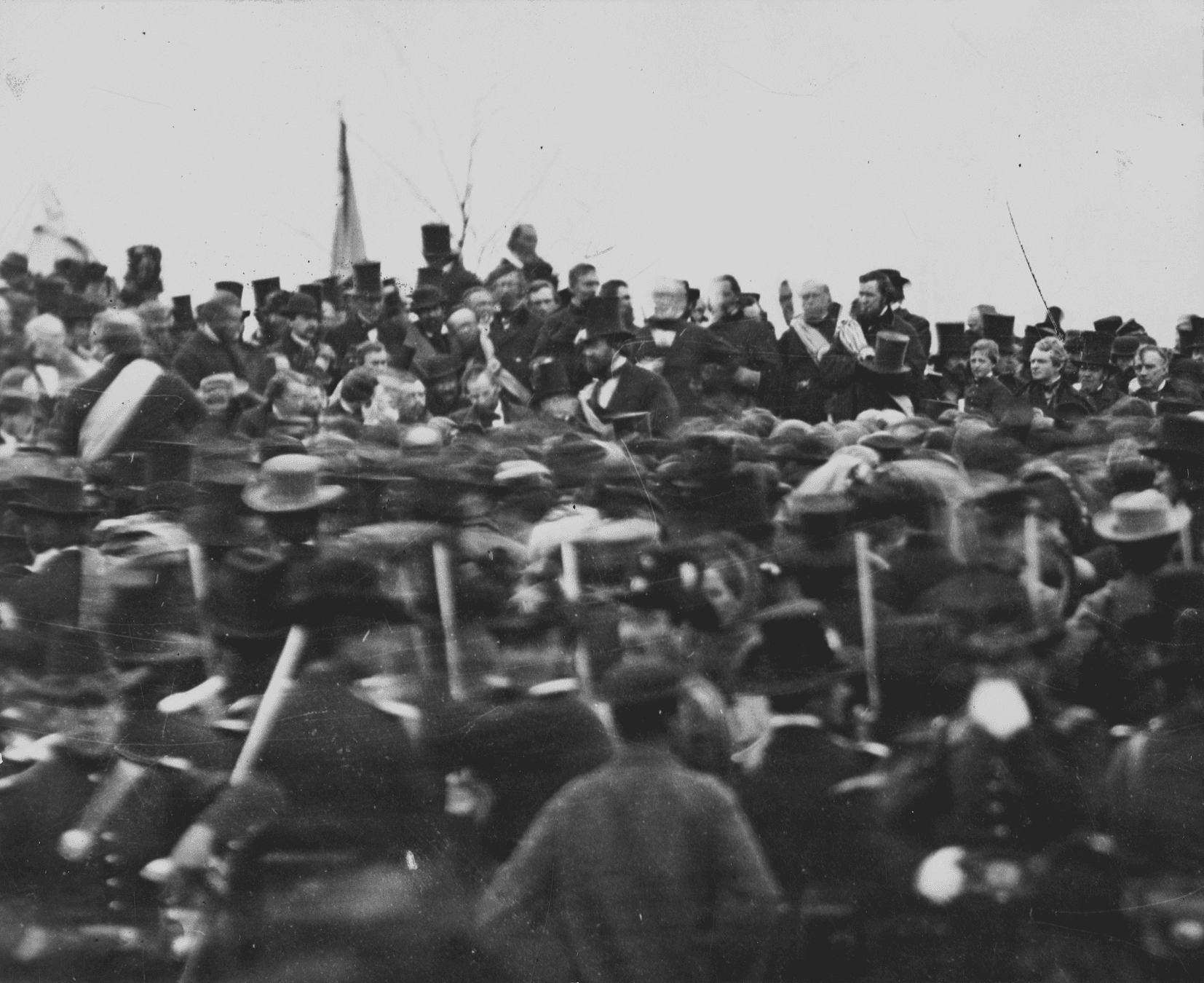
Everett composed a flowery speech that was two hours long, an epic which he recited from memory. One Gettysburg resident said she thought Everett’s speech would never end. In the words of Garry Wills, a historian and scholar of rhetoric, Everett’s speech, as ornate and polished as it was, “was made obsolete within a half-hour of the time it was spoken.” When Everett had finished, music played, and then President Lincoln stood up and spoke fewer than three-hundred words in around three minutes. He had finished writing and revising them the night before.
It is the nature of poetry to endure in the mind. Joseph Gilbert, a journalist for the Associated Press, was there to report on Lincoln’s speech. Lincoln stepped to the front of the platform, his hands clasped, and began to speak. Gilbert was taking notes, but as he listened to the words, he became mesmerized, and his pen came to a full stop. “Fascinated by his intense earnestness and depth of feeling, I unconsciously stopped taking notes and looked up at him,” he wrote.
Plato says that the two aims of a funeral speech are to extol the dead and to exhort the living — “Laud the dead and lead the survivors.” Lincoln did both, but he didn’t just instruct us to strive forward. He challenged the crowd to remember the meaning of the past. And as with most challenges, there is a right way of responding. The future will judge whether we responded well. Lincoln dared the crowd then, and dares us now to ask whether we have made ourselves worthy of the sacrifices of the past.
A couple of months before my Gettysburg visit, I met a French sculptor named Missor who told me he feared we were returning to a pagan sense of time, when time was thought to circle back on itself, like a millstone turning in place. He told me we needed to remind people–even shock them–through sculpture that history could be linear. History could rise to greater heights, potentially to the stars, he said, but we had to see time as something we carve, like a stone, to pass on to those who come after us.
“Non! Mankind’s ultimate act is not to forget,” he said, as only a fiery Gallic artist could. “He only becomes a singular being if he remembers.” He then elaborated the point: “Mon ami, in ‘Les Misérables,’ the hero gives his life for a promise he made to someone who is dead. I find it so beautiful, and also, so civilizational… to keep a promise to someone who is not here anymore, who cannot check on our promise. For me, that is the definition of humanity, what separates us from the beasts. That is what I mean by memory.”
Beneath the statues in Gettysburg, I remembered my friend, and the fear that the past would indefinitely repeat itself. Lincoln forcefully rejected this, and said that a future dedicated to the propositions of freedom could be different. The statues reject this, too, I think.
“Some people say these monuments are over the top, in your face, we won the war monuments,” Abbott told us at one point. “But that’s not what these are at all. These monuments are here to heal the veterans. Gettysburg truly is a place of healing. Come out here someday and be quiet and just pay attention, and you’ll see old guys coming up and touching the monuments. Because our veterans today, we don’t have these monuments. Our veterans today, a lot of them will come here to remember the people that they lost.”
To close our time together, Willink led us to a hill just outside the ground of the cemetery. “We get to walk around out here, we get to talk about these leadership decisions, and learn those lessons, and then you walk through that graveyard. And that graveyard represents a fraction — a fraction — of the people who sacrificed their lives for the Union.”
He pulled out a piece of paper and read aloud an entry from an unknown soldier’s journal depicting the horrors of the Gettysburg battlefield: rotting bodies, “some with faces bloated and blackened beyond recognition, some with glassy eyes staring up at the summer sun and others with faces downward and clenched hands filled with grass or earth which told of the agony of their last moments.”
Willink reflected on what it feels like to see this horror in war and then to return to your home. “If a human being can do this to another human being, then we must be doomed. It’s so easy to go down that path. But if we can detach, if we can take a step back, something else reveals itself on the battlefield. The will to live. The will to fight for freedom. The will to fight for something bigger than ourselves.”
Willink then recited the Gettysburg Address. There wasn’t a dry eye in our group.
Civilization
•
Our Greatest Task
A venture capitalist visits Gettysburg with a group of Navy SEALs to learn the lessons of the battlefield.
“The past and the future meet in the memory of the dead. The sweetest and brightest link in the chain that stretches over the past, binds us to the dead.” – from the diary of George B. Taylor, Virginia, 1863.
The road from Northern Virginia to Gettysburg in the springtime is a parade of white dogwoods, purple serviceberries, and endless miles of grass waving in the wind. Brick homes with proud classical columns and big red barns dot the landscape. The orchards are in full blossom, and it’s hard to imagine that this bucolic, bountiful quarter was once the crucible of the worst violence our nation has ever seen. I was traveling to Gettysburg to tour the battlefield with a group of Navy SEALs, and try to learn from the Civil War’s pivotal battle, the bloodiest three days of our nation’s worst conflict. Our spring visit was 160 years, almost to the day, since the end of that war.
I run a venture capital fund out of Silicon Valley. I live in the young West, far from the old battlefields of the East. I almost never visit cemeteries. My trade is really about the future. But I wanted to visit Gettysburg because of that link in the chain that George Taylor described, and that in learning deeply about a critical moment of the past, I’d have some new knowledge about how we might get past our present disunion.
America is in a discordant moment. Our politics are deeply polarized, even deranged at times, with hatred of the opposing party intensifying all the time. Political violence has been sadly normalized. Talk of anything from impeachment and prosecution to outright war is not uncommon as a response to the crisis of the week, whatever that happens to be. So often it feels like we’re walking a tightrope over a precipice. And at the same time, we try constantly to avoid reckoning with serious crises, like our ballooning national debt. Our cities are not a point of pride for our civilization, but are often embarrassing messes.
In Gettysburg’s quiet fields, the unseriousness of our day stings badly. If there is one seminal lesson from the past, it is that we have an important job to do. All we possess—our freedom, our wealth, our long lives, our ease—was passed on to us, not earned. We have to do justice to these gifts. It is that “great task remaining before us” that Lincoln spoke of when he visited Gettysburg in November 1863.
Three Martini Lunch.
Follow the money: from Wall Street’s great ’80s boom to the energy traders and builders financing what comes next.
Subscribe + Issue 006
Now as then, the place of the dead can be made a school for the living.
***
Jocko Willink served in the SEALs for twenty years. His unit, Task Unit Bruiser, is the Iraq War’s most highly decorated Special Operations unit. Together with the “Ready First” Brigade of the U.S. Army’s First Armored Division, Willink commanded operations against insurgents and al-Qaeda in Iraq that helped win the Battle of Ramadi in 2006. Willink and his colleague Leif Babin brought their battle-tested lessons from Ramadi back to Coronado, California — the West Coast SEAL headquarters — where they created a leadership training program for SEALs who would soon be deployed.
Since hanging up their Navy uniforms, Willink and Babin have taken those hard-won lessons to the wider world. They’ve penned a #1 New York Times bestseller, launched a popular podcast, and started a consultancy called Echelon Front. Willink’s most watched clip on YouTube – with 14 million views – is a monologue called “Good” in which he expresses his resolute optimism by saying “good” like a manic mantra in response to any setback. “Didn’t get promoted? Good. More time to get better.” Some can’t help but chuckle at the masochistic fervor, but for most listeners, it has become a defiant staredown with fate, a way to turn loss into learning. “Didn’t get the job you wanted? Got injured? Sprained your ankle? Got tapped out? Good. Got beat? Good. You learned.”
The first night of our meeting, we gathered in a private dining hall at the 1863 Inn of Gettysburg, located in the heart of the town’s historic district. There were about 35 of us, and our seats were assigned by group. Most of the tables were filled by whole teams from firms who had come to learn how to become better leaders. They tended to be mostly male and from industries like construction and even milk production. My table was the island of the miscellaneous.
Willink has a crew cut and broad shoulders; he is just shy of six feet tall, with hands that could dislocate your shoulders. He is a black belt in Jiu Jitsu, a booming voice, and a soldier’s eyes etched with lines. Willink’s colleague Babin writes in one of their books that “Even among SEALs, Jocko was a big, mean-looking, intimidating guy.” He is clearly not your average leadership guru, having really been to the edge of violence and endured.
He opened the night by talking about the challenges of leadership and the labyrinth of the human heart. “Welcome to Gettysburg, everybody. Y’all traveled a long way.” He scanned the room, taking everyone in.
“I was flying out here, and I was sitting on the plane,” he began. “I have a really chaotic brain sometimes, and I’m thinking…what is leadership? You can look it up in the dictionary, and you’ll see a bunch of very academic and cerebral definitions of what leadership is. I had all these very verbose definitions floating around in my head. But I don’t really like verbose definitions very much. And so I broke it down as simply as I possibly could. It’s getting people to do things. That’s all it is. It’s just getting people to do things. So it shouldn’t be that big of a deal, right?”
The room chuckled, half nodding in recognition, half at the glaring obviousness of it.
“I’m glad some of you chuckled at that. Because getting people to do things is so complicated. I think it might be the most complicated thing that there is. And the reason it’s so complicated is because human beings are so complicated. Leadership is the ultimate challenge.”
Willink is at his best, his most humorous, and most insightful, I find, when he riffs his way into a monologue. In this case, it was about how getting your children to clean their room or getting a Navy SEAL platoon to secure a hill are all really the same problem. The plan of action is clear, but getting people to act on it is hard.
“You have to do what I tell you to do because I outrank you” doesn’t work in the military, and it doesn’t work with your kids. It doesn’t even work with yourself! We fail to lead ourselves to do the right thing all the time. If all it took were reading the right business book or the right self-help manual, the world would be full of billionaires, sages, and happy families. But it’s not. Because even if the principles of leadership are written down, even if the best piece of advice is a billboard-sized slogan right in your face at the moment you need it, it is how we act our principles in the moment that really matters. Not to mention that we’re lazy, weak willed, and our egos get in the way.
Adding other people to the mix complicates it even more. The same error patterns within teams occur again and again. Principles, rules of thumb, and standards that are supposed to reduce these errors are often simple but not always easy to follow. This became a recurring motif for the next two days. “Simple, but not easy.” The other main theme was ownership (hence the name of Willink’s book, Extreme Ownership). Willink told us the best-performing SEAL units had leaders who accepted responsibility for everything: every mistake, every failure, every shortfall. The worst performers blamed others.
It was a lot to digest, let alone commit to memory, but we would walk the battlefield tomorrow to see where those principles won the day, or where ignoring them left bodies in the earth.
***
In the Spring of 1863, the Confederacy needed a big victory in the East to balance its impending loss in besieged Vicksburg, the last major Confederate stronghold on the Mississippi River. That loss was a big threat. (When Ulysses S. Grant’s siege at Vicksburg was complete on the morning of July 4, it cut the Confederacy in two, and gave the Union control of the Mississippi River, a strategic and logistical boon). But if Robert E. Lee could win a decisive battle in the East, it wouldn’t matter what happened in the West. Lee had decided it was time, in own words, to “assume the aggressive.”
The war had been dragging on for two years. For Lincoln, the disastrous battles of the last year made him seem a failure as commander-in-chief. The Confederate Army under Lee was on a roll. The Union had lost at Fredericksburg, Virginia in December. And in May, it lost again at nearby Chancellorsville. The Union was on its third chief general in less than two years. As a result, the coalition supporting Lincoln was fraying. Republicans who lost their seats in Congress blamed Lincoln. Moderates in border states like Maryland and Kentucky bitterly regretted the Emancipation Proclamation while abolitionists in Massachusetts cursed Lincoln’s hesitation to end slavery outright. In Maryland, Lincoln censored the press, suppressed freedom of speech, and put political dissidents in jail. They are controversial moves to this day that had little to show for the sacrifice.
The Election of 1864 was approaching fast. Support for the war in the border states had plummeted, and the peace platform of the Democratic Party was gaining ground. General Lee thought a Confederate victory in the heart of the Union — Pennsylvania — would convince voters that the war was going on too long, at too high a price. Lincoln would have to come to the negotiating table.
Then there was a simple brute fact. Armies at that time were like locusts, eating anything and everything in their environs. Lee’s army had been stationary for so long that all the farms and orchards in Virginia were stripped bare. His men needed food and there was plenty of it in the North. So on June 3, 1863, Lee broke the calm of the spring and invaded the North.
The three days of July 1, 2, and 3 in 1863 at Gettysburg marked a turning point in the Civil War, the beginning of the end of the Confederacy, and with it, slavery in the United States. The two armies had 57,000 casualties total, with 9,600 dead and the rest wounded or missing. To this day it remains the bloodiest battle in the history of the United States.
***
What can we learn from the past?
Willink and his team were telling us that, at a minimum, history can illuminate the pitfalls, by revealing the common mistakes we repeat and what we could have done differently. But so many academic historians, those guardians of serious opinion, recoil at the thought of “What if?” questions, the idea that things might have been different, if only significant actors had made different, better decisions. E.H. Carr, in What is History?, a classic book from 1961 that has sold hundreds of thousands of copies, captures the disdain of professional historians when he dismisses attempts to ponder “What if?” questions as a mere “parlour game” and a “red herring.” His colleague E.P. Thompson goes further, calling the whole enterprise “Geschichtswissenschlopff, unhistorical shit.”
History, Carr concludes, “is a record of what people did, not what they failed to do.”
That spirit continues today, slightly altered, in the work of historians like Jill Lepore, a professor at Harvard and a writer for The New Yorker whose book, These Truths: A History of the United States, ascended the bestseller lists amid critical genuflections. There, she exalts the anonymous swell of social movements over the isolated gestures of individuals. In a 2019 Rolling Stone interview to promote the book, she derided vulgar histories fixated on battles or presidential action, stating “Most popular history is either military or presidential and has little sense of the incredible force and political power of social movements and protest movements…” As if individuals could ever bend the arc of events. (Incidentally, Harvard claims its mission is to educate “citizen-leaders for our society” but doesn’t offer a single undergraduate class in leadership. Maybe Lepore convinced them it didn’t matter.)
And not only academics, but even Tolstoy, in his great novel, War and Peace, was possessed by the idea, quite monomaniacally towards the end of his sprawling masterpiece, that examining decisions and action is a futile pastime. For Tolstoy, the act of decision-making on a battlefield was delusional. Actually, in fact, it was worse than that. He saw a tragic irony in action: the more you strove, the worse you did. So the fatalistic Russian concludes, “Those, however, who tried to understand the general course of things and wanted to take part in it with self-sacrifice and heroism, were the most useless members of society…”
It’s fair to say that we live in a post-heroic age, heirs to the disenchantment of Carr, Lepore, Tolstoy, and other futilitarians and determinists. Our contemporary philosophy of history centers on the idea that history is largely unpredictable and driven by countless chaotic individual actions. We are involuntary instruments of larger forces we cannot comprehend, nor ever dream of leading. “Such is the inevitable fate of all men of action,” Tolstoy writes, “The higher they stand in the human hierarchy, the less free they are.”
But here in the dining room at the Inn, far from the academic chatter, we were examining the role individuals and teams play in shaping the destiny of a battle, a war, and a nation.
There is an old tradition in the U.S. military, going back to the aftermath of the Civil War, where younger commanders were teamed with Civil War veterans to tour a battlefield. It was called a staff ride because they would ride horses, get off at significant locations, stand around, and have discussions over what took place and why certain leaders may have made the decisions that they made. They discussed “What if?” questions to understand how they might improve their performance on the field. The past was a guide to the future. For the next two days, ignoring Harvard historians and Tolstoy, we would be doing the same.
There would be four sections to each stop on the battlefield. The first bit would be led by Colonel Rob Abbott, a retired Marine and licensed Gettysburg tour guide. He’d explain what had happened in the battle up until that point and the overall strategic context. Abbott has a wry sense of humor and would salt his narrative with colorful anecdotes. The second section, led by J.D. Baker, would relate in greater detail the leaders, their personalities, and the key decision they faced in that moment. Baker is also a retired Marine and the former director of the Marines’ scout-sniper program. He is a real cut up who turns it up to eleven in his animated delivery and comedic role playing. The next section would open up into a group discussion, both about how leadership could have made better decisions in this moment, and how we might apply the same principle in our own work. During the last section of a stop, Willink, the guides, and the other SEALs would offer their insights and takeaways in a roundup.
Willink closed out the night by informing us he’d be in the hotel parking lot at 4:30am for a workout of burpees–squats, push-ups, and jumps. We were free to join. It was our choice. Buses would depart for the battlefield at 6:30am.
July 1, 1863
I did not make it to the 4:30am workout. Breakfast at the hotel was a soggy array of waffles, eggs, and sausages. Waiting for a weak toaster to brown my bagel on its third time through, I sipped tepid coffee. Last night, for no apparent reason, I was appointed leader of my table, now called a fire team, which meant that I had to make sure five strangers were always accounted for and on the bus. Every time one of the SEALS asked me for a headcount, I froze a bit, worried I had missed someone.
The first stop on our battlefield review was to McPherson’s Ridge, a small hill half a mile west of Gettysburg from which John Buford, a Union cavalry officer, commanded his forces on the morning of July 1, 1863. The sun was starting to rise as our bus made its way to the ridge, and the statues placed near the roads were dark silhouettes in the early light. We disembarked, walked across a wet field, and formed a half circle around Willink, Abbott, Baker and the others.
“Listen up,” Willink said. We were starting our first discussion.
After peeling off from the battlelines of Virginia, Lee had concealed the movement of his army behind parallel mountain ranges and ridges, running north by northeast, slanting through Virginia, across the Potomac River, through Maryland, and up into Pennsylvania. His warpath was close to the route I had taken driving from Dulles International Airport, the key difference being that Lee hid his army behind the Allegheny Mountains further to the West (and what today takes 90 minutes was a many-day affair on foot).
The Union Army couldn’t see beyond the mountains and was at a complete loss as to Lee’s whereabouts. The Grey Fox had invaded the North, and no one really knew where he was.
Lincoln wanted to crush Lee, of course, but his primary strategic objective was to defend Baltimore, with its vital port, and Washington. The Army of the Potomac, therefore, had to position itself between Lee and the Capital. Adding to the chaos was the fact that Lincoln had sacked General Hooker and replaced him with General Meade, knowing full well that Lee had already invaded and that a battle was imminent. The Army of the Potomac began its march north, but when and where they would meet Lee was only a guess.
A guess, that is, until Union cavalryman John Buford’s brigade spotted and identified three southern infantry corps coming down through the mountain pass west of Gettysburg. After three weeks, Lee had concentrated his forces and had turned east through the mountains at last. Buford was staring down the tip of the spear of a 72,000 man army. Some 50,000 men would be coming down the road in front of him. And to his right, from the northern road, another 20,000 or so Confederates were approaching. Standing on McPherson Ridge, we were looking out from the same vantage point as Buford did that morning of July 1st, 1863.
The previous evening, Buford had rushed a note to General Meade: “We need help now.” Meade and the bulk of the Northern Army were 14 miles away. The closest army corps of a few thousand men was five miles away and led by John Reynolds. It would take time for the army to get to Buford. His staff recalled later they “had never seen him so apprehensive, so uneasy about a situation as he was at this time.”
As the night went on, Buford had a difficult decision to make. Generals on both sides were desperate to fight battles on grounds of their choosing. Terrain and elevation were often decisive factors. Even invading armies preferred a defensive battle, if they could manage it through maneuvers, where they could pick a position on the high ground and wait for an attack. In fact, Meade had devised a plan to try to lure Lee down to Pipe Creek and Parr’s Ridge, and make a stand about 15 miles south of Gettysburg, where he thought the terrain was most to their advantage.
Buford saw that to surrender the high ground just south of Gettysburg—the now famous topography of Little Round Top and Cemetery Ridge—would be a massive strategic blunder. But the odds were not in his favor. His two brigades, just 2,950 men, would have to hold off tens of thousands of Confederates until reinforcements led by Reynolds and then Meade could arrive and secure the heights. He’d have to hold them off for at least three hours in the morning of July 1st.
Buford was a hard man and, by many accounts, arguably the best cavalryman in the whole army. Nevertheless, he had little direct guidance from headquarters. He was only in Gettysburg on a scouting mission. His orders were to “cover and protect the front, and communicate all information of the enemy rapidly and surely.” So what was Buford to do? Retreat and let the Confederates seize Gettysburg? Or fight and skirmish? His best hope was to delay them. If he couldn’t, they’d take the town and claim the high ground from which it would be lethal to dislodge them.
Willink split us into our fire teams to discuss Buford’s decision. If Lee took the high ground, he could flank the Army of the Potomac, and the road to Baltimore and its port would be wide open. (J.D. Baker made this point for us by pointing his whole arm towards Baltimore like a frantic human semaphore, as if to emphasize that Baltimore lay somewhere just beyond the town of Gettysburg.) Buford had to have confidence that his improvised tactical plan would move up from the front lines to the top of the chain of command.
Think about that, one of the SEALs marveled: the top general had a plan, and a subordinate had to have the confidence that he could change the general’s mind to adopt a new course of action.
This, we learned, was one of the first principles of combat for the SEALs, what Willink called decentralized command. No soul has a full grasp of everything happening across the battlefield; the fog of war and distance blind all. Leaders who are remote, listening to radios, and staring at maps can’t monitor the actions of multiple units in a chaotic environment. Decentralized command pushes choice downwards, to the line’s edge, where fighters can shift tactics with new information.
Reciprocal trust is key. Those on the frontline have to trust that their senior leaders have made good strategic plans. And then those leaders in turn must place great trust in their subordinates, empowering them to take improvised tactical action. For that to work, subordinates need to know why, and understand the mission’s North Star. The opposite is to micromanage without explanation, to dictate every X on the map from on high: a general, hunched over his desk, trying to puppeteer every soldier, every regiment like a marionettist, yanking strings till they snap. It doesn’t work.
“Keep that in mind,” Willink said. “Meade had a good plan. Directly from the president. Protect these areas. And then he goes, okay, I heard from my front line troops that there’s a better option. Can you confirm there’s a better option? Nope. But it seems like a better option, I’m going to trust my guy. Let’s go. How do you think that made these guys here on McPherson Ridge feel? How do you think that made Reynolds feel? The boss listens…how much is that worth?”
As luck would have it, Meade and Reynolds were longtime friends who respected and trusted each other. Both respected Buford by reputation. One staff officer noted, “Buford and Reynolds were soldiers of the same order, and each found in the other just the qualities that were most needed to perfect and complete the task entrusted to them.” Buford sent a note up the chain of command saying he would “entertain” the enemy until Reynolds could reach the battle. The entire battleplan of the Union army shifted at that moment. Now Buford just had to pull off a miracle.
Buford devised a defense in depth, i.e. one with multiple layers. The intelligence Buford had collected suggested that the Confederates were massed in a small town down the road our bus had come in on, the Chambersburg Pike. From the elevated terrain of McPherson’s ridge, we could see the road going to the mountains in the west. Buford scattered his men in arcs from where we were standing — behind posts and rail fences, spaced in intervals like a series of ripples widening out to the west and north.
His men were cavalry, not infantry. They kept their horses a short distance behind their posts; a quarter of the men were stationed in the rear to hold the others’ horses. Buford wanted them to act like infantry in order to fool the southern commanders into thinking that there were more men than there actually were. Their orders were to fire their carbines at the enemy as they approached to vex and slow them down. The order was not to hold their ground. When the Southerners were close enough, a picket of men should peel off, hightail it on horses back to a new post, and delay the Confederate advance further.
Sometime just after 6am, two privates from the 8th Illinois Cavalry, Thomas B. Kelly and James O. Hall, saw a prodigious cloud of dust rising from the road ahead, about three miles down. Something massive was moving their way. They sent word back to a commanding officer. Lieutenant Marcellus E. Jones came to check it out. Eventually they could make out a Confederate flag and the men carrying it in the lead column. Jones asked one of the soldiers for his carbine, which had a range of about 800 yards. He propped it up on a rail fence and aimed at a soldier on horseback near the flag. At about 7:30am, Jones fired the first shot in the Battle of Gettysburg.
The fighting that morning was intense, and the Confederates drove Buford’s line further and further back. But the defense in depth had stalled long enough for Reynolds’ reinforcements to arrive.
The general consensus is that the South won the first day of the battle. Over the rest of the day, their forces would overwhelm the Union Army, push them back, and ultimately seize the town of Gettysburg. Lee himself declared that his opponents “were entirely routed.” When Reynolds arrived on the scene that morning, he had ordered reserves of infantry and artillery to hold Cemetery Hill, just south of the town that Lee now held. Shortly after giving these orders, Reynolds would be shot and killed, a Minié ball right through his neck, but the high ground had been secured.
Below, Lee would soon learn the price of his error.
Little Round Top, July 2nd, 1863
I slept through the 4:30am burpee workout again. With another half-toasted bagel and headcount, we were off on the bus at 6:30am to visit our first two locations in the morning, the Peach Orchard and Little Round Top. The fight for Little Round Top was the hinge in the three day battle, a rock that stood against wave after crashing wave of attack. By defending this otherwise unremarkable hill, a few Northern brigades blocked Lee’s army from flanking the entire line of the Army of the Potomac.
Victory would constrain Lee’s options for the next day. With no way to flank the Union, Lee was left with a thrust straight at the heart of the Union line, Pickett’s doomed charge into the maw of Northern guns firing down from the high ground. Winning the fight for Little Round Top was critical for the Northern victory at Gettysburg. It is the high water mark from which the South would recede forever. But it was almost lost.
We gathered on the highest ridge at Little Round Top, in a semi-circle around Willink, Abbott, Baker, and the other SEALs. It had started to rain. Some pulled out umbrellas. I put on a rain poncho some young technologists had given me, a world away in California. It says “Dyson Sphere Maintenance Crew” across the back. A Dyson Sphere is a sci-fi dream to harness all the power of the sun. I can’t think of a more remote concept from what I was looking down upon.
In the fields below us, in an area called the Devil’s Den, and near it the Wheat Field, by the afternoon of July 2nd, the bullets had cut the wheat down and painted it red. There were 6,000 dead or wounded in the Wheat Field that day and they were packed in so tight soldiers later said you could walk from one end of the field to the other without ever touching the ground. The farmers had fled the area, but their hogs stuck around, and had started eating on the dead and wounded men. Soldiers wrote in their journals that they stayed up all night with swords and bayonets trying to keep the hogs at bay in the dark.
The slaughter on both sides that day was horrific. The action, sharp and at close quarters. Human masses would teem, move, get destroyed, and then crop up again. The most common image used by soldiers in their diaries is of a scythe reaping a harvest of death. Bursting shells, firefights, clouds of flash and thunder, volleys, canisters exploding into a hailstorm of shot, men screaming, sweeping enfilades fired down lines of men, killing five or seven soldiers at a time. It was a mowing.
From where we stood, the elevated ridge lines clearly provided superior shooting positions, rocks for cover, and ravines for exit. Abbott had set the scene for us, and now Baker was reflecting on how it came to this, the storm of violent chaos below and the desperate attempt by the North to protect its exposed side on this hill.
“We are dealing with the repercussions of one individual who decides that he doesn’t like his position on the Union line. He disobeys orders six times. Six times. Paddy O’Rorke, the 20th Maine, Pennsylvania and New York–they’re all struggling on Little Round Top because of one individual,” Baker said. “It only takes one to make sense of where we are.”
That man was a character named Daniel Sickles. Sickles was a notorious figure. A former congressman from New York, and a New York City power broker, Sickles shot and killed his 15-year-old wife’s lover, and was acquitted on the murder charge, making his case the first successful use of the temporary insanity defense in U.S. history.
Sickles commanded the Third Corps, and he didn’t exactly follow orders well. He was not a soldier by training; he had not attended West Point, nor had he served in the military prior to the war. He had earned his position as a general through political influence. At the end of the first day of fighting, thanks to Buford’s and Reynolds’ delaying action, the Union had formed a defensive line on the high ground in the shape of a fish hook. That hook began south of downtown Gettysburg at Culp’s Hill, curved northwest to Cemetery Hill, then turned south, running two miles along Cemetery Ridge all the way to Little Round Top. Meade had positioned Sickles towards the end of Cemetery Ridge near the bottom of the fish hook, just north of Little Round Top.
For reasons unknown, on the morning of July 2nd, Sickles decided to position his men out on a limb, extended far from where he should be in a peach orchard, nearly a mile away from the main defensive line on Cemetery Ridge. Sickles didn’t even notify headquarters he did this. (One major who served with Sickles later said he and Sickles both agreed the peach orchard was more advantageous for meeting the anticipated Southern attack. Sickles claimed his artillery would be better situated on the flatter ground. Another account reported that Sickles thought his men were more vulnerable on the ridge thanks to Buford’s cavalry being relieved and no one replacing them. And yet another account stresses that Sickles was a friend of Joe Hooker, the man General Meade replaced, and that Sickles, a Democrat, resented Lincoln’s choice, and that he despised the cliquish and cautious West Pointers).
At any rate, Sickles ignored Meade’s orders to return to the defensive line on the ridge six times. After the fifth act of insubordination, Meade mounted on his horse and rode out to the peach orchard to deliver the order himself, telling Sickles to return to his position on Cemetery Ridge. But Sickles refused to leave. Meade’s aide had never seen Meade so angry. Sickles’ corps was exposed, isolated, and on flat ground. But by this point, it was already too late. Sickle’s men were soon hit by the first wave of Confederate attack.
Meade then had to order thousands of men out to the fields and down from the high ground to bail Sickles out. These were the men who fought and died in great numbers in the Wheat Field. And because Sickles had moved his corps to the peach orchard, he had left Little Round Top defenseless. Save for a few men waving flags to communicate, the hill was now unprotected, exposed, and inviting an attack.
Willink used this opportunity to raise a difficult problem for leadership. What do you do when the people below you do not follow orders? We broke up into our fire teams, and he had us run a role playing scenario where one of us would play Meade and the other Sickles, trying to convince one another.
The people who played Sickles asked, wasn’t Sickles like Buford? Shouldn’t we see decentralized command as a virtue? It worked the day before. What was different here? Maybe Sickles had discovered some new information about the topography that Meade and the others were unaware of.
Willink jumped in with his perspective during the recap. “There is absolutely going to be risk with decentralized command. And so you, as a leader, have to pay attention,” he offered. Compared to Buford, who communicated clearly and often, Sickles was an unresponsive scoundrel.
Another SEAL suggested that Meade might have taken ownership of the situation earlier, based on Sickles’ already demonstrated recalcitrance. Meade might have had a face to face meeting with Sickles in the Peach Orchard much earlier in the day than he did. He could have better explained to Sickles in the morning that he didn’t have a full understanding of the enemy’s position or movements. Whatever the case may be, it was on Meade to make sure Sickles understood the overall strategy and to train him up. Leadership is a skill, Willink and his colleagues would remind us.
Any principle can be taken too far. In the case of decentralization, it only works if the constituent parts — in this case, men — are aligned in purpose. Buford, Meade, and Reynolds had strong relationships. Sickles was an antagonistic outsider. And as Baker put it, “If you disobey an order, you better win.” Tragically, Sickles did not. Meade’s men paid the price.
A year later Sickles would testify against Meade before a Congressional committee, saying that his actions in the Peach Orchard set the Union up for victory at Gettysburg, and that Meade had been trying to retreat to Pipe Creek. In a darkly funny twist, Sickles was awarded the Medal of Honor in 1897.
Back on the ridge, Baker closed out our session by reading aloud from Elijah Hunt Rhodes’s journal, now a book called All for the Union. Rhodes started the war as a private; by the end, he was the colonel of his regiment. Rhodes and his fellow men marched thirty-four miles non-stop to join the battle at Gettysburg that day. The soldiers, though exhausted, quickly prepared to engage and entered the fray below us on this ridge.
“So as you’re looking over these fields, and you’re trying to imagine what it was like on July 2nd, 1863,” Baker said, before stopping for a moment. “You know, I was with some Marines and they questioned the training and education that I was giving, and they’re like, ‘What are you preparing your men for?’ And I would read them this chapter. This is what I’m preparing for. It’s why you get up at 4:45am in the morning. Because I’ve got to be ready to go this distance, to enter these fields, all for the Union.”
It made me question my decision to skip burpees with Willink at 4:30am.
***
One Alabama brigade started July 2nd on the other side of the mountains to the west in New Guilford. They were awakened at 3 o’clock in the morning and ordered to march thirty miles in 11 hours. As the Alabamians approached the front line, they sent a group to go fetch some water. But Union sharpshooters captured the twenty-two guys carrying all of the canteens. So they didn’t have any water. Then they lost four of their five colonels, one wounded, three down with heat stroke. The rest made it to Little Round Top, and they were going to unleash an assault upon the hill.
The Alabamians hit a wall. They kept probing, looking for a gap, trying to feel out where the utmost left flank of the Union was, because they wanted, in the words of Baker, to flank’em and spank’em.
The force they hit was put in place by a Union colonel named Strong Vincent and the soldiers manning the line were the 20th Maine, led by Joshua L. Chamberlain. The Union was lucky these 500 men were there. Their presence as a defensive line at this moment hung on the most unlikely chain of competent, daring men finding each other and taking action.
Here, again and again, they pushed back Alabama’s attacks; Alabama renewed their attacks. It was a bitter struggle of diminishing numbers, low to no ammunition, and hand to hand combat. On top of that, diarrhea, heatstroke, and hunger. The short distance between the men from Alabama and the men from Maine produced some of the most terrifying carnage, and also the most inspiring heroism of the war.
Our group made its way down from the high ridge, and walked down to the southern back side of Little Round Top, to the point where the 20th Maine held its ground. A slight incline, it was full of bushes, trees, stumps and large boulders, but there was still a clear view to the rising slope where the action took place in the late afternoon of July 2nd. Abbott set the scene for us.
Meade had mounted his horse, and was on his way to get Sickles’ corps out of the Peach Orchard and repair his defensive line. Along the way, he and one of his staff, a man named Gouverneur Warren, noticed that Little Round Top was undefended. Meade told Warren to check it out and report back to him. He had to go rip into Sickles for not obeying orders. So Warren peeled off. When he got to the ridge, his anxiety deepened. There were no Union soldiers there. Rifle bullets zipped by and tore through the trees around him. If he didn’t get reinforcements quickly, the Confederates would take the hill.
Warren immediately sent handwritten notes off to rustle up some brigades to the hilltop. The unlikely, fragile chain began to form. He gave a note to a teenage soldier-courier, telling him to find a commanding officer named General Sykes. Then Sykes told one of his captains to tell General Barnes, and now that captain was riding around, trying to find General Barnes…but he couldn’t find him in the confusion. Suddenly Strong Vincent of the 20th Maine saw the captain looking lost and hopeless. He asked to see the note. Vincent was supposed to be heading to the Wheat Field, to help save Sickle’s corps. But now he was alerted that Little Round Top was vacant. He had to change his plans.
Taking action, not waiting for permission, Vincent marched his men to the top of the hill, and ordered other brigades to join him. It was the right thing to do, but his action was so quick that he made one mistake that would come back to hurt the brigades that defended Little Round Top. Vincent forgot to tell his logs chief, the man in charge of supplies, to redirect their supplies to Little Round Top, instead of the Wheat Field. The brigades that fought on the hilltop had limited ammunition, limited water, and limited food.
Once on the hilltop, Vincent began to place the regiments in an arc stretched the line all the way around the hill to its rocky western face where we had been. The left most point was the extreme end of the Union line. It would become the point of maximum conflict. To Colonel Joshua L. Chamberlain of the 20th Maine, Vincent said, “I place you here! This is the left of the Union line. You understand? You are to hold this ground at all costs!”
Chamberlain was a professor of rhetoric at Bowdoin College in Maine. Major Ellis Spear, a former student of Chamberlain’s who served under him, described Chamberlain as “a gentleman and a scholar, and although he was also without military knowledge or experience, he was a man of such intelligence and urbanity and kindliness of feeling that he exerted a useful influence.”
Bowdoin College thought Chamberlain was departing to Europe to conduct research, on paid leave no less. Teachers were exempt from mandatory military service. Instead, Chamberlain snuck off and joined the Union Army. And now he was holding the line, fending off hit after hit from a ferocious Southern attack. After hours of the onslaught, his brigade had nearly run out of ammunition. His line had thinned. Wounded men lay around screaming in agony. The dead scattered everywhere.
“I want to give you a sense of Chamberlain, in his memories, of what he did here at Little Round Top,” Baker said to us. “Chamberlain is right here where you are standing. He’s got this young officer who comes up to him and says, ‘Something’s happening down there out in front that we can’t see.’ So Chamberlain runs back, and he mounts a great rock.”
Baker acted out Chamberlain’s action. He moved from where we were standing in our semi-circle back to a rock no one had really noticed before.
“This is the rock that Chamberlain mounted. So Chamberlain rises up on the rock and sees something going on down there. He’s elevated himself, and he’s up here.” Then Baker began to read aloud from Chamberlain’s war memoir, Bayonet! Forward, a section that is his report written to his superiors three days after the battle:
“Mounting a large rock, I was able to see a considerable body of the enemy moving by the flank in rear of their line engaged, and passing from the direction of the foot of Great Round Top through the valley toward the front of my left…We opened a brisk fire at close range, which was so sudden and effective that they soon fell back among the rocks and low trees in the valley, only to burst forth again with a shout, and rapidly advanced, firing as they came. They pushed up to within a dozen yards of us before the terrible effectiveness of our fire compelled them to break and take shelter. They renewed the assault on our whole front, and for an hour the fighting was severe. Squads of the enemy broke through our line in several places, and the fight was literally hand-to-hand. The edge of the fight rolled forward and backward like a wave. The dead and wounded were now in front and then in our rear. Forced from our position, we desperately recovered it, and pushed the enemy down to the foot of the slope.”
Baker continued to read out loud: “It did not seem possible to withstand another shock like this now coming on. Our loss had been severe. One-half of my left wing had fallen and a third of my regiment lay just behind us dead or badly wounded. At this moment my anxiety was increased by a great roar of musketry in my rear, on the farther or northerly slope of Little Round Top, apparently on the flank of the regular brigade, which was in support of Hazlett’s battery on the crest behind us. The bullets from this attack struck into my left rear, and I feared the enemy might have nearly surrounded the Little Round Top, and only a desperate chance was left for us. My ammunition was soon exhausted. My men were firing their last shot…It was imperative to strike before we were struck by this overwhelming force in a hand-to-hand fight, which we could not probably have withstood or survived. At that crisis, I ordered the bayonet. The word was enough. It ran like fire along the line from man to man, and rose into a shout, with which they sprang forward upon the enemy, now not thirty yards away. The effect was surprising; many of the enemy’s first line threw down their arms and surrendered. An officer fired his pistol at my head with one hand while he handed me his sword with the other.”
The bayonet charge of the 20th Maine was the turning point of the battle and possibly the war. That could be a claim taken too far, but I am prepared to defend it. Academic historians in our anti-heroic age tend to downplay the importance of Little Round Top, largely I think because in the decades after Gettysburg, it took on the stature of a legend. It was just too heroic to be true. It was too self-serving.
Now granted, it is true that Warren, Vincent, and others deserve their fair share of credit; and that Chamberlain was his own best promoter in the decades that followed (he was a gifted writer). And it also must be said that there were other critical fights taking place that day, first in the center of the Union’s line and then at the top of the fish hook at Culp’s Hill. And there was another day of battle ahead. I can grant all of this, but the counterfactuals these historians present to make the case just aren’t convincing.
It’s hard to imagine a scenario where the Confederates take Little Round Top, roll up the Union left flank, cut them off from their supply chain, and flank the rest of the defensive line, and yet somehow, we are then to believe this wouldn’t matter to the outcome of the battle as a whole. In his Gettysburg: The Last Invasion, Princeton professor Allen C. Guelzo suggests that reinforcing Little Round Top may have weakened Sickles position in the Peach Orchard and thus caused the Union more trouble, which one look at the topography could have refuted. The best the Union could do there was limit their losses. Even less credible are Southern officers who later wrote they had already decided to retreat before Chamberlain and his men charged. There is no getting around the fact that screaming Yankees on the run had put fear into their hearts. Those Yankees chased the Confederates all the way beyond the next hill over. Some joked they could have kept going all the way to Richmond.
“If we had been five minutes later [to Little Round Top],” Charles Salter, a private from a Michigan regiment posted near Chamberlain, wrote, “the enemy would have gained the ridge we were on, and turned our left flank, and it would have been very hard to drive them from it.” This was a private with no fame to gain, not a politician with an election to win or a proud loser looking to save face.
After Baker stepped down from the rock, I had to stand on it for myself, to see what Chamberlain saw. There is a presence, I must admit, a standing-thereness to the rock, a heightened silence, an edge to something for which there are no words. Chamberlain had started the day with 500 men under his command. At the end of the day, only 198 were left. Some years later, a group of the veteran Confederate soldiers who fought that day wanted to place a monument on Little Round Top to honor the Alabama regiments. They sent a note to Chamberlain, in effect asking for his blessing. And Chamberlain’s response was, “Why would they want to put a monument on Little Round Top? They never got there.
November 19, 1863
The significance of Gettysburg was not clear right away to the warring parties, nor even to Lincoln himself. He was distraught that Lee had gathered his broken forces and had escaped back to Virginia. Gettysburg was Lee’s Waterloo, and Meade had let Napoleon go. Lincoln felt it should have meant the end of the entire war. He wrote a letter to Meade excoriating him, but in the end, decided not to send it. Instead, he left it in his desk drawer for history to discover.
Three weeks after the battle, the dead were still scattered throughout the hills and fields. David Wills, a local lawyer and leading light of Gettysburg, wrote to the governor of Pennsylvania that “In many instances arms and legs and sometimes heads protrude and my attention has been directed to several places where the hogs were actually rooting out the bodies and devouring them.”
There were more dead than there were inhabitants of Gettysburg. It was an open question what to do with all of the limbs, corpses, and other remains. The governor appointed Wills as his agent to establish a national cemetery for the Union dead. Confederate bodies were thrown in unmarked mass graves and moved to the South years later. Wills secured land for the cemetery, and arranged a dedication ceremony.
Wills invited a man who was considered the greatest public speaker of the time, Edward Everett, the former president of Harvard University, to provide an “oration.” Originally, Wills wanted the event to take place in October, before the frost came, which would make it difficult to inter the bodies, but Everett objected , saying that he would need more time to compose a speech worthy of the occasion. So the event was pushed to November 19th, 1863.
Everett composed a flowery speech that was two hours long, an epic which he recited from memory. One Gettysburg resident said she thought Everett’s speech would never end. In the words of Garry Wills, a historian and scholar of rhetoric, Everett’s speech, as ornate and polished as it was, “was made obsolete within a half-hour of the time it was spoken.” When Everett had finished, music played, and then President Lincoln stood up and spoke fewer than three-hundred words in around three minutes. He had finished writing and revising them the night before.
It is the nature of poetry to endure in the mind. Joseph Gilbert, a journalist for the Associated Press, was there to report on Lincoln’s speech. Lincoln stepped to the front of the platform, his hands clasped, and began to speak. Gilbert was taking notes, but as he listened to the words, he became mesmerized, and his pen came to a full stop. “Fascinated by his intense earnestness and depth of feeling, I unconsciously stopped taking notes and looked up at him,” he wrote.
Plato says that the two aims of a funeral speech are to extol the dead and to exhort the living — “Laud the dead and lead the survivors.” Lincoln did both, but he didn’t just instruct us to strive forward. He challenged the crowd to remember the meaning of the past. And as with most challenges, there is a right way of responding. The future will judge whether we responded well. Lincoln dared the crowd then, and dares us now to ask whether we have made ourselves worthy of the sacrifices of the past.
A couple of months before my Gettysburg visit, I met a French sculptor named Missor who told me he feared we were returning to a pagan sense of time, when time was thought to circle back on itself, like a millstone turning in place. He told me we needed to remind people–even shock them–through sculpture that history could be linear. History could rise to greater heights, potentially to the stars, he said, but we had to see time as something we carve, like a stone, to pass on to those who come after us.
“Non! Mankind’s ultimate act is not to forget,” he said, as only a fiery Gallic artist could. “He only becomes a singular being if he remembers.” He then elaborated the point: “Mon ami, in ‘Les Misérables,’ the hero gives his life for a promise he made to someone who is dead. I find it so beautiful, and also, so civilizational… to keep a promise to someone who is not here anymore, who cannot check on our promise. For me, that is the definition of humanity, what separates us from the beasts. That is what I mean by memory.”
Beneath the statues in Gettysburg, I remembered my friend, and the fear that the past would indefinitely repeat itself. Lincoln forcefully rejected this, and said that a future dedicated to the propositions of freedom could be different. The statues reject this, too, I think.
“Some people say these monuments are over the top, in your face, we won the war monuments,” Abbott told us at one point. “But that’s not what these are at all. These monuments are here to heal the veterans. Gettysburg truly is a place of healing. Come out here someday and be quiet and just pay attention, and you’ll see old guys coming up and touching the monuments. Because our veterans today, we don’t have these monuments. Our veterans today, a lot of them will come here to remember the people that they lost.”
To close our time together, Willink led us to a hill just outside the ground of the cemetery. “We get to walk around out here, we get to talk about these leadership decisions, and learn those lessons, and then you walk through that graveyard. And that graveyard represents a fraction — a fraction — of the people who sacrificed their lives for the Union.”
He pulled out a piece of paper and read aloud an entry from an unknown soldier’s journal depicting the horrors of the Gettysburg battlefield: rotting bodies, “some with faces bloated and blackened beyond recognition, some with glassy eyes staring up at the summer sun and others with faces downward and clenched hands filled with grass or earth which told of the agony of their last moments.”
Willink reflected on what it feels like to see this horror in war and then to return to your home. “If a human being can do this to another human being, then we must be doomed. It’s so easy to go down that path. But if we can detach, if we can take a step back, something else reveals itself on the battlefield. The will to live. The will to fight for freedom. The will to fight for something bigger than ourselves.”
Willink then recited the Gettysburg Address. There wasn’t a dry eye in our group.
Civilization
•
Our Greatest Task
A venture capitalist visits Gettysburg with a group of Navy SEALs to learn the lessons of the battlefield.
“The past and the future meet in the memory of the dead. The sweetest and brightest link in the chain that stretches over the past, binds us to the dead.” – from the diary of George B. Taylor, Virginia, 1863.
The road from Northern Virginia to Gettysburg in the springtime is a parade of white dogwoods, purple serviceberries, and endless miles of grass waving in the wind. Brick homes with proud classical columns and big red barns dot the landscape. The orchards are in full blossom, and it’s hard to imagine that this bucolic, bountiful quarter was once the crucible of the worst violence our nation has ever seen. I was traveling to Gettysburg to tour the battlefield with a group of Navy SEALs, and try to learn from the Civil War’s pivotal battle, the bloodiest three days of our nation’s worst conflict. Our spring visit was 160 years, almost to the day, since the end of that war.
I run a venture capital fund out of Silicon Valley. I live in the young West, far from the old battlefields of the East. I almost never visit cemeteries. My trade is really about the future. But I wanted to visit Gettysburg because of that link in the chain that George Taylor described, and that in learning deeply about a critical moment of the past, I’d have some new knowledge about how we might get past our present disunion.
America is in a discordant moment. Our politics are deeply polarized, even deranged at times, with hatred of the opposing party intensifying all the time. Political violence has been sadly normalized. Talk of anything from impeachment and prosecution to outright war is not uncommon as a response to the crisis of the week, whatever that happens to be. So often it feels like we’re walking a tightrope over a precipice. And at the same time, we try constantly to avoid reckoning with serious crises, like our ballooning national debt. Our cities are not a point of pride for our civilization, but are often embarrassing messes.
In Gettysburg’s quiet fields, the unseriousness of our day stings badly. If there is one seminal lesson from the past, it is that we have an important job to do. All we possess—our freedom, our wealth, our long lives, our ease—was passed on to us, not earned. We have to do justice to these gifts. It is that “great task remaining before us” that Lincoln spoke of when he visited Gettysburg in November 1863.
Three Martini Lunch.
Follow the money: from Wall Street’s great ’80s boom to the energy traders and builders financing what comes next.
Subscribe + Issue 006
Now as then, the place of the dead can be made a school for the living.
***
Jocko Willink served in the SEALs for twenty years. His unit, Task Unit Bruiser, is the Iraq War’s most highly decorated Special Operations unit. Together with the “Ready First” Brigade of the U.S. Army’s First Armored Division, Willink commanded operations against insurgents and al-Qaeda in Iraq that helped win the Battle of Ramadi in 2006. Willink and his colleague Leif Babin brought their battle-tested lessons from Ramadi back to Coronado, California — the West Coast SEAL headquarters — where they created a leadership training program for SEALs who would soon be deployed.
Since hanging up their Navy uniforms, Willink and Babin have taken those hard-won lessons to the wider world. They’ve penned a #1 New York Times bestseller, launched a popular podcast, and started a consultancy called Echelon Front. Willink’s most watched clip on YouTube – with 14 million views – is a monologue called “Good” in which he expresses his resolute optimism by saying “good” like a manic mantra in response to any setback. “Didn’t get promoted? Good. More time to get better.” Some can’t help but chuckle at the masochistic fervor, but for most listeners, it has become a defiant staredown with fate, a way to turn loss into learning. “Didn’t get the job you wanted? Got injured? Sprained your ankle? Got tapped out? Good. Got beat? Good. You learned.”
The first night of our meeting, we gathered in a private dining hall at the 1863 Inn of Gettysburg, located in the heart of the town’s historic district. There were about 35 of us, and our seats were assigned by group. Most of the tables were filled by whole teams from firms who had come to learn how to become better leaders. They tended to be mostly male and from industries like construction and even milk production. My table was the island of the miscellaneous.
Willink has a crew cut and broad shoulders; he is just shy of six feet tall, with hands that could dislocate your shoulders. He is a black belt in Jiu Jitsu, a booming voice, and a soldier’s eyes etched with lines. Willink’s colleague Babin writes in one of their books that “Even among SEALs, Jocko was a big, mean-looking, intimidating guy.” He is clearly not your average leadership guru, having really been to the edge of violence and endured.
He opened the night by talking about the challenges of leadership and the labyrinth of the human heart. “Welcome to Gettysburg, everybody. Y’all traveled a long way.” He scanned the room, taking everyone in.
“I was flying out here, and I was sitting on the plane,” he began. “I have a really chaotic brain sometimes, and I’m thinking…what is leadership? You can look it up in the dictionary, and you’ll see a bunch of very academic and cerebral definitions of what leadership is. I had all these very verbose definitions floating around in my head. But I don’t really like verbose definitions very much. And so I broke it down as simply as I possibly could. It’s getting people to do things. That’s all it is. It’s just getting people to do things. So it shouldn’t be that big of a deal, right?”
The room chuckled, half nodding in recognition, half at the glaring obviousness of it.
“I’m glad some of you chuckled at that. Because getting people to do things is so complicated. I think it might be the most complicated thing that there is. And the reason it’s so complicated is because human beings are so complicated. Leadership is the ultimate challenge.”
Willink is at his best, his most humorous, and most insightful, I find, when he riffs his way into a monologue. In this case, it was about how getting your children to clean their room or getting a Navy SEAL platoon to secure a hill are all really the same problem. The plan of action is clear, but getting people to act on it is hard.
“You have to do what I tell you to do because I outrank you” doesn’t work in the military, and it doesn’t work with your kids. It doesn’t even work with yourself! We fail to lead ourselves to do the right thing all the time. If all it took were reading the right business book or the right self-help manual, the world would be full of billionaires, sages, and happy families. But it’s not. Because even if the principles of leadership are written down, even if the best piece of advice is a billboard-sized slogan right in your face at the moment you need it, it is how we act our principles in the moment that really matters. Not to mention that we’re lazy, weak willed, and our egos get in the way.
Adding other people to the mix complicates it even more. The same error patterns within teams occur again and again. Principles, rules of thumb, and standards that are supposed to reduce these errors are often simple but not always easy to follow. This became a recurring motif for the next two days. “Simple, but not easy.” The other main theme was ownership (hence the name of Willink’s book, Extreme Ownership). Willink told us the best-performing SEAL units had leaders who accepted responsibility for everything: every mistake, every failure, every shortfall. The worst performers blamed others.
It was a lot to digest, let alone commit to memory, but we would walk the battlefield tomorrow to see where those principles won the day, or where ignoring them left bodies in the earth.
***
In the Spring of 1863, the Confederacy needed a big victory in the East to balance its impending loss in besieged Vicksburg, the last major Confederate stronghold on the Mississippi River. That loss was a big threat. (When Ulysses S. Grant’s siege at Vicksburg was complete on the morning of July 4, it cut the Confederacy in two, and gave the Union control of the Mississippi River, a strategic and logistical boon). But if Robert E. Lee could win a decisive battle in the East, it wouldn’t matter what happened in the West. Lee had decided it was time, in own words, to “assume the aggressive.”
The war had been dragging on for two years. For Lincoln, the disastrous battles of the last year made him seem a failure as commander-in-chief. The Confederate Army under Lee was on a roll. The Union had lost at Fredericksburg, Virginia in December. And in May, it lost again at nearby Chancellorsville. The Union was on its third chief general in less than two years. As a result, the coalition supporting Lincoln was fraying. Republicans who lost their seats in Congress blamed Lincoln. Moderates in border states like Maryland and Kentucky bitterly regretted the Emancipation Proclamation while abolitionists in Massachusetts cursed Lincoln’s hesitation to end slavery outright. In Maryland, Lincoln censored the press, suppressed freedom of speech, and put political dissidents in jail. They are controversial moves to this day that had little to show for the sacrifice.
The Election of 1864 was approaching fast. Support for the war in the border states had plummeted, and the peace platform of the Democratic Party was gaining ground. General Lee thought a Confederate victory in the heart of the Union — Pennsylvania — would convince voters that the war was going on too long, at too high a price. Lincoln would have to come to the negotiating table.
Then there was a simple brute fact. Armies at that time were like locusts, eating anything and everything in their environs. Lee’s army had been stationary for so long that all the farms and orchards in Virginia were stripped bare. His men needed food and there was plenty of it in the North. So on June 3, 1863, Lee broke the calm of the spring and invaded the North.
The three days of July 1, 2, and 3 in 1863 at Gettysburg marked a turning point in the Civil War, the beginning of the end of the Confederacy, and with it, slavery in the United States. The two armies had 57,000 casualties total, with 9,600 dead and the rest wounded or missing. To this day it remains the bloodiest battle in the history of the United States.
***
What can we learn from the past?
Willink and his team were telling us that, at a minimum, history can illuminate the pitfalls, by revealing the common mistakes we repeat and what we could have done differently. But so many academic historians, those guardians of serious opinion, recoil at the thought of “What if?” questions, the idea that things might have been different, if only significant actors had made different, better decisions. E.H. Carr, in What is History?, a classic book from 1961 that has sold hundreds of thousands of copies, captures the disdain of professional historians when he dismisses attempts to ponder “What if?” questions as a mere “parlour game” and a “red herring.” His colleague E.P. Thompson goes further, calling the whole enterprise “Geschichtswissenschlopff, unhistorical shit.”
History, Carr concludes, “is a record of what people did, not what they failed to do.”
That spirit continues today, slightly altered, in the work of historians like Jill Lepore, a professor at Harvard and a writer for The New Yorker whose book, These Truths: A History of the United States, ascended the bestseller lists amid critical genuflections. There, she exalts the anonymous swell of social movements over the isolated gestures of individuals. In a 2019 Rolling Stone interview to promote the book, she derided vulgar histories fixated on battles or presidential action, stating “Most popular history is either military or presidential and has little sense of the incredible force and political power of social movements and protest movements…” As if individuals could ever bend the arc of events. (Incidentally, Harvard claims its mission is to educate “citizen-leaders for our society” but doesn’t offer a single undergraduate class in leadership. Maybe Lepore convinced them it didn’t matter.)
And not only academics, but even Tolstoy, in his great novel, War and Peace, was possessed by the idea, quite monomaniacally towards the end of his sprawling masterpiece, that examining decisions and action is a futile pastime. For Tolstoy, the act of decision-making on a battlefield was delusional. Actually, in fact, it was worse than that. He saw a tragic irony in action: the more you strove, the worse you did. So the fatalistic Russian concludes, “Those, however, who tried to understand the general course of things and wanted to take part in it with self-sacrifice and heroism, were the most useless members of society…”
It’s fair to say that we live in a post-heroic age, heirs to the disenchantment of Carr, Lepore, Tolstoy, and other futilitarians and determinists. Our contemporary philosophy of history centers on the idea that history is largely unpredictable and driven by countless chaotic individual actions. We are involuntary instruments of larger forces we cannot comprehend, nor ever dream of leading. “Such is the inevitable fate of all men of action,” Tolstoy writes, “The higher they stand in the human hierarchy, the less free they are.”
But here in the dining room at the Inn, far from the academic chatter, we were examining the role individuals and teams play in shaping the destiny of a battle, a war, and a nation.
There is an old tradition in the U.S. military, going back to the aftermath of the Civil War, where younger commanders were teamed with Civil War veterans to tour a battlefield. It was called a staff ride because they would ride horses, get off at significant locations, stand around, and have discussions over what took place and why certain leaders may have made the decisions that they made. They discussed “What if?” questions to understand how they might improve their performance on the field. The past was a guide to the future. For the next two days, ignoring Harvard historians and Tolstoy, we would be doing the same.
There would be four sections to each stop on the battlefield. The first bit would be led by Colonel Rob Abbott, a retired Marine and licensed Gettysburg tour guide. He’d explain what had happened in the battle up until that point and the overall strategic context. Abbott has a wry sense of humor and would salt his narrative with colorful anecdotes. The second section, led by J.D. Baker, would relate in greater detail the leaders, their personalities, and the key decision they faced in that moment. Baker is also a retired Marine and the former director of the Marines’ scout-sniper program. He is a real cut up who turns it up to eleven in his animated delivery and comedic role playing. The next section would open up into a group discussion, both about how leadership could have made better decisions in this moment, and how we might apply the same principle in our own work. During the last section of a stop, Willink, the guides, and the other SEALs would offer their insights and takeaways in a roundup.
Willink closed out the night by informing us he’d be in the hotel parking lot at 4:30am for a workout of burpees–squats, push-ups, and jumps. We were free to join. It was our choice. Buses would depart for the battlefield at 6:30am.
July 1, 1863
I did not make it to the 4:30am workout. Breakfast at the hotel was a soggy array of waffles, eggs, and sausages. Waiting for a weak toaster to brown my bagel on its third time through, I sipped tepid coffee. Last night, for no apparent reason, I was appointed leader of my table, now called a fire team, which meant that I had to make sure five strangers were always accounted for and on the bus. Every time one of the SEALS asked me for a headcount, I froze a bit, worried I had missed someone.
The first stop on our battlefield review was to McPherson’s Ridge, a small hill half a mile west of Gettysburg from which John Buford, a Union cavalry officer, commanded his forces on the morning of July 1, 1863. The sun was starting to rise as our bus made its way to the ridge, and the statues placed near the roads were dark silhouettes in the early light. We disembarked, walked across a wet field, and formed a half circle around Willink, Abbott, Baker and the others.
“Listen up,” Willink said. We were starting our first discussion.
After peeling off from the battlelines of Virginia, Lee had concealed the movement of his army behind parallel mountain ranges and ridges, running north by northeast, slanting through Virginia, across the Potomac River, through Maryland, and up into Pennsylvania. His warpath was close to the route I had taken driving from Dulles International Airport, the key difference being that Lee hid his army behind the Allegheny Mountains further to the West (and what today takes 90 minutes was a many-day affair on foot).
The Union Army couldn’t see beyond the mountains and was at a complete loss as to Lee’s whereabouts. The Grey Fox had invaded the North, and no one really knew where he was.
Lincoln wanted to crush Lee, of course, but his primary strategic objective was to defend Baltimore, with its vital port, and Washington. The Army of the Potomac, therefore, had to position itself between Lee and the Capital. Adding to the chaos was the fact that Lincoln had sacked General Hooker and replaced him with General Meade, knowing full well that Lee had already invaded and that a battle was imminent. The Army of the Potomac began its march north, but when and where they would meet Lee was only a guess.
A guess, that is, until Union cavalryman John Buford’s brigade spotted and identified three southern infantry corps coming down through the mountain pass west of Gettysburg. After three weeks, Lee had concentrated his forces and had turned east through the mountains at last. Buford was staring down the tip of the spear of a 72,000 man army. Some 50,000 men would be coming down the road in front of him. And to his right, from the northern road, another 20,000 or so Confederates were approaching. Standing on McPherson Ridge, we were looking out from the same vantage point as Buford did that morning of July 1st, 1863.
The previous evening, Buford had rushed a note to General Meade: “We need help now.” Meade and the bulk of the Northern Army were 14 miles away. The closest army corps of a few thousand men was five miles away and led by John Reynolds. It would take time for the army to get to Buford. His staff recalled later they “had never seen him so apprehensive, so uneasy about a situation as he was at this time.”
As the night went on, Buford had a difficult decision to make. Generals on both sides were desperate to fight battles on grounds of their choosing. Terrain and elevation were often decisive factors. Even invading armies preferred a defensive battle, if they could manage it through maneuvers, where they could pick a position on the high ground and wait for an attack. In fact, Meade had devised a plan to try to lure Lee down to Pipe Creek and Parr’s Ridge, and make a stand about 15 miles south of Gettysburg, where he thought the terrain was most to their advantage.
Buford saw that to surrender the high ground just south of Gettysburg—the now famous topography of Little Round Top and Cemetery Ridge—would be a massive strategic blunder. But the odds were not in his favor. His two brigades, just 2,950 men, would have to hold off tens of thousands of Confederates until reinforcements led by Reynolds and then Meade could arrive and secure the heights. He’d have to hold them off for at least three hours in the morning of July 1st.
Buford was a hard man and, by many accounts, arguably the best cavalryman in the whole army. Nevertheless, he had little direct guidance from headquarters. He was only in Gettysburg on a scouting mission. His orders were to “cover and protect the front, and communicate all information of the enemy rapidly and surely.” So what was Buford to do? Retreat and let the Confederates seize Gettysburg? Or fight and skirmish? His best hope was to delay them. If he couldn’t, they’d take the town and claim the high ground from which it would be lethal to dislodge them.
Willink split us into our fire teams to discuss Buford’s decision. If Lee took the high ground, he could flank the Army of the Potomac, and the road to Baltimore and its port would be wide open. (J.D. Baker made this point for us by pointing his whole arm towards Baltimore like a frantic human semaphore, as if to emphasize that Baltimore lay somewhere just beyond the town of Gettysburg.) Buford had to have confidence that his improvised tactical plan would move up from the front lines to the top of the chain of command.
Think about that, one of the SEALs marveled: the top general had a plan, and a subordinate had to have the confidence that he could change the general’s mind to adopt a new course of action.
This, we learned, was one of the first principles of combat for the SEALs, what Willink called decentralized command. No soul has a full grasp of everything happening across the battlefield; the fog of war and distance blind all. Leaders who are remote, listening to radios, and staring at maps can’t monitor the actions of multiple units in a chaotic environment. Decentralized command pushes choice downwards, to the line’s edge, where fighters can shift tactics with new information.
Reciprocal trust is key. Those on the frontline have to trust that their senior leaders have made good strategic plans. And then those leaders in turn must place great trust in their subordinates, empowering them to take improvised tactical action. For that to work, subordinates need to know why, and understand the mission’s North Star. The opposite is to micromanage without explanation, to dictate every X on the map from on high: a general, hunched over his desk, trying to puppeteer every soldier, every regiment like a marionettist, yanking strings till they snap. It doesn’t work.
“Keep that in mind,” Willink said. “Meade had a good plan. Directly from the president. Protect these areas. And then he goes, okay, I heard from my front line troops that there’s a better option. Can you confirm there’s a better option? Nope. But it seems like a better option, I’m going to trust my guy. Let’s go. How do you think that made these guys here on McPherson Ridge feel? How do you think that made Reynolds feel? The boss listens…how much is that worth?”
As luck would have it, Meade and Reynolds were longtime friends who respected and trusted each other. Both respected Buford by reputation. One staff officer noted, “Buford and Reynolds were soldiers of the same order, and each found in the other just the qualities that were most needed to perfect and complete the task entrusted to them.” Buford sent a note up the chain of command saying he would “entertain” the enemy until Reynolds could reach the battle. The entire battleplan of the Union army shifted at that moment. Now Buford just had to pull off a miracle.
Buford devised a defense in depth, i.e. one with multiple layers. The intelligence Buford had collected suggested that the Confederates were massed in a small town down the road our bus had come in on, the Chambersburg Pike. From the elevated terrain of McPherson’s ridge, we could see the road going to the mountains in the west. Buford scattered his men in arcs from where we were standing — behind posts and rail fences, spaced in intervals like a series of ripples widening out to the west and north.
His men were cavalry, not infantry. They kept their horses a short distance behind their posts; a quarter of the men were stationed in the rear to hold the others’ horses. Buford wanted them to act like infantry in order to fool the southern commanders into thinking that there were more men than there actually were. Their orders were to fire their carbines at the enemy as they approached to vex and slow them down. The order was not to hold their ground. When the Southerners were close enough, a picket of men should peel off, hightail it on horses back to a new post, and delay the Confederate advance further.
Sometime just after 6am, two privates from the 8th Illinois Cavalry, Thomas B. Kelly and James O. Hall, saw a prodigious cloud of dust rising from the road ahead, about three miles down. Something massive was moving their way. They sent word back to a commanding officer. Lieutenant Marcellus E. Jones came to check it out. Eventually they could make out a Confederate flag and the men carrying it in the lead column. Jones asked one of the soldiers for his carbine, which had a range of about 800 yards. He propped it up on a rail fence and aimed at a soldier on horseback near the flag. At about 7:30am, Jones fired the first shot in the Battle of Gettysburg.
The fighting that morning was intense, and the Confederates drove Buford’s line further and further back. But the defense in depth had stalled long enough for Reynolds’ reinforcements to arrive.
The general consensus is that the South won the first day of the battle. Over the rest of the day, their forces would overwhelm the Union Army, push them back, and ultimately seize the town of Gettysburg. Lee himself declared that his opponents “were entirely routed.” When Reynolds arrived on the scene that morning, he had ordered reserves of infantry and artillery to hold Cemetery Hill, just south of the town that Lee now held. Shortly after giving these orders, Reynolds would be shot and killed, a Minié ball right through his neck, but the high ground had been secured.
Below, Lee would soon learn the price of his error.
Little Round Top, July 2nd, 1863
I slept through the 4:30am burpee workout again. With another half-toasted bagel and headcount, we were off on the bus at 6:30am to visit our first two locations in the morning, the Peach Orchard and Little Round Top. The fight for Little Round Top was the hinge in the three day battle, a rock that stood against wave after crashing wave of attack. By defending this otherwise unremarkable hill, a few Northern brigades blocked Lee’s army from flanking the entire line of the Army of the Potomac.
Victory would constrain Lee’s options for the next day. With no way to flank the Union, Lee was left with a thrust straight at the heart of the Union line, Pickett’s doomed charge into the maw of Northern guns firing down from the high ground. Winning the fight for Little Round Top was critical for the Northern victory at Gettysburg. It is the high water mark from which the South would recede forever. But it was almost lost.
We gathered on the highest ridge at Little Round Top, in a semi-circle around Willink, Abbott, Baker, and the other SEALs. It had started to rain. Some pulled out umbrellas. I put on a rain poncho some young technologists had given me, a world away in California. It says “Dyson Sphere Maintenance Crew” across the back. A Dyson Sphere is a sci-fi dream to harness all the power of the sun. I can’t think of a more remote concept from what I was looking down upon.
In the fields below us, in an area called the Devil’s Den, and near it the Wheat Field, by the afternoon of July 2nd, the bullets had cut the wheat down and painted it red. There were 6,000 dead or wounded in the Wheat Field that day and they were packed in so tight soldiers later said you could walk from one end of the field to the other without ever touching the ground. The farmers had fled the area, but their hogs stuck around, and had started eating on the dead and wounded men. Soldiers wrote in their journals that they stayed up all night with swords and bayonets trying to keep the hogs at bay in the dark.
The slaughter on both sides that day was horrific. The action, sharp and at close quarters. Human masses would teem, move, get destroyed, and then crop up again. The most common image used by soldiers in their diaries is of a scythe reaping a harvest of death. Bursting shells, firefights, clouds of flash and thunder, volleys, canisters exploding into a hailstorm of shot, men screaming, sweeping enfilades fired down lines of men, killing five or seven soldiers at a time. It was a mowing.
From where we stood, the elevated ridge lines clearly provided superior shooting positions, rocks for cover, and ravines for exit. Abbott had set the scene for us, and now Baker was reflecting on how it came to this, the storm of violent chaos below and the desperate attempt by the North to protect its exposed side on this hill.
“We are dealing with the repercussions of one individual who decides that he doesn’t like his position on the Union line. He disobeys orders six times. Six times. Paddy O’Rorke, the 20th Maine, Pennsylvania and New York–they’re all struggling on Little Round Top because of one individual,” Baker said. “It only takes one to make sense of where we are.”
That man was a character named Daniel Sickles. Sickles was a notorious figure. A former congressman from New York, and a New York City power broker, Sickles shot and killed his 15-year-old wife’s lover, and was acquitted on the murder charge, making his case the first successful use of the temporary insanity defense in U.S. history.
Sickles commanded the Third Corps, and he didn’t exactly follow orders well. He was not a soldier by training; he had not attended West Point, nor had he served in the military prior to the war. He had earned his position as a general through political influence. At the end of the first day of fighting, thanks to Buford’s and Reynolds’ delaying action, the Union had formed a defensive line on the high ground in the shape of a fish hook. That hook began south of downtown Gettysburg at Culp’s Hill, curved northwest to Cemetery Hill, then turned south, running two miles along Cemetery Ridge all the way to Little Round Top. Meade had positioned Sickles towards the end of Cemetery Ridge near the bottom of the fish hook, just north of Little Round Top.
For reasons unknown, on the morning of July 2nd, Sickles decided to position his men out on a limb, extended far from where he should be in a peach orchard, nearly a mile away from the main defensive line on Cemetery Ridge. Sickles didn’t even notify headquarters he did this. (One major who served with Sickles later said he and Sickles both agreed the peach orchard was more advantageous for meeting the anticipated Southern attack. Sickles claimed his artillery would be better situated on the flatter ground. Another account reported that Sickles thought his men were more vulnerable on the ridge thanks to Buford’s cavalry being relieved and no one replacing them. And yet another account stresses that Sickles was a friend of Joe Hooker, the man General Meade replaced, and that Sickles, a Democrat, resented Lincoln’s choice, and that he despised the cliquish and cautious West Pointers).
At any rate, Sickles ignored Meade’s orders to return to the defensive line on the ridge six times. After the fifth act of insubordination, Meade mounted on his horse and rode out to the peach orchard to deliver the order himself, telling Sickles to return to his position on Cemetery Ridge. But Sickles refused to leave. Meade’s aide had never seen Meade so angry. Sickles’ corps was exposed, isolated, and on flat ground. But by this point, it was already too late. Sickle’s men were soon hit by the first wave of Confederate attack.
Meade then had to order thousands of men out to the fields and down from the high ground to bail Sickles out. These were the men who fought and died in great numbers in the Wheat Field. And because Sickles had moved his corps to the peach orchard, he had left Little Round Top defenseless. Save for a few men waving flags to communicate, the hill was now unprotected, exposed, and inviting an attack.
Willink used this opportunity to raise a difficult problem for leadership. What do you do when the people below you do not follow orders? We broke up into our fire teams, and he had us run a role playing scenario where one of us would play Meade and the other Sickles, trying to convince one another.
The people who played Sickles asked, wasn’t Sickles like Buford? Shouldn’t we see decentralized command as a virtue? It worked the day before. What was different here? Maybe Sickles had discovered some new information about the topography that Meade and the others were unaware of.
Willink jumped in with his perspective during the recap. “There is absolutely going to be risk with decentralized command. And so you, as a leader, have to pay attention,” he offered. Compared to Buford, who communicated clearly and often, Sickles was an unresponsive scoundrel.
Another SEAL suggested that Meade might have taken ownership of the situation earlier, based on Sickles’ already demonstrated recalcitrance. Meade might have had a face to face meeting with Sickles in the Peach Orchard much earlier in the day than he did. He could have better explained to Sickles in the morning that he didn’t have a full understanding of the enemy’s position or movements. Whatever the case may be, it was on Meade to make sure Sickles understood the overall strategy and to train him up. Leadership is a skill, Willink and his colleagues would remind us.
Any principle can be taken too far. In the case of decentralization, it only works if the constituent parts — in this case, men — are aligned in purpose. Buford, Meade, and Reynolds had strong relationships. Sickles was an antagonistic outsider. And as Baker put it, “If you disobey an order, you better win.” Tragically, Sickles did not. Meade’s men paid the price.
A year later Sickles would testify against Meade before a Congressional committee, saying that his actions in the Peach Orchard set the Union up for victory at Gettysburg, and that Meade had been trying to retreat to Pipe Creek. In a darkly funny twist, Sickles was awarded the Medal of Honor in 1897.
Back on the ridge, Baker closed out our session by reading aloud from Elijah Hunt Rhodes’s journal, now a book called All for the Union. Rhodes started the war as a private; by the end, he was the colonel of his regiment. Rhodes and his fellow men marched thirty-four miles non-stop to join the battle at Gettysburg that day. The soldiers, though exhausted, quickly prepared to engage and entered the fray below us on this ridge.
“So as you’re looking over these fields, and you’re trying to imagine what it was like on July 2nd, 1863,” Baker said, before stopping for a moment. “You know, I was with some Marines and they questioned the training and education that I was giving, and they’re like, ‘What are you preparing your men for?’ And I would read them this chapter. This is what I’m preparing for. It’s why you get up at 4:45am in the morning. Because I’ve got to be ready to go this distance, to enter these fields, all for the Union.”
It made me question my decision to skip burpees with Willink at 4:30am.
***
One Alabama brigade started July 2nd on the other side of the mountains to the west in New Guilford. They were awakened at 3 o’clock in the morning and ordered to march thirty miles in 11 hours. As the Alabamians approached the front line, they sent a group to go fetch some water. But Union sharpshooters captured the twenty-two guys carrying all of the canteens. So they didn’t have any water. Then they lost four of their five colonels, one wounded, three down with heat stroke. The rest made it to Little Round Top, and they were going to unleash an assault upon the hill.
The Alabamians hit a wall. They kept probing, looking for a gap, trying to feel out where the utmost left flank of the Union was, because they wanted, in the words of Baker, to flank’em and spank’em.
The force they hit was put in place by a Union colonel named Strong Vincent and the soldiers manning the line were the 20th Maine, led by Joshua L. Chamberlain. The Union was lucky these 500 men were there. Their presence as a defensive line at this moment hung on the most unlikely chain of competent, daring men finding each other and taking action.
Here, again and again, they pushed back Alabama’s attacks; Alabama renewed their attacks. It was a bitter struggle of diminishing numbers, low to no ammunition, and hand to hand combat. On top of that, diarrhea, heatstroke, and hunger. The short distance between the men from Alabama and the men from Maine produced some of the most terrifying carnage, and also the most inspiring heroism of the war.
Our group made its way down from the high ridge, and walked down to the southern back side of Little Round Top, to the point where the 20th Maine held its ground. A slight incline, it was full of bushes, trees, stumps and large boulders, but there was still a clear view to the rising slope where the action took place in the late afternoon of July 2nd. Abbott set the scene for us.
Meade had mounted his horse, and was on his way to get Sickles’ corps out of the Peach Orchard and repair his defensive line. Along the way, he and one of his staff, a man named Gouverneur Warren, noticed that Little Round Top was undefended. Meade told Warren to check it out and report back to him. He had to go rip into Sickles for not obeying orders. So Warren peeled off. When he got to the ridge, his anxiety deepened. There were no Union soldiers there. Rifle bullets zipped by and tore through the trees around him. If he didn’t get reinforcements quickly, the Confederates would take the hill.
Warren immediately sent handwritten notes off to rustle up some brigades to the hilltop. The unlikely, fragile chain began to form. He gave a note to a teenage soldier-courier, telling him to find a commanding officer named General Sykes. Then Sykes told one of his captains to tell General Barnes, and now that captain was riding around, trying to find General Barnes…but he couldn’t find him in the confusion. Suddenly Strong Vincent of the 20th Maine saw the captain looking lost and hopeless. He asked to see the note. Vincent was supposed to be heading to the Wheat Field, to help save Sickle’s corps. But now he was alerted that Little Round Top was vacant. He had to change his plans.
Taking action, not waiting for permission, Vincent marched his men to the top of the hill, and ordered other brigades to join him. It was the right thing to do, but his action was so quick that he made one mistake that would come back to hurt the brigades that defended Little Round Top. Vincent forgot to tell his logs chief, the man in charge of supplies, to redirect their supplies to Little Round Top, instead of the Wheat Field. The brigades that fought on the hilltop had limited ammunition, limited water, and limited food.
Once on the hilltop, Vincent began to place the regiments in an arc stretched the line all the way around the hill to its rocky western face where we had been. The left most point was the extreme end of the Union line. It would become the point of maximum conflict. To Colonel Joshua L. Chamberlain of the 20th Maine, Vincent said, “I place you here! This is the left of the Union line. You understand? You are to hold this ground at all costs!”
Chamberlain was a professor of rhetoric at Bowdoin College in Maine. Major Ellis Spear, a former student of Chamberlain’s who served under him, described Chamberlain as “a gentleman and a scholar, and although he was also without military knowledge or experience, he was a man of such intelligence and urbanity and kindliness of feeling that he exerted a useful influence.”
Bowdoin College thought Chamberlain was departing to Europe to conduct research, on paid leave no less. Teachers were exempt from mandatory military service. Instead, Chamberlain snuck off and joined the Union Army. And now he was holding the line, fending off hit after hit from a ferocious Southern attack. After hours of the onslaught, his brigade had nearly run out of ammunition. His line had thinned. Wounded men lay around screaming in agony. The dead scattered everywhere.
“I want to give you a sense of Chamberlain, in his memories, of what he did here at Little Round Top,” Baker said to us. “Chamberlain is right here where you are standing. He’s got this young officer who comes up to him and says, ‘Something’s happening down there out in front that we can’t see.’ So Chamberlain runs back, and he mounts a great rock.”
Baker acted out Chamberlain’s action. He moved from where we were standing in our semi-circle back to a rock no one had really noticed before.
“This is the rock that Chamberlain mounted. So Chamberlain rises up on the rock and sees something going on down there. He’s elevated himself, and he’s up here.” Then Baker began to read aloud from Chamberlain’s war memoir, Bayonet! Forward, a section that is his report written to his superiors three days after the battle:
“Mounting a large rock, I was able to see a considerable body of the enemy moving by the flank in rear of their line engaged, and passing from the direction of the foot of Great Round Top through the valley toward the front of my left…We opened a brisk fire at close range, which was so sudden and effective that they soon fell back among the rocks and low trees in the valley, only to burst forth again with a shout, and rapidly advanced, firing as they came. They pushed up to within a dozen yards of us before the terrible effectiveness of our fire compelled them to break and take shelter. They renewed the assault on our whole front, and for an hour the fighting was severe. Squads of the enemy broke through our line in several places, and the fight was literally hand-to-hand. The edge of the fight rolled forward and backward like a wave. The dead and wounded were now in front and then in our rear. Forced from our position, we desperately recovered it, and pushed the enemy down to the foot of the slope.”
Baker continued to read out loud: “It did not seem possible to withstand another shock like this now coming on. Our loss had been severe. One-half of my left wing had fallen and a third of my regiment lay just behind us dead or badly wounded. At this moment my anxiety was increased by a great roar of musketry in my rear, on the farther or northerly slope of Little Round Top, apparently on the flank of the regular brigade, which was in support of Hazlett’s battery on the crest behind us. The bullets from this attack struck into my left rear, and I feared the enemy might have nearly surrounded the Little Round Top, and only a desperate chance was left for us. My ammunition was soon exhausted. My men were firing their last shot…It was imperative to strike before we were struck by this overwhelming force in a hand-to-hand fight, which we could not probably have withstood or survived. At that crisis, I ordered the bayonet. The word was enough. It ran like fire along the line from man to man, and rose into a shout, with which they sprang forward upon the enemy, now not thirty yards away. The effect was surprising; many of the enemy’s first line threw down their arms and surrendered. An officer fired his pistol at my head with one hand while he handed me his sword with the other.”
The bayonet charge of the 20th Maine was the turning point of the battle and possibly the war. That could be a claim taken too far, but I am prepared to defend it. Academic historians in our anti-heroic age tend to downplay the importance of Little Round Top, largely I think because in the decades after Gettysburg, it took on the stature of a legend. It was just too heroic to be true. It was too self-serving.
Now granted, it is true that Warren, Vincent, and others deserve their fair share of credit; and that Chamberlain was his own best promoter in the decades that followed (he was a gifted writer). And it also must be said that there were other critical fights taking place that day, first in the center of the Union’s line and then at the top of the fish hook at Culp’s Hill. And there was another day of battle ahead. I can grant all of this, but the counterfactuals these historians present to make the case just aren’t convincing.
It’s hard to imagine a scenario where the Confederates take Little Round Top, roll up the Union left flank, cut them off from their supply chain, and flank the rest of the defensive line, and yet somehow, we are then to believe this wouldn’t matter to the outcome of the battle as a whole. In his Gettysburg: The Last Invasion, Princeton professor Allen C. Guelzo suggests that reinforcing Little Round Top may have weakened Sickles position in the Peach Orchard and thus caused the Union more trouble, which one look at the topography could have refuted. The best the Union could do there was limit their losses. Even less credible are Southern officers who later wrote they had already decided to retreat before Chamberlain and his men charged. There is no getting around the fact that screaming Yankees on the run had put fear into their hearts. Those Yankees chased the Confederates all the way beyond the next hill over. Some joked they could have kept going all the way to Richmond.
“If we had been five minutes later [to Little Round Top],” Charles Salter, a private from a Michigan regiment posted near Chamberlain, wrote, “the enemy would have gained the ridge we were on, and turned our left flank, and it would have been very hard to drive them from it.” This was a private with no fame to gain, not a politician with an election to win or a proud loser looking to save face.
After Baker stepped down from the rock, I had to stand on it for myself, to see what Chamberlain saw. There is a presence, I must admit, a standing-thereness to the rock, a heightened silence, an edge to something for which there are no words. Chamberlain had started the day with 500 men under his command. At the end of the day, only 198 were left. Some years later, a group of the veteran Confederate soldiers who fought that day wanted to place a monument on Little Round Top to honor the Alabama regiments. They sent a note to Chamberlain, in effect asking for his blessing. And Chamberlain’s response was, “Why would they want to put a monument on Little Round Top? They never got there.
November 19, 1863
The significance of Gettysburg was not clear right away to the warring parties, nor even to Lincoln himself. He was distraught that Lee had gathered his broken forces and had escaped back to Virginia. Gettysburg was Lee’s Waterloo, and Meade had let Napoleon go. Lincoln felt it should have meant the end of the entire war. He wrote a letter to Meade excoriating him, but in the end, decided not to send it. Instead, he left it in his desk drawer for history to discover.
Three weeks after the battle, the dead were still scattered throughout the hills and fields. David Wills, a local lawyer and leading light of Gettysburg, wrote to the governor of Pennsylvania that “In many instances arms and legs and sometimes heads protrude and my attention has been directed to several places where the hogs were actually rooting out the bodies and devouring them.”
There were more dead than there were inhabitants of Gettysburg. It was an open question what to do with all of the limbs, corpses, and other remains. The governor appointed Wills as his agent to establish a national cemetery for the Union dead. Confederate bodies were thrown in unmarked mass graves and moved to the South years later. Wills secured land for the cemetery, and arranged a dedication ceremony.
Wills invited a man who was considered the greatest public speaker of the time, Edward Everett, the former president of Harvard University, to provide an “oration.” Originally, Wills wanted the event to take place in October, before the frost came, which would make it difficult to inter the bodies, but Everett objected , saying that he would need more time to compose a speech worthy of the occasion. So the event was pushed to November 19th, 1863.
Everett composed a flowery speech that was two hours long, an epic which he recited from memory. One Gettysburg resident said she thought Everett’s speech would never end. In the words of Garry Wills, a historian and scholar of rhetoric, Everett’s speech, as ornate and polished as it was, “was made obsolete within a half-hour of the time it was spoken.” When Everett had finished, music played, and then President Lincoln stood up and spoke fewer than three-hundred words in around three minutes. He had finished writing and revising them the night before.
It is the nature of poetry to endure in the mind. Joseph Gilbert, a journalist for the Associated Press, was there to report on Lincoln’s speech. Lincoln stepped to the front of the platform, his hands clasped, and began to speak. Gilbert was taking notes, but as he listened to the words, he became mesmerized, and his pen came to a full stop. “Fascinated by his intense earnestness and depth of feeling, I unconsciously stopped taking notes and looked up at him,” he wrote.
Plato says that the two aims of a funeral speech are to extol the dead and to exhort the living — “Laud the dead and lead the survivors.” Lincoln did both, but he didn’t just instruct us to strive forward. He challenged the crowd to remember the meaning of the past. And as with most challenges, there is a right way of responding. The future will judge whether we responded well. Lincoln dared the crowd then, and dares us now to ask whether we have made ourselves worthy of the sacrifices of the past.
A couple of months before my Gettysburg visit, I met a French sculptor named Missor who told me he feared we were returning to a pagan sense of time, when time was thought to circle back on itself, like a millstone turning in place. He told me we needed to remind people–even shock them–through sculpture that history could be linear. History could rise to greater heights, potentially to the stars, he said, but we had to see time as something we carve, like a stone, to pass on to those who come after us.
“Non! Mankind’s ultimate act is not to forget,” he said, as only a fiery Gallic artist could. “He only becomes a singular being if he remembers.” He then elaborated the point: “Mon ami, in ‘Les Misérables,’ the hero gives his life for a promise he made to someone who is dead. I find it so beautiful, and also, so civilizational… to keep a promise to someone who is not here anymore, who cannot check on our promise. For me, that is the definition of humanity, what separates us from the beasts. That is what I mean by memory.”
Beneath the statues in Gettysburg, I remembered my friend, and the fear that the past would indefinitely repeat itself. Lincoln forcefully rejected this, and said that a future dedicated to the propositions of freedom could be different. The statues reject this, too, I think.
“Some people say these monuments are over the top, in your face, we won the war monuments,” Abbott told us at one point. “But that’s not what these are at all. These monuments are here to heal the veterans. Gettysburg truly is a place of healing. Come out here someday and be quiet and just pay attention, and you’ll see old guys coming up and touching the monuments. Because our veterans today, we don’t have these monuments. Our veterans today, a lot of them will come here to remember the people that they lost.”
To close our time together, Willink led us to a hill just outside the ground of the cemetery. “We get to walk around out here, we get to talk about these leadership decisions, and learn those lessons, and then you walk through that graveyard. And that graveyard represents a fraction — a fraction — of the people who sacrificed their lives for the Union.”
He pulled out a piece of paper and read aloud an entry from an unknown soldier’s journal depicting the horrors of the Gettysburg battlefield: rotting bodies, “some with faces bloated and blackened beyond recognition, some with glassy eyes staring up at the summer sun and others with faces downward and clenched hands filled with grass or earth which told of the agony of their last moments.”
Willink reflected on what it feels like to see this horror in war and then to return to your home. “If a human being can do this to another human being, then we must be doomed. It’s so easy to go down that path. But if we can detach, if we can take a step back, something else reveals itself on the battlefield. The will to live. The will to fight for freedom. The will to fight for something bigger than ourselves.”
Willink then recited the Gettysburg Address. There wasn’t a dry eye in our group.
About the Author
Michael Gibson is a General Partner at 1517 Fund and the author of "Paper Belt on Fire." He is on X @William_Blake