tt
tt
tt
tt
tt
tt
Technology
•
A Telos In Stone
Wyoming's Tech-Savvy Monastery

“There are cathedrals everywhere for those with the eyes to see,” goes the infamous meme. I tend to agree that cathedrals are too restrictive a category to focus on when measuring human achievement, but they’re not bad as a first pass. They endure for centuries. They require an immensity of human labor. They reveal the vital energy and conviction of a people.
Cathedral is a technical term, though. It specifically refers to a Catholic church which is the seat of a bishop and the central church in a diocese. Taken as a group, however, such churches correspond only loosely to the popular idea of cathedral-ness. Interesting large buildings, in a more general sense, are what most people associate with the noun ‘cathedral,’ and are a better yardstick for human achievement anyways. I think this is especially true in light of what I like to call the conservation law of religiosity: If you look at a society and see no obvious organized religion, it hasn’t evaporated into the ether, it’s merely gone subterranean. The corollary to this is that no tall building has ever stood without having some sort of belief system embedded into its structure.
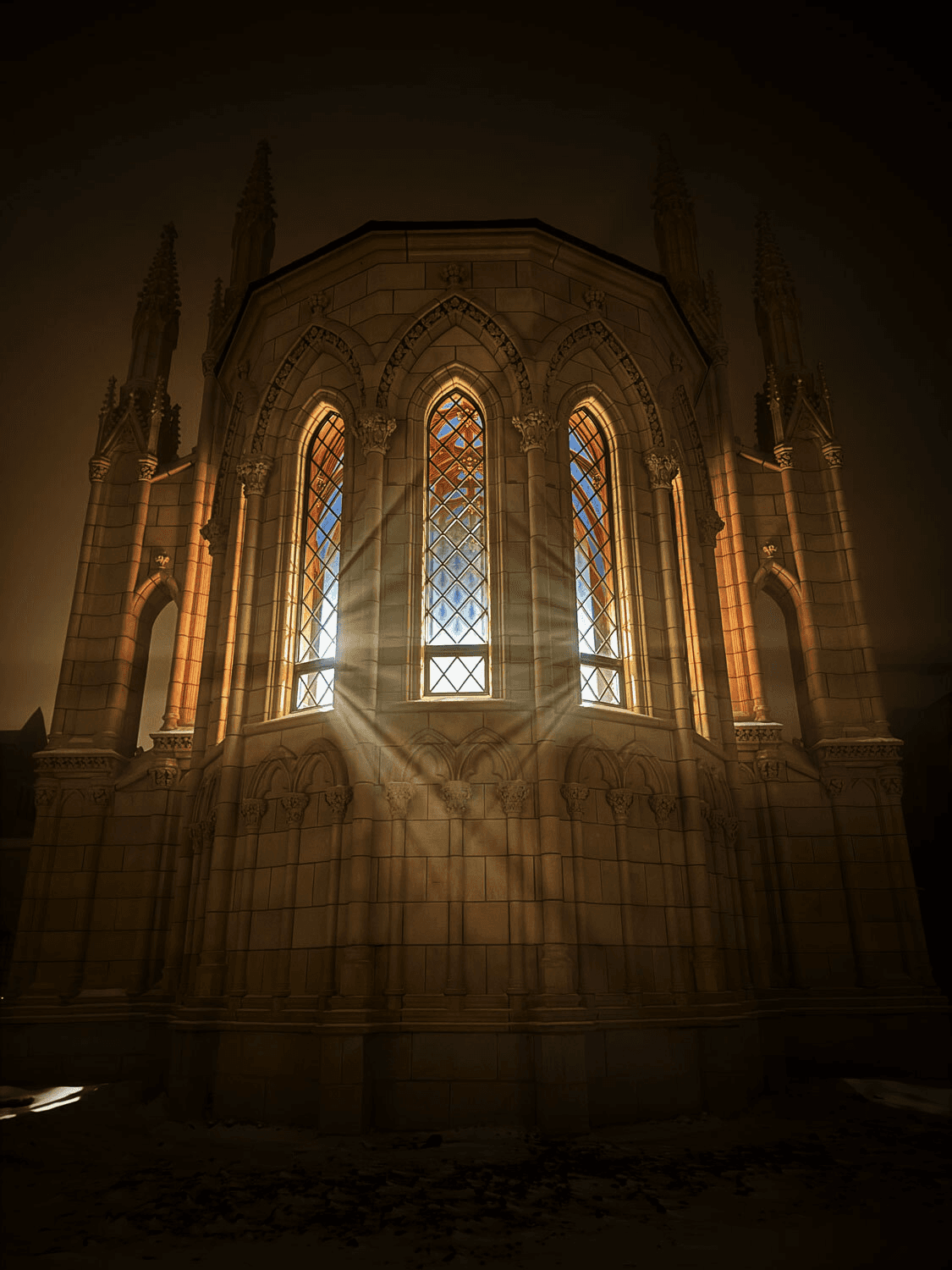
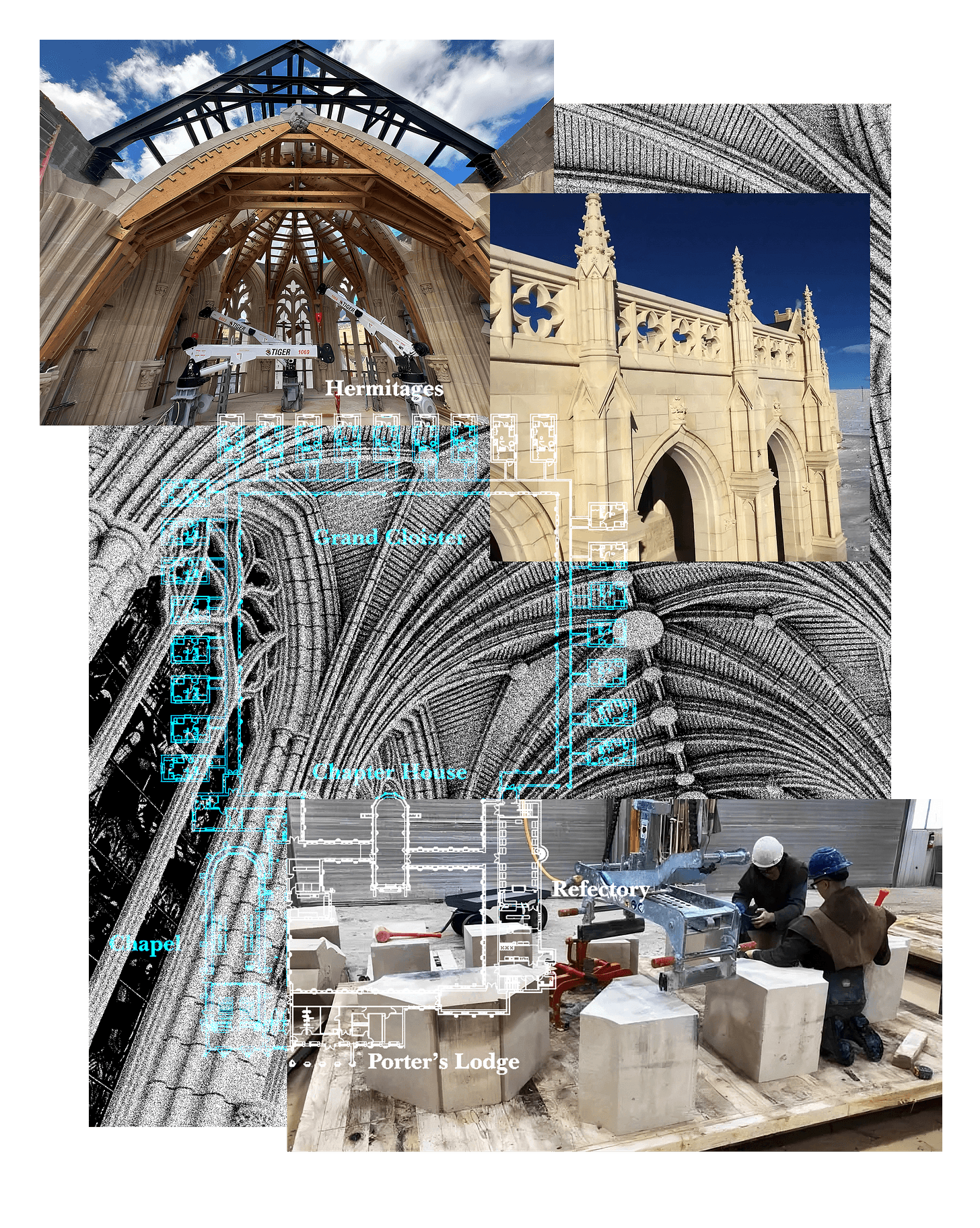
In the United States, skyscrapers have supplanted cathedrals as the centers of our cities. Our modern behemoths of steel, concrete, and glass — not cathedrals — are viewed as symbols of American technological progress. That does not have to be the case. There is an even more peculiar large building than the Central Park Tower, a modern skyscraper par excellence, constructed in the alpine foothills of the Wyoming section of the Rocky Mountains by cloistered Carmelite monks. This peculiar building is made of multi-ton slabs of stone, carved into Gothic forms by an arsenal of machine tools whose movements are dictated by computer programs. It is not strictly a cathedral, but much like them, it strikes one as a sparkling anachronism.
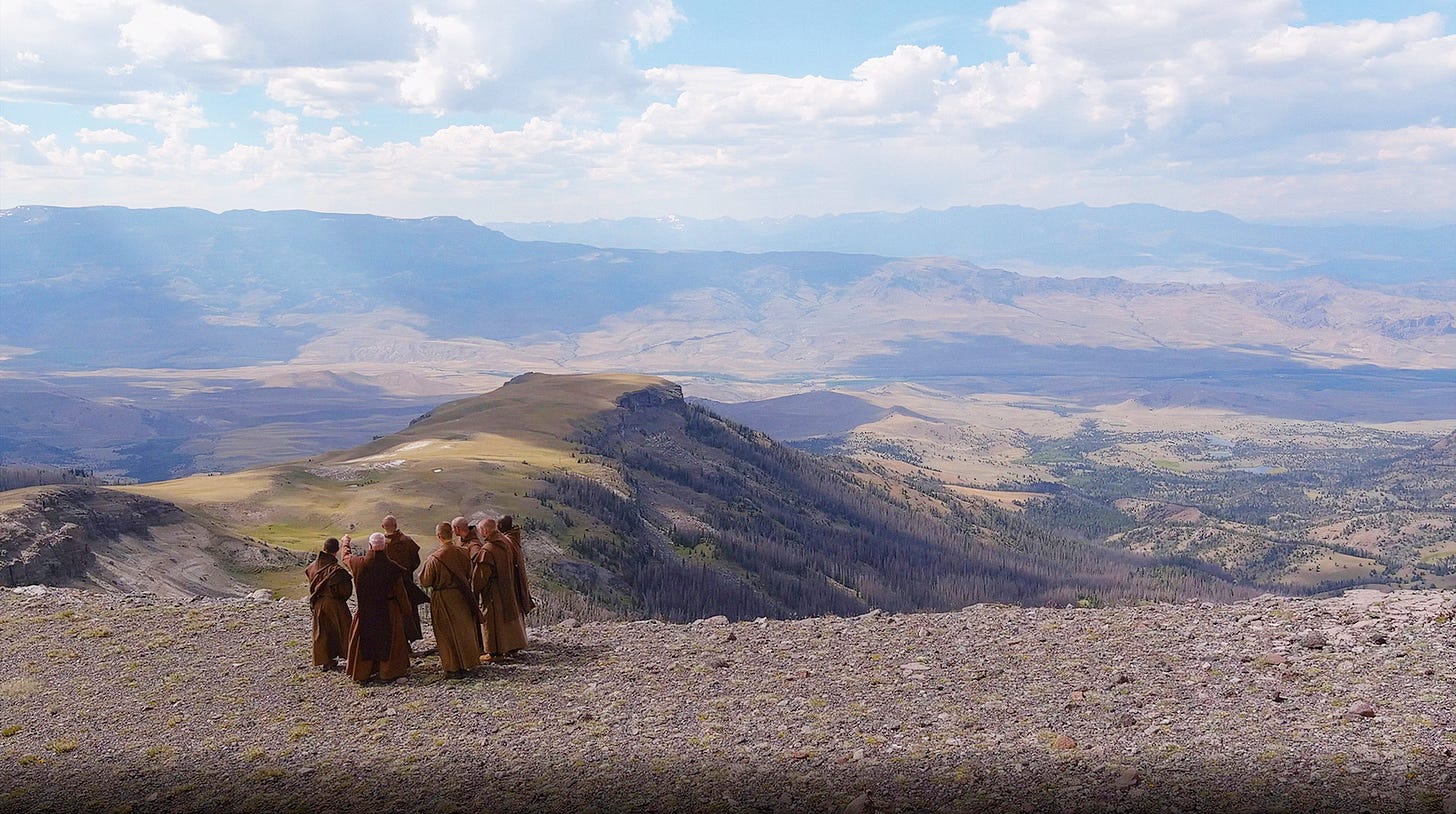
The New Mount Carmel Monastery sits roughly three hours away from Yellowstone National Park in Northwest Wyoming. Surrounded by near-pristine forest and the Rocky Mountains, the brothers at the monastery can be found variously tending to cattle on horseback, praying in quiet contemplation near streams, or programming toolpaths for their robotic CNC arms. Despite the infusion of neoindustrial cowboy aesthetics, their lives are structured in a way that would be recognizable to the founding hermits of the Carmelite Order. That Order traces its origins to hermit communities on Mount Carmel (in present-day Israel) in the 12th century, and officially took on a rule under Albert of Jerusalem in the early 13th century. The Wyoming branch of the Carmelites was founded in 2003 by the then-Bishop of Wyoming, David L. Ricken, as the “Monks of the Most Blessed Virgin Mary of Mount Carmel,” in a setting which naturally mirrors the solitude-at-elevation of their spiritual origins.
They celebrate the Carmelite Mass in Latin with Gregorian chants, maintain a strict horarium — schedule — replete with ora et labora, and cite the importance of manly virtue as expounded by Saint Teresa of Ávila. The John Wayne references alongside Saint Teresa might be a bit of a surprise to the founding hermits of their order if they could read them, though. To quote their writing on manliness and manual labor, “8 hours of work, 8 hours of prayer and 8 hours of sleep provide a perfectly balanced lifestyle for monks to attain holiness...Men need a challenge. John Wayne explained it best when he said, ‘I define manhood simply: men should be tough, fair, and courageous, never petty, never looking for a fight, but never backing down from one either.’” For the monks in Wyoming, those eight hours of manual labor are split between a variety of tasks, of which construction is only one part. For instance, they also roast and sell coffee to help fund their construction projects and the normal costs of operating the monastery. The emphasis on balance in their way of life means that they are patient with respect to overall timelines. However, the technological efficiency of their construction methods has already enabled them to finish a substantial amount of their master plan, and they think their crown jewel building — the chapel — could be completed by as early as 2030.
It’s all too easy in a hyper-modern world, especially in hyper-modern cities like San Francisco or Los Angeles or New York, to look at friars garbed in brown habits and write them off as antiquated or myopic. A more lucid picture is to regard monastic orders as a stable font of civilizational progress that have existed for millennia and will likely exist for millennia more. Roger Bacon, a friar in the Franciscan order, gave us much of the scientific method as we know it today; Gregor Mendel, part of the Order of Saint Augustine, gave us the field of genetics; Guido of Arezzo, a Benedictine monk, gave us the backbone of Western music. They have quite the track record.
Calling the brothers of New Mount Carmel anachronistic is a naive misunderstanding. Under any historical perspective, their engagement with and advancement of techne makes vastly more sense than, say, semiconductor manufacturing springing up from the soil of Bay Area orchards. The Carmelites in alpine Wyoming are the inheritors of a deep tradition that excels at maintaining its integrity while effectively adapting to local flavor. Their meditative yet pragmatic approach is precisely what one would expect from the serene, harsh environment of the Rocky Mountains. On the other end of the spectrum, the technology industries of our major cities excel at rapidly generating novelty ex nihilo, and by virtue of creative destruction cannot meaningfully participate in a deep tradition.
Similar, if you squint, to the Carmelite monks is Monumental Labs, a New York-based company which operates CNC stone-carving robots as a service. In contrast to Monumental, our Carmelite monks do not have to compete for architectural restoration commissions or vanity projects of the techno-riche. Instead of raising venture dollars, they rely on donations, tithes, and the freely-given labor of competent young men. The Carmelites know their aim, and merely choose CNC stone carving and 3D modeling as the most effective way to achieve that aim in our era. Despite completely lacking the requisite esoteric knowledge of machine tools and stone when they began, they found their way by devouring old reference books and learning what they could from projects like the restoration of Notre Dame after its disastrous fire in 2019. The state-of-the-art techniques were merely seen as instrumental to attaining their overarching goal of praising Jesus Christ.
The project of the New Mount Carmel Monastery is not an act of nostalgia. Gothic is not a style so much as metaphysic in stone. Each rib, arch, and pointed vault is like some frozen gesture of reaching out toward the divine. That the Carmelite monks have resurrected such forms with precision robotic tools suggests that technology, rightly ordered, can be drawn back into the service of transcendence. The same KUKA robotic arm which might otherwise be used to assemble the next generation of Meta products is, in their calloused hands, carving echoes of Heaven. The key difference is teleology. The monks pray to the God of Abraham, while Meta prays to the god of Nick Land’s technocapital singularity.
Seen this way, the monks’ project exposes the emptiness of modern architectural ambition. Despite their scale, skyscrapers like the Salesforce Tower say very little beyond themselves. In contrast, the monastery proclaims, “I am not a building to be optimized or monetized, I am one to be prayed and labored into existence.” Hundreds of thousands gaze at Salesforce Tower on the skyline of San Francisco every day and feel nothing. A single person could walk into New Mount Carmel in Cody, Wyoming and feel the weight of the cosmos pressing on their chest.
I’ve heard from my own friends an oft-quoted factoid that the knowledge of how to construct Gothic ribbed vaults has been lost. This is characteristic of the self-defeating disdain perpetuated by the so-called architecture schools that Tom Wolfe lambasted half a century ago in From Bauhaus to Our House — and our civilizational reluctance to build things that step outside the domain of pure utility. The existence proof to the contrary of that factoid is in Wyoming, it’s hundreds of feet high, and it’s made of American limestone.
Technology
•
A Telos In Stone
Wyoming's Tech-Savvy Monastery
“There are cathedrals everywhere for those with the eyes to see,” goes the infamous meme. I tend to agree that cathedrals are too restrictive a category to focus on when measuring human achievement, but they’re not bad as a first pass. They endure for centuries. They require an immensity of human labor. They reveal the vital energy and conviction of a people.
Cathedral is a technical term, though. It specifically refers to a Catholic church which is the seat of a bishop and the central church in a diocese. Taken as a group, however, such churches correspond only loosely to the popular idea of cathedral-ness. Interesting large buildings, in a more general sense, are what most people associate with the noun ‘cathedral,’ and are a better yardstick for human achievement anyways. I think this is especially true in light of what I like to call the conservation law of religiosity: If you look at a society and see no obvious organized religion, it hasn’t evaporated into the ether, it’s merely gone subterranean. The corollary to this is that no tall building has ever stood without having some sort of belief system embedded into its structure.
In the United States, skyscrapers have supplanted cathedrals as the centers of our cities. Our modern behemoths of steel, concrete, and glass — not cathedrals — are viewed as symbols of American technological progress. That does not have to be the case. There is an even more peculiar large building than the Central Park Tower, a modern skyscraper par excellence, constructed in the alpine foothills of the Wyoming section of the Rocky Mountains by cloistered Carmelite monks. This peculiar building is made of multi-ton slabs of stone, carved into Gothic forms by an arsenal of machine tools whose movements are dictated by computer programs. It is not strictly a cathedral, but much like them, it strikes one as a sparkling anachronism.
The New Mount Carmel Monastery sits roughly three hours away from Yellowstone National Park in Northwest Wyoming. Surrounded by near-pristine forest and the Rocky Mountains, the brothers at the monastery can be found variously tending to cattle on horseback, praying in quiet contemplation near streams, or programming toolpaths for their robotic CNC arms. Despite the infusion of neoindustrial cowboy aesthetics, their lives are structured in a way that would be recognizable to the founding hermits of the Carmelite Order. That Order traces its origins to hermit communities on Mount Carmel (in present-day Israel) in the 12th century, and officially took on a rule under Albert of Jerusalem in the early 13th century. The Wyoming branch of the Carmelites was founded in 2003 by the then-Bishop of Wyoming, David L. Ricken, as the “Monks of the Most Blessed Virgin Mary of Mount Carmel,” in a setting which naturally mirrors the solitude-at-elevation of their spiritual origins.
They celebrate the Carmelite Mass in Latin with Gregorian chants, maintain a strict horarium — schedule — replete with ora et labora, and cite the importance of manly virtue as expounded by Saint Teresa of Ávila. The John Wayne references alongside Saint Teresa might be a bit of a surprise to the founding hermits of their order if they could read them, though. To quote their writing on manliness and manual labor, “8 hours of work, 8 hours of prayer and 8 hours of sleep provide a perfectly balanced lifestyle for monks to attain holiness...Men need a challenge. John Wayne explained it best when he said, ‘I define manhood simply: men should be tough, fair, and courageous, never petty, never looking for a fight, but never backing down from one either.’” For the monks in Wyoming, those eight hours of manual labor are split between a variety of tasks, of which construction is only one part. For instance, they also roast and sell coffee to help fund their construction projects and the normal costs of operating the monastery. The emphasis on balance in their way of life means that they are patient with respect to overall timelines. However, the technological efficiency of their construction methods has already enabled them to finish a substantial amount of their master plan, and they think their crown jewel building — the chapel — could be completed by as early as 2030.
It’s all too easy in a hyper-modern world, especially in hyper-modern cities like San Francisco or Los Angeles or New York, to look at friars garbed in brown habits and write them off as antiquated or myopic. A more lucid picture is to regard monastic orders as a stable font of civilizational progress that have existed for millennia and will likely exist for millennia more. Roger Bacon, a friar in the Franciscan order, gave us much of the scientific method as we know it today; Gregor Mendel, part of the Order of Saint Augustine, gave us the field of genetics; Guido of Arezzo, a Benedictine monk, gave us the backbone of Western music. They have quite the track record.
Calling the brothers of New Mount Carmel anachronistic is a naive misunderstanding. Under any historical perspective, their engagement with and advancement of techne makes vastly more sense than, say, semiconductor manufacturing springing up from the soil of Bay Area orchards. The Carmelites in alpine Wyoming are the inheritors of a deep tradition that excels at maintaining its integrity while effectively adapting to local flavor. Their meditative yet pragmatic approach is precisely what one would expect from the serene, harsh environment of the Rocky Mountains. On the other end of the spectrum, the technology industries of our major cities excel at rapidly generating novelty ex nihilo, and by virtue of creative destruction cannot meaningfully participate in a deep tradition.
Similar, if you squint, to the Carmelite monks is Monumental Labs, a New York-based company which operates CNC stone-carving robots as a service. In contrast to Monumental, our Carmelite monks do not have to compete for architectural restoration commissions or vanity projects of the techno-riche. Instead of raising venture dollars, they rely on donations, tithes, and the freely-given labor of competent young men. The Carmelites know their aim, and merely choose CNC stone carving and 3D modeling as the most effective way to achieve that aim in our era. Despite completely lacking the requisite esoteric knowledge of machine tools and stone when they began, they found their way by devouring old reference books and learning what they could from projects like the restoration of Notre Dame after its disastrous fire in 2019. The state-of-the-art techniques were merely seen as instrumental to attaining their overarching goal of praising Jesus Christ.
The project of the New Mount Carmel Monastery is not an act of nostalgia. Gothic is not a style so much as metaphysic in stone. Each rib, arch, and pointed vault is like some frozen gesture of reaching out toward the divine. That the Carmelite monks have resurrected such forms with precision robotic tools suggests that technology, rightly ordered, can be drawn back into the service of transcendence. The same KUKA robotic arm which might otherwise be used to assemble the next generation of Meta products is, in their calloused hands, carving echoes of Heaven. The key difference is teleology. The monks pray to the God of Abraham, while Meta prays to the god of Nick Land’s technocapital singularity.
Seen this way, the monks’ project exposes the emptiness of modern architectural ambition. Despite their scale, skyscrapers like the Salesforce Tower say very little beyond themselves. In contrast, the monastery proclaims, “I am not a building to be optimized or monetized, I am one to be prayed and labored into existence.” Hundreds of thousands gaze at Salesforce Tower on the skyline of San Francisco every day and feel nothing. A single person could walk into New Mount Carmel in Cody, Wyoming and feel the weight of the cosmos pressing on their chest.
I’ve heard from my own friends an oft-quoted factoid that the knowledge of how to construct Gothic ribbed vaults has been lost. This is characteristic of the self-defeating disdain perpetuated by the so-called architecture schools that Tom Wolfe lambasted half a century ago in From Bauhaus to Our House — and our civilizational reluctance to build things that step outside the domain of pure utility. The existence proof to the contrary of that factoid is in Wyoming, it’s hundreds of feet high, and it’s made of American limestone.
About the Author
Keegan McNamara researches geometry and aesthetics at Gradient Control Laboratories. He is on X @keegan_mcnamara