tt
tt
tt
tt
tt
tt

Technology
•
Trashing Out
How I Learned to Stop Worrying and Love Space Debris


A defunct Russian satellite drifts through low Earth orbit (LEO), silent for decades. Then it gets clipped by a fragment of debris no larger than a bolt, traveling at 17,000 miles per hour, fast enough to shred through the solid aluminum that makes up the satellite’s body. The collision spawns thousands of new fragments of more debris, moving ten times faster than a rifle round. A few months later, one of those fragments rips through a European weather satellite, which itself becomes 10,000 more projectiles. Normally, debris drags against the outer limits of Earth’s atmosphere, losing speed, and altitude to eventually burn up. But we are approaching an inflection point at which collisions create fragments faster than the atmosphere can clear them. This is the Kessler Syndrome: a self-sustaining debris cascade, first proposed by NASA scientist Donald Kessler, that could render low Earth orbit an impassable wall of shrapnel.
This is the slow strangulation of modern civilization. The syndrome doesn’t announce itself with a single catastrophic day as movies like Gravity (2013) portray. It creeps. Satellite insurance premiums rise. Operators spend more on collision-avoidance maneuvers. Over the years, missions become uneconomical, then unsafe, then impossible. Imagine a world without GPS: every plane is grounded, every ship drifts, precision-guided weapons become nothing more than expensive scrap metal. Financial markets, dependent on satellite timing for transactions, seize up. Supply chains fracture; food and fuel shortages spread across continents. Not just in developing nations: American and European cities, fed by just-in-time logistics with no buffer stock, would watch their shelves grow bare.
Soon after, the full horror sets in: we are trapped. The debris field has thickened into an impenetrable shroud of hypersonic shrapnel encircling the Earth. No rocket can launch. No capsule can escape. Mars becomes a fantasy again; the Moon, unreachable. Humanity is imprisoned on this single fragile rock, watching the sky fill with the glittering wreckage of everything we built.
This is why we need a “precision deorbit service” before the cascade gets out of control. Beyond staving off an existential crisis, such a system, once operational, would also offer new military capabilities.

For Your Eyes Only.
Spies. Satellites. State secrets. Inside the technologies and intelligence contests shaping American power.
Subscribe + Issue 007
Picture a different scenario: North Korea launches an intercontinental missile toward the US. Sensors track a clean arc through the boost phase until a brief flash, a breakup, and then silence. The missile has failed. North Korean investigations point to a sudden flash caused by a propellant tank failure, which exploded the rest of the satellite. But was it a tank failure, or a puncture from collision with space debris? Was it a miscalculation? Or did America’s orbital garbage collectors just intercept a nuclear strike? Pyongyang can’t be sure. And the interceptor cost nothing: the debris was already in orbit, waiting to be cleaned up. This is the advantage of a “precision deorbit service” — it doubles as a space-based interceptor.
The idea of a space-based interceptor system has been around for decades. Reagan’s Strategic Defense Initiative (SDI) in the 1980s proposed “Brilliant Pebbles,” a constellation of thousands of small, autonomous interceptor satellites, each no larger than a watermelon, loitering in orbit to destroy missiles through kinetic impact. The program was championed by Edward Teller, father of the hydrogen bomb, who personally persuaded Reagan that space-based missile defense was achievable. Teller, then in his eighties, brought the same visionary intensity to orbital interceptors that he had once brought to thermonuclear weapons. The concept was technically elegant: instead of launching interceptors from the ground in response to an attack, they would already be in position, waiting. An incoming ICBM would be met by a swarm of kinetic kill vehicles that would home in on its heat signature and collide with it at closing speeds exceeding 20,000 miles per hour, speed providing all the explosive energy needed for the job. Brilliant Pebbles peaked at roughly 4,000 planned interceptors before budgetary and political realities intervened. Costs spiraled into hundreds of billions. The Cold War ended; Reagan’s SDI was quietly shelved.
Another concept from that era was even more audacious: Project Thor, colloquially known as “Rods from God.” Tungsten rods, roughly 20 feet long and one foot in diameter, would be released from orbital platforms and fall towards Earth. No explosives. No guidance beyond initial targeting. Just dense metal plummeting, striking the Earth at terminal velocities approaching Mach 10. The kinetic energy would rival a tactical nuclear weapon, with none of the radiation. Thor never advanced beyond feasibility studies as the cost of lifting thousands of pounds of tungsten into orbit was prohibitive ($85,000 per kg).
✺
The Trump administration’s Golden Dome initiative, first ordered in January 2025 and formally unveiled last May, promises what missile defense advocates have sought for decades: a space-based shield capable of intercepting intercontinental ballistic missiles during their vulnerable boost phase. This is a narrow window — roughly five minutes — when the missile is at its slowest, its engines blazing hot and visible to infrared sensors, before it releases warheads into the cold silence of space. The appeal is obvious. Space offers the ultimate high ground: thousands of miles above Earth’s surface, it provides persistent coverage, global reach, and geometric advantages that ground-based systems cannot match.
The program is no longer theoretical. The Missile Defense Agency, under the Department of War, has qualified over 2,100 firms in December 2025 to compete for awards under its Scalable Homeland Innovative Enterprise Layered Defense (SHIELD) contract vehicle, with a ceiling of $151 billion over ten years. The Space Force has awarded initial prototype contracts for space-based interceptors to Northrop Grumman, Lockheed Martin, Anduril Industries, and True Anomaly, with leading firms receiving up to $10 million each for prototype development. SpaceX is reportedly set to receive a $2 billion contract to build a 600-satellite constellation for missile targeting. General Michael Guetlein, the program’s lead, has stated that Golden Dome will achieve “operational capability” by mid-2028.
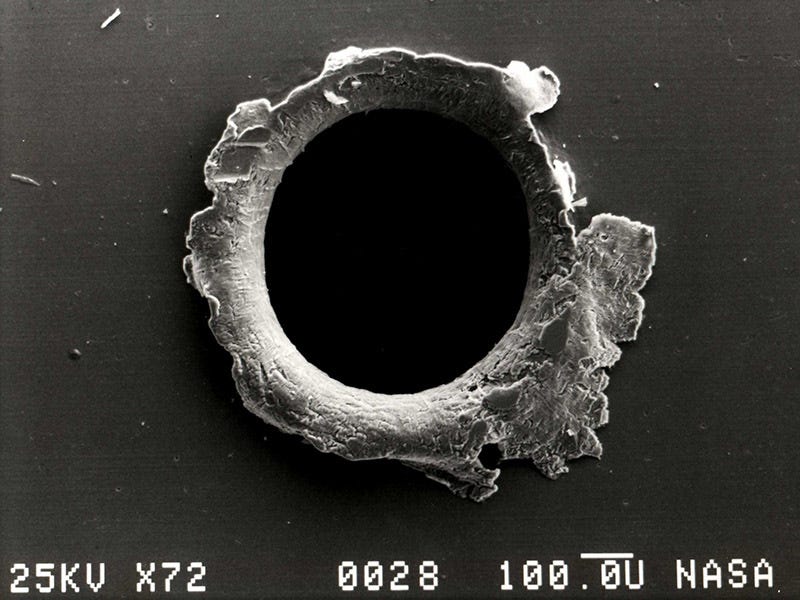
View of an orbital debris hole made in the panel of the Solar Max experiment.
But before the government commits further, it’s worth asking: can the fundamental economics of space-based missile defense ever work? The challenge has haunted ambitious defense projects since SDI: cost.
The economics of missile defense are brutal. Every interceptor must be more reliable, more precise, and, inevitably, it will be more expensive than the weapon it seeks to destroy. This asymmetry compounds at scale. An adversary need only produce enough offensive missiles to exhaust your defensive stockpile, then launch the rest unopposed. The math favors the attacker.
Israel’s Iron Dome offers an instructive case study. The system, developed starting in 2007 and deployed in 2011, works brilliantly against Hamas’ rockets, achieving interception rates above 90 percent. It uses radar to track incoming projectiles and launches interceptors only against those threatening populated areas. But each Tamir interceptor, a three-meter missile with an active radar seeker and proximity-fused warhead, costs $50,000 to $100,000, while Hamas’ Qassam rockets cost a few hundred dollars to produce. In 2024, during the Israel-Hamas War, Israel fired 2,900 Tamir missiles in 12 days, burning through roughly $160 million in interceptors alone — triple the planned annual budget. Israel can sustain this disparity because Hamas’s manufacturing capacity is limited and because the alternative of allowing rockets fall on Israeli cities is politically unacceptable. But the cost ratio remains unfavorable: roughly 100-to-1 against the defender. Scale this to great power competition, where adversaries like Russia and China can manufacture sophisticated missiles by the thousand, and the economics become untenable.
Any viable Golden Dome architecture must solve this problem. The solution may already be orbiting overhead, accumulating by the ton every year: space debris.
The same falling launch costs that enabled the satellite boom of the past decade have created an increasingly cluttered orbital environment. SpaceX, Rocket Lab, and their competitors have democratized access to LEO; thousands of new satellites now circle the planet. But satellites eventually fail, upper stages remain in orbit, and collisions generate fragments — space debris — that clutter LEO for decades. The debris population grows faster than our ability to manage it. Modern Space Surveillance Network sensors can detect and catalog objects as small as ten centimeters, a remarkable capability that transforms debris from an undifferentiated hazard into a characterized, trackable inventory.
Private satellite operators have strong incentives to maneuver around debris but weak incentives to remove it. Debris removal is a classic collective action problem: everyone benefits, but no one wants to pay. The orbital environment degrades as a commons, and calls for remediation grow louder each year. But what if debris removal were dual-use? It requires a specific capability: the ability to track objects precisely, rendezvous with them, and alter their trajectories. That capability has another name: space-based interception.
Here lies the opportunity. A national program to develop and deploy space debris removal capabilities would face, unlike Golden Dome, minimal diplomatic resistance. Debris threatens everyone’s satellites: American GPS, Chinese BeiDou, European Galileo, Russian GLONASS. Cleaning up orbit is transparently beneficial, a common good. The United States could acquire significant debris manipulation capabilities under the banner of environmental stewardship, building infrastructure and operational experience with broad legitimacy.
Debris removal is no longer theoretical. The core technologies exist and have been demonstrated in orbit.
The primary challenge is rendezvous and proximity operations: tracking a piece of debris, matching its orbit, approaching it safely, and then either capturing it or nudging it onto a new trajectory. In February 2024, the Japanese company Astroscale launched ADRAS-J, the world’s first attempt to safely approach large debris through rendezvous and proximity operations. By December, the spacecraft had approached an abandoned rocket upper stage to within 15 meters, the closest a commercial mission has ever come to uncooperative debris. The target was an 11-meter, 3-ton Japanese rocket body that had been drifting unpowered since 2009. ADRAS-J circled it, photographed it from multiple angles, and demonstrated the autonomous navigation and collision-avoidance systems necessary for capture. A follow-on mission will attempt to deorbit the stage.
China demonstrated the capability even earlier. In January 2022, its Shijian-21 satellite docked with a defunct BeiDou navigation satellite and towed it 3,000 kilometers above the geostationary belt into a graveyard orbit, a capability previously demonstrated by the United States.
The European Space Agency (ESA) is preparing ClearSpace-1, a mission to rendezvous with, capture, and deorbit an uncooperative piece of debris using robotic arms. Other active removal methods under development include nets, tethers, harpoons, and ion beam shepherds — the last of which can push debris without physical contact.
The scale of the problem is vast. Of the 35,000 objects tracked by space surveillance networks, 26,000 are debris larger than ten centimeters, and ESA estimates a further million pieces larger than one centimeter.
Current demonstration missions like ClearSpace-1 are essentially disposable: the servicer grabs one piece of debris, deorbits, and both burn up together. At roughly €86 million per removal, this approach cannot scale. With over a million pieces of dangerous debris in orbit, the economics only work with reusable infrastructure — a network of thousands of tugs passing debris along like a bucket brigade, each imparting a small delta-v before handing off to the next, relaying targets to a cycling center or into the atmosphere to burn up. This relay architecture makes the math feasible: if each tug only needs to impart a small velocity change before handing debris off to the next station, propulsion requirements per maneuver stay minimal. The coordination challenge is real but solvable.
But a system capable of precisely deorbiting debris is, by definition, capable of placing that debris in the path of an ascending ICBM. The same technologies that can clear a defunct satellite from a commercial operator’s orbital path can redirect debris onto an intercept trajectory with a missile.
Consider what this means for the cost asymmetry problem troubling missile interceptors. Debris is free ammunition already in position; it requires no launch or manufacturing cost. A debris-based interceptor system would flip the traditional calculus: the defender’s marginal cost per engagement drops to the energy cost of a redirection burn which would be close to zero, the cost of nudging debris around space. The attacker, however, must still bear the full expense of each missile produced and launched. The relay network would require real-time integration with missile warning satellites and autonomous decision-making at the tug level — a coordination challenge, but not fundamentally different from what modern air defense systems already achieve.
More importantly, debris-based interception offers something no conventional missile defense can provide: plausible deniability.
When a ground-based interceptor destroys a missile, the defender’s action is unambiguous. The launch is detected, the engagement is visible, and the message is clear: we stopped your attack. This clarity has strategic value in some scenarios (deterrence depends partly on demonstrated capability), but it also forecloses options and invites escalation. An overt interception is an act that demands a response.
A debris strike is different. Space is genuinely littered with collision hazards. Tracking remains imperfect. Even sophisticated trajectory modeling involves uncertainty. Solar activity causes the upper atmosphere to expand and contract, changing drag on orbiting objects. Debris tumbles irregularly, altering its aerodynamic profile moment to moment. And the vast majority of dangerous fragments, those between one and ten centimeters, remain too small to track but large enough to destroy satellites. If a missile fails during boost phase after encountering debris, the attacker faces an epistemological problem: was this natural misfortune or deliberate interception? That ambiguity creates off-ramps that overt interception forecloses.
By building debris removal capability under legitimate environmental auspices, the United States could acquire a missile defense architecture that is economically sustainable, diplomatically defensible, and strategically ambiguous. The system would provide genuine orbital cleanup benefits, a real service to the international community. But it would also constitute a latent interceptor capability, activatable in crisis, whose use would look like an accident.
Adversaries would know, of course, that America possesses debris manipulation technology. That knowledge is unavoidable and, ultimately, beside the point. Capability is not attribution. Consider weather modification: the United States has possessed cloud seeding technology for decades. It does not follow that every rainstorm is artificial. Rain happens. The technology simply allows you to make it happen when and where you want. Should every Category 5 hurricane be attributed to government cloud-seeding? Depends on your level of paranoia. The same logic applies to orbital debris. Collisions occur. Missiles fail. The relay network ensures only that an existing threat finds its target. An ascending ICBM might be struck by natural misfortune. Or a tug might have nudged a fragment into its path. From the outside, these events look identical.
Another reasonable objection: Iron Dome’s Tamir interceptors carry onboard guidance systems that allow them to adjust course mid-flight. Debris has no such capability. Once a tug imparts a trajectory change, the fragment follows a ballistic path with no correction. If the ICBM maneuvers or the timing is slightly off, the debris misses.
This is a real limitation, but the economics compensate for it. A Tamir interceptor costs $50,000 to $100,000. Debris costs nothing: it is already in orbit, already moving at 17,000 miles per hour. The relay network needs only to position it. If one fragment has a 10% chance of intercept, you send ten. If you need redundancy, you send fifty. Your adversary will only ever learn about the one hit. The math that bankrupts traditional missile defense, where every interceptor must be manufactured and launched, inverts entirely when your ammunition is pre-deployed waste. Precision matters less when volume is free. The war in Ukraine taught the same lesson: million-dollar tanks are constantly destroyed by cheap FPV drones.
There is another path. The debris manipulation infrastructure described above could support two distinct strategic postures, and the United States could choose between them in advance.
The first posture is stealth. Redirect debris as-is toward ascending missiles. Accept lower precision, compensate with volume. Maintain plausible deniability. This is the approach described above: the relay network nudges fragments into intercept trajectories, the missile fails, and the adversary cannot prove intent. Stealth preserves ambiguity but sacrifices reliability.
The second posture is overt. Remember Rods from God? The concept foundered on economics: lifting tungsten to orbit costs several thousand dollars per kilogram at current SpaceX rates, and a single 20-foot rod weighs thousands of kilograms, depending on diameter. But the same relay network that cleans debris could instead funnel it toward orbital recycling facilities instead. Imagine a constellation of processing stations that collect debris, sort it by material composition, and manufacture kinetic penetrators — dense projectiles designed to destroy targets through sheer impact force rather than explosives — in orbit. These would not be Rods from God in the original conception. They would be something cheaper, something built from the detritus already circling overhead.
In-orbit metal manufacturing is no longer theoretical. In 2024, ESA sent a metal 3D printer to the ISS and demonstrated metal printing in orbit. Meanwhile, recent research has explored how representative aerospace aluminum scrap could be cast into feedstock and processed via solid-state additive methods such as additive friction stir deposition. But an end-to-end ‘capture, sort, refine, manufacture’ pipeline remains conceptual, with open engineering constraints — especially around feedstock purity, power, automation, and the harsh thermochemistry of reentry.
The physics are worth understanding. Space debris is not uniform. Rocket bodies are primarily aluminum alloys. Satellite components include steel, titanium, copper, gold, and various composites. Debris contains materials already proven for reentry: nickel-based superalloys like Inconel, carbon composites similar to the reinforced carbon-carbon used on the Space Shuttle’s nose, aluminum alloys that melt predictably at 660°C. The recycling station wouldn’t need to manufacture exotic materials — it would sort and layer what’s already there. Each material has a different melting point and aerodynamic profile during reentry. A random tumbling fragment ablates unpredictably, shedding mass unevenly, its trajectory warping as drag forces shift. This is why debris makes an imprecise interceptor in its raw state.
But what if you sorted the debris first? An orbital recycling center could separate collected materials by melting point: aluminum (660°C), steel (1,370°C), titanium (1,668°C). Layer them deliberately. Use the heat of reentry as a foundry, binding materials as they accelerate. By the time the penetrator reaches lower altitudes, what remains is a uniform, aerodynamically stable core. The differential melting that makes raw debris unpredictable becomes an engineering advantage when deliberately sequenced. You are essentially building a heat shield into the weapon itself. Ceramic foams — silicon carbide lattices, for instance — could regulate heat transfer within the penetrator, ensuring the outer layers ablate at predictable rates while the core remains intact.
The physics are already exploited elsewhere. Kinetic penetrators would use ‘self-sharpening’ mechanisms: alloys engineered so that edge material fractures away along stress boundaries while the core remains intact, maintaining a sharp profile through impact. Reentry vehicles use layered materials with different thermal properties, precisely because differential ablation is a known phenomenon. The proposal here is to reverse-engineer that relationship: instead of minimizing shape change from ablation, engineer the layering so ablation produces a desired geometry.
The result: a kinetic penetrator manufactured in orbit from recycled space junk at a fraction of the cost of launching raw tungsten from Earth. Call them orbital trash cans. These would not match a purpose-built tungsten rod in density or penetration capability, but they would be far cheaper and already in position. The recycling infrastructure serves a legitimate civilian function — clearing orbit of hazardous debris — while simultaneously stockpiling raw material for kinetic bombardment.
The choice between stealth and overt need not be made in advance. The same relay network, the same recycling infrastructure, supports both. In peacetime, debris is cleaned and processed. In crisis, fragments can be redirected for deniable interception, or manufactured penetrators deployed for unmistakable strike. The infrastructure is dual-use at every level.
Does this approach sacrifice deterrent value? Perhaps. But deterrence through ambiguity has its own logic. The adversary who cannot be certain whether his missiles will reach their targets, who cannot even be certain whether previous failures were accidents or interdictions, faces a different kind of uncertainty than one confronting an overt shield. Both create doubt. The debris-based approach simply creates doubt that doesn’t demand escalation.
A more fundamental objection: wouldn’t using debris as interceptors accelerate the very cascade the system is meant to prevent? Yes, intercepting a missile with debris creates additional fragments. But the Kessler Syndrome is a threshold phenomenon. Below critical density, collisions add debris slower than atmospheric drag removes it. According to Kessler, we may already be in the early stages of this process in certain altitudes, but it could take decades before the environment becomes unusable. This is precisely why the debris removal infrastructure must be built now. The tradeoff between building a spaced debris removal system that might occasionally create more debris from intercepting missiles; and having debris removal system that is more expensive and without the dual use, is real but manageable: occasional interceptions that add fragments to an environment already being actively cleaned, versus the current trajectory of unchecked accumulation with no removal capacity at all. The same system that defends against missiles can also clean the space commons.
Golden Dome faces insurmountable issues of economics and diplomacy. Cost asymmetry makes it unsustainable; international opposition makes it diplomatically destructive. But a debris removal program solves both. It’s economically viable because the ammunition is already in orbit and the infrastructure is reusable. It’s diplomatically palatable because orbital cleanup is universally beneficial.
Sometimes the best defense is one your adversaries help you build. Scrap Golden Dome and call its successor the “Sustainable Space Leadership Act.”
Technology
•
Trashing Out
How I Learned to Stop Worrying and Love Space Debris
A defunct Russian satellite drifts through low Earth orbit (LEO), silent for decades. Then it gets clipped by a fragment of debris no larger than a bolt, traveling at 17,000 miles per hour, fast enough to shred through the solid aluminum that makes up the satellite’s body. The collision spawns thousands of new fragments of more debris, moving ten times faster than a rifle round. A few months later, one of those fragments rips through a European weather satellite, which itself becomes 10,000 more projectiles. Normally, debris drags against the outer limits of Earth’s atmosphere, losing speed, and altitude to eventually burn up. But we are approaching an inflection point at which collisions create fragments faster than the atmosphere can clear them. This is the Kessler Syndrome: a self-sustaining debris cascade, first proposed by NASA scientist Donald Kessler, that could render low Earth orbit an impassable wall of shrapnel.
This is the slow strangulation of modern civilization. The syndrome doesn’t announce itself with a single catastrophic day as movies like Gravity (2013) portray. It creeps. Satellite insurance premiums rise. Operators spend more on collision-avoidance maneuvers. Over the years, missions become uneconomical, then unsafe, then impossible. Imagine a world without GPS: every plane is grounded, every ship drifts, precision-guided weapons become nothing more than expensive scrap metal. Financial markets, dependent on satellite timing for transactions, seize up. Supply chains fracture; food and fuel shortages spread across continents. Not just in developing nations: American and European cities, fed by just-in-time logistics with no buffer stock, would watch their shelves grow bare.
Soon after, the full horror sets in: we are trapped. The debris field has thickened into an impenetrable shroud of hypersonic shrapnel encircling the Earth. No rocket can launch. No capsule can escape. Mars becomes a fantasy again; the Moon, unreachable. Humanity is imprisoned on this single fragile rock, watching the sky fill with the glittering wreckage of everything we built.
This is why we need a “precision deorbit service” before the cascade gets out of control. Beyond staving off an existential crisis, such a system, once operational, would also offer new military capabilities.
For Your Eyes Only.
Spies. Satellites. State secrets. Inside the technologies and intelligence contests shaping American power.
Subscribe + Issue 007
Picture a different scenario: North Korea launches an intercontinental missile toward the US. Sensors track a clean arc through the boost phase until a brief flash, a breakup, and then silence. The missile has failed. North Korean investigations point to a sudden flash caused by a propellant tank failure, which exploded the rest of the satellite. But was it a tank failure, or a puncture from collision with space debris? Was it a miscalculation? Or did America’s orbital garbage collectors just intercept a nuclear strike? Pyongyang can’t be sure. And the interceptor cost nothing: the debris was already in orbit, waiting to be cleaned up. This is the advantage of a “precision deorbit service” — it doubles as a space-based interceptor.
The idea of a space-based interceptor system has been around for decades. Reagan’s Strategic Defense Initiative (SDI) in the 1980s proposed “Brilliant Pebbles,” a constellation of thousands of small, autonomous interceptor satellites, each no larger than a watermelon, loitering in orbit to destroy missiles through kinetic impact. The program was championed by Edward Teller, father of the hydrogen bomb, who personally persuaded Reagan that space-based missile defense was achievable. Teller, then in his eighties, brought the same visionary intensity to orbital interceptors that he had once brought to thermonuclear weapons. The concept was technically elegant: instead of launching interceptors from the ground in response to an attack, they would already be in position, waiting. An incoming ICBM would be met by a swarm of kinetic kill vehicles that would home in on its heat signature and collide with it at closing speeds exceeding 20,000 miles per hour, speed providing all the explosive energy needed for the job. Brilliant Pebbles peaked at roughly 4,000 planned interceptors before budgetary and political realities intervened. Costs spiraled into hundreds of billions. The Cold War ended; Reagan’s SDI was quietly shelved.
Another concept from that era was even more audacious: Project Thor, colloquially known as “Rods from God.” Tungsten rods, roughly 20 feet long and one foot in diameter, would be released from orbital platforms and fall towards Earth. No explosives. No guidance beyond initial targeting. Just dense metal plummeting, striking the Earth at terminal velocities approaching Mach 10. The kinetic energy would rival a tactical nuclear weapon, with none of the radiation. Thor never advanced beyond feasibility studies as the cost of lifting thousands of pounds of tungsten into orbit was prohibitive ($85,000 per kg).
✺
The Trump administration’s Golden Dome initiative, first ordered in January 2025 and formally unveiled last May, promises what missile defense advocates have sought for decades: a space-based shield capable of intercepting intercontinental ballistic missiles during their vulnerable boost phase. This is a narrow window — roughly five minutes — when the missile is at its slowest, its engines blazing hot and visible to infrared sensors, before it releases warheads into the cold silence of space. The appeal is obvious. Space offers the ultimate high ground: thousands of miles above Earth’s surface, it provides persistent coverage, global reach, and geometric advantages that ground-based systems cannot match.
The program is no longer theoretical. The Missile Defense Agency, under the Department of War, has qualified over 2,100 firms in December 2025 to compete for awards under its Scalable Homeland Innovative Enterprise Layered Defense (SHIELD) contract vehicle, with a ceiling of $151 billion over ten years. The Space Force has awarded initial prototype contracts for space-based interceptors to Northrop Grumman, Lockheed Martin, Anduril Industries, and True Anomaly, with leading firms receiving up to $10 million each for prototype development. SpaceX is reportedly set to receive a $2 billion contract to build a 600-satellite constellation for missile targeting. General Michael Guetlein, the program’s lead, has stated that Golden Dome will achieve “operational capability” by mid-2028.
View of an orbital debris hole made in the panel of the Solar Max experiment.
But before the government commits further, it’s worth asking: can the fundamental economics of space-based missile defense ever work? The challenge has haunted ambitious defense projects since SDI: cost.
The economics of missile defense are brutal. Every interceptor must be more reliable, more precise, and, inevitably, it will be more expensive than the weapon it seeks to destroy. This asymmetry compounds at scale. An adversary need only produce enough offensive missiles to exhaust your defensive stockpile, then launch the rest unopposed. The math favors the attacker.
Israel’s Iron Dome offers an instructive case study. The system, developed starting in 2007 and deployed in 2011, works brilliantly against Hamas’ rockets, achieving interception rates above 90 percent. It uses radar to track incoming projectiles and launches interceptors only against those threatening populated areas. But each Tamir interceptor, a three-meter missile with an active radar seeker and proximity-fused warhead, costs $50,000 to $100,000, while Hamas’ Qassam rockets cost a few hundred dollars to produce. In 2024, during the Israel-Hamas War, Israel fired 2,900 Tamir missiles in 12 days, burning through roughly $160 million in interceptors alone — triple the planned annual budget. Israel can sustain this disparity because Hamas’s manufacturing capacity is limited and because the alternative of allowing rockets fall on Israeli cities is politically unacceptable. But the cost ratio remains unfavorable: roughly 100-to-1 against the defender. Scale this to great power competition, where adversaries like Russia and China can manufacture sophisticated missiles by the thousand, and the economics become untenable.
Any viable Golden Dome architecture must solve this problem. The solution may already be orbiting overhead, accumulating by the ton every year: space debris.
The same falling launch costs that enabled the satellite boom of the past decade have created an increasingly cluttered orbital environment. SpaceX, Rocket Lab, and their competitors have democratized access to LEO; thousands of new satellites now circle the planet. But satellites eventually fail, upper stages remain in orbit, and collisions generate fragments — space debris — that clutter LEO for decades. The debris population grows faster than our ability to manage it. Modern Space Surveillance Network sensors can detect and catalog objects as small as ten centimeters, a remarkable capability that transforms debris from an undifferentiated hazard into a characterized, trackable inventory.
Private satellite operators have strong incentives to maneuver around debris but weak incentives to remove it. Debris removal is a classic collective action problem: everyone benefits, but no one wants to pay. The orbital environment degrades as a commons, and calls for remediation grow louder each year. But what if debris removal were dual-use? It requires a specific capability: the ability to track objects precisely, rendezvous with them, and alter their trajectories. That capability has another name: space-based interception.
Here lies the opportunity. A national program to develop and deploy space debris removal capabilities would face, unlike Golden Dome, minimal diplomatic resistance. Debris threatens everyone’s satellites: American GPS, Chinese BeiDou, European Galileo, Russian GLONASS. Cleaning up orbit is transparently beneficial, a common good. The United States could acquire significant debris manipulation capabilities under the banner of environmental stewardship, building infrastructure and operational experience with broad legitimacy.
Debris removal is no longer theoretical. The core technologies exist and have been demonstrated in orbit.
The primary challenge is rendezvous and proximity operations: tracking a piece of debris, matching its orbit, approaching it safely, and then either capturing it or nudging it onto a new trajectory. In February 2024, the Japanese company Astroscale launched ADRAS-J, the world’s first attempt to safely approach large debris through rendezvous and proximity operations. By December, the spacecraft had approached an abandoned rocket upper stage to within 15 meters, the closest a commercial mission has ever come to uncooperative debris. The target was an 11-meter, 3-ton Japanese rocket body that had been drifting unpowered since 2009. ADRAS-J circled it, photographed it from multiple angles, and demonstrated the autonomous navigation and collision-avoidance systems necessary for capture. A follow-on mission will attempt to deorbit the stage.
China demonstrated the capability even earlier. In January 2022, its Shijian-21 satellite docked with a defunct BeiDou navigation satellite and towed it 3,000 kilometers above the geostationary belt into a graveyard orbit, a capability previously demonstrated by the United States.
The European Space Agency (ESA) is preparing ClearSpace-1, a mission to rendezvous with, capture, and deorbit an uncooperative piece of debris using robotic arms. Other active removal methods under development include nets, tethers, harpoons, and ion beam shepherds — the last of which can push debris without physical contact.
The scale of the problem is vast. Of the 35,000 objects tracked by space surveillance networks, 26,000 are debris larger than ten centimeters, and ESA estimates a further million pieces larger than one centimeter.
Current demonstration missions like ClearSpace-1 are essentially disposable: the servicer grabs one piece of debris, deorbits, and both burn up together. At roughly €86 million per removal, this approach cannot scale. With over a million pieces of dangerous debris in orbit, the economics only work with reusable infrastructure — a network of thousands of tugs passing debris along like a bucket brigade, each imparting a small delta-v before handing off to the next, relaying targets to a cycling center or into the atmosphere to burn up. This relay architecture makes the math feasible: if each tug only needs to impart a small velocity change before handing debris off to the next station, propulsion requirements per maneuver stay minimal. The coordination challenge is real but solvable.
But a system capable of precisely deorbiting debris is, by definition, capable of placing that debris in the path of an ascending ICBM. The same technologies that can clear a defunct satellite from a commercial operator’s orbital path can redirect debris onto an intercept trajectory with a missile.
Consider what this means for the cost asymmetry problem troubling missile interceptors. Debris is free ammunition already in position; it requires no launch or manufacturing cost. A debris-based interceptor system would flip the traditional calculus: the defender’s marginal cost per engagement drops to the energy cost of a redirection burn which would be close to zero, the cost of nudging debris around space. The attacker, however, must still bear the full expense of each missile produced and launched. The relay network would require real-time integration with missile warning satellites and autonomous decision-making at the tug level — a coordination challenge, but not fundamentally different from what modern air defense systems already achieve.
More importantly, debris-based interception offers something no conventional missile defense can provide: plausible deniability.
When a ground-based interceptor destroys a missile, the defender’s action is unambiguous. The launch is detected, the engagement is visible, and the message is clear: we stopped your attack. This clarity has strategic value in some scenarios (deterrence depends partly on demonstrated capability), but it also forecloses options and invites escalation. An overt interception is an act that demands a response.
A debris strike is different. Space is genuinely littered with collision hazards. Tracking remains imperfect. Even sophisticated trajectory modeling involves uncertainty. Solar activity causes the upper atmosphere to expand and contract, changing drag on orbiting objects. Debris tumbles irregularly, altering its aerodynamic profile moment to moment. And the vast majority of dangerous fragments, those between one and ten centimeters, remain too small to track but large enough to destroy satellites. If a missile fails during boost phase after encountering debris, the attacker faces an epistemological problem: was this natural misfortune or deliberate interception? That ambiguity creates off-ramps that overt interception forecloses.
By building debris removal capability under legitimate environmental auspices, the United States could acquire a missile defense architecture that is economically sustainable, diplomatically defensible, and strategically ambiguous. The system would provide genuine orbital cleanup benefits, a real service to the international community. But it would also constitute a latent interceptor capability, activatable in crisis, whose use would look like an accident.
Adversaries would know, of course, that America possesses debris manipulation technology. That knowledge is unavoidable and, ultimately, beside the point. Capability is not attribution. Consider weather modification: the United States has possessed cloud seeding technology for decades. It does not follow that every rainstorm is artificial. Rain happens. The technology simply allows you to make it happen when and where you want. Should every Category 5 hurricane be attributed to government cloud-seeding? Depends on your level of paranoia. The same logic applies to orbital debris. Collisions occur. Missiles fail. The relay network ensures only that an existing threat finds its target. An ascending ICBM might be struck by natural misfortune. Or a tug might have nudged a fragment into its path. From the outside, these events look identical.
Another reasonable objection: Iron Dome’s Tamir interceptors carry onboard guidance systems that allow them to adjust course mid-flight. Debris has no such capability. Once a tug imparts a trajectory change, the fragment follows a ballistic path with no correction. If the ICBM maneuvers or the timing is slightly off, the debris misses.
This is a real limitation, but the economics compensate for it. A Tamir interceptor costs $50,000 to $100,000. Debris costs nothing: it is already in orbit, already moving at 17,000 miles per hour. The relay network needs only to position it. If one fragment has a 10% chance of intercept, you send ten. If you need redundancy, you send fifty. Your adversary will only ever learn about the one hit. The math that bankrupts traditional missile defense, where every interceptor must be manufactured and launched, inverts entirely when your ammunition is pre-deployed waste. Precision matters less when volume is free. The war in Ukraine taught the same lesson: million-dollar tanks are constantly destroyed by cheap FPV drones.
There is another path. The debris manipulation infrastructure described above could support two distinct strategic postures, and the United States could choose between them in advance.
The first posture is stealth. Redirect debris as-is toward ascending missiles. Accept lower precision, compensate with volume. Maintain plausible deniability. This is the approach described above: the relay network nudges fragments into intercept trajectories, the missile fails, and the adversary cannot prove intent. Stealth preserves ambiguity but sacrifices reliability.
The second posture is overt. Remember Rods from God? The concept foundered on economics: lifting tungsten to orbit costs several thousand dollars per kilogram at current SpaceX rates, and a single 20-foot rod weighs thousands of kilograms, depending on diameter. But the same relay network that cleans debris could instead funnel it toward orbital recycling facilities instead. Imagine a constellation of processing stations that collect debris, sort it by material composition, and manufacture kinetic penetrators — dense projectiles designed to destroy targets through sheer impact force rather than explosives — in orbit. These would not be Rods from God in the original conception. They would be something cheaper, something built from the detritus already circling overhead.
In-orbit metal manufacturing is no longer theoretical. In 2024, ESA sent a metal 3D printer to the ISS and demonstrated metal printing in orbit. Meanwhile, recent research has explored how representative aerospace aluminum scrap could be cast into feedstock and processed via solid-state additive methods such as additive friction stir deposition. But an end-to-end ‘capture, sort, refine, manufacture’ pipeline remains conceptual, with open engineering constraints — especially around feedstock purity, power, automation, and the harsh thermochemistry of reentry.
The physics are worth understanding. Space debris is not uniform. Rocket bodies are primarily aluminum alloys. Satellite components include steel, titanium, copper, gold, and various composites. Debris contains materials already proven for reentry: nickel-based superalloys like Inconel, carbon composites similar to the reinforced carbon-carbon used on the Space Shuttle’s nose, aluminum alloys that melt predictably at 660°C. The recycling station wouldn’t need to manufacture exotic materials — it would sort and layer what’s already there. Each material has a different melting point and aerodynamic profile during reentry. A random tumbling fragment ablates unpredictably, shedding mass unevenly, its trajectory warping as drag forces shift. This is why debris makes an imprecise interceptor in its raw state.
But what if you sorted the debris first? An orbital recycling center could separate collected materials by melting point: aluminum (660°C), steel (1,370°C), titanium (1,668°C). Layer them deliberately. Use the heat of reentry as a foundry, binding materials as they accelerate. By the time the penetrator reaches lower altitudes, what remains is a uniform, aerodynamically stable core. The differential melting that makes raw debris unpredictable becomes an engineering advantage when deliberately sequenced. You are essentially building a heat shield into the weapon itself. Ceramic foams — silicon carbide lattices, for instance — could regulate heat transfer within the penetrator, ensuring the outer layers ablate at predictable rates while the core remains intact.
The physics are already exploited elsewhere. Kinetic penetrators would use ‘self-sharpening’ mechanisms: alloys engineered so that edge material fractures away along stress boundaries while the core remains intact, maintaining a sharp profile through impact. Reentry vehicles use layered materials with different thermal properties, precisely because differential ablation is a known phenomenon. The proposal here is to reverse-engineer that relationship: instead of minimizing shape change from ablation, engineer the layering so ablation produces a desired geometry.
The result: a kinetic penetrator manufactured in orbit from recycled space junk at a fraction of the cost of launching raw tungsten from Earth. Call them orbital trash cans. These would not match a purpose-built tungsten rod in density or penetration capability, but they would be far cheaper and already in position. The recycling infrastructure serves a legitimate civilian function — clearing orbit of hazardous debris — while simultaneously stockpiling raw material for kinetic bombardment.
The choice between stealth and overt need not be made in advance. The same relay network, the same recycling infrastructure, supports both. In peacetime, debris is cleaned and processed. In crisis, fragments can be redirected for deniable interception, or manufactured penetrators deployed for unmistakable strike. The infrastructure is dual-use at every level.
Does this approach sacrifice deterrent value? Perhaps. But deterrence through ambiguity has its own logic. The adversary who cannot be certain whether his missiles will reach their targets, who cannot even be certain whether previous failures were accidents or interdictions, faces a different kind of uncertainty than one confronting an overt shield. Both create doubt. The debris-based approach simply creates doubt that doesn’t demand escalation.
A more fundamental objection: wouldn’t using debris as interceptors accelerate the very cascade the system is meant to prevent? Yes, intercepting a missile with debris creates additional fragments. But the Kessler Syndrome is a threshold phenomenon. Below critical density, collisions add debris slower than atmospheric drag removes it. According to Kessler, we may already be in the early stages of this process in certain altitudes, but it could take decades before the environment becomes unusable. This is precisely why the debris removal infrastructure must be built now. The tradeoff between building a spaced debris removal system that might occasionally create more debris from intercepting missiles; and having debris removal system that is more expensive and without the dual use, is real but manageable: occasional interceptions that add fragments to an environment already being actively cleaned, versus the current trajectory of unchecked accumulation with no removal capacity at all. The same system that defends against missiles can also clean the space commons.
Golden Dome faces insurmountable issues of economics and diplomacy. Cost asymmetry makes it unsustainable; international opposition makes it diplomatically destructive. But a debris removal program solves both. It’s economically viable because the ammunition is already in orbit and the infrastructure is reusable. It’s diplomatically palatable because orbital cleanup is universally beneficial.
Sometimes the best defense is one your adversaries help you build. Scrap Golden Dome and call its successor the “Sustainable Space Leadership Act.”
Technology
•
Trashing Out
How I Learned to Stop Worrying and Love Space Debris
A defunct Russian satellite drifts through low Earth orbit (LEO), silent for decades. Then it gets clipped by a fragment of debris no larger than a bolt, traveling at 17,000 miles per hour, fast enough to shred through the solid aluminum that makes up the satellite’s body. The collision spawns thousands of new fragments of more debris, moving ten times faster than a rifle round. A few months later, one of those fragments rips through a European weather satellite, which itself becomes 10,000 more projectiles. Normally, debris drags against the outer limits of Earth’s atmosphere, losing speed, and altitude to eventually burn up. But we are approaching an inflection point at which collisions create fragments faster than the atmosphere can clear them. This is the Kessler Syndrome: a self-sustaining debris cascade, first proposed by NASA scientist Donald Kessler, that could render low Earth orbit an impassable wall of shrapnel.
This is the slow strangulation of modern civilization. The syndrome doesn’t announce itself with a single catastrophic day as movies like Gravity (2013) portray. It creeps. Satellite insurance premiums rise. Operators spend more on collision-avoidance maneuvers. Over the years, missions become uneconomical, then unsafe, then impossible. Imagine a world without GPS: every plane is grounded, every ship drifts, precision-guided weapons become nothing more than expensive scrap metal. Financial markets, dependent on satellite timing for transactions, seize up. Supply chains fracture; food and fuel shortages spread across continents. Not just in developing nations: American and European cities, fed by just-in-time logistics with no buffer stock, would watch their shelves grow bare.
Soon after, the full horror sets in: we are trapped. The debris field has thickened into an impenetrable shroud of hypersonic shrapnel encircling the Earth. No rocket can launch. No capsule can escape. Mars becomes a fantasy again; the Moon, unreachable. Humanity is imprisoned on this single fragile rock, watching the sky fill with the glittering wreckage of everything we built.
This is why we need a “precision deorbit service” before the cascade gets out of control. Beyond staving off an existential crisis, such a system, once operational, would also offer new military capabilities.
For Your Eyes Only.
Spies. Satellites. State secrets. Inside the technologies and intelligence contests shaping American power.
Subscribe + Issue 007
Picture a different scenario: North Korea launches an intercontinental missile toward the US. Sensors track a clean arc through the boost phase until a brief flash, a breakup, and then silence. The missile has failed. North Korean investigations point to a sudden flash caused by a propellant tank failure, which exploded the rest of the satellite. But was it a tank failure, or a puncture from collision with space debris? Was it a miscalculation? Or did America’s orbital garbage collectors just intercept a nuclear strike? Pyongyang can’t be sure. And the interceptor cost nothing: the debris was already in orbit, waiting to be cleaned up. This is the advantage of a “precision deorbit service” — it doubles as a space-based interceptor.
The idea of a space-based interceptor system has been around for decades. Reagan’s Strategic Defense Initiative (SDI) in the 1980s proposed “Brilliant Pebbles,” a constellation of thousands of small, autonomous interceptor satellites, each no larger than a watermelon, loitering in orbit to destroy missiles through kinetic impact. The program was championed by Edward Teller, father of the hydrogen bomb, who personally persuaded Reagan that space-based missile defense was achievable. Teller, then in his eighties, brought the same visionary intensity to orbital interceptors that he had once brought to thermonuclear weapons. The concept was technically elegant: instead of launching interceptors from the ground in response to an attack, they would already be in position, waiting. An incoming ICBM would be met by a swarm of kinetic kill vehicles that would home in on its heat signature and collide with it at closing speeds exceeding 20,000 miles per hour, speed providing all the explosive energy needed for the job. Brilliant Pebbles peaked at roughly 4,000 planned interceptors before budgetary and political realities intervened. Costs spiraled into hundreds of billions. The Cold War ended; Reagan’s SDI was quietly shelved.
Another concept from that era was even more audacious: Project Thor, colloquially known as “Rods from God.” Tungsten rods, roughly 20 feet long and one foot in diameter, would be released from orbital platforms and fall towards Earth. No explosives. No guidance beyond initial targeting. Just dense metal plummeting, striking the Earth at terminal velocities approaching Mach 10. The kinetic energy would rival a tactical nuclear weapon, with none of the radiation. Thor never advanced beyond feasibility studies as the cost of lifting thousands of pounds of tungsten into orbit was prohibitive ($85,000 per kg).
✺
The Trump administration’s Golden Dome initiative, first ordered in January 2025 and formally unveiled last May, promises what missile defense advocates have sought for decades: a space-based shield capable of intercepting intercontinental ballistic missiles during their vulnerable boost phase. This is a narrow window — roughly five minutes — when the missile is at its slowest, its engines blazing hot and visible to infrared sensors, before it releases warheads into the cold silence of space. The appeal is obvious. Space offers the ultimate high ground: thousands of miles above Earth’s surface, it provides persistent coverage, global reach, and geometric advantages that ground-based systems cannot match.
The program is no longer theoretical. The Missile Defense Agency, under the Department of War, has qualified over 2,100 firms in December 2025 to compete for awards under its Scalable Homeland Innovative Enterprise Layered Defense (SHIELD) contract vehicle, with a ceiling of $151 billion over ten years. The Space Force has awarded initial prototype contracts for space-based interceptors to Northrop Grumman, Lockheed Martin, Anduril Industries, and True Anomaly, with leading firms receiving up to $10 million each for prototype development. SpaceX is reportedly set to receive a $2 billion contract to build a 600-satellite constellation for missile targeting. General Michael Guetlein, the program’s lead, has stated that Golden Dome will achieve “operational capability” by mid-2028.
View of an orbital debris hole made in the panel of the Solar Max experiment.
But before the government commits further, it’s worth asking: can the fundamental economics of space-based missile defense ever work? The challenge has haunted ambitious defense projects since SDI: cost.
The economics of missile defense are brutal. Every interceptor must be more reliable, more precise, and, inevitably, it will be more expensive than the weapon it seeks to destroy. This asymmetry compounds at scale. An adversary need only produce enough offensive missiles to exhaust your defensive stockpile, then launch the rest unopposed. The math favors the attacker.
Israel’s Iron Dome offers an instructive case study. The system, developed starting in 2007 and deployed in 2011, works brilliantly against Hamas’ rockets, achieving interception rates above 90 percent. It uses radar to track incoming projectiles and launches interceptors only against those threatening populated areas. But each Tamir interceptor, a three-meter missile with an active radar seeker and proximity-fused warhead, costs $50,000 to $100,000, while Hamas’ Qassam rockets cost a few hundred dollars to produce. In 2024, during the Israel-Hamas War, Israel fired 2,900 Tamir missiles in 12 days, burning through roughly $160 million in interceptors alone — triple the planned annual budget. Israel can sustain this disparity because Hamas’s manufacturing capacity is limited and because the alternative of allowing rockets fall on Israeli cities is politically unacceptable. But the cost ratio remains unfavorable: roughly 100-to-1 against the defender. Scale this to great power competition, where adversaries like Russia and China can manufacture sophisticated missiles by the thousand, and the economics become untenable.
Any viable Golden Dome architecture must solve this problem. The solution may already be orbiting overhead, accumulating by the ton every year: space debris.
The same falling launch costs that enabled the satellite boom of the past decade have created an increasingly cluttered orbital environment. SpaceX, Rocket Lab, and their competitors have democratized access to LEO; thousands of new satellites now circle the planet. But satellites eventually fail, upper stages remain in orbit, and collisions generate fragments — space debris — that clutter LEO for decades. The debris population grows faster than our ability to manage it. Modern Space Surveillance Network sensors can detect and catalog objects as small as ten centimeters, a remarkable capability that transforms debris from an undifferentiated hazard into a characterized, trackable inventory.
Private satellite operators have strong incentives to maneuver around debris but weak incentives to remove it. Debris removal is a classic collective action problem: everyone benefits, but no one wants to pay. The orbital environment degrades as a commons, and calls for remediation grow louder each year. But what if debris removal were dual-use? It requires a specific capability: the ability to track objects precisely, rendezvous with them, and alter their trajectories. That capability has another name: space-based interception.
Here lies the opportunity. A national program to develop and deploy space debris removal capabilities would face, unlike Golden Dome, minimal diplomatic resistance. Debris threatens everyone’s satellites: American GPS, Chinese BeiDou, European Galileo, Russian GLONASS. Cleaning up orbit is transparently beneficial, a common good. The United States could acquire significant debris manipulation capabilities under the banner of environmental stewardship, building infrastructure and operational experience with broad legitimacy.
Debris removal is no longer theoretical. The core technologies exist and have been demonstrated in orbit.
The primary challenge is rendezvous and proximity operations: tracking a piece of debris, matching its orbit, approaching it safely, and then either capturing it or nudging it onto a new trajectory. In February 2024, the Japanese company Astroscale launched ADRAS-J, the world’s first attempt to safely approach large debris through rendezvous and proximity operations. By December, the spacecraft had approached an abandoned rocket upper stage to within 15 meters, the closest a commercial mission has ever come to uncooperative debris. The target was an 11-meter, 3-ton Japanese rocket body that had been drifting unpowered since 2009. ADRAS-J circled it, photographed it from multiple angles, and demonstrated the autonomous navigation and collision-avoidance systems necessary for capture. A follow-on mission will attempt to deorbit the stage.
China demonstrated the capability even earlier. In January 2022, its Shijian-21 satellite docked with a defunct BeiDou navigation satellite and towed it 3,000 kilometers above the geostationary belt into a graveyard orbit, a capability previously demonstrated by the United States.
The European Space Agency (ESA) is preparing ClearSpace-1, a mission to rendezvous with, capture, and deorbit an uncooperative piece of debris using robotic arms. Other active removal methods under development include nets, tethers, harpoons, and ion beam shepherds — the last of which can push debris without physical contact.
The scale of the problem is vast. Of the 35,000 objects tracked by space surveillance networks, 26,000 are debris larger than ten centimeters, and ESA estimates a further million pieces larger than one centimeter.
Current demonstration missions like ClearSpace-1 are essentially disposable: the servicer grabs one piece of debris, deorbits, and both burn up together. At roughly €86 million per removal, this approach cannot scale. With over a million pieces of dangerous debris in orbit, the economics only work with reusable infrastructure — a network of thousands of tugs passing debris along like a bucket brigade, each imparting a small delta-v before handing off to the next, relaying targets to a cycling center or into the atmosphere to burn up. This relay architecture makes the math feasible: if each tug only needs to impart a small velocity change before handing debris off to the next station, propulsion requirements per maneuver stay minimal. The coordination challenge is real but solvable.
But a system capable of precisely deorbiting debris is, by definition, capable of placing that debris in the path of an ascending ICBM. The same technologies that can clear a defunct satellite from a commercial operator’s orbital path can redirect debris onto an intercept trajectory with a missile.
Consider what this means for the cost asymmetry problem troubling missile interceptors. Debris is free ammunition already in position; it requires no launch or manufacturing cost. A debris-based interceptor system would flip the traditional calculus: the defender’s marginal cost per engagement drops to the energy cost of a redirection burn which would be close to zero, the cost of nudging debris around space. The attacker, however, must still bear the full expense of each missile produced and launched. The relay network would require real-time integration with missile warning satellites and autonomous decision-making at the tug level — a coordination challenge, but not fundamentally different from what modern air defense systems already achieve.
More importantly, debris-based interception offers something no conventional missile defense can provide: plausible deniability.
When a ground-based interceptor destroys a missile, the defender’s action is unambiguous. The launch is detected, the engagement is visible, and the message is clear: we stopped your attack. This clarity has strategic value in some scenarios (deterrence depends partly on demonstrated capability), but it also forecloses options and invites escalation. An overt interception is an act that demands a response.
A debris strike is different. Space is genuinely littered with collision hazards. Tracking remains imperfect. Even sophisticated trajectory modeling involves uncertainty. Solar activity causes the upper atmosphere to expand and contract, changing drag on orbiting objects. Debris tumbles irregularly, altering its aerodynamic profile moment to moment. And the vast majority of dangerous fragments, those between one and ten centimeters, remain too small to track but large enough to destroy satellites. If a missile fails during boost phase after encountering debris, the attacker faces an epistemological problem: was this natural misfortune or deliberate interception? That ambiguity creates off-ramps that overt interception forecloses.
By building debris removal capability under legitimate environmental auspices, the United States could acquire a missile defense architecture that is economically sustainable, diplomatically defensible, and strategically ambiguous. The system would provide genuine orbital cleanup benefits, a real service to the international community. But it would also constitute a latent interceptor capability, activatable in crisis, whose use would look like an accident.
Adversaries would know, of course, that America possesses debris manipulation technology. That knowledge is unavoidable and, ultimately, beside the point. Capability is not attribution. Consider weather modification: the United States has possessed cloud seeding technology for decades. It does not follow that every rainstorm is artificial. Rain happens. The technology simply allows you to make it happen when and where you want. Should every Category 5 hurricane be attributed to government cloud-seeding? Depends on your level of paranoia. The same logic applies to orbital debris. Collisions occur. Missiles fail. The relay network ensures only that an existing threat finds its target. An ascending ICBM might be struck by natural misfortune. Or a tug might have nudged a fragment into its path. From the outside, these events look identical.
Another reasonable objection: Iron Dome’s Tamir interceptors carry onboard guidance systems that allow them to adjust course mid-flight. Debris has no such capability. Once a tug imparts a trajectory change, the fragment follows a ballistic path with no correction. If the ICBM maneuvers or the timing is slightly off, the debris misses.
This is a real limitation, but the economics compensate for it. A Tamir interceptor costs $50,000 to $100,000. Debris costs nothing: it is already in orbit, already moving at 17,000 miles per hour. The relay network needs only to position it. If one fragment has a 10% chance of intercept, you send ten. If you need redundancy, you send fifty. Your adversary will only ever learn about the one hit. The math that bankrupts traditional missile defense, where every interceptor must be manufactured and launched, inverts entirely when your ammunition is pre-deployed waste. Precision matters less when volume is free. The war in Ukraine taught the same lesson: million-dollar tanks are constantly destroyed by cheap FPV drones.
There is another path. The debris manipulation infrastructure described above could support two distinct strategic postures, and the United States could choose between them in advance.
The first posture is stealth. Redirect debris as-is toward ascending missiles. Accept lower precision, compensate with volume. Maintain plausible deniability. This is the approach described above: the relay network nudges fragments into intercept trajectories, the missile fails, and the adversary cannot prove intent. Stealth preserves ambiguity but sacrifices reliability.
The second posture is overt. Remember Rods from God? The concept foundered on economics: lifting tungsten to orbit costs several thousand dollars per kilogram at current SpaceX rates, and a single 20-foot rod weighs thousands of kilograms, depending on diameter. But the same relay network that cleans debris could instead funnel it toward orbital recycling facilities instead. Imagine a constellation of processing stations that collect debris, sort it by material composition, and manufacture kinetic penetrators — dense projectiles designed to destroy targets through sheer impact force rather than explosives — in orbit. These would not be Rods from God in the original conception. They would be something cheaper, something built from the detritus already circling overhead.
In-orbit metal manufacturing is no longer theoretical. In 2024, ESA sent a metal 3D printer to the ISS and demonstrated metal printing in orbit. Meanwhile, recent research has explored how representative aerospace aluminum scrap could be cast into feedstock and processed via solid-state additive methods such as additive friction stir deposition. But an end-to-end ‘capture, sort, refine, manufacture’ pipeline remains conceptual, with open engineering constraints — especially around feedstock purity, power, automation, and the harsh thermochemistry of reentry.
The physics are worth understanding. Space debris is not uniform. Rocket bodies are primarily aluminum alloys. Satellite components include steel, titanium, copper, gold, and various composites. Debris contains materials already proven for reentry: nickel-based superalloys like Inconel, carbon composites similar to the reinforced carbon-carbon used on the Space Shuttle’s nose, aluminum alloys that melt predictably at 660°C. The recycling station wouldn’t need to manufacture exotic materials — it would sort and layer what’s already there. Each material has a different melting point and aerodynamic profile during reentry. A random tumbling fragment ablates unpredictably, shedding mass unevenly, its trajectory warping as drag forces shift. This is why debris makes an imprecise interceptor in its raw state.
But what if you sorted the debris first? An orbital recycling center could separate collected materials by melting point: aluminum (660°C), steel (1,370°C), titanium (1,668°C). Layer them deliberately. Use the heat of reentry as a foundry, binding materials as they accelerate. By the time the penetrator reaches lower altitudes, what remains is a uniform, aerodynamically stable core. The differential melting that makes raw debris unpredictable becomes an engineering advantage when deliberately sequenced. You are essentially building a heat shield into the weapon itself. Ceramic foams — silicon carbide lattices, for instance — could regulate heat transfer within the penetrator, ensuring the outer layers ablate at predictable rates while the core remains intact.
The physics are already exploited elsewhere. Kinetic penetrators would use ‘self-sharpening’ mechanisms: alloys engineered so that edge material fractures away along stress boundaries while the core remains intact, maintaining a sharp profile through impact. Reentry vehicles use layered materials with different thermal properties, precisely because differential ablation is a known phenomenon. The proposal here is to reverse-engineer that relationship: instead of minimizing shape change from ablation, engineer the layering so ablation produces a desired geometry.
The result: a kinetic penetrator manufactured in orbit from recycled space junk at a fraction of the cost of launching raw tungsten from Earth. Call them orbital trash cans. These would not match a purpose-built tungsten rod in density or penetration capability, but they would be far cheaper and already in position. The recycling infrastructure serves a legitimate civilian function — clearing orbit of hazardous debris — while simultaneously stockpiling raw material for kinetic bombardment.
The choice between stealth and overt need not be made in advance. The same relay network, the same recycling infrastructure, supports both. In peacetime, debris is cleaned and processed. In crisis, fragments can be redirected for deniable interception, or manufactured penetrators deployed for unmistakable strike. The infrastructure is dual-use at every level.
Does this approach sacrifice deterrent value? Perhaps. But deterrence through ambiguity has its own logic. The adversary who cannot be certain whether his missiles will reach their targets, who cannot even be certain whether previous failures were accidents or interdictions, faces a different kind of uncertainty than one confronting an overt shield. Both create doubt. The debris-based approach simply creates doubt that doesn’t demand escalation.
A more fundamental objection: wouldn’t using debris as interceptors accelerate the very cascade the system is meant to prevent? Yes, intercepting a missile with debris creates additional fragments. But the Kessler Syndrome is a threshold phenomenon. Below critical density, collisions add debris slower than atmospheric drag removes it. According to Kessler, we may already be in the early stages of this process in certain altitudes, but it could take decades before the environment becomes unusable. This is precisely why the debris removal infrastructure must be built now. The tradeoff between building a spaced debris removal system that might occasionally create more debris from intercepting missiles; and having debris removal system that is more expensive and without the dual use, is real but manageable: occasional interceptions that add fragments to an environment already being actively cleaned, versus the current trajectory of unchecked accumulation with no removal capacity at all. The same system that defends against missiles can also clean the space commons.
Golden Dome faces insurmountable issues of economics and diplomacy. Cost asymmetry makes it unsustainable; international opposition makes it diplomatically destructive. But a debris removal program solves both. It’s economically viable because the ammunition is already in orbit and the infrastructure is reusable. It’s diplomatically palatable because orbital cleanup is universally beneficial.
Sometimes the best defense is one your adversaries help you build. Scrap Golden Dome and call its successor the “Sustainable Space Leadership Act.”
About the Author
Pablo Antonio Peniche is the first employee of Aqua Voice, an artificial intelligence startup in San Francisco. He can be found on X at: @PabloAntonio