tt
tt
tt
tt
tt
tt
Science
•
The Heat Shield at the Edge of Space
Six decades of spaceflight, one unsolved materials problem.

The South Texas sky was still a pale pink when SpaceX’s Super Heavy Booster 12 began its descent at dawn on October 13, 2024. 233 feet of stainless steel, falling from the edge of space, slowing itself with bursts of flame as it dropped toward a pair of mechanical arms jutting from the Starbase launch tower that SpaceX engineers had nicknamed “the chopsticks.” The booster had to hit a target measured in meters while descending at over 700 miles per hour. Miss by a few meters and the rocket becomes a fireball. As the arms gripped the rocket, the flame went out, and the roaring of the rocket engines was replaced by the roaring of the still-sleepy onlookers on the beach.
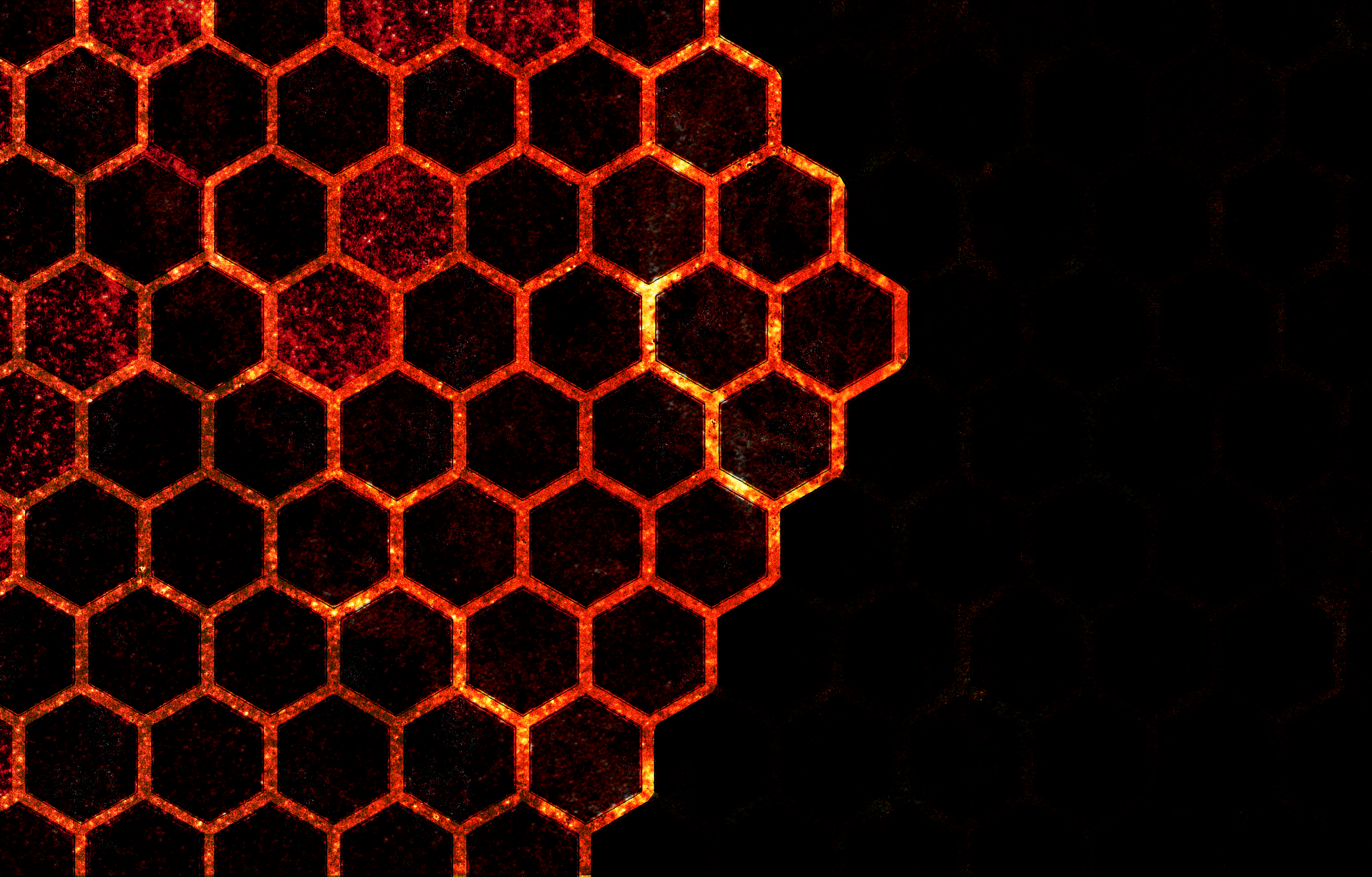
The “chopstick catch” was the most precise rocket recovery in history. But as SpaceX engineers watched the live video feed of the Starship spacecraft that had flown atop the booster before separation, they saw the same problem that has haunted every attempt at reusable spaceflight for six decades. The hexagonal black tiles that protect Starship’s underside glowed and charred during reentry, plasma eating through the forward flaps. Starship survived long enough to execute a perfect flip maneuver and splash down in the Indian Ocean. Whatever remains of its heatshield is now beneath the waves.
Every Starship that has reentered Earth’s atmosphere has told the same story: tiles crack, tiles burn through, tiles fall off. The spacecraft is supposed to make spaceflight as routine as catching a Southwest flight to Phoenix, but a heat shield that degrades dangerously after every flight makes that impossible.
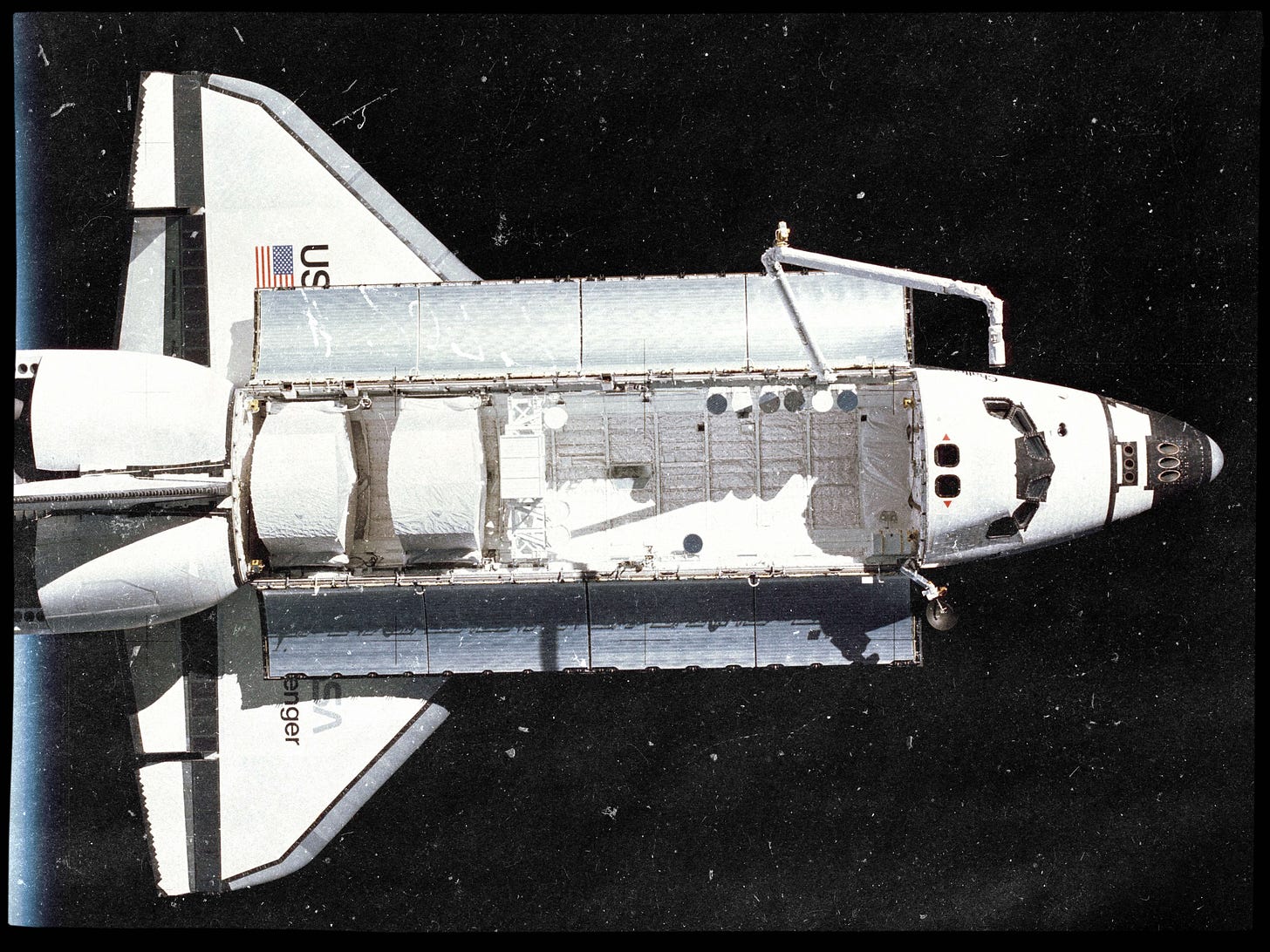
21 years earlier, on February 1, 2003, the Space Shuttle Columbia broke apart over Texas during reentry and killed all seven astronauts aboard. The cause was a breach in the reinforced carbon-carbon (RCC) panels that protect the leading edges of the shuttle’s wings. A chunk of foam insulation weighing less than two pounds had punched a hole about the size of a dinner plate in those panels 81 seconds after launch, 16 days before the disaster.

For Your Eyes Only.
Spies. Satellites. State secrets. Inside the technologies and intelligence contests shaping American power.
Subscribe + Issue 007
For the 15 days that Columbia orbited Earth, mission managers in Houston debated whether the strike had caused real damage. Engineers requested imaging of the damage from spy satellites. Management said no. The official view was that even if damage existed, nothing could be done about it. When Columbia reentered the atmosphere at 17,500 miles per hour, superheated plasma poured through that hole and ate the spacecraft from the inside out.
Between the Columbia disaster and the chopstick catch were two decades of stunning progress in propulsion, guidance, and autonomous systems. Rockets now land themselves on drone ships pitching in Atlantic swells. Satellites can be deployed by the thousand. Private companies put more payload into orbit than most nations. But the problem of developing materials that can survive the violence of atmospheric reentry and fly again without months of repair remains extremely tricky.
The First Heat Shields
Engineers understood the reentry problem before any human reached space, and the physics were brutal. When an object enters Earth’s atmosphere at orbital velocity, roughly 17,500 miles per hour for low-Earth orbit (LEO) and 25,000 mph for a return from the Moon, it compresses the air ahead of it so much that temperatures exceed 3,000° Fahrenheit. For a sense of what 3,000° F means: aluminum melts at 1,220° F and steel at 2,600° F. At that temperature, air itself becomes plasma, a screaming sheath of ionized gas that can vaporize almost anything. Almost.
The first solution came from NASA’s Ames Research Center in Silicon Valley, where researchers had been studying hypersonic heating since the early 1950s. The facility’s arc-jet tunnels blasted test materials with superheated gas at thousands of degrees, simulating in seconds what a spacecraft would endure during reentry. In 1953, the spirited engineer H. Julian Allen, nicknamed “Harvey” after the rabbit in the eponymous Broadway play, published his groundbreaking “blunt body theory,” which posited that a blunt, rounded nose would survive reentry better than the long, sharp noses used in ballistic missiles at the time. The blunt nose pushed the hottest air away from the spacecraft, creating a protective buffer. This theory led to the development of ablative heat shields — materials designed to char and vaporize, carrying heat away in the process. The concept was counterintuitive, almost perverse: protect the spacecraft by letting part of it burn away.
The Mercury capsule, which carried the first American astronauts to space, used an ablative shield made of fiberglass bonded with modified phenolic resin. As the capsule plunged through the atmosphere, the outer surface charred and vaporized, carrying heat away in the smoke. The shield worked. On February 20, 1962, World War II fighter pilot and future U.S. Senator John Glenn became the first American to orbit Earth and return safely in the Friendship 7 mission, though controllers spent his final orbits convinced a faulty sensor meant his heat shield had come loose. Glenn suspected trouble in-flight from the odd questions and small tests controllers kept asking him to perform, but didn’t learn the cause of their alarm until after splashdown.
The Apollo program, however, needed something tougher. A spacecraft returning from the Moon would hit the atmosphere at nearly 25,000 miles per hour, over 40% faster than an orbital return, and the heating would be correspondingly more savage. NASA contracted with Avco Corporation to develop a new ablative material called AVCOAT 5026-39, a honeycomb structure filled with epoxy-novolac resin reinforced with silica fibers. The shield varied in thickness from 0.7 inches to 2.7 inches, with the heaviest armor at the capsule’s base where the plasma hit hardest.
On November 9, 1967, Apollo 4 tested the shield at lunar-return velocities for the first time, speeds boosted by the Moon’s gravity accelerating the spacecraft earthward. The unmanned capsule punched into the atmosphere at 24,974 mph and came through intact. Twenty months later, Apollo 11 brought Neil Armstrong, Buzz Aldrin, and Michael Collins home from the Moon.
The Soviets, meanwhile, were building their own lunar hardware. The N1-L3 rocket that was supposed to carry cosmonauts to the Moon never completed a successful test flight. Four launches between 1969 and 1972 all failed — one even ending in a launchpad vehicle explosion — the result of chronic problems with the rocket’s nightmarish 30-engine first stage. But Soviet engineers had cracked the reentry problem. Their Zond spacecraft, designed to loop around the Moon and return, used ablative materials similar to the American approach. Zond 5 completed a circumlunar flight in September 1968, three months before Apollo 8, and survived reentry despite subjection to 20 g‘s of deceleration.
The problem with ablatives was obvious: they couldn’t be reused. Every flight required a new heat shield, every heat shield required months of painstaking manufacturing, and the cost of reaching space stayed astronomical. For the one-shot capsule programs of the 1960s, this was acceptable. Each mission was a discrete event, planned years in advance, celebrated like a moon landing even when it wasn’t. But if spaceflight was ever going to become routine, something had to change.
The Space Shuttle was supposed to be that change. Unlike the capsules that preceded it, the Shuttle was designed to fly repeatedly. NASA’s original projections, drawn up when President Nixon was still in office, called for flights every two weeks rather than every few months. An ablative heat shield that burned away on every flight was incompatible with this vision. The shuttle needed thermal protection that could survive reentry and fly again more or less immediately.
The solution came from Lockheed Missiles & Space Company. In the 1960s, a Lockheed engineer named Robert M. Beasley, who had joined the company from Corning Glass Works and spent years studying heat-resistant ceramics, developed a material called LI-900. The tiles were made from 99.9% pure silica glass fibers and were 94% air by volume, weighing just nine pounds per cubic foot (steel weighs about 500 lb/ft3) but able to withstand temperatures of up to 2,300° F. Its qualities were almost magical: at maximum heat exposure, the edges of an LI-900 tile could glow red-hot while the interior stayed cool enough to touch with a bare hand.
The tiles worked through a combination of insulation and radiation. Silica fibers are terrible conductors of heat. The tile’s surface was coated with reaction-cured glass that reflects 90% of the heat back into the atmosphere, while the tiles’ interior absorbs the remaining 10%. Each shuttle bore 24,000 of these tiles. The shuttle’s complex curved surfaces meant that no two tiles had exactly the same shape. Each had to be individually manufactured, numbered, and installed in its precise location by technicians, like archaeologists reassembling pottery shards. The gaps between tiles had to be filled with a flexible material that could accommodate thermal expansion without cracking. The entire thermal protection system was, in effect, a 24,000-piece jigsaw puzzle where every piece was irreplaceable and a missing one in the wrong location could kill the crew.
The fragility of this system revealed itself on the very first shuttle mission. When Columbia touched down on April 14, 1981, after a two-day orbital flight, inspectors swarming the orbiter found that 16 tiles had ripped off entirely and another 148 were damaged. An overpressure wave during launch had stripped tiles from the orbital maneuvering system pods at the back of the spacecraft. Fortunately, it was an area where reentry heating was less severe compared to the belly or wing leading edges.
NASA had expected some tile losses. The system was designed to tolerate limited damage. But the extent of the problem was troubling, and over the following years engineers scrambled to develop better bonding agents and installation techniques. Tile losses decreased but never stopped. Every shuttle flight came home wounded. Every turnaround required extensive inspection and repair. The dream of airline-style operations collapsed into the reality of six to eight flights per year, with months of preparation between each one.
The tiles protected the shuttle’s underside, where heating during reentry was intense but relatively uniform. The wing leading edges faced something worse. Here the airflow compressed against a curved surface, creating localized heating that could exceed 3,000°F, far beyond what silica tiles could survive. These areas were protected by reinforced carbon-carbon panels, called RCC: a composite of carbon fibers in a carbon matrix, coated with silicon carbide and secured with a glassy sealant to prevent oxidation.
RCC could handle the heat, but it was brittle, almost fragile, and the panels could be cracked or punctured by impacts that would barely dent aluminum. NASA knew this. Foam strikes from the external tank had occurred on multiple shuttle flights without apparent incident. Mission managers came to view them as a nuisance, a maintenance issue rather than a safety concern. This was a grave mistake, as revealed in the Columbia disaster.
No Solution in Sight
The Columbia Accident Investigation Board released its report in August 2003, and the findings were damning. NASA’s organizational culture had become so fixated on schedule and budget that safety concerns were routinely waved away. The foam problem had been normalized, treated as an acceptable risk because nothing bad had happened yet. The report called for sweeping changes to how NASA managed safety. It also surfaced a harder truth: the shuttle’s thermal protection system was brittle, and the RCC panels that had failed on Columbia were relics of 1970s engineering—developed using state-of-the-art technology of that era, but lacking the impact resistance to survive a foam strike. The panels were manufactured through a complex, multi-stage process, and for safe operation, the hottest leading-edge panels were limited to 50 missions. After Columbia, NASA worked to procure replacement panels and maintain a spare inventory, but the program’s days were numbered.
From 2005-2011, the shuttle program flew 22 more missions after Columbia before its sunset. The three remaining orbiters — Discovery, Endeavour, and Atlantis — completed their final flights in 2011, with Atlantis landing on July 21, 2011 to close out the program. During those years, NASA flew with obsessive caution, inspecting the thermal protection system in orbit using the shuttle’s new robotic arm and arranging for the International Space Station to serve as a lifeboat if inspectors found damage. No further accidents occurred, but the shuttle never came close to achieving the routine reusability its designers had hoped for. Two decades later, SpaceX is wrestling with the same challenge.
Starship’s heat shield uses roughly 18,000 hexagonal black tiles on the spacecraft’s windward side, fewer than the shuttle but still a complex system requiring precise installation and constant maintenance. The exact composition of the tiles is a closely held company secret, but the material is believed to be made up of silica, alumina-borosilicate, and aluminum oxide.
The shuttle descended steeply during reentry, its nose pitched up like a fighter jet coming in for a landing — meeting the atmosphere at a sharp angle. But Starship’s upper stage (the spacecraft that carries cargo and eventually crew) takes a different approach: flipping perpendicular to its flight path and falling through the atmosphere broadside, its entire belly facing the oncoming air like a skydiver in freefall. This “belly-flop” maneuver spreads the intense heating across a larger surface area, but creates bizarre stress patterns the shuttle never experienced. Each test flight generates terabytes of data about where the tiles crack and why.
The iteration cycle is rapid and unconventional, especially by NASA standards. SpaceX builds quickly, flies early, expects failures and extracts maximum data from each test cycle. SpaceX’s test philosophy treats explosions as tuition payments: everything is a learning opportunity. SN8, which flew in December 2020, demonstrated the belly-flop maneuver before slamming into the landing pad and detonating in a fireball. In May 2021, SN15 achieved the first successful landing. The Integrated Flight Tests that began in 2023 pushed toward orbital velocities, revealing heat shield failures that no wind tunnel or computer model had predicted.
IFT-3, in March 2024, was the first Starship spacecraft to experience full orbital-velocity reentry heating, and it shed tiles like a dog losing its winter coat. IFT-4, in June 2024, showed better tile adhesion but extensive burn damage to the ship’s control flaps, which had warped and charred in ways that concerned even SpaceX’s optimistic engineers.
Each test burns an estimated $100 million. SpaceX is running materials experiments at industrial scale, generating performance data that supplements computer models and ground testing. “For full reusability of the ship, there’s still a lot of work that remains on the heat shield. No one has ever made a fully reusable orbital heat shield,” Elon Musk said during an interview at the All-In Summit in September 2025. “We really are looking at fundamental physics here, trying to figure out how we make something that can withstand the heat, is very light, doesn’t transmit the heat to the primary structure, and the tiles stay on and don’t crack.”
The heat shield must survive reentry not once but dozens or hundreds of times if Starship is going to fulfill its intended purpose. An ablative system that burns away on every flight would require replacement before each mission. Manageable for Earth operations, maybe, but completely unworkable on Mars, where there are no tile factories, no bonding agents, no technicians to do the work. A reusable Starship requires a heat shield that can fly to Mars, land, refuel, launch, survive Earth reentry, and fly again. No such material exists today outside of PowerPoint slides.
The Knowledge Problem
The materials challenges of spaceflight extend far beyond heat shields. The space environment puts stress on all materials: radiation, temperature swings of 500° F between sun and shadow, hard vacuum conditions that cause materials degradation, micrometeorite impacts, atomic oxygen erosion… Each demands specialized solutions, and the solutions often conflict with each other.
Radiation-hardened electronics are another critical bottleneck. Earth’s atmosphere and magnetic field shield the surface from most cosmic radiation, but spacecraft in high orbits or beyond Earth’s magnetosphere are hammered by energetic particles that can flip bits in computer memory, corrupt data, or fry circuits permanently.
On April 5, 2010, the Intelsat Galaxy 15 communications satellite stopped responding to commands from Earth. The spacecraft’s computer had apparently been scrambled by a radiation-induced anomaly, likely from a strong solar event that had swept through geostationary orbit. The satellite remained functional but uncontrollable, a 4,000-pound zombie drifting through the geostationary arc and threatening to jam other satellites’ signals. For eight months, Intelsat and rival operators tracked the wandering satellite with growing alarm. Then, on December 23, 2010, the spacecraft’s computer spontaneously rebooted and normal operations resumed.
More capable spacecraft rely on specialized chips manufactured with processes designed to shrug off particle strikes. BAE Systems and Honeywell produce radiation-hardened processors using silicon-on-insulator fabrication and redundant circuit architectures that catch and correct errors before they propagate. These chips are expensive and typically run more than a decade behind the performance curve of the phone in your pocket.
Rocket engines must be designed to withstand the extreme violence of continuous explosions. The SpaceX Raptor engine operates at chamber pressures exceeding 300 bar, more than 4,350 pounds per square inch, with combustion temperatures over 5,400° F. The engine nozzle must contain this inferno while staying light enough to lift itself to orbit.
SpaceX uses proprietary nickel superalloys designated SX300 and SX500 for critical Raptor components. Nickel-based superalloys hold their strength at temperatures that would turn most metals to taffy. The nozzle is cooled regeneratively: liquid methane flows through channels machined into the nozzle walls, absorbing heat before being injected into the combustion chamber. The engineering is exquisite, but it depends entirely on materials that can survive conditions where most substances simply cease to exist.
The development history of rocket engines is largely a chronicle of materials breakthroughs and materials disasters. The Saturn V’s F-1 engine, which remains the most powerful single-chamber liquid-fueled rocket engine ever flown, required seven years of development to tame combustion instability problems that kept blowing engines apart on test stands. The solution was a meticulous redesign of the fuel injector, 2,832 precisely positioned orifices arranged in patterns that spread combustion evenly across the chamber. The injector geometry and the alloys that could survive it emerged from thousands of tests, countless explosions, and a blank check from a nation terrified of Soviet rockets.
Then there’s the square-cube law that haunts every structural engineer: a rocket twice as tall doesn’t need structural members twice as strong, but eight times stronger, because the mass it must support scales with the cube of its dimensions while the cross-sectional area of structural members scales only with the square. This law pushed rocket designers toward ever-lighter materials: aluminum-lithium alloys, carbon fiber composites, and eventually, in Starship’s case, stainless steel.
The choice of steel seemed crazy when Musk announced it in 2018. Steel is heavier than carbon fiber or aluminum, but it has properties that composites lack. It actually gets stronger when supercooled by liquid methane and oxygen propellants. It holds its strength at high temperatures, surviving reentry heating that would destroy lighter materials. And it’s cheap, available at any steel yard in America, and easy to weld in a muddy field in South Texas.
The switch was a systems-level gamble, trading mass for thermal performance and manufacturing flexibility. It was also a bet that materials constraints could be managed through clever engineering rather than exotic metallurgy. Whether that bet pays off depends on whether SpaceX can solve the tile problem that keeps burning through their spacecraft.

The Computational Promise
The biggest problem with heat shield development is that we’re still largely discovering materials through human trial and error. A tile composition that survives test flight IFT-4 might fail catastrophically on IFT-5. Engineers then adjust the formula based on their best educated guess, run hundreds of simulations, and hope for the best. But this iterative approach is glacially slow and expensive. To progress heat shield technology at the pace needed to meet space travel ambitions, we need a shortcut.
In November 2023, Google DeepMind announced GNoME, an AI system that predicted 2.2 million stable inorganic crystals, materials used in technologies like computer chips, batteries and solar panels. The discovery was a hundredfold increase over what human scientists had previously catalogued, the equivalent of 800 years worth of knowledge. The announcement sparked breathless headlines about AI revolutionizing materials discovery.
The reality is messier.
Predicting computationally that a material might be stable is the beginning of a very long road, not the end. A crystal structure that looks thermodynamically stable on a screen might prove impossible to synthesize in a real laboratory. An alloy that can be cooked up in small batches might behave completely differently at industrial scale. A ceramic that performs beautifully in a test furnace might crack the first time it experiences the thermal shock of atmospheric reentry.
NASA’s Technology Readiness Levels formalize this painful truth. A material at TRL 1 exists only as a concept on a whiteboard. At TRL 3, someone has demonstrated it works in laboratory conditions. At TRL 6, it’s been validated in an environment resembling actual use. At TRL 9, it flew successfully and proved itself in operation. The journey from TRL 1 to TRL 9 typically consumes 10 to 20 years. AI can accelerate the earliest stages, but it can’t compress the testing, qualification, and operational validation that follow. At least, not yet.
Belgian-American scientist Gerbrand Ceder — with whom I co-founded Radical AI — has spent decades trying to speed this process up. A professor of materials science and engineering at UC Berkeley who co-founded the Materials Project, an open database of computed materials properties, argues that the bottleneck to materials progress is no longer computational because supercomputers and sophisticated algorithms are plentiful. What’s scarce is experimental infrastructure to test predictions at scale and manufacturing capacity to produce validated materials in quantity. At Lawrence Berkeley National Laboratory, Ceder built A-Lab, the first autonomous facility where robots synthesize and characterize around the clock without human hands.
But even with robots working 24/7 and exhaustive experimental data capture, the qualification gauntlet for space-rated materials is painstaking. Thermal cycling tests subject samples to repeated heating and cooling across temperature ranges simulating the space environment. Vibration tests shake components at frequencies from 20 Hz to 2,000 Hz to simulate the violence of launch. Outgassing tests check whether materials release contaminants that could fog optics or poison sensors. Atomic oxygen exposure tests simulate the corrosive soup of LEO. Each test generates data, each data point feeds qualification, and none of it can be skipped or shortcut.
The Valley of Death
The chasm between laboratory discovery and commercial production has a name among researchers: the valley of death. Promising materials routinely fail to make the crossing, because scaling them is expensive, tedious, and nobody’s job.
Gorilla Glass offers an instructive detour from aerospace.
In 1960, Corning scientists worked on “Project Muscle,” developing a chemically strengthened glass they named Chemcor. Strong and scratch-resistant, it seemed like a breakthrough — but no mass market materialized. Chemcor limped along in niche applications for the automotive, aviation and pharmaceutical industries, but faded from use by the early 1990s.
Then, in early 2007, Steve Jobs unveiled the iPhone at MacWorld with a plastic screen. But the day after his presentation, Jobs noticed the screen on the prototype had scratched from the keys in his pocket. He called Apple’s chief operating officer, Jeff Williams, with a directive: “I don’t know how we’re going to do it, but when it ships in June, it’s gonna be glass.”
A few days later, a panicked Williams got a call from Corning CEO Wendell Weeks: “Your boss called and said my glass sucks.” Despite the insult, Weeks proposed reviving the company’s old chemically strengthened glass research.
Within six miraculous months, Corning had spun up production, tweaked the composition, and shipped enough to cover the first iPhones. (By February 2008, the material was formally rechristened “Gorilla Glass.”) The glass gained its strength from ion exchange: soaking it in molten potassium salt forced fat potassium ions to muscle aside smaller sodium ions in the glass surface, creating compressive stress that resisted cracking. The chemistry has been understood for half a century — the only thing that changed was a customer with deep pockets and a deadline.
Today, Gorilla Glass protects more than 8 billion devices worldwide, from smartphones to laptops to car dashboards and last year, Apple pumped a fresh $2.5 billion into Corning’s Kentucky manufacturing facilities to guarantee supply. A multi-billion-dollar business built on materials science that gathered dust for decades because nobody needed it badly enough.
Materials that could solve reentry heating, radiation hardening, or structural weight problems for the space industry may already exist in some university freezer. But the infrastructure to scale them doesn’t. Unlike consumer electronics, where a single deep-pocketed customer can yank a dormant technology into production overnight, aerospace procurement moves at glacial pace. Qualification cycles stretch for years with contracts that favor incumbents. The incentives to bridge the valley are weak, and promising materials keep dying in the crossing.
The Metrics That Matter
When SpaceX catches a rocket with its chopsticks, it’s demonstrating precision guidance and propulsion control. Those systems have matured to the point where the catch itself was almost anticlimactic, the booster dropping exactly as planned and grabbed exactly as intended. The catch is the easy part. Everything that happened during reentry — when tiles glowed, cracked and burned away — is another story.
Ask most people how to measure space leadership and they’ll point to spectacle: biggest rockets, most satellites, most dramatic recoveries racking up views on YouTube. Ask an aerospace engineer actually doing the work, and you’ll get a very different answer. What matters is the materials learning curve: How fast does a program accumulate knowledge about what survives and what doesn’t? How effectively does that knowledge get retained and fed into the next design? How efficiently does a laboratory discovery translate to qualified hardware to factory production?
By these measures, SpaceX is the clear leader. Its tiles are better than everyone else’s, sure, but their testing tempo also generates data at rates no other organization can match. Each flight is an experiment, each cracked tile is a data point, and each iteration improves on the last. The materials problems remain unsolved, but their learning rate is unprecedented.
China is steepening its own curve through systematic investment and centralized command. The European Space Agency, Japan, and India each maintain independent programs at varying levels of capability. Russia’s space effort, once a peer competitor, has withered under sanctions and brain drain. The exodus of Soviet talent that enriched Western programs after 1991 can’t be repeated, and no comparable reservoir of expertise waits to be tapped.
The constraint that keeps winning is physics.
Materials must survive temperatures that vaporize most substances, must hold their properties through hundreds of thermal cycles, brutal vibration loads, and relentless radiation bombardment, and must be manufacturable at rates supporting operational flight schedules. They must also cost little enough that reusability actually saves money.
These requirements haven’t changed since Mercury. What’s changed is our ability to hunt for solutions systematically, test candidates rapidly, and learn from failures collectively. The core problem — finding materials that can take the punishment of reentry and fly again without endless refurbishment — is exactly what it was when NASA engineers first wrestled with it in the 1950s.
The nation that cracks truly reusable thermal protection will own the next century of spaceflight, because everything else — the rockets, the satellites, the Moon bases — will flow from that breakthrough. SpaceX is closer than any entity has ever been, but even the gem of 21st-century American aerospace excellence hasn’t quite figured it out. On any given day at SpaceX’s Starbase facility in South Texas, technicians can be found crawling over Starship prototypes, inspecting heat shield tiles, prying out damaged ones, gluing in replacements, adjusting gap filler, prepping the spacecraft for its next ride through hell. Forty years ago, technicians at Kennedy Space Center did the same work on Columbia and her sisters.
The tools have improved, the materials have evolved, but the manual, painstaking work remains — and the brutality of the atmosphere, and the laws of physics, too.
Science
•
The Heat Shield at the Edge of Space
Six decades of spaceflight, one unsolved materials problem.
The South Texas sky was still a pale pink when SpaceX’s Super Heavy Booster 12 began its descent at dawn on October 13, 2024. 233 feet of stainless steel, falling from the edge of space, slowing itself with bursts of flame as it dropped toward a pair of mechanical arms jutting from the Starbase launch tower that SpaceX engineers had nicknamed “the chopsticks.” The booster had to hit a target measured in meters while descending at over 700 miles per hour. Miss by a few meters and the rocket becomes a fireball. As the arms gripped the rocket, the flame went out, and the roaring of the rocket engines was replaced by the roaring of the still-sleepy onlookers on the beach.
The “chopstick catch” was the most precise rocket recovery in history. But as SpaceX engineers watched the live video feed of the Starship spacecraft that had flown atop the booster before separation, they saw the same problem that has haunted every attempt at reusable spaceflight for six decades. The hexagonal black tiles that protect Starship’s underside glowed and charred during reentry, plasma eating through the forward flaps. Starship survived long enough to execute a perfect flip maneuver and splash down in the Indian Ocean. Whatever remains of its heatshield is now beneath the waves.
Every Starship that has reentered Earth’s atmosphere has told the same story: tiles crack, tiles burn through, tiles fall off. The spacecraft is supposed to make spaceflight as routine as catching a Southwest flight to Phoenix, but a heat shield that degrades dangerously after every flight makes that impossible.
21 years earlier, on February 1, 2003, the Space Shuttle Columbia broke apart over Texas during reentry and killed all seven astronauts aboard. The cause was a breach in the reinforced carbon-carbon (RCC) panels that protect the leading edges of the shuttle’s wings. A chunk of foam insulation weighing less than two pounds had punched a hole about the size of a dinner plate in those panels 81 seconds after launch, 16 days before the disaster.
For Your Eyes Only.
Spies. Satellites. State secrets. Inside the technologies and intelligence contests shaping American power.
Subscribe + Issue 007
For the 15 days that Columbia orbited Earth, mission managers in Houston debated whether the strike had caused real damage. Engineers requested imaging of the damage from spy satellites. Management said no. The official view was that even if damage existed, nothing could be done about it. When Columbia reentered the atmosphere at 17,500 miles per hour, superheated plasma poured through that hole and ate the spacecraft from the inside out.
Between the Columbia disaster and the chopstick catch were two decades of stunning progress in propulsion, guidance, and autonomous systems. Rockets now land themselves on drone ships pitching in Atlantic swells. Satellites can be deployed by the thousand. Private companies put more payload into orbit than most nations. But the problem of developing materials that can survive the violence of atmospheric reentry and fly again without months of repair remains extremely tricky.
The First Heat Shields
Engineers understood the reentry problem before any human reached space, and the physics were brutal. When an object enters Earth’s atmosphere at orbital velocity, roughly 17,500 miles per hour for low-Earth orbit (LEO) and 25,000 mph for a return from the Moon, it compresses the air ahead of it so much that temperatures exceed 3,000° Fahrenheit. For a sense of what 3,000° F means: aluminum melts at 1,220° F and steel at 2,600° F. At that temperature, air itself becomes plasma, a screaming sheath of ionized gas that can vaporize almost anything. Almost.
The first solution came from NASA’s Ames Research Center in Silicon Valley, where researchers had been studying hypersonic heating since the early 1950s. The facility’s arc-jet tunnels blasted test materials with superheated gas at thousands of degrees, simulating in seconds what a spacecraft would endure during reentry. In 1953, the spirited engineer H. Julian Allen, nicknamed “Harvey” after the rabbit in the eponymous Broadway play, published his groundbreaking “blunt body theory,” which posited that a blunt, rounded nose would survive reentry better than the long, sharp noses used in ballistic missiles at the time. The blunt nose pushed the hottest air away from the spacecraft, creating a protective buffer. This theory led to the development of ablative heat shields — materials designed to char and vaporize, carrying heat away in the process. The concept was counterintuitive, almost perverse: protect the spacecraft by letting part of it burn away.
The Mercury capsule, which carried the first American astronauts to space, used an ablative shield made of fiberglass bonded with modified phenolic resin. As the capsule plunged through the atmosphere, the outer surface charred and vaporized, carrying heat away in the smoke. The shield worked. On February 20, 1962, World War II fighter pilot and future U.S. Senator John Glenn became the first American to orbit Earth and return safely in the Friendship 7 mission, though controllers spent his final orbits convinced a faulty sensor meant his heat shield had come loose. Glenn suspected trouble in-flight from the odd questions and small tests controllers kept asking him to perform, but didn’t learn the cause of their alarm until after splashdown.
The Apollo program, however, needed something tougher. A spacecraft returning from the Moon would hit the atmosphere at nearly 25,000 miles per hour, over 40% faster than an orbital return, and the heating would be correspondingly more savage. NASA contracted with Avco Corporation to develop a new ablative material called AVCOAT 5026-39, a honeycomb structure filled with epoxy-novolac resin reinforced with silica fibers. The shield varied in thickness from 0.7 inches to 2.7 inches, with the heaviest armor at the capsule’s base where the plasma hit hardest.
On November 9, 1967, Apollo 4 tested the shield at lunar-return velocities for the first time, speeds boosted by the Moon’s gravity accelerating the spacecraft earthward. The unmanned capsule punched into the atmosphere at 24,974 mph and came through intact. Twenty months later, Apollo 11 brought Neil Armstrong, Buzz Aldrin, and Michael Collins home from the Moon.
The Soviets, meanwhile, were building their own lunar hardware. The N1-L3 rocket that was supposed to carry cosmonauts to the Moon never completed a successful test flight. Four launches between 1969 and 1972 all failed — one even ending in a launchpad vehicle explosion — the result of chronic problems with the rocket’s nightmarish 30-engine first stage. But Soviet engineers had cracked the reentry problem. Their Zond spacecraft, designed to loop around the Moon and return, used ablative materials similar to the American approach. Zond 5 completed a circumlunar flight in September 1968, three months before Apollo 8, and survived reentry despite subjection to 20 g‘s of deceleration.
The problem with ablatives was obvious: they couldn’t be reused. Every flight required a new heat shield, every heat shield required months of painstaking manufacturing, and the cost of reaching space stayed astronomical. For the one-shot capsule programs of the 1960s, this was acceptable. Each mission was a discrete event, planned years in advance, celebrated like a moon landing even when it wasn’t. But if spaceflight was ever going to become routine, something had to change.
The Space Shuttle was supposed to be that change. Unlike the capsules that preceded it, the Shuttle was designed to fly repeatedly. NASA’s original projections, drawn up when President Nixon was still in office, called for flights every two weeks rather than every few months. An ablative heat shield that burned away on every flight was incompatible with this vision. The shuttle needed thermal protection that could survive reentry and fly again more or less immediately.
The solution came from Lockheed Missiles & Space Company. In the 1960s, a Lockheed engineer named Robert M. Beasley, who had joined the company from Corning Glass Works and spent years studying heat-resistant ceramics, developed a material called LI-900. The tiles were made from 99.9% pure silica glass fibers and were 94% air by volume, weighing just nine pounds per cubic foot (steel weighs about 500 lb/ft3) but able to withstand temperatures of up to 2,300° F. Its qualities were almost magical: at maximum heat exposure, the edges of an LI-900 tile could glow red-hot while the interior stayed cool enough to touch with a bare hand.
The tiles worked through a combination of insulation and radiation. Silica fibers are terrible conductors of heat. The tile’s surface was coated with reaction-cured glass that reflects 90% of the heat back into the atmosphere, while the tiles’ interior absorbs the remaining 10%. Each shuttle bore 24,000 of these tiles. The shuttle’s complex curved surfaces meant that no two tiles had exactly the same shape. Each had to be individually manufactured, numbered, and installed in its precise location by technicians, like archaeologists reassembling pottery shards. The gaps between tiles had to be filled with a flexible material that could accommodate thermal expansion without cracking. The entire thermal protection system was, in effect, a 24,000-piece jigsaw puzzle where every piece was irreplaceable and a missing one in the wrong location could kill the crew.
The fragility of this system revealed itself on the very first shuttle mission. When Columbia touched down on April 14, 1981, after a two-day orbital flight, inspectors swarming the orbiter found that 16 tiles had ripped off entirely and another 148 were damaged. An overpressure wave during launch had stripped tiles from the orbital maneuvering system pods at the back of the spacecraft. Fortunately, it was an area where reentry heating was less severe compared to the belly or wing leading edges.
NASA had expected some tile losses. The system was designed to tolerate limited damage. But the extent of the problem was troubling, and over the following years engineers scrambled to develop better bonding agents and installation techniques. Tile losses decreased but never stopped. Every shuttle flight came home wounded. Every turnaround required extensive inspection and repair. The dream of airline-style operations collapsed into the reality of six to eight flights per year, with months of preparation between each one.
The tiles protected the shuttle’s underside, where heating during reentry was intense but relatively uniform. The wing leading edges faced something worse. Here the airflow compressed against a curved surface, creating localized heating that could exceed 3,000°F, far beyond what silica tiles could survive. These areas were protected by reinforced carbon-carbon panels, called RCC: a composite of carbon fibers in a carbon matrix, coated with silicon carbide and secured with a glassy sealant to prevent oxidation.
RCC could handle the heat, but it was brittle, almost fragile, and the panels could be cracked or punctured by impacts that would barely dent aluminum. NASA knew this. Foam strikes from the external tank had occurred on multiple shuttle flights without apparent incident. Mission managers came to view them as a nuisance, a maintenance issue rather than a safety concern. This was a grave mistake, as revealed in the Columbia disaster.
No Solution in Sight
The Columbia Accident Investigation Board released its report in August 2003, and the findings were damning. NASA’s organizational culture had become so fixated on schedule and budget that safety concerns were routinely waved away. The foam problem had been normalized, treated as an acceptable risk because nothing bad had happened yet. The report called for sweeping changes to how NASA managed safety. It also surfaced a harder truth: the shuttle’s thermal protection system was brittle, and the RCC panels that had failed on Columbia were relics of 1970s engineering—developed using state-of-the-art technology of that era, but lacking the impact resistance to survive a foam strike. The panels were manufactured through a complex, multi-stage process, and for safe operation, the hottest leading-edge panels were limited to 50 missions. After Columbia, NASA worked to procure replacement panels and maintain a spare inventory, but the program’s days were numbered.
From 2005-2011, the shuttle program flew 22 more missions after Columbia before its sunset. The three remaining orbiters — Discovery, Endeavour, and Atlantis — completed their final flights in 2011, with Atlantis landing on July 21, 2011 to close out the program. During those years, NASA flew with obsessive caution, inspecting the thermal protection system in orbit using the shuttle’s new robotic arm and arranging for the International Space Station to serve as a lifeboat if inspectors found damage. No further accidents occurred, but the shuttle never came close to achieving the routine reusability its designers had hoped for. Two decades later, SpaceX is wrestling with the same challenge.
Starship’s heat shield uses roughly 18,000 hexagonal black tiles on the spacecraft’s windward side, fewer than the shuttle but still a complex system requiring precise installation and constant maintenance. The exact composition of the tiles is a closely held company secret, but the material is believed to be made up of silica, alumina-borosilicate, and aluminum oxide.
The shuttle descended steeply during reentry, its nose pitched up like a fighter jet coming in for a landing — meeting the atmosphere at a sharp angle. But Starship’s upper stage (the spacecraft that carries cargo and eventually crew) takes a different approach: flipping perpendicular to its flight path and falling through the atmosphere broadside, its entire belly facing the oncoming air like a skydiver in freefall. This “belly-flop” maneuver spreads the intense heating across a larger surface area, but creates bizarre stress patterns the shuttle never experienced. Each test flight generates terabytes of data about where the tiles crack and why.
The iteration cycle is rapid and unconventional, especially by NASA standards. SpaceX builds quickly, flies early, expects failures and extracts maximum data from each test cycle. SpaceX’s test philosophy treats explosions as tuition payments: everything is a learning opportunity. SN8, which flew in December 2020, demonstrated the belly-flop maneuver before slamming into the landing pad and detonating in a fireball. In May 2021, SN15 achieved the first successful landing. The Integrated Flight Tests that began in 2023 pushed toward orbital velocities, revealing heat shield failures that no wind tunnel or computer model had predicted.
IFT-3, in March 2024, was the first Starship spacecraft to experience full orbital-velocity reentry heating, and it shed tiles like a dog losing its winter coat. IFT-4, in June 2024, showed better tile adhesion but extensive burn damage to the ship’s control flaps, which had warped and charred in ways that concerned even SpaceX’s optimistic engineers.
Each test burns an estimated $100 million. SpaceX is running materials experiments at industrial scale, generating performance data that supplements computer models and ground testing. “For full reusability of the ship, there’s still a lot of work that remains on the heat shield. No one has ever made a fully reusable orbital heat shield,” Elon Musk said during an interview at the All-In Summit in September 2025. “We really are looking at fundamental physics here, trying to figure out how we make something that can withstand the heat, is very light, doesn’t transmit the heat to the primary structure, and the tiles stay on and don’t crack.”
The heat shield must survive reentry not once but dozens or hundreds of times if Starship is going to fulfill its intended purpose. An ablative system that burns away on every flight would require replacement before each mission. Manageable for Earth operations, maybe, but completely unworkable on Mars, where there are no tile factories, no bonding agents, no technicians to do the work. A reusable Starship requires a heat shield that can fly to Mars, land, refuel, launch, survive Earth reentry, and fly again. No such material exists today outside of PowerPoint slides.
The Knowledge Problem
The materials challenges of spaceflight extend far beyond heat shields. The space environment puts stress on all materials: radiation, temperature swings of 500° F between sun and shadow, hard vacuum conditions that cause materials degradation, micrometeorite impacts, atomic oxygen erosion… Each demands specialized solutions, and the solutions often conflict with each other.
Radiation-hardened electronics are another critical bottleneck. Earth’s atmosphere and magnetic field shield the surface from most cosmic radiation, but spacecraft in high orbits or beyond Earth’s magnetosphere are hammered by energetic particles that can flip bits in computer memory, corrupt data, or fry circuits permanently.
On April 5, 2010, the Intelsat Galaxy 15 communications satellite stopped responding to commands from Earth. The spacecraft’s computer had apparently been scrambled by a radiation-induced anomaly, likely from a strong solar event that had swept through geostationary orbit. The satellite remained functional but uncontrollable, a 4,000-pound zombie drifting through the geostationary arc and threatening to jam other satellites’ signals. For eight months, Intelsat and rival operators tracked the wandering satellite with growing alarm. Then, on December 23, 2010, the spacecraft’s computer spontaneously rebooted and normal operations resumed.
More capable spacecraft rely on specialized chips manufactured with processes designed to shrug off particle strikes. BAE Systems and Honeywell produce radiation-hardened processors using silicon-on-insulator fabrication and redundant circuit architectures that catch and correct errors before they propagate. These chips are expensive and typically run more than a decade behind the performance curve of the phone in your pocket.
Rocket engines must be designed to withstand the extreme violence of continuous explosions. The SpaceX Raptor engine operates at chamber pressures exceeding 300 bar, more than 4,350 pounds per square inch, with combustion temperatures over 5,400° F. The engine nozzle must contain this inferno while staying light enough to lift itself to orbit.
SpaceX uses proprietary nickel superalloys designated SX300 and SX500 for critical Raptor components. Nickel-based superalloys hold their strength at temperatures that would turn most metals to taffy. The nozzle is cooled regeneratively: liquid methane flows through channels machined into the nozzle walls, absorbing heat before being injected into the combustion chamber. The engineering is exquisite, but it depends entirely on materials that can survive conditions where most substances simply cease to exist.
The development history of rocket engines is largely a chronicle of materials breakthroughs and materials disasters. The Saturn V’s F-1 engine, which remains the most powerful single-chamber liquid-fueled rocket engine ever flown, required seven years of development to tame combustion instability problems that kept blowing engines apart on test stands. The solution was a meticulous redesign of the fuel injector, 2,832 precisely positioned orifices arranged in patterns that spread combustion evenly across the chamber. The injector geometry and the alloys that could survive it emerged from thousands of tests, countless explosions, and a blank check from a nation terrified of Soviet rockets.
Then there’s the square-cube law that haunts every structural engineer: a rocket twice as tall doesn’t need structural members twice as strong, but eight times stronger, because the mass it must support scales with the cube of its dimensions while the cross-sectional area of structural members scales only with the square. This law pushed rocket designers toward ever-lighter materials: aluminum-lithium alloys, carbon fiber composites, and eventually, in Starship’s case, stainless steel.
The choice of steel seemed crazy when Musk announced it in 2018. Steel is heavier than carbon fiber or aluminum, but it has properties that composites lack. It actually gets stronger when supercooled by liquid methane and oxygen propellants. It holds its strength at high temperatures, surviving reentry heating that would destroy lighter materials. And it’s cheap, available at any steel yard in America, and easy to weld in a muddy field in South Texas.
The switch was a systems-level gamble, trading mass for thermal performance and manufacturing flexibility. It was also a bet that materials constraints could be managed through clever engineering rather than exotic metallurgy. Whether that bet pays off depends on whether SpaceX can solve the tile problem that keeps burning through their spacecraft.
The Computational Promise
The biggest problem with heat shield development is that we’re still largely discovering materials through human trial and error. A tile composition that survives test flight IFT-4 might fail catastrophically on IFT-5. Engineers then adjust the formula based on their best educated guess, run hundreds of simulations, and hope for the best. But this iterative approach is glacially slow and expensive. To progress heat shield technology at the pace needed to meet space travel ambitions, we need a shortcut.
In November 2023, Google DeepMind announced GNoME, an AI system that predicted 2.2 million stable inorganic crystals, materials used in technologies like computer chips, batteries and solar panels. The discovery was a hundredfold increase over what human scientists had previously catalogued, the equivalent of 800 years worth of knowledge. The announcement sparked breathless headlines about AI revolutionizing materials discovery.
The reality is messier.
Predicting computationally that a material might be stable is the beginning of a very long road, not the end. A crystal structure that looks thermodynamically stable on a screen might prove impossible to synthesize in a real laboratory. An alloy that can be cooked up in small batches might behave completely differently at industrial scale. A ceramic that performs beautifully in a test furnace might crack the first time it experiences the thermal shock of atmospheric reentry.
NASA’s Technology Readiness Levels formalize this painful truth. A material at TRL 1 exists only as a concept on a whiteboard. At TRL 3, someone has demonstrated it works in laboratory conditions. At TRL 6, it’s been validated in an environment resembling actual use. At TRL 9, it flew successfully and proved itself in operation. The journey from TRL 1 to TRL 9 typically consumes 10 to 20 years. AI can accelerate the earliest stages, but it can’t compress the testing, qualification, and operational validation that follow. At least, not yet.
Belgian-American scientist Gerbrand Ceder — with whom I co-founded Radical AI — has spent decades trying to speed this process up. A professor of materials science and engineering at UC Berkeley who co-founded the Materials Project, an open database of computed materials properties, argues that the bottleneck to materials progress is no longer computational because supercomputers and sophisticated algorithms are plentiful. What’s scarce is experimental infrastructure to test predictions at scale and manufacturing capacity to produce validated materials in quantity. At Lawrence Berkeley National Laboratory, Ceder built A-Lab, the first autonomous facility where robots synthesize and characterize around the clock without human hands.
But even with robots working 24/7 and exhaustive experimental data capture, the qualification gauntlet for space-rated materials is painstaking. Thermal cycling tests subject samples to repeated heating and cooling across temperature ranges simulating the space environment. Vibration tests shake components at frequencies from 20 Hz to 2,000 Hz to simulate the violence of launch. Outgassing tests check whether materials release contaminants that could fog optics or poison sensors. Atomic oxygen exposure tests simulate the corrosive soup of LEO. Each test generates data, each data point feeds qualification, and none of it can be skipped or shortcut.
The Valley of Death
The chasm between laboratory discovery and commercial production has a name among researchers: the valley of death. Promising materials routinely fail to make the crossing, because scaling them is expensive, tedious, and nobody’s job.
Gorilla Glass offers an instructive detour from aerospace.
In 1960, Corning scientists worked on “Project Muscle,” developing a chemically strengthened glass they named Chemcor. Strong and scratch-resistant, it seemed like a breakthrough — but no mass market materialized. Chemcor limped along in niche applications for the automotive, aviation and pharmaceutical industries, but faded from use by the early 1990s.
Then, in early 2007, Steve Jobs unveiled the iPhone at MacWorld with a plastic screen. But the day after his presentation, Jobs noticed the screen on the prototype had scratched from the keys in his pocket. He called Apple’s chief operating officer, Jeff Williams, with a directive: “I don’t know how we’re going to do it, but when it ships in June, it’s gonna be glass.”
A few days later, a panicked Williams got a call from Corning CEO Wendell Weeks: “Your boss called and said my glass sucks.” Despite the insult, Weeks proposed reviving the company’s old chemically strengthened glass research.
Within six miraculous months, Corning had spun up production, tweaked the composition, and shipped enough to cover the first iPhones. (By February 2008, the material was formally rechristened “Gorilla Glass.”) The glass gained its strength from ion exchange: soaking it in molten potassium salt forced fat potassium ions to muscle aside smaller sodium ions in the glass surface, creating compressive stress that resisted cracking. The chemistry has been understood for half a century — the only thing that changed was a customer with deep pockets and a deadline.
Today, Gorilla Glass protects more than 8 billion devices worldwide, from smartphones to laptops to car dashboards and last year, Apple pumped a fresh $2.5 billion into Corning’s Kentucky manufacturing facilities to guarantee supply. A multi-billion-dollar business built on materials science that gathered dust for decades because nobody needed it badly enough.
Materials that could solve reentry heating, radiation hardening, or structural weight problems for the space industry may already exist in some university freezer. But the infrastructure to scale them doesn’t. Unlike consumer electronics, where a single deep-pocketed customer can yank a dormant technology into production overnight, aerospace procurement moves at glacial pace. Qualification cycles stretch for years with contracts that favor incumbents. The incentives to bridge the valley are weak, and promising materials keep dying in the crossing.
The Metrics That Matter
When SpaceX catches a rocket with its chopsticks, it’s demonstrating precision guidance and propulsion control. Those systems have matured to the point where the catch itself was almost anticlimactic, the booster dropping exactly as planned and grabbed exactly as intended. The catch is the easy part. Everything that happened during reentry — when tiles glowed, cracked and burned away — is another story.
Ask most people how to measure space leadership and they’ll point to spectacle: biggest rockets, most satellites, most dramatic recoveries racking up views on YouTube. Ask an aerospace engineer actually doing the work, and you’ll get a very different answer. What matters is the materials learning curve: How fast does a program accumulate knowledge about what survives and what doesn’t? How effectively does that knowledge get retained and fed into the next design? How efficiently does a laboratory discovery translate to qualified hardware to factory production?
By these measures, SpaceX is the clear leader. Its tiles are better than everyone else’s, sure, but their testing tempo also generates data at rates no other organization can match. Each flight is an experiment, each cracked tile is a data point, and each iteration improves on the last. The materials problems remain unsolved, but their learning rate is unprecedented.
China is steepening its own curve through systematic investment and centralized command. The European Space Agency, Japan, and India each maintain independent programs at varying levels of capability. Russia’s space effort, once a peer competitor, has withered under sanctions and brain drain. The exodus of Soviet talent that enriched Western programs after 1991 can’t be repeated, and no comparable reservoir of expertise waits to be tapped.
The constraint that keeps winning is physics.
Materials must survive temperatures that vaporize most substances, must hold their properties through hundreds of thermal cycles, brutal vibration loads, and relentless radiation bombardment, and must be manufacturable at rates supporting operational flight schedules. They must also cost little enough that reusability actually saves money.
These requirements haven’t changed since Mercury. What’s changed is our ability to hunt for solutions systematically, test candidates rapidly, and learn from failures collectively. The core problem — finding materials that can take the punishment of reentry and fly again without endless refurbishment — is exactly what it was when NASA engineers first wrestled with it in the 1950s.
The nation that cracks truly reusable thermal protection will own the next century of spaceflight, because everything else — the rockets, the satellites, the Moon bases — will flow from that breakthrough. SpaceX is closer than any entity has ever been, but even the gem of 21st-century American aerospace excellence hasn’t quite figured it out. On any given day at SpaceX’s Starbase facility in South Texas, technicians can be found crawling over Starship prototypes, inspecting heat shield tiles, prying out damaged ones, gluing in replacements, adjusting gap filler, prepping the spacecraft for its next ride through hell. Forty years ago, technicians at Kennedy Space Center did the same work on Columbia and her sisters.
The tools have improved, the materials have evolved, but the manual, painstaking work remains — and the brutality of the atmosphere, and the laws of physics, too.
Science
•
The Heat Shield at the Edge of Space
Six decades of spaceflight, one unsolved materials problem.
The South Texas sky was still a pale pink when SpaceX’s Super Heavy Booster 12 began its descent at dawn on October 13, 2024. 233 feet of stainless steel, falling from the edge of space, slowing itself with bursts of flame as it dropped toward a pair of mechanical arms jutting from the Starbase launch tower that SpaceX engineers had nicknamed “the chopsticks.” The booster had to hit a target measured in meters while descending at over 700 miles per hour. Miss by a few meters and the rocket becomes a fireball. As the arms gripped the rocket, the flame went out, and the roaring of the rocket engines was replaced by the roaring of the still-sleepy onlookers on the beach.
The “chopstick catch” was the most precise rocket recovery in history. But as SpaceX engineers watched the live video feed of the Starship spacecraft that had flown atop the booster before separation, they saw the same problem that has haunted every attempt at reusable spaceflight for six decades. The hexagonal black tiles that protect Starship’s underside glowed and charred during reentry, plasma eating through the forward flaps. Starship survived long enough to execute a perfect flip maneuver and splash down in the Indian Ocean. Whatever remains of its heatshield is now beneath the waves.
Every Starship that has reentered Earth’s atmosphere has told the same story: tiles crack, tiles burn through, tiles fall off. The spacecraft is supposed to make spaceflight as routine as catching a Southwest flight to Phoenix, but a heat shield that degrades dangerously after every flight makes that impossible.
21 years earlier, on February 1, 2003, the Space Shuttle Columbia broke apart over Texas during reentry and killed all seven astronauts aboard. The cause was a breach in the reinforced carbon-carbon (RCC) panels that protect the leading edges of the shuttle’s wings. A chunk of foam insulation weighing less than two pounds had punched a hole about the size of a dinner plate in those panels 81 seconds after launch, 16 days before the disaster.
For Your Eyes Only.
Spies. Satellites. State secrets. Inside the technologies and intelligence contests shaping American power.
Subscribe + Issue 007
For the 15 days that Columbia orbited Earth, mission managers in Houston debated whether the strike had caused real damage. Engineers requested imaging of the damage from spy satellites. Management said no. The official view was that even if damage existed, nothing could be done about it. When Columbia reentered the atmosphere at 17,500 miles per hour, superheated plasma poured through that hole and ate the spacecraft from the inside out.
Between the Columbia disaster and the chopstick catch were two decades of stunning progress in propulsion, guidance, and autonomous systems. Rockets now land themselves on drone ships pitching in Atlantic swells. Satellites can be deployed by the thousand. Private companies put more payload into orbit than most nations. But the problem of developing materials that can survive the violence of atmospheric reentry and fly again without months of repair remains extremely tricky.
The First Heat Shields
Engineers understood the reentry problem before any human reached space, and the physics were brutal. When an object enters Earth’s atmosphere at orbital velocity, roughly 17,500 miles per hour for low-Earth orbit (LEO) and 25,000 mph for a return from the Moon, it compresses the air ahead of it so much that temperatures exceed 3,000° Fahrenheit. For a sense of what 3,000° F means: aluminum melts at 1,220° F and steel at 2,600° F. At that temperature, air itself becomes plasma, a screaming sheath of ionized gas that can vaporize almost anything. Almost.
The first solution came from NASA’s Ames Research Center in Silicon Valley, where researchers had been studying hypersonic heating since the early 1950s. The facility’s arc-jet tunnels blasted test materials with superheated gas at thousands of degrees, simulating in seconds what a spacecraft would endure during reentry. In 1953, the spirited engineer H. Julian Allen, nicknamed “Harvey” after the rabbit in the eponymous Broadway play, published his groundbreaking “blunt body theory,” which posited that a blunt, rounded nose would survive reentry better than the long, sharp noses used in ballistic missiles at the time. The blunt nose pushed the hottest air away from the spacecraft, creating a protective buffer. This theory led to the development of ablative heat shields — materials designed to char and vaporize, carrying heat away in the process. The concept was counterintuitive, almost perverse: protect the spacecraft by letting part of it burn away.
The Mercury capsule, which carried the first American astronauts to space, used an ablative shield made of fiberglass bonded with modified phenolic resin. As the capsule plunged through the atmosphere, the outer surface charred and vaporized, carrying heat away in the smoke. The shield worked. On February 20, 1962, World War II fighter pilot and future U.S. Senator John Glenn became the first American to orbit Earth and return safely in the Friendship 7 mission, though controllers spent his final orbits convinced a faulty sensor meant his heat shield had come loose. Glenn suspected trouble in-flight from the odd questions and small tests controllers kept asking him to perform, but didn’t learn the cause of their alarm until after splashdown.
The Apollo program, however, needed something tougher. A spacecraft returning from the Moon would hit the atmosphere at nearly 25,000 miles per hour, over 40% faster than an orbital return, and the heating would be correspondingly more savage. NASA contracted with Avco Corporation to develop a new ablative material called AVCOAT 5026-39, a honeycomb structure filled with epoxy-novolac resin reinforced with silica fibers. The shield varied in thickness from 0.7 inches to 2.7 inches, with the heaviest armor at the capsule’s base where the plasma hit hardest.
On November 9, 1967, Apollo 4 tested the shield at lunar-return velocities for the first time, speeds boosted by the Moon’s gravity accelerating the spacecraft earthward. The unmanned capsule punched into the atmosphere at 24,974 mph and came through intact. Twenty months later, Apollo 11 brought Neil Armstrong, Buzz Aldrin, and Michael Collins home from the Moon.
The Soviets, meanwhile, were building their own lunar hardware. The N1-L3 rocket that was supposed to carry cosmonauts to the Moon never completed a successful test flight. Four launches between 1969 and 1972 all failed — one even ending in a launchpad vehicle explosion — the result of chronic problems with the rocket’s nightmarish 30-engine first stage. But Soviet engineers had cracked the reentry problem. Their Zond spacecraft, designed to loop around the Moon and return, used ablative materials similar to the American approach. Zond 5 completed a circumlunar flight in September 1968, three months before Apollo 8, and survived reentry despite subjection to 20 g‘s of deceleration.
The problem with ablatives was obvious: they couldn’t be reused. Every flight required a new heat shield, every heat shield required months of painstaking manufacturing, and the cost of reaching space stayed astronomical. For the one-shot capsule programs of the 1960s, this was acceptable. Each mission was a discrete event, planned years in advance, celebrated like a moon landing even when it wasn’t. But if spaceflight was ever going to become routine, something had to change.
The Space Shuttle was supposed to be that change. Unlike the capsules that preceded it, the Shuttle was designed to fly repeatedly. NASA’s original projections, drawn up when President Nixon was still in office, called for flights every two weeks rather than every few months. An ablative heat shield that burned away on every flight was incompatible with this vision. The shuttle needed thermal protection that could survive reentry and fly again more or less immediately.
The solution came from Lockheed Missiles & Space Company. In the 1960s, a Lockheed engineer named Robert M. Beasley, who had joined the company from Corning Glass Works and spent years studying heat-resistant ceramics, developed a material called LI-900. The tiles were made from 99.9% pure silica glass fibers and were 94% air by volume, weighing just nine pounds per cubic foot (steel weighs about 500 lb/ft3) but able to withstand temperatures of up to 2,300° F. Its qualities were almost magical: at maximum heat exposure, the edges of an LI-900 tile could glow red-hot while the interior stayed cool enough to touch with a bare hand.
The tiles worked through a combination of insulation and radiation. Silica fibers are terrible conductors of heat. The tile’s surface was coated with reaction-cured glass that reflects 90% of the heat back into the atmosphere, while the tiles’ interior absorbs the remaining 10%. Each shuttle bore 24,000 of these tiles. The shuttle’s complex curved surfaces meant that no two tiles had exactly the same shape. Each had to be individually manufactured, numbered, and installed in its precise location by technicians, like archaeologists reassembling pottery shards. The gaps between tiles had to be filled with a flexible material that could accommodate thermal expansion without cracking. The entire thermal protection system was, in effect, a 24,000-piece jigsaw puzzle where every piece was irreplaceable and a missing one in the wrong location could kill the crew.
The fragility of this system revealed itself on the very first shuttle mission. When Columbia touched down on April 14, 1981, after a two-day orbital flight, inspectors swarming the orbiter found that 16 tiles had ripped off entirely and another 148 were damaged. An overpressure wave during launch had stripped tiles from the orbital maneuvering system pods at the back of the spacecraft. Fortunately, it was an area where reentry heating was less severe compared to the belly or wing leading edges.
NASA had expected some tile losses. The system was designed to tolerate limited damage. But the extent of the problem was troubling, and over the following years engineers scrambled to develop better bonding agents and installation techniques. Tile losses decreased but never stopped. Every shuttle flight came home wounded. Every turnaround required extensive inspection and repair. The dream of airline-style operations collapsed into the reality of six to eight flights per year, with months of preparation between each one.
The tiles protected the shuttle’s underside, where heating during reentry was intense but relatively uniform. The wing leading edges faced something worse. Here the airflow compressed against a curved surface, creating localized heating that could exceed 3,000°F, far beyond what silica tiles could survive. These areas were protected by reinforced carbon-carbon panels, called RCC: a composite of carbon fibers in a carbon matrix, coated with silicon carbide and secured with a glassy sealant to prevent oxidation.
RCC could handle the heat, but it was brittle, almost fragile, and the panels could be cracked or punctured by impacts that would barely dent aluminum. NASA knew this. Foam strikes from the external tank had occurred on multiple shuttle flights without apparent incident. Mission managers came to view them as a nuisance, a maintenance issue rather than a safety concern. This was a grave mistake, as revealed in the Columbia disaster.
No Solution in Sight
The Columbia Accident Investigation Board released its report in August 2003, and the findings were damning. NASA’s organizational culture had become so fixated on schedule and budget that safety concerns were routinely waved away. The foam problem had been normalized, treated as an acceptable risk because nothing bad had happened yet. The report called for sweeping changes to how NASA managed safety. It also surfaced a harder truth: the shuttle’s thermal protection system was brittle, and the RCC panels that had failed on Columbia were relics of 1970s engineering—developed using state-of-the-art technology of that era, but lacking the impact resistance to survive a foam strike. The panels were manufactured through a complex, multi-stage process, and for safe operation, the hottest leading-edge panels were limited to 50 missions. After Columbia, NASA worked to procure replacement panels and maintain a spare inventory, but the program’s days were numbered.
From 2005-2011, the shuttle program flew 22 more missions after Columbia before its sunset. The three remaining orbiters — Discovery, Endeavour, and Atlantis — completed their final flights in 2011, with Atlantis landing on July 21, 2011 to close out the program. During those years, NASA flew with obsessive caution, inspecting the thermal protection system in orbit using the shuttle’s new robotic arm and arranging for the International Space Station to serve as a lifeboat if inspectors found damage. No further accidents occurred, but the shuttle never came close to achieving the routine reusability its designers had hoped for. Two decades later, SpaceX is wrestling with the same challenge.
Starship’s heat shield uses roughly 18,000 hexagonal black tiles on the spacecraft’s windward side, fewer than the shuttle but still a complex system requiring precise installation and constant maintenance. The exact composition of the tiles is a closely held company secret, but the material is believed to be made up of silica, alumina-borosilicate, and aluminum oxide.
The shuttle descended steeply during reentry, its nose pitched up like a fighter jet coming in for a landing — meeting the atmosphere at a sharp angle. But Starship’s upper stage (the spacecraft that carries cargo and eventually crew) takes a different approach: flipping perpendicular to its flight path and falling through the atmosphere broadside, its entire belly facing the oncoming air like a skydiver in freefall. This “belly-flop” maneuver spreads the intense heating across a larger surface area, but creates bizarre stress patterns the shuttle never experienced. Each test flight generates terabytes of data about where the tiles crack and why.
The iteration cycle is rapid and unconventional, especially by NASA standards. SpaceX builds quickly, flies early, expects failures and extracts maximum data from each test cycle. SpaceX’s test philosophy treats explosions as tuition payments: everything is a learning opportunity. SN8, which flew in December 2020, demonstrated the belly-flop maneuver before slamming into the landing pad and detonating in a fireball. In May 2021, SN15 achieved the first successful landing. The Integrated Flight Tests that began in 2023 pushed toward orbital velocities, revealing heat shield failures that no wind tunnel or computer model had predicted.
IFT-3, in March 2024, was the first Starship spacecraft to experience full orbital-velocity reentry heating, and it shed tiles like a dog losing its winter coat. IFT-4, in June 2024, showed better tile adhesion but extensive burn damage to the ship’s control flaps, which had warped and charred in ways that concerned even SpaceX’s optimistic engineers.
Each test burns an estimated $100 million. SpaceX is running materials experiments at industrial scale, generating performance data that supplements computer models and ground testing. “For full reusability of the ship, there’s still a lot of work that remains on the heat shield. No one has ever made a fully reusable orbital heat shield,” Elon Musk said during an interview at the All-In Summit in September 2025. “We really are looking at fundamental physics here, trying to figure out how we make something that can withstand the heat, is very light, doesn’t transmit the heat to the primary structure, and the tiles stay on and don’t crack.”
The heat shield must survive reentry not once but dozens or hundreds of times if Starship is going to fulfill its intended purpose. An ablative system that burns away on every flight would require replacement before each mission. Manageable for Earth operations, maybe, but completely unworkable on Mars, where there are no tile factories, no bonding agents, no technicians to do the work. A reusable Starship requires a heat shield that can fly to Mars, land, refuel, launch, survive Earth reentry, and fly again. No such material exists today outside of PowerPoint slides.
The Knowledge Problem
The materials challenges of spaceflight extend far beyond heat shields. The space environment puts stress on all materials: radiation, temperature swings of 500° F between sun and shadow, hard vacuum conditions that cause materials degradation, micrometeorite impacts, atomic oxygen erosion… Each demands specialized solutions, and the solutions often conflict with each other.
Radiation-hardened electronics are another critical bottleneck. Earth’s atmosphere and magnetic field shield the surface from most cosmic radiation, but spacecraft in high orbits or beyond Earth’s magnetosphere are hammered by energetic particles that can flip bits in computer memory, corrupt data, or fry circuits permanently.
On April 5, 2010, the Intelsat Galaxy 15 communications satellite stopped responding to commands from Earth. The spacecraft’s computer had apparently been scrambled by a radiation-induced anomaly, likely from a strong solar event that had swept through geostationary orbit. The satellite remained functional but uncontrollable, a 4,000-pound zombie drifting through the geostationary arc and threatening to jam other satellites’ signals. For eight months, Intelsat and rival operators tracked the wandering satellite with growing alarm. Then, on December 23, 2010, the spacecraft’s computer spontaneously rebooted and normal operations resumed.
More capable spacecraft rely on specialized chips manufactured with processes designed to shrug off particle strikes. BAE Systems and Honeywell produce radiation-hardened processors using silicon-on-insulator fabrication and redundant circuit architectures that catch and correct errors before they propagate. These chips are expensive and typically run more than a decade behind the performance curve of the phone in your pocket.
Rocket engines must be designed to withstand the extreme violence of continuous explosions. The SpaceX Raptor engine operates at chamber pressures exceeding 300 bar, more than 4,350 pounds per square inch, with combustion temperatures over 5,400° F. The engine nozzle must contain this inferno while staying light enough to lift itself to orbit.
SpaceX uses proprietary nickel superalloys designated SX300 and SX500 for critical Raptor components. Nickel-based superalloys hold their strength at temperatures that would turn most metals to taffy. The nozzle is cooled regeneratively: liquid methane flows through channels machined into the nozzle walls, absorbing heat before being injected into the combustion chamber. The engineering is exquisite, but it depends entirely on materials that can survive conditions where most substances simply cease to exist.
The development history of rocket engines is largely a chronicle of materials breakthroughs and materials disasters. The Saturn V’s F-1 engine, which remains the most powerful single-chamber liquid-fueled rocket engine ever flown, required seven years of development to tame combustion instability problems that kept blowing engines apart on test stands. The solution was a meticulous redesign of the fuel injector, 2,832 precisely positioned orifices arranged in patterns that spread combustion evenly across the chamber. The injector geometry and the alloys that could survive it emerged from thousands of tests, countless explosions, and a blank check from a nation terrified of Soviet rockets.
Then there’s the square-cube law that haunts every structural engineer: a rocket twice as tall doesn’t need structural members twice as strong, but eight times stronger, because the mass it must support scales with the cube of its dimensions while the cross-sectional area of structural members scales only with the square. This law pushed rocket designers toward ever-lighter materials: aluminum-lithium alloys, carbon fiber composites, and eventually, in Starship’s case, stainless steel.
The choice of steel seemed crazy when Musk announced it in 2018. Steel is heavier than carbon fiber or aluminum, but it has properties that composites lack. It actually gets stronger when supercooled by liquid methane and oxygen propellants. It holds its strength at high temperatures, surviving reentry heating that would destroy lighter materials. And it’s cheap, available at any steel yard in America, and easy to weld in a muddy field in South Texas.
The switch was a systems-level gamble, trading mass for thermal performance and manufacturing flexibility. It was also a bet that materials constraints could be managed through clever engineering rather than exotic metallurgy. Whether that bet pays off depends on whether SpaceX can solve the tile problem that keeps burning through their spacecraft.
The Computational Promise
The biggest problem with heat shield development is that we’re still largely discovering materials through human trial and error. A tile composition that survives test flight IFT-4 might fail catastrophically on IFT-5. Engineers then adjust the formula based on their best educated guess, run hundreds of simulations, and hope for the best. But this iterative approach is glacially slow and expensive. To progress heat shield technology at the pace needed to meet space travel ambitions, we need a shortcut.
In November 2023, Google DeepMind announced GNoME, an AI system that predicted 2.2 million stable inorganic crystals, materials used in technologies like computer chips, batteries and solar panels. The discovery was a hundredfold increase over what human scientists had previously catalogued, the equivalent of 800 years worth of knowledge. The announcement sparked breathless headlines about AI revolutionizing materials discovery.
The reality is messier.
Predicting computationally that a material might be stable is the beginning of a very long road, not the end. A crystal structure that looks thermodynamically stable on a screen might prove impossible to synthesize in a real laboratory. An alloy that can be cooked up in small batches might behave completely differently at industrial scale. A ceramic that performs beautifully in a test furnace might crack the first time it experiences the thermal shock of atmospheric reentry.
NASA’s Technology Readiness Levels formalize this painful truth. A material at TRL 1 exists only as a concept on a whiteboard. At TRL 3, someone has demonstrated it works in laboratory conditions. At TRL 6, it’s been validated in an environment resembling actual use. At TRL 9, it flew successfully and proved itself in operation. The journey from TRL 1 to TRL 9 typically consumes 10 to 20 years. AI can accelerate the earliest stages, but it can’t compress the testing, qualification, and operational validation that follow. At least, not yet.
Belgian-American scientist Gerbrand Ceder — with whom I co-founded Radical AI — has spent decades trying to speed this process up. A professor of materials science and engineering at UC Berkeley who co-founded the Materials Project, an open database of computed materials properties, argues that the bottleneck to materials progress is no longer computational because supercomputers and sophisticated algorithms are plentiful. What’s scarce is experimental infrastructure to test predictions at scale and manufacturing capacity to produce validated materials in quantity. At Lawrence Berkeley National Laboratory, Ceder built A-Lab, the first autonomous facility where robots synthesize and characterize around the clock without human hands.
But even with robots working 24/7 and exhaustive experimental data capture, the qualification gauntlet for space-rated materials is painstaking. Thermal cycling tests subject samples to repeated heating and cooling across temperature ranges simulating the space environment. Vibration tests shake components at frequencies from 20 Hz to 2,000 Hz to simulate the violence of launch. Outgassing tests check whether materials release contaminants that could fog optics or poison sensors. Atomic oxygen exposure tests simulate the corrosive soup of LEO. Each test generates data, each data point feeds qualification, and none of it can be skipped or shortcut.
The Valley of Death
The chasm between laboratory discovery and commercial production has a name among researchers: the valley of death. Promising materials routinely fail to make the crossing, because scaling them is expensive, tedious, and nobody’s job.
Gorilla Glass offers an instructive detour from aerospace.
In 1960, Corning scientists worked on “Project Muscle,” developing a chemically strengthened glass they named Chemcor. Strong and scratch-resistant, it seemed like a breakthrough — but no mass market materialized. Chemcor limped along in niche applications for the automotive, aviation and pharmaceutical industries, but faded from use by the early 1990s.
Then, in early 2007, Steve Jobs unveiled the iPhone at MacWorld with a plastic screen. But the day after his presentation, Jobs noticed the screen on the prototype had scratched from the keys in his pocket. He called Apple’s chief operating officer, Jeff Williams, with a directive: “I don’t know how we’re going to do it, but when it ships in June, it’s gonna be glass.”
A few days later, a panicked Williams got a call from Corning CEO Wendell Weeks: “Your boss called and said my glass sucks.” Despite the insult, Weeks proposed reviving the company’s old chemically strengthened glass research.
Within six miraculous months, Corning had spun up production, tweaked the composition, and shipped enough to cover the first iPhones. (By February 2008, the material was formally rechristened “Gorilla Glass.”) The glass gained its strength from ion exchange: soaking it in molten potassium salt forced fat potassium ions to muscle aside smaller sodium ions in the glass surface, creating compressive stress that resisted cracking. The chemistry has been understood for half a century — the only thing that changed was a customer with deep pockets and a deadline.
Today, Gorilla Glass protects more than 8 billion devices worldwide, from smartphones to laptops to car dashboards and last year, Apple pumped a fresh $2.5 billion into Corning’s Kentucky manufacturing facilities to guarantee supply. A multi-billion-dollar business built on materials science that gathered dust for decades because nobody needed it badly enough.
Materials that could solve reentry heating, radiation hardening, or structural weight problems for the space industry may already exist in some university freezer. But the infrastructure to scale them doesn’t. Unlike consumer electronics, where a single deep-pocketed customer can yank a dormant technology into production overnight, aerospace procurement moves at glacial pace. Qualification cycles stretch for years with contracts that favor incumbents. The incentives to bridge the valley are weak, and promising materials keep dying in the crossing.
The Metrics That Matter
When SpaceX catches a rocket with its chopsticks, it’s demonstrating precision guidance and propulsion control. Those systems have matured to the point where the catch itself was almost anticlimactic, the booster dropping exactly as planned and grabbed exactly as intended. The catch is the easy part. Everything that happened during reentry — when tiles glowed, cracked and burned away — is another story.
Ask most people how to measure space leadership and they’ll point to spectacle: biggest rockets, most satellites, most dramatic recoveries racking up views on YouTube. Ask an aerospace engineer actually doing the work, and you’ll get a very different answer. What matters is the materials learning curve: How fast does a program accumulate knowledge about what survives and what doesn’t? How effectively does that knowledge get retained and fed into the next design? How efficiently does a laboratory discovery translate to qualified hardware to factory production?
By these measures, SpaceX is the clear leader. Its tiles are better than everyone else’s, sure, but their testing tempo also generates data at rates no other organization can match. Each flight is an experiment, each cracked tile is a data point, and each iteration improves on the last. The materials problems remain unsolved, but their learning rate is unprecedented.
China is steepening its own curve through systematic investment and centralized command. The European Space Agency, Japan, and India each maintain independent programs at varying levels of capability. Russia’s space effort, once a peer competitor, has withered under sanctions and brain drain. The exodus of Soviet talent that enriched Western programs after 1991 can’t be repeated, and no comparable reservoir of expertise waits to be tapped.
The constraint that keeps winning is physics.
Materials must survive temperatures that vaporize most substances, must hold their properties through hundreds of thermal cycles, brutal vibration loads, and relentless radiation bombardment, and must be manufacturable at rates supporting operational flight schedules. They must also cost little enough that reusability actually saves money.
These requirements haven’t changed since Mercury. What’s changed is our ability to hunt for solutions systematically, test candidates rapidly, and learn from failures collectively. The core problem — finding materials that can take the punishment of reentry and fly again without endless refurbishment — is exactly what it was when NASA engineers first wrestled with it in the 1950s.
The nation that cracks truly reusable thermal protection will own the next century of spaceflight, because everything else — the rockets, the satellites, the Moon bases — will flow from that breakthrough. SpaceX is closer than any entity has ever been, but even the gem of 21st-century American aerospace excellence hasn’t quite figured it out. On any given day at SpaceX’s Starbase facility in South Texas, technicians can be found crawling over Starship prototypes, inspecting heat shield tiles, prying out damaged ones, gluing in replacements, adjusting gap filler, prepping the spacecraft for its next ride through hell. Forty years ago, technicians at Kennedy Space Center did the same work on Columbia and her sisters.
The tools have improved, the materials have evolved, but the manual, painstaking work remains — and the brutality of the atmosphere, and the laws of physics, too.
About the Author
Joseph F. Krause is the cofounder and CEO of Radical AI, a materials company using AI and self-driving laboratory technology to discover breakthrough materials for mission-critical industries. He is on X @josephfkrause