tt
tt
tt
tt
Technology
•
Principals: Andy Lowery
An interview with the CEO of Epirus

Much of the history of warfare has been preoccupied by a simple problem: how can the largest possible payload be delivered on target with the greatest degree of accuracy? During World War II, precision strike capabilities came into being with the advent of early cruise missiles, radio-guided bombs, and long-range rockets. Over the ensuing decades, these capabilities became more refined and vastly more expensive, culminating in the overwhelming technological asymmetry displayed by coalition forces during the Gulf War and the early campaigns of the Global War on Terror. Precision became the defining feature of American military dominance.
After four years of war in Ukraine, that dominance has been fundamentally unsettled. The first-person-view (FPV) drone has democratized what was once the preserve of advanced industrial powers. For a fraction of the cost of a cruise missile, even lightly equipped forces can now deliver accurate, long-range strikes at scale. Relentless waves of drones are reshaping armored maneuver, trench warfare, air defense, and even basic infantry tactics. The implications extend beyond Ukraine’s battlefields. These technologies can threaten airports, stadiums, critical infrastructure, and public events within the United States, complicating homeland security in ways hard to anticipate just a few years ago.
Founded in 2018, Epirus is a US-based defense technology company focused on counter-drone and electronic warfare systems. Its flagship system, Leonidas, uses high-powered microwave energy to disable the electronics of incoming drones, rendering them inoperable without relying on traditional kinetic interceptors. I spoke with CEO Andy Lowery, a Navy veteran and former Chief Engineer for electronic warfare at Raytheon, about the lessons of drone warfare, the implications of directed energy for national security, and the dangers of the drone age. What follows is a transcript of our conversation.
CB: I wanted to start with June 2025. Operation Midnight Hammer, the strikes on Iran, which, in my view, show the primes at their best: the B-2, Trident missiles, subs — the Military Industrial Complex in action. Two weeks prior to that: Operation Spiderweb. The Ukrainians launched drones deep into Russia to attack their strategic bomber fleet. What are the lessons, from the perspective of Epirus?
AL: Let’s talk about Spiderweb first, and then there’s another operation that you didn’t mention, Operation Rising Lion. That was an Israeli-run operation which disabled Iran’s vast Air Defense Network. For 200 jets to fly in and not one of them take a scrape and fly out is remarkable, but it was enabled by drones inside of Iran disabling their air defense networks first.
Operation Spiderweb, what we have there is essentially Amazon container logistics trucks, parked around the strategic bombers, open up the tops of these containers, and a swarm comes out. Out come 119 drones, all laden with a bunch of kinetic blast bombs, and they take out 30% to 35% of the strategic bombing fleet. Billions of dollars in damage. These are just Group 1 or 2 quadcopters — absolutely smashing them.
We have an island called Guam that has a bunch of large air defense systems to see what China is doing, and we have defensive missiles and defensive systems that can protect Hawaii and even the United States.
Now we remember the New Jersey drones toward the end of 2024. There were a lot of theories around what that was. One of the theories, a very realistic scenario, would be a container ship owned by China or North Korea, let’s say, with hundreds of containers like they had on the 18-wheelers all over the front of the ship. They could park miles out at sea and be out of visual sight from Guam. They open up, and here they come into Guam.
There is a real necessity for the United States to think very urgently and very quickly. They need to be able to protect the protector: protecting THAAD or Patriot missile batteries, for example. Mini-Golden Domes are needed for drone defense around these expensive radars and interceptors. This is a thing that General Matt Ross, who runs JIATF-401, calls “protect the protector.” JIATF acts as a coordination layer where they’re going to get at these different tier-one types of installation protections using systems, including ours, and a number of layers. In this day and age, that’s the only way you can fight a war and hope not to get taken off the map by a bunch of drones.
CB: Four years into the war in Ukraine, what are the drone threats and how have they developed?
AL: I read a statistic just yesterday that 80% of all casualties of Ukrainians are caused by drones. I read another statistic about a year ago that 40% of the Black Sea Fleet was destroyed by maritime drones. Ukraine destroyed 40% of the Black Sea Fleet with no navy. I mean, similar to 30% of the bombers, like we were talking about with the drone attack on soil. So drones are not just significant. They are almost everything in this war. This type of warfare, leveraging asymmetric, robotic, increasingly autonomous threats is what we call The Sixth Domain of warfare.
There is a no-man’s wasteland between the Russians and the Ukrainians right now that looks like spider webs, because once they realized they can spool out fiber optic, which is, by the way, a prelude to what true autonomy will bring without the wires. The drones are flying with a wire for now, but soon, in the future, they are going to have the same sorts of robustness against electronic warfare and have fully autonomous drone swarms without the cables. And they say, if you get into that dead-man zone and you’re there for too long, you’re done; they’re going to send a drone. So that has really changed the landscape of warfare.
CB: What exactly is electronic warfare?
AL: I was the business area Chief Engineer for electronic warfare for the whole of Raytheon. I had all Raytheon electronic warfare projects underneath me. I had about 100 programs, the capstone one being Next Generation Jammer, a standoff electronic attack system that flies on an F-18 that has been a topic of conversation following the Venezuelan operation and the talk around a “discombobulator.”
Now, the military considers electronic warfare to have three subcomponents, and sometimes they talk about a fourth. The first subcomponent is electronic attack.
Next Generation Jammer is a big electronic attack system. What those systems do is they look for antennas, receivers, things that are using RF and microwave technologies to detect airplanes from far away and so on. And they overwhelm those received channels with a bunch of electronic warfare-type signals. You could be looking at a radar, and you could see 1,000 dots on it. Like I’ve got a thousand things coming at me. That’s putting electronic attack and electronic warfare energy into the system that it’s not expecting and fooling the system into thinking it’s something that it’s not. Or you just blast it so much that it wipes out the whole screen and you can’t see anything. That’s electronic attack.
Electronic surveillance is the next group.
Electronic surveillance is just what it says. It’s listening to the RF environment. Right now, if you put a really sensitive 0 to 6 gigahertz receiver around you that picked up a wide band, it would find around a million or maybe even 5 million pulses per second. You are surrounded by RF energy right now. It’s light, it’s very little, it’s very non-harmful, but it’s all over the place. If you could see RF frequencies, you’d be like, “Oh my God, this place is flooded.”
What electronic surveillance does is take that whole haystack of different RF — it picks up the needles in the haystack. It says, where’s the signal coming from? Who’s this coming from? And this is a very emergent area in the neo-primes, and companies like Hidden Level that have receivers that basically open up and use other emitters, like cell phone towers and other things, in order to bounce that RF energy. Anyway, they take the bounce, do some math, and don’t need any transmitters at all to see what’s going on out there, both physically and then also on the RF spectrum.
The third is electronic protection. In some ways, I think that’s what our form of directed energy, the Leonidas, is. It’s sort of like an electronic protection system. Only sometimes you’re protecting a stadium or an airport, sometimes you’re protecting a vehicle, sometimes you’re protecting a squad. And you have different size systems that would protect at different distances and ranges, different costs and different power levels, so that you could have a larger range around a base and a smaller range around a vehicle.
Cyber has been emerging in the last 20 years. It’s an area where you see a lot of cyber-swarm attacks. Every which way, swarms try to hit and penetrate cyber systems. And it seems like what we have today is “physical cyber.” Drones are like the little software Trojan attacks physically manifesting and providing the same sort of attack vectors in the physical domain as we saw in the software domain for years.
What we specialize in at Epirus is providing a protection layer that can handle many simultaneous attacks. That’s what cyber defense does. It’s the way we have to protect against these physical manifestations, drone swarms. We need to do something that could defend “one to many,” because that’s what’s happening. We’re going to see hundreds or thousands of drones that are overwhelming our traditional air defenses. We weren’t used to having a thousand drones come in at the same time. We didn’t see these kinds of swarms in yesteryear, and we’re not equipped to defend against them today without a Leonidas-type system, because we have limited magazines. An installation may have, say, 10 Coyote missiles. We quickly run out of those. And it’s not even an expense thing. They just don’t have enough.
CB: Could you tell me a little more about Epirus’ Leonidas system and the challenges you anticipate as drones become more autonomous?
AL: First of all, when drones become networked together into autonomous swarms, legacy defenses are going to be completely saturated. One missile to one threat does not scale. Legacy EW will not work on drones that have no signal back to the operator. So, how does Epirus help? Electromagnetic interference forcefields.
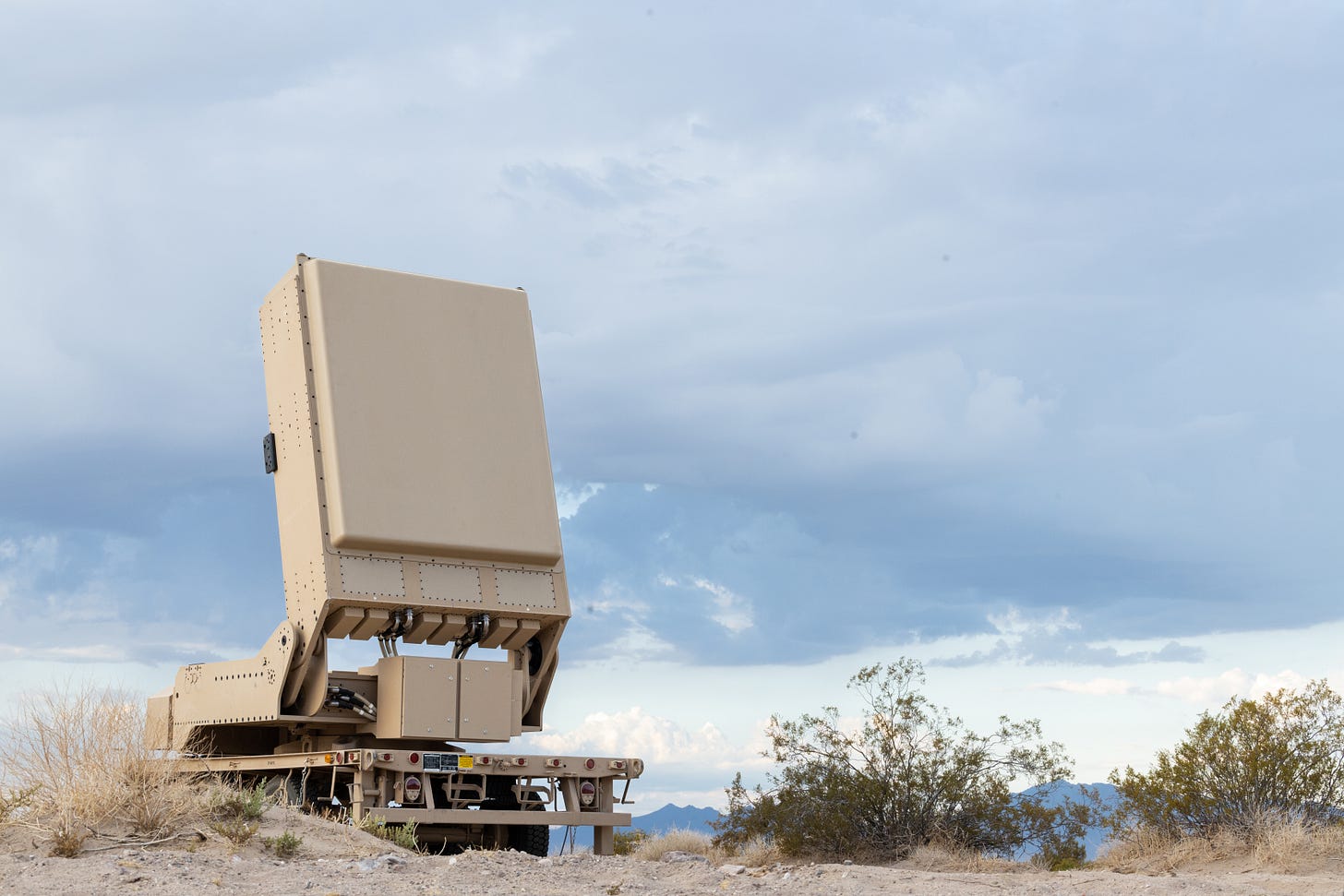
In some ways what we’re doing is super sophisticated, but in some ways it’s super basic. On a basic level, what we thought about was how a ton of electromagnetic interference disables commercial computers. All these electromagnetic waves get absorbed straight into the computer board. The board itself acts like an antenna that pulls in all that energy, puts the voltage of energy on the computer board, and then the computer board just goes down. So at a basic level, that’s what Leonidas does. It uses weaponized, or intelligent, electromagnetic interference to be able to put these vast, pulsating fields out there in a volume of space in the sky in order to defend against many drones at once. And then it also rotates 360 degrees around, so it can go around on a slip ring, and then in microseconds it can scan and put energy everywhere, providing a large electromagnetic wall, and it just doesn’t allow any number of drones to get through that wall.
That’s the principle of its operation. Now, we use different frequencies, different pulse patterns, and different things to make this EMI very intelligent, because in the past, what some of the folks that work in traditional directed energy would say is that it’s a narrow-band system, and what they mean by that is it just looks at one frequency or a couple of frequencies, whereas our wide-band systems use a method to cover lots of frequencies all at the same time, all in the same shot. They say, “Well, how is this narrow band going to work?” The fact of the matter is that gallium nitride, this very special substance that’s come along in the last 10-20 years, has really kind of exploded in its ability to handle huge power densities, and by using the state-of-the-art gallium nitride, we’ve created the world’s most power-dense circuits in order to create that very high-powered electromagnetics.
We then use techniques and tools like AI to tune that EMI to be right on target and at great range and make a great defensive layer. The sophistication is the phased array, the signal selection, and the basicness is the fact that we’re just using weaponized electromagnetic interference versus trying to use some, let’s call it, like a death ray or something, which is more the traditional directed energy.
CB: What’s so hard about defeating a fiber optic drone or an autonomous drone?
AL: To defeat a fiber optic drone, you can use something kinetic, you can use a laser. A laser is just a long-range blowtorch. That defeats a fiber optic drone. Typically, how electronic warfare defeats drones is to go into the signals themselves, like the guy has the controller, and he has different frequencies coming out of the controller to control the drone — just to match those same frequencies, but at a higher power so that you’re overriding the signals, and now you can control their drone. Now, the issue with those methods is that fiber-optic drones don’t need signals from a person on a controller that’s sending controls over the air to the drone. There’s no front door. When you see a fiber optic drone flying right over an EW truck in Ukraine, EW isn’t going to work on any fiber optic drone. That thing’s going to go right into the tank every single time. It’s the same when drones use AI to navigate on their own.
But remember when I was talking about what Epirus does. We don’t need a front door. You can close all your front doors, and we’re coming in the back door. The back door is those very susceptible computer boards. Those drones are flying computers, just like a Tesla is a driving computer. And on that computer board are all kinds of electronics that, when we apply our electromagnetic interference, suck up that energy, no matter if it’s being controlled by a fiber optic, whether it’s totally automated, whether it has no signals coming in and out, or lots of signals coming in and out, it treats it the same.
CB: When you look at what’s happened in Ukraine, you’ve seen tanks being marginalized, armored personnel carriers, helicopters, even infantry. I was talking to some guy recently. He said the infantry have to walk like 30 feet apart so they can only be picked off one by one. Is there a case where you could put one of these things on a tank, on a helicopter, have an infantryman carrying it with his platoon? Can you scale it down like that?
AL: Our technology is completely modular and scalable, meaning it can go onto any platform and scale to whatever size is needed to complete the mission.
And the way phased arrays work — and that’s what our system is, an AESA, or an active electronically scanned array, or a phased array — how they work is they have a whole bunch of Lego blocks, we’ll call them. These are amplifiers. We might have 200 of these transmit modules in a system that’s going to protect a base. We might have 75 of these transmit modules for a system that’s going to protect a group of Marines in an expeditionary unit. We might have 20 of these transmit modules in a system that could go on the crow’s nest and protect an Abrams tank with a little golden bubble of electromagnetic interference to stop drones.
As you scale down the number of transmit modules, you’re decreasing the size, decreasing the weight, and decreasing the range, but you’re increasing the portability of it. And so future designs and future efforts, starting in 2026, you’ll start to see released not only the large-size system, which is what most people know us for, but also a medium-sized system and a small system that will be for vehicle, for convoy, for mobile, and then for large, fixed and semi-fixed type applications for the large system.
CB: In the 2026 National Defense Strategy, they mention “a renewed focus on countering unmanned aerial threats.” That falls under the defense of the U.S. homeland. What exactly are these threats? And how are you positioning Epirus to confront this new kind of warfare?
AL: We can only imagine the bad actors that lie as sleeper cells in the U.S. I’m sure they’re still there, despite the great efforts of the administration in trying to weed them all out. There are bad actors out there, and bad actors want publicity, right? They want global publicity. They want to punch America in the eye and have the whole world see it. When you look at upcoming events around America, you’ve got the FIFA World Cup, you’ve got the Olympics, you’ve got these globally visible events that I do think that if I were in the administration, I would be worried about that.
You’ve got borders, you’ve got ports, you’ve got stadiums, you’ve got critical protected sites like the White House or Mar-a-Lago. These are what are called tier-one installations. And what this administration has wisely done is create a Joint Interagency Task Force. It’s called JIATF-401, and its job is to protect the homeland, protect our bases, protect critical infrastructure - by working with each and every service as well as federal and state and local partners.
CB: Are your systems combat tested?
AL: They’ve been deployed twice, once to the Philippines as part of Exercise Balikatan. I can’t say the other place. We’re seeing massive demand from international partners, also. They’re seeing the drone threat in a more concentrated manner in the Middle East and Europe, and, of course, Japan, Australia, the Philippines, and South Korea. It’s a problem everywhere.
CB: Epirus raised a $250 million Series D last year. What are you guys doing with that capital? Are you guys developing new systems? Are you scaling manufacturing?
AL: We’re scaling up manufacturing. We can do at least 24 large systems per year now, but we’re prepared to scale beyond that. We have a family of three different sizes coming out that will feature the latest and greatest electronics in gallium nitride. We have a large, medium, and small offering. All three of those come with their own set of sensors, their own set of C2 software that runs everything, because each application has a much different use case. We sell all of that. We don’t manufacture all of it, but we sell all of that in integrated packages.
Part of the money is to flesh out, if you will, a fully-fledged prime that could act as a prime and take care of the aftermarket support, the field servicing support. All of those different elements are part of the expansion of the $250 million. And then, of course, volume manufacturing beyond 24 per year. We’re looking at Oklahoma. Oklahoma is a great partner of ours.
We have big manufacturing plans, and we haven’t quite decided where we’re going to land, but we have a couple of buildings with over 750,000 square feet available that we’re going to transform into a massive facility where we’ll be making not only Leonidas systems but accompanying electronic warfare systems, sensing systems, and everything else that we need to be a fully fleshed-out prime to do a mission, versus just a part of a mission, or one layer in a mission.
Things are heating up, and we’re getting closer and closer to massive adoption. By 2027, my thought is we’ll be either just a hair away or we’ll be above break even and profitable as an organization.
Technology
•
Principals: Andy Lowery
An interview with the CEO of Epirus
Much of the history of warfare has been preoccupied by a simple problem: how can the largest possible payload be delivered on target with the greatest degree of accuracy? During World War II, precision strike capabilities came into being with the advent of early cruise missiles, radio-guided bombs, and long-range rockets. Over the ensuing decades, these capabilities became more refined and vastly more expensive, culminating in the overwhelming technological asymmetry displayed by coalition forces during the Gulf War and the early campaigns of the Global War on Terror. Precision became the defining feature of American military dominance.
After four years of war in Ukraine, that dominance has been fundamentally unsettled. The first-person-view (FPV) drone has democratized what was once the preserve of advanced industrial powers. For a fraction of the cost of a cruise missile, even lightly equipped forces can now deliver accurate, long-range strikes at scale. Relentless waves of drones are reshaping armored maneuver, trench warfare, air defense, and even basic infantry tactics. The implications extend beyond Ukraine’s battlefields. These technologies can threaten airports, stadiums, critical infrastructure, and public events within the United States, complicating homeland security in ways hard to anticipate just a few years ago.
Founded in 2018, Epirus is a US-based defense technology company focused on counter-drone and electronic warfare systems. Its flagship system, Leonidas, uses high-powered microwave energy to disable the electronics of incoming drones, rendering them inoperable without relying on traditional kinetic interceptors. I spoke with CEO Andy Lowery, a Navy veteran and former Chief Engineer for electronic warfare at Raytheon, about the lessons of drone warfare, the implications of directed energy for national security, and the dangers of the drone age. What follows is a transcript of our conversation.
CB: I wanted to start with June 2025. Operation Midnight Hammer, the strikes on Iran, which, in my view, show the primes at their best: the B-2, Trident missiles, subs — the Military Industrial Complex in action. Two weeks prior to that: Operation Spiderweb. The Ukrainians launched drones deep into Russia to attack their strategic bomber fleet. What are the lessons, from the perspective of Epirus?
AL: Let’s talk about Spiderweb first, and then there’s another operation that you didn’t mention, Operation Rising Lion. That was an Israeli-run operation which disabled Iran’s vast Air Defense Network. For 200 jets to fly in and not one of them take a scrape and fly out is remarkable, but it was enabled by drones inside of Iran disabling their air defense networks first.
Operation Spiderweb, what we have there is essentially Amazon container logistics trucks, parked around the strategic bombers, open up the tops of these containers, and a swarm comes out. Out come 119 drones, all laden with a bunch of kinetic blast bombs, and they take out 30% to 35% of the strategic bombing fleet. Billions of dollars in damage. These are just Group 1 or 2 quadcopters — absolutely smashing them.
We have an island called Guam that has a bunch of large air defense systems to see what China is doing, and we have defensive missiles and defensive systems that can protect Hawaii and even the United States.
Now we remember the New Jersey drones toward the end of 2024. There were a lot of theories around what that was. One of the theories, a very realistic scenario, would be a container ship owned by China or North Korea, let’s say, with hundreds of containers like they had on the 18-wheelers all over the front of the ship. They could park miles out at sea and be out of visual sight from Guam. They open up, and here they come into Guam.
There is a real necessity for the United States to think very urgently and very quickly. They need to be able to protect the protector: protecting THAAD or Patriot missile batteries, for example. Mini-Golden Domes are needed for drone defense around these expensive radars and interceptors. This is a thing that General Matt Ross, who runs JIATF-401, calls “protect the protector.” JIATF acts as a coordination layer where they’re going to get at these different tier-one types of installation protections using systems, including ours, and a number of layers. In this day and age, that’s the only way you can fight a war and hope not to get taken off the map by a bunch of drones.
CB: Four years into the war in Ukraine, what are the drone threats and how have they developed?
AL: I read a statistic just yesterday that 80% of all casualties of Ukrainians are caused by drones. I read another statistic about a year ago that 40% of the Black Sea Fleet was destroyed by maritime drones. Ukraine destroyed 40% of the Black Sea Fleet with no navy. I mean, similar to 30% of the bombers, like we were talking about with the drone attack on soil. So drones are not just significant. They are almost everything in this war. This type of warfare, leveraging asymmetric, robotic, increasingly autonomous threats is what we call The Sixth Domain of warfare.
There is a no-man’s wasteland between the Russians and the Ukrainians right now that looks like spider webs, because once they realized they can spool out fiber optic, which is, by the way, a prelude to what true autonomy will bring without the wires. The drones are flying with a wire for now, but soon, in the future, they are going to have the same sorts of robustness against electronic warfare and have fully autonomous drone swarms without the cables. And they say, if you get into that dead-man zone and you’re there for too long, you’re done; they’re going to send a drone. So that has really changed the landscape of warfare.
CB: What exactly is electronic warfare?
AL: I was the business area Chief Engineer for electronic warfare for the whole of Raytheon. I had all Raytheon electronic warfare projects underneath me. I had about 100 programs, the capstone one being Next Generation Jammer, a standoff electronic attack system that flies on an F-18 that has been a topic of conversation following the Venezuelan operation and the talk around a “discombobulator.”
Now, the military considers electronic warfare to have three subcomponents, and sometimes they talk about a fourth. The first subcomponent is electronic attack.
Next Generation Jammer is a big electronic attack system. What those systems do is they look for antennas, receivers, things that are using RF and microwave technologies to detect airplanes from far away and so on. And they overwhelm those received channels with a bunch of electronic warfare-type signals. You could be looking at a radar, and you could see 1,000 dots on it. Like I’ve got a thousand things coming at me. That’s putting electronic attack and electronic warfare energy into the system that it’s not expecting and fooling the system into thinking it’s something that it’s not. Or you just blast it so much that it wipes out the whole screen and you can’t see anything. That’s electronic attack.
Electronic surveillance is the next group.
Electronic surveillance is just what it says. It’s listening to the RF environment. Right now, if you put a really sensitive 0 to 6 gigahertz receiver around you that picked up a wide band, it would find around a million or maybe even 5 million pulses per second. You are surrounded by RF energy right now. It’s light, it’s very little, it’s very non-harmful, but it’s all over the place. If you could see RF frequencies, you’d be like, “Oh my God, this place is flooded.”
What electronic surveillance does is take that whole haystack of different RF — it picks up the needles in the haystack. It says, where’s the signal coming from? Who’s this coming from? And this is a very emergent area in the neo-primes, and companies like Hidden Level that have receivers that basically open up and use other emitters, like cell phone towers and other things, in order to bounce that RF energy. Anyway, they take the bounce, do some math, and don’t need any transmitters at all to see what’s going on out there, both physically and then also on the RF spectrum.
The third is electronic protection. In some ways, I think that’s what our form of directed energy, the Leonidas, is. It’s sort of like an electronic protection system. Only sometimes you’re protecting a stadium or an airport, sometimes you’re protecting a vehicle, sometimes you’re protecting a squad. And you have different size systems that would protect at different distances and ranges, different costs and different power levels, so that you could have a larger range around a base and a smaller range around a vehicle.
Cyber has been emerging in the last 20 years. It’s an area where you see a lot of cyber-swarm attacks. Every which way, swarms try to hit and penetrate cyber systems. And it seems like what we have today is “physical cyber.” Drones are like the little software Trojan attacks physically manifesting and providing the same sort of attack vectors in the physical domain as we saw in the software domain for years.
What we specialize in at Epirus is providing a protection layer that can handle many simultaneous attacks. That’s what cyber defense does. It’s the way we have to protect against these physical manifestations, drone swarms. We need to do something that could defend “one to many,” because that’s what’s happening. We’re going to see hundreds or thousands of drones that are overwhelming our traditional air defenses. We weren’t used to having a thousand drones come in at the same time. We didn’t see these kinds of swarms in yesteryear, and we’re not equipped to defend against them today without a Leonidas-type system, because we have limited magazines. An installation may have, say, 10 Coyote missiles. We quickly run out of those. And it’s not even an expense thing. They just don’t have enough.
CB: Could you tell me a little more about Epirus’ Leonidas system and the challenges you anticipate as drones become more autonomous?
AL: First of all, when drones become networked together into autonomous swarms, legacy defenses are going to be completely saturated. One missile to one threat does not scale. Legacy EW will not work on drones that have no signal back to the operator. So, how does Epirus help? Electromagnetic interference forcefields.
In some ways what we’re doing is super sophisticated, but in some ways it’s super basic. On a basic level, what we thought about was how a ton of electromagnetic interference disables commercial computers. All these electromagnetic waves get absorbed straight into the computer board. The board itself acts like an antenna that pulls in all that energy, puts the voltage of energy on the computer board, and then the computer board just goes down. So at a basic level, that’s what Leonidas does. It uses weaponized, or intelligent, electromagnetic interference to be able to put these vast, pulsating fields out there in a volume of space in the sky in order to defend against many drones at once. And then it also rotates 360 degrees around, so it can go around on a slip ring, and then in microseconds it can scan and put energy everywhere, providing a large electromagnetic wall, and it just doesn’t allow any number of drones to get through that wall.
That’s the principle of its operation. Now, we use different frequencies, different pulse patterns, and different things to make this EMI very intelligent, because in the past, what some of the folks that work in traditional directed energy would say is that it’s a narrow-band system, and what they mean by that is it just looks at one frequency or a couple of frequencies, whereas our wide-band systems use a method to cover lots of frequencies all at the same time, all in the same shot. They say, “Well, how is this narrow band going to work?” The fact of the matter is that gallium nitride, this very special substance that’s come along in the last 10-20 years, has really kind of exploded in its ability to handle huge power densities, and by using the state-of-the-art gallium nitride, we’ve created the world’s most power-dense circuits in order to create that very high-powered electromagnetics.
We then use techniques and tools like AI to tune that EMI to be right on target and at great range and make a great defensive layer. The sophistication is the phased array, the signal selection, and the basicness is the fact that we’re just using weaponized electromagnetic interference versus trying to use some, let’s call it, like a death ray or something, which is more the traditional directed energy.
CB: What’s so hard about defeating a fiber optic drone or an autonomous drone?
AL: To defeat a fiber optic drone, you can use something kinetic, you can use a laser. A laser is just a long-range blowtorch. That defeats a fiber optic drone. Typically, how electronic warfare defeats drones is to go into the signals themselves, like the guy has the controller, and he has different frequencies coming out of the controller to control the drone — just to match those same frequencies, but at a higher power so that you’re overriding the signals, and now you can control their drone. Now, the issue with those methods is that fiber-optic drones don’t need signals from a person on a controller that’s sending controls over the air to the drone. There’s no front door. When you see a fiber optic drone flying right over an EW truck in Ukraine, EW isn’t going to work on any fiber optic drone. That thing’s going to go right into the tank every single time. It’s the same when drones use AI to navigate on their own.
But remember when I was talking about what Epirus does. We don’t need a front door. You can close all your front doors, and we’re coming in the back door. The back door is those very susceptible computer boards. Those drones are flying computers, just like a Tesla is a driving computer. And on that computer board are all kinds of electronics that, when we apply our electromagnetic interference, suck up that energy, no matter if it’s being controlled by a fiber optic, whether it’s totally automated, whether it has no signals coming in and out, or lots of signals coming in and out, it treats it the same.
CB: When you look at what’s happened in Ukraine, you’ve seen tanks being marginalized, armored personnel carriers, helicopters, even infantry. I was talking to some guy recently. He said the infantry have to walk like 30 feet apart so they can only be picked off one by one. Is there a case where you could put one of these things on a tank, on a helicopter, have an infantryman carrying it with his platoon? Can you scale it down like that?
AL: Our technology is completely modular and scalable, meaning it can go onto any platform and scale to whatever size is needed to complete the mission.
And the way phased arrays work — and that’s what our system is, an AESA, or an active electronically scanned array, or a phased array — how they work is they have a whole bunch of Lego blocks, we’ll call them. These are amplifiers. We might have 200 of these transmit modules in a system that’s going to protect a base. We might have 75 of these transmit modules for a system that’s going to protect a group of Marines in an expeditionary unit. We might have 20 of these transmit modules in a system that could go on the crow’s nest and protect an Abrams tank with a little golden bubble of electromagnetic interference to stop drones.
As you scale down the number of transmit modules, you’re decreasing the size, decreasing the weight, and decreasing the range, but you’re increasing the portability of it. And so future designs and future efforts, starting in 2026, you’ll start to see released not only the large-size system, which is what most people know us for, but also a medium-sized system and a small system that will be for vehicle, for convoy, for mobile, and then for large, fixed and semi-fixed type applications for the large system.
CB: In the 2026 National Defense Strategy, they mention “a renewed focus on countering unmanned aerial threats.” That falls under the defense of the U.S. homeland. What exactly are these threats? And how are you positioning Epirus to confront this new kind of warfare?
AL: We can only imagine the bad actors that lie as sleeper cells in the U.S. I’m sure they’re still there, despite the great efforts of the administration in trying to weed them all out. There are bad actors out there, and bad actors want publicity, right? They want global publicity. They want to punch America in the eye and have the whole world see it. When you look at upcoming events around America, you’ve got the FIFA World Cup, you’ve got the Olympics, you’ve got these globally visible events that I do think that if I were in the administration, I would be worried about that.
You’ve got borders, you’ve got ports, you’ve got stadiums, you’ve got critical protected sites like the White House or Mar-a-Lago. These are what are called tier-one installations. And what this administration has wisely done is create a Joint Interagency Task Force. It’s called JIATF-401, and its job is to protect the homeland, protect our bases, protect critical infrastructure - by working with each and every service as well as federal and state and local partners.
CB: Are your systems combat tested?
AL: They’ve been deployed twice, once to the Philippines as part of Exercise Balikatan. I can’t say the other place. We’re seeing massive demand from international partners, also. They’re seeing the drone threat in a more concentrated manner in the Middle East and Europe, and, of course, Japan, Australia, the Philippines, and South Korea. It’s a problem everywhere.
CB: Epirus raised a $250 million Series D last year. What are you guys doing with that capital? Are you guys developing new systems? Are you scaling manufacturing?
AL: We’re scaling up manufacturing. We can do at least 24 large systems per year now, but we’re prepared to scale beyond that. We have a family of three different sizes coming out that will feature the latest and greatest electronics in gallium nitride. We have a large, medium, and small offering. All three of those come with their own set of sensors, their own set of C2 software that runs everything, because each application has a much different use case. We sell all of that. We don’t manufacture all of it, but we sell all of that in integrated packages.
Part of the money is to flesh out, if you will, a fully-fledged prime that could act as a prime and take care of the aftermarket support, the field servicing support. All of those different elements are part of the expansion of the $250 million. And then, of course, volume manufacturing beyond 24 per year. We’re looking at Oklahoma. Oklahoma is a great partner of ours.
We have big manufacturing plans, and we haven’t quite decided where we’re going to land, but we have a couple of buildings with over 750,000 square feet available that we’re going to transform into a massive facility where we’ll be making not only Leonidas systems but accompanying electronic warfare systems, sensing systems, and everything else that we need to be a fully fleshed-out prime to do a mission, versus just a part of a mission, or one layer in a mission.
Things are heating up, and we’re getting closer and closer to massive adoption. By 2027, my thought is we’ll be either just a hair away or we’ll be above break even and profitable as an organization.
About the Author
Carson Becker is Editor-at-Large at Arena Magazine. He is on X @carsonjbecker