tt
tt
tt
tt
tt
tt
Technology
•
Making Space Lasers Boring


A team assembled at an undisclosed location near the global epicenter of espionage, Washington, DC. In November 2025, the night air started to bite, dropping below 40°F. A plane flew overhead. The team cheered, though no animal or bird noticed anything had changed. A laser from the plane flying 16,500 feet overhead has found its target on the ground and held steady.
This team isn’t CIA or FBI — they’re in the private sector. With a product that seems Bond-like, if not fodder for conspiracy theories, Overview Energy specializes in space lasers. Their space lasers are not for a Death Star or to swing sports events by blinding professional athletes at critical moments (it’s come up). It is designed to be utterly harmless. It is not even useful for entertaining big cats.
Overview Energy plans to use lasers to transmit power from space. From a geosynchronous earth orbit (GEO, a term for which Wikipedia uses the legally wrong and therefore confusing definition), 22,000 miles above the Earth, their satellites would continuously collect the Sun’s photons — the particles that carry its light and energy — with a hundred meter long solar panels. Like solar panels on Earth, the photons would excite electrons in the panel, knocking them loose into a channel which flows into lasers. Outfitted with a proprietary optics design, the lasers would deliver power anywhere on Earth within direct line of sight. Transmitting via the near infrared spectrum, the beam would be completely invisible to most lifeforms on Earth. (Overview’s review of biological research indicates only the Nile tilapia, a bottom-feeding freshwater fish in Egypt, may be able to see the near IR spectrum. They have ruled out sending power to the bottom of the Nile River.) From GEO, a satellite could ‘see’ roughly one third of the Earth, so a small fleet would quickly blanket the Earth — if it can find its target and hold the laser on point for long enough. In November 2025, Overview Energy demonstrated their tech can successfully steer a laser from a moving vehicle, track their target, and deliver power from 16,500 feet above. Even better, the only receiver necessary is already plentiful: solar panels.
The problem Overview Energy is focused on is straightforward: today, solar panels can only generate power about half the time, during daylight hours. Engineers attempt to capture just how much the power source is available throughout the year with a measure called a capacity factor, the ratio of the actual electrical energy a power plant produces over a period to the maximum amount of possible energy it could have produced if it ran at continuous full power during that same time. In the United States, solar power’s capacity factor ranges from 23-27%, fluctuating with the seasons, the latitude, and cloud cover. Even with those limitations, solar power is already among the cheapest power sources in the country. If it could generate at any time, solar power could become baseload—continuous, reliable energy. Better yet, a space-based laser could send power all over the planet, wherever it is needed most. If Starlink is a broadband telco provider in space, then Overview is a power company in space.
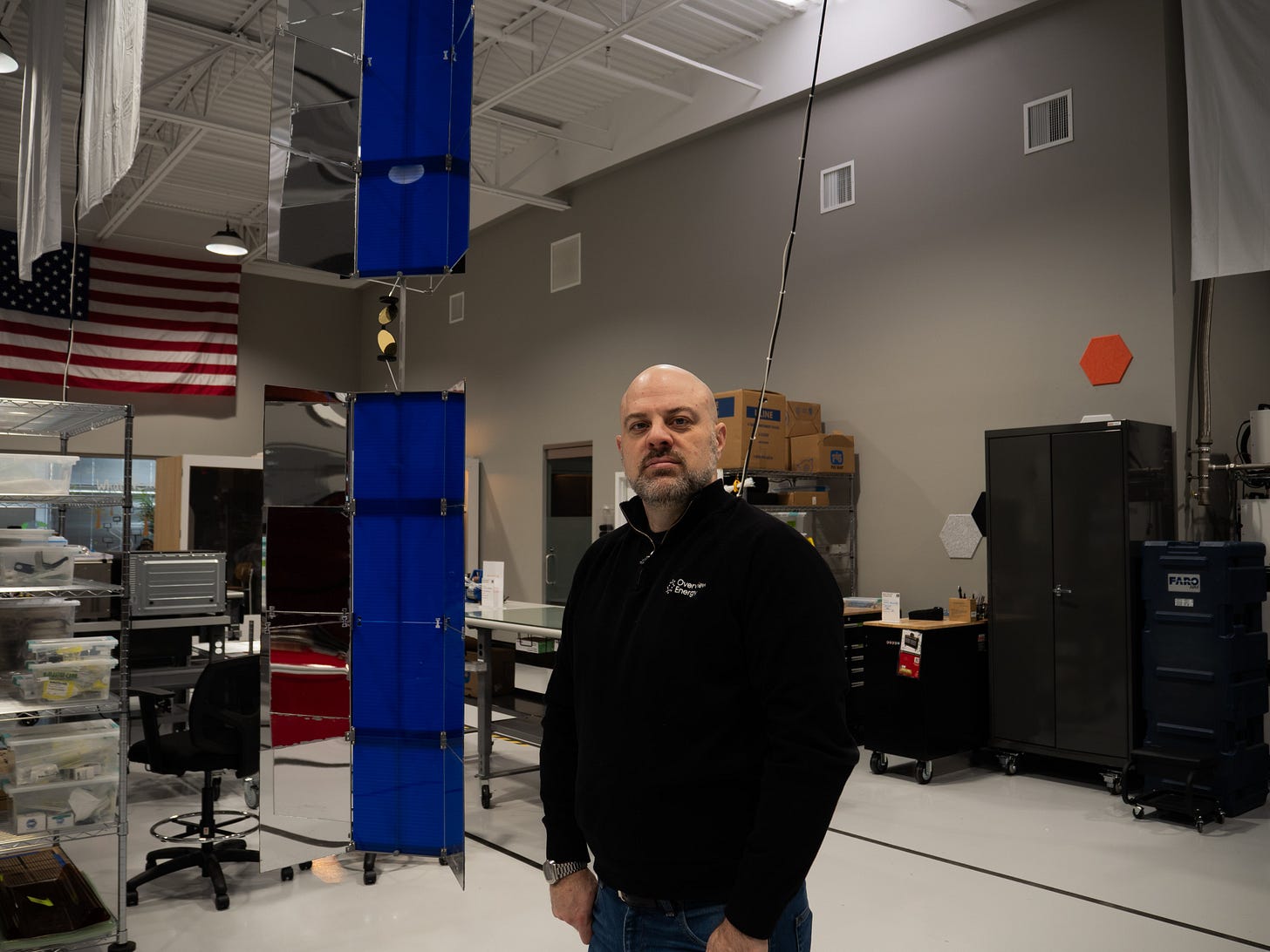
Overview is the passion project of its founder, Marc Berte. The Bond villain comparisons write themselves: he’s a bald man, obsessed with ‘power,’ who wants to surround the Earth with lasers from space. I can assure you I make the comparison only to tease him: Marc is a friend. (Full disclosure, I have some small exposure to Overview Energy’s success through my wife’s investments.) Ultimately, I want Overview Energy to succeed for my friend’s sake and because of what its potential means for the planet.
For Your Eyes Only.
Spies. Satellites. State secrets. Inside the technologies and intelligence contests shaping American power.
Subscribe + Issue 007
It’s a hard job to market ‘space lasers’ for non-lethal purposes. Space lasers in pop culture are synonymous with weapons, a trope the James Bond franchise helped establish. In 1964’s Goldfinger, the eponymous villain planned to execute and humiliate a captive Bond with a cutting edge laser, a technology that was then just four years old. In 1971’s Diamonds Are Forever, Bond faces his first space laser threat: Blofeld creates the immense, diamond-powered “Diamond Satellite” as a weapon of mass destruction that could neutralize any nuclear threat. Smaller space lasers would feature in 1979’s Moonraker, inspired by Star Wars and featured Space Shuttles and Marines armed with laser pistols and rifles. In 2002’s Die Another Day, villain Gustav Graves would threaten the world with the Icarus satellite, a solar-powered laser. (1995’s GoldenEye was a satellite weapon, but it generated an EMP not a laser.)
Sadly, reality is sometimes much dumber than fiction. Space lasers have been the subject of conspiracy theories that I would rather not repeat. While the practical use of space lasers may sound outlandish, they are real tools that Marc believes are poised to reshape the energy industry.
Overview Energy is not building a weapon. Moreover, Overview intends that their satellites cannot conceivably cause harm to anyone. In engineering terms, their laser is passively safe by design. In Marc’s words, “Passive safety means there is nothing a user or program has to do to make it safe.” Comparing it to children’s toys, Marc claims, “A lot of design effort prevents kids from permanently harming themselves”. For example, passive safety is like a pool noodle, safe by default even when attempting to wield it as a weapon. Active safety is like a pool drain to prevent small limbs from getting stuck, requiring system-level design (multiple redundant drains) and features (anti-vortex covers, automatic shut-off systems, and safety vacuum release systems) that keep the unit safe. Marc cites previous attempts at microwave-based power transmission that relied on active safety systems as a cautionary tale. The power of microwave systems is “way above the safety threshold” requiring a system that would “keep people out of the beam or shut the beam down if something transits the beam.” To illustrate the challenge of active safety for a microwave, imagine a home microwave with the door off. It would be extremely unpleasant to stick your hand in while warming up a burrito. To be considered safe, the system would need a way to detect if something is in the path of the beam and, if so, disable the beam. That system of detection and disabling is active safety, and it only gets harder to ensure the reliability of an active safety system when the microwave is no longer a box at home but moving in space and pointed at Earth. Some common commercially deployed laser systems do rely on active safety. Many autonomous driving systems rely on LIDAR, which spins a laser. Because the laser is spinning, it would not deliver enough power to hurt a human eye. However, the laser is strong enough that if it stopped spinning with line of sight to someone’s eye, the amount of energy delivered per laser could damage the retina. As a result, Waymo’s control system has an interlock that activates to disable the laser if the spinning stops to prevent injury.
As directed energy weapons — the category of weapons that intentionally destroy or damage with energy in the form of microwaves and lasers—have moved from science fiction to possibility, I ask about the ballpark of the intensity of Overview’s laser to a military-grade one. Marc indulges me with “napkin math”, which is supposed to be rough estimates to check your intuition. “If you want to damage things, melt stuff, blind a sensor, physically damage stuff, the easiest way is to assess the melting temperature of the target material in question. In space, we compare it to how efficiently the material can radiate energy away. 1500 °C will melt steel. That requires radiating 450,000 watts per meter squared of the melting steel, rounding off emissivity. Weapon lasers are in that ballpark. If Overview’s power transmission system is running at peak capacity, it would generate 350 W per meter squared or about 1200 times less than a weapon that can melt steel.”
Instead, Overview Energy aims to be the pool noodle of space lasers by designing their transmission system to be inside the safe exposure for lasers. “You can stand in the beam, stare at it, spend eight hours a day in it for the rest of your life, and it’s fine,” Marc told me. That may establish the beam is safe, but it also must be effective. “Because the beam is relatively low power, you can now make a small aperture with a small wavelength, which is cheap. So you can make lots and lots of them. It’s better to mass produce one design than make one big satellite. With small, attritable systems, it’s much safer, it’s resilient to damage, and you don’t care if you lose one.” To summarize, in order to deliver sufficient power, the system relies on many satellites positioned with line of sight to the target that can beam power simultaneously. Each beam is designed to be safe both individually and collectively.
Understanding why generating solar at night is valuable is straightforward: money. Understanding why lasers are the best tech to transmit power requires some background. Sputnik-1 kicked off the Space Age in October 1957; the first working space laser was built soon after it in May 1960, when it was still capitalized as LASER to represent the acronym “light amplification by stimulated emission of radiation.” Four years later, NASA would use its first laser, GODLAS (standing for Goddard Laser), firing from the ground to check the range of satellites in space. On December 11, 1965, Lt. Frank Borman and Comdr. Jim Lovell (of Apollo 13 fame) demonstrated the first in-space use of a laser to attempt transmitting data, known as the Gemini-7 test, though their experiment was only a partial success. Their task was to essentially hit a receiver, in this case think of it as a telescope but instead of producing an image, it produced a signal that can transmit a wave. Their voices would be embedded in that wave. Using a laser made by the Radio Corporation of America (RCA), once a titan of all kinds of American goods that is now defunct, the astronauts hit their target, but they could not successfully track their target. The contact between the laser and the target was too intermittent to successfully transmit any information. It is hard enough to hit a target from space, and the task is complicated by attenuation through the atmosphere.
In the decades since, control systems have been refined and laser usage has grown exponentially for space-to-space laser data transfer. Starlink, SpaceX’s space-based internet service, passes petabytes per second of data between its constellation of satellites with laser-powered datalinks. In 2025, most space-to-ground datalinks use radio frequency (RF) that are more forgiving with precision and weather but limit how much data can be transmitted. Projects like Laser Communication Relay Demonstration (LCRD) at the Lincoln Laboratory at the Massachusetts Institute of Technology, NASA’s TeraByte Infrafred Delivery (TBIRD), military mesh networks like Space Defense Agency’s Proliferated Warfighter Space Architecture, and products like Cailabs Optical Ground Stations show a future of data transmission via laser to Earth.
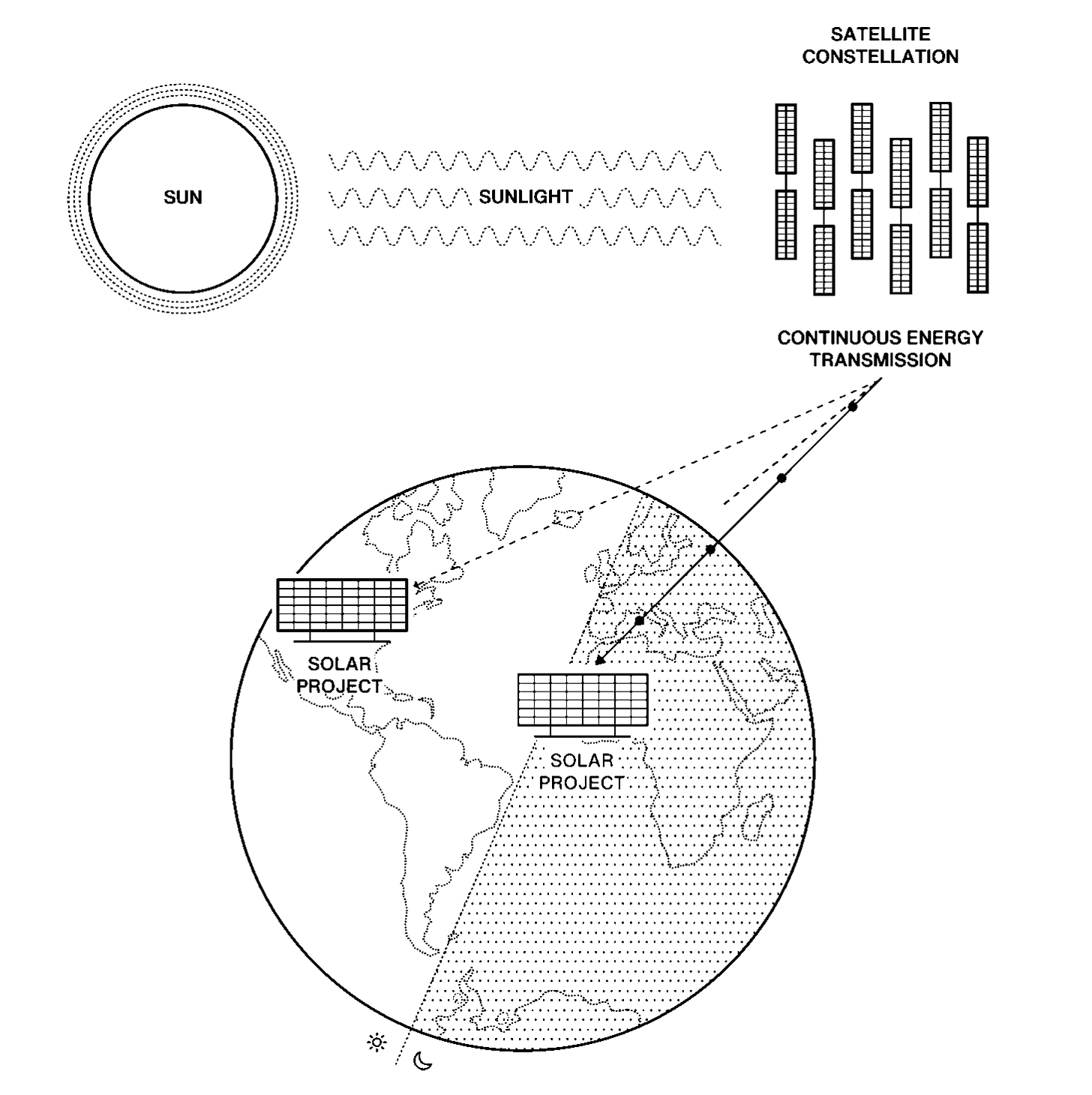
While Overview Energy wants to transmit power, not data, the principles of successful lasing are the same: their control system must be able to keep the laser on target to ensure the photons get to the solar panels where they are useful rather than the surrounding dirt where they are not. A laser power transmission system, working successfully, starts with photons ejected by the sun hitting solar panels attached to the satellite in space. The solar panels do exactly what they do on Earth, absorbing the energy from the photons to excite electrons that flow to the laser. The laser converts electrons back to photons, except now that beam can be aimed. In ideal conditions, the beam could be aimed directly at a solar panel on Earth. Lasers do suffer from attenuation through the atmosphere, and significant cloud cover can completely block the beam. But being in GEO means that so much of the Earth is in view that a small change in the satellite’s aim could hit another solar plant where the weather isn’t. The physics are constant, but Overview Energy exists because progress in lasers, space launches, and solar panels have utterly transformed their economics in a way that other wireless transmission technologies have not.
Microwaves are much more forgiving in power transmission than lasers. They do not require precise alignment, and they can penetrate cloud cover. Satellites with solar panels and microwave transmitters could transfer power, but not safely. Every concern from a household microwave applies: it could slowly cook you or start fires if it heats metal beams. The danger grows the tighter the beam is. The Federal Communications Commission enforces maximum permissible exposure (MPE) which limits RF (radio frequency) energy to ~10 watts per meter squared. To transmit safely, the beam would be bigger — much bigger. Transmitting 1 gigawatt passively safe per FCC regulations would require 100 million square meters — or 38 square miles — of continuous ground receivers. And unlike solar panels, which are cheap and plentiful, microwave ground receivers are expensive rectifier antennas that generate no power without an active beam.
Another option is… just deliver more light with giant mirrors in space, specifically in low earth orbits. A startup called Reflect Orbital is attempting exactly this — positioning satellites with large mirrors to bounce sunlight to solar farms after dark. But in Marc’s words, “the issue with mirrors is, the more you look at it, the more problems you find.” For reflected light to be useful to a solar panel, it has to already be night on the ground. As a result, each satellite would have to synchronize with the sun, constantly chasing the terminator — the line between day and night on the Earth. The satellite’s altitude in LEO also poses issues. Mirrors can only add power within a few hours before sunrise or after sunset. Moving into higher orbits allows the mirror to go deeper into the night time, but makes the beam size “gigantic”. Imagine you are floating 500 km over Hawaii, like our Gemini-7 astronauts, but now with a mirror. Hold the mirror parallel to the surface — if it’s not parallel, the beam will form an oval instead of a circle. The tightest beam of light hitting the earth is 5 km or 3 miles across. At higher orbits, the spot size grows to 10-20 km or 6 to 12 miles across, drastically reducing the power density of the beam. The result: you’d need hundreds to thousands of satellites, all crowded into a sun-synchronous orbit. Managing their operations and deorbiting malfunctioning satellites without colliding into others poses a significant engineering and operational challenge. And then there is the light pollution. Stargazing, scientific telescopes, and the creatures that rely on light-based REM cycles (including humans) would suffer with visible light spraying the night sky.
In Overview Energy’s case, the necessary technologies to beam energy onto Earth are all improving dramatically and continuously. Potential customers like hyperscaling AI data centers and even power utilities are desperate for power, especially cheap and clean power. Solar farms are plentiful, so no net new land usage is required. According to Marc, space-based solar power was “kind of a thing that was always the energy source of the future. Nobody could make it work. And if a thing didn’t work, I want to understand why, then see if the situation has changed. If it has, do that thing.”
Lasers improved substantially in the early 2000s, thanks to a DARPA initiative called SHEDS (Super High-Efficiency Diode Sources). Until that research program, laser efficiency ranged from 20-50%. DARPA hoped to cut the energy requirements for high-power lasers, with a “DARPA hard” goal of 85%. Through many optimizations of the design and manufacture of lasers, DARPA brought laser efficiency to 60-70% at room temperature, addressing a longstanding issue to broader laser use. Improving from 70% to 85% required active cooling. In Marc’s words, “cold laser, good laser”. Those efficiency improvements were attainable, but not economically. The power to run the cooling system was more than the power saved running the laser colder, so the industry had to settle for merely triple the laser efficiency as before.
Notably, Overview Energy’s spacecraft design operates in a much colder environment. One side always faces the sun and the other faces the vacuum of space—a heat gradient which allows for ultralightweight radiators and sufficient space to cool the lasers effectively. Marc believes their beam size in GEO will be 2 to 5 km (1.2 to 3.1) miles across and reach MW-class per beam.
The cost for Overview Energy to get a satellite to orbit has fallen significantly, due to the pioneers of the modern space economy, SpaceX. Their reusable rockets continue to lower the cost of launching mass to orbit through manufacturing lots of rockets and launching and relaunching them as often as they can. That virtuous cycle drives down the cost of each launch, savings SpaceX uses to offer the lowest prices to reach orbit. In December 2025, Falcon 9 rideshare missions to LEO cost roughly $6500 per kilogram, an increase from a low of $5000 per kilogram before inflation drove up costs throughout the industry. SpaceX believes their fully reusable Starship and SuperHeavy rocket together could drop launch costs another 10x; Marc believes Overview Energy can be profitable at a cost of $1000 per kilogram to orbit. Only Elon knows how much prices may follow these costs, but for context, proponents of space-based data centers assume costs will reach $350-500 per kilogram in the near future to make their designs competitive with ground-based data centers.
If lowering launch costs for other space companies was not enough, SpaceX has also demonstrated another critical milestone — satellites can be mass manufactured. Before Starlink, satellites were frequently one-off products. Starlink demonstrated that the design requirements for space are within reach of existing, cheap components used in consumer electronics. While the space environment’s temperature swings between -100°C and 260°C, the electronics inside satellites don’t experience those extremes. Interior chambers can be sealed and maintained at consistent temperatures. As Marc explains: “If you compare it to automotive electronics, the temperature range is more manageable. The same pickup truck needs to operate in both the constraints of Saudi Arabia and Alaska. Space can be designed to be one, fairly constant environment that can be designed for. The tradeoff is that, once you put it up, you can’t fix it if anything breaks.” By proving satellites can be commodity products, engineers and investors now have a reference point to design and invest in other kinds of mass-produced spacecraft.
Which brings us back to the Gemini-7 problem—tracking the ground receiver successfully—and explains why the Overview Energy team was cheering in the dark. “Tracking is the hard part,” Marc told me. Overview had to demonstrate they could build an optics and control system that could hit a stationary target from 3 miles above and hold the beam on that target, a lightweight version of the challenge that ultimately flunked the Gemini-7 laser tracking test in 1965. “Integrating complex systems is hard,” Marc explains. “Most power beaming demonstrations to date are fixed point to fixed point, with about 1 part in a 1,000 from a beam reaching a drone a mile away. To hit a receiver from GEO, you need a one kilometer wide receiver [in this case, a solar farm] with a beam within a few hundred meters so it’s not wobbling all over the place.” This demonstration tested their entire control system, including the ground-based trigger. “The receiver has a beacon with upward looking infrared. The satellite uses that beacon to lock onto the location and transmit back down. The airborne test demonstrated that, using the same method, same lasers, and same infrared beacon that we would use in GEO.”
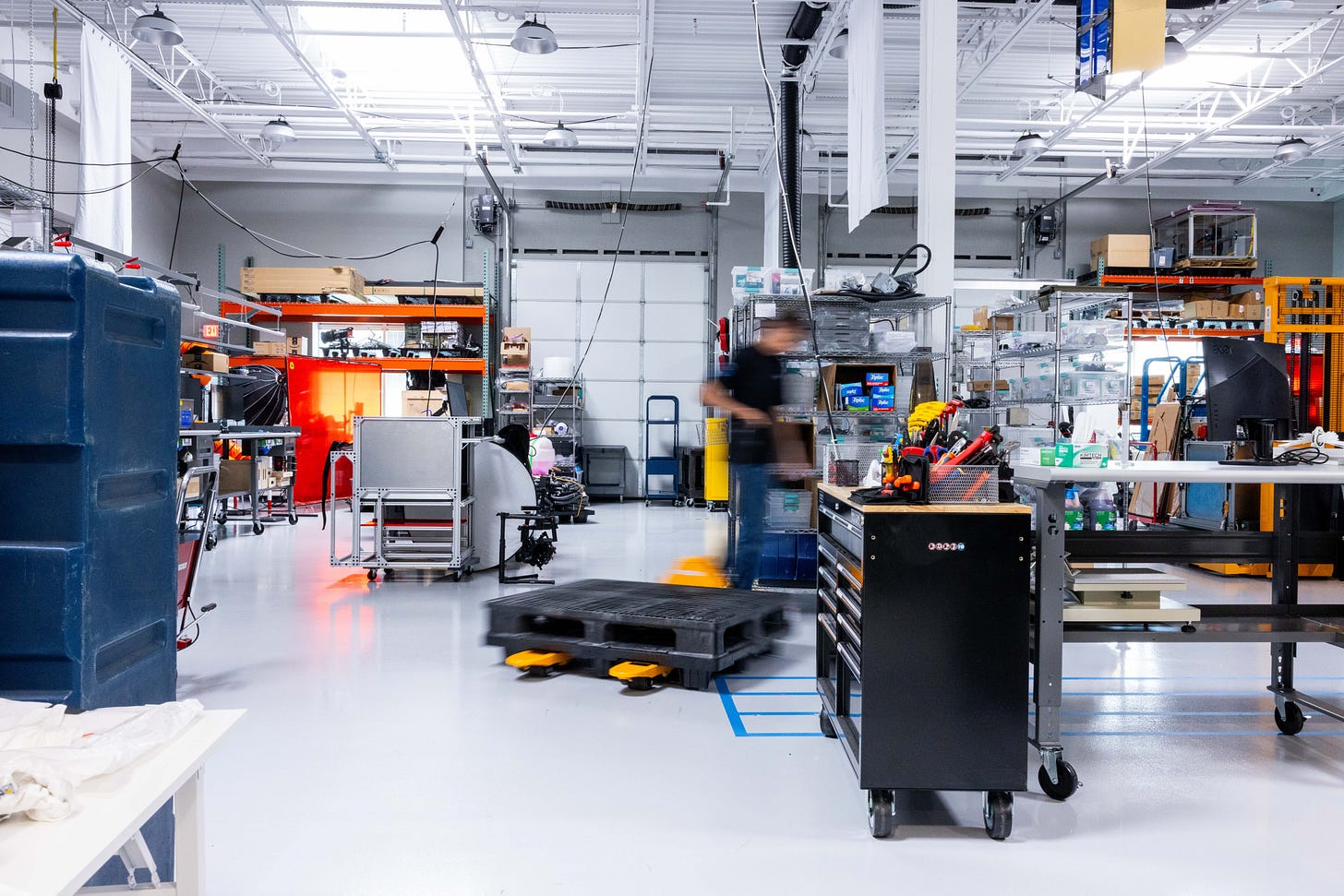
Marc has been training all his life for this challenge. How does a man choose space lasers as a profession? In the 1990s and 2000s, it was not for the money but for the thrills. Both of the traditional sources of funding for space tech were running dry. As the Space Race wound down, NASA’s budgets were under constant pressure; the end of the Cold War ushered in the Peace Dividend, a reduction in military spending. But Marc knew that he wanted to pursue a career at the intersection of aerospace and nuclear engineering. Growing up at the end of the Cold War, Marc was enamored with radical proposals, such as the Strategic Defensive Initiative proposal to position space lasers to intercept intercontinental ballistic missiles. More fundamentally for this aspiring Q, Marc wanted to be at the edge of technology and applied research. The farther out at the edge, the more fun. But technology has many frontiers, so Marc doubled-down on following the action to the highest energy levels: rockets, nuclear reactors, wireless power transmission, and all the components that made those practical. Marc double-majored in aerospace and nuclear engineering at MIT, studying small modular nuclear reactors (SMRs) and the potential for fusion energy. He completed his double-major in just three and half years.
Working at the edge of a field is more like pioneering than a gold rush, and many that wanted to venture into these domains relied on adventurous engineers like Marc to find a path and keep them on it. His professional career included time at the Institute for Defense Analysis working on proposals for space lasers to ward off intercontinental ballistic missiles, consulting for DARPA, developing optics and lasers for the Missile Defense Agency and Raytheon, and consulting for many startups and companies developing SMRs. In 2017, SpaceX’s reusable Falcon 9 rockets dramatically lowered the costs of launching mass to orbit, essentially making it cheaper to reach the frontier and enabling new kinds of businesses. Investors and entrepreneurs would also consult with Marc on their path through this new frontier, and he still serves as a friendly voice to help them on their path. But as he helped others find their path, Marc found one of his own. Based on old ideas about what might be possible with space-based power, Marc thought the time had finally come.
Overview’s next milestone is slated for 2028: beaming from LEO aboard a booked SpaceX flight. This milestone will test the final optics design, validate the design is suitable for space, and demonstrate the tracking control is close to the target needed for optimal economics. “The optics for the LEO satellite are 5-10x bigger than the airborne one, but if the input wiggle is constant and the optics get bigger, the output wiggle is smaller. The same amount of control as we demonstrated in the airborne demo gets a 5-10x improvement with our bigger optics.” Improvements to the control system are all about steadiness. From GEO, Overview will need to demonstrate control within about roughly the angle between your eyes when you’re looking at a coin from a mile away. Now imagine keeping a beam of energy locked on that coin while both you and the coin are moving. The optics alone get them about halfway to that level of control, and other improvements in the LEO design are expected to close the gap.
Marc sees other challenges ahead. The new space industry is hot, but Marc stresses that Overview is here to build cheap, clean power, not hype. They are building for a future of cheap launch costs that SpaceX and others are racing towards, but is not here yet. Few investors can evaluate both space tech and energy, making fundraising complex. While AI is driving a revolution in engineering on the ground (I asked: engineers at Overview Energy use Claude), Marc still sees talent as a constraint: “Can you get the right people at the right time and enough of them that are passionate about what they’re doing? The hard part isn’t making something work at all costs, it’s making it work reliably at cost, on time. We need people that can make space lasers boring.”
Technology
•
Making Space Lasers Boring
A team assembled at an undisclosed location near the global epicenter of espionage, Washington, DC. In November 2025, the night air started to bite, dropping below 40°F. A plane flew overhead. The team cheered, though no animal or bird noticed anything had changed. A laser from the plane flying 16,500 feet overhead has found its target on the ground and held steady.
This team isn’t CIA or FBI — they’re in the private sector. With a product that seems Bond-like, if not fodder for conspiracy theories, Overview Energy specializes in space lasers. Their space lasers are not for a Death Star or to swing sports events by blinding professional athletes at critical moments (it’s come up). It is designed to be utterly harmless. It is not even useful for entertaining big cats.
Overview Energy plans to use lasers to transmit power from space. From a geosynchronous earth orbit (GEO, a term for which Wikipedia uses the legally wrong and therefore confusing definition), 22,000 miles above the Earth, their satellites would continuously collect the Sun’s photons — the particles that carry its light and energy — with a hundred meter long solar panels. Like solar panels on Earth, the photons would excite electrons in the panel, knocking them loose into a channel which flows into lasers. Outfitted with a proprietary optics design, the lasers would deliver power anywhere on Earth within direct line of sight. Transmitting via the near infrared spectrum, the beam would be completely invisible to most lifeforms on Earth. (Overview’s review of biological research indicates only the Nile tilapia, a bottom-feeding freshwater fish in Egypt, may be able to see the near IR spectrum. They have ruled out sending power to the bottom of the Nile River.) From GEO, a satellite could ‘see’ roughly one third of the Earth, so a small fleet would quickly blanket the Earth — if it can find its target and hold the laser on point for long enough. In November 2025, Overview Energy demonstrated their tech can successfully steer a laser from a moving vehicle, track their target, and deliver power from 16,500 feet above. Even better, the only receiver necessary is already plentiful: solar panels.
The problem Overview Energy is focused on is straightforward: today, solar panels can only generate power about half the time, during daylight hours. Engineers attempt to capture just how much the power source is available throughout the year with a measure called a capacity factor, the ratio of the actual electrical energy a power plant produces over a period to the maximum amount of possible energy it could have produced if it ran at continuous full power during that same time. In the United States, solar power’s capacity factor ranges from 23-27%, fluctuating with the seasons, the latitude, and cloud cover. Even with those limitations, solar power is already among the cheapest power sources in the country. If it could generate at any time, solar power could become baseload—continuous, reliable energy. Better yet, a space-based laser could send power all over the planet, wherever it is needed most. If Starlink is a broadband telco provider in space, then Overview is a power company in space.
Overview is the passion project of its founder, Marc Berte. The Bond villain comparisons write themselves: he’s a bald man, obsessed with ‘power,’ who wants to surround the Earth with lasers from space. I can assure you I make the comparison only to tease him: Marc is a friend. (Full disclosure, I have some small exposure to Overview Energy’s success through my wife’s investments.) Ultimately, I want Overview Energy to succeed for my friend’s sake and because of what its potential means for the planet.
For Your Eyes Only.
Spies. Satellites. State secrets. Inside the technologies and intelligence contests shaping American power.
Subscribe + Issue 007
It’s a hard job to market ‘space lasers’ for non-lethal purposes. Space lasers in pop culture are synonymous with weapons, a trope the James Bond franchise helped establish. In 1964’s Goldfinger, the eponymous villain planned to execute and humiliate a captive Bond with a cutting edge laser, a technology that was then just four years old. In 1971’s Diamonds Are Forever, Bond faces his first space laser threat: Blofeld creates the immense, diamond-powered “Diamond Satellite” as a weapon of mass destruction that could neutralize any nuclear threat. Smaller space lasers would feature in 1979’s Moonraker, inspired by Star Wars and featured Space Shuttles and Marines armed with laser pistols and rifles. In 2002’s Die Another Day, villain Gustav Graves would threaten the world with the Icarus satellite, a solar-powered laser. (1995’s GoldenEye was a satellite weapon, but it generated an EMP not a laser.)
Sadly, reality is sometimes much dumber than fiction. Space lasers have been the subject of conspiracy theories that I would rather not repeat. While the practical use of space lasers may sound outlandish, they are real tools that Marc believes are poised to reshape the energy industry.
Overview Energy is not building a weapon. Moreover, Overview intends that their satellites cannot conceivably cause harm to anyone. In engineering terms, their laser is passively safe by design. In Marc’s words, “Passive safety means there is nothing a user or program has to do to make it safe.” Comparing it to children’s toys, Marc claims, “A lot of design effort prevents kids from permanently harming themselves”. For example, passive safety is like a pool noodle, safe by default even when attempting to wield it as a weapon. Active safety is like a pool drain to prevent small limbs from getting stuck, requiring system-level design (multiple redundant drains) and features (anti-vortex covers, automatic shut-off systems, and safety vacuum release systems) that keep the unit safe. Marc cites previous attempts at microwave-based power transmission that relied on active safety systems as a cautionary tale. The power of microwave systems is “way above the safety threshold” requiring a system that would “keep people out of the beam or shut the beam down if something transits the beam.” To illustrate the challenge of active safety for a microwave, imagine a home microwave with the door off. It would be extremely unpleasant to stick your hand in while warming up a burrito. To be considered safe, the system would need a way to detect if something is in the path of the beam and, if so, disable the beam. That system of detection and disabling is active safety, and it only gets harder to ensure the reliability of an active safety system when the microwave is no longer a box at home but moving in space and pointed at Earth. Some common commercially deployed laser systems do rely on active safety. Many autonomous driving systems rely on LIDAR, which spins a laser. Because the laser is spinning, it would not deliver enough power to hurt a human eye. However, the laser is strong enough that if it stopped spinning with line of sight to someone’s eye, the amount of energy delivered per laser could damage the retina. As a result, Waymo’s control system has an interlock that activates to disable the laser if the spinning stops to prevent injury.
As directed energy weapons — the category of weapons that intentionally destroy or damage with energy in the form of microwaves and lasers—have moved from science fiction to possibility, I ask about the ballpark of the intensity of Overview’s laser to a military-grade one. Marc indulges me with “napkin math”, which is supposed to be rough estimates to check your intuition. “If you want to damage things, melt stuff, blind a sensor, physically damage stuff, the easiest way is to assess the melting temperature of the target material in question. In space, we compare it to how efficiently the material can radiate energy away. 1500 °C will melt steel. That requires radiating 450,000 watts per meter squared of the melting steel, rounding off emissivity. Weapon lasers are in that ballpark. If Overview’s power transmission system is running at peak capacity, it would generate 350 W per meter squared or about 1200 times less than a weapon that can melt steel.”
Instead, Overview Energy aims to be the pool noodle of space lasers by designing their transmission system to be inside the safe exposure for lasers. “You can stand in the beam, stare at it, spend eight hours a day in it for the rest of your life, and it’s fine,” Marc told me. That may establish the beam is safe, but it also must be effective. “Because the beam is relatively low power, you can now make a small aperture with a small wavelength, which is cheap. So you can make lots and lots of them. It’s better to mass produce one design than make one big satellite. With small, attritable systems, it’s much safer, it’s resilient to damage, and you don’t care if you lose one.” To summarize, in order to deliver sufficient power, the system relies on many satellites positioned with line of sight to the target that can beam power simultaneously. Each beam is designed to be safe both individually and collectively.
Understanding why generating solar at night is valuable is straightforward: money. Understanding why lasers are the best tech to transmit power requires some background. Sputnik-1 kicked off the Space Age in October 1957; the first working space laser was built soon after it in May 1960, when it was still capitalized as LASER to represent the acronym “light amplification by stimulated emission of radiation.” Four years later, NASA would use its first laser, GODLAS (standing for Goddard Laser), firing from the ground to check the range of satellites in space. On December 11, 1965, Lt. Frank Borman and Comdr. Jim Lovell (of Apollo 13 fame) demonstrated the first in-space use of a laser to attempt transmitting data, known as the Gemini-7 test, though their experiment was only a partial success. Their task was to essentially hit a receiver, in this case think of it as a telescope but instead of producing an image, it produced a signal that can transmit a wave. Their voices would be embedded in that wave. Using a laser made by the Radio Corporation of America (RCA), once a titan of all kinds of American goods that is now defunct, the astronauts hit their target, but they could not successfully track their target. The contact between the laser and the target was too intermittent to successfully transmit any information. It is hard enough to hit a target from space, and the task is complicated by attenuation through the atmosphere.
In the decades since, control systems have been refined and laser usage has grown exponentially for space-to-space laser data transfer. Starlink, SpaceX’s space-based internet service, passes petabytes per second of data between its constellation of satellites with laser-powered datalinks. In 2025, most space-to-ground datalinks use radio frequency (RF) that are more forgiving with precision and weather but limit how much data can be transmitted. Projects like Laser Communication Relay Demonstration (LCRD) at the Lincoln Laboratory at the Massachusetts Institute of Technology, NASA’s TeraByte Infrafred Delivery (TBIRD), military mesh networks like Space Defense Agency’s Proliferated Warfighter Space Architecture, and products like Cailabs Optical Ground Stations show a future of data transmission via laser to Earth.
While Overview Energy wants to transmit power, not data, the principles of successful lasing are the same: their control system must be able to keep the laser on target to ensure the photons get to the solar panels where they are useful rather than the surrounding dirt where they are not. A laser power transmission system, working successfully, starts with photons ejected by the sun hitting solar panels attached to the satellite in space. The solar panels do exactly what they do on Earth, absorbing the energy from the photons to excite electrons that flow to the laser. The laser converts electrons back to photons, except now that beam can be aimed. In ideal conditions, the beam could be aimed directly at a solar panel on Earth. Lasers do suffer from attenuation through the atmosphere, and significant cloud cover can completely block the beam. But being in GEO means that so much of the Earth is in view that a small change in the satellite’s aim could hit another solar plant where the weather isn’t. The physics are constant, but Overview Energy exists because progress in lasers, space launches, and solar panels have utterly transformed their economics in a way that other wireless transmission technologies have not.
Microwaves are much more forgiving in power transmission than lasers. They do not require precise alignment, and they can penetrate cloud cover. Satellites with solar panels and microwave transmitters could transfer power, but not safely. Every concern from a household microwave applies: it could slowly cook you or start fires if it heats metal beams. The danger grows the tighter the beam is. The Federal Communications Commission enforces maximum permissible exposure (MPE) which limits RF (radio frequency) energy to ~10 watts per meter squared. To transmit safely, the beam would be bigger — much bigger. Transmitting 1 gigawatt passively safe per FCC regulations would require 100 million square meters — or 38 square miles — of continuous ground receivers. And unlike solar panels, which are cheap and plentiful, microwave ground receivers are expensive rectifier antennas that generate no power without an active beam.
Another option is… just deliver more light with giant mirrors in space, specifically in low earth orbits. A startup called Reflect Orbital is attempting exactly this — positioning satellites with large mirrors to bounce sunlight to solar farms after dark. But in Marc’s words, “the issue with mirrors is, the more you look at it, the more problems you find.” For reflected light to be useful to a solar panel, it has to already be night on the ground. As a result, each satellite would have to synchronize with the sun, constantly chasing the terminator — the line between day and night on the Earth. The satellite’s altitude in LEO also poses issues. Mirrors can only add power within a few hours before sunrise or after sunset. Moving into higher orbits allows the mirror to go deeper into the night time, but makes the beam size “gigantic”. Imagine you are floating 500 km over Hawaii, like our Gemini-7 astronauts, but now with a mirror. Hold the mirror parallel to the surface — if it’s not parallel, the beam will form an oval instead of a circle. The tightest beam of light hitting the earth is 5 km or 3 miles across. At higher orbits, the spot size grows to 10-20 km or 6 to 12 miles across, drastically reducing the power density of the beam. The result: you’d need hundreds to thousands of satellites, all crowded into a sun-synchronous orbit. Managing their operations and deorbiting malfunctioning satellites without colliding into others poses a significant engineering and operational challenge. And then there is the light pollution. Stargazing, scientific telescopes, and the creatures that rely on light-based REM cycles (including humans) would suffer with visible light spraying the night sky.
In Overview Energy’s case, the necessary technologies to beam energy onto Earth are all improving dramatically and continuously. Potential customers like hyperscaling AI data centers and even power utilities are desperate for power, especially cheap and clean power. Solar farms are plentiful, so no net new land usage is required. According to Marc, space-based solar power was “kind of a thing that was always the energy source of the future. Nobody could make it work. And if a thing didn’t work, I want to understand why, then see if the situation has changed. If it has, do that thing.”
Lasers improved substantially in the early 2000s, thanks to a DARPA initiative called SHEDS (Super High-Efficiency Diode Sources). Until that research program, laser efficiency ranged from 20-50%. DARPA hoped to cut the energy requirements for high-power lasers, with a “DARPA hard” goal of 85%. Through many optimizations of the design and manufacture of lasers, DARPA brought laser efficiency to 60-70% at room temperature, addressing a longstanding issue to broader laser use. Improving from 70% to 85% required active cooling. In Marc’s words, “cold laser, good laser”. Those efficiency improvements were attainable, but not economically. The power to run the cooling system was more than the power saved running the laser colder, so the industry had to settle for merely triple the laser efficiency as before.
Notably, Overview Energy’s spacecraft design operates in a much colder environment. One side always faces the sun and the other faces the vacuum of space—a heat gradient which allows for ultralightweight radiators and sufficient space to cool the lasers effectively. Marc believes their beam size in GEO will be 2 to 5 km (1.2 to 3.1) miles across and reach MW-class per beam.
The cost for Overview Energy to get a satellite to orbit has fallen significantly, due to the pioneers of the modern space economy, SpaceX. Their reusable rockets continue to lower the cost of launching mass to orbit through manufacturing lots of rockets and launching and relaunching them as often as they can. That virtuous cycle drives down the cost of each launch, savings SpaceX uses to offer the lowest prices to reach orbit. In December 2025, Falcon 9 rideshare missions to LEO cost roughly $6500 per kilogram, an increase from a low of $5000 per kilogram before inflation drove up costs throughout the industry. SpaceX believes their fully reusable Starship and SuperHeavy rocket together could drop launch costs another 10x; Marc believes Overview Energy can be profitable at a cost of $1000 per kilogram to orbit. Only Elon knows how much prices may follow these costs, but for context, proponents of space-based data centers assume costs will reach $350-500 per kilogram in the near future to make their designs competitive with ground-based data centers.
If lowering launch costs for other space companies was not enough, SpaceX has also demonstrated another critical milestone — satellites can be mass manufactured. Before Starlink, satellites were frequently one-off products. Starlink demonstrated that the design requirements for space are within reach of existing, cheap components used in consumer electronics. While the space environment’s temperature swings between -100°C and 260°C, the electronics inside satellites don’t experience those extremes. Interior chambers can be sealed and maintained at consistent temperatures. As Marc explains: “If you compare it to automotive electronics, the temperature range is more manageable. The same pickup truck needs to operate in both the constraints of Saudi Arabia and Alaska. Space can be designed to be one, fairly constant environment that can be designed for. The tradeoff is that, once you put it up, you can’t fix it if anything breaks.” By proving satellites can be commodity products, engineers and investors now have a reference point to design and invest in other kinds of mass-produced spacecraft.
Which brings us back to the Gemini-7 problem—tracking the ground receiver successfully—and explains why the Overview Energy team was cheering in the dark. “Tracking is the hard part,” Marc told me. Overview had to demonstrate they could build an optics and control system that could hit a stationary target from 3 miles above and hold the beam on that target, a lightweight version of the challenge that ultimately flunked the Gemini-7 laser tracking test in 1965. “Integrating complex systems is hard,” Marc explains. “Most power beaming demonstrations to date are fixed point to fixed point, with about 1 part in a 1,000 from a beam reaching a drone a mile away. To hit a receiver from GEO, you need a one kilometer wide receiver [in this case, a solar farm] with a beam within a few hundred meters so it’s not wobbling all over the place.” This demonstration tested their entire control system, including the ground-based trigger. “The receiver has a beacon with upward looking infrared. The satellite uses that beacon to lock onto the location and transmit back down. The airborne test demonstrated that, using the same method, same lasers, and same infrared beacon that we would use in GEO.”
Marc has been training all his life for this challenge. How does a man choose space lasers as a profession? In the 1990s and 2000s, it was not for the money but for the thrills. Both of the traditional sources of funding for space tech were running dry. As the Space Race wound down, NASA’s budgets were under constant pressure; the end of the Cold War ushered in the Peace Dividend, a reduction in military spending. But Marc knew that he wanted to pursue a career at the intersection of aerospace and nuclear engineering. Growing up at the end of the Cold War, Marc was enamored with radical proposals, such as the Strategic Defensive Initiative proposal to position space lasers to intercept intercontinental ballistic missiles. More fundamentally for this aspiring Q, Marc wanted to be at the edge of technology and applied research. The farther out at the edge, the more fun. But technology has many frontiers, so Marc doubled-down on following the action to the highest energy levels: rockets, nuclear reactors, wireless power transmission, and all the components that made those practical. Marc double-majored in aerospace and nuclear engineering at MIT, studying small modular nuclear reactors (SMRs) and the potential for fusion energy. He completed his double-major in just three and half years.
Working at the edge of a field is more like pioneering than a gold rush, and many that wanted to venture into these domains relied on adventurous engineers like Marc to find a path and keep them on it. His professional career included time at the Institute for Defense Analysis working on proposals for space lasers to ward off intercontinental ballistic missiles, consulting for DARPA, developing optics and lasers for the Missile Defense Agency and Raytheon, and consulting for many startups and companies developing SMRs. In 2017, SpaceX’s reusable Falcon 9 rockets dramatically lowered the costs of launching mass to orbit, essentially making it cheaper to reach the frontier and enabling new kinds of businesses. Investors and entrepreneurs would also consult with Marc on their path through this new frontier, and he still serves as a friendly voice to help them on their path. But as he helped others find their path, Marc found one of his own. Based on old ideas about what might be possible with space-based power, Marc thought the time had finally come.
Overview’s next milestone is slated for 2028: beaming from LEO aboard a booked SpaceX flight. This milestone will test the final optics design, validate the design is suitable for space, and demonstrate the tracking control is close to the target needed for optimal economics. “The optics for the LEO satellite are 5-10x bigger than the airborne one, but if the input wiggle is constant and the optics get bigger, the output wiggle is smaller. The same amount of control as we demonstrated in the airborne demo gets a 5-10x improvement with our bigger optics.” Improvements to the control system are all about steadiness. From GEO, Overview will need to demonstrate control within about roughly the angle between your eyes when you’re looking at a coin from a mile away. Now imagine keeping a beam of energy locked on that coin while both you and the coin are moving. The optics alone get them about halfway to that level of control, and other improvements in the LEO design are expected to close the gap.
Marc sees other challenges ahead. The new space industry is hot, but Marc stresses that Overview is here to build cheap, clean power, not hype. They are building for a future of cheap launch costs that SpaceX and others are racing towards, but is not here yet. Few investors can evaluate both space tech and energy, making fundraising complex. While AI is driving a revolution in engineering on the ground (I asked: engineers at Overview Energy use Claude), Marc still sees talent as a constraint: “Can you get the right people at the right time and enough of them that are passionate about what they’re doing? The hard part isn’t making something work at all costs, it’s making it work reliably at cost, on time. We need people that can make space lasers boring.”
Technology
•
Making Space Lasers Boring
A team assembled at an undisclosed location near the global epicenter of espionage, Washington, DC. In November 2025, the night air started to bite, dropping below 40°F. A plane flew overhead. The team cheered, though no animal or bird noticed anything had changed. A laser from the plane flying 16,500 feet overhead has found its target on the ground and held steady.
This team isn’t CIA or FBI — they’re in the private sector. With a product that seems Bond-like, if not fodder for conspiracy theories, Overview Energy specializes in space lasers. Their space lasers are not for a Death Star or to swing sports events by blinding professional athletes at critical moments (it’s come up). It is designed to be utterly harmless. It is not even useful for entertaining big cats.
Overview Energy plans to use lasers to transmit power from space. From a geosynchronous earth orbit (GEO, a term for which Wikipedia uses the legally wrong and therefore confusing definition), 22,000 miles above the Earth, their satellites would continuously collect the Sun’s photons — the particles that carry its light and energy — with a hundred meter long solar panels. Like solar panels on Earth, the photons would excite electrons in the panel, knocking them loose into a channel which flows into lasers. Outfitted with a proprietary optics design, the lasers would deliver power anywhere on Earth within direct line of sight. Transmitting via the near infrared spectrum, the beam would be completely invisible to most lifeforms on Earth. (Overview’s review of biological research indicates only the Nile tilapia, a bottom-feeding freshwater fish in Egypt, may be able to see the near IR spectrum. They have ruled out sending power to the bottom of the Nile River.) From GEO, a satellite could ‘see’ roughly one third of the Earth, so a small fleet would quickly blanket the Earth — if it can find its target and hold the laser on point for long enough. In November 2025, Overview Energy demonstrated their tech can successfully steer a laser from a moving vehicle, track their target, and deliver power from 16,500 feet above. Even better, the only receiver necessary is already plentiful: solar panels.
The problem Overview Energy is focused on is straightforward: today, solar panels can only generate power about half the time, during daylight hours. Engineers attempt to capture just how much the power source is available throughout the year with a measure called a capacity factor, the ratio of the actual electrical energy a power plant produces over a period to the maximum amount of possible energy it could have produced if it ran at continuous full power during that same time. In the United States, solar power’s capacity factor ranges from 23-27%, fluctuating with the seasons, the latitude, and cloud cover. Even with those limitations, solar power is already among the cheapest power sources in the country. If it could generate at any time, solar power could become baseload—continuous, reliable energy. Better yet, a space-based laser could send power all over the planet, wherever it is needed most. If Starlink is a broadband telco provider in space, then Overview is a power company in space.
Overview is the passion project of its founder, Marc Berte. The Bond villain comparisons write themselves: he’s a bald man, obsessed with ‘power,’ who wants to surround the Earth with lasers from space. I can assure you I make the comparison only to tease him: Marc is a friend. (Full disclosure, I have some small exposure to Overview Energy’s success through my wife’s investments.) Ultimately, I want Overview Energy to succeed for my friend’s sake and because of what its potential means for the planet.
For Your Eyes Only.
Spies. Satellites. State secrets. Inside the technologies and intelligence contests shaping American power.
Subscribe + Issue 007
It’s a hard job to market ‘space lasers’ for non-lethal purposes. Space lasers in pop culture are synonymous with weapons, a trope the James Bond franchise helped establish. In 1964’s Goldfinger, the eponymous villain planned to execute and humiliate a captive Bond with a cutting edge laser, a technology that was then just four years old. In 1971’s Diamonds Are Forever, Bond faces his first space laser threat: Blofeld creates the immense, diamond-powered “Diamond Satellite” as a weapon of mass destruction that could neutralize any nuclear threat. Smaller space lasers would feature in 1979’s Moonraker, inspired by Star Wars and featured Space Shuttles and Marines armed with laser pistols and rifles. In 2002’s Die Another Day, villain Gustav Graves would threaten the world with the Icarus satellite, a solar-powered laser. (1995’s GoldenEye was a satellite weapon, but it generated an EMP not a laser.)
Sadly, reality is sometimes much dumber than fiction. Space lasers have been the subject of conspiracy theories that I would rather not repeat. While the practical use of space lasers may sound outlandish, they are real tools that Marc believes are poised to reshape the energy industry.
Overview Energy is not building a weapon. Moreover, Overview intends that their satellites cannot conceivably cause harm to anyone. In engineering terms, their laser is passively safe by design. In Marc’s words, “Passive safety means there is nothing a user or program has to do to make it safe.” Comparing it to children’s toys, Marc claims, “A lot of design effort prevents kids from permanently harming themselves”. For example, passive safety is like a pool noodle, safe by default even when attempting to wield it as a weapon. Active safety is like a pool drain to prevent small limbs from getting stuck, requiring system-level design (multiple redundant drains) and features (anti-vortex covers, automatic shut-off systems, and safety vacuum release systems) that keep the unit safe. Marc cites previous attempts at microwave-based power transmission that relied on active safety systems as a cautionary tale. The power of microwave systems is “way above the safety threshold” requiring a system that would “keep people out of the beam or shut the beam down if something transits the beam.” To illustrate the challenge of active safety for a microwave, imagine a home microwave with the door off. It would be extremely unpleasant to stick your hand in while warming up a burrito. To be considered safe, the system would need a way to detect if something is in the path of the beam and, if so, disable the beam. That system of detection and disabling is active safety, and it only gets harder to ensure the reliability of an active safety system when the microwave is no longer a box at home but moving in space and pointed at Earth. Some common commercially deployed laser systems do rely on active safety. Many autonomous driving systems rely on LIDAR, which spins a laser. Because the laser is spinning, it would not deliver enough power to hurt a human eye. However, the laser is strong enough that if it stopped spinning with line of sight to someone’s eye, the amount of energy delivered per laser could damage the retina. As a result, Waymo’s control system has an interlock that activates to disable the laser if the spinning stops to prevent injury.
As directed energy weapons — the category of weapons that intentionally destroy or damage with energy in the form of microwaves and lasers—have moved from science fiction to possibility, I ask about the ballpark of the intensity of Overview’s laser to a military-grade one. Marc indulges me with “napkin math”, which is supposed to be rough estimates to check your intuition. “If you want to damage things, melt stuff, blind a sensor, physically damage stuff, the easiest way is to assess the melting temperature of the target material in question. In space, we compare it to how efficiently the material can radiate energy away. 1500 °C will melt steel. That requires radiating 450,000 watts per meter squared of the melting steel, rounding off emissivity. Weapon lasers are in that ballpark. If Overview’s power transmission system is running at peak capacity, it would generate 350 W per meter squared or about 1200 times less than a weapon that can melt steel.”
Instead, Overview Energy aims to be the pool noodle of space lasers by designing their transmission system to be inside the safe exposure for lasers. “You can stand in the beam, stare at it, spend eight hours a day in it for the rest of your life, and it’s fine,” Marc told me. That may establish the beam is safe, but it also must be effective. “Because the beam is relatively low power, you can now make a small aperture with a small wavelength, which is cheap. So you can make lots and lots of them. It’s better to mass produce one design than make one big satellite. With small, attritable systems, it’s much safer, it’s resilient to damage, and you don’t care if you lose one.” To summarize, in order to deliver sufficient power, the system relies on many satellites positioned with line of sight to the target that can beam power simultaneously. Each beam is designed to be safe both individually and collectively.
Understanding why generating solar at night is valuable is straightforward: money. Understanding why lasers are the best tech to transmit power requires some background. Sputnik-1 kicked off the Space Age in October 1957; the first working space laser was built soon after it in May 1960, when it was still capitalized as LASER to represent the acronym “light amplification by stimulated emission of radiation.” Four years later, NASA would use its first laser, GODLAS (standing for Goddard Laser), firing from the ground to check the range of satellites in space. On December 11, 1965, Lt. Frank Borman and Comdr. Jim Lovell (of Apollo 13 fame) demonstrated the first in-space use of a laser to attempt transmitting data, known as the Gemini-7 test, though their experiment was only a partial success. Their task was to essentially hit a receiver, in this case think of it as a telescope but instead of producing an image, it produced a signal that can transmit a wave. Their voices would be embedded in that wave. Using a laser made by the Radio Corporation of America (RCA), once a titan of all kinds of American goods that is now defunct, the astronauts hit their target, but they could not successfully track their target. The contact between the laser and the target was too intermittent to successfully transmit any information. It is hard enough to hit a target from space, and the task is complicated by attenuation through the atmosphere.
In the decades since, control systems have been refined and laser usage has grown exponentially for space-to-space laser data transfer. Starlink, SpaceX’s space-based internet service, passes petabytes per second of data between its constellation of satellites with laser-powered datalinks. In 2025, most space-to-ground datalinks use radio frequency (RF) that are more forgiving with precision and weather but limit how much data can be transmitted. Projects like Laser Communication Relay Demonstration (LCRD) at the Lincoln Laboratory at the Massachusetts Institute of Technology, NASA’s TeraByte Infrafred Delivery (TBIRD), military mesh networks like Space Defense Agency’s Proliferated Warfighter Space Architecture, and products like Cailabs Optical Ground Stations show a future of data transmission via laser to Earth.
While Overview Energy wants to transmit power, not data, the principles of successful lasing are the same: their control system must be able to keep the laser on target to ensure the photons get to the solar panels where they are useful rather than the surrounding dirt where they are not. A laser power transmission system, working successfully, starts with photons ejected by the sun hitting solar panels attached to the satellite in space. The solar panels do exactly what they do on Earth, absorbing the energy from the photons to excite electrons that flow to the laser. The laser converts electrons back to photons, except now that beam can be aimed. In ideal conditions, the beam could be aimed directly at a solar panel on Earth. Lasers do suffer from attenuation through the atmosphere, and significant cloud cover can completely block the beam. But being in GEO means that so much of the Earth is in view that a small change in the satellite’s aim could hit another solar plant where the weather isn’t. The physics are constant, but Overview Energy exists because progress in lasers, space launches, and solar panels have utterly transformed their economics in a way that other wireless transmission technologies have not.
Microwaves are much more forgiving in power transmission than lasers. They do not require precise alignment, and they can penetrate cloud cover. Satellites with solar panels and microwave transmitters could transfer power, but not safely. Every concern from a household microwave applies: it could slowly cook you or start fires if it heats metal beams. The danger grows the tighter the beam is. The Federal Communications Commission enforces maximum permissible exposure (MPE) which limits RF (radio frequency) energy to ~10 watts per meter squared. To transmit safely, the beam would be bigger — much bigger. Transmitting 1 gigawatt passively safe per FCC regulations would require 100 million square meters — or 38 square miles — of continuous ground receivers. And unlike solar panels, which are cheap and plentiful, microwave ground receivers are expensive rectifier antennas that generate no power without an active beam.
Another option is… just deliver more light with giant mirrors in space, specifically in low earth orbits. A startup called Reflect Orbital is attempting exactly this — positioning satellites with large mirrors to bounce sunlight to solar farms after dark. But in Marc’s words, “the issue with mirrors is, the more you look at it, the more problems you find.” For reflected light to be useful to a solar panel, it has to already be night on the ground. As a result, each satellite would have to synchronize with the sun, constantly chasing the terminator — the line between day and night on the Earth. The satellite’s altitude in LEO also poses issues. Mirrors can only add power within a few hours before sunrise or after sunset. Moving into higher orbits allows the mirror to go deeper into the night time, but makes the beam size “gigantic”. Imagine you are floating 500 km over Hawaii, like our Gemini-7 astronauts, but now with a mirror. Hold the mirror parallel to the surface — if it’s not parallel, the beam will form an oval instead of a circle. The tightest beam of light hitting the earth is 5 km or 3 miles across. At higher orbits, the spot size grows to 10-20 km or 6 to 12 miles across, drastically reducing the power density of the beam. The result: you’d need hundreds to thousands of satellites, all crowded into a sun-synchronous orbit. Managing their operations and deorbiting malfunctioning satellites without colliding into others poses a significant engineering and operational challenge. And then there is the light pollution. Stargazing, scientific telescopes, and the creatures that rely on light-based REM cycles (including humans) would suffer with visible light spraying the night sky.
In Overview Energy’s case, the necessary technologies to beam energy onto Earth are all improving dramatically and continuously. Potential customers like hyperscaling AI data centers and even power utilities are desperate for power, especially cheap and clean power. Solar farms are plentiful, so no net new land usage is required. According to Marc, space-based solar power was “kind of a thing that was always the energy source of the future. Nobody could make it work. And if a thing didn’t work, I want to understand why, then see if the situation has changed. If it has, do that thing.”
Lasers improved substantially in the early 2000s, thanks to a DARPA initiative called SHEDS (Super High-Efficiency Diode Sources). Until that research program, laser efficiency ranged from 20-50%. DARPA hoped to cut the energy requirements for high-power lasers, with a “DARPA hard” goal of 85%. Through many optimizations of the design and manufacture of lasers, DARPA brought laser efficiency to 60-70% at room temperature, addressing a longstanding issue to broader laser use. Improving from 70% to 85% required active cooling. In Marc’s words, “cold laser, good laser”. Those efficiency improvements were attainable, but not economically. The power to run the cooling system was more than the power saved running the laser colder, so the industry had to settle for merely triple the laser efficiency as before.
Notably, Overview Energy’s spacecraft design operates in a much colder environment. One side always faces the sun and the other faces the vacuum of space—a heat gradient which allows for ultralightweight radiators and sufficient space to cool the lasers effectively. Marc believes their beam size in GEO will be 2 to 5 km (1.2 to 3.1) miles across and reach MW-class per beam.
The cost for Overview Energy to get a satellite to orbit has fallen significantly, due to the pioneers of the modern space economy, SpaceX. Their reusable rockets continue to lower the cost of launching mass to orbit through manufacturing lots of rockets and launching and relaunching them as often as they can. That virtuous cycle drives down the cost of each launch, savings SpaceX uses to offer the lowest prices to reach orbit. In December 2025, Falcon 9 rideshare missions to LEO cost roughly $6500 per kilogram, an increase from a low of $5000 per kilogram before inflation drove up costs throughout the industry. SpaceX believes their fully reusable Starship and SuperHeavy rocket together could drop launch costs another 10x; Marc believes Overview Energy can be profitable at a cost of $1000 per kilogram to orbit. Only Elon knows how much prices may follow these costs, but for context, proponents of space-based data centers assume costs will reach $350-500 per kilogram in the near future to make their designs competitive with ground-based data centers.
If lowering launch costs for other space companies was not enough, SpaceX has also demonstrated another critical milestone — satellites can be mass manufactured. Before Starlink, satellites were frequently one-off products. Starlink demonstrated that the design requirements for space are within reach of existing, cheap components used in consumer electronics. While the space environment’s temperature swings between -100°C and 260°C, the electronics inside satellites don’t experience those extremes. Interior chambers can be sealed and maintained at consistent temperatures. As Marc explains: “If you compare it to automotive electronics, the temperature range is more manageable. The same pickup truck needs to operate in both the constraints of Saudi Arabia and Alaska. Space can be designed to be one, fairly constant environment that can be designed for. The tradeoff is that, once you put it up, you can’t fix it if anything breaks.” By proving satellites can be commodity products, engineers and investors now have a reference point to design and invest in other kinds of mass-produced spacecraft.
Which brings us back to the Gemini-7 problem—tracking the ground receiver successfully—and explains why the Overview Energy team was cheering in the dark. “Tracking is the hard part,” Marc told me. Overview had to demonstrate they could build an optics and control system that could hit a stationary target from 3 miles above and hold the beam on that target, a lightweight version of the challenge that ultimately flunked the Gemini-7 laser tracking test in 1965. “Integrating complex systems is hard,” Marc explains. “Most power beaming demonstrations to date are fixed point to fixed point, with about 1 part in a 1,000 from a beam reaching a drone a mile away. To hit a receiver from GEO, you need a one kilometer wide receiver [in this case, a solar farm] with a beam within a few hundred meters so it’s not wobbling all over the place.” This demonstration tested their entire control system, including the ground-based trigger. “The receiver has a beacon with upward looking infrared. The satellite uses that beacon to lock onto the location and transmit back down. The airborne test demonstrated that, using the same method, same lasers, and same infrared beacon that we would use in GEO.”
Marc has been training all his life for this challenge. How does a man choose space lasers as a profession? In the 1990s and 2000s, it was not for the money but for the thrills. Both of the traditional sources of funding for space tech were running dry. As the Space Race wound down, NASA’s budgets were under constant pressure; the end of the Cold War ushered in the Peace Dividend, a reduction in military spending. But Marc knew that he wanted to pursue a career at the intersection of aerospace and nuclear engineering. Growing up at the end of the Cold War, Marc was enamored with radical proposals, such as the Strategic Defensive Initiative proposal to position space lasers to intercept intercontinental ballistic missiles. More fundamentally for this aspiring Q, Marc wanted to be at the edge of technology and applied research. The farther out at the edge, the more fun. But technology has many frontiers, so Marc doubled-down on following the action to the highest energy levels: rockets, nuclear reactors, wireless power transmission, and all the components that made those practical. Marc double-majored in aerospace and nuclear engineering at MIT, studying small modular nuclear reactors (SMRs) and the potential for fusion energy. He completed his double-major in just three and half years.
Working at the edge of a field is more like pioneering than a gold rush, and many that wanted to venture into these domains relied on adventurous engineers like Marc to find a path and keep them on it. His professional career included time at the Institute for Defense Analysis working on proposals for space lasers to ward off intercontinental ballistic missiles, consulting for DARPA, developing optics and lasers for the Missile Defense Agency and Raytheon, and consulting for many startups and companies developing SMRs. In 2017, SpaceX’s reusable Falcon 9 rockets dramatically lowered the costs of launching mass to orbit, essentially making it cheaper to reach the frontier and enabling new kinds of businesses. Investors and entrepreneurs would also consult with Marc on their path through this new frontier, and he still serves as a friendly voice to help them on their path. But as he helped others find their path, Marc found one of his own. Based on old ideas about what might be possible with space-based power, Marc thought the time had finally come.
Overview’s next milestone is slated for 2028: beaming from LEO aboard a booked SpaceX flight. This milestone will test the final optics design, validate the design is suitable for space, and demonstrate the tracking control is close to the target needed for optimal economics. “The optics for the LEO satellite are 5-10x bigger than the airborne one, but if the input wiggle is constant and the optics get bigger, the output wiggle is smaller. The same amount of control as we demonstrated in the airborne demo gets a 5-10x improvement with our bigger optics.” Improvements to the control system are all about steadiness. From GEO, Overview will need to demonstrate control within about roughly the angle between your eyes when you’re looking at a coin from a mile away. Now imagine keeping a beam of energy locked on that coin while both you and the coin are moving. The optics alone get them about halfway to that level of control, and other improvements in the LEO design are expected to close the gap.
Marc sees other challenges ahead. The new space industry is hot, but Marc stresses that Overview is here to build cheap, clean power, not hype. They are building for a future of cheap launch costs that SpaceX and others are racing towards, but is not here yet. Few investors can evaluate both space tech and energy, making fundraising complex. While AI is driving a revolution in engineering on the ground (I asked: engineers at Overview Energy use Claude), Marc still sees talent as a constraint: “Can you get the right people at the right time and enough of them that are passionate about what they’re doing? The hard part isn’t making something work at all costs, it’s making it work reliably at cost, on time. We need people that can make space lasers boring.”
About the Author
Rob L’Heureux is a writer, entrepreneur, and Roots of Progress fellow. He can be found on X at @rob_lh.