tt
tt
tt
tt
tt
tt
Technology
•
Navier's PC Moment for the Sea
Navier's hydrofoiling boat is about to cross the Atlantic — alone.
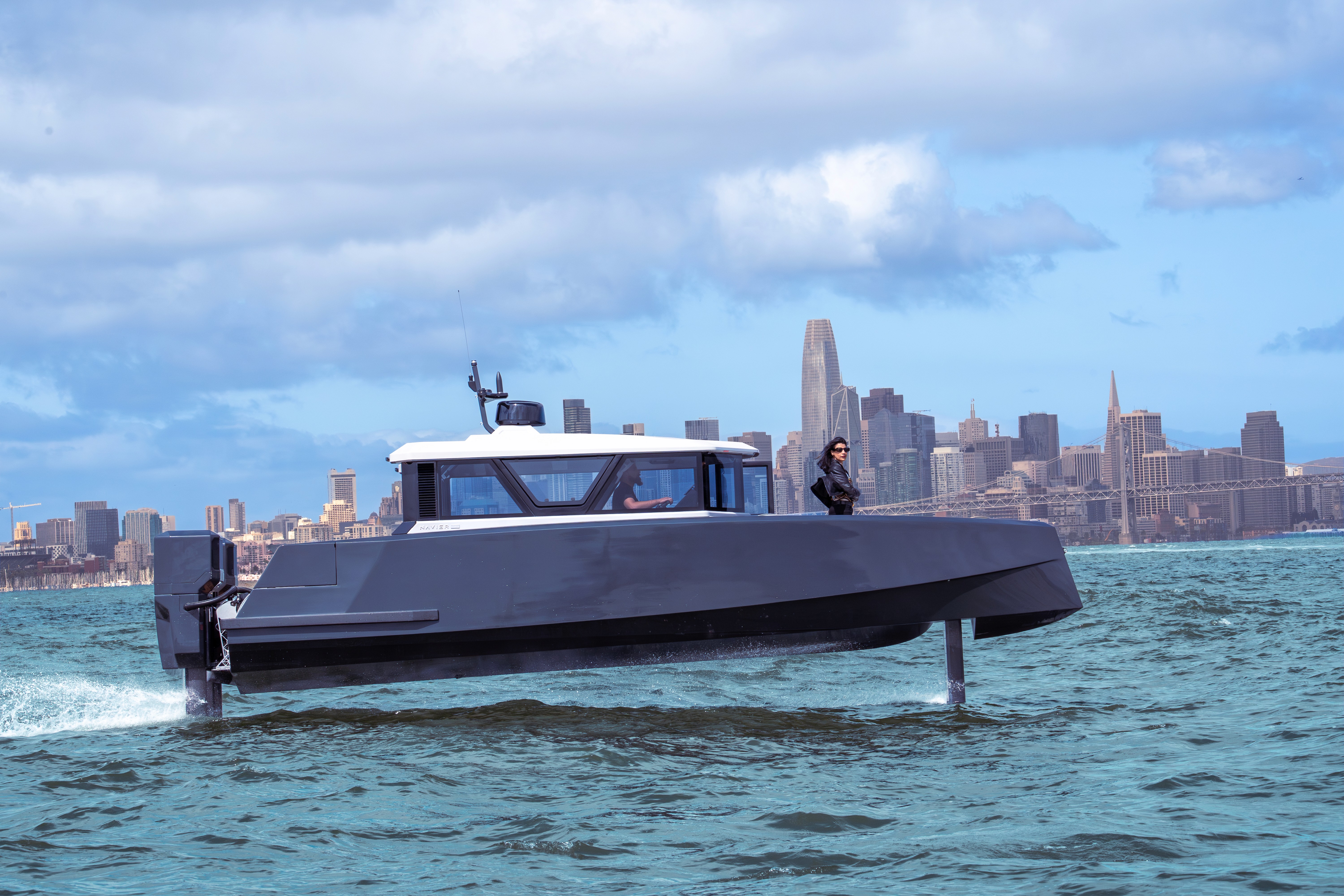

In less than two months, if everything works, an unmanned boat called the Quanta-D will begin sea trials for an attempted Atlantic crossing later this year. 2000 nautical miles without refueling. The category average for a vessel that size is about 400 nautical miles.
The boat is being built by Sampriti Bhattacharyya and her team at Navier, a six-year-old maritime startup in Alameda, California. The company is named for the Navier-Stokes equation, which describes the motion of viscous fluids. Its flagship product, the N30, is the United States’ first all-electric hydrofoiling boat: a thirty-foot craft that cruises above the water at twenty knots on three actively controlled foils, reducing drag by roughly 90% and cutting operating cost from around four dollars per nautical mile to 38 cents. The first production unit was delivered in October 2024 to Rich Ross, a lifelong American boater who keeps it at his home on Hilton Head, South Carolina. Earlier that year, Navier launched a commuter pilot with Stripe, shuttling employees between Larkspur in Marin County and South San Francisco on a route that takes 90 minutes by car and 30 by water.
In October 2025, Navier unveiled three new vessels: the thirty-foot Quanta-D, the eighty-foot Valkyrie, and the 120-foot Morpheus. All hybrid-electric; all hydrofoiling. All built on what the company calls the Generalized Marine Vessel Platform, a single chassis-and-software architecture that can be configured as a luxury day boat, a commuter ferry, a cargo vessel, an unmanned patrol craft, or a sensor-laden escort. The Quanta-D, a hybrid-electric variant, is the vessel beginning sea trials this spring. Defense customers include Leidos, a multi-billion-dollar defense IT and engineering contractor that has been quietly building one of the deepest portfolios in maritime autonomy, and the Department of War. Navier has raised over $30 million publicly and reports multimillion-dollar revenue across defense, commercial, and recreational sectors.
✺
Sampriti grew up in India, went to what she calls a “teeny weeny” college — not IIT, nothing close — and got her first airplane ride to America on the back of one cold email, sent among several hundred to American labs and graduate programs. She had wanted to work in space since she was 13, when cable television arrived at her house and she saw footage of the Apollo missions for the first time. Space was her first love and she reached for it.

At Sea.
Subscribe and add Issue 008.
Add both to cart
It took her to Fermilab, a particle physics and accelerator laboratory 40 miles west of Chicago, where she worked on experimental high-energy physics with the Department of Energy. Then to Ohio State, where she earned a master’s in aerospace engineering, worked on flight controls at NASA over the summers, and wrote her thesis on accelerator-driven subcritical reactors — a design she says she chose specifically so that America could be energy independent. Then to MIT, where she completed a PhD and built a fleet of small underwater drones called Hydroswarm, originally built for inspecting nuclear reactors and later adapted for ocean mapping, then for mine countermeasure and submarine situational awareness. The intellectual property ended up at one of the largest American defense primes. Sampriti was 28.
Somewhere along the way, working in space stopped being the goal. “The purpose of life is to create,” Sampriti tells me. The reach for the moon had been about the wonder. The wonder, it turned out, was closer to hand. The ocean covered 70% of the earth’s surface, had been mapped less thoroughly than the surface of Mars, and nobody was paying attention to it. She mentions Palmer Luckey, one of the few other founders she remembers being early on defense work when early was unfashionable, before American Dynamism was a marketing strategy.
✺
Hydrofoils are not new. They were patented in the early 1900s. The US Navy started building its largest hydrofoil class in the 1960s. The boats flew but the program died. The reason the program died is, to Sampriti, the most important technical fact about Navier, and she offers it unprompted. A hydrofoil is a boat with underwater wings that generate lift at speed, pulling the hull clear of the water. Drag goes with it. An active hydrofoil — one where the foil angle is continuously adjusted mid-flight to hold the boat stable in chop — requires three things: sensors to read the water, computers to process the read, and actuators to move the foils. In the 1960s and 70s, all three were, in her words, “really crappy.” The boats were unreliable and the maintenance was punishing. The last Pegasus came out of the water in 1993 and the Navy did not return to the concept.
What is new, three decades later, is not hydrofoiling. It is that sensing and compute and actuation got good and cheap enough to support the physics. On the N30, the flight control system adjusts the aileron flaps on each foil up to 50 times per second, reading wave conditions in real time. The hardware that does this work would have cost a fortune in 1965.
“We solve the physics tax,” Sampriti says. A conventional hull pushes water, and pushing water burns most of the fuel it consumes. A foiling boat climbs above the water, rather than pushing it, thus the tax disappears. The other thing the physics unlocks is stability. Most of the venture money flowing into maritime defense right now is going to companies building conventional vessels — boats that sit in the water like every other boat. Sampriti makes a specific claim about them: not one of them, she says, can hold a counter-UAS payload in sea state 4 or 5 (swells of roughly four to thirteen feet). The hulls roll and pitch too much in moderate swell. This matters because countering enemy drones — increasingly the dominant threat to surface vessels in contested waters — requires a platform stable enough to track and engage them. A boat that can’t hold its sensors steady is, for that mission, useless. A Navier boat can, because the same foil that saves fuel also damps the roll and pitch. “You would need a destroyer or like three times bigger vessel to get the same stability,” she says.
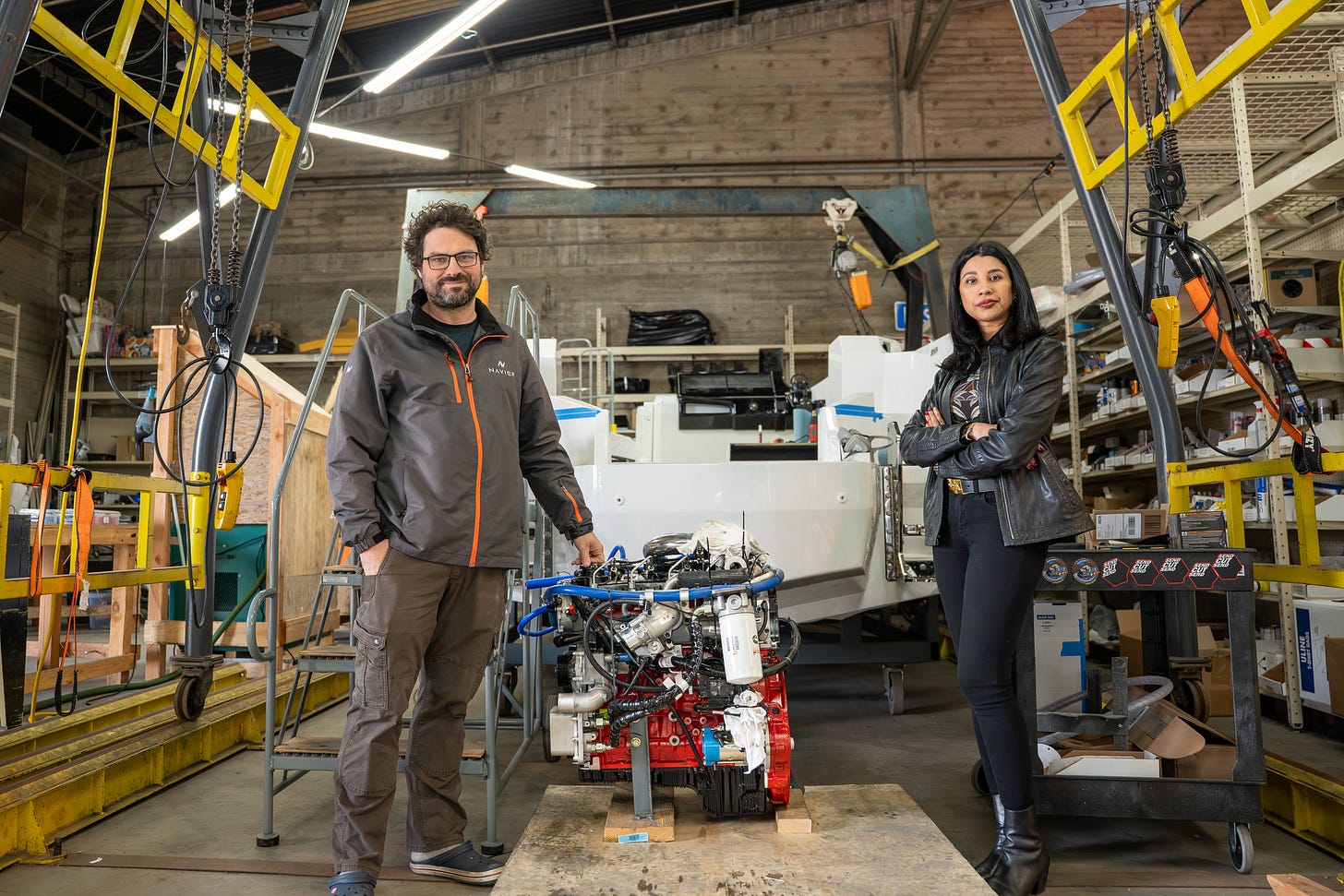
Navier’s objective is to move a unit of payload per unit mile in the fastest, most cost-efficient, most reliable way possible. Everything on top of the GMVP — the hull and flight-control system that are Navier’s foundational layer — is payload. The platform is purpose-built for three constraints: cost across building, scaling, and operating; range per unit payload per unit mile; and sea-state adaptability. Everything else follows. “Follow the mission,” she says. “Don’t get married to a solution.”
Sampriti puts it directly: “We are building the Nvidia chip of the marine industry.” The hull and the flight control software are the core architecture. What gets built on top, whether a luxury day boat, a cargo deck, a USV, or something else, is the application layer. “You can put a ferry superstructure on us,” she says. “You can put a cargo ship, a naval.”
This is where most maritime companies do something Navier refuses to do: build a bespoke vessel per customer. The traditional American shipbuilding industry, currently ranked 19th in the world by output, is structured around one-off vessels built by hand over multi-year timelines. The Navy’s Constellation-class frigate program, contracted in 2020 with a planned delivery in 2026, slipped three years to 2029 and ran $1.5 billion over budget before the Navy cancelled most of it in November 2025, capping a planned 20-ship class at the two hulls already under construction. According to a Congressional Research Service report, it takes around two years to build a new oceangoing Jones Act–compliant vessel — and US shipyards typically deliver only two or three of them a year.
Navier is trying to invert that by borrowing from industries that have already solved mass production. Its supply chain is stitched together from aerospace and automotive, not legacy maritime. Navier’s hull is almost secondary to its flight control system.
If the Generalized Marine Vessel Platform works as advertised, the consequence is structural. One chassis serving multiple markets means the commercial fleet scales the manufacturing that makes the defense fleet cheap. The flight-control code that reads wave conditions 50 times a second on a Stripe commuter boat is the same code that can run on the Quanta-D through the Strait of Hormuz. The foil geometries, the actuator hardware, the sensor stack, the redundant propulsion systems are all shared across the fleet. It is how Navier could, in principle, make a defense platform that actually costs what Sampriti says it should cost.
Most defense contractors subsidize commercial R&D with defense contracts. Navier, if their platform bet works, will do the opposite: subsidize defense production economics with commercial volume. That is a structurally different company from anyone else in the sector — and the mechanism by which the slogan from Sampriti’s recent Axios interview, “out-innovate, not out-produce,” has a chance of producing a real supply chain.
While the consensus in defense-tech discourse right now is “cheap vessels,” Sampriti thinks that is only half the battle. Fuel, she points out, dominates lifetime cost. A boat that costs more to build but consumes just a fifth of the fuel of an ostensibly “cheap vessel” is the actually-cheap boat over 20 years. Today, escorting a multi-hundred-million-dollar oil tanker through the contested Strait of Hormuz requires a destroyer. Sampriti’s pitch is a distributed presence of smaller, better, cheaper vessels — four or five Navier boats carrying ISR, counter-UAS, electronic warfare, and minesweeping payloads, continuously on station, refueling less often than anything in the category can.
Navier boats have already been delivered to the Gulf region, where they are being evaluated for naval operations in the Strait of Hormuz.
✺
Sampriti is a first-generation American immigrant building, among other things, for American naval power. The obvious question is why.
Much of the American Dynamism rhetoric is reactive, defined against a rising China, against peer adversaries, against the specter of American decline. Sampriti’s version predates the wave and runs in the opposite direction. Her vision is positive in structure rather than negative. She loves the country because of what it lets her do. She arrived in Illinois with no family, no network, no money, and it worked out anyway. “Nowhere else in the world,” she says, “I could have done what I have been able to do.” She mentions twice that American women could not have credit cards in their own names until 1974; the opening she walked through is, historically speaking, five minutes old, and worth protecting on those terms alone.
Sampriti believes the logic from there is self-evident. If America stops being the dominant world power, all the alternatives are worse. Therefore American power is worth defending. Therefore defense is worth building.
A few years ago, many tech investors told her that Navier was outside their thesis. She will not name them on record. “The same venture capitalists who are very patriotic today could not have imagined funding a defense tech company,” she says. “I definitely have the emails.”
Another VC told her he would have funded Navier if she had been doing just defense, because defense has higher margins. She declined. “Yes, you can make more money on defense,” she admits. “But to me that was pretty unpatriotic. What will actually make American defense win,” she says, “is a low cost maritime platform that is formidable at sea and available at scale.” Extracting money from DoW grants and contracts is not the same as delivering real maritime power.
There is something particularly American about the distinction. The country’s economic mythology is built on competition in markets — building things people want and then winning by building them better. The country’s defense mythology is built similarly: World War II–era industrial mobilization, the postwar aerospace boom, the chip industry that grew out of dual-use research. By Sampriti’s logic, the way to be patriotic in defense is to compete on the merits — to build a platform that outperforms in commercial markets and earns its way into government use. The way to be unpatriotic is to treat the Department of War as a procurement window where margins live untouched by competition.
✺
Sampriti’s long-term vision for Navier, and America, goes beyond defense. Global ocean logistics today is centralized in a few enormous, slow vessels — what she calls the mainframe era of shipping. She wants to end it. The replacement she has in mind is a network of smaller, faster, distributed boats: hydrofoiling vessels running point-to-point across coastal cities, ports, and trade corridors at a fraction of current cost. Ships today are big and slow because drag scales as velocity squared, and efficiency-per-ton requires size. That is why global logistics has been a choice between thirty-day ocean freight and one-day airfreight, with nothing in between. Hydrofoiling breaks the scaling law. If efficiency comes from the foil rather than size, you can build smaller and faster without paying the cost penalty.
Roughly half the world’s population lives in coastal cities. The majority of global economic activity happens in them. “We are thinking of spending billions of dollars trying to build air taxis,” she says, “and we are stuck and not building networks on the water because we haven’t figured out the physics of it.”
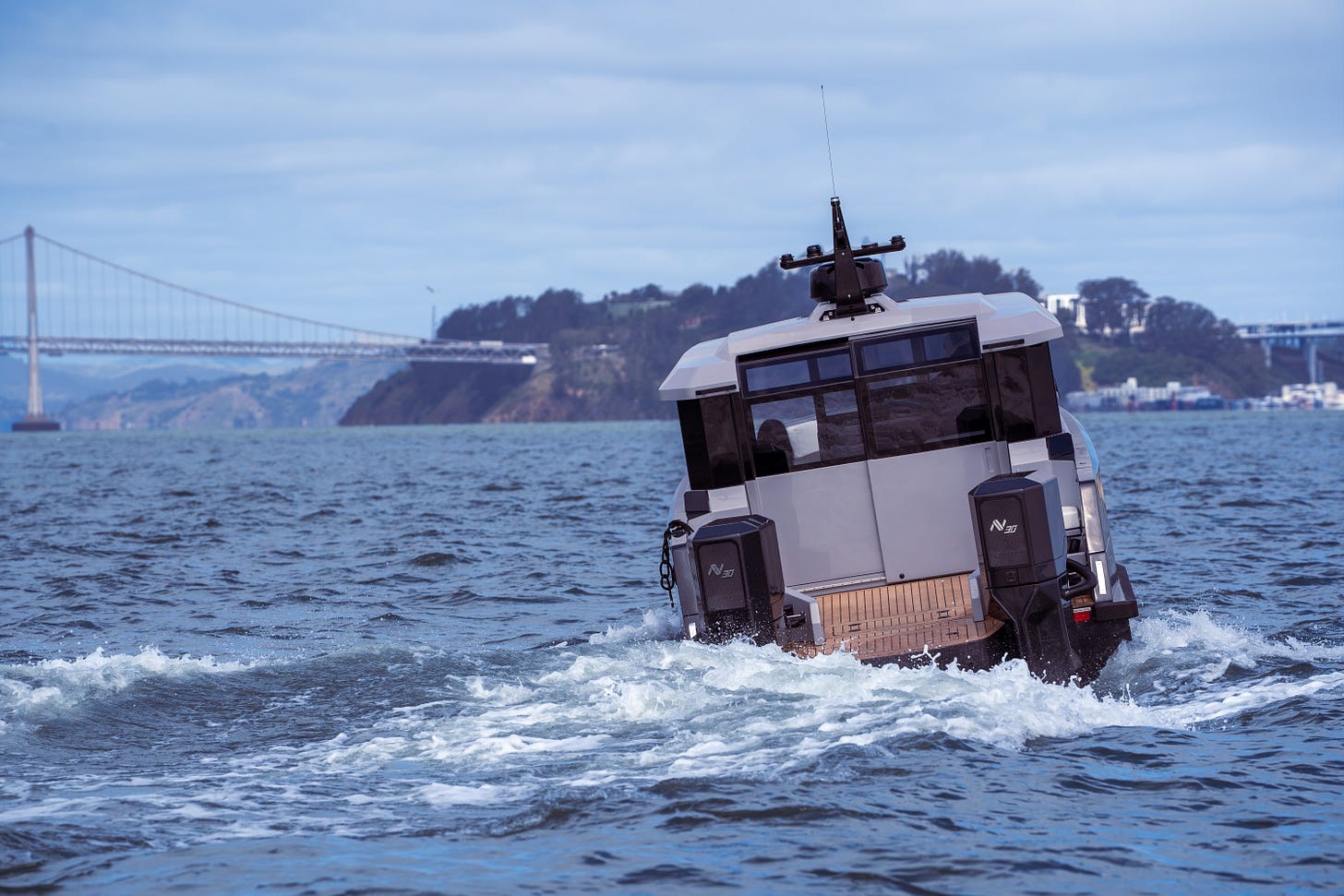
“Alameda” — a coastal city built on an archipelago across the Bay from San Francisco — “is such a great place to live,” Sampriti says. “If you are going to work at Oyster Point, you should totally be able to live in Alameda.” For anyone who has sat in Bay Area traffic on a Tuesday morning, or paid San Francisco’s steep rents, the geography starts rearranging itself against the reader’s will. Hence the Stripe commuter boat.
“The world moves at the cost and speed at which goods and people move,” Sampriti recites. She’s almost certainly said it before, in other interviews and presentations, but the reminder seems appropriate. Her company has even signed a hundred-vessel contract to build a new transit network.
Sampriti says she would “risk the last pieces of everything I have to build Navier.”
I consider believing it. She grew up, she says, in “chaotic” circumstances. She says she was rebellious and ran away from home more than once but doesn’t explain why. On a backpacking trip in the mountains, she tells me, she came close enough to being killed by a landslide that she now uses the incident as shorthand for a worldview: “life is a game of inches.” She has no family in America. She frames the work as a video game. Higher level, harder game, she says — “that is the point, you chose it.” She is not claiming to try to finish the infinite game. But she does not give up on what she believes in.
In less than 60 days, the Quanta-D begins sea trials. If the Atlantic crossing succeeds later this year, it will be the longest autonomous voyage by an unmanned hydrofoiling vessel and one of the longest by any vessel of its 30-foot size class. (The 2022 Mayflower autonomous ship, which made the first autonomous transatlantic crossing by a powered boat, was 50 feet.) Navier will have delivered, at scale, the proof of an argument Sampriti has been making since Hydroswarm: that the ocean is the frontier that has been waiting for a platform shift, that the physics tax holding back maritime can be repealed, that a thirty-foot boat with the right software can do work that used to require a destroyer (or was not done at all). And if it fails, they will fix it and try again.
Somewhere on the other side of the country, in a warehouse in Alameda, the boat is almost ready.
Technology
•
Navier's PC Moment for the Sea
Navier's hydrofoiling boat is about to cross the Atlantic — alone.
In less than two months, if everything works, an unmanned boat called the Quanta-D will begin sea trials for an attempted Atlantic crossing later this year. 2000 nautical miles without refueling. The category average for a vessel that size is about 400 nautical miles.
The boat is being built by Sampriti Bhattacharyya and her team at Navier, a six-year-old maritime startup in Alameda, California. The company is named for the Navier-Stokes equation, which describes the motion of viscous fluids. Its flagship product, the N30, is the United States’ first all-electric hydrofoiling boat: a thirty-foot craft that cruises above the water at twenty knots on three actively controlled foils, reducing drag by roughly 90% and cutting operating cost from around four dollars per nautical mile to 38 cents. The first production unit was delivered in October 2024 to Rich Ross, a lifelong American boater who keeps it at his home on Hilton Head, South Carolina. Earlier that year, Navier launched a commuter pilot with Stripe, shuttling employees between Larkspur in Marin County and South San Francisco on a route that takes 90 minutes by car and 30 by water.
In October 2025, Navier unveiled three new vessels: the thirty-foot Quanta-D, the eighty-foot Valkyrie, and the 120-foot Morpheus. All hybrid-electric; all hydrofoiling. All built on what the company calls the Generalized Marine Vessel Platform, a single chassis-and-software architecture that can be configured as a luxury day boat, a commuter ferry, a cargo vessel, an unmanned patrol craft, or a sensor-laden escort. The Quanta-D, a hybrid-electric variant, is the vessel beginning sea trials this spring. Defense customers include Leidos, a multi-billion-dollar defense IT and engineering contractor that has been quietly building one of the deepest portfolios in maritime autonomy, and the Department of War. Navier has raised over $30 million publicly and reports multimillion-dollar revenue across defense, commercial, and recreational sectors.
✺
Sampriti grew up in India, went to what she calls a “teeny weeny” college — not IIT, nothing close — and got her first airplane ride to America on the back of one cold email, sent among several hundred to American labs and graduate programs. She had wanted to work in space since she was 13, when cable television arrived at her house and she saw footage of the Apollo missions for the first time. Space was her first love and she reached for it.
At Sea.
Subscribe and add Issue 008.
Add both to cart
It took her to Fermilab, a particle physics and accelerator laboratory 40 miles west of Chicago, where she worked on experimental high-energy physics with the Department of Energy. Then to Ohio State, where she earned a master’s in aerospace engineering, worked on flight controls at NASA over the summers, and wrote her thesis on accelerator-driven subcritical reactors — a design she says she chose specifically so that America could be energy independent. Then to MIT, where she completed a PhD and built a fleet of small underwater drones called Hydroswarm, originally built for inspecting nuclear reactors and later adapted for ocean mapping, then for mine countermeasure and submarine situational awareness. The intellectual property ended up at one of the largest American defense primes. Sampriti was 28.
Somewhere along the way, working in space stopped being the goal. “The purpose of life is to create,” Sampriti tells me. The reach for the moon had been about the wonder. The wonder, it turned out, was closer to hand. The ocean covered 70% of the earth’s surface, had been mapped less thoroughly than the surface of Mars, and nobody was paying attention to it. She mentions Palmer Luckey, one of the few other founders she remembers being early on defense work when early was unfashionable, before American Dynamism was a marketing strategy.
✺
Hydrofoils are not new. They were patented in the early 1900s. The US Navy started building its largest hydrofoil class in the 1960s. The boats flew but the program died. The reason the program died is, to Sampriti, the most important technical fact about Navier, and she offers it unprompted. A hydrofoil is a boat with underwater wings that generate lift at speed, pulling the hull clear of the water. Drag goes with it. An active hydrofoil — one where the foil angle is continuously adjusted mid-flight to hold the boat stable in chop — requires three things: sensors to read the water, computers to process the read, and actuators to move the foils. In the 1960s and 70s, all three were, in her words, “really crappy.” The boats were unreliable and the maintenance was punishing. The last Pegasus came out of the water in 1993 and the Navy did not return to the concept.
What is new, three decades later, is not hydrofoiling. It is that sensing and compute and actuation got good and cheap enough to support the physics. On the N30, the flight control system adjusts the aileron flaps on each foil up to 50 times per second, reading wave conditions in real time. The hardware that does this work would have cost a fortune in 1965.
“We solve the physics tax,” Sampriti says. A conventional hull pushes water, and pushing water burns most of the fuel it consumes. A foiling boat climbs above the water, rather than pushing it, thus the tax disappears. The other thing the physics unlocks is stability. Most of the venture money flowing into maritime defense right now is going to companies building conventional vessels — boats that sit in the water like every other boat. Sampriti makes a specific claim about them: not one of them, she says, can hold a counter-UAS payload in sea state 4 or 5 (swells of roughly four to thirteen feet). The hulls roll and pitch too much in moderate swell. This matters because countering enemy drones — increasingly the dominant threat to surface vessels in contested waters — requires a platform stable enough to track and engage them. A boat that can’t hold its sensors steady is, for that mission, useless. A Navier boat can, because the same foil that saves fuel also damps the roll and pitch. “You would need a destroyer or like three times bigger vessel to get the same stability,” she says.
Navier’s objective is to move a unit of payload per unit mile in the fastest, most cost-efficient, most reliable way possible. Everything on top of the GMVP — the hull and flight-control system that are Navier’s foundational layer — is payload. The platform is purpose-built for three constraints: cost across building, scaling, and operating; range per unit payload per unit mile; and sea-state adaptability. Everything else follows. “Follow the mission,” she says. “Don’t get married to a solution.”
Sampriti puts it directly: “We are building the Nvidia chip of the marine industry.” The hull and the flight control software are the core architecture. What gets built on top, whether a luxury day boat, a cargo deck, a USV, or something else, is the application layer. “You can put a ferry superstructure on us,” she says. “You can put a cargo ship, a naval.”
This is where most maritime companies do something Navier refuses to do: build a bespoke vessel per customer. The traditional American shipbuilding industry, currently ranked 19th in the world by output, is structured around one-off vessels built by hand over multi-year timelines. The Navy’s Constellation-class frigate program, contracted in 2020 with a planned delivery in 2026, slipped three years to 2029 and ran $1.5 billion over budget before the Navy cancelled most of it in November 2025, capping a planned 20-ship class at the two hulls already under construction. According to a Congressional Research Service report, it takes around two years to build a new oceangoing Jones Act–compliant vessel — and US shipyards typically deliver only two or three of them a year.
Navier is trying to invert that by borrowing from industries that have already solved mass production. Its supply chain is stitched together from aerospace and automotive, not legacy maritime. Navier’s hull is almost secondary to its flight control system.
If the Generalized Marine Vessel Platform works as advertised, the consequence is structural. One chassis serving multiple markets means the commercial fleet scales the manufacturing that makes the defense fleet cheap. The flight-control code that reads wave conditions 50 times a second on a Stripe commuter boat is the same code that can run on the Quanta-D through the Strait of Hormuz. The foil geometries, the actuator hardware, the sensor stack, the redundant propulsion systems are all shared across the fleet. It is how Navier could, in principle, make a defense platform that actually costs what Sampriti says it should cost.
Most defense contractors subsidize commercial R&D with defense contracts. Navier, if their platform bet works, will do the opposite: subsidize defense production economics with commercial volume. That is a structurally different company from anyone else in the sector — and the mechanism by which the slogan from Sampriti’s recent Axios interview, “out-innovate, not out-produce,” has a chance of producing a real supply chain.
While the consensus in defense-tech discourse right now is “cheap vessels,” Sampriti thinks that is only half the battle. Fuel, she points out, dominates lifetime cost. A boat that costs more to build but consumes just a fifth of the fuel of an ostensibly “cheap vessel” is the actually-cheap boat over 20 years. Today, escorting a multi-hundred-million-dollar oil tanker through the contested Strait of Hormuz requires a destroyer. Sampriti’s pitch is a distributed presence of smaller, better, cheaper vessels — four or five Navier boats carrying ISR, counter-UAS, electronic warfare, and minesweeping payloads, continuously on station, refueling less often than anything in the category can.
Navier boats have already been delivered to the Gulf region, where they are being evaluated for naval operations in the Strait of Hormuz.
✺
Sampriti is a first-generation American immigrant building, among other things, for American naval power. The obvious question is why.
Much of the American Dynamism rhetoric is reactive, defined against a rising China, against peer adversaries, against the specter of American decline. Sampriti’s version predates the wave and runs in the opposite direction. Her vision is positive in structure rather than negative. She loves the country because of what it lets her do. She arrived in Illinois with no family, no network, no money, and it worked out anyway. “Nowhere else in the world,” she says, “I could have done what I have been able to do.” She mentions twice that American women could not have credit cards in their own names until 1974; the opening she walked through is, historically speaking, five minutes old, and worth protecting on those terms alone.
Sampriti believes the logic from there is self-evident. If America stops being the dominant world power, all the alternatives are worse. Therefore American power is worth defending. Therefore defense is worth building.
A few years ago, many tech investors told her that Navier was outside their thesis. She will not name them on record. “The same venture capitalists who are very patriotic today could not have imagined funding a defense tech company,” she says. “I definitely have the emails.”
Another VC told her he would have funded Navier if she had been doing just defense, because defense has higher margins. She declined. “Yes, you can make more money on defense,” she admits. “But to me that was pretty unpatriotic. What will actually make American defense win,” she says, “is a low cost maritime platform that is formidable at sea and available at scale.” Extracting money from DoW grants and contracts is not the same as delivering real maritime power.
There is something particularly American about the distinction. The country’s economic mythology is built on competition in markets — building things people want and then winning by building them better. The country’s defense mythology is built similarly: World War II–era industrial mobilization, the postwar aerospace boom, the chip industry that grew out of dual-use research. By Sampriti’s logic, the way to be patriotic in defense is to compete on the merits — to build a platform that outperforms in commercial markets and earns its way into government use. The way to be unpatriotic is to treat the Department of War as a procurement window where margins live untouched by competition.
✺
Sampriti’s long-term vision for Navier, and America, goes beyond defense. Global ocean logistics today is centralized in a few enormous, slow vessels — what she calls the mainframe era of shipping. She wants to end it. The replacement she has in mind is a network of smaller, faster, distributed boats: hydrofoiling vessels running point-to-point across coastal cities, ports, and trade corridors at a fraction of current cost. Ships today are big and slow because drag scales as velocity squared, and efficiency-per-ton requires size. That is why global logistics has been a choice between thirty-day ocean freight and one-day airfreight, with nothing in between. Hydrofoiling breaks the scaling law. If efficiency comes from the foil rather than size, you can build smaller and faster without paying the cost penalty.
Roughly half the world’s population lives in coastal cities. The majority of global economic activity happens in them. “We are thinking of spending billions of dollars trying to build air taxis,” she says, “and we are stuck and not building networks on the water because we haven’t figured out the physics of it.”
“Alameda” — a coastal city built on an archipelago across the Bay from San Francisco — “is such a great place to live,” Sampriti says. “If you are going to work at Oyster Point, you should totally be able to live in Alameda.” For anyone who has sat in Bay Area traffic on a Tuesday morning, or paid San Francisco’s steep rents, the geography starts rearranging itself against the reader’s will. Hence the Stripe commuter boat.
“The world moves at the cost and speed at which goods and people move,” Sampriti recites. She’s almost certainly said it before, in other interviews and presentations, but the reminder seems appropriate. Her company has even signed a hundred-vessel contract to build a new transit network.
Sampriti says she would “risk the last pieces of everything I have to build Navier.”
I consider believing it. She grew up, she says, in “chaotic” circumstances. She says she was rebellious and ran away from home more than once but doesn’t explain why. On a backpacking trip in the mountains, she tells me, she came close enough to being killed by a landslide that she now uses the incident as shorthand for a worldview: “life is a game of inches.” She has no family in America. She frames the work as a video game. Higher level, harder game, she says — “that is the point, you chose it.” She is not claiming to try to finish the infinite game. But she does not give up on what she believes in.
In less than 60 days, the Quanta-D begins sea trials. If the Atlantic crossing succeeds later this year, it will be the longest autonomous voyage by an unmanned hydrofoiling vessel and one of the longest by any vessel of its 30-foot size class. (The 2022 Mayflower autonomous ship, which made the first autonomous transatlantic crossing by a powered boat, was 50 feet.) Navier will have delivered, at scale, the proof of an argument Sampriti has been making since Hydroswarm: that the ocean is the frontier that has been waiting for a platform shift, that the physics tax holding back maritime can be repealed, that a thirty-foot boat with the right software can do work that used to require a destroyer (or was not done at all). And if it fails, they will fix it and try again.
Somewhere on the other side of the country, in a warehouse in Alameda, the boat is almost ready.
Technology
•
Navier's PC Moment for the Sea
Navier's hydrofoiling boat is about to cross the Atlantic — alone.
In less than two months, if everything works, an unmanned boat called the Quanta-D will begin sea trials for an attempted Atlantic crossing later this year. 2000 nautical miles without refueling. The category average for a vessel that size is about 400 nautical miles.
The boat is being built by Sampriti Bhattacharyya and her team at Navier, a six-year-old maritime startup in Alameda, California. The company is named for the Navier-Stokes equation, which describes the motion of viscous fluids. Its flagship product, the N30, is the United States’ first all-electric hydrofoiling boat: a thirty-foot craft that cruises above the water at twenty knots on three actively controlled foils, reducing drag by roughly 90% and cutting operating cost from around four dollars per nautical mile to 38 cents. The first production unit was delivered in October 2024 to Rich Ross, a lifelong American boater who keeps it at his home on Hilton Head, South Carolina. Earlier that year, Navier launched a commuter pilot with Stripe, shuttling employees between Larkspur in Marin County and South San Francisco on a route that takes 90 minutes by car and 30 by water.
In October 2025, Navier unveiled three new vessels: the thirty-foot Quanta-D, the eighty-foot Valkyrie, and the 120-foot Morpheus. All hybrid-electric; all hydrofoiling. All built on what the company calls the Generalized Marine Vessel Platform, a single chassis-and-software architecture that can be configured as a luxury day boat, a commuter ferry, a cargo vessel, an unmanned patrol craft, or a sensor-laden escort. The Quanta-D, a hybrid-electric variant, is the vessel beginning sea trials this spring. Defense customers include Leidos, a multi-billion-dollar defense IT and engineering contractor that has been quietly building one of the deepest portfolios in maritime autonomy, and the Department of War. Navier has raised over $30 million publicly and reports multimillion-dollar revenue across defense, commercial, and recreational sectors.
✺
Sampriti grew up in India, went to what she calls a “teeny weeny” college — not IIT, nothing close — and got her first airplane ride to America on the back of one cold email, sent among several hundred to American labs and graduate programs. She had wanted to work in space since she was 13, when cable television arrived at her house and she saw footage of the Apollo missions for the first time. Space was her first love and she reached for it.
At Sea.
Subscribe and add Issue 008.
Add both to cart
It took her to Fermilab, a particle physics and accelerator laboratory 40 miles west of Chicago, where she worked on experimental high-energy physics with the Department of Energy. Then to Ohio State, where she earned a master’s in aerospace engineering, worked on flight controls at NASA over the summers, and wrote her thesis on accelerator-driven subcritical reactors — a design she says she chose specifically so that America could be energy independent. Then to MIT, where she completed a PhD and built a fleet of small underwater drones called Hydroswarm, originally built for inspecting nuclear reactors and later adapted for ocean mapping, then for mine countermeasure and submarine situational awareness. The intellectual property ended up at one of the largest American defense primes. Sampriti was 28.
Somewhere along the way, working in space stopped being the goal. “The purpose of life is to create,” Sampriti tells me. The reach for the moon had been about the wonder. The wonder, it turned out, was closer to hand. The ocean covered 70% of the earth’s surface, had been mapped less thoroughly than the surface of Mars, and nobody was paying attention to it. She mentions Palmer Luckey, one of the few other founders she remembers being early on defense work when early was unfashionable, before American Dynamism was a marketing strategy.
✺
Hydrofoils are not new. They were patented in the early 1900s. The US Navy started building its largest hydrofoil class in the 1960s. The boats flew but the program died. The reason the program died is, to Sampriti, the most important technical fact about Navier, and she offers it unprompted. A hydrofoil is a boat with underwater wings that generate lift at speed, pulling the hull clear of the water. Drag goes with it. An active hydrofoil — one where the foil angle is continuously adjusted mid-flight to hold the boat stable in chop — requires three things: sensors to read the water, computers to process the read, and actuators to move the foils. In the 1960s and 70s, all three were, in her words, “really crappy.” The boats were unreliable and the maintenance was punishing. The last Pegasus came out of the water in 1993 and the Navy did not return to the concept.
What is new, three decades later, is not hydrofoiling. It is that sensing and compute and actuation got good and cheap enough to support the physics. On the N30, the flight control system adjusts the aileron flaps on each foil up to 50 times per second, reading wave conditions in real time. The hardware that does this work would have cost a fortune in 1965.
“We solve the physics tax,” Sampriti says. A conventional hull pushes water, and pushing water burns most of the fuel it consumes. A foiling boat climbs above the water, rather than pushing it, thus the tax disappears. The other thing the physics unlocks is stability. Most of the venture money flowing into maritime defense right now is going to companies building conventional vessels — boats that sit in the water like every other boat. Sampriti makes a specific claim about them: not one of them, she says, can hold a counter-UAS payload in sea state 4 or 5 (swells of roughly four to thirteen feet). The hulls roll and pitch too much in moderate swell. This matters because countering enemy drones — increasingly the dominant threat to surface vessels in contested waters — requires a platform stable enough to track and engage them. A boat that can’t hold its sensors steady is, for that mission, useless. A Navier boat can, because the same foil that saves fuel also damps the roll and pitch. “You would need a destroyer or like three times bigger vessel to get the same stability,” she says.
Navier’s objective is to move a unit of payload per unit mile in the fastest, most cost-efficient, most reliable way possible. Everything on top of the GMVP — the hull and flight-control system that are Navier’s foundational layer — is payload. The platform is purpose-built for three constraints: cost across building, scaling, and operating; range per unit payload per unit mile; and sea-state adaptability. Everything else follows. “Follow the mission,” she says. “Don’t get married to a solution.”
Sampriti puts it directly: “We are building the Nvidia chip of the marine industry.” The hull and the flight control software are the core architecture. What gets built on top, whether a luxury day boat, a cargo deck, a USV, or something else, is the application layer. “You can put a ferry superstructure on us,” she says. “You can put a cargo ship, a naval.”
This is where most maritime companies do something Navier refuses to do: build a bespoke vessel per customer. The traditional American shipbuilding industry, currently ranked 19th in the world by output, is structured around one-off vessels built by hand over multi-year timelines. The Navy’s Constellation-class frigate program, contracted in 2020 with a planned delivery in 2026, slipped three years to 2029 and ran $1.5 billion over budget before the Navy cancelled most of it in November 2025, capping a planned 20-ship class at the two hulls already under construction. According to a Congressional Research Service report, it takes around two years to build a new oceangoing Jones Act–compliant vessel — and US shipyards typically deliver only two or three of them a year.
Navier is trying to invert that by borrowing from industries that have already solved mass production. Its supply chain is stitched together from aerospace and automotive, not legacy maritime. Navier’s hull is almost secondary to its flight control system.
If the Generalized Marine Vessel Platform works as advertised, the consequence is structural. One chassis serving multiple markets means the commercial fleet scales the manufacturing that makes the defense fleet cheap. The flight-control code that reads wave conditions 50 times a second on a Stripe commuter boat is the same code that can run on the Quanta-D through the Strait of Hormuz. The foil geometries, the actuator hardware, the sensor stack, the redundant propulsion systems are all shared across the fleet. It is how Navier could, in principle, make a defense platform that actually costs what Sampriti says it should cost.
Most defense contractors subsidize commercial R&D with defense contracts. Navier, if their platform bet works, will do the opposite: subsidize defense production economics with commercial volume. That is a structurally different company from anyone else in the sector — and the mechanism by which the slogan from Sampriti’s recent Axios interview, “out-innovate, not out-produce,” has a chance of producing a real supply chain.
While the consensus in defense-tech discourse right now is “cheap vessels,” Sampriti thinks that is only half the battle. Fuel, she points out, dominates lifetime cost. A boat that costs more to build but consumes just a fifth of the fuel of an ostensibly “cheap vessel” is the actually-cheap boat over 20 years. Today, escorting a multi-hundred-million-dollar oil tanker through the contested Strait of Hormuz requires a destroyer. Sampriti’s pitch is a distributed presence of smaller, better, cheaper vessels — four or five Navier boats carrying ISR, counter-UAS, electronic warfare, and minesweeping payloads, continuously on station, refueling less often than anything in the category can.
Navier boats have already been delivered to the Gulf region, where they are being evaluated for naval operations in the Strait of Hormuz.
✺
Sampriti is a first-generation American immigrant building, among other things, for American naval power. The obvious question is why.
Much of the American Dynamism rhetoric is reactive, defined against a rising China, against peer adversaries, against the specter of American decline. Sampriti’s version predates the wave and runs in the opposite direction. Her vision is positive in structure rather than negative. She loves the country because of what it lets her do. She arrived in Illinois with no family, no network, no money, and it worked out anyway. “Nowhere else in the world,” she says, “I could have done what I have been able to do.” She mentions twice that American women could not have credit cards in their own names until 1974; the opening she walked through is, historically speaking, five minutes old, and worth protecting on those terms alone.
Sampriti believes the logic from there is self-evident. If America stops being the dominant world power, all the alternatives are worse. Therefore American power is worth defending. Therefore defense is worth building.
A few years ago, many tech investors told her that Navier was outside their thesis. She will not name them on record. “The same venture capitalists who are very patriotic today could not have imagined funding a defense tech company,” she says. “I definitely have the emails.”
Another VC told her he would have funded Navier if she had been doing just defense, because defense has higher margins. She declined. “Yes, you can make more money on defense,” she admits. “But to me that was pretty unpatriotic. What will actually make American defense win,” she says, “is a low cost maritime platform that is formidable at sea and available at scale.” Extracting money from DoW grants and contracts is not the same as delivering real maritime power.
There is something particularly American about the distinction. The country’s economic mythology is built on competition in markets — building things people want and then winning by building them better. The country’s defense mythology is built similarly: World War II–era industrial mobilization, the postwar aerospace boom, the chip industry that grew out of dual-use research. By Sampriti’s logic, the way to be patriotic in defense is to compete on the merits — to build a platform that outperforms in commercial markets and earns its way into government use. The way to be unpatriotic is to treat the Department of War as a procurement window where margins live untouched by competition.
✺
Sampriti’s long-term vision for Navier, and America, goes beyond defense. Global ocean logistics today is centralized in a few enormous, slow vessels — what she calls the mainframe era of shipping. She wants to end it. The replacement she has in mind is a network of smaller, faster, distributed boats: hydrofoiling vessels running point-to-point across coastal cities, ports, and trade corridors at a fraction of current cost. Ships today are big and slow because drag scales as velocity squared, and efficiency-per-ton requires size. That is why global logistics has been a choice between thirty-day ocean freight and one-day airfreight, with nothing in between. Hydrofoiling breaks the scaling law. If efficiency comes from the foil rather than size, you can build smaller and faster without paying the cost penalty.
Roughly half the world’s population lives in coastal cities. The majority of global economic activity happens in them. “We are thinking of spending billions of dollars trying to build air taxis,” she says, “and we are stuck and not building networks on the water because we haven’t figured out the physics of it.”
“Alameda” — a coastal city built on an archipelago across the Bay from San Francisco — “is such a great place to live,” Sampriti says. “If you are going to work at Oyster Point, you should totally be able to live in Alameda.” For anyone who has sat in Bay Area traffic on a Tuesday morning, or paid San Francisco’s steep rents, the geography starts rearranging itself against the reader’s will. Hence the Stripe commuter boat.
“The world moves at the cost and speed at which goods and people move,” Sampriti recites. She’s almost certainly said it before, in other interviews and presentations, but the reminder seems appropriate. Her company has even signed a hundred-vessel contract to build a new transit network.
Sampriti says she would “risk the last pieces of everything I have to build Navier.”
I consider believing it. She grew up, she says, in “chaotic” circumstances. She says she was rebellious and ran away from home more than once but doesn’t explain why. On a backpacking trip in the mountains, she tells me, she came close enough to being killed by a landslide that she now uses the incident as shorthand for a worldview: “life is a game of inches.” She has no family in America. She frames the work as a video game. Higher level, harder game, she says — “that is the point, you chose it.” She is not claiming to try to finish the infinite game. But she does not give up on what she believes in.
In less than 60 days, the Quanta-D begins sea trials. If the Atlantic crossing succeeds later this year, it will be the longest autonomous voyage by an unmanned hydrofoiling vessel and one of the longest by any vessel of its 30-foot size class. (The 2022 Mayflower autonomous ship, which made the first autonomous transatlantic crossing by a powered boat, was 50 feet.) Navier will have delivered, at scale, the proof of an argument Sampriti has been making since Hydroswarm: that the ocean is the frontier that has been waiting for a platform shift, that the physics tax holding back maritime can be repealed, that a thirty-foot boat with the right software can do work that used to require a destroyer (or was not done at all). And if it fails, they will fix it and try again.
Somewhere on the other side of the country, in a warehouse in Alameda, the boat is almost ready.
About the Author
Shreeda Segan is a contributing writer to Arena Magazine. She can be found on X @freeshreeda.