tt
tt
tt
tt
Technology
•
The Miracle Under the Sea
1,188,574 miles of submarine cables run across the ocean floor and weave the world together.

Just after dinnertime on December 26, 2006, the seabed off the southern tip of Taiwan suddenly lurched. Eight minutes later, it lurched again. The region had been struck by two major earthquakes that could be felt as far away as Hong Kong. Over the next few hours, coastal Taiwan was so heavily damaged that one of the reactors at the nearby Maanshan Nuclear Power Plant was forced into an emergency shutdown. The event left two people dead and 45 injured. Thankfully, the emergency response was quick. Power was restored within hours, and, by the next day, the cleanup had commenced. What many international commenters failed to realize at the time was that the damage on land was only half the story.
Deep beneath the Luzon Strait, the body of water connecting Taiwan to the northernmost island of the Philippines, a handful of fiber optic submarine cables were severed by the quakes. Within hours of the first tremors, cable operators reported that six of the seven cable systems in that corridor were failing. From the shoreline, nothing looked different. But online, the “cloud” suddenly buckled. International communication and digital activity on Taiwan and its neighboring nations was interrupted. Customers could not withdraw money from banks, traders could not fill orders, airlines could not check in customers.
By the next day, the two largest Chinese telecom companies reported that their capacity to connect users with the US and Europe was down over 90 percent, severely limiting international communications and business activity. Taiwan’s largest internet service provider (ISP), Chunghwa Telecom, lost all connection to Hong Kong and the rest of Southeast Asia, forcing firms to re-route traffic through satellites and alternative cable routes near Singapore. Taiwanese users, along with others across the region, were completely shut out from sites such as Yahoo, MSN, and Hotmail.
While the disruption is most apparent at the edge of the digital network, in this instance landing pages and email servers, it could not be solved by pushing a software update. Fixing this problem would require physical infrastructure: ships. On December 28, repair vessels started to arrive. Behind the scenes, industry investigators discovered that a submarine landslide likely compounded the damage, snapping and displacing cable segments in a way that made recovery slower and more complex than a single clean break.


At Sea.
Subscribe and add Issue 008.
Add both to cart
People who lived in Taiwan and the surrounding region could access the internet within a few days, as operators rerouted traffic across longer paths until the seafloor could be stitched back together. By January 5th, Hong Kong reported that major ISPs were back to “reasonable levels” of service, even before the main cables were fully repaired. The episode’s lesson was startling: the modern internet can bend without breaking. But it still depends on a few slender strands of glass laid across a dark ocean trench — and on the rare ships, and the crews who can sail out, hook the seafloor, and knit the world back together.
What makes this tale so remarkable is that it was essentially invisible to the vast majority of people. You can climb the Hoover Dam, you can ride to the top of the Burj Khalifa, you can gaze in awe at the Hagia Sophia. But you cannot visit the pieces of what has become one of humanity’s greatest engineering achievements, because they lie in silence across continental shelves and abyssal plains, stitched together by repeaters, branching units, and the patience of crews who work with grapnels and ploughs in seas that do not care about your deadline.
You will likely never see these arteries of the global information flow. Maybe you’ll see a nondescript hut near a beach, a manhole cover in the sand, a warning sign on a fence that says “Danger — Buried Cable — Do Not Dig.” Through that unremarkable doorway runs the nervous system of modern life. The markets that open at dawn, the cloud that holds your photos, the calls between presidents, the texts you send without thinking — all of it relies on these cables. The world’s most consequential infrastructure is a bundle of glass fibers under miles of water, doing its work so quietly that we only remember it exists when it breaks.
Submarine Cables 101
For most people, the internet lives somewhere overhead. It is in the ether, the glowing nowhere from which emails emerge and into which tweets vanish. This is, of course, a charming fiction.
The reality is that the modern world is manufactured, dragged, bolted, buried, landed, maintained, and repaired. Submarine cables are one of those pieces of infrastructure that have a science-fictional character. The basic proposition is preposterous enough: take the most advanced communications technology of our age, wrap it in layers of metal and rubber, lower thousands of miles of it into the briny ocean, and trust that civilization can henceforth depend on it. Let us strip away the sci-fi for just a few moments.
As with any infrastructure deployment, the first step is planning where the cable will be laid. Mapping a route requires considerable diligence. There are constraints put upon these cables by man and the nation-state, such as security reviews of partners and financiers, and environmental permitting in and around the landing site. Cable projects span a spectrum of ownership models: a single company, a private consortium, a mixed consortium of private entities and state-backed telecommunications services or utilities, or a fully government-owned and controlled cable.
Then, there are the constraints imposed by the sea itself. Before a route is approved, engineers, oceanographers, and financiers need hydrographic surveys to identify topographical impediments or threats, geophysical surveys to identify hazards or threats on the seabed, and geotechnical investigations to determine the engineering required to secure and protect the cable.
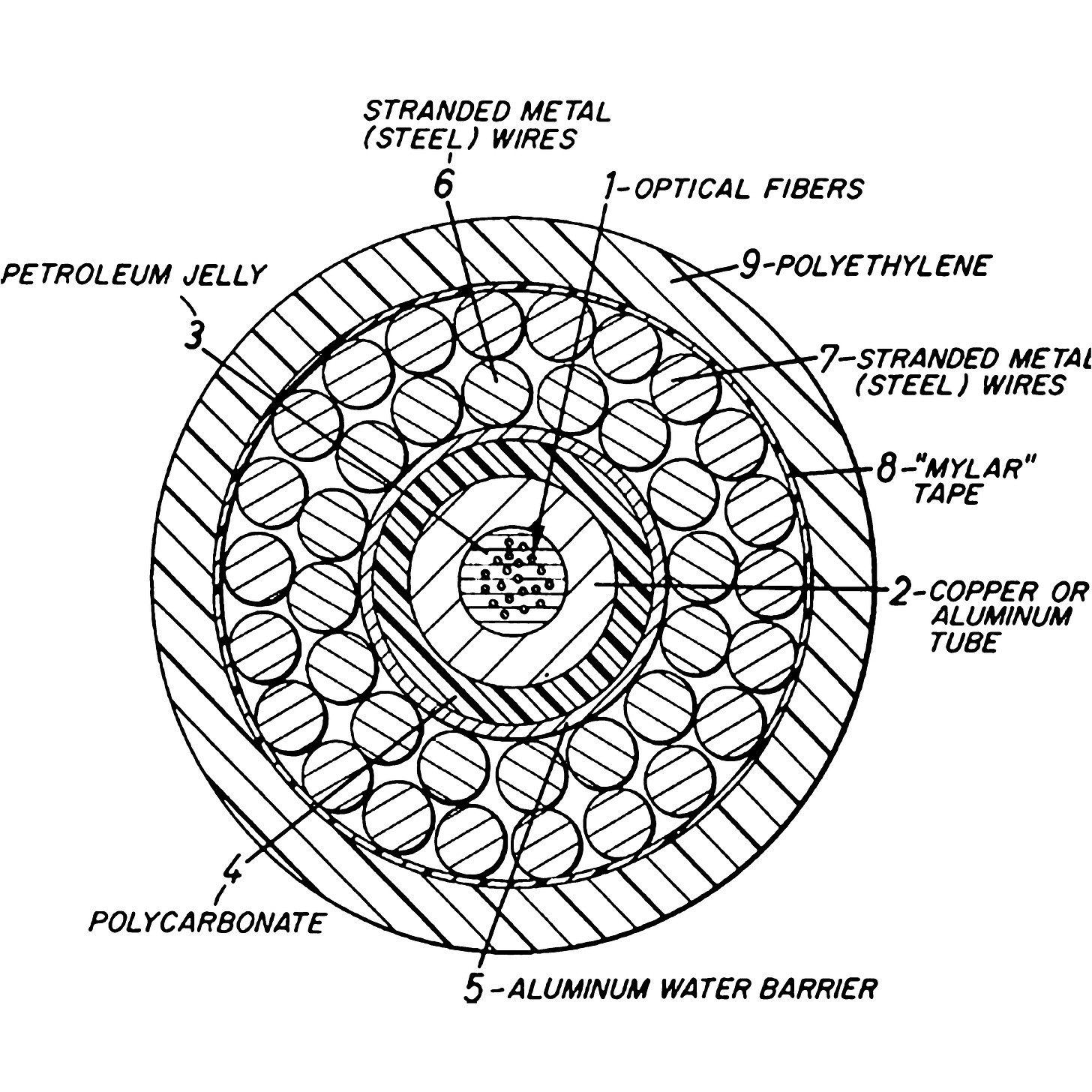
Next, the cable must be prepared for deployment. Each segment can be more than 1,000 km long; the longest continuous cable in operation stretches over 45,000 km from the United Kingdom, around the Cape of Good Hope, and up to the Persian Gulf. The submarine cables in use today are marvels of layered engineering: thin strands of glass fiber-optics coated in a UV-cured acrylic material to prevent bending, bundled together with a copper conductor to enable connectivity. That fiber bundle is then encased in a copper tube to further protect the strands and conduct electricity from a landing station to “repeaters,” the copper components within the cable that amplify signals sent from the landing station along the cable, enabling consistent flows of energy and information. Over that comes a water barrier and polyethylene coating to ensure the cable is dry and secure. For particularly vulnerable routes, where fishing vessels or unforgiving submarine topography raise the risk of damage, such as the Japan-Guam-Australia South Cable and the EAR / Trans-Caribbean Fiber System, some cables receive armoring such as chains or metal shielding.
Just as with terrestrial fiber cables, deployment begins with trenching. But the submarine version is more onerous. First, a crew uses a drilling rig to put the cable in the ground and enable it to extend the cable into the shallow ocean. More modern cables leverage horizontal directional drilling, which allows a pipeline to pass through the coastline, emerging at a predetermined underwater location, through which the cable enters the water. From there, a cable-laying ship equipped with an underwater plow prepares the seabed, followed by a remotely operated vehicle (ROV), controlled by a crewmember, that buries the cable behind it. The depth and length of the burial depend on environmental factors such as local regulations or the potential for disruption by shipping activity. Once in deep water, most cables are simply laid on the seabed.
Once laid, cables can be disrupted and severed, requiring repair crews to retrieve the broken cable and repair it at sea. By international estimates, there are more than 200 cable disruptions requiring repair or replacement every year. The number has been steadily rising, and while many incidents are accidental, the growing scale of Chinese “gray fleets” — vessels operating outside normal regulatory oversight -— and the extensive history of Russian vessels purposefully severing cables mean that intentional disruption is becoming more common. As recently as 2025, a Chinese cargo vessel dropped its anchor six nautical miles offshore, dragging it along the seabed and severing the Taiwan-Penghu No. 3 cable in an act of blatant maritime sabotage.
Cable repair ships are among the most specialized vessels in operation, prepared to respond to cuts or disruptions within 24 to 48 hours — but repairs can take around a month on average, depending on where and when a disruption occurs. The International Cable Protection Committee (ICPC) puts the average cost of a cable repair between $1 million and $3 million. To detect and pinpoint the disruption, crews on land run various tests and analyses to diagnose the break, supported by ROVs to find the exact spot to begin repair.
But before a new cable can be laid, the old one is extricated from the ocean using a grapnel — essentially a grappling hook — that is positioned and dragged along the cable until it hooks and lifts it out of the water. Think of it as a higher-stakes version of an arcade claw game. The damaged portion of the cable is repaired, spliced, reattached, and sent back to its home under the sea.
Cable repair capacity remains a chokepoint in the market and life cycle for submarine cables. According to the ICPC, there are only 63 operational ships capable of laying or replacing cables worldwide. Between 2011 and 2020, only five new ships with this ability were constructed globally. The US government controls one cable repair ship, the USNS Zeus, but has contractual relationships with two more, and access to nine total, thanks to commercial entities based in America or controlled by US entities. China’s shipbuilding capacity dwarfs that of the US by 23,000 percent, measured by annual vessel output, but the country currently controls only six ships capable of laying and repairing cables. If that asymmetry translates into more Chinese ships at sea, the US could find itself dependent on its chief competitor to maintain essential infrastructure. This geopolitical asymmetry is built into the world of submarine cables, connecting the whole world but controlled only by the countries willing to invest in the infrastructure to lay them down and protect them.
Cables and Empire
It is tempting to tell this story as a triumph of private ingenuity — visionary businessmen such as Samuel Morse who bullied the future into existence. Those figures appear in this story, but, from the beginning, submarine cables were entangled with the state. They required diplomatic agreements, naval assistance, public subsidies, imperial logistics, and the conviction that instantaneous communication was worth a ridiculous amount of trouble. And trouble was what they got.
The first attempts at laying a transatlantic submarine cable did not go well. Cyrus W. Field established the Atlantic Telegraph Company in 1856 and promptly convinced the British and American governments to back the project. In exchange for free use of the line, the two governments agreed to provide an annual subsidy for the company and to provide the ships needed to lay the cable. When the USS Niagara and HMS Agamemnon set out carrying 2,500 tons of cable to connect Newfoundland to Ireland, the comedy of errors had already begun.
For one thing, the cable itself was both poorly designed and hurriedly manufactured. After only 350 miles had been laid, it broke and fell to the bottom of the sea. After months spent securing a new cable, the fleet set out again only to weather a ferocious storm before the cable snapped three more times, forcing them back to Ireland to reprovision. When the cable finally connected Newfoundland to Valentia Bay in 1858, it was met with enormous fanfare. Queen Victoria sent the first transatlantic telegraph message to President James Buchanan, and the Times compared it to the discovery of the New World. Less than a month later, the cable stopped working.

Operators at the GPO’s Central Telegraph Office in London c. 1898
The man put in charge of the project, Dr. Edward Whitehouse, was sorely out of his depth. Whitehouse’s decision to use high-voltage induction to conduct energy within the cable had burned through the cable’s insulation, rendering it useless. Field and his Atlantic Telegraph Company promptly sacked Whitehouse in favor of an Irish professor of natural philosophy, William Thomson, better known to history as Lord Kelvin. After commissioning the largest ship afloat, reengineering the cable, and enduring a few more failed attempts, Atlantic Telegraph successfully laid the first functional submarine cable in 1866.
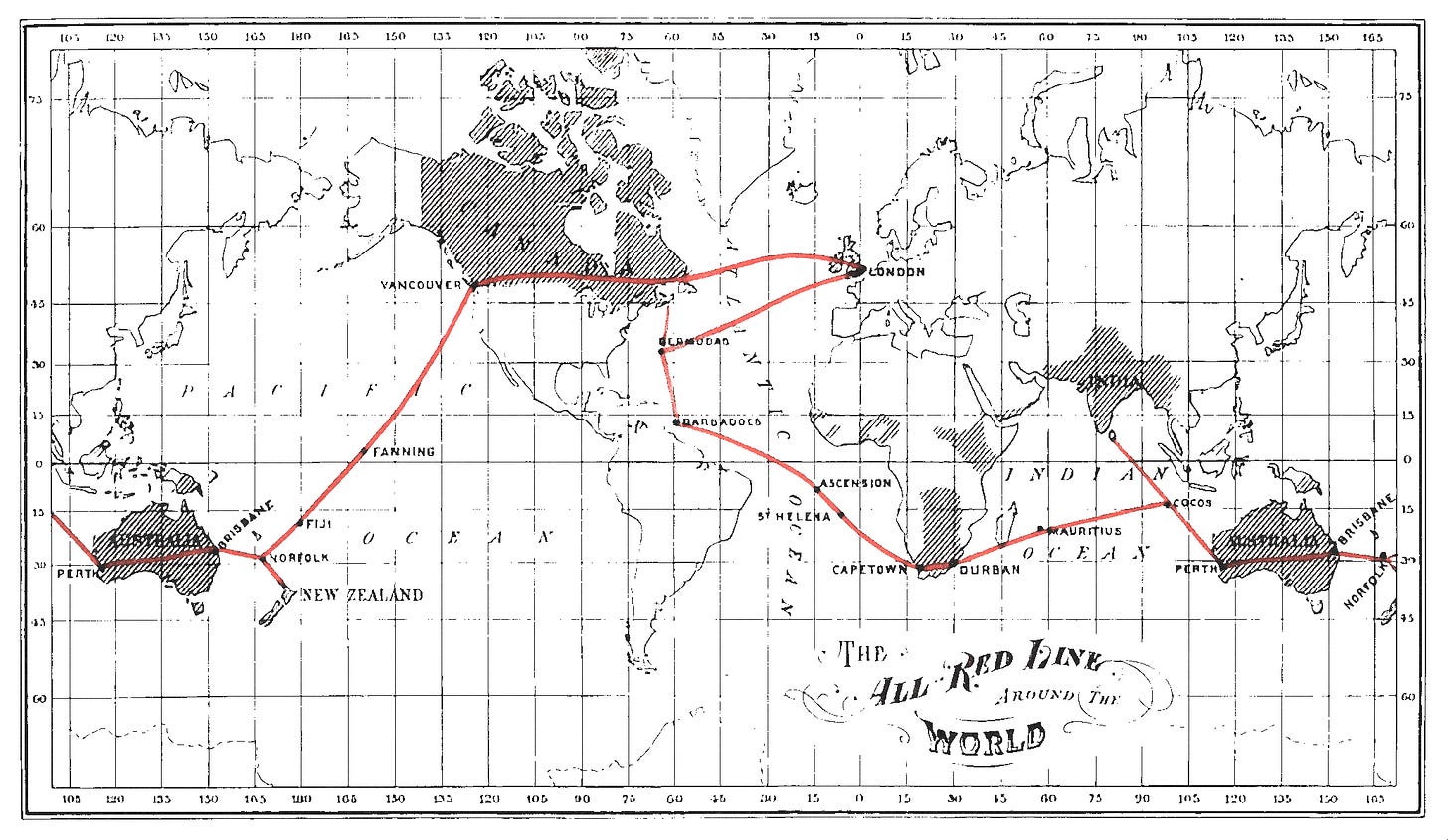
From then on, the operations took on a distinctly imperial character. Governments subsidized the firms to build them, navies protected them, post offices administered them, and imperial planners obsessed over their routes. Great Britain recognized the political and strategic value of cables. A telegraph cable, the earliest iteration of submarine cables, laid on the seabed, could bind colonies to the metropole more tightly than a governor’s speech or a frigate in the harbor ever could. By 1902, the British had completed the “All-Red Line,” a cable network stitched across imperial possessions so that messages could travel around the world while touching as little foreign territory as possible, denying colonial competitors any leverage over information flows. It was communications policy as statecraft.
Steam-powered empires ruled by telegraph. For nearly one hundred years after the British East India Company took control of India, dispatches from London to the subcontinent took around 10 weeks round trip, leaving senior British officials with a great deal of practical autonomy. As a result, when the Revolt of 1857 broke out north of Delhi, Governor General Charles Canning had to gather reinforcements, redirect troops (including a detachment of British regulars on their way to China), and manage the revolt before metropolitan oversight could meaningfully catch up. While some, including close associates, questioned whether Canning was up to the task, his deft handling of the revolt earned him the moniker “Clemency Canning” and the faith of both Parliament and the Crown. When ordered to preside over the reorganization of British rule in India, Canning was guided by the Indian Councils Act of 1861 and orders from Whitehouse, but was given plenty of room to act first and explain later.
That model of governance, which encouraged independent action by prudent, autonomous leaders, did not survive the arrival of the telegraph. Britain completed several overland and submarine telegraph cables connecting London and Calcutta between 1868 and 1870. The Suez Canal was completed around the same time, which allowed for greater commercial operations and communications between London and its colonial jewel. The combination dramatically shortened the feedback loop of colonial governance.
By the outbreak of the Second Afghan War in 1878, India’s frontier policy was orchestrated and conducted through rapid telegrams. Parliamentary records from this period reflect a very different tenor in the metropole’s oversight than during the Revolt of 1857. For example, in one exchange dated December 6, 1878, less than two weeks after the British invasion of Afghanistan, Lord Robert Montagu questioned the Chancellor of the Exchequer about a relatively minor discrepancy between the telegram dispatches — wired via submarine cables — of Lord Lytton, Major Cavagnari, and Sir Neville Chamberlain (not that one).
The cable solved coordination problems but quickly introduced a new vulnerability for statesmen and industrialists. A cable is miraculous right up until the moment it breaks. Then it becomes a very long, very expensive piece of damp string. For example, the 1859 failure of a cable built through the Red Sea and Arabian Sea to connect London and Karachi left both Whitehouse and Lord Canning bewildered amid the chaos of governmental reorganization. The cable fell victim to the rough environment within the Red Sea and was subsequently abandoned in favor of alternative over-land routes in the short run, and better engineering over the long-term.
The romance of the cable age was always shadowed by the less glamorous business of maintenance. While we remember the funders and boosters, the true heroes of submarine communications are the cable ships and their crews. Deployment and maintenance required charts, depots, shore stations, legal protections, trained crews, and standing arrangements for repair. In other words, they required institutions, a vast and unglamorous apparatus that made the miracle possible.
The state was the guarantor of the cables. Even when nominal ownership was mixed or private, the world’s submarine cables depended on government guarantees, government ships, government monopolies, and the kind of bureaucratic patience that can afford to think in decades. You could not build a global cable system the way one builds a fashionable app — licensing, laying rights, and the sheer upfront costs of construction and operation demanded something more patient than venture capital. You needed a navy. By the mid-twentieth century, the technology changed, but the political economy remained stable, and the role of the state persisted in planning, funding, and operating the infrastructure. The first transatlantic telephone cable, TAT-1, entered service in 1956 as a joint venture among New York-based AT&T, the British General Post Office, and the Canadian Overseas Telecommunications Corporation. TAT-1 inaugurated the modern era of reliable undersea voice communications, using coaxial cable, submerged repeaters, and an engineering standard that set the benchmark for the industry.
The remarkable thing is how long this clubby order endured. For decades, submarine cables were the domain of regulated monopolies and state-linked carriers, usually justified in the language of national interest rather than entrepreneurial disruption. Even as the internet took hold at the end of the 20th century, the network beneath the waves retained this old-regime flavor. The early internet, after all, began as a government project. The digital future was born, once again, in a world of public money, research institutions, and strategic priorities. The frontier mythology came later.
Long before Silicon Valley began speaking in the airy language of frictionless connection and information freedom, there were men trying to fish a broken empire out of the rough waters of the Atlantic. The submarine cable has always been both modern and archaic in this way: a machine for annihilating distance and time that is dependent on ships, sailors, steel, and states to keep the messages flowing.
The New Lords of the Seabed
By the 1990s, the old cable order was beginning to dissolve. The age of state-backed monopolies and national carriers had been broken up, privatized, deregulated, and been thrown into a storm of free(r) markets. Even some of the cables that were built and maintained by the USSR were absorbed by early telecommunications firms in the Russian Federation and upgraded with the help of Western technology and expertise. In the final decade of the century, cables increasingly were laid as privatized, speculative bets on a digital future that appeared to have no ceiling. The new cables were often financed by private consortia made up of telecom firms, carriers, investors, and, later, technology companies whose appetites for bandwidth would have seemed insane to an earlier generation. The state remained in the picture, naturally, but ownership and initiative were shifting. The modern network of cables would be built more like a syndicate than a ministry. Thus the internet, still young enough to feel slightly unserious, arrived at exactly the moment when the legal and financial architecture of global communications was becoming less imperial, less bureaucratic, and far more competitive.
The commercial reality was irresistible. Fiber-optic technology — pioneered by researchers in the UK and the Netherlands and made commercially viable by Robert Maurer, Donald Keck, and Peter Schultz at Corning Glass in New York — made undersea transmission vastly more powerful as internet traffic became a category of traffic unto itself. In the US, partnership between Corning and Bell Labs spurred iterative development of more advanced fiber cores, expanding capacity and reducing signal loss. New routes were laid, landing stations multiplied, and capacity exploded.
There was, for a while, something almost euphoric about this digital gold rush. The 1980s and 1990s produced one of those familiar modern spectacles in which financiers, engineers, and techno-evangelists all convince one another that this time demand really is infinite, and that information itself was the commodity. The dot-com boom led to a frenzy of traffic and cable construction. When the bubble burst, major cable builders and network operators went bankrupt, were forced to reorganize their firms, and in some cases, sell their recently-built networks to other operators. While many companies failed, the cables survived.
But the political constituency of the system changed. The old monopolies gave way to consortia, and the consortia eventually had to make room for a new class of actors altogether: the hyperscalers. As Amazon, Google, Meta, Microsoft, and Oracle expanded into cloud computing, global content delivery, and planetary-scale data storage, they started behaving more like infrastructure owners than like customers of ISPs. At first they bought capacity on other people’s lines. Then they bought more. Then, increasingly, they backed or financed entire systems themselves.
TeleGeography reported in 2025 that aggregate new-construction costs had averaged more than $2 billion annually over the previous nine years, and forecast more than $13 billion in cable investment for systems expected to come online between 2025 and 2027. In February 2025, Meta announced Project Waterworth, a multi-billion-dollar, multi-year system spanning five continents. Google, meanwhile, recently announced three major projects, including America-India Connect, anchored by Google’s five-year, $15 billion AI infrastructure investment in India. In the Americas, the MANTA consortium, composed of private entities, launched in March 2025 to connect Mexico, the United States, Central America, and Latin America with new low-latency routes.
This is one of the strange reversals of our time. We are accustomed to thinking of the internet as a force that dissolved old concentrations of power. In practice, its physical backbone has often moved in the opposite direction. What emerged was not the nationalized order of the cable empires that cyberlibertarians like John Perry Barlow called the “information railroad,” nor the frictionless commons the cypherpunks envisioned. It was a world in which a handful of very large firms, operating alongside carriers and consortia, came to possess extraordinary influence over the routes, capacity, and resilience of global communication. Some cables are wholly owned by a single hyperscaler — Google’s Dunant system, for example, connects the US to France. Others follow a consortium model, like MAREA, backed by Meta and Microsoft, where spare capacity is sold to third-party providers. The network became more distributed in some ways and more concentrated in others — the sort of paradox modern infrastructure tends to embody.
And because the complex system of submarine cables had become easy to ignore to their average beneficiary, its vulnerabilities acquired a new theatrical quality whenever they broke the surface. Thanks to redundancy, a severed cable no longer means the total communications blackout that a Victorian official might have feared. But local shocks can still feel unnervingly medieval. When cables connecting the Channel Islands were accidentally cut in 2016, banking, phone service, and ordinary online life all suddenly shut down — a sharp reminder that islands remain islands, however digital their economies may be.
The new crop of financiers are indeed private entities, but it would be wrong to assume this means that such infrastructure is now bereft of government influence. For any cable that lands on US soil, the owner or consortium must submit documentation to the Federal Communications Commission to comply with the Cable Landing Licensing Act of 1921. The current licensing process requires cable financiers and supporters to submit documentation to the FCC and “Team Telecom” — a cross-government team composed of national security officials to evaluate a project’s funding sources, cable path, environmental permits, equipment components and sources, among other criteria — to ensure cables cannot be used as vectors for foreign influence or sabotage. Financing, planning, and operations are increasingly privately driven, but not without the state’s permission.
Fault Lines
The most obvious problem besetting the world’s digital arteries is that everything is getting bigger. The traffic volumes are bigger, the data centers are bigger, the systems are bigger, the expectations of impact are bigger. That growth is not merely quantitative; it changes the engineering problem itself. Each new system is sold as faster, denser, more efficient, and more indispensable.
There is no easy “build more cables” button that will catch up with the growth. Behind every cable is a chain of dependencies: permits, landing stations, terrestrial backhaul, power equipment, marine surveys, maintenance contracts, spare parts, legal access, political consent. The challenge is building enough capacity without creating a world in which every increment of scale also widens the blast radius when something goes wrong.
Then there is the more unsettling problem: some breaks are not accidents.
Consider the Red Sea. Amid the disorder of the Houthi missiles in the Red Sea, it is one of the places where the submarine cable system is forced to reveal how much of its traffic still passes through narrow gates. What the Suez Canal is for shipping, the Gulf of Aden, Strait of Mandeb, and Red Sea corridor are for internet traffic between Europe and Asia: a chokepoint through which Europe, Asia, and the Gulf remain tied together by a bundle of vulnerable lines.
On February 24, 2024, Asia Africa Europe-1, Europe India Gateway, and SEACOM/Tata TGN-Eurasia suffered faults in the Red Sea. The disruptions were initially linked to the Houthi rebels, who earlier that year had circulated maps and images of submarine cables on Telegram channels. Investigators determined that the Houthis did not cut the cables directly; rather, the cables were damaged by the anchor of the Rubymar cargo ship, which was struck by Houthi missiles. The Rubymar subsequently dragged its anchor across the sea floor before sinking. After the disruption, the three cables were not repaired until July, five months later, with commentators suggesting repair capacity was constrained by the threat of more attacks.
That vulnerability is physical before it is geopolitical. Submarine cables follow the earth as it is, and, more often than not, the best route is also the one most exposed to politics, violence, fishing gear, landslides, and simple bad luck. In the Red Sea, those hazards do not sit neatly apart from one another. That is what made the Houthi-linked disruptions in 2024 so unnerving. Cable damage is one problem, but more importantly, the attacks tested the modern internet’s much-advertised redundancy in one of the least convenient places on earth. The global network could, and largely did, reroute around the trouble. But the episode was a vivid reminder that resilience, the ability for infrastructure to withstand stress, is not the same thing as invulnerability. Redundancy buys time and flexibility. But if enough cables in a narrow corridor are threatened at once, the problem stops looking like an isolated repair job and starts looking like a stress test for the architecture of globalization itself.
And so the geopolitics come back to the conversation. Governments once again began speaking openly about cable security, foreign ownership, surveillance risk, landing rights, and strategic dependence. Security services and legislators rediscovered an interest in who builds repeaters, who operates repair ships, and whose territory hosts key interchanges for data and power. The 21st century, built upon the optimism of the early internet and buoyed by the idea that information should be free, was forced to admit that information has a cost. It also requires a route, a permit, an insurer, a repair crew, and political certainty. Even now, as oil tankers and cruise ships become blockade runners in the Strait of Hormuz, a whole industry of IT and security professionals is monitoring the situation on the seafloor of the Persian Gulf.
This, too, is not entirely new. On August 4, 1914, immediately after Britain transmitted its declaration of war to Kaiser Wilhelm II, His Majesty’s Telegraph Ship (HMTS) Alert was sent into the English Channel to cut German telegraph cables on the seabed. This, one of Britain’s first acts of the war, was intended to force the German military onto radio and other communications systems that Britain could monitor more easily. The result was an unmitigated success, opening the door for the British Admiralty’s codebreaking unit, Room 40, to decrypt and read German naval messages. In fact, the United States’ entry into World War I can be tied directly to the work of the HMTS Alert on that summer’s eve.
When German State Secretary for Foreign Affairs Arthur Zimmermann sent his now-famous telegram in January 1917 proposing that Mexico join Germany in the event of war with the United States, Berlin’s direct links across the Atlantic had already been severed for nearly three years. As a result, the telegram traveled via Washington DC and was relayed onward by the German ambassador there — exactly the kind of detour that gave Britain an opening. Having already tapped many of these lines for surveillance, the British Admiralty easily copied the message and relayed it to Room 40 for decryption while the US Department of State maintained deniability and passed the message along to Mexico as requested. The real brilliance came afterward: Britain had to show the telegram to the Americans without revealing that it was reading diplomatic traffic and cracking German codes, so it masked the true source and let the message emerge under a carefully managed cover story. The result was one of the great intelligence coups of the war.
Perhaps more importantly, Britain’s deep understanding of the strategic significance of submarine cables and codebreaking during World War I set the stage for Bletchley Park and Alan Turing’s team during World War II. Nations understood perfectly well in the telegraph and telephone era that cutting cables could isolate an opponent, degrade communications, and divert traffic onto more favorable routes. What has changed is how appealing such action has become. In an age of gray-zone coercion, deniable sabotage, increasing technical sophistication, and infrastructural pressure below the threshold of open war, submarine cables are temptingly vulnerable. For an adversary, that is an attractive combination.
This leads to the least glamorous and perhaps most important challenge of all: cable repair. The process is costly, time-consuming, and constrained by the limited number of ships that can do the job. This creates a bottleneck with serious downstream consequences: reduced capacity, impeded digital communication, disrupted commercial activity, and sensitive traffic exposed to insecure infrastructure. If several disruptions occur at once, or if a major corridor is hit repeatedly, or if conflict turns one region into a hazardous operating environment, repair starts looking like triage. A small fleet means waiting. Waiting means economic cost, degraded service, nervous governments, and growing uncertainty about what comes next. As the cost of cable disruption — intentional or otherwise — continues to rise, so do opportunities for companies developing sensors and autonomous undersea vehicles to identify threats before they cause disruption or mitigate damage before it becomes physical.
Then politics takes the baton from engineering. A ship and her crew may be ready, but the repair can still stall because access is denied or the operating area becomes too dangerous to enter. It is much easier to damage a cable than to repair one. Which means the cloud still depends, rather embarrassingly, on whether the right ship can get to the right patch of water at the right time with the right permissions.
And yet the better lesson may be the harder one: the system of submarine cables has always survived despite the difficult world it serves. Submarine cables have endured wars, storms, earthquakes, bubbles, busts, and the constant indignity of the sea itself. Their survival has rested on redundancy, improvisation, and the incredible competence of the people who fix things when they break.
The Future in the Deep
It would be easy, after spending so much time with cable cuts, chokepoints, repair ships, and the general malice of geography, to end on a note of anxious realism. But that would miss the larger point. The future toward which submarine cables are carrying us is one of greater economic depth, broader technical possibility, and, if we are wise about it, a more open and resilient information environment. The best thing about this infrastructure is that, when expanded intelligently, it enlarges what society can become. Greater dependency drives demand for greater redundancy — which, in turn, drives interest in defending the digital arteries from clogs and cuts.
This is already visible on the balance sheet. More cables mean more capacity, but capacity is only the beginning. Research from the World Bank has found that when a submarine cable is laid or capacity is expanded, it is associated with a statistically significant decline in internet prices, between 14 and 21 percent per doubling of cable capacity. The World Bank also has found that cable expansion raises the probability of receiving services-sector foreign direct investment. Research published in the American Economic Review surveyed the effect of staggered deployment of submarine cables and additional terrestrial fiber backbone across twelve African nations, finding employment gains ranging from 3.1 to 13.2 percent across the study. It also found that nighttime light density increases 2.4 percent, a proxy for economic activity. The IMF similarly linked submarine scale expansion to increases in total-factor productivity and real per-capita GDP growth. Submarine cables are catalysts for economic growth, no matter where they land.
That matters because the next wave of value will come from enabling the next generation of digital services — globally distributed AI workloads, real-time industrial control across borders, more sophisticated scientific collaboration, and planetary-scale applications — that are only possible with dense, resilient, and high-capacity international networks. Google’s recent cable announcements are striking in part because they say this plainly: the new routes are constructed to support AI and computationally-heavy services that demand a robust physical architecture that spans the world.
This is where the politics of cables becomes especially interesting. In the cable world, more is simply better. More cables mean more routes. More routes mean more diversity. More diversity means fewer brittle chokepoints, less dependence on any one corridor, and greater room to reroute traffic when something fails or someone tries to make it fail. The OECD’s recent work on communications resilience is admirably blunt on this point: “Resilient communication networks are built on the principles of redundancy and diversity.”
A world with more routes and more operators is not a perfectly free world — the US, for example, would still be dependent upon a limited fleet of repair ships and cable networks running through hardware built or maintained by foreign adversaries. Still, it is plainly better than a world in which speech, commerce, and knowledge are forced through a few narrow maritime gates and a handful of vulnerable landing points. If liberal societies care about an open internet, they should care about route diversity with the same seriousness that earlier statesmen cared about sea lanes and coaling stations.
The ongoing cable boom is, at its core, a strategic public good being financed through a messy public-private mix (though, of course, it does benefit the hyperscalers and telecom firms). The government’s job is the unglamorous part: streamlining permits, protecting landing sites, avoiding self-defeating regulatory delays, expanding repair capacity, and supporting diverse routes. Cable security ought to be thought of as economic policy, not a national-security afterthought.
Governments can also follow Chile’s lead with Google, or the European Commission’s more recent example: acting as partners and co-investors when the strategic case for resilience exceeds commercial logic alone. In early 2026, the European Commission amended its digital infrastructure program to allocate €347 million for strategic cable projects, repair capacity, and “smart” cable systems, while the International Telecommunications Union and International Cable Protection Committee have similarly turned cable resilience into a sustained multilateral agenda, encouraging greater international collaboration on cable protection, route diversity, and investment.
There is something genuinely wondrous in the steady expansion of routes, financiers, and the services such infrastructure brings. The ocean, which once divided markets and empires, is becoming ever more densely sewn into the fabric of a common digital life.
If the submarine cable is the hidden architecture of our age, then the task ahead is to build more of it with confidence. Which is why submarine cables retain their peculiar capacity to inspire awe. Every age gets the sublime it deserves. Ours is not only in rockets, reactors, and retatrutide. It is also down there in the dark, where a network of glass threads holds together a planet that prefers not to think about how much it depends on them. The miracle under the sea is not finished. It is still being laid.
Technology
•
The Miracle Under the Sea
1,188,574 miles of submarine cables run across the ocean floor and weave the world together.
Just after dinnertime on December 26, 2006, the seabed off the southern tip of Taiwan suddenly lurched. Eight minutes later, it lurched again. The region had been struck by two major earthquakes that could be felt as far away as Hong Kong. Over the next few hours, coastal Taiwan was so heavily damaged that one of the reactors at the nearby Maanshan Nuclear Power Plant was forced into an emergency shutdown. The event left two people dead and 45 injured. Thankfully, the emergency response was quick. Power was restored within hours, and, by the next day, the cleanup had commenced. What many international commenters failed to realize at the time was that the damage on land was only half the story.
Deep beneath the Luzon Strait, the body of water connecting Taiwan to the northernmost island of the Philippines, a handful of fiber optic submarine cables were severed by the quakes. Within hours of the first tremors, cable operators reported that six of the seven cable systems in that corridor were failing. From the shoreline, nothing looked different. But online, the “cloud” suddenly buckled. International communication and digital activity on Taiwan and its neighboring nations was interrupted. Customers could not withdraw money from banks, traders could not fill orders, airlines could not check in customers.
By the next day, the two largest Chinese telecom companies reported that their capacity to connect users with the US and Europe was down over 90 percent, severely limiting international communications and business activity. Taiwan’s largest internet service provider (ISP), Chunghwa Telecom, lost all connection to Hong Kong and the rest of Southeast Asia, forcing firms to re-route traffic through satellites and alternative cable routes near Singapore. Taiwanese users, along with others across the region, were completely shut out from sites such as Yahoo, MSN, and Hotmail.
While the disruption is most apparent at the edge of the digital network, in this instance landing pages and email servers, it could not be solved by pushing a software update. Fixing this problem would require physical infrastructure: ships. On December 28, repair vessels started to arrive. Behind the scenes, industry investigators discovered that a submarine landslide likely compounded the damage, snapping and displacing cable segments in a way that made recovery slower and more complex than a single clean break.
At Sea.
Subscribe and add Issue 008.
Add both to cart
People who lived in Taiwan and the surrounding region could access the internet within a few days, as operators rerouted traffic across longer paths until the seafloor could be stitched back together. By January 5th, Hong Kong reported that major ISPs were back to “reasonable levels” of service, even before the main cables were fully repaired. The episode’s lesson was startling: the modern internet can bend without breaking. But it still depends on a few slender strands of glass laid across a dark ocean trench — and on the rare ships, and the crews who can sail out, hook the seafloor, and knit the world back together.
What makes this tale so remarkable is that it was essentially invisible to the vast majority of people. You can climb the Hoover Dam, you can ride to the top of the Burj Khalifa, you can gaze in awe at the Hagia Sophia. But you cannot visit the pieces of what has become one of humanity’s greatest engineering achievements, because they lie in silence across continental shelves and abyssal plains, stitched together by repeaters, branching units, and the patience of crews who work with grapnels and ploughs in seas that do not care about your deadline.
You will likely never see these arteries of the global information flow. Maybe you’ll see a nondescript hut near a beach, a manhole cover in the sand, a warning sign on a fence that says “Danger — Buried Cable — Do Not Dig.” Through that unremarkable doorway runs the nervous system of modern life. The markets that open at dawn, the cloud that holds your photos, the calls between presidents, the texts you send without thinking — all of it relies on these cables. The world’s most consequential infrastructure is a bundle of glass fibers under miles of water, doing its work so quietly that we only remember it exists when it breaks.
Submarine Cables 101
For most people, the internet lives somewhere overhead. It is in the ether, the glowing nowhere from which emails emerge and into which tweets vanish. This is, of course, a charming fiction.
The reality is that the modern world is manufactured, dragged, bolted, buried, landed, maintained, and repaired. Submarine cables are one of those pieces of infrastructure that have a science-fictional character. The basic proposition is preposterous enough: take the most advanced communications technology of our age, wrap it in layers of metal and rubber, lower thousands of miles of it into the briny ocean, and trust that civilization can henceforth depend on it. Let us strip away the sci-fi for just a few moments.
As with any infrastructure deployment, the first step is planning where the cable will be laid. Mapping a route requires considerable diligence. There are constraints put upon these cables by man and the nation-state, such as security reviews of partners and financiers, and environmental permitting in and around the landing site. Cable projects span a spectrum of ownership models: a single company, a private consortium, a mixed consortium of private entities and state-backed telecommunications services or utilities, or a fully government-owned and controlled cable.
Then, there are the constraints imposed by the sea itself. Before a route is approved, engineers, oceanographers, and financiers need hydrographic surveys to identify topographical impediments or threats, geophysical surveys to identify hazards or threats on the seabed, and geotechnical investigations to determine the engineering required to secure and protect the cable.
Next, the cable must be prepared for deployment. Each segment can be more than 1,000 km long; the longest continuous cable in operation stretches over 45,000 km from the United Kingdom, around the Cape of Good Hope, and up to the Persian Gulf. The submarine cables in use today are marvels of layered engineering: thin strands of glass fiber-optics coated in a UV-cured acrylic material to prevent bending, bundled together with a copper conductor to enable connectivity. That fiber bundle is then encased in a copper tube to further protect the strands and conduct electricity from a landing station to “repeaters,” the copper components within the cable that amplify signals sent from the landing station along the cable, enabling consistent flows of energy and information. Over that comes a water barrier and polyethylene coating to ensure the cable is dry and secure. For particularly vulnerable routes, where fishing vessels or unforgiving submarine topography raise the risk of damage, such as the Japan-Guam-Australia South Cable and the EAR / Trans-Caribbean Fiber System, some cables receive armoring such as chains or metal shielding.
Just as with terrestrial fiber cables, deployment begins with trenching. But the submarine version is more onerous. First, a crew uses a drilling rig to put the cable in the ground and enable it to extend the cable into the shallow ocean. More modern cables leverage horizontal directional drilling, which allows a pipeline to pass through the coastline, emerging at a predetermined underwater location, through which the cable enters the water. From there, a cable-laying ship equipped with an underwater plow prepares the seabed, followed by a remotely operated vehicle (ROV), controlled by a crewmember, that buries the cable behind it. The depth and length of the burial depend on environmental factors such as local regulations or the potential for disruption by shipping activity. Once in deep water, most cables are simply laid on the seabed.
Once laid, cables can be disrupted and severed, requiring repair crews to retrieve the broken cable and repair it at sea. By international estimates, there are more than 200 cable disruptions requiring repair or replacement every year. The number has been steadily rising, and while many incidents are accidental, the growing scale of Chinese “gray fleets” — vessels operating outside normal regulatory oversight -— and the extensive history of Russian vessels purposefully severing cables mean that intentional disruption is becoming more common. As recently as 2025, a Chinese cargo vessel dropped its anchor six nautical miles offshore, dragging it along the seabed and severing the Taiwan-Penghu No. 3 cable in an act of blatant maritime sabotage.
Cable repair ships are among the most specialized vessels in operation, prepared to respond to cuts or disruptions within 24 to 48 hours — but repairs can take around a month on average, depending on where and when a disruption occurs. The International Cable Protection Committee (ICPC) puts the average cost of a cable repair between $1 million and $3 million. To detect and pinpoint the disruption, crews on land run various tests and analyses to diagnose the break, supported by ROVs to find the exact spot to begin repair.
But before a new cable can be laid, the old one is extricated from the ocean using a grapnel — essentially a grappling hook — that is positioned and dragged along the cable until it hooks and lifts it out of the water. Think of it as a higher-stakes version of an arcade claw game. The damaged portion of the cable is repaired, spliced, reattached, and sent back to its home under the sea.
Cable repair capacity remains a chokepoint in the market and life cycle for submarine cables. According to the ICPC, there are only 63 operational ships capable of laying or replacing cables worldwide. Between 2011 and 2020, only five new ships with this ability were constructed globally. The US government controls one cable repair ship, the USNS Zeus, but has contractual relationships with two more, and access to nine total, thanks to commercial entities based in America or controlled by US entities. China’s shipbuilding capacity dwarfs that of the US by 23,000 percent, measured by annual vessel output, but the country currently controls only six ships capable of laying and repairing cables. If that asymmetry translates into more Chinese ships at sea, the US could find itself dependent on its chief competitor to maintain essential infrastructure. This geopolitical asymmetry is built into the world of submarine cables, connecting the whole world but controlled only by the countries willing to invest in the infrastructure to lay them down and protect them.
Cables and Empire
It is tempting to tell this story as a triumph of private ingenuity — visionary businessmen such as Samuel Morse who bullied the future into existence. Those figures appear in this story, but, from the beginning, submarine cables were entangled with the state. They required diplomatic agreements, naval assistance, public subsidies, imperial logistics, and the conviction that instantaneous communication was worth a ridiculous amount of trouble. And trouble was what they got.
The first attempts at laying a transatlantic submarine cable did not go well. Cyrus W. Field established the Atlantic Telegraph Company in 1856 and promptly convinced the British and American governments to back the project. In exchange for free use of the line, the two governments agreed to provide an annual subsidy for the company and to provide the ships needed to lay the cable. When the USS Niagara and HMS Agamemnon set out carrying 2,500 tons of cable to connect Newfoundland to Ireland, the comedy of errors had already begun.
For one thing, the cable itself was both poorly designed and hurriedly manufactured. After only 350 miles had been laid, it broke and fell to the bottom of the sea. After months spent securing a new cable, the fleet set out again only to weather a ferocious storm before the cable snapped three more times, forcing them back to Ireland to reprovision. When the cable finally connected Newfoundland to Valentia Bay in 1858, it was met with enormous fanfare. Queen Victoria sent the first transatlantic telegraph message to President James Buchanan, and the Times compared it to the discovery of the New World. Less than a month later, the cable stopped working.
Operators at the GPO’s Central Telegraph Office in London c. 1898
The man put in charge of the project, Dr. Edward Whitehouse, was sorely out of his depth. Whitehouse’s decision to use high-voltage induction to conduct energy within the cable had burned through the cable’s insulation, rendering it useless. Field and his Atlantic Telegraph Company promptly sacked Whitehouse in favor of an Irish professor of natural philosophy, William Thomson, better known to history as Lord Kelvin. After commissioning the largest ship afloat, reengineering the cable, and enduring a few more failed attempts, Atlantic Telegraph successfully laid the first functional submarine cable in 1866.
From then on, the operations took on a distinctly imperial character. Governments subsidized the firms to build them, navies protected them, post offices administered them, and imperial planners obsessed over their routes. Great Britain recognized the political and strategic value of cables. A telegraph cable, the earliest iteration of submarine cables, laid on the seabed, could bind colonies to the metropole more tightly than a governor’s speech or a frigate in the harbor ever could. By 1902, the British had completed the “All-Red Line,” a cable network stitched across imperial possessions so that messages could travel around the world while touching as little foreign territory as possible, denying colonial competitors any leverage over information flows. It was communications policy as statecraft.
Steam-powered empires ruled by telegraph. For nearly one hundred years after the British East India Company took control of India, dispatches from London to the subcontinent took around 10 weeks round trip, leaving senior British officials with a great deal of practical autonomy. As a result, when the Revolt of 1857 broke out north of Delhi, Governor General Charles Canning had to gather reinforcements, redirect troops (including a detachment of British regulars on their way to China), and manage the revolt before metropolitan oversight could meaningfully catch up. While some, including close associates, questioned whether Canning was up to the task, his deft handling of the revolt earned him the moniker “Clemency Canning” and the faith of both Parliament and the Crown. When ordered to preside over the reorganization of British rule in India, Canning was guided by the Indian Councils Act of 1861 and orders from Whitehouse, but was given plenty of room to act first and explain later.
That model of governance, which encouraged independent action by prudent, autonomous leaders, did not survive the arrival of the telegraph. Britain completed several overland and submarine telegraph cables connecting London and Calcutta between 1868 and 1870. The Suez Canal was completed around the same time, which allowed for greater commercial operations and communications between London and its colonial jewel. The combination dramatically shortened the feedback loop of colonial governance.
By the outbreak of the Second Afghan War in 1878, India’s frontier policy was orchestrated and conducted through rapid telegrams. Parliamentary records from this period reflect a very different tenor in the metropole’s oversight than during the Revolt of 1857. For example, in one exchange dated December 6, 1878, less than two weeks after the British invasion of Afghanistan, Lord Robert Montagu questioned the Chancellor of the Exchequer about a relatively minor discrepancy between the telegram dispatches — wired via submarine cables — of Lord Lytton, Major Cavagnari, and Sir Neville Chamberlain (not that one).
The cable solved coordination problems but quickly introduced a new vulnerability for statesmen and industrialists. A cable is miraculous right up until the moment it breaks. Then it becomes a very long, very expensive piece of damp string. For example, the 1859 failure of a cable built through the Red Sea and Arabian Sea to connect London and Karachi left both Whitehouse and Lord Canning bewildered amid the chaos of governmental reorganization. The cable fell victim to the rough environment within the Red Sea and was subsequently abandoned in favor of alternative over-land routes in the short run, and better engineering over the long-term.
The romance of the cable age was always shadowed by the less glamorous business of maintenance. While we remember the funders and boosters, the true heroes of submarine communications are the cable ships and their crews. Deployment and maintenance required charts, depots, shore stations, legal protections, trained crews, and standing arrangements for repair. In other words, they required institutions, a vast and unglamorous apparatus that made the miracle possible.
The state was the guarantor of the cables. Even when nominal ownership was mixed or private, the world’s submarine cables depended on government guarantees, government ships, government monopolies, and the kind of bureaucratic patience that can afford to think in decades. You could not build a global cable system the way one builds a fashionable app — licensing, laying rights, and the sheer upfront costs of construction and operation demanded something more patient than venture capital. You needed a navy. By the mid-twentieth century, the technology changed, but the political economy remained stable, and the role of the state persisted in planning, funding, and operating the infrastructure. The first transatlantic telephone cable, TAT-1, entered service in 1956 as a joint venture among New York-based AT&T, the British General Post Office, and the Canadian Overseas Telecommunications Corporation. TAT-1 inaugurated the modern era of reliable undersea voice communications, using coaxial cable, submerged repeaters, and an engineering standard that set the benchmark for the industry.
The remarkable thing is how long this clubby order endured. For decades, submarine cables were the domain of regulated monopolies and state-linked carriers, usually justified in the language of national interest rather than entrepreneurial disruption. Even as the internet took hold at the end of the 20th century, the network beneath the waves retained this old-regime flavor. The early internet, after all, began as a government project. The digital future was born, once again, in a world of public money, research institutions, and strategic priorities. The frontier mythology came later.
Long before Silicon Valley began speaking in the airy language of frictionless connection and information freedom, there were men trying to fish a broken empire out of the rough waters of the Atlantic. The submarine cable has always been both modern and archaic in this way: a machine for annihilating distance and time that is dependent on ships, sailors, steel, and states to keep the messages flowing.
The New Lords of the Seabed
By the 1990s, the old cable order was beginning to dissolve. The age of state-backed monopolies and national carriers had been broken up, privatized, deregulated, and been thrown into a storm of free(r) markets. Even some of the cables that were built and maintained by the USSR were absorbed by early telecommunications firms in the Russian Federation and upgraded with the help of Western technology and expertise. In the final decade of the century, cables increasingly were laid as privatized, speculative bets on a digital future that appeared to have no ceiling. The new cables were often financed by private consortia made up of telecom firms, carriers, investors, and, later, technology companies whose appetites for bandwidth would have seemed insane to an earlier generation. The state remained in the picture, naturally, but ownership and initiative were shifting. The modern network of cables would be built more like a syndicate than a ministry. Thus the internet, still young enough to feel slightly unserious, arrived at exactly the moment when the legal and financial architecture of global communications was becoming less imperial, less bureaucratic, and far more competitive.
The commercial reality was irresistible. Fiber-optic technology — pioneered by researchers in the UK and the Netherlands and made commercially viable by Robert Maurer, Donald Keck, and Peter Schultz at Corning Glass in New York — made undersea transmission vastly more powerful as internet traffic became a category of traffic unto itself. In the US, partnership between Corning and Bell Labs spurred iterative development of more advanced fiber cores, expanding capacity and reducing signal loss. New routes were laid, landing stations multiplied, and capacity exploded.
There was, for a while, something almost euphoric about this digital gold rush. The 1980s and 1990s produced one of those familiar modern spectacles in which financiers, engineers, and techno-evangelists all convince one another that this time demand really is infinite, and that information itself was the commodity. The dot-com boom led to a frenzy of traffic and cable construction. When the bubble burst, major cable builders and network operators went bankrupt, were forced to reorganize their firms, and in some cases, sell their recently-built networks to other operators. While many companies failed, the cables survived.
But the political constituency of the system changed. The old monopolies gave way to consortia, and the consortia eventually had to make room for a new class of actors altogether: the hyperscalers. As Amazon, Google, Meta, Microsoft, and Oracle expanded into cloud computing, global content delivery, and planetary-scale data storage, they started behaving more like infrastructure owners than like customers of ISPs. At first they bought capacity on other people’s lines. Then they bought more. Then, increasingly, they backed or financed entire systems themselves.
TeleGeography reported in 2025 that aggregate new-construction costs had averaged more than $2 billion annually over the previous nine years, and forecast more than $13 billion in cable investment for systems expected to come online between 2025 and 2027. In February 2025, Meta announced Project Waterworth, a multi-billion-dollar, multi-year system spanning five continents. Google, meanwhile, recently announced three major projects, including America-India Connect, anchored by Google’s five-year, $15 billion AI infrastructure investment in India. In the Americas, the MANTA consortium, composed of private entities, launched in March 2025 to connect Mexico, the United States, Central America, and Latin America with new low-latency routes.
This is one of the strange reversals of our time. We are accustomed to thinking of the internet as a force that dissolved old concentrations of power. In practice, its physical backbone has often moved in the opposite direction. What emerged was not the nationalized order of the cable empires that cyberlibertarians like John Perry Barlow called the “information railroad,” nor the frictionless commons the cypherpunks envisioned. It was a world in which a handful of very large firms, operating alongside carriers and consortia, came to possess extraordinary influence over the routes, capacity, and resilience of global communication. Some cables are wholly owned by a single hyperscaler — Google’s Dunant system, for example, connects the US to France. Others follow a consortium model, like MAREA, backed by Meta and Microsoft, where spare capacity is sold to third-party providers. The network became more distributed in some ways and more concentrated in others — the sort of paradox modern infrastructure tends to embody.
And because the complex system of submarine cables had become easy to ignore to their average beneficiary, its vulnerabilities acquired a new theatrical quality whenever they broke the surface. Thanks to redundancy, a severed cable no longer means the total communications blackout that a Victorian official might have feared. But local shocks can still feel unnervingly medieval. When cables connecting the Channel Islands were accidentally cut in 2016, banking, phone service, and ordinary online life all suddenly shut down — a sharp reminder that islands remain islands, however digital their economies may be.
The new crop of financiers are indeed private entities, but it would be wrong to assume this means that such infrastructure is now bereft of government influence. For any cable that lands on US soil, the owner or consortium must submit documentation to the Federal Communications Commission to comply with the Cable Landing Licensing Act of 1921. The current licensing process requires cable financiers and supporters to submit documentation to the FCC and “Team Telecom” — a cross-government team composed of national security officials to evaluate a project’s funding sources, cable path, environmental permits, equipment components and sources, among other criteria — to ensure cables cannot be used as vectors for foreign influence or sabotage. Financing, planning, and operations are increasingly privately driven, but not without the state’s permission.
Fault Lines
The most obvious problem besetting the world’s digital arteries is that everything is getting bigger. The traffic volumes are bigger, the data centers are bigger, the systems are bigger, the expectations of impact are bigger. That growth is not merely quantitative; it changes the engineering problem itself. Each new system is sold as faster, denser, more efficient, and more indispensable.
There is no easy “build more cables” button that will catch up with the growth. Behind every cable is a chain of dependencies: permits, landing stations, terrestrial backhaul, power equipment, marine surveys, maintenance contracts, spare parts, legal access, political consent. The challenge is building enough capacity without creating a world in which every increment of scale also widens the blast radius when something goes wrong.
Then there is the more unsettling problem: some breaks are not accidents.
Consider the Red Sea. Amid the disorder of the Houthi missiles in the Red Sea, it is one of the places where the submarine cable system is forced to reveal how much of its traffic still passes through narrow gates. What the Suez Canal is for shipping, the Gulf of Aden, Strait of Mandeb, and Red Sea corridor are for internet traffic between Europe and Asia: a chokepoint through which Europe, Asia, and the Gulf remain tied together by a bundle of vulnerable lines.
On February 24, 2024, Asia Africa Europe-1, Europe India Gateway, and SEACOM/Tata TGN-Eurasia suffered faults in the Red Sea. The disruptions were initially linked to the Houthi rebels, who earlier that year had circulated maps and images of submarine cables on Telegram channels. Investigators determined that the Houthis did not cut the cables directly; rather, the cables were damaged by the anchor of the Rubymar cargo ship, which was struck by Houthi missiles. The Rubymar subsequently dragged its anchor across the sea floor before sinking. After the disruption, the three cables were not repaired until July, five months later, with commentators suggesting repair capacity was constrained by the threat of more attacks.
That vulnerability is physical before it is geopolitical. Submarine cables follow the earth as it is, and, more often than not, the best route is also the one most exposed to politics, violence, fishing gear, landslides, and simple bad luck. In the Red Sea, those hazards do not sit neatly apart from one another. That is what made the Houthi-linked disruptions in 2024 so unnerving. Cable damage is one problem, but more importantly, the attacks tested the modern internet’s much-advertised redundancy in one of the least convenient places on earth. The global network could, and largely did, reroute around the trouble. But the episode was a vivid reminder that resilience, the ability for infrastructure to withstand stress, is not the same thing as invulnerability. Redundancy buys time and flexibility. But if enough cables in a narrow corridor are threatened at once, the problem stops looking like an isolated repair job and starts looking like a stress test for the architecture of globalization itself.
And so the geopolitics come back to the conversation. Governments once again began speaking openly about cable security, foreign ownership, surveillance risk, landing rights, and strategic dependence. Security services and legislators rediscovered an interest in who builds repeaters, who operates repair ships, and whose territory hosts key interchanges for data and power. The 21st century, built upon the optimism of the early internet and buoyed by the idea that information should be free, was forced to admit that information has a cost. It also requires a route, a permit, an insurer, a repair crew, and political certainty. Even now, as oil tankers and cruise ships become blockade runners in the Strait of Hormuz, a whole industry of IT and security professionals is monitoring the situation on the seafloor of the Persian Gulf.
This, too, is not entirely new. On August 4, 1914, immediately after Britain transmitted its declaration of war to Kaiser Wilhelm II, His Majesty’s Telegraph Ship (HMTS) Alert was sent into the English Channel to cut German telegraph cables on the seabed. This, one of Britain’s first acts of the war, was intended to force the German military onto radio and other communications systems that Britain could monitor more easily. The result was an unmitigated success, opening the door for the British Admiralty’s codebreaking unit, Room 40, to decrypt and read German naval messages. In fact, the United States’ entry into World War I can be tied directly to the work of the HMTS Alert on that summer’s eve.
When German State Secretary for Foreign Affairs Arthur Zimmermann sent his now-famous telegram in January 1917 proposing that Mexico join Germany in the event of war with the United States, Berlin’s direct links across the Atlantic had already been severed for nearly three years. As a result, the telegram traveled via Washington DC and was relayed onward by the German ambassador there — exactly the kind of detour that gave Britain an opening. Having already tapped many of these lines for surveillance, the British Admiralty easily copied the message and relayed it to Room 40 for decryption while the US Department of State maintained deniability and passed the message along to Mexico as requested. The real brilliance came afterward: Britain had to show the telegram to the Americans without revealing that it was reading diplomatic traffic and cracking German codes, so it masked the true source and let the message emerge under a carefully managed cover story. The result was one of the great intelligence coups of the war.
Perhaps more importantly, Britain’s deep understanding of the strategic significance of submarine cables and codebreaking during World War I set the stage for Bletchley Park and Alan Turing’s team during World War II. Nations understood perfectly well in the telegraph and telephone era that cutting cables could isolate an opponent, degrade communications, and divert traffic onto more favorable routes. What has changed is how appealing such action has become. In an age of gray-zone coercion, deniable sabotage, increasing technical sophistication, and infrastructural pressure below the threshold of open war, submarine cables are temptingly vulnerable. For an adversary, that is an attractive combination.
This leads to the least glamorous and perhaps most important challenge of all: cable repair. The process is costly, time-consuming, and constrained by the limited number of ships that can do the job. This creates a bottleneck with serious downstream consequences: reduced capacity, impeded digital communication, disrupted commercial activity, and sensitive traffic exposed to insecure infrastructure. If several disruptions occur at once, or if a major corridor is hit repeatedly, or if conflict turns one region into a hazardous operating environment, repair starts looking like triage. A small fleet means waiting. Waiting means economic cost, degraded service, nervous governments, and growing uncertainty about what comes next. As the cost of cable disruption — intentional or otherwise — continues to rise, so do opportunities for companies developing sensors and autonomous undersea vehicles to identify threats before they cause disruption or mitigate damage before it becomes physical.
Then politics takes the baton from engineering. A ship and her crew may be ready, but the repair can still stall because access is denied or the operating area becomes too dangerous to enter. It is much easier to damage a cable than to repair one. Which means the cloud still depends, rather embarrassingly, on whether the right ship can get to the right patch of water at the right time with the right permissions.
And yet the better lesson may be the harder one: the system of submarine cables has always survived despite the difficult world it serves. Submarine cables have endured wars, storms, earthquakes, bubbles, busts, and the constant indignity of the sea itself. Their survival has rested on redundancy, improvisation, and the incredible competence of the people who fix things when they break.
The Future in the Deep
It would be easy, after spending so much time with cable cuts, chokepoints, repair ships, and the general malice of geography, to end on a note of anxious realism. But that would miss the larger point. The future toward which submarine cables are carrying us is one of greater economic depth, broader technical possibility, and, if we are wise about it, a more open and resilient information environment. The best thing about this infrastructure is that, when expanded intelligently, it enlarges what society can become. Greater dependency drives demand for greater redundancy — which, in turn, drives interest in defending the digital arteries from clogs and cuts.
This is already visible on the balance sheet. More cables mean more capacity, but capacity is only the beginning. Research from the World Bank has found that when a submarine cable is laid or capacity is expanded, it is associated with a statistically significant decline in internet prices, between 14 and 21 percent per doubling of cable capacity. The World Bank also has found that cable expansion raises the probability of receiving services-sector foreign direct investment. Research published in the American Economic Review surveyed the effect of staggered deployment of submarine cables and additional terrestrial fiber backbone across twelve African nations, finding employment gains ranging from 3.1 to 13.2 percent across the study. It also found that nighttime light density increases 2.4 percent, a proxy for economic activity. The IMF similarly linked submarine scale expansion to increases in total-factor productivity and real per-capita GDP growth. Submarine cables are catalysts for economic growth, no matter where they land.
That matters because the next wave of value will come from enabling the next generation of digital services — globally distributed AI workloads, real-time industrial control across borders, more sophisticated scientific collaboration, and planetary-scale applications — that are only possible with dense, resilient, and high-capacity international networks. Google’s recent cable announcements are striking in part because they say this plainly: the new routes are constructed to support AI and computationally-heavy services that demand a robust physical architecture that spans the world.
This is where the politics of cables becomes especially interesting. In the cable world, more is simply better. More cables mean more routes. More routes mean more diversity. More diversity means fewer brittle chokepoints, less dependence on any one corridor, and greater room to reroute traffic when something fails or someone tries to make it fail. The OECD’s recent work on communications resilience is admirably blunt on this point: “Resilient communication networks are built on the principles of redundancy and diversity.”
A world with more routes and more operators is not a perfectly free world — the US, for example, would still be dependent upon a limited fleet of repair ships and cable networks running through hardware built or maintained by foreign adversaries. Still, it is plainly better than a world in which speech, commerce, and knowledge are forced through a few narrow maritime gates and a handful of vulnerable landing points. If liberal societies care about an open internet, they should care about route diversity with the same seriousness that earlier statesmen cared about sea lanes and coaling stations.
The ongoing cable boom is, at its core, a strategic public good being financed through a messy public-private mix (though, of course, it does benefit the hyperscalers and telecom firms). The government’s job is the unglamorous part: streamlining permits, protecting landing sites, avoiding self-defeating regulatory delays, expanding repair capacity, and supporting diverse routes. Cable security ought to be thought of as economic policy, not a national-security afterthought.
Governments can also follow Chile’s lead with Google, or the European Commission’s more recent example: acting as partners and co-investors when the strategic case for resilience exceeds commercial logic alone. In early 2026, the European Commission amended its digital infrastructure program to allocate €347 million for strategic cable projects, repair capacity, and “smart” cable systems, while the International Telecommunications Union and International Cable Protection Committee have similarly turned cable resilience into a sustained multilateral agenda, encouraging greater international collaboration on cable protection, route diversity, and investment.
There is something genuinely wondrous in the steady expansion of routes, financiers, and the services such infrastructure brings. The ocean, which once divided markets and empires, is becoming ever more densely sewn into the fabric of a common digital life.
If the submarine cable is the hidden architecture of our age, then the task ahead is to build more of it with confidence. Which is why submarine cables retain their peculiar capacity to inspire awe. Every age gets the sublime it deserves. Ours is not only in rockets, reactors, and retatrutide. It is also down there in the dark, where a network of glass threads holds together a planet that prefers not to think about how much it depends on them. The miracle under the sea is not finished. It is still being laid.
Technology
•
The Miracle Under the Sea
1,188,574 miles of submarine cables run across the ocean floor and weave the world together.
Just after dinnertime on December 26, 2006, the seabed off the southern tip of Taiwan suddenly lurched. Eight minutes later, it lurched again. The region had been struck by two major earthquakes that could be felt as far away as Hong Kong. Over the next few hours, coastal Taiwan was so heavily damaged that one of the reactors at the nearby Maanshan Nuclear Power Plant was forced into an emergency shutdown. The event left two people dead and 45 injured. Thankfully, the emergency response was quick. Power was restored within hours, and, by the next day, the cleanup had commenced. What many international commenters failed to realize at the time was that the damage on land was only half the story.
Deep beneath the Luzon Strait, the body of water connecting Taiwan to the northernmost island of the Philippines, a handful of fiber optic submarine cables were severed by the quakes. Within hours of the first tremors, cable operators reported that six of the seven cable systems in that corridor were failing. From the shoreline, nothing looked different. But online, the “cloud” suddenly buckled. International communication and digital activity on Taiwan and its neighboring nations was interrupted. Customers could not withdraw money from banks, traders could not fill orders, airlines could not check in customers.
By the next day, the two largest Chinese telecom companies reported that their capacity to connect users with the US and Europe was down over 90 percent, severely limiting international communications and business activity. Taiwan’s largest internet service provider (ISP), Chunghwa Telecom, lost all connection to Hong Kong and the rest of Southeast Asia, forcing firms to re-route traffic through satellites and alternative cable routes near Singapore. Taiwanese users, along with others across the region, were completely shut out from sites such as Yahoo, MSN, and Hotmail.
While the disruption is most apparent at the edge of the digital network, in this instance landing pages and email servers, it could not be solved by pushing a software update. Fixing this problem would require physical infrastructure: ships. On December 28, repair vessels started to arrive. Behind the scenes, industry investigators discovered that a submarine landslide likely compounded the damage, snapping and displacing cable segments in a way that made recovery slower and more complex than a single clean break.
At Sea.
Subscribe and add Issue 008.
Add both to cart
People who lived in Taiwan and the surrounding region could access the internet within a few days, as operators rerouted traffic across longer paths until the seafloor could be stitched back together. By January 5th, Hong Kong reported that major ISPs were back to “reasonable levels” of service, even before the main cables were fully repaired. The episode’s lesson was startling: the modern internet can bend without breaking. But it still depends on a few slender strands of glass laid across a dark ocean trench — and on the rare ships, and the crews who can sail out, hook the seafloor, and knit the world back together.
What makes this tale so remarkable is that it was essentially invisible to the vast majority of people. You can climb the Hoover Dam, you can ride to the top of the Burj Khalifa, you can gaze in awe at the Hagia Sophia. But you cannot visit the pieces of what has become one of humanity’s greatest engineering achievements, because they lie in silence across continental shelves and abyssal plains, stitched together by repeaters, branching units, and the patience of crews who work with grapnels and ploughs in seas that do not care about your deadline.
You will likely never see these arteries of the global information flow. Maybe you’ll see a nondescript hut near a beach, a manhole cover in the sand, a warning sign on a fence that says “Danger — Buried Cable — Do Not Dig.” Through that unremarkable doorway runs the nervous system of modern life. The markets that open at dawn, the cloud that holds your photos, the calls between presidents, the texts you send without thinking — all of it relies on these cables. The world’s most consequential infrastructure is a bundle of glass fibers under miles of water, doing its work so quietly that we only remember it exists when it breaks.
Submarine Cables 101
For most people, the internet lives somewhere overhead. It is in the ether, the glowing nowhere from which emails emerge and into which tweets vanish. This is, of course, a charming fiction.
The reality is that the modern world is manufactured, dragged, bolted, buried, landed, maintained, and repaired. Submarine cables are one of those pieces of infrastructure that have a science-fictional character. The basic proposition is preposterous enough: take the most advanced communications technology of our age, wrap it in layers of metal and rubber, lower thousands of miles of it into the briny ocean, and trust that civilization can henceforth depend on it. Let us strip away the sci-fi for just a few moments.
As with any infrastructure deployment, the first step is planning where the cable will be laid. Mapping a route requires considerable diligence. There are constraints put upon these cables by man and the nation-state, such as security reviews of partners and financiers, and environmental permitting in and around the landing site. Cable projects span a spectrum of ownership models: a single company, a private consortium, a mixed consortium of private entities and state-backed telecommunications services or utilities, or a fully government-owned and controlled cable.
Then, there are the constraints imposed by the sea itself. Before a route is approved, engineers, oceanographers, and financiers need hydrographic surveys to identify topographical impediments or threats, geophysical surveys to identify hazards or threats on the seabed, and geotechnical investigations to determine the engineering required to secure and protect the cable.
Next, the cable must be prepared for deployment. Each segment can be more than 1,000 km long; the longest continuous cable in operation stretches over 45,000 km from the United Kingdom, around the Cape of Good Hope, and up to the Persian Gulf. The submarine cables in use today are marvels of layered engineering: thin strands of glass fiber-optics coated in a UV-cured acrylic material to prevent bending, bundled together with a copper conductor to enable connectivity. That fiber bundle is then encased in a copper tube to further protect the strands and conduct electricity from a landing station to “repeaters,” the copper components within the cable that amplify signals sent from the landing station along the cable, enabling consistent flows of energy and information. Over that comes a water barrier and polyethylene coating to ensure the cable is dry and secure. For particularly vulnerable routes, where fishing vessels or unforgiving submarine topography raise the risk of damage, such as the Japan-Guam-Australia South Cable and the EAR / Trans-Caribbean Fiber System, some cables receive armoring such as chains or metal shielding.
Just as with terrestrial fiber cables, deployment begins with trenching. But the submarine version is more onerous. First, a crew uses a drilling rig to put the cable in the ground and enable it to extend the cable into the shallow ocean. More modern cables leverage horizontal directional drilling, which allows a pipeline to pass through the coastline, emerging at a predetermined underwater location, through which the cable enters the water. From there, a cable-laying ship equipped with an underwater plow prepares the seabed, followed by a remotely operated vehicle (ROV), controlled by a crewmember, that buries the cable behind it. The depth and length of the burial depend on environmental factors such as local regulations or the potential for disruption by shipping activity. Once in deep water, most cables are simply laid on the seabed.
Once laid, cables can be disrupted and severed, requiring repair crews to retrieve the broken cable and repair it at sea. By international estimates, there are more than 200 cable disruptions requiring repair or replacement every year. The number has been steadily rising, and while many incidents are accidental, the growing scale of Chinese “gray fleets” — vessels operating outside normal regulatory oversight -— and the extensive history of Russian vessels purposefully severing cables mean that intentional disruption is becoming more common. As recently as 2025, a Chinese cargo vessel dropped its anchor six nautical miles offshore, dragging it along the seabed and severing the Taiwan-Penghu No. 3 cable in an act of blatant maritime sabotage.
Cable repair ships are among the most specialized vessels in operation, prepared to respond to cuts or disruptions within 24 to 48 hours — but repairs can take around a month on average, depending on where and when a disruption occurs. The International Cable Protection Committee (ICPC) puts the average cost of a cable repair between $1 million and $3 million. To detect and pinpoint the disruption, crews on land run various tests and analyses to diagnose the break, supported by ROVs to find the exact spot to begin repair.
But before a new cable can be laid, the old one is extricated from the ocean using a grapnel — essentially a grappling hook — that is positioned and dragged along the cable until it hooks and lifts it out of the water. Think of it as a higher-stakes version of an arcade claw game. The damaged portion of the cable is repaired, spliced, reattached, and sent back to its home under the sea.
Cable repair capacity remains a chokepoint in the market and life cycle for submarine cables. According to the ICPC, there are only 63 operational ships capable of laying or replacing cables worldwide. Between 2011 and 2020, only five new ships with this ability were constructed globally. The US government controls one cable repair ship, the USNS Zeus, but has contractual relationships with two more, and access to nine total, thanks to commercial entities based in America or controlled by US entities. China’s shipbuilding capacity dwarfs that of the US by 23,000 percent, measured by annual vessel output, but the country currently controls only six ships capable of laying and repairing cables. If that asymmetry translates into more Chinese ships at sea, the US could find itself dependent on its chief competitor to maintain essential infrastructure. This geopolitical asymmetry is built into the world of submarine cables, connecting the whole world but controlled only by the countries willing to invest in the infrastructure to lay them down and protect them.
Cables and Empire
It is tempting to tell this story as a triumph of private ingenuity — visionary businessmen such as Samuel Morse who bullied the future into existence. Those figures appear in this story, but, from the beginning, submarine cables were entangled with the state. They required diplomatic agreements, naval assistance, public subsidies, imperial logistics, and the conviction that instantaneous communication was worth a ridiculous amount of trouble. And trouble was what they got.
The first attempts at laying a transatlantic submarine cable did not go well. Cyrus W. Field established the Atlantic Telegraph Company in 1856 and promptly convinced the British and American governments to back the project. In exchange for free use of the line, the two governments agreed to provide an annual subsidy for the company and to provide the ships needed to lay the cable. When the USS Niagara and HMS Agamemnon set out carrying 2,500 tons of cable to connect Newfoundland to Ireland, the comedy of errors had already begun.
For one thing, the cable itself was both poorly designed and hurriedly manufactured. After only 350 miles had been laid, it broke and fell to the bottom of the sea. After months spent securing a new cable, the fleet set out again only to weather a ferocious storm before the cable snapped three more times, forcing them back to Ireland to reprovision. When the cable finally connected Newfoundland to Valentia Bay in 1858, it was met with enormous fanfare. Queen Victoria sent the first transatlantic telegraph message to President James Buchanan, and the Times compared it to the discovery of the New World. Less than a month later, the cable stopped working.
Operators at the GPO’s Central Telegraph Office in London c. 1898
The man put in charge of the project, Dr. Edward Whitehouse, was sorely out of his depth. Whitehouse’s decision to use high-voltage induction to conduct energy within the cable had burned through the cable’s insulation, rendering it useless. Field and his Atlantic Telegraph Company promptly sacked Whitehouse in favor of an Irish professor of natural philosophy, William Thomson, better known to history as Lord Kelvin. After commissioning the largest ship afloat, reengineering the cable, and enduring a few more failed attempts, Atlantic Telegraph successfully laid the first functional submarine cable in 1866.
From then on, the operations took on a distinctly imperial character. Governments subsidized the firms to build them, navies protected them, post offices administered them, and imperial planners obsessed over their routes. Great Britain recognized the political and strategic value of cables. A telegraph cable, the earliest iteration of submarine cables, laid on the seabed, could bind colonies to the metropole more tightly than a governor’s speech or a frigate in the harbor ever could. By 1902, the British had completed the “All-Red Line,” a cable network stitched across imperial possessions so that messages could travel around the world while touching as little foreign territory as possible, denying colonial competitors any leverage over information flows. It was communications policy as statecraft.
Steam-powered empires ruled by telegraph. For nearly one hundred years after the British East India Company took control of India, dispatches from London to the subcontinent took around 10 weeks round trip, leaving senior British officials with a great deal of practical autonomy. As a result, when the Revolt of 1857 broke out north of Delhi, Governor General Charles Canning had to gather reinforcements, redirect troops (including a detachment of British regulars on their way to China), and manage the revolt before metropolitan oversight could meaningfully catch up. While some, including close associates, questioned whether Canning was up to the task, his deft handling of the revolt earned him the moniker “Clemency Canning” and the faith of both Parliament and the Crown. When ordered to preside over the reorganization of British rule in India, Canning was guided by the Indian Councils Act of 1861 and orders from Whitehouse, but was given plenty of room to act first and explain later.
That model of governance, which encouraged independent action by prudent, autonomous leaders, did not survive the arrival of the telegraph. Britain completed several overland and submarine telegraph cables connecting London and Calcutta between 1868 and 1870. The Suez Canal was completed around the same time, which allowed for greater commercial operations and communications between London and its colonial jewel. The combination dramatically shortened the feedback loop of colonial governance.
By the outbreak of the Second Afghan War in 1878, India’s frontier policy was orchestrated and conducted through rapid telegrams. Parliamentary records from this period reflect a very different tenor in the metropole’s oversight than during the Revolt of 1857. For example, in one exchange dated December 6, 1878, less than two weeks after the British invasion of Afghanistan, Lord Robert Montagu questioned the Chancellor of the Exchequer about a relatively minor discrepancy between the telegram dispatches — wired via submarine cables — of Lord Lytton, Major Cavagnari, and Sir Neville Chamberlain (not that one).
The cable solved coordination problems but quickly introduced a new vulnerability for statesmen and industrialists. A cable is miraculous right up until the moment it breaks. Then it becomes a very long, very expensive piece of damp string. For example, the 1859 failure of a cable built through the Red Sea and Arabian Sea to connect London and Karachi left both Whitehouse and Lord Canning bewildered amid the chaos of governmental reorganization. The cable fell victim to the rough environment within the Red Sea and was subsequently abandoned in favor of alternative over-land routes in the short run, and better engineering over the long-term.
The romance of the cable age was always shadowed by the less glamorous business of maintenance. While we remember the funders and boosters, the true heroes of submarine communications are the cable ships and their crews. Deployment and maintenance required charts, depots, shore stations, legal protections, trained crews, and standing arrangements for repair. In other words, they required institutions, a vast and unglamorous apparatus that made the miracle possible.
The state was the guarantor of the cables. Even when nominal ownership was mixed or private, the world’s submarine cables depended on government guarantees, government ships, government monopolies, and the kind of bureaucratic patience that can afford to think in decades. You could not build a global cable system the way one builds a fashionable app — licensing, laying rights, and the sheer upfront costs of construction and operation demanded something more patient than venture capital. You needed a navy. By the mid-twentieth century, the technology changed, but the political economy remained stable, and the role of the state persisted in planning, funding, and operating the infrastructure. The first transatlantic telephone cable, TAT-1, entered service in 1956 as a joint venture among New York-based AT&T, the British General Post Office, and the Canadian Overseas Telecommunications Corporation. TAT-1 inaugurated the modern era of reliable undersea voice communications, using coaxial cable, submerged repeaters, and an engineering standard that set the benchmark for the industry.
The remarkable thing is how long this clubby order endured. For decades, submarine cables were the domain of regulated monopolies and state-linked carriers, usually justified in the language of national interest rather than entrepreneurial disruption. Even as the internet took hold at the end of the 20th century, the network beneath the waves retained this old-regime flavor. The early internet, after all, began as a government project. The digital future was born, once again, in a world of public money, research institutions, and strategic priorities. The frontier mythology came later.
Long before Silicon Valley began speaking in the airy language of frictionless connection and information freedom, there were men trying to fish a broken empire out of the rough waters of the Atlantic. The submarine cable has always been both modern and archaic in this way: a machine for annihilating distance and time that is dependent on ships, sailors, steel, and states to keep the messages flowing.
The New Lords of the Seabed
By the 1990s, the old cable order was beginning to dissolve. The age of state-backed monopolies and national carriers had been broken up, privatized, deregulated, and been thrown into a storm of free(r) markets. Even some of the cables that were built and maintained by the USSR were absorbed by early telecommunications firms in the Russian Federation and upgraded with the help of Western technology and expertise. In the final decade of the century, cables increasingly were laid as privatized, speculative bets on a digital future that appeared to have no ceiling. The new cables were often financed by private consortia made up of telecom firms, carriers, investors, and, later, technology companies whose appetites for bandwidth would have seemed insane to an earlier generation. The state remained in the picture, naturally, but ownership and initiative were shifting. The modern network of cables would be built more like a syndicate than a ministry. Thus the internet, still young enough to feel slightly unserious, arrived at exactly the moment when the legal and financial architecture of global communications was becoming less imperial, less bureaucratic, and far more competitive.
The commercial reality was irresistible. Fiber-optic technology — pioneered by researchers in the UK and the Netherlands and made commercially viable by Robert Maurer, Donald Keck, and Peter Schultz at Corning Glass in New York — made undersea transmission vastly more powerful as internet traffic became a category of traffic unto itself. In the US, partnership between Corning and Bell Labs spurred iterative development of more advanced fiber cores, expanding capacity and reducing signal loss. New routes were laid, landing stations multiplied, and capacity exploded.
There was, for a while, something almost euphoric about this digital gold rush. The 1980s and 1990s produced one of those familiar modern spectacles in which financiers, engineers, and techno-evangelists all convince one another that this time demand really is infinite, and that information itself was the commodity. The dot-com boom led to a frenzy of traffic and cable construction. When the bubble burst, major cable builders and network operators went bankrupt, were forced to reorganize their firms, and in some cases, sell their recently-built networks to other operators. While many companies failed, the cables survived.
But the political constituency of the system changed. The old monopolies gave way to consortia, and the consortia eventually had to make room for a new class of actors altogether: the hyperscalers. As Amazon, Google, Meta, Microsoft, and Oracle expanded into cloud computing, global content delivery, and planetary-scale data storage, they started behaving more like infrastructure owners than like customers of ISPs. At first they bought capacity on other people’s lines. Then they bought more. Then, increasingly, they backed or financed entire systems themselves.
TeleGeography reported in 2025 that aggregate new-construction costs had averaged more than $2 billion annually over the previous nine years, and forecast more than $13 billion in cable investment for systems expected to come online between 2025 and 2027. In February 2025, Meta announced Project Waterworth, a multi-billion-dollar, multi-year system spanning five continents. Google, meanwhile, recently announced three major projects, including America-India Connect, anchored by Google’s five-year, $15 billion AI infrastructure investment in India. In the Americas, the MANTA consortium, composed of private entities, launched in March 2025 to connect Mexico, the United States, Central America, and Latin America with new low-latency routes.
This is one of the strange reversals of our time. We are accustomed to thinking of the internet as a force that dissolved old concentrations of power. In practice, its physical backbone has often moved in the opposite direction. What emerged was not the nationalized order of the cable empires that cyberlibertarians like John Perry Barlow called the “information railroad,” nor the frictionless commons the cypherpunks envisioned. It was a world in which a handful of very large firms, operating alongside carriers and consortia, came to possess extraordinary influence over the routes, capacity, and resilience of global communication. Some cables are wholly owned by a single hyperscaler — Google’s Dunant system, for example, connects the US to France. Others follow a consortium model, like MAREA, backed by Meta and Microsoft, where spare capacity is sold to third-party providers. The network became more distributed in some ways and more concentrated in others — the sort of paradox modern infrastructure tends to embody.
And because the complex system of submarine cables had become easy to ignore to their average beneficiary, its vulnerabilities acquired a new theatrical quality whenever they broke the surface. Thanks to redundancy, a severed cable no longer means the total communications blackout that a Victorian official might have feared. But local shocks can still feel unnervingly medieval. When cables connecting the Channel Islands were accidentally cut in 2016, banking, phone service, and ordinary online life all suddenly shut down — a sharp reminder that islands remain islands, however digital their economies may be.
The new crop of financiers are indeed private entities, but it would be wrong to assume this means that such infrastructure is now bereft of government influence. For any cable that lands on US soil, the owner or consortium must submit documentation to the Federal Communications Commission to comply with the Cable Landing Licensing Act of 1921. The current licensing process requires cable financiers and supporters to submit documentation to the FCC and “Team Telecom” — a cross-government team composed of national security officials to evaluate a project’s funding sources, cable path, environmental permits, equipment components and sources, among other criteria — to ensure cables cannot be used as vectors for foreign influence or sabotage. Financing, planning, and operations are increasingly privately driven, but not without the state’s permission.
Fault Lines
The most obvious problem besetting the world’s digital arteries is that everything is getting bigger. The traffic volumes are bigger, the data centers are bigger, the systems are bigger, the expectations of impact are bigger. That growth is not merely quantitative; it changes the engineering problem itself. Each new system is sold as faster, denser, more efficient, and more indispensable.
There is no easy “build more cables” button that will catch up with the growth. Behind every cable is a chain of dependencies: permits, landing stations, terrestrial backhaul, power equipment, marine surveys, maintenance contracts, spare parts, legal access, political consent. The challenge is building enough capacity without creating a world in which every increment of scale also widens the blast radius when something goes wrong.
Then there is the more unsettling problem: some breaks are not accidents.
Consider the Red Sea. Amid the disorder of the Houthi missiles in the Red Sea, it is one of the places where the submarine cable system is forced to reveal how much of its traffic still passes through narrow gates. What the Suez Canal is for shipping, the Gulf of Aden, Strait of Mandeb, and Red Sea corridor are for internet traffic between Europe and Asia: a chokepoint through which Europe, Asia, and the Gulf remain tied together by a bundle of vulnerable lines.
On February 24, 2024, Asia Africa Europe-1, Europe India Gateway, and SEACOM/Tata TGN-Eurasia suffered faults in the Red Sea. The disruptions were initially linked to the Houthi rebels, who earlier that year had circulated maps and images of submarine cables on Telegram channels. Investigators determined that the Houthis did not cut the cables directly; rather, the cables were damaged by the anchor of the Rubymar cargo ship, which was struck by Houthi missiles. The Rubymar subsequently dragged its anchor across the sea floor before sinking. After the disruption, the three cables were not repaired until July, five months later, with commentators suggesting repair capacity was constrained by the threat of more attacks.
That vulnerability is physical before it is geopolitical. Submarine cables follow the earth as it is, and, more often than not, the best route is also the one most exposed to politics, violence, fishing gear, landslides, and simple bad luck. In the Red Sea, those hazards do not sit neatly apart from one another. That is what made the Houthi-linked disruptions in 2024 so unnerving. Cable damage is one problem, but more importantly, the attacks tested the modern internet’s much-advertised redundancy in one of the least convenient places on earth. The global network could, and largely did, reroute around the trouble. But the episode was a vivid reminder that resilience, the ability for infrastructure to withstand stress, is not the same thing as invulnerability. Redundancy buys time and flexibility. But if enough cables in a narrow corridor are threatened at once, the problem stops looking like an isolated repair job and starts looking like a stress test for the architecture of globalization itself.
And so the geopolitics come back to the conversation. Governments once again began speaking openly about cable security, foreign ownership, surveillance risk, landing rights, and strategic dependence. Security services and legislators rediscovered an interest in who builds repeaters, who operates repair ships, and whose territory hosts key interchanges for data and power. The 21st century, built upon the optimism of the early internet and buoyed by the idea that information should be free, was forced to admit that information has a cost. It also requires a route, a permit, an insurer, a repair crew, and political certainty. Even now, as oil tankers and cruise ships become blockade runners in the Strait of Hormuz, a whole industry of IT and security professionals is monitoring the situation on the seafloor of the Persian Gulf.
This, too, is not entirely new. On August 4, 1914, immediately after Britain transmitted its declaration of war to Kaiser Wilhelm II, His Majesty’s Telegraph Ship (HMTS) Alert was sent into the English Channel to cut German telegraph cables on the seabed. This, one of Britain’s first acts of the war, was intended to force the German military onto radio and other communications systems that Britain could monitor more easily. The result was an unmitigated success, opening the door for the British Admiralty’s codebreaking unit, Room 40, to decrypt and read German naval messages. In fact, the United States’ entry into World War I can be tied directly to the work of the HMTS Alert on that summer’s eve.
When German State Secretary for Foreign Affairs Arthur Zimmermann sent his now-famous telegram in January 1917 proposing that Mexico join Germany in the event of war with the United States, Berlin’s direct links across the Atlantic had already been severed for nearly three years. As a result, the telegram traveled via Washington DC and was relayed onward by the German ambassador there — exactly the kind of detour that gave Britain an opening. Having already tapped many of these lines for surveillance, the British Admiralty easily copied the message and relayed it to Room 40 for decryption while the US Department of State maintained deniability and passed the message along to Mexico as requested. The real brilliance came afterward: Britain had to show the telegram to the Americans without revealing that it was reading diplomatic traffic and cracking German codes, so it masked the true source and let the message emerge under a carefully managed cover story. The result was one of the great intelligence coups of the war.
Perhaps more importantly, Britain’s deep understanding of the strategic significance of submarine cables and codebreaking during World War I set the stage for Bletchley Park and Alan Turing’s team during World War II. Nations understood perfectly well in the telegraph and telephone era that cutting cables could isolate an opponent, degrade communications, and divert traffic onto more favorable routes. What has changed is how appealing such action has become. In an age of gray-zone coercion, deniable sabotage, increasing technical sophistication, and infrastructural pressure below the threshold of open war, submarine cables are temptingly vulnerable. For an adversary, that is an attractive combination.
This leads to the least glamorous and perhaps most important challenge of all: cable repair. The process is costly, time-consuming, and constrained by the limited number of ships that can do the job. This creates a bottleneck with serious downstream consequences: reduced capacity, impeded digital communication, disrupted commercial activity, and sensitive traffic exposed to insecure infrastructure. If several disruptions occur at once, or if a major corridor is hit repeatedly, or if conflict turns one region into a hazardous operating environment, repair starts looking like triage. A small fleet means waiting. Waiting means economic cost, degraded service, nervous governments, and growing uncertainty about what comes next. As the cost of cable disruption — intentional or otherwise — continues to rise, so do opportunities for companies developing sensors and autonomous undersea vehicles to identify threats before they cause disruption or mitigate damage before it becomes physical.
Then politics takes the baton from engineering. A ship and her crew may be ready, but the repair can still stall because access is denied or the operating area becomes too dangerous to enter. It is much easier to damage a cable than to repair one. Which means the cloud still depends, rather embarrassingly, on whether the right ship can get to the right patch of water at the right time with the right permissions.
And yet the better lesson may be the harder one: the system of submarine cables has always survived despite the difficult world it serves. Submarine cables have endured wars, storms, earthquakes, bubbles, busts, and the constant indignity of the sea itself. Their survival has rested on redundancy, improvisation, and the incredible competence of the people who fix things when they break.
The Future in the Deep
It would be easy, after spending so much time with cable cuts, chokepoints, repair ships, and the general malice of geography, to end on a note of anxious realism. But that would miss the larger point. The future toward which submarine cables are carrying us is one of greater economic depth, broader technical possibility, and, if we are wise about it, a more open and resilient information environment. The best thing about this infrastructure is that, when expanded intelligently, it enlarges what society can become. Greater dependency drives demand for greater redundancy — which, in turn, drives interest in defending the digital arteries from clogs and cuts.
This is already visible on the balance sheet. More cables mean more capacity, but capacity is only the beginning. Research from the World Bank has found that when a submarine cable is laid or capacity is expanded, it is associated with a statistically significant decline in internet prices, between 14 and 21 percent per doubling of cable capacity. The World Bank also has found that cable expansion raises the probability of receiving services-sector foreign direct investment. Research published in the American Economic Review surveyed the effect of staggered deployment of submarine cables and additional terrestrial fiber backbone across twelve African nations, finding employment gains ranging from 3.1 to 13.2 percent across the study. It also found that nighttime light density increases 2.4 percent, a proxy for economic activity. The IMF similarly linked submarine scale expansion to increases in total-factor productivity and real per-capita GDP growth. Submarine cables are catalysts for economic growth, no matter where they land.
That matters because the next wave of value will come from enabling the next generation of digital services — globally distributed AI workloads, real-time industrial control across borders, more sophisticated scientific collaboration, and planetary-scale applications — that are only possible with dense, resilient, and high-capacity international networks. Google’s recent cable announcements are striking in part because they say this plainly: the new routes are constructed to support AI and computationally-heavy services that demand a robust physical architecture that spans the world.
This is where the politics of cables becomes especially interesting. In the cable world, more is simply better. More cables mean more routes. More routes mean more diversity. More diversity means fewer brittle chokepoints, less dependence on any one corridor, and greater room to reroute traffic when something fails or someone tries to make it fail. The OECD’s recent work on communications resilience is admirably blunt on this point: “Resilient communication networks are built on the principles of redundancy and diversity.”
A world with more routes and more operators is not a perfectly free world — the US, for example, would still be dependent upon a limited fleet of repair ships and cable networks running through hardware built or maintained by foreign adversaries. Still, it is plainly better than a world in which speech, commerce, and knowledge are forced through a few narrow maritime gates and a handful of vulnerable landing points. If liberal societies care about an open internet, they should care about route diversity with the same seriousness that earlier statesmen cared about sea lanes and coaling stations.
The ongoing cable boom is, at its core, a strategic public good being financed through a messy public-private mix (though, of course, it does benefit the hyperscalers and telecom firms). The government’s job is the unglamorous part: streamlining permits, protecting landing sites, avoiding self-defeating regulatory delays, expanding repair capacity, and supporting diverse routes. Cable security ought to be thought of as economic policy, not a national-security afterthought.
Governments can also follow Chile’s lead with Google, or the European Commission’s more recent example: acting as partners and co-investors when the strategic case for resilience exceeds commercial logic alone. In early 2026, the European Commission amended its digital infrastructure program to allocate €347 million for strategic cable projects, repair capacity, and “smart” cable systems, while the International Telecommunications Union and International Cable Protection Committee have similarly turned cable resilience into a sustained multilateral agenda, encouraging greater international collaboration on cable protection, route diversity, and investment.
There is something genuinely wondrous in the steady expansion of routes, financiers, and the services such infrastructure brings. The ocean, which once divided markets and empires, is becoming ever more densely sewn into the fabric of a common digital life.
If the submarine cable is the hidden architecture of our age, then the task ahead is to build more of it with confidence. Which is why submarine cables retain their peculiar capacity to inspire awe. Every age gets the sublime it deserves. Ours is not only in rockets, reactors, and retatrutide. It is also down there in the dark, where a network of glass threads holds together a planet that prefers not to think about how much it depends on them. The miracle under the sea is not finished. It is still being laid.
About the Author
Luke Hogg is a Senior Fellow, Technology and Statecraft, at the Foundation for American Innovation. He is on X @LEHogg
• • •
Joshua Levine is the Director of Technology and Statecraft at the Foundation for American Innovation. He is on X @JoshuaTLevine