tt
tt
tt
tt
tt
tt

Technology
•
Blue Stewards
Inside Ulysses, the company building autonomy for the deep.

Written by Irish novelist James Joyce, Ulysses is a landmark work of stream-of-consciousness fiction, a 700-page attempt to elevate a single day in Dublin, Ireland into something mythic.
That idea — of turning life into an epic — carries through to Ulysses, a young company in San Francisco developing autonomous underwater robots. “Ulysses is the Latin for Odyssey,” Will O’Brien tells me, “which is also a maritime quest.” Homer’s Odyssey follows the king of Ithaca, Odysseus, at the end of the Trojan War, on a ten year return voyage across the Mediterranean Sea to his home kingdom, during which he and his crew of roughly 600 men, face the sea and all its perils — natural disasters, monsters, and enchantresses. The name stuck for a few other serendipitous reasons: the first Ulysses office in Dublin was situated between James Joyce’s childhood home and the Museum of Literature Ireland — home to an original copy of Ulysses — with a statue of Joyce in the park across the street. “So, north, south, east, and west was Ulysses.”
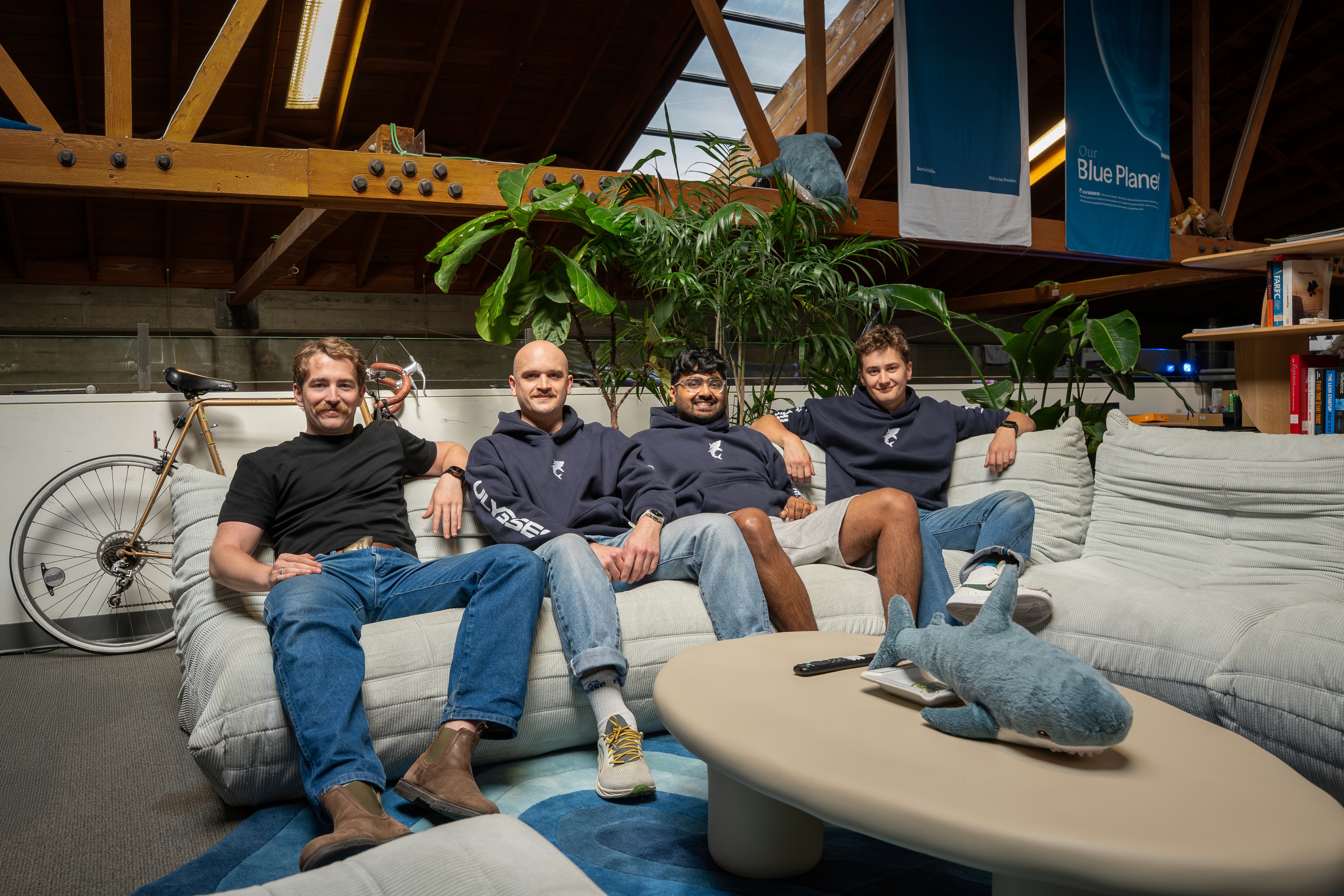
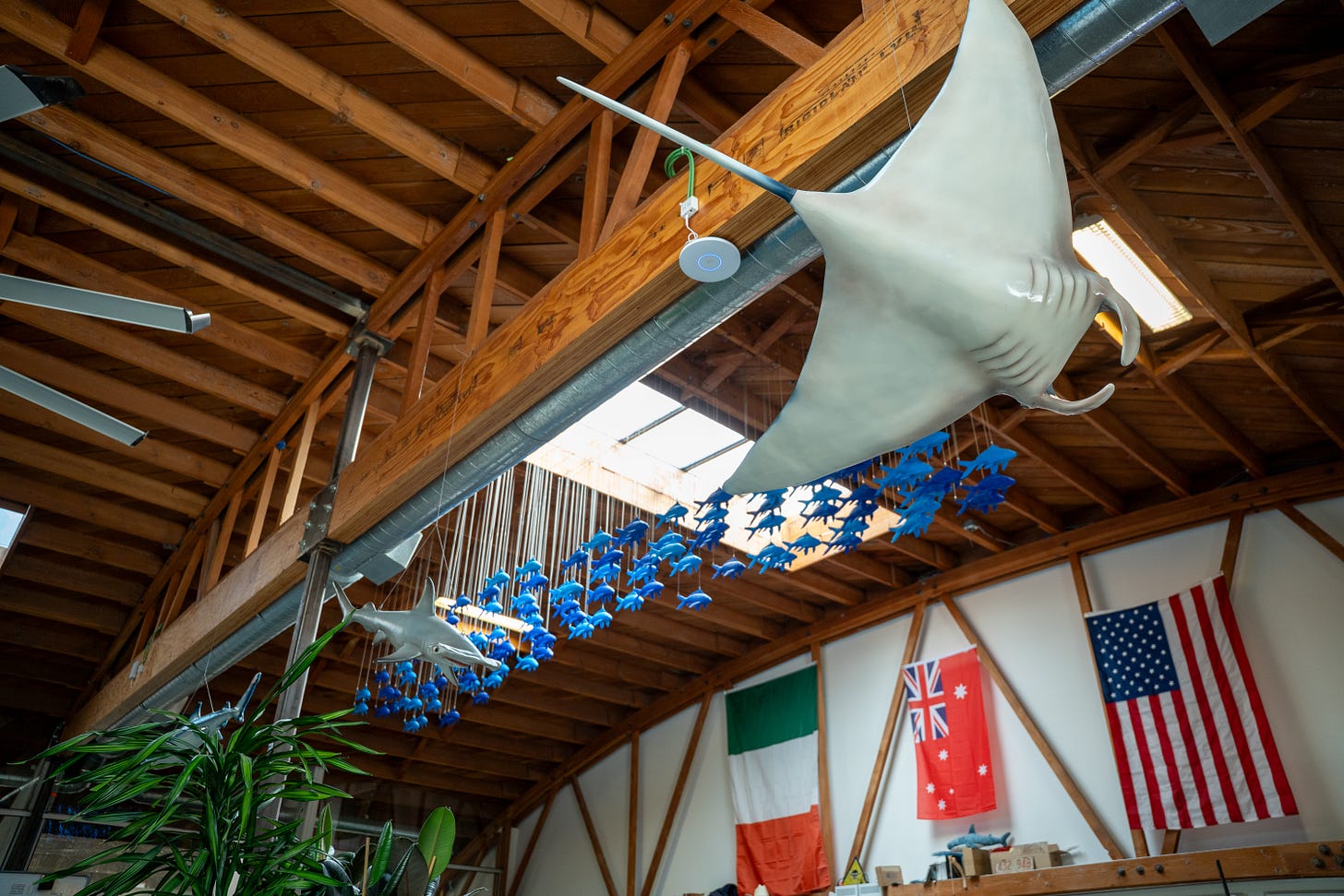
Their current headquarters in the South Beach neighborhood of San Francisco is one of the most colorful offices I’ve ever visited, teeming with life. The color blue runs through everything, and so do sharks: there are sharks on the walls, as stuffed animals on the floor and railings; small ones, medium sized ones, and one big enough to cover the ceiling of the ground floor cafe. There is a bookshelf in the shape of a wave stocked with reading material like Zero to One, textbooks on rocket propulsion and climate policy, and, of course, Ulysses.
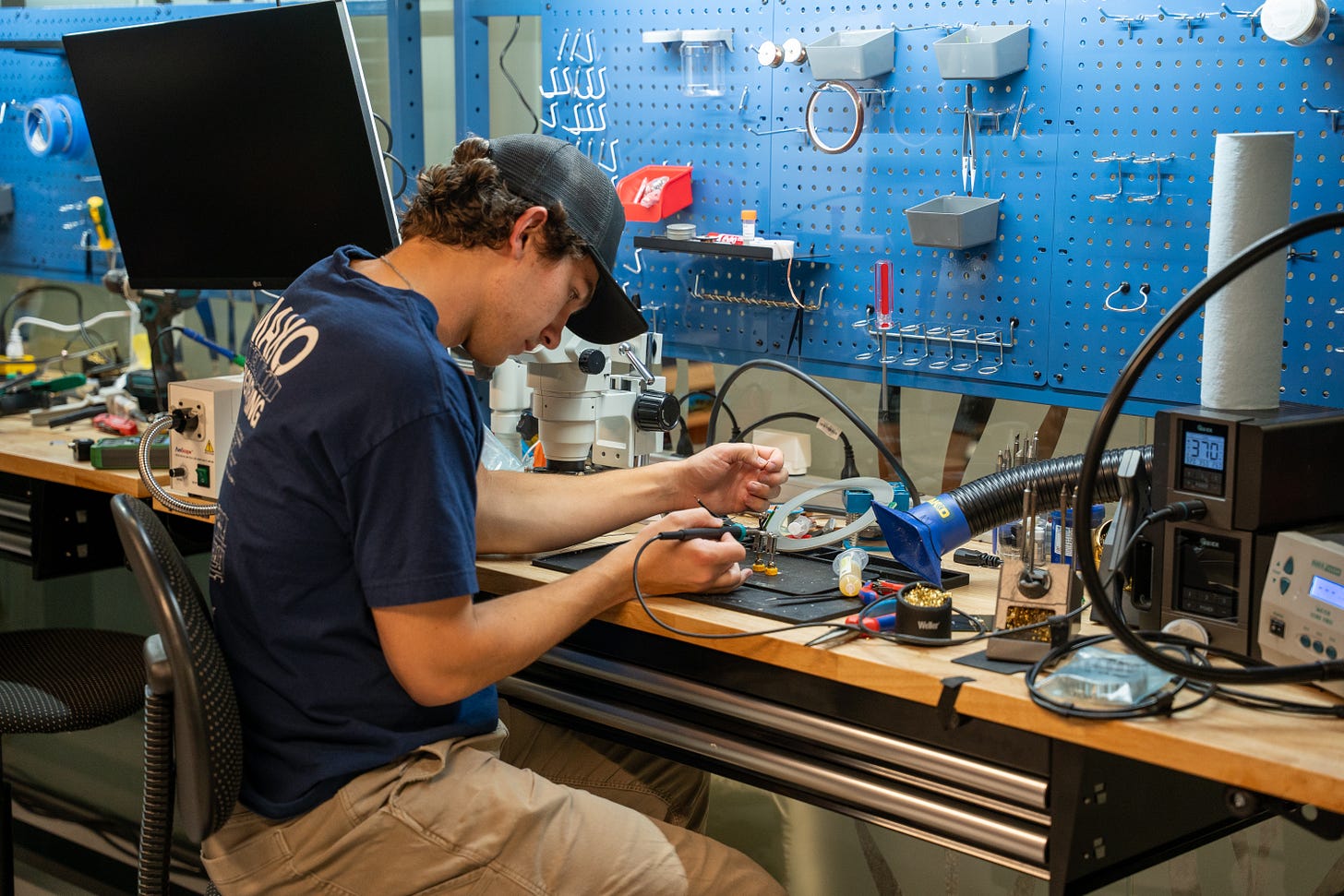
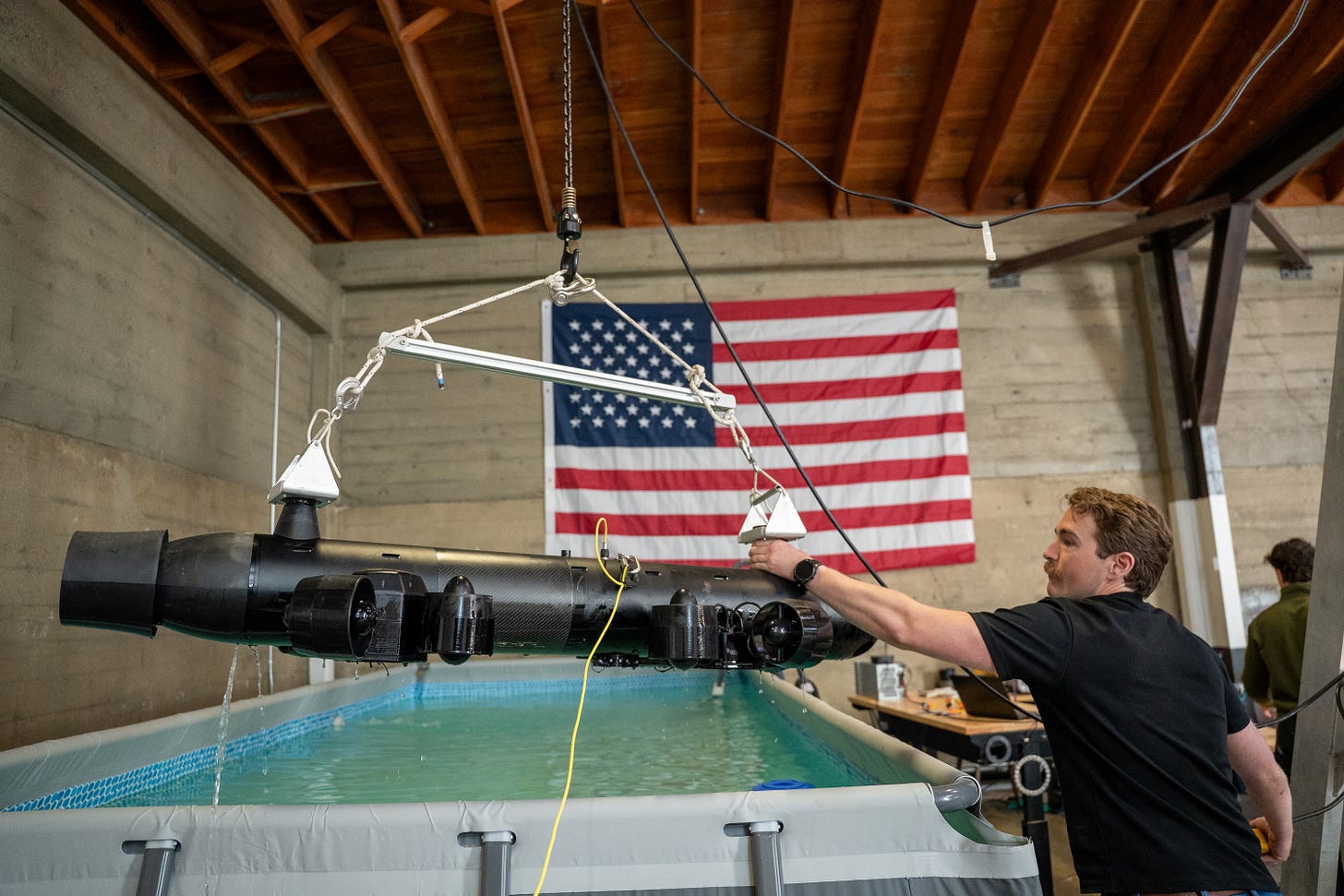
On the ground floor, a fully equipped engineering lab flanks an open space. A map of San Francisco is plastered on the ceiling, ocean motifs adorn the walls and doors, and packed industrial shelves are arranged in rows. To the right opens a door to their 14,000 square foot factory, where you can find an industrial grade inflatable pool set up in front of a massive flag of the US, manufacturing machines with engineers at work, multiple desks, and modules of their hero product in varying stages of development. A Mako is being tested in the pool, with cable attachments to a rugged laptop and a Playstation controller. “You’d be surprised by how much of the world’s GDP depends on Playstation controllers,” Will tells me.


At Sea.
Subscribe and add Issue 008.
Add both to cart
As I sit down with CEO Akhil Voorakkara, he brings me water — in a Guinness glass. “Jamie is the only non-Irish co-founder, he’s from Scotland,” he explains. The four founders — Akhil , President Will O’Brien, CTO Jamie Wedderburn and COO Colm O’Brien (co-founders O’Brien and O’Brien are not related) — founded Ulysses Maritime Technologies in Dublin in the summer of 2023.
“It started with me and Jamie,” Akhil tells me. “We both worked at the same company straight out of college, a drone delivery startup in Ireland called Manna. I was an electronics engineer there and he was a mechanical engineer there. And we had a lot of fun working together until that job wasn’t fun. It got really political and messy.” Akhil ended up in a consulting role at McKinsey and Jamie went back to Scotland to work as an engineer at a space data analytics company called Spire.
“18 months later, we were both pretty bored where we were. And Jamie hits me up out of the blue: ‘I’m thinking about doing a startup.’” The two first entertained the possibility of doing another drone startup, considering their experience and know-how. The idea they settled upon eventually sprang from the complaints of a friend of Jamie’s, a marine biologist, about the cost and manual labor of doing field work in the ocean.
“It’s just pretty hard to do things in the ocean effectively, even on a small scale — let alone on a large scale,” Akhil explains. The friend’s woes were exacerbated by “miserable Scottish weather, having to wade into this intertidal area. Very cold, very wet.” Jamie was perplexed: why were there no tools to do this? Why were a group of 50 human beings going out into the water to perform what he called a “relatively simple task” of seagrass restoration?
Seagrasses are the only flowering marine plants — forming dense fields of long, narrow leaves in shallow coastal waters, resembling terrestrial grasslands — and are crucial to the ocean ecosystem. Seagrass meadows sequester about 10% of the ocean’s carbon and provide a thriving habitat for wildlife, with just one hectare able to sustain around 80,000 fish and 100 million tiny invertebrates. A typical day of fieldwork in seagrass restoration lasts eight to ten hours — marking plots in shallow coastal sites, measuring environmental conditions, manually planting seagrass shoots or scattering seeds, securing them in the sediment while working against tides and murky water, all while documenting the process with photos and water quality samples.
Jamie’s friend’s team were transplanting shoots they had harvested elsewhere to restore their site’s seagrass. “It was really expensive. You’re talking hundreds and thousands of dollars for a hectare, which is a 100th of a square kilometer — which is tiny. And then hundreds of man hours of planning and labor. The economics of it were just insane.” Akhil compared the lack of development in sea stewardship to the efficiency and ease of modern day agricultural farming, which humanity has refined over more than 10,000 years. “We could do drones, but underwater robots are so much cooler.” The other realization was that “there’s no one actually building tools to operate on a massive scale in the ocean,” despite the technology to do so already existing.
The ultimate factor that bolstered Akhil’s faith in the sea robots idea was how each of his future co-founders lit up at the mention of the idea “I’m not crazy, really smart people, people that I respect were also getting excited about it.”
“It was just sufficiently weird,” says Will. Colm, who was working as an Aerodynamics Engineer at Red Bull Racing and was about to join Formula One — “literally a dream job” — was also in.
Akhil was the one who knew each of the boys well before Ulysses came together. He had been friends with Colm since they were 12; Colm’s father ran a coding club for children in Dublin, where both Colm and Akhil later taught. While at Dublin City University, Akhil founded the Irish Student Hyperloop team, and Colm took over as leader in the second year of the project. It was there that they met Will, who reached out asking, “How can I help?”. Jamie and Akhil met later, working together at Manna after graduation. Coincidentally, Will was working in the same office building at the same time at a startup called at Zipp, the first bike sharing app in the UK and Ireland. Akhil then assembled the group. He recalls thinking: “me, Colm, Jamie, Will. We can literally build the ocean company. I’m making the group chat now.”
Jamie and Akhil started 3D printing “contraptions of a robot that couldn’t swim but could operate under water and deposit seagrass seeds,” with Colm working on designs. “It was just pure excitement,” Jamie recalls.
I ask where they sourced the 3D printers from, “I just had them”, answers Akhil. “I’ve had a 3D printer of some form or the other in my bedroom since I was 15.” He ran a small online business while in high school — clients would meet him at local shopping centers with cash in exchange for the trinkets he 3D printed for them. Another project was a small-scale self-driving car experiment, “I 3D printed a bunch of them [small cars], and then I put radio communications in them, so they would talk to each other and drive around the course and not crash into each other. They crashed into each other, but it was really fun.”
As Jamie flew in from Scotland, the boys convened at Will’s apartment in Dublin the next weekend, bringing bags of 3D printed parts to assemble. “There were no tools in the house. Not even a ruler.” So they spent the weekend on their laptops, ironing out non-hardware details. “Will fleshed out the business plan, did customer research, and then Colm and Jamie were scheming on whiteboards. One thing Will did have was a whiteboard.” The next morning they all headed to Akhil’s apartment. “We spent the next day on the living room floor of my house and were just gluing these things together.”
In just a weekend, the robot they had assembled could do the basic job of planting seeds into the ground — they tested and filmed a demo of the rudimentary machine in Dublin Bay’s murky waters. The Ulysses team had gone from an idea to a robot that could pass as autonomous, and they had also proven they worked well together as a team.
Will and Akhil spent the next couple of weeks making a deck, a data room, speaking to customers, and reaching out to investors — including European ones. “The risk appetite in Europe is just not the same as here. The appetite for ambition is nothing compared to here,” Akhil told me, gesturing at San Francisco.
Their dream investor was Lowercarbon Capital. Will met someone at an event who gave them an email address and promptly sent over their pitch deck. Akhil recalls that he received an email with some questions while walking to dinner with his then fiancée, Julia. “I had to stop and was like, ‘I’m gonna go to the car for 20 minutes, and type a response to the email.’” In the first week of September, 2023, they registered Ulysses as a Delaware C-Corp, quit their jobs, and flew to San Francisco. “We landed here on the 15th of September, went back on the 20th of October, and the round was closed.”
Their $2 million pre-seed round was led by Lowercarbon, with participation from Superorganism, Regen Ventures, and angel investors. In their month-long fundraising sprint, Akhil recalled, “we had this prototype and we had this tub filled with water and we were driving around San Francisco. And every time we went over a bump — the road quality is not good here — the water would splash around in the back of this rental car.”
“Our first underwater vehicle, we called it the Mako. What we’re selling today is still the Mako,” Akhil jokes. The name for their first product has stayed the same, but the Mako has evolved into something far more versatile than the Ulysses founders had first anticipated.
Named after a species of shortfin shark known for its agility — small and fast — the Mako is a family of underwater autonomous vehicles built on a modular architecture: each section serves a specific function that can be swapped or extended depending on the mission. The nose cone houses acoustic and visual sensors; the “brain” module contains the compute and software that guides the vehicle. Power comes from a 2kWh battery that can be stacked, and a universal payload connector allows integration of any sensor or robotic tool. Made mainly of aluminum and carbon fiber, the Mako runs without external cables — though users can attach a cable for live viewing if desired. The six-foot-eight vehicle can work for up to 72 hours without surfacing or recharging, dive to 5,000 feet, and carry a 200-pound payload. It can precision plant seagrass, map the seafloor, and monitor and scan underwater habitats. Aided by Ulysses’ technology, the Mako is able to run a data-center class GPU on board. A launch, recovery, and recharge system named Kraken and an autonomous surface mothership called Leviathan are currently under development. The Mako, Akhil says, “punches way above its weight. And it’s also a cool name.”
Ulysses did a million dollars in revenue planting seagrass in their first year, and realized along the way that the Mako could do a lot more; inspect and survey maritime infrastructure — pipelines, telecoms, cables, LNG terminals, ports, and bridges. And, being a robot, it can fix, maintain, and even install said infrastructure.
“We knew how big the opportunity was, but we didn’t know how easy it would be for a product that we were building for one market to serve another market.” Only through doing the field work did the team realize “how similar the attachments are, how similar the robots need to be, and how similar the payloads that needed to be carried. Even the software that runs the robots” — Ulysses’ proprietary software — “that you’d use to go and survey seagrass is the software that can scan the Strait of Hormuz for mines.” Akhil stresses that expanding the scope of the Mako was less about updating the product than discovering the full extent of their market. He explained: “The more time we spent in the water, the further we could see.”
I ask how Ulysses would deploy at the Strait of Hormuz today. (We spoke at the height of the 2026 US-Iran conflict, with the Strait dominating most defense and tech conversations.) Akhil describes today’s systems as fragmented and labor-intensive: “Two people have to put them [machines] in the water, then go out and do a scan, then they review the data, and then send out other vehicles to neutralize the mines.” The method limits coverage to small patches at a time and depends on expensive, aging equipment that “cost millions of dollars apiece.” The Mako, by contrast, can detect and neutralize threats in a single mission at a far lower cost — enabling far greater numbers in the water. Its lightweight design and aluminum hull give it a low acoustic and magnetic signature, allowing it to approach and disable mines while remaining undetected. Autonomous mothership and launch-and-recovery systems mean that the vehicle can remain on station for extended periods, continuously monitoring and responding. The result is a system designed to “see, decide and act” in real time — covering “the whole Strait” rather than of isolated sections patrolled intermittently by high-value assets.
Such a shift in cost and autonomy is what enables a fundamentally different security model for the ocean at large. Even outside of geopolitical flashpoints, “the ocean is like the wild West,” Will explains — piracy, murder on the high seas, illegal fishing. Ulysses’ solution is a dense, distributed presence: the goal is to become “the world’s largest private navy,” with “millions of robots in the world’s oceans keeping them safe, healthy, and prosperous.”
The company now serves commercial and defense customers well beyond its origins in conservation. “Immediately after deciding to branch out from seagrass, we closed a $2 million contract with the California Energy Commission for offshore wind monitoring and maintenance — which is huge,” Akhil recalls. They soon after signed their first contract with the US Navy. Jamie believes Ulysses was well-positioned to meet an increase in the Navy’s demand for high volume surface and subsea platforms — a demand driven largely by the war in Ukraine.
Ulysses designs, manufactures, and writes the software for everything in house. “All the manufacturing is right here in this office — 3D printers, CNC machines, PCB assembly machines. Everything is in house,” Akhil says.
Making their own motors was a recent breakthrough. They were using “semi-custom ones from China,” but ran into problems: “Lead time is terrible, and they’re not actually very good motors,” Jamie explains, with suppliers failing to grasp key requirements like depth sealing. Off-the-shelf alternatives for subsea applications weren’t viable either — they cost “a bajillion dollars” — leaving Ulysses caught between low quality and extremely high cost. Taking the initiative, Ulysses’ 13 engineers whipped up novel prototypes of motors within a few months.
I ask if it’s a lack of bureaucracy that enables this “move fast, create things” culture at Ulysses. “A hundred percent,” Jamie replies. “We exclusively hire engineers that are comfortable with a lot of autonomy and a lot of ownership,” Colm adds. “It’s hard to get motors that are made in America. And it’s even harder to get subsea motors made in America.” They have ordered some from China for inventory — but Ulysses has built their own in the time it is taking for them to arrive.
I ask them why Ulysses was able to produce their own motors, when others haven’t. “It’s not that others can’t, it’s that others won’t,” quips Akhil. “A lot of people are afraid to vertically integrate. Whereas we’re maybe a bit very retarded sometimes: let’s just put it in the water and see what happens.”
“There’s just no other option,” Jamie adds. Will recounts that while fundraising, “a software investor in our seed round started asking questions — ‘Why can’t you just buy it off the shelf? We have this other company that does it like this.’ And I don’t think I’ve ever seen these two guys [pointing to Jamie & Colm] more outraged in their lives.”
“If you’re just resorting to buying everything off the shelf,” Colm says, “skill issue.”
Ulysses is also building their inertial navigation system (INS) in-house, engineering sensors that cost “50x less” without compromising on positional accuracy. This bespoke navigation system gives Mako a “sense of position” when GPS isn’t reliable — as is typical underwater.
“We have a very clear picture of what we want to build now. We started off with this vision of the low cost modular underwater vehicle, the deployment system” — the Mako — “and that was just based on common sense reasoning,” Jamie says. “We invented the tech and now we’ve found that what we’re building is right for the industry. The only thing that keeps me up is that people want to buy it right now. And so we need to build it as quickly as possible. But we need to do it well.”
Today, Ulysses is at their sixth iteration of the Mako, and preparing for first unit sales to defense customers.
After raising their pre-seed in San Francisco, the team headed back to Dublin to develop and build the company while waiting for their US visas. Jamie commuted from Glasgow to Dublin and lived in the office. “We initially thought it would take us six months to get the visa, but it ended up being a year. So I was stuck in this mouldy office for a whole year. It was also tough only getting to see Tilly” — his fiancée — “on the weekends.”
“April 2024,” when the team was still in Dublin, “we got our first employee.” Ulysses brought on Dylan Cannyghin, another childhood friend of Akhil’s, who became the company’s founding engineer.
“And then, one by one, we got our visas sorted, and then it was time to move.” In September 2024, the team made the transition to San Francisco. “Julia and I were planning on getting married, and we had to accelerate the timeline,” Akhil says — Julia eventually had to quit her job at Intel to make the move. Jamie’s fiancée, Tilly, transferred her job at Novotech to the San Francisco office. “Big commitments from everyone.”.
A major customer deployment was awaiting the young company in Australia the following November. The move had been “super disruptive” and when the Ulysses team arrived Down Under, “a lot of stuff just didn’t work.” It was the company’s first stress test — and they were failing it.
“That was deeply traumatic,” Jamie exhales. “The setup in these operations is there’s you and the customer on the boat with your robot. So, there’s no covering up that your robot’s broken. So you’re there scrambling to fix it. You can look in their [the customer’s] eyes and they look disappointed.”
The team was supposed to plant Posidonia, a type of slow-growing seagrass found in Australia and the Mediterranean, during a narrow seasonal window when temperature, growth cycle, and seed viability align. “It was just hubris,” Jamie explains, “We collectively had this delusion; oh, we’re great engineers, and all you’re doing is putting a seed in a tube and pitching into the ground. Must be easy.” What they found was that while they had been perfecting the core mechanics of the Mako, they had neglected system level integration like control, communication, and robustness. Once in the field, failures stacked up: “it just started dissolving, our tether broke, connectors had problems — it was just a shocker.”
The mission failed. Colm explains the mechanics of it: “it had an electrical short and it was shorting against the salt water, essentially started dissolving its own anodization. So its face was melting away. Because of the electricity, we called it Benji — Benjamin Franklin.” The client was angry. And this wasn’t a problem they could iterate around in a week. The next Posidonia seeding window was exactly a year away. “You only really get one shot per year,” explains Colm. It took until April 2025 — months — for the team to recover mentally and spiritually. “We basically overpromised and underdelivered. It was our first reality check,” Akhil explains. But, the entire team agrees, it forced a reckoning: it was only afterwards that the co-founders defined their individual roles and niches within the company. “It was a big reset. As founders, we had a lot of stuff to work through.” Most importantly, they did eventually return to the Australian coast after a year — and succeed, “that was pure redemption,” Jamie says. “Everything worked.”
In May 2025, Ulysses closed an eight million dollar seed round — nearly a year and a half after their pre-seed — moved into a bigger headquarters, and grew from five people to sixteen. A few weeks after these interviews were conducted, Ulysses announced a Series A fundraise of $38 million, led by a16z.
What made the fundraise work, and what has kept Ulysses moving fast, is the balance of the founding team. “We are such a stacked team,” Akhil explains, “It wasn’t one co-founder or two. It was four.” I ask him what each founder excels at. “Will, he could sell sand in a desert. He’s just an incredible communicator. He loves deals, a natural born salesperson.” Will put Ulysses on the map in San Francisco. The company’s December 2025 launch party — the Ulysses Rodeo — made “top holiday events in the Bay Area” lists and offered guests a chance to ride a mechanical shark. In his spare time, he serves on the leadership for the Hamilton Society, a San Francisco debate society that is attended by local parishioners (the debates are hosted at Star of the Sea Church) and tech billionaires alike. Will informed me that he was even invited to the White House for Saint Patrick’s Day.
Jamie and Colm, both mechanical engineers, form Ulysses’ engineering core, “right from the birth of it, the company had so much engineering bandwidth,” Akhil boasts.
I ask the two if it’s challenging to share a skill set on one leadership team. “I think we argue the least,” Jamie says. Colm elaborates: “We get in front of a whiteboard and just scheme something out. And to any observer, it would look like harebrained lines on a chalkboard, completely meaningless. But we understand what’s going on.” Jamie views their engineering work as a form of art — not illustrating an emotion, but making beautiful, perfect systems work. Colm’s definition of perfect is straightforward: “If the thing you’re making doesn’t function in the real world, and can’t function for a fucking long time, and isn’t satisfying to use, then it’s not perfect.”
That philosophy directly shaped Ulysses’ approach to the incumbent underwater vehicle industry, where Jamie believes companies don’t actually build systems — they buy components from different suppliers and assemble them. “All they do is put it in a tube. And have a rat’s nest of cables in it.” Their competitors, he says, put massive markups on aggregated components: “it would cost us a little over $300K — and they retail them for $15 million. That’s just a complete joke.”
Ulysses’ applications are straightforward — seafarming, underwater mine detection, surveillance — answers to problems that have existed for decades. The robots are novel, but conceptually simple and elegant. And yet the work Ulysses has cut out for itself in building and deploying their robots at scale is immense.
From building critical systems in-house to uncovering viable use cases, Ulysses has had to confront a domain that remains largely uncharted.
According to Jamie, the lack of innovation in subsea technology is rooted as much in history and culture as in engineering. During the Cold War, while the Space Race captured public imagination, equally advanced work in the ocean remained hidden: “there was a huge amount of money going into subsea, but it was top secret.” Rockets and fighter jets were visible, celebrated, and aspirational; underwater systems, by contrast, operated in silence, shaping a talent pipeline where “all the best engineers, they graduate college and they want to work at SpaceX,” with very few even considering nuclear subs.
“People used to talk about the undersea domain in the same breath as space,” Will tells me. “In fact, JFK, in the same year that he increased funding for the Apollo programs, he also funded the first undersea habitats — SEALAB I, II, III. There were about 60 of these habitats all around the world. We were sending aquanauts there to live underwater.” Then, months before Armstrong landed on the moon, aquanaut Berry L. Cannon died in a tragic accident while deployed on the SEALAB III. The Vietnam War followed, and funding for ocean exploration faced considerable cuts, leaving the sea a neglected frontier.
The structure of the subsea market reinforced stagnation. Unlike aviation or space, where large commercial demand drives competition and cost reduction, the ocean economy has been dominated by oil, gas, and defense — sectors where, Jamie believes, “they don’t care about cost, all they care about is functionality… and cash.” Incumbents operated with little pressure to innovate, “taking everyone for a ride.” The result is an industry that never developed the same culture of iteration or scale. Now, in Will’s view, that is beginning to shift: advances in autonomy, EV batteries, and satellite connectivity are creating conditions for a new wave of ocean innovation — doing for the sea what SpaceX did for space.
“All the AI stuff,” Will says —“we need more energy, we need more cables, we need more critical minerals. All of these supply chains rest on the ocean, in a very serious way.” His argument is a simple chain: the ocean is going to be an increasingly critical resource this century; robots will do most of the essential work of the future; and companies will build and operate these robots. Put those three together, and the opportunity becomes clear: unlike land-based robotics, which already has many competitors, nobody is building a company to operate robots in the ocean, despite the fact that it covers two-thirds of the planet and underpins much of human civilization, from protein sources to commerce.
“There’s no company like Ulysses. There’s nobody that’s doing commercial, nature and defense. There’s a $100 billion market waiting for us — and we want it all.” Ulysses, then, is a frontier exploration company, one that has chosen the ocean as its primary domain.
Technology
•
Blue Stewards
Inside Ulysses, the company building autonomy for the deep.
Written by Irish novelist James Joyce, Ulysses is a landmark work of stream-of-consciousness fiction, a 700-page attempt to elevate a single day in Dublin, Ireland into something mythic.
That idea — of turning life into an epic — carries through to Ulysses, a young company in San Francisco developing autonomous underwater robots. “Ulysses is the Latin for Odyssey,” Will O’Brien tells me, “which is also a maritime quest.” Homer’s Odyssey follows the king of Ithaca, Odysseus, at the end of the Trojan War, on a ten year return voyage across the Mediterranean Sea to his home kingdom, during which he and his crew of roughly 600 men, face the sea and all its perils — natural disasters, monsters, and enchantresses. The name stuck for a few other serendipitous reasons: the first Ulysses office in Dublin was situated between James Joyce’s childhood home and the Museum of Literature Ireland — home to an original copy of Ulysses — with a statue of Joyce in the park across the street. “So, north, south, east, and west was Ulysses.”
Their current headquarters in the South Beach neighborhood of San Francisco is one of the most colorful offices I’ve ever visited, teeming with life. The color blue runs through everything, and so do sharks: there are sharks on the walls, as stuffed animals on the floor and railings; small ones, medium sized ones, and one big enough to cover the ceiling of the ground floor cafe. There is a bookshelf in the shape of a wave stocked with reading material like Zero to One, textbooks on rocket propulsion and climate policy, and, of course, Ulysses.
On the ground floor, a fully equipped engineering lab flanks an open space. A map of San Francisco is plastered on the ceiling, ocean motifs adorn the walls and doors, and packed industrial shelves are arranged in rows. To the right opens a door to their 14,000 square foot factory, where you can find an industrial grade inflatable pool set up in front of a massive flag of the US, manufacturing machines with engineers at work, multiple desks, and modules of their hero product in varying stages of development. A Mako is being tested in the pool, with cable attachments to a rugged laptop and a Playstation controller. “You’d be surprised by how much of the world’s GDP depends on Playstation controllers,” Will tells me.
At Sea.
Subscribe and add Issue 008.
Add both to cart
As I sit down with CEO Akhil Voorakkara, he brings me water — in a Guinness glass. “Jamie is the only non-Irish co-founder, he’s from Scotland,” he explains. The four founders — Akhil , President Will O’Brien, CTO Jamie Wedderburn and COO Colm O’Brien (co-founders O’Brien and O’Brien are not related) — founded Ulysses Maritime Technologies in Dublin in the summer of 2023.
“It started with me and Jamie,” Akhil tells me. “We both worked at the same company straight out of college, a drone delivery startup in Ireland called Manna. I was an electronics engineer there and he was a mechanical engineer there. And we had a lot of fun working together until that job wasn’t fun. It got really political and messy.” Akhil ended up in a consulting role at McKinsey and Jamie went back to Scotland to work as an engineer at a space data analytics company called Spire.
“18 months later, we were both pretty bored where we were. And Jamie hits me up out of the blue: ‘I’m thinking about doing a startup.’” The two first entertained the possibility of doing another drone startup, considering their experience and know-how. The idea they settled upon eventually sprang from the complaints of a friend of Jamie’s, a marine biologist, about the cost and manual labor of doing field work in the ocean.
“It’s just pretty hard to do things in the ocean effectively, even on a small scale — let alone on a large scale,” Akhil explains. The friend’s woes were exacerbated by “miserable Scottish weather, having to wade into this intertidal area. Very cold, very wet.” Jamie was perplexed: why were there no tools to do this? Why were a group of 50 human beings going out into the water to perform what he called a “relatively simple task” of seagrass restoration?
Seagrasses are the only flowering marine plants — forming dense fields of long, narrow leaves in shallow coastal waters, resembling terrestrial grasslands — and are crucial to the ocean ecosystem. Seagrass meadows sequester about 10% of the ocean’s carbon and provide a thriving habitat for wildlife, with just one hectare able to sustain around 80,000 fish and 100 million tiny invertebrates. A typical day of fieldwork in seagrass restoration lasts eight to ten hours — marking plots in shallow coastal sites, measuring environmental conditions, manually planting seagrass shoots or scattering seeds, securing them in the sediment while working against tides and murky water, all while documenting the process with photos and water quality samples.
Jamie’s friend’s team were transplanting shoots they had harvested elsewhere to restore their site’s seagrass. “It was really expensive. You’re talking hundreds and thousands of dollars for a hectare, which is a 100th of a square kilometer — which is tiny. And then hundreds of man hours of planning and labor. The economics of it were just insane.” Akhil compared the lack of development in sea stewardship to the efficiency and ease of modern day agricultural farming, which humanity has refined over more than 10,000 years. “We could do drones, but underwater robots are so much cooler.” The other realization was that “there’s no one actually building tools to operate on a massive scale in the ocean,” despite the technology to do so already existing.
The ultimate factor that bolstered Akhil’s faith in the sea robots idea was how each of his future co-founders lit up at the mention of the idea “I’m not crazy, really smart people, people that I respect were also getting excited about it.”
“It was just sufficiently weird,” says Will. Colm, who was working as an Aerodynamics Engineer at Red Bull Racing and was about to join Formula One — “literally a dream job” — was also in.
Akhil was the one who knew each of the boys well before Ulysses came together. He had been friends with Colm since they were 12; Colm’s father ran a coding club for children in Dublin, where both Colm and Akhil later taught. While at Dublin City University, Akhil founded the Irish Student Hyperloop team, and Colm took over as leader in the second year of the project. It was there that they met Will, who reached out asking, “How can I help?”. Jamie and Akhil met later, working together at Manna after graduation. Coincidentally, Will was working in the same office building at the same time at a startup called at Zipp, the first bike sharing app in the UK and Ireland. Akhil then assembled the group. He recalls thinking: “me, Colm, Jamie, Will. We can literally build the ocean company. I’m making the group chat now.”
Jamie and Akhil started 3D printing “contraptions of a robot that couldn’t swim but could operate under water and deposit seagrass seeds,” with Colm working on designs. “It was just pure excitement,” Jamie recalls.
I ask where they sourced the 3D printers from, “I just had them”, answers Akhil. “I’ve had a 3D printer of some form or the other in my bedroom since I was 15.” He ran a small online business while in high school — clients would meet him at local shopping centers with cash in exchange for the trinkets he 3D printed for them. Another project was a small-scale self-driving car experiment, “I 3D printed a bunch of them [small cars], and then I put radio communications in them, so they would talk to each other and drive around the course and not crash into each other. They crashed into each other, but it was really fun.”
As Jamie flew in from Scotland, the boys convened at Will’s apartment in Dublin the next weekend, bringing bags of 3D printed parts to assemble. “There were no tools in the house. Not even a ruler.” So they spent the weekend on their laptops, ironing out non-hardware details. “Will fleshed out the business plan, did customer research, and then Colm and Jamie were scheming on whiteboards. One thing Will did have was a whiteboard.” The next morning they all headed to Akhil’s apartment. “We spent the next day on the living room floor of my house and were just gluing these things together.”
In just a weekend, the robot they had assembled could do the basic job of planting seeds into the ground — they tested and filmed a demo of the rudimentary machine in Dublin Bay’s murky waters. The Ulysses team had gone from an idea to a robot that could pass as autonomous, and they had also proven they worked well together as a team.
Will and Akhil spent the next couple of weeks making a deck, a data room, speaking to customers, and reaching out to investors — including European ones. “The risk appetite in Europe is just not the same as here. The appetite for ambition is nothing compared to here,” Akhil told me, gesturing at San Francisco.
Their dream investor was Lowercarbon Capital. Will met someone at an event who gave them an email address and promptly sent over their pitch deck. Akhil recalls that he received an email with some questions while walking to dinner with his then fiancée, Julia. “I had to stop and was like, ‘I’m gonna go to the car for 20 minutes, and type a response to the email.’” In the first week of September, 2023, they registered Ulysses as a Delaware C-Corp, quit their jobs, and flew to San Francisco. “We landed here on the 15th of September, went back on the 20th of October, and the round was closed.”
Their $2 million pre-seed round was led by Lowercarbon, with participation from Superorganism, Regen Ventures, and angel investors. In their month-long fundraising sprint, Akhil recalled, “we had this prototype and we had this tub filled with water and we were driving around San Francisco. And every time we went over a bump — the road quality is not good here — the water would splash around in the back of this rental car.”
“Our first underwater vehicle, we called it the Mako. What we’re selling today is still the Mako,” Akhil jokes. The name for their first product has stayed the same, but the Mako has evolved into something far more versatile than the Ulysses founders had first anticipated.
Named after a species of shortfin shark known for its agility — small and fast — the Mako is a family of underwater autonomous vehicles built on a modular architecture: each section serves a specific function that can be swapped or extended depending on the mission. The nose cone houses acoustic and visual sensors; the “brain” module contains the compute and software that guides the vehicle. Power comes from a 2kWh battery that can be stacked, and a universal payload connector allows integration of any sensor or robotic tool. Made mainly of aluminum and carbon fiber, the Mako runs without external cables — though users can attach a cable for live viewing if desired. The six-foot-eight vehicle can work for up to 72 hours without surfacing or recharging, dive to 5,000 feet, and carry a 200-pound payload. It can precision plant seagrass, map the seafloor, and monitor and scan underwater habitats. Aided by Ulysses’ technology, the Mako is able to run a data-center class GPU on board. A launch, recovery, and recharge system named Kraken and an autonomous surface mothership called Leviathan are currently under development. The Mako, Akhil says, “punches way above its weight. And it’s also a cool name.”
Ulysses did a million dollars in revenue planting seagrass in their first year, and realized along the way that the Mako could do a lot more; inspect and survey maritime infrastructure — pipelines, telecoms, cables, LNG terminals, ports, and bridges. And, being a robot, it can fix, maintain, and even install said infrastructure.
“We knew how big the opportunity was, but we didn’t know how easy it would be for a product that we were building for one market to serve another market.” Only through doing the field work did the team realize “how similar the attachments are, how similar the robots need to be, and how similar the payloads that needed to be carried. Even the software that runs the robots” — Ulysses’ proprietary software — “that you’d use to go and survey seagrass is the software that can scan the Strait of Hormuz for mines.” Akhil stresses that expanding the scope of the Mako was less about updating the product than discovering the full extent of their market. He explained: “The more time we spent in the water, the further we could see.”
I ask how Ulysses would deploy at the Strait of Hormuz today. (We spoke at the height of the 2026 US-Iran conflict, with the Strait dominating most defense and tech conversations.) Akhil describes today’s systems as fragmented and labor-intensive: “Two people have to put them [machines] in the water, then go out and do a scan, then they review the data, and then send out other vehicles to neutralize the mines.” The method limits coverage to small patches at a time and depends on expensive, aging equipment that “cost millions of dollars apiece.” The Mako, by contrast, can detect and neutralize threats in a single mission at a far lower cost — enabling far greater numbers in the water. Its lightweight design and aluminum hull give it a low acoustic and magnetic signature, allowing it to approach and disable mines while remaining undetected. Autonomous mothership and launch-and-recovery systems mean that the vehicle can remain on station for extended periods, continuously monitoring and responding. The result is a system designed to “see, decide and act” in real time — covering “the whole Strait” rather than of isolated sections patrolled intermittently by high-value assets.
Such a shift in cost and autonomy is what enables a fundamentally different security model for the ocean at large. Even outside of geopolitical flashpoints, “the ocean is like the wild West,” Will explains — piracy, murder on the high seas, illegal fishing. Ulysses’ solution is a dense, distributed presence: the goal is to become “the world’s largest private navy,” with “millions of robots in the world’s oceans keeping them safe, healthy, and prosperous.”
The company now serves commercial and defense customers well beyond its origins in conservation. “Immediately after deciding to branch out from seagrass, we closed a $2 million contract with the California Energy Commission for offshore wind monitoring and maintenance — which is huge,” Akhil recalls. They soon after signed their first contract with the US Navy. Jamie believes Ulysses was well-positioned to meet an increase in the Navy’s demand for high volume surface and subsea platforms — a demand driven largely by the war in Ukraine.
Ulysses designs, manufactures, and writes the software for everything in house. “All the manufacturing is right here in this office — 3D printers, CNC machines, PCB assembly machines. Everything is in house,” Akhil says.
Making their own motors was a recent breakthrough. They were using “semi-custom ones from China,” but ran into problems: “Lead time is terrible, and they’re not actually very good motors,” Jamie explains, with suppliers failing to grasp key requirements like depth sealing. Off-the-shelf alternatives for subsea applications weren’t viable either — they cost “a bajillion dollars” — leaving Ulysses caught between low quality and extremely high cost. Taking the initiative, Ulysses’ 13 engineers whipped up novel prototypes of motors within a few months.
I ask if it’s a lack of bureaucracy that enables this “move fast, create things” culture at Ulysses. “A hundred percent,” Jamie replies. “We exclusively hire engineers that are comfortable with a lot of autonomy and a lot of ownership,” Colm adds. “It’s hard to get motors that are made in America. And it’s even harder to get subsea motors made in America.” They have ordered some from China for inventory — but Ulysses has built their own in the time it is taking for them to arrive.
I ask them why Ulysses was able to produce their own motors, when others haven’t. “It’s not that others can’t, it’s that others won’t,” quips Akhil. “A lot of people are afraid to vertically integrate. Whereas we’re maybe a bit very retarded sometimes: let’s just put it in the water and see what happens.”
“There’s just no other option,” Jamie adds. Will recounts that while fundraising, “a software investor in our seed round started asking questions — ‘Why can’t you just buy it off the shelf? We have this other company that does it like this.’ And I don’t think I’ve ever seen these two guys [pointing to Jamie & Colm] more outraged in their lives.”
“If you’re just resorting to buying everything off the shelf,” Colm says, “skill issue.”
Ulysses is also building their inertial navigation system (INS) in-house, engineering sensors that cost “50x less” without compromising on positional accuracy. This bespoke navigation system gives Mako a “sense of position” when GPS isn’t reliable — as is typical underwater.
“We have a very clear picture of what we want to build now. We started off with this vision of the low cost modular underwater vehicle, the deployment system” — the Mako — “and that was just based on common sense reasoning,” Jamie says. “We invented the tech and now we’ve found that what we’re building is right for the industry. The only thing that keeps me up is that people want to buy it right now. And so we need to build it as quickly as possible. But we need to do it well.”
Today, Ulysses is at their sixth iteration of the Mako, and preparing for first unit sales to defense customers.
After raising their pre-seed in San Francisco, the team headed back to Dublin to develop and build the company while waiting for their US visas. Jamie commuted from Glasgow to Dublin and lived in the office. “We initially thought it would take us six months to get the visa, but it ended up being a year. So I was stuck in this mouldy office for a whole year. It was also tough only getting to see Tilly” — his fiancée — “on the weekends.”
“April 2024,” when the team was still in Dublin, “we got our first employee.” Ulysses brought on Dylan Cannyghin, another childhood friend of Akhil’s, who became the company’s founding engineer.
“And then, one by one, we got our visas sorted, and then it was time to move.” In September 2024, the team made the transition to San Francisco. “Julia and I were planning on getting married, and we had to accelerate the timeline,” Akhil says — Julia eventually had to quit her job at Intel to make the move. Jamie’s fiancée, Tilly, transferred her job at Novotech to the San Francisco office. “Big commitments from everyone.”.
A major customer deployment was awaiting the young company in Australia the following November. The move had been “super disruptive” and when the Ulysses team arrived Down Under, “a lot of stuff just didn’t work.” It was the company’s first stress test — and they were failing it.
“That was deeply traumatic,” Jamie exhales. “The setup in these operations is there’s you and the customer on the boat with your robot. So, there’s no covering up that your robot’s broken. So you’re there scrambling to fix it. You can look in their [the customer’s] eyes and they look disappointed.”
The team was supposed to plant Posidonia, a type of slow-growing seagrass found in Australia and the Mediterranean, during a narrow seasonal window when temperature, growth cycle, and seed viability align. “It was just hubris,” Jamie explains, “We collectively had this delusion; oh, we’re great engineers, and all you’re doing is putting a seed in a tube and pitching into the ground. Must be easy.” What they found was that while they had been perfecting the core mechanics of the Mako, they had neglected system level integration like control, communication, and robustness. Once in the field, failures stacked up: “it just started dissolving, our tether broke, connectors had problems — it was just a shocker.”
The mission failed. Colm explains the mechanics of it: “it had an electrical short and it was shorting against the salt water, essentially started dissolving its own anodization. So its face was melting away. Because of the electricity, we called it Benji — Benjamin Franklin.” The client was angry. And this wasn’t a problem they could iterate around in a week. The next Posidonia seeding window was exactly a year away. “You only really get one shot per year,” explains Colm. It took until April 2025 — months — for the team to recover mentally and spiritually. “We basically overpromised and underdelivered. It was our first reality check,” Akhil explains. But, the entire team agrees, it forced a reckoning: it was only afterwards that the co-founders defined their individual roles and niches within the company. “It was a big reset. As founders, we had a lot of stuff to work through.” Most importantly, they did eventually return to the Australian coast after a year — and succeed, “that was pure redemption,” Jamie says. “Everything worked.”
In May 2025, Ulysses closed an eight million dollar seed round — nearly a year and a half after their pre-seed — moved into a bigger headquarters, and grew from five people to sixteen. A few weeks after these interviews were conducted, Ulysses announced a Series A fundraise of $38 million, led by a16z.
What made the fundraise work, and what has kept Ulysses moving fast, is the balance of the founding team. “We are such a stacked team,” Akhil explains, “It wasn’t one co-founder or two. It was four.” I ask him what each founder excels at. “Will, he could sell sand in a desert. He’s just an incredible communicator. He loves deals, a natural born salesperson.” Will put Ulysses on the map in San Francisco. The company’s December 2025 launch party — the Ulysses Rodeo — made “top holiday events in the Bay Area” lists and offered guests a chance to ride a mechanical shark. In his spare time, he serves on the leadership for the Hamilton Society, a San Francisco debate society that is attended by local parishioners (the debates are hosted at Star of the Sea Church) and tech billionaires alike. Will informed me that he was even invited to the White House for Saint Patrick’s Day.
Jamie and Colm, both mechanical engineers, form Ulysses’ engineering core, “right from the birth of it, the company had so much engineering bandwidth,” Akhil boasts.
I ask the two if it’s challenging to share a skill set on one leadership team. “I think we argue the least,” Jamie says. Colm elaborates: “We get in front of a whiteboard and just scheme something out. And to any observer, it would look like harebrained lines on a chalkboard, completely meaningless. But we understand what’s going on.” Jamie views their engineering work as a form of art — not illustrating an emotion, but making beautiful, perfect systems work. Colm’s definition of perfect is straightforward: “If the thing you’re making doesn’t function in the real world, and can’t function for a fucking long time, and isn’t satisfying to use, then it’s not perfect.”
That philosophy directly shaped Ulysses’ approach to the incumbent underwater vehicle industry, where Jamie believes companies don’t actually build systems — they buy components from different suppliers and assemble them. “All they do is put it in a tube. And have a rat’s nest of cables in it.” Their competitors, he says, put massive markups on aggregated components: “it would cost us a little over $300K — and they retail them for $15 million. That’s just a complete joke.”
Ulysses’ applications are straightforward — seafarming, underwater mine detection, surveillance — answers to problems that have existed for decades. The robots are novel, but conceptually simple and elegant. And yet the work Ulysses has cut out for itself in building and deploying their robots at scale is immense.
From building critical systems in-house to uncovering viable use cases, Ulysses has had to confront a domain that remains largely uncharted.
According to Jamie, the lack of innovation in subsea technology is rooted as much in history and culture as in engineering. During the Cold War, while the Space Race captured public imagination, equally advanced work in the ocean remained hidden: “there was a huge amount of money going into subsea, but it was top secret.” Rockets and fighter jets were visible, celebrated, and aspirational; underwater systems, by contrast, operated in silence, shaping a talent pipeline where “all the best engineers, they graduate college and they want to work at SpaceX,” with very few even considering nuclear subs.
“People used to talk about the undersea domain in the same breath as space,” Will tells me. “In fact, JFK, in the same year that he increased funding for the Apollo programs, he also funded the first undersea habitats — SEALAB I, II, III. There were about 60 of these habitats all around the world. We were sending aquanauts there to live underwater.” Then, months before Armstrong landed on the moon, aquanaut Berry L. Cannon died in a tragic accident while deployed on the SEALAB III. The Vietnam War followed, and funding for ocean exploration faced considerable cuts, leaving the sea a neglected frontier.
The structure of the subsea market reinforced stagnation. Unlike aviation or space, where large commercial demand drives competition and cost reduction, the ocean economy has been dominated by oil, gas, and defense — sectors where, Jamie believes, “they don’t care about cost, all they care about is functionality… and cash.” Incumbents operated with little pressure to innovate, “taking everyone for a ride.” The result is an industry that never developed the same culture of iteration or scale. Now, in Will’s view, that is beginning to shift: advances in autonomy, EV batteries, and satellite connectivity are creating conditions for a new wave of ocean innovation — doing for the sea what SpaceX did for space.
“All the AI stuff,” Will says —“we need more energy, we need more cables, we need more critical minerals. All of these supply chains rest on the ocean, in a very serious way.” His argument is a simple chain: the ocean is going to be an increasingly critical resource this century; robots will do most of the essential work of the future; and companies will build and operate these robots. Put those three together, and the opportunity becomes clear: unlike land-based robotics, which already has many competitors, nobody is building a company to operate robots in the ocean, despite the fact that it covers two-thirds of the planet and underpins much of human civilization, from protein sources to commerce.
“There’s no company like Ulysses. There’s nobody that’s doing commercial, nature and defense. There’s a $100 billion market waiting for us — and we want it all.” Ulysses, then, is a frontier exploration company, one that has chosen the ocean as its primary domain.
Technology
•
Blue Stewards
Inside Ulysses, the company building autonomy for the deep.
Written by Irish novelist James Joyce, Ulysses is a landmark work of stream-of-consciousness fiction, a 700-page attempt to elevate a single day in Dublin, Ireland into something mythic.
That idea — of turning life into an epic — carries through to Ulysses, a young company in San Francisco developing autonomous underwater robots. “Ulysses is the Latin for Odyssey,” Will O’Brien tells me, “which is also a maritime quest.” Homer’s Odyssey follows the king of Ithaca, Odysseus, at the end of the Trojan War, on a ten year return voyage across the Mediterranean Sea to his home kingdom, during which he and his crew of roughly 600 men, face the sea and all its perils — natural disasters, monsters, and enchantresses. The name stuck for a few other serendipitous reasons: the first Ulysses office in Dublin was situated between James Joyce’s childhood home and the Museum of Literature Ireland — home to an original copy of Ulysses — with a statue of Joyce in the park across the street. “So, north, south, east, and west was Ulysses.”
Their current headquarters in the South Beach neighborhood of San Francisco is one of the most colorful offices I’ve ever visited, teeming with life. The color blue runs through everything, and so do sharks: there are sharks on the walls, as stuffed animals on the floor and railings; small ones, medium sized ones, and one big enough to cover the ceiling of the ground floor cafe. There is a bookshelf in the shape of a wave stocked with reading material like Zero to One, textbooks on rocket propulsion and climate policy, and, of course, Ulysses.
On the ground floor, a fully equipped engineering lab flanks an open space. A map of San Francisco is plastered on the ceiling, ocean motifs adorn the walls and doors, and packed industrial shelves are arranged in rows. To the right opens a door to their 14,000 square foot factory, where you can find an industrial grade inflatable pool set up in front of a massive flag of the US, manufacturing machines with engineers at work, multiple desks, and modules of their hero product in varying stages of development. A Mako is being tested in the pool, with cable attachments to a rugged laptop and a Playstation controller. “You’d be surprised by how much of the world’s GDP depends on Playstation controllers,” Will tells me.
At Sea.
Subscribe and add Issue 008.
Add both to cart
As I sit down with CEO Akhil Voorakkara, he brings me water — in a Guinness glass. “Jamie is the only non-Irish co-founder, he’s from Scotland,” he explains. The four founders — Akhil , President Will O’Brien, CTO Jamie Wedderburn and COO Colm O’Brien (co-founders O’Brien and O’Brien are not related) — founded Ulysses Maritime Technologies in Dublin in the summer of 2023.
“It started with me and Jamie,” Akhil tells me. “We both worked at the same company straight out of college, a drone delivery startup in Ireland called Manna. I was an electronics engineer there and he was a mechanical engineer there. And we had a lot of fun working together until that job wasn’t fun. It got really political and messy.” Akhil ended up in a consulting role at McKinsey and Jamie went back to Scotland to work as an engineer at a space data analytics company called Spire.
“18 months later, we were both pretty bored where we were. And Jamie hits me up out of the blue: ‘I’m thinking about doing a startup.’” The two first entertained the possibility of doing another drone startup, considering their experience and know-how. The idea they settled upon eventually sprang from the complaints of a friend of Jamie’s, a marine biologist, about the cost and manual labor of doing field work in the ocean.
“It’s just pretty hard to do things in the ocean effectively, even on a small scale — let alone on a large scale,” Akhil explains. The friend’s woes were exacerbated by “miserable Scottish weather, having to wade into this intertidal area. Very cold, very wet.” Jamie was perplexed: why were there no tools to do this? Why were a group of 50 human beings going out into the water to perform what he called a “relatively simple task” of seagrass restoration?
Seagrasses are the only flowering marine plants — forming dense fields of long, narrow leaves in shallow coastal waters, resembling terrestrial grasslands — and are crucial to the ocean ecosystem. Seagrass meadows sequester about 10% of the ocean’s carbon and provide a thriving habitat for wildlife, with just one hectare able to sustain around 80,000 fish and 100 million tiny invertebrates. A typical day of fieldwork in seagrass restoration lasts eight to ten hours — marking plots in shallow coastal sites, measuring environmental conditions, manually planting seagrass shoots or scattering seeds, securing them in the sediment while working against tides and murky water, all while documenting the process with photos and water quality samples.
Jamie’s friend’s team were transplanting shoots they had harvested elsewhere to restore their site’s seagrass. “It was really expensive. You’re talking hundreds and thousands of dollars for a hectare, which is a 100th of a square kilometer — which is tiny. And then hundreds of man hours of planning and labor. The economics of it were just insane.” Akhil compared the lack of development in sea stewardship to the efficiency and ease of modern day agricultural farming, which humanity has refined over more than 10,000 years. “We could do drones, but underwater robots are so much cooler.” The other realization was that “there’s no one actually building tools to operate on a massive scale in the ocean,” despite the technology to do so already existing.
The ultimate factor that bolstered Akhil’s faith in the sea robots idea was how each of his future co-founders lit up at the mention of the idea “I’m not crazy, really smart people, people that I respect were also getting excited about it.”
“It was just sufficiently weird,” says Will. Colm, who was working as an Aerodynamics Engineer at Red Bull Racing and was about to join Formula One — “literally a dream job” — was also in.
Akhil was the one who knew each of the boys well before Ulysses came together. He had been friends with Colm since they were 12; Colm’s father ran a coding club for children in Dublin, where both Colm and Akhil later taught. While at Dublin City University, Akhil founded the Irish Student Hyperloop team, and Colm took over as leader in the second year of the project. It was there that they met Will, who reached out asking, “How can I help?”. Jamie and Akhil met later, working together at Manna after graduation. Coincidentally, Will was working in the same office building at the same time at a startup called at Zipp, the first bike sharing app in the UK and Ireland. Akhil then assembled the group. He recalls thinking: “me, Colm, Jamie, Will. We can literally build the ocean company. I’m making the group chat now.”
Jamie and Akhil started 3D printing “contraptions of a robot that couldn’t swim but could operate under water and deposit seagrass seeds,” with Colm working on designs. “It was just pure excitement,” Jamie recalls.
I ask where they sourced the 3D printers from, “I just had them”, answers Akhil. “I’ve had a 3D printer of some form or the other in my bedroom since I was 15.” He ran a small online business while in high school — clients would meet him at local shopping centers with cash in exchange for the trinkets he 3D printed for them. Another project was a small-scale self-driving car experiment, “I 3D printed a bunch of them [small cars], and then I put radio communications in them, so they would talk to each other and drive around the course and not crash into each other. They crashed into each other, but it was really fun.”
As Jamie flew in from Scotland, the boys convened at Will’s apartment in Dublin the next weekend, bringing bags of 3D printed parts to assemble. “There were no tools in the house. Not even a ruler.” So they spent the weekend on their laptops, ironing out non-hardware details. “Will fleshed out the business plan, did customer research, and then Colm and Jamie were scheming on whiteboards. One thing Will did have was a whiteboard.” The next morning they all headed to Akhil’s apartment. “We spent the next day on the living room floor of my house and were just gluing these things together.”
In just a weekend, the robot they had assembled could do the basic job of planting seeds into the ground — they tested and filmed a demo of the rudimentary machine in Dublin Bay’s murky waters. The Ulysses team had gone from an idea to a robot that could pass as autonomous, and they had also proven they worked well together as a team.
Will and Akhil spent the next couple of weeks making a deck, a data room, speaking to customers, and reaching out to investors — including European ones. “The risk appetite in Europe is just not the same as here. The appetite for ambition is nothing compared to here,” Akhil told me, gesturing at San Francisco.
Their dream investor was Lowercarbon Capital. Will met someone at an event who gave them an email address and promptly sent over their pitch deck. Akhil recalls that he received an email with some questions while walking to dinner with his then fiancée, Julia. “I had to stop and was like, ‘I’m gonna go to the car for 20 minutes, and type a response to the email.’” In the first week of September, 2023, they registered Ulysses as a Delaware C-Corp, quit their jobs, and flew to San Francisco. “We landed here on the 15th of September, went back on the 20th of October, and the round was closed.”
Their $2 million pre-seed round was led by Lowercarbon, with participation from Superorganism, Regen Ventures, and angel investors. In their month-long fundraising sprint, Akhil recalled, “we had this prototype and we had this tub filled with water and we were driving around San Francisco. And every time we went over a bump — the road quality is not good here — the water would splash around in the back of this rental car.”
“Our first underwater vehicle, we called it the Mako. What we’re selling today is still the Mako,” Akhil jokes. The name for their first product has stayed the same, but the Mako has evolved into something far more versatile than the Ulysses founders had first anticipated.
Named after a species of shortfin shark known for its agility — small and fast — the Mako is a family of underwater autonomous vehicles built on a modular architecture: each section serves a specific function that can be swapped or extended depending on the mission. The nose cone houses acoustic and visual sensors; the “brain” module contains the compute and software that guides the vehicle. Power comes from a 2kWh battery that can be stacked, and a universal payload connector allows integration of any sensor or robotic tool. Made mainly of aluminum and carbon fiber, the Mako runs without external cables — though users can attach a cable for live viewing if desired. The six-foot-eight vehicle can work for up to 72 hours without surfacing or recharging, dive to 5,000 feet, and carry a 200-pound payload. It can precision plant seagrass, map the seafloor, and monitor and scan underwater habitats. Aided by Ulysses’ technology, the Mako is able to run a data-center class GPU on board. A launch, recovery, and recharge system named Kraken and an autonomous surface mothership called Leviathan are currently under development. The Mako, Akhil says, “punches way above its weight. And it’s also a cool name.”
Ulysses did a million dollars in revenue planting seagrass in their first year, and realized along the way that the Mako could do a lot more; inspect and survey maritime infrastructure — pipelines, telecoms, cables, LNG terminals, ports, and bridges. And, being a robot, it can fix, maintain, and even install said infrastructure.
“We knew how big the opportunity was, but we didn’t know how easy it would be for a product that we were building for one market to serve another market.” Only through doing the field work did the team realize “how similar the attachments are, how similar the robots need to be, and how similar the payloads that needed to be carried. Even the software that runs the robots” — Ulysses’ proprietary software — “that you’d use to go and survey seagrass is the software that can scan the Strait of Hormuz for mines.” Akhil stresses that expanding the scope of the Mako was less about updating the product than discovering the full extent of their market. He explained: “The more time we spent in the water, the further we could see.”
I ask how Ulysses would deploy at the Strait of Hormuz today. (We spoke at the height of the 2026 US-Iran conflict, with the Strait dominating most defense and tech conversations.) Akhil describes today’s systems as fragmented and labor-intensive: “Two people have to put them [machines] in the water, then go out and do a scan, then they review the data, and then send out other vehicles to neutralize the mines.” The method limits coverage to small patches at a time and depends on expensive, aging equipment that “cost millions of dollars apiece.” The Mako, by contrast, can detect and neutralize threats in a single mission at a far lower cost — enabling far greater numbers in the water. Its lightweight design and aluminum hull give it a low acoustic and magnetic signature, allowing it to approach and disable mines while remaining undetected. Autonomous mothership and launch-and-recovery systems mean that the vehicle can remain on station for extended periods, continuously monitoring and responding. The result is a system designed to “see, decide and act” in real time — covering “the whole Strait” rather than of isolated sections patrolled intermittently by high-value assets.
Such a shift in cost and autonomy is what enables a fundamentally different security model for the ocean at large. Even outside of geopolitical flashpoints, “the ocean is like the wild West,” Will explains — piracy, murder on the high seas, illegal fishing. Ulysses’ solution is a dense, distributed presence: the goal is to become “the world’s largest private navy,” with “millions of robots in the world’s oceans keeping them safe, healthy, and prosperous.”
The company now serves commercial and defense customers well beyond its origins in conservation. “Immediately after deciding to branch out from seagrass, we closed a $2 million contract with the California Energy Commission for offshore wind monitoring and maintenance — which is huge,” Akhil recalls. They soon after signed their first contract with the US Navy. Jamie believes Ulysses was well-positioned to meet an increase in the Navy’s demand for high volume surface and subsea platforms — a demand driven largely by the war in Ukraine.
Ulysses designs, manufactures, and writes the software for everything in house. “All the manufacturing is right here in this office — 3D printers, CNC machines, PCB assembly machines. Everything is in house,” Akhil says.
Making their own motors was a recent breakthrough. They were using “semi-custom ones from China,” but ran into problems: “Lead time is terrible, and they’re not actually very good motors,” Jamie explains, with suppliers failing to grasp key requirements like depth sealing. Off-the-shelf alternatives for subsea applications weren’t viable either — they cost “a bajillion dollars” — leaving Ulysses caught between low quality and extremely high cost. Taking the initiative, Ulysses’ 13 engineers whipped up novel prototypes of motors within a few months.
I ask if it’s a lack of bureaucracy that enables this “move fast, create things” culture at Ulysses. “A hundred percent,” Jamie replies. “We exclusively hire engineers that are comfortable with a lot of autonomy and a lot of ownership,” Colm adds. “It’s hard to get motors that are made in America. And it’s even harder to get subsea motors made in America.” They have ordered some from China for inventory — but Ulysses has built their own in the time it is taking for them to arrive.
I ask them why Ulysses was able to produce their own motors, when others haven’t. “It’s not that others can’t, it’s that others won’t,” quips Akhil. “A lot of people are afraid to vertically integrate. Whereas we’re maybe a bit very retarded sometimes: let’s just put it in the water and see what happens.”
“There’s just no other option,” Jamie adds. Will recounts that while fundraising, “a software investor in our seed round started asking questions — ‘Why can’t you just buy it off the shelf? We have this other company that does it like this.’ And I don’t think I’ve ever seen these two guys [pointing to Jamie & Colm] more outraged in their lives.”
“If you’re just resorting to buying everything off the shelf,” Colm says, “skill issue.”
Ulysses is also building their inertial navigation system (INS) in-house, engineering sensors that cost “50x less” without compromising on positional accuracy. This bespoke navigation system gives Mako a “sense of position” when GPS isn’t reliable — as is typical underwater.
“We have a very clear picture of what we want to build now. We started off with this vision of the low cost modular underwater vehicle, the deployment system” — the Mako — “and that was just based on common sense reasoning,” Jamie says. “We invented the tech and now we’ve found that what we’re building is right for the industry. The only thing that keeps me up is that people want to buy it right now. And so we need to build it as quickly as possible. But we need to do it well.”
Today, Ulysses is at their sixth iteration of the Mako, and preparing for first unit sales to defense customers.
After raising their pre-seed in San Francisco, the team headed back to Dublin to develop and build the company while waiting for their US visas. Jamie commuted from Glasgow to Dublin and lived in the office. “We initially thought it would take us six months to get the visa, but it ended up being a year. So I was stuck in this mouldy office for a whole year. It was also tough only getting to see Tilly” — his fiancée — “on the weekends.”
“April 2024,” when the team was still in Dublin, “we got our first employee.” Ulysses brought on Dylan Cannyghin, another childhood friend of Akhil’s, who became the company’s founding engineer.
“And then, one by one, we got our visas sorted, and then it was time to move.” In September 2024, the team made the transition to San Francisco. “Julia and I were planning on getting married, and we had to accelerate the timeline,” Akhil says — Julia eventually had to quit her job at Intel to make the move. Jamie’s fiancée, Tilly, transferred her job at Novotech to the San Francisco office. “Big commitments from everyone.”.
A major customer deployment was awaiting the young company in Australia the following November. The move had been “super disruptive” and when the Ulysses team arrived Down Under, “a lot of stuff just didn’t work.” It was the company’s first stress test — and they were failing it.
“That was deeply traumatic,” Jamie exhales. “The setup in these operations is there’s you and the customer on the boat with your robot. So, there’s no covering up that your robot’s broken. So you’re there scrambling to fix it. You can look in their [the customer’s] eyes and they look disappointed.”
The team was supposed to plant Posidonia, a type of slow-growing seagrass found in Australia and the Mediterranean, during a narrow seasonal window when temperature, growth cycle, and seed viability align. “It was just hubris,” Jamie explains, “We collectively had this delusion; oh, we’re great engineers, and all you’re doing is putting a seed in a tube and pitching into the ground. Must be easy.” What they found was that while they had been perfecting the core mechanics of the Mako, they had neglected system level integration like control, communication, and robustness. Once in the field, failures stacked up: “it just started dissolving, our tether broke, connectors had problems — it was just a shocker.”
The mission failed. Colm explains the mechanics of it: “it had an electrical short and it was shorting against the salt water, essentially started dissolving its own anodization. So its face was melting away. Because of the electricity, we called it Benji — Benjamin Franklin.” The client was angry. And this wasn’t a problem they could iterate around in a week. The next Posidonia seeding window was exactly a year away. “You only really get one shot per year,” explains Colm. It took until April 2025 — months — for the team to recover mentally and spiritually. “We basically overpromised and underdelivered. It was our first reality check,” Akhil explains. But, the entire team agrees, it forced a reckoning: it was only afterwards that the co-founders defined their individual roles and niches within the company. “It was a big reset. As founders, we had a lot of stuff to work through.” Most importantly, they did eventually return to the Australian coast after a year — and succeed, “that was pure redemption,” Jamie says. “Everything worked.”
In May 2025, Ulysses closed an eight million dollar seed round — nearly a year and a half after their pre-seed — moved into a bigger headquarters, and grew from five people to sixteen. A few weeks after these interviews were conducted, Ulysses announced a Series A fundraise of $38 million, led by a16z.
What made the fundraise work, and what has kept Ulysses moving fast, is the balance of the founding team. “We are such a stacked team,” Akhil explains, “It wasn’t one co-founder or two. It was four.” I ask him what each founder excels at. “Will, he could sell sand in a desert. He’s just an incredible communicator. He loves deals, a natural born salesperson.” Will put Ulysses on the map in San Francisco. The company’s December 2025 launch party — the Ulysses Rodeo — made “top holiday events in the Bay Area” lists and offered guests a chance to ride a mechanical shark. In his spare time, he serves on the leadership for the Hamilton Society, a San Francisco debate society that is attended by local parishioners (the debates are hosted at Star of the Sea Church) and tech billionaires alike. Will informed me that he was even invited to the White House for Saint Patrick’s Day.
Jamie and Colm, both mechanical engineers, form Ulysses’ engineering core, “right from the birth of it, the company had so much engineering bandwidth,” Akhil boasts.
I ask the two if it’s challenging to share a skill set on one leadership team. “I think we argue the least,” Jamie says. Colm elaborates: “We get in front of a whiteboard and just scheme something out. And to any observer, it would look like harebrained lines on a chalkboard, completely meaningless. But we understand what’s going on.” Jamie views their engineering work as a form of art — not illustrating an emotion, but making beautiful, perfect systems work. Colm’s definition of perfect is straightforward: “If the thing you’re making doesn’t function in the real world, and can’t function for a fucking long time, and isn’t satisfying to use, then it’s not perfect.”
That philosophy directly shaped Ulysses’ approach to the incumbent underwater vehicle industry, where Jamie believes companies don’t actually build systems — they buy components from different suppliers and assemble them. “All they do is put it in a tube. And have a rat’s nest of cables in it.” Their competitors, he says, put massive markups on aggregated components: “it would cost us a little over $300K — and they retail them for $15 million. That’s just a complete joke.”
Ulysses’ applications are straightforward — seafarming, underwater mine detection, surveillance — answers to problems that have existed for decades. The robots are novel, but conceptually simple and elegant. And yet the work Ulysses has cut out for itself in building and deploying their robots at scale is immense.
From building critical systems in-house to uncovering viable use cases, Ulysses has had to confront a domain that remains largely uncharted.
According to Jamie, the lack of innovation in subsea technology is rooted as much in history and culture as in engineering. During the Cold War, while the Space Race captured public imagination, equally advanced work in the ocean remained hidden: “there was a huge amount of money going into subsea, but it was top secret.” Rockets and fighter jets were visible, celebrated, and aspirational; underwater systems, by contrast, operated in silence, shaping a talent pipeline where “all the best engineers, they graduate college and they want to work at SpaceX,” with very few even considering nuclear subs.
“People used to talk about the undersea domain in the same breath as space,” Will tells me. “In fact, JFK, in the same year that he increased funding for the Apollo programs, he also funded the first undersea habitats — SEALAB I, II, III. There were about 60 of these habitats all around the world. We were sending aquanauts there to live underwater.” Then, months before Armstrong landed on the moon, aquanaut Berry L. Cannon died in a tragic accident while deployed on the SEALAB III. The Vietnam War followed, and funding for ocean exploration faced considerable cuts, leaving the sea a neglected frontier.
The structure of the subsea market reinforced stagnation. Unlike aviation or space, where large commercial demand drives competition and cost reduction, the ocean economy has been dominated by oil, gas, and defense — sectors where, Jamie believes, “they don’t care about cost, all they care about is functionality… and cash.” Incumbents operated with little pressure to innovate, “taking everyone for a ride.” The result is an industry that never developed the same culture of iteration or scale. Now, in Will’s view, that is beginning to shift: advances in autonomy, EV batteries, and satellite connectivity are creating conditions for a new wave of ocean innovation — doing for the sea what SpaceX did for space.
“All the AI stuff,” Will says —“we need more energy, we need more cables, we need more critical minerals. All of these supply chains rest on the ocean, in a very serious way.” His argument is a simple chain: the ocean is going to be an increasingly critical resource this century; robots will do most of the essential work of the future; and companies will build and operate these robots. Put those three together, and the opportunity becomes clear: unlike land-based robotics, which already has many competitors, nobody is building a company to operate robots in the ocean, despite the fact that it covers two-thirds of the planet and underpins much of human civilization, from protein sources to commerce.
“There’s no company like Ulysses. There’s nobody that’s doing commercial, nature and defense. There’s a $100 billion market waiting for us — and we want it all.” Ulysses, then, is a frontier exploration company, one that has chosen the ocean as its primary domain.
About the Author
Zaitoon Zafar is a junior editor at Arena Magazine. She can be found on X at: @zaitoonx.