tt
tt
tt
tt
tt
tt

Technology
•
The Fifth Shift
Saronic's autonomous vessels are a revolution in naval warfare.
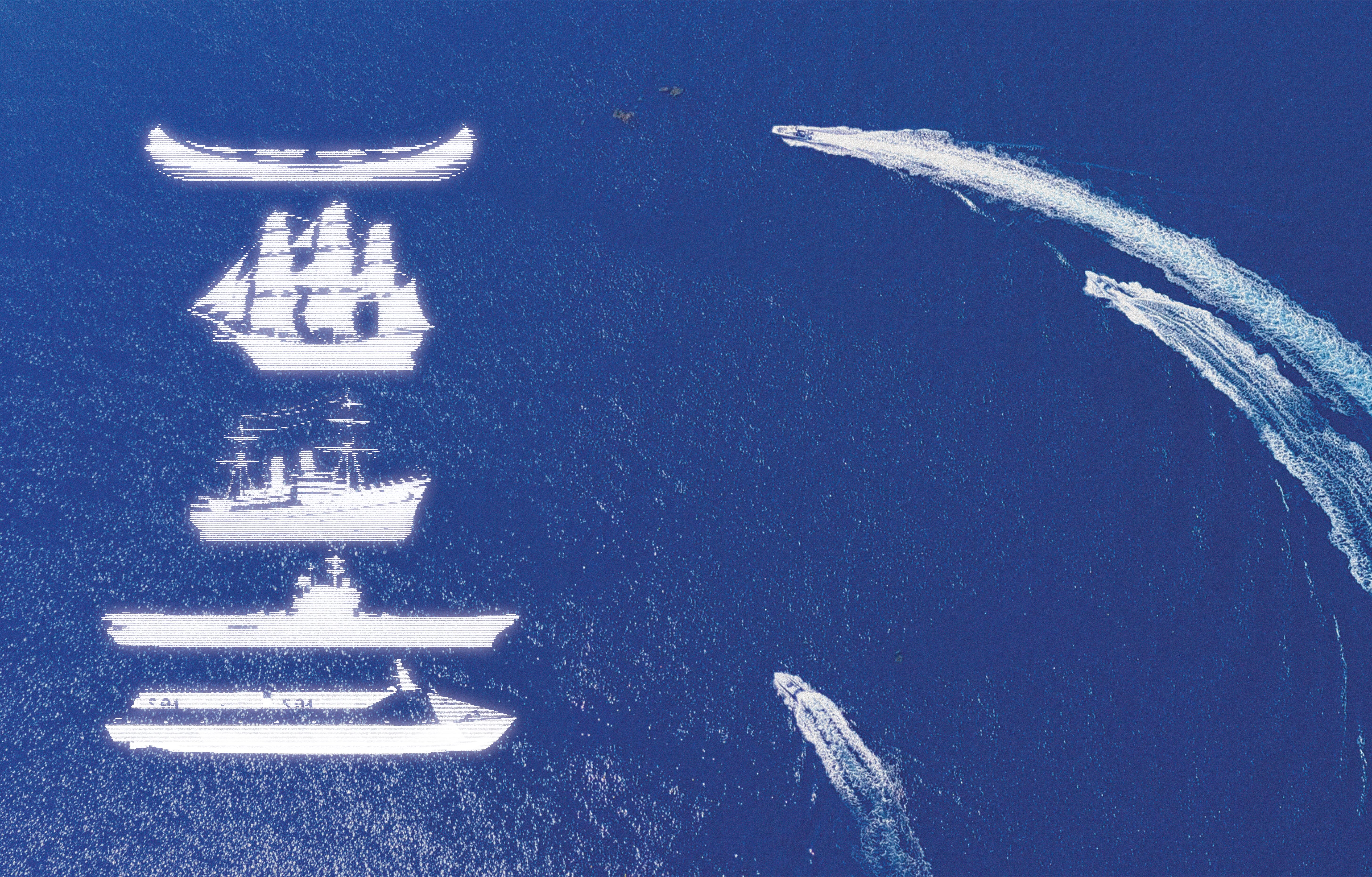

The oldest boat known to history is around ten thousand years old and three meters long. This boat, known as the Pesse Canoe was discovered by a farmer in what is now the Netherlands, and dates to around 8000 BCE. The Pesse Canoe was a dugout canoe — definitely not a “ship,” and barely even a boat. (Using the old sailor’s joke of “a ship can carry a boat, but a boat cannot carry a ship” as a loose definition). The first proper ship was the 143-foot-long Khufu ship, built around 2500 BCE, made of cedar planks and buried next to the Great Pyramid of Giza, which is believed to have been buried there in order to transport an Egyptian king into the afterlife.
Since then, Dino Mavrookas tells me, “There have only been five major paradigm shifts in naval power since the beginning of human history. First, there’s the invention of the ship. Then, in the 1500s, you have sails and gunpowder and cannonballs. Then in the 1800s, you have steam and the pre-WWII battleship. On December 7, 1941, the day of Pearl Harbor, carrier-based aviation became the center of naval power. And then, between December 7, 1941 and October 29, 2022, not too much happened.” In those eighty-or-so years, he explained, “the ships became larger, more exquisite, more powerful, more capable, but nothing fundamentally changed. And in that process, they also became much more expensive, much harder to build.” What changed on October 29, 2022 was that Ukraine — a country without a navy and so forced to innovate — used an unmanned surface vessel (USV) to hit a Russian ship. “This was the first time an autonomous boat hit a naval ship — and you had the transition to maritime autonomy as that fifth paradigm shift in naval power.”
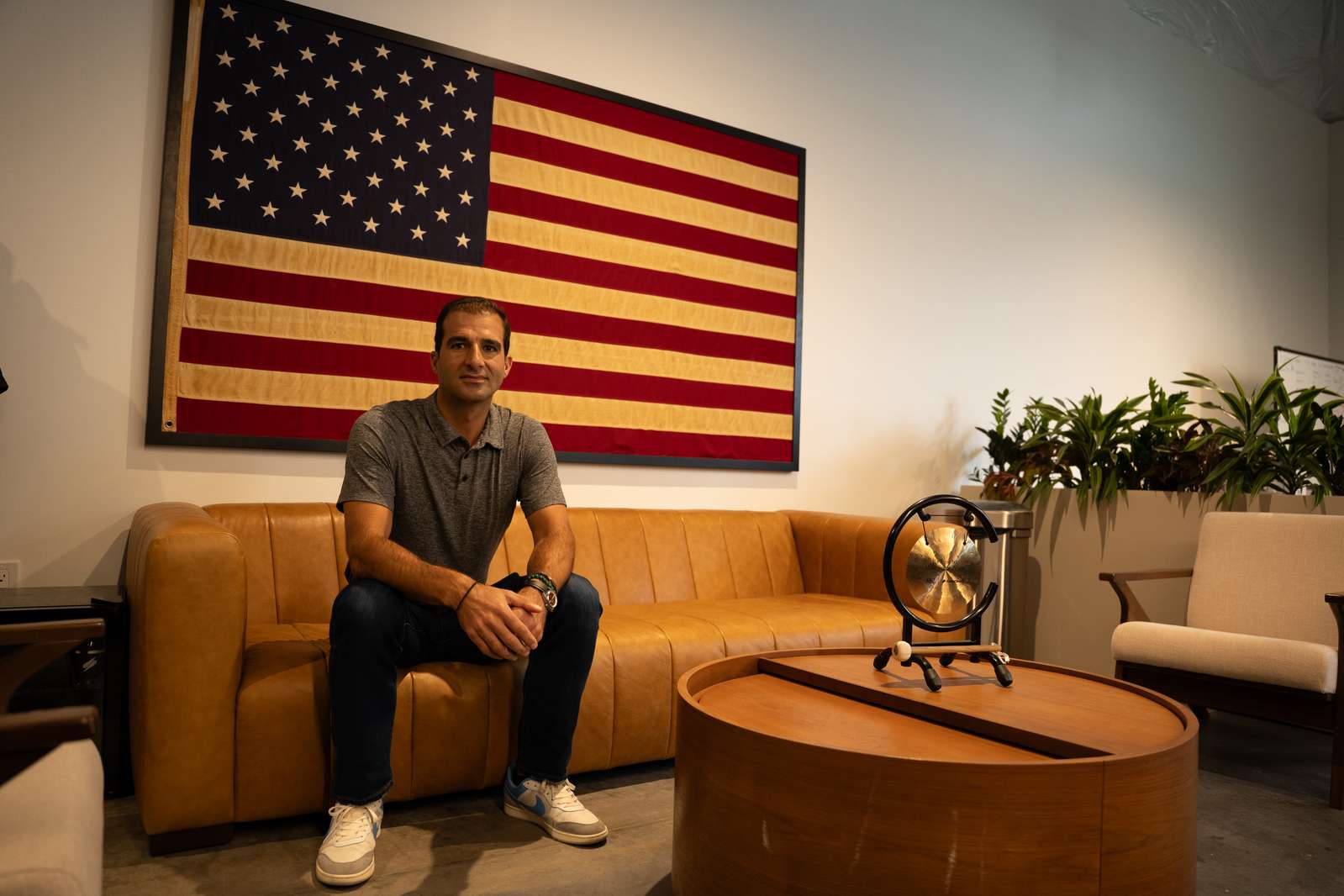
Dino Mavrookas is the co-founder and CEO of Saronic, an Austin-based startup building autonomous boats and ships for both defense and commercial use. In other words, he is ushering in the transition to maritime autonomy: the long-awaited fifth paradigm shift. Saronic incorporated six weeks before Ukraine’s navy-less military hit a Russian ship on October 29, 2022. “We were very much ahead of the market, and just believed that maritime autonomy was where the Navy had to go,” Mavrookas told me.
Vib Altekar, cofounder and CTO of Saronic, gives me the pitch for autonomous vessels, explaining that “Ukraine had no navy when this war started. Russia had the third largest navy in the world. And with no navy, Ukraine was able to detect, defeat, and mitigate a lot of the lethalities that the Russian Navy was putting on them.” This success of asymmetric warfare, where David prevails — or at least fends off Goliath — proved that affordable, autonomous boats and ships were a technological leap worth taking.

At Sea.
Subscribe and add Issue 008.
Add both to cart
But the price asymmetry in autonomous naval warfare cuts both ways. If the Ukrainians, sans navy, could sink a third of the Russian fleet and neutralize the Russian naval threat, then a hostile power could easily deploy swarms of cheap autonomous vessels against American destroyers, large, multi-mission warships designed to protect smaller vessels and project force across the ocean that cost billions of dollars and years to build. The answer isn’t to keep building these destroyers. Saronic’s argument is that the defender can reclaim the advantage, but only by building cheaper, faster, and at scale. Altekar mentioned the large delta between the cost of a USV — which costs less than $1 million — and a destroyer, which costs $3 to $4 billion. “Nobody’s wealthy enough that they could cover a 1,000x, 2,000x difference.” He continued by articulating how Saronic had to foreground the economic reality of defense to be successful: “These are prohibitively expensive costs,” but these costs can be driven down by autonomous vessels. The solution is to build thousands of autonomous boats, and to do so faster and cheaper than anyone else can.
When Altekar was first introduced to Dino back in 2022, “the pitch was, we’re gonna build a ton of ships for the Navy.” The pitch didn’t take long. “And I was like, honestly, that sounds chill. Self driving cars are here. How hard can boats be? Turns out, they’re harder than I expected.”
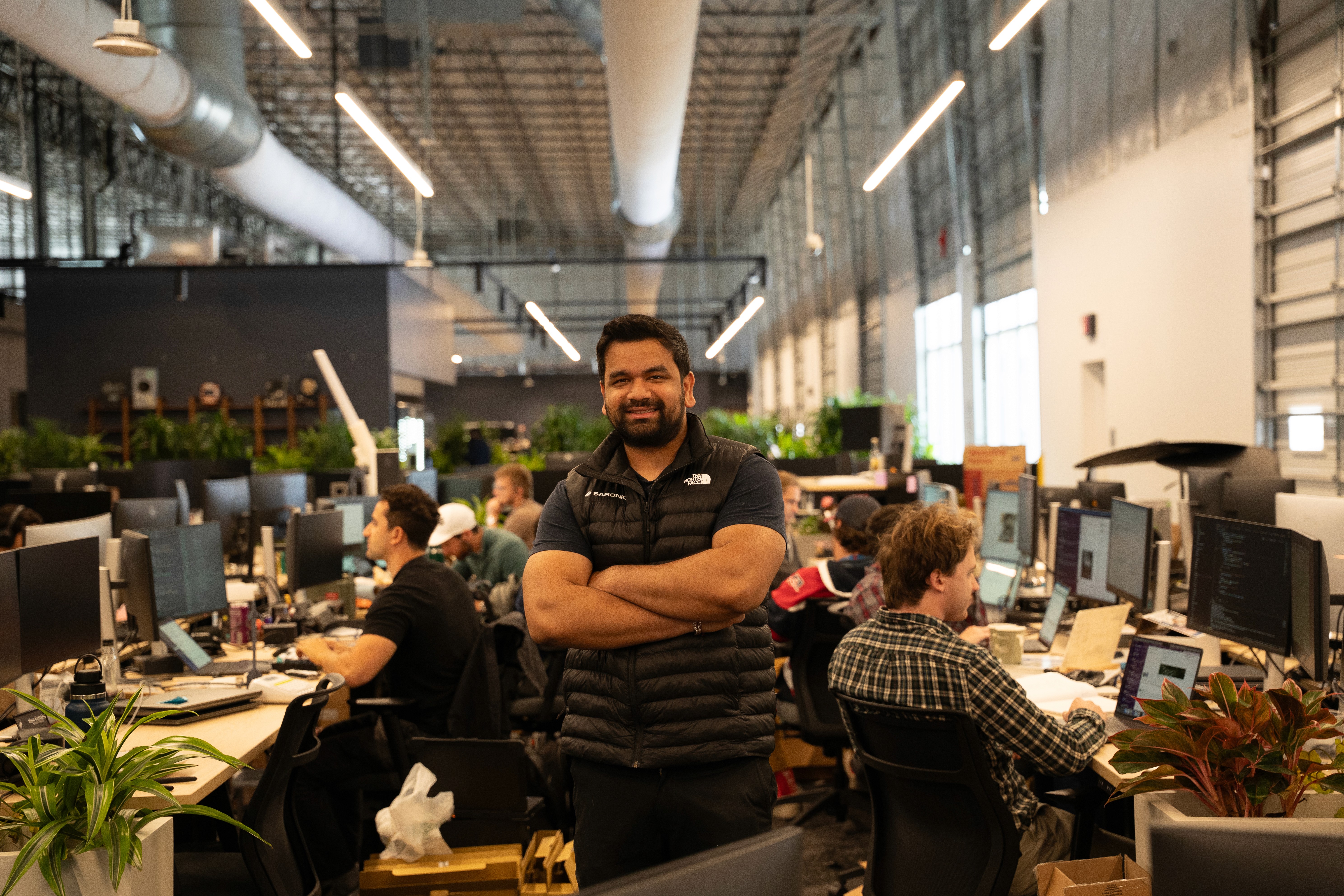
Within the first 90 days of Saronic’s incorporation in September 2022, the company had a cooperative research and development agreement with the US Navy. At the time, Saronic had a thesis and a team — but no boats. “We partnered with the Navy from almost day one,” Mavrookas says. “We signed the contract within 90 days of starting the company. This was a completely unpaid contract. It was a cooperative research and development agreement, but it let us work alongside the Navy, understand the problem, understand the mission set, and start that development and iteration process.”
Saronic’s first model was a six-foot boat called Spyglass — ”not bigger than this table,” Mavrookas says. Spyglass — and all of Saronic’s vessels thereafter — were designed around the principle of scalability. “I don’t care what the design is, and I don’t care what the software does, unless you can build thousands of them. And then let’s work back: if we’re going to build thousands, what does the hardware need to look like? What does the software need to be capable of? So you just instill that into everything that we build. Now that six-foot product is actually sunset, but it built that fundamental DNA into our company.”
“Making existing shipyards 30 percent, 40 percent, 50 percent more efficient does not actually move the needle,” Mavrookas says. Building ships one-by-one is no way to catch up to China. “So you have to do something wildly different; that’s autonomous, that’s mass production.” Enter Saronic, building autonomous boats and ships at scale.
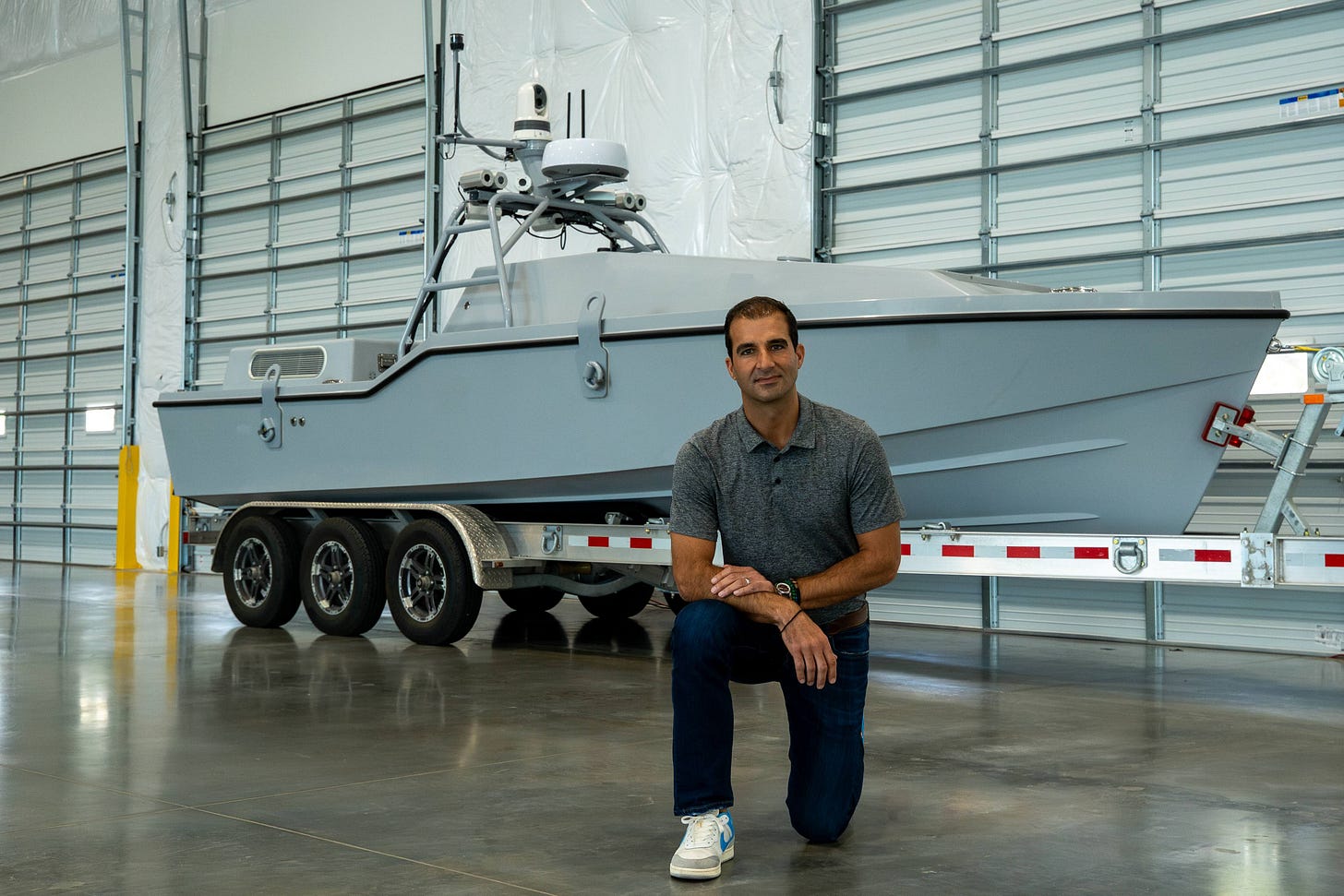
Today, Saronic’s smallest vessel is the Corsair, a 24-foot autonomous surface vessel capable of traveling over 1,000 nautical miles while carrying a 1,000-pound payload. Saronic iterated through the six-foot prototype, as well as a 14-foot version called Cutlass before landing on the 24-foot boat. “Range and payload capacity were what those smaller boats were missing.” The Corsair didn’t exist 19 months ago. Now Saronic is producing high volumes of these low-profile boats that carry cargo, sensors, weapons — you name it — in a payload bay. It’s fueled by a Volvo engine at the stern and a 270-gallon fuel tank.
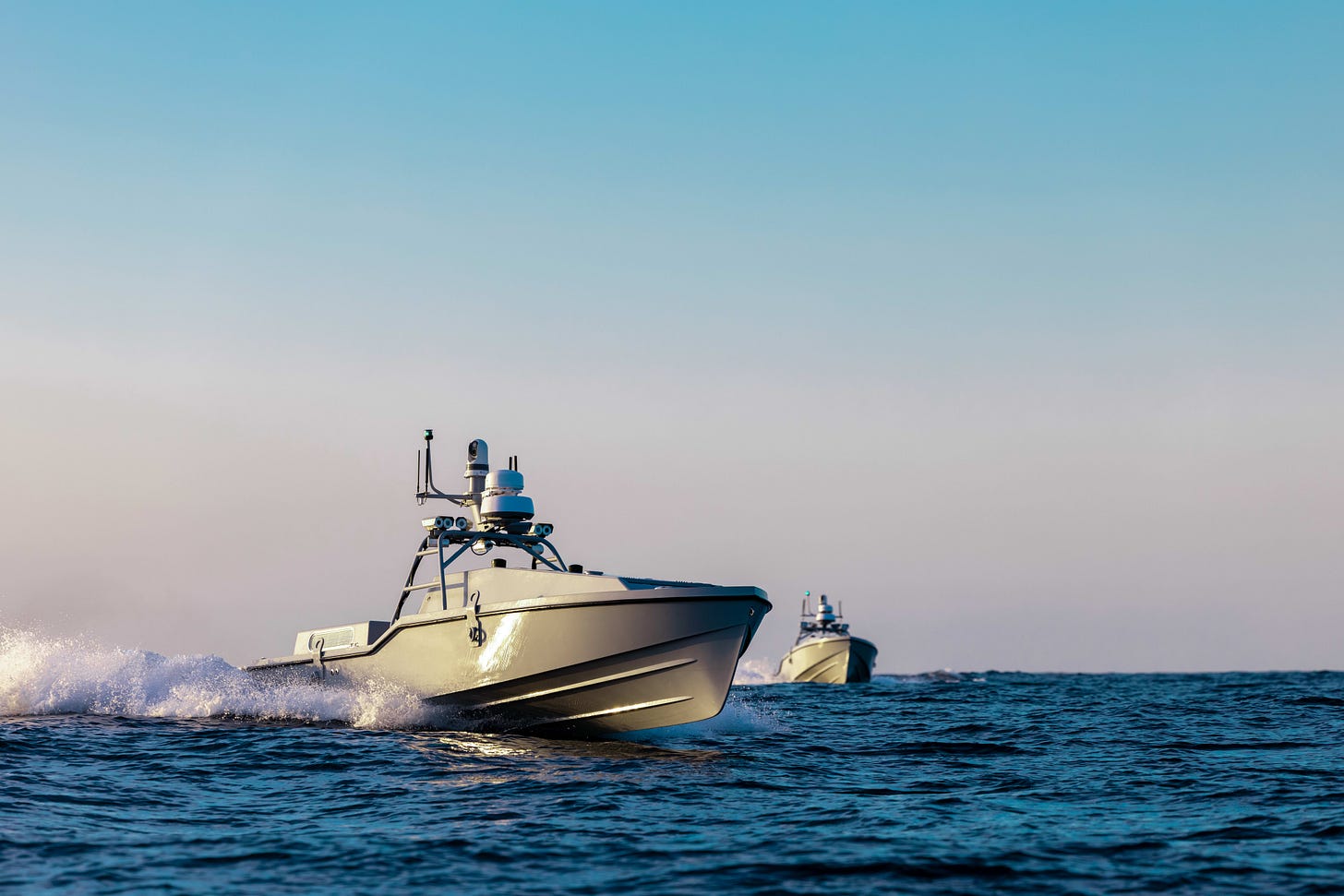
As of April 2026, Saronic has the capability to “build thousands of Corsairs every single year,” Mavrookas tells me. Part of that construction occurs in Austin, Texas, where the company moved into a 420,000 square foot facility in October, 2024. Speed was of the essence. “We grew to over 25,000 square feet in our first nine to 12 months. Then we took over a 75,000 square foot building, which quadrupled our footprint. Three months after that, we were running out of space again, and so we started basically piecing together office buildings on that road. And so within 24 months of our company starting, we had committed to over 500,000 square feet of space.” In addition to the Austin facilities, in the past two years, Saronic “opened an office in DC, acquired the shipyard in Louisiana, opened 80,000 square feet in San Diego, an office in New Orleans, and opened Australia and UK offices” — the latter two have served as test sites for Saronic’s fleet. In east Austin, we walked through a few buildings in the seven-building main campus; and across East Ben White Boulevard, in a slightly older office, we saw the Corsair manufacturing lines in action (the original Saronic office was next to a Tesla repair shop, an Austin whiskey distillery, and a sizable pickleball complex).
While pointing at a Corsair in an open warehouse with a few dozen folding chairs and a Corsair where Saronic had their company Christmas party, Mavrookas anthropomorphized the boat. “Up here is kind of the brains of everything. This is where the compute lives.” I would tell you where he’s pointing at, but doing so would be a security risk. “This is where all the communications live. And then, you have the sensors and the cameras. So that’s the eyeballs. This is the brain. These are the legs, essentially.” Because the boat is built without humans in mind, Saronic is “redesigning what a ship actually is from the inside out.”
Saronic’s largest offering — one that passes the threshold from “boat” into “ship” territory — is the Marauder; at 180 feet, it can no longer be built inland. The distinction matters when building these vessels. Anything that you can build inland, build here in Austin, you can put it on the back of a truck, you could ship it anywhere in the world, that’s a boat,” Mavrookas explains — “anything that has to be built on the water, that’s a ship.” The Marauder can carry four ISO shipping containers and operate autonomously for extended periods at sea. In between is the 52-foot Mirage, which can travel over 2,000 nautical miles carrying a 2,000-pound payload (double that of the Corsair). A fleet is being assembled, designed in the landlocked city of Austin, Texas.
The Saronic Gulf is the body of water that separates Athens from the Peloponnese. The second Greco-Persian war was fought in the Saronic Gulf. “This was the battle of Salamis,” Mavrookas explains. “The Greeks split up the Persian fleet and were able to beat the Persian fleet, which was a much larger fleet. It was this really fascinating story, very reflective of what we’re doing here at Saronic.” Saronic’s titular nod to Greece is also personal: Mavrookas’ father immigrated from Greece to New Jersey, where he opened a Greek diner that his son worked at. After working in his father’s diner, he studied computer engineering at Rutgers. 9/11 was his junior year of college; soon after, he walked into an FBI career day event and said that he wanted to do tactical operations. “They said, ‘You need military experience.’ I said, ‘Okay, what does military experience look like?’ Long story short, I learned about the Navy SEAL teams from a Navy recruiter.” The day Mavrookas graduated, he enlisted in the Navy, where he served for 11 years; his last five were spent in SEAL Team Six.
In 2003, the year before Mavrookas enlisted, the US Navy fell below 300 battle force ships — the ships counted towards the Navy’s stated size — for the first time since the early 20th century. As of October 2025, the Navy had 293. China has more than 370, with projections of 435 by 2030.
After the Cold War and the collapse of the Soviet Union, the defense industrial base shrunk, thinking that the end of history would usher in a new age of globalization and commercially facilitated peace, making great power conflict a thing of the past. To make room for this miracle of capitalism, the defense budget as a whole shrunk by a quarter; “the Navy’s budget actually shrunk by 40%,” Dino explains. “You had decreased competition, decreased investment, you had closings of shipyards — all of these things were happening because of globalization, because you can go and build ships cheaper in China.” Throughout the 1990s and 2000s, China, rather than being viewed as our greatest geopolitical rival, was generally thought of as America’s “everything-factory,” a neutral ground where things were simply made. The dream of globalization made it unthinkable for the United States to do the dirty work of shipbuilding in house when it was easier — and cheaper — to have that same work done in China. At the end of history, suggesting that offshoring these critical defense functions would be a problem down the line was verboten as it implied the idyll of mutual economic dependence might end. (Similarly, the US imports a quarter of our enriched uranium from Russia because we have offshored the dirty work of uranium enrichment as well.) Now, China builds about 1,000 cargo ships a year; the United States builds about three. Throughout our conversation, Mavrookas kept repeating a figure from the Office of Naval Intelligence that, measured by tonnage, China’s shipbuilding capacity is 230 times greater than that of the US.
“China had ‘a backwater navy’ only half a century ago,” Mavrookas explained. “Right now they have aircraft carriers, nuclear submarines and hypersonic missiles. They’ve done all of this in a period of 30 years, because there’s an intense focus from the government on pouring capital into that space.” State capitalism has allowed China to pump money into national defense. In the US, by contrast, the drowning shipbuilding industry can be understood as a lack of financial incentives. As Altekar put it, “we spend a billion dollars a year on technology that is worse than an iPhone that’s going into the pocket of soldiers.”
The United States has the largest defense budget in the world. But compared to rapid improvements in aerial drones, intelligence software, and missile systems, naval defense stagnated after the Cold War, deemed wasteful without a great power to compete with — and the stagnation has fed on itself. Fewer dollars going into maritime research and development meant less innovation, which meant fewer investors willing to put their money into research and development, which meant less innovation. Altekar told me that “the economics never really worked out for people to innovate on the boat or the ship itself.” The commercial incentive to innovate was thin. Plus, the post-9/11 conflicts in the Middle East oriented the American defense establishment towards fending off ground-based insurgency groups, not building fleets to fight peer competitors at sea. In the past 10 years, it has become more and more obvious to Washington that the US is only as strong as its navy in a fight against China over the island of Taiwan. However, this realization alone has not created market incentives strong enough to change the status quo. Saronic is trying to reverse-engineer those incentives.
Get the Mag in Print.
Arena publishes four stunning print editions per year, full of stories just like this one on American technology, capital, and industry.



Despite the ocean’s indifference to human affairs, there’s unquestionably an allure to the open sea that makes us want to explore it. Altekar recalled: “Humans had canoes in 7000 BC, right? That predated the wheel. The wheel came out in 3500 BC.”
Since human beings have had fleets at their disposal, Altekar tells me, naval supremacy has been defined by having “large ships, lots of ships, and a very skilled set of people that can operate those ships.” Navies are expensive: “they’re large, they’re complex, they’re built for humans and the supply chain.” Mavrookas agrees, telling me that “autonomous ships that don’t have to support people allow you to strip out 80 to 90 percent of the complexity of the platform.” There don’t need to be hallways, bathrooms, nor kitchens. Since much of the expense of shipbuilding comes from making them fit for human crew, autonomous ships are actually an economical option once the tech is sorted out. “Our ship,” Mavrookas says, “we can break down to seven major subcomponents,” compared to “thousands” on a naval destroyer.
Removing humans from the equation unlocks the possibility of what a boat or ship can do. Unlike autonomous cars, autonomous boats get to change the physics of the vehicle at hand. Waymos, Altekar explains, “don’t have increased fuel efficiency or energy efficiency because the car is self-driving — maybe a little bit, but the same amount that you get from cruise control.” Autonomous boats and ships, by contrast, are not floating hotels like their old-school counterparts; they don’t need gyms, bathrooms, kitchens, and so on, which allows more space for engineers and designers to reimagine what a boat or ship ought to look like. “When you design the ship for there to be no humans at all… suddenly you can take a sharp 90-degree turn, take three and a half lateral G’s, like an F1 car. And it doesn’t matter. You don’t need Lewis Hamilton in there.”
Common parlance in start-up world is the “X for Y” formula: for example, “Uber for food” (DoorDash), or “Netflix for fitness” (Peloton). At first glance, one might call Saronic, a company that builds autonomous boats and ships, “Waymo for the ocean.” But even that characterization would be missing an important part of the point, and the ingenuity of Saronic’s tech: while autonomous cars are designed to be both more pleasant and safer for human passengers, autonomous boats cut out the idea of passengers — or, in this case, a “crew” — entirely.
What makes Saronic’s task far more difficult than, say, Waymo or Zoox — both marvels of engineering that have required decades of sustained software and hardware engineering, is that there is no ‘training data’ about maritime navigation and sea conditions for autonomous surface vehicles to begin with. Altekar explained how “Lyft would publish its own data, Waymo publishes data sets.” On the seas, no such foundation existed — before Saronic. He continued: “The economics don’t work for a large ship within the Jones Act” — the century-old law requiring that cargo shipped between American ports must travel on American-built, American-crewed vessels — “to go, ‘let’s put $10,000 of LIDARs on this thing.’” (The Jones Act protects a small domestic fleet of just 92 ships from foreign competition — but without competition, there’s no pressure to innovate.) In order to teach its vessels to navigate the open ocean, Saronic had to go collect this data itself; the “MOPs” (mission operations) team within Saronic now operates round-the-clock testing in Galveston, an East Coast test site, Sydney, and the UK. The ocean has no traffic laws, but it has difficult physics. An unexpected wave or a sharp turn can throw an entire boat to one side. And all of the electronics on a ship, down to the plastic fan inside a computer, must be able to withstand pulling five Gs at once. Saronic’s software engineers can push software updates to their vessels from anywhere; their growing team of software engineers push code from Austin.
Another reason why Saronic’s task is so much harder than Waymo’s is the water environment itself. Altekar — who grew up in the Bay Area and developed an interest in defense tech through his time working as an engineer at Anduril — has a sailor’s respect for, and deference to, the ocean. He puts it bluntly: “Putting hardware in the ocean means that your hardware will break. Salt water is cancerous for electronics. The ocean can, at any given point in time, do whatever it wants to you.”
One of the benefits of building in the ocean is that “the ocean is vast and sparse,” Altekar says, so there’s no need to take pedestrians or cyclists into consideration. But the same emptiness that makes things easier also means there are no street signs or lane markings to guide the way. The vast, open sea that drove many a sailor to madness is the same sea that Saronic’s vessels must navigate through. Worse yet, different classes of boats must turn, accelerate, and slow down extremely differently — so that data collected from one vessel is not easily applied to another. It’s much harder to transition data from a tanker to a destroyer to a Corsair than it is to transition comparable data from a sedan to a sports car to a minivan. Saronic’s solution to this problem has been to design its fleet from a “software-native perspective” from the beginning” — Saronic’s software engineers can see their code tested on the water within 24 hours.
What makes Saronic’s task far more difficult than, say, Waymo or Zoox — both marvels of engineering that have required decades of sustained software and hardware engineering, is that there is no ‘training data’ about maritime navigation and sea conditions for autonomous surface vehicles to begin with.
Saronic’s boats and ships are totally vertically integrated. The management systems for the factory lines are designed in house; so is the software running on all of the ships. Walking down the factory floor, you can see in real-time what percent of each vessel, built from scratch in Austin, Texas, is complete. Saronic has a machine shop in house, a composite shop in house, and a wiring shop — where individual wires and cable assemblies are made — in house. “As the manufacturing leader,” John Morgan tells me, “I want to be able to control my own destiny, right? And the only way you can do that is being able to control the machine shops, the wiring houses.”
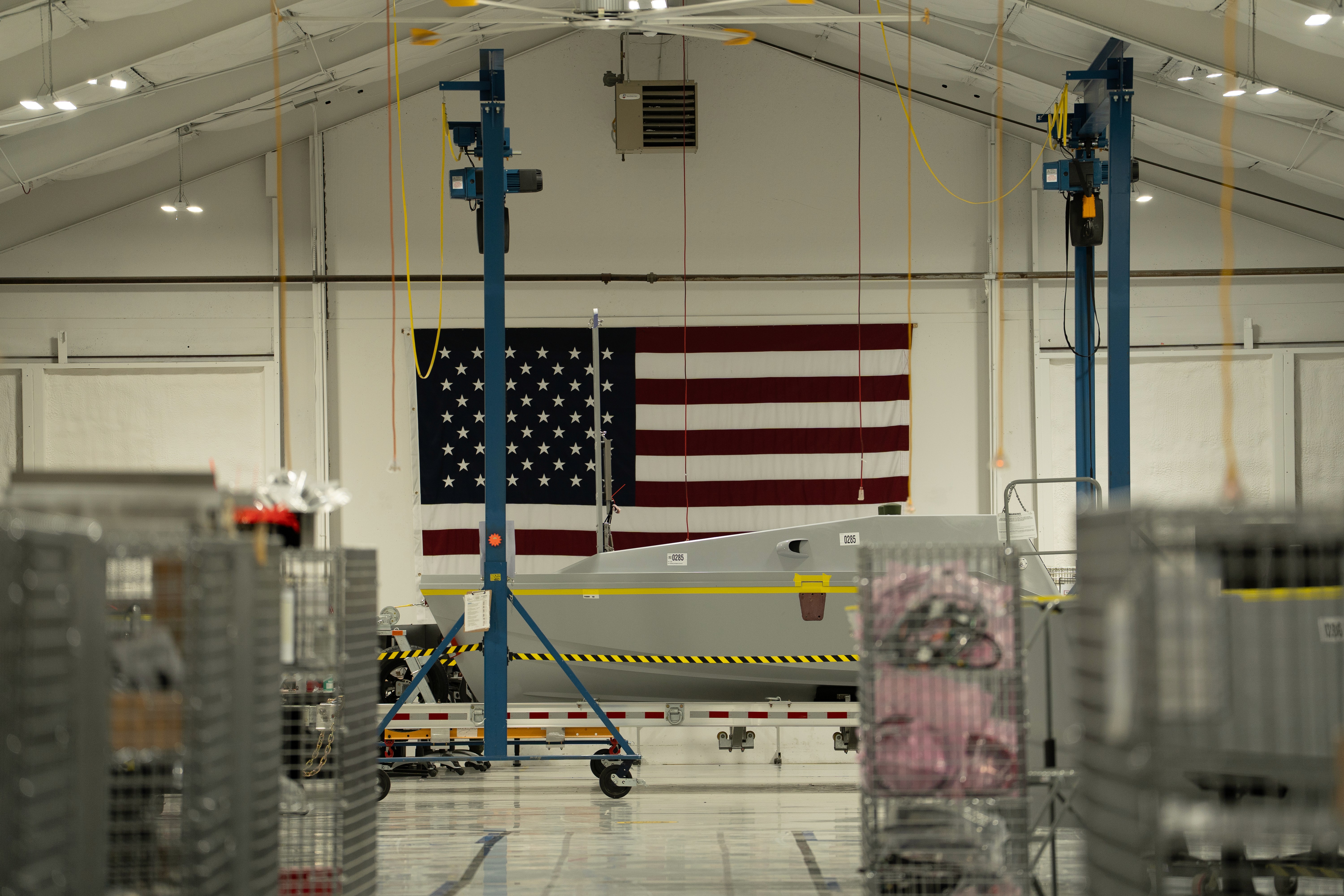
Saronic’s manufacturing chief John Morgan got an education in the “school of Elon,” as he puts it. He joined SpaceX in 2013, where he ended up running the final integration line on the Raptor engine. Walking through one of the production floors, which had two parallel production lines and a dozen or so stations on each line, Morgan remarked that the linear production lines “very much came from Elon. Just walking down this production line, you inherently understand where the key bottlenecks are or what stations are running behind because you’ll see a gap in the line, and that allows you — five minutes from the first time that you walk in and got your coffee — you immediately understood where your problem is on the production line.” We were walking through the center of two Corsair production lines, with factory workers on each station. Each step was additive; as you walked down the factory floor, you saw each step of the boat’s manufacturing process. By the end of the line, the Corsair was nearly complete.
As we walk through the production lines, Morgan tells us that the factory was once a concrete mixing plant. When they moved in, “every single one of these surfaces had an inch of concrete on them.” They cleaned up the factory and made it “high, white, and bright,” a production line that both adds the air of a best-in-class work environment and allows for inefficiencies to show themselves. Later, Morgan let us in on a little secret: “the color tones are actually modelled off the Ferrari factory, the light gray and gray — you want people to come in and think, ‘wow, I’m very proud to come here and work.’”
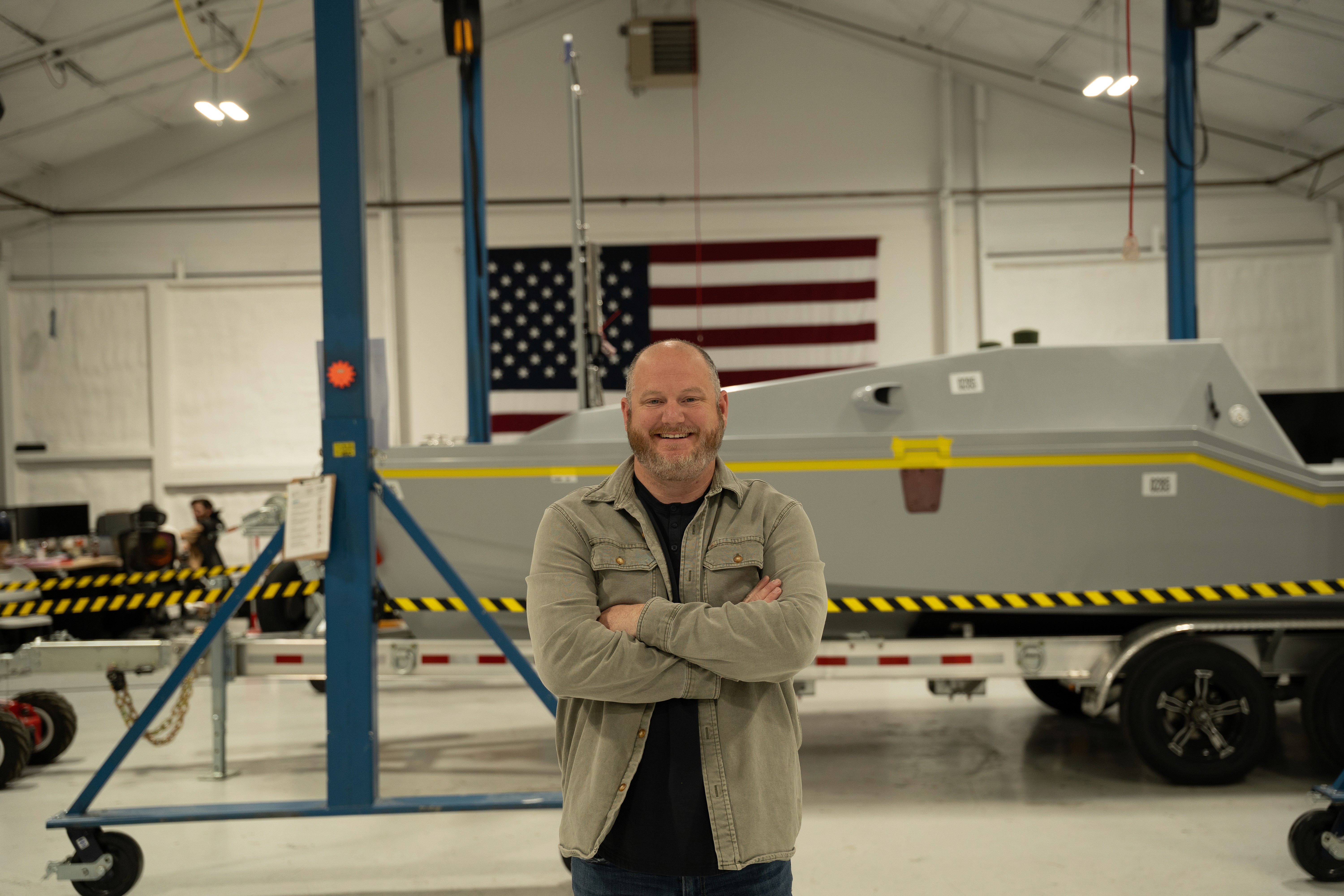
The facility is highly organized. Every part has a bar code, a tracking number. “We can go and track every single thing down to the nut and washer. Because, let’s say I can build a boat every day, but I can’t get one harness” — the wiring that connects sensors, antennas, and engines — “or this composite structure every two days. Guess what? I’m only building a boat every two days.” Traceability, Morgan explains, is key to improving throughput and getting vessels built quickly. Harnessing — the wiring system — in particular had a lead time of eight to 12 weeks — “that’s just something that we’re not going to accept.” So they built a harnessing center in house; vertical manufacturing at its best.
Once a new boat is complete, Morgan explains, the testing team goes to Saronic’s lake in the outskirts of Austin where they do “mops almost 24 hours a day, seven days a week.” In testing a new boat, they “really push the needle on what this boat can do.” When I asked him how Saronic tests for enemy strikes on the boat, he reminds me that Saronic is dual-use, providing its boats and ships for both commercial and defense customers. The Corsair just completed 100,000 nautical miles of internal testing.
Part of what makes Saronic so impressive is just how fast the startup has moved. Both in the sense of corporate growth — the three-and-a-half year-old startup now has over 1,400 employees, the majority of them on the manufacturing floor — and in the sense of the sheer number of boats and ships Saronic has built. Morgan gives his own definition for boats: “we think of boat building as anything that’s 52 feet and below, anything that can be road transportable.” Shipbuilding, echoing Mavrookas’ definition, “is purpose built on a body of water, usually an ocean, to go and start building those things.” China did not will the American shipbuilding industry to obsolescence; American shipbuilding died for a reason. In part, American shipbuilding died because it failed to adopt 21st century manufacturing techniques — shipyards are old, and neither the private market nor the government thought to invest in updating them. But the “school of Elon,” to borrow Morgan’s phrase, teaches that it is possible for American industry to compete with China — and out-build our allies in Japan and Europe — by building smarter — by simplifying and lowering costs across the board.
For shipyards writ large to update, however, that requires pausing production lines, which are already struggling to meet demand. Port Alpha is Saronic’s vision for a “greenfield” facility, Morgan says, “purpose-built with the ability to go and expand as new techniques come out.” Saronic is yet to announce the site of the shipyard of the 21st century. The Port Alpha site will provide the infrastructure to build larger ships. Mavrookas told me that, “as you build more large vessels, more of that commercial market opens up, and eventually we want to be building cargo containers and bulk carriers and oil tankers.” Saronic’s CEO told me that Port Alpha and Saronic’s other manufacturing efforts will “create thousands of jobs, up to 10,000 jobs over the next decade.”
“In this facility” — the Austin facility that Saronic moved into in 2022 and has since outgrown — ”we have the capacity to build thousands a month” of the Corsair, Morgan tells me. “In Franklin, we’ll be building 20 Marauders a year. I’ll tell you, 20 a year is some of the highest throughput rate of any shipyard in the United States.”
Technology
•
The Fifth Shift
Saronic's autonomous vessels are a revolution in naval warfare.
The oldest boat known to history is around ten thousand years old and three meters long. This boat, known as the Pesse Canoe was discovered by a farmer in what is now the Netherlands, and dates to around 8000 BCE. The Pesse Canoe was a dugout canoe — definitely not a “ship,” and barely even a boat. (Using the old sailor’s joke of “a ship can carry a boat, but a boat cannot carry a ship” as a loose definition). The first proper ship was the 143-foot-long Khufu ship, built around 2500 BCE, made of cedar planks and buried next to the Great Pyramid of Giza, which is believed to have been buried there in order to transport an Egyptian king into the afterlife.
Since then, Dino Mavrookas tells me, “There have only been five major paradigm shifts in naval power since the beginning of human history. First, there’s the invention of the ship. Then, in the 1500s, you have sails and gunpowder and cannonballs. Then in the 1800s, you have steam and the pre-WWII battleship. On December 7, 1941, the day of Pearl Harbor, carrier-based aviation became the center of naval power. And then, between December 7, 1941 and October 29, 2022, not too much happened.” In those eighty-or-so years, he explained, “the ships became larger, more exquisite, more powerful, more capable, but nothing fundamentally changed. And in that process, they also became much more expensive, much harder to build.” What changed on October 29, 2022 was that Ukraine — a country without a navy and so forced to innovate — used an unmanned surface vessel (USV) to hit a Russian ship. “This was the first time an autonomous boat hit a naval ship — and you had the transition to maritime autonomy as that fifth paradigm shift in naval power.”
Dino Mavrookas is the co-founder and CEO of Saronic, an Austin-based startup building autonomous boats and ships for both defense and commercial use. In other words, he is ushering in the transition to maritime autonomy: the long-awaited fifth paradigm shift. Saronic incorporated six weeks before Ukraine’s navy-less military hit a Russian ship on October 29, 2022. “We were very much ahead of the market, and just believed that maritime autonomy was where the Navy had to go,” Mavrookas told me.
Vib Altekar, cofounder and CTO of Saronic, gives me the pitch for autonomous vessels, explaining that “Ukraine had no navy when this war started. Russia had the third largest navy in the world. And with no navy, Ukraine was able to detect, defeat, and mitigate a lot of the lethalities that the Russian Navy was putting on them.” This success of asymmetric warfare, where David prevails — or at least fends off Goliath — proved that affordable, autonomous boats and ships were a technological leap worth taking.
At Sea.
Subscribe and add Issue 008.
Add both to cart
But the price asymmetry in autonomous naval warfare cuts both ways. If the Ukrainians, sans navy, could sink a third of the Russian fleet and neutralize the Russian naval threat, then a hostile power could easily deploy swarms of cheap autonomous vessels against American destroyers, large, multi-mission warships designed to protect smaller vessels and project force across the ocean that cost billions of dollars and years to build. The answer isn’t to keep building these destroyers. Saronic’s argument is that the defender can reclaim the advantage, but only by building cheaper, faster, and at scale. Altekar mentioned the large delta between the cost of a USV — which costs less than $1 million — and a destroyer, which costs $3 to $4 billion. “Nobody’s wealthy enough that they could cover a 1,000x, 2,000x difference.” He continued by articulating how Saronic had to foreground the economic reality of defense to be successful: “These are prohibitively expensive costs,” but these costs can be driven down by autonomous vessels. The solution is to build thousands of autonomous boats, and to do so faster and cheaper than anyone else can.
When Altekar was first introduced to Dino back in 2022, “the pitch was, we’re gonna build a ton of ships for the Navy.” The pitch didn’t take long. “And I was like, honestly, that sounds chill. Self driving cars are here. How hard can boats be? Turns out, they’re harder than I expected.”
Within the first 90 days of Saronic’s incorporation in September 2022, the company had a cooperative research and development agreement with the US Navy. At the time, Saronic had a thesis and a team — but no boats. “We partnered with the Navy from almost day one,” Mavrookas says. “We signed the contract within 90 days of starting the company. This was a completely unpaid contract. It was a cooperative research and development agreement, but it let us work alongside the Navy, understand the problem, understand the mission set, and start that development and iteration process.”
Saronic’s first model was a six-foot boat called Spyglass — ”not bigger than this table,” Mavrookas says. Spyglass — and all of Saronic’s vessels thereafter — were designed around the principle of scalability. “I don’t care what the design is, and I don’t care what the software does, unless you can build thousands of them. And then let’s work back: if we’re going to build thousands, what does the hardware need to look like? What does the software need to be capable of? So you just instill that into everything that we build. Now that six-foot product is actually sunset, but it built that fundamental DNA into our company.”
“Making existing shipyards 30 percent, 40 percent, 50 percent more efficient does not actually move the needle,” Mavrookas says. Building ships one-by-one is no way to catch up to China. “So you have to do something wildly different; that’s autonomous, that’s mass production.” Enter Saronic, building autonomous boats and ships at scale.
Today, Saronic’s smallest vessel is the Corsair, a 24-foot autonomous surface vessel capable of traveling over 1,000 nautical miles while carrying a 1,000-pound payload. Saronic iterated through the six-foot prototype, as well as a 14-foot version called Cutlass before landing on the 24-foot boat. “Range and payload capacity were what those smaller boats were missing.” The Corsair didn’t exist 19 months ago. Now Saronic is producing high volumes of these low-profile boats that carry cargo, sensors, weapons — you name it — in a payload bay. It’s fueled by a Volvo engine at the stern and a 270-gallon fuel tank.
As of April 2026, Saronic has the capability to “build thousands of Corsairs every single year,” Mavrookas tells me. Part of that construction occurs in Austin, Texas, where the company moved into a 420,000 square foot facility in October, 2024. Speed was of the essence. “We grew to over 25,000 square feet in our first nine to 12 months. Then we took over a 75,000 square foot building, which quadrupled our footprint. Three months after that, we were running out of space again, and so we started basically piecing together office buildings on that road. And so within 24 months of our company starting, we had committed to over 500,000 square feet of space.” In addition to the Austin facilities, in the past two years, Saronic “opened an office in DC, acquired the shipyard in Louisiana, opened 80,000 square feet in San Diego, an office in New Orleans, and opened Australia and UK offices” — the latter two have served as test sites for Saronic’s fleet. In east Austin, we walked through a few buildings in the seven-building main campus; and across East Ben White Boulevard, in a slightly older office, we saw the Corsair manufacturing lines in action (the original Saronic office was next to a Tesla repair shop, an Austin whiskey distillery, and a sizable pickleball complex).
While pointing at a Corsair in an open warehouse with a few dozen folding chairs and a Corsair where Saronic had their company Christmas party, Mavrookas anthropomorphized the boat. “Up here is kind of the brains of everything. This is where the compute lives.” I would tell you where he’s pointing at, but doing so would be a security risk. “This is where all the communications live. And then, you have the sensors and the cameras. So that’s the eyeballs. This is the brain. These are the legs, essentially.” Because the boat is built without humans in mind, Saronic is “redesigning what a ship actually is from the inside out.”
Saronic’s largest offering — one that passes the threshold from “boat” into “ship” territory — is the Marauder; at 180 feet, it can no longer be built inland. The distinction matters when building these vessels. Anything that you can build inland, build here in Austin, you can put it on the back of a truck, you could ship it anywhere in the world, that’s a boat,” Mavrookas explains — “anything that has to be built on the water, that’s a ship.” The Marauder can carry four ISO shipping containers and operate autonomously for extended periods at sea. In between is the 52-foot Mirage, which can travel over 2,000 nautical miles carrying a 2,000-pound payload (double that of the Corsair). A fleet is being assembled, designed in the landlocked city of Austin, Texas.
The Saronic Gulf is the body of water that separates Athens from the Peloponnese. The second Greco-Persian war was fought in the Saronic Gulf. “This was the battle of Salamis,” Mavrookas explains. “The Greeks split up the Persian fleet and were able to beat the Persian fleet, which was a much larger fleet. It was this really fascinating story, very reflective of what we’re doing here at Saronic.” Saronic’s titular nod to Greece is also personal: Mavrookas’ father immigrated from Greece to New Jersey, where he opened a Greek diner that his son worked at. After working in his father’s diner, he studied computer engineering at Rutgers. 9/11 was his junior year of college; soon after, he walked into an FBI career day event and said that he wanted to do tactical operations. “They said, ‘You need military experience.’ I said, ‘Okay, what does military experience look like?’ Long story short, I learned about the Navy SEAL teams from a Navy recruiter.” The day Mavrookas graduated, he enlisted in the Navy, where he served for 11 years; his last five were spent in SEAL Team Six.
In 2003, the year before Mavrookas enlisted, the US Navy fell below 300 battle force ships — the ships counted towards the Navy’s stated size — for the first time since the early 20th century. As of October 2025, the Navy had 293. China has more than 370, with projections of 435 by 2030.
After the Cold War and the collapse of the Soviet Union, the defense industrial base shrunk, thinking that the end of history would usher in a new age of globalization and commercially facilitated peace, making great power conflict a thing of the past. To make room for this miracle of capitalism, the defense budget as a whole shrunk by a quarter; “the Navy’s budget actually shrunk by 40%,” Dino explains. “You had decreased competition, decreased investment, you had closings of shipyards — all of these things were happening because of globalization, because you can go and build ships cheaper in China.” Throughout the 1990s and 2000s, China, rather than being viewed as our greatest geopolitical rival, was generally thought of as America’s “everything-factory,” a neutral ground where things were simply made. The dream of globalization made it unthinkable for the United States to do the dirty work of shipbuilding in house when it was easier — and cheaper — to have that same work done in China. At the end of history, suggesting that offshoring these critical defense functions would be a problem down the line was verboten as it implied the idyll of mutual economic dependence might end. (Similarly, the US imports a quarter of our enriched uranium from Russia because we have offshored the dirty work of uranium enrichment as well.) Now, China builds about 1,000 cargo ships a year; the United States builds about three. Throughout our conversation, Mavrookas kept repeating a figure from the Office of Naval Intelligence that, measured by tonnage, China’s shipbuilding capacity is 230 times greater than that of the US.
“China had ‘a backwater navy’ only half a century ago,” Mavrookas explained. “Right now they have aircraft carriers, nuclear submarines and hypersonic missiles. They’ve done all of this in a period of 30 years, because there’s an intense focus from the government on pouring capital into that space.” State capitalism has allowed China to pump money into national defense. In the US, by contrast, the drowning shipbuilding industry can be understood as a lack of financial incentives. As Altekar put it, “we spend a billion dollars a year on technology that is worse than an iPhone that’s going into the pocket of soldiers.”
The United States has the largest defense budget in the world. But compared to rapid improvements in aerial drones, intelligence software, and missile systems, naval defense stagnated after the Cold War, deemed wasteful without a great power to compete with — and the stagnation has fed on itself. Fewer dollars going into maritime research and development meant less innovation, which meant fewer investors willing to put their money into research and development, which meant less innovation. Altekar told me that “the economics never really worked out for people to innovate on the boat or the ship itself.” The commercial incentive to innovate was thin. Plus, the post-9/11 conflicts in the Middle East oriented the American defense establishment towards fending off ground-based insurgency groups, not building fleets to fight peer competitors at sea. In the past 10 years, it has become more and more obvious to Washington that the US is only as strong as its navy in a fight against China over the island of Taiwan. However, this realization alone has not created market incentives strong enough to change the status quo. Saronic is trying to reverse-engineer those incentives.
Get the Mag in Print.
Arena publishes four stunning print editions per year, full of stories just like this one on American technology, capital, and industry.
Despite the ocean’s indifference to human affairs, there’s unquestionably an allure to the open sea that makes us want to explore it. Altekar recalled: “Humans had canoes in 7000 BC, right? That predated the wheel. The wheel came out in 3500 BC.”
Since human beings have had fleets at their disposal, Altekar tells me, naval supremacy has been defined by having “large ships, lots of ships, and a very skilled set of people that can operate those ships.” Navies are expensive: “they’re large, they’re complex, they’re built for humans and the supply chain.” Mavrookas agrees, telling me that “autonomous ships that don’t have to support people allow you to strip out 80 to 90 percent of the complexity of the platform.” There don’t need to be hallways, bathrooms, nor kitchens. Since much of the expense of shipbuilding comes from making them fit for human crew, autonomous ships are actually an economical option once the tech is sorted out. “Our ship,” Mavrookas says, “we can break down to seven major subcomponents,” compared to “thousands” on a naval destroyer.
Removing humans from the equation unlocks the possibility of what a boat or ship can do. Unlike autonomous cars, autonomous boats get to change the physics of the vehicle at hand. Waymos, Altekar explains, “don’t have increased fuel efficiency or energy efficiency because the car is self-driving — maybe a little bit, but the same amount that you get from cruise control.” Autonomous boats and ships, by contrast, are not floating hotels like their old-school counterparts; they don’t need gyms, bathrooms, kitchens, and so on, which allows more space for engineers and designers to reimagine what a boat or ship ought to look like. “When you design the ship for there to be no humans at all… suddenly you can take a sharp 90-degree turn, take three and a half lateral G’s, like an F1 car. And it doesn’t matter. You don’t need Lewis Hamilton in there.”
Common parlance in start-up world is the “X for Y” formula: for example, “Uber for food” (DoorDash), or “Netflix for fitness” (Peloton). At first glance, one might call Saronic, a company that builds autonomous boats and ships, “Waymo for the ocean.” But even that characterization would be missing an important part of the point, and the ingenuity of Saronic’s tech: while autonomous cars are designed to be both more pleasant and safer for human passengers, autonomous boats cut out the idea of passengers — or, in this case, a “crew” — entirely.
What makes Saronic’s task far more difficult than, say, Waymo or Zoox — both marvels of engineering that have required decades of sustained software and hardware engineering, is that there is no ‘training data’ about maritime navigation and sea conditions for autonomous surface vehicles to begin with. Altekar explained how “Lyft would publish its own data, Waymo publishes data sets.” On the seas, no such foundation existed — before Saronic. He continued: “The economics don’t work for a large ship within the Jones Act” — the century-old law requiring that cargo shipped between American ports must travel on American-built, American-crewed vessels — “to go, ‘let’s put $10,000 of LIDARs on this thing.’” (The Jones Act protects a small domestic fleet of just 92 ships from foreign competition — but without competition, there’s no pressure to innovate.) In order to teach its vessels to navigate the open ocean, Saronic had to go collect this data itself; the “MOPs” (mission operations) team within Saronic now operates round-the-clock testing in Galveston, an East Coast test site, Sydney, and the UK. The ocean has no traffic laws, but it has difficult physics. An unexpected wave or a sharp turn can throw an entire boat to one side. And all of the electronics on a ship, down to the plastic fan inside a computer, must be able to withstand pulling five Gs at once. Saronic’s software engineers can push software updates to their vessels from anywhere; their growing team of software engineers push code from Austin.
Another reason why Saronic’s task is so much harder than Waymo’s is the water environment itself. Altekar — who grew up in the Bay Area and developed an interest in defense tech through his time working as an engineer at Anduril — has a sailor’s respect for, and deference to, the ocean. He puts it bluntly: “Putting hardware in the ocean means that your hardware will break. Salt water is cancerous for electronics. The ocean can, at any given point in time, do whatever it wants to you.”
One of the benefits of building in the ocean is that “the ocean is vast and sparse,” Altekar says, so there’s no need to take pedestrians or cyclists into consideration. But the same emptiness that makes things easier also means there are no street signs or lane markings to guide the way. The vast, open sea that drove many a sailor to madness is the same sea that Saronic’s vessels must navigate through. Worse yet, different classes of boats must turn, accelerate, and slow down extremely differently — so that data collected from one vessel is not easily applied to another. It’s much harder to transition data from a tanker to a destroyer to a Corsair than it is to transition comparable data from a sedan to a sports car to a minivan. Saronic’s solution to this problem has been to design its fleet from a “software-native perspective” from the beginning” — Saronic’s software engineers can see their code tested on the water within 24 hours.
What makes Saronic’s task far more difficult than, say, Waymo or Zoox — both marvels of engineering that have required decades of sustained software and hardware engineering, is that there is no ‘training data’ about maritime navigation and sea conditions for autonomous surface vehicles to begin with.
Saronic’s boats and ships are totally vertically integrated. The management systems for the factory lines are designed in house; so is the software running on all of the ships. Walking down the factory floor, you can see in real-time what percent of each vessel, built from scratch in Austin, Texas, is complete. Saronic has a machine shop in house, a composite shop in house, and a wiring shop — where individual wires and cable assemblies are made — in house. “As the manufacturing leader,” John Morgan tells me, “I want to be able to control my own destiny, right? And the only way you can do that is being able to control the machine shops, the wiring houses.”
Saronic’s manufacturing chief John Morgan got an education in the “school of Elon,” as he puts it. He joined SpaceX in 2013, where he ended up running the final integration line on the Raptor engine. Walking through one of the production floors, which had two parallel production lines and a dozen or so stations on each line, Morgan remarked that the linear production lines “very much came from Elon. Just walking down this production line, you inherently understand where the key bottlenecks are or what stations are running behind because you’ll see a gap in the line, and that allows you — five minutes from the first time that you walk in and got your coffee — you immediately understood where your problem is on the production line.” We were walking through the center of two Corsair production lines, with factory workers on each station. Each step was additive; as you walked down the factory floor, you saw each step of the boat’s manufacturing process. By the end of the line, the Corsair was nearly complete.
As we walk through the production lines, Morgan tells us that the factory was once a concrete mixing plant. When they moved in, “every single one of these surfaces had an inch of concrete on them.” They cleaned up the factory and made it “high, white, and bright,” a production line that both adds the air of a best-in-class work environment and allows for inefficiencies to show themselves. Later, Morgan let us in on a little secret: “the color tones are actually modelled off the Ferrari factory, the light gray and gray — you want people to come in and think, ‘wow, I’m very proud to come here and work.’”
The facility is highly organized. Every part has a bar code, a tracking number. “We can go and track every single thing down to the nut and washer. Because, let’s say I can build a boat every day, but I can’t get one harness” — the wiring that connects sensors, antennas, and engines — “or this composite structure every two days. Guess what? I’m only building a boat every two days.” Traceability, Morgan explains, is key to improving throughput and getting vessels built quickly. Harnessing — the wiring system — in particular had a lead time of eight to 12 weeks — “that’s just something that we’re not going to accept.” So they built a harnessing center in house; vertical manufacturing at its best.
Once a new boat is complete, Morgan explains, the testing team goes to Saronic’s lake in the outskirts of Austin where they do “mops almost 24 hours a day, seven days a week.” In testing a new boat, they “really push the needle on what this boat can do.” When I asked him how Saronic tests for enemy strikes on the boat, he reminds me that Saronic is dual-use, providing its boats and ships for both commercial and defense customers. The Corsair just completed 100,000 nautical miles of internal testing.
Part of what makes Saronic so impressive is just how fast the startup has moved. Both in the sense of corporate growth — the three-and-a-half year-old startup now has over 1,400 employees, the majority of them on the manufacturing floor — and in the sense of the sheer number of boats and ships Saronic has built. Morgan gives his own definition for boats: “we think of boat building as anything that’s 52 feet and below, anything that can be road transportable.” Shipbuilding, echoing Mavrookas’ definition, “is purpose built on a body of water, usually an ocean, to go and start building those things.” China did not will the American shipbuilding industry to obsolescence; American shipbuilding died for a reason. In part, American shipbuilding died because it failed to adopt 21st century manufacturing techniques — shipyards are old, and neither the private market nor the government thought to invest in updating them. But the “school of Elon,” to borrow Morgan’s phrase, teaches that it is possible for American industry to compete with China — and out-build our allies in Japan and Europe — by building smarter — by simplifying and lowering costs across the board.
For shipyards writ large to update, however, that requires pausing production lines, which are already struggling to meet demand. Port Alpha is Saronic’s vision for a “greenfield” facility, Morgan says, “purpose-built with the ability to go and expand as new techniques come out.” Saronic is yet to announce the site of the shipyard of the 21st century. The Port Alpha site will provide the infrastructure to build larger ships. Mavrookas told me that, “as you build more large vessels, more of that commercial market opens up, and eventually we want to be building cargo containers and bulk carriers and oil tankers.” Saronic’s CEO told me that Port Alpha and Saronic’s other manufacturing efforts will “create thousands of jobs, up to 10,000 jobs over the next decade.”
“In this facility” — the Austin facility that Saronic moved into in 2022 and has since outgrown — ”we have the capacity to build thousands a month” of the Corsair, Morgan tells me. “In Franklin, we’ll be building 20 Marauders a year. I’ll tell you, 20 a year is some of the highest throughput rate of any shipyard in the United States.”
Technology
•
The Fifth Shift
Saronic's autonomous vessels are a revolution in naval warfare.
The oldest boat known to history is around ten thousand years old and three meters long. This boat, known as the Pesse Canoe was discovered by a farmer in what is now the Netherlands, and dates to around 8000 BCE. The Pesse Canoe was a dugout canoe — definitely not a “ship,” and barely even a boat. (Using the old sailor’s joke of “a ship can carry a boat, but a boat cannot carry a ship” as a loose definition). The first proper ship was the 143-foot-long Khufu ship, built around 2500 BCE, made of cedar planks and buried next to the Great Pyramid of Giza, which is believed to have been buried there in order to transport an Egyptian king into the afterlife.
Since then, Dino Mavrookas tells me, “There have only been five major paradigm shifts in naval power since the beginning of human history. First, there’s the invention of the ship. Then, in the 1500s, you have sails and gunpowder and cannonballs. Then in the 1800s, you have steam and the pre-WWII battleship. On December 7, 1941, the day of Pearl Harbor, carrier-based aviation became the center of naval power. And then, between December 7, 1941 and October 29, 2022, not too much happened.” In those eighty-or-so years, he explained, “the ships became larger, more exquisite, more powerful, more capable, but nothing fundamentally changed. And in that process, they also became much more expensive, much harder to build.” What changed on October 29, 2022 was that Ukraine — a country without a navy and so forced to innovate — used an unmanned surface vessel (USV) to hit a Russian ship. “This was the first time an autonomous boat hit a naval ship — and you had the transition to maritime autonomy as that fifth paradigm shift in naval power.”
Dino Mavrookas is the co-founder and CEO of Saronic, an Austin-based startup building autonomous boats and ships for both defense and commercial use. In other words, he is ushering in the transition to maritime autonomy: the long-awaited fifth paradigm shift. Saronic incorporated six weeks before Ukraine’s navy-less military hit a Russian ship on October 29, 2022. “We were very much ahead of the market, and just believed that maritime autonomy was where the Navy had to go,” Mavrookas told me.
Vib Altekar, cofounder and CTO of Saronic, gives me the pitch for autonomous vessels, explaining that “Ukraine had no navy when this war started. Russia had the third largest navy in the world. And with no navy, Ukraine was able to detect, defeat, and mitigate a lot of the lethalities that the Russian Navy was putting on them.” This success of asymmetric warfare, where David prevails — or at least fends off Goliath — proved that affordable, autonomous boats and ships were a technological leap worth taking.
At Sea.
Subscribe and add Issue 008.
Add both to cart
But the price asymmetry in autonomous naval warfare cuts both ways. If the Ukrainians, sans navy, could sink a third of the Russian fleet and neutralize the Russian naval threat, then a hostile power could easily deploy swarms of cheap autonomous vessels against American destroyers, large, multi-mission warships designed to protect smaller vessels and project force across the ocean that cost billions of dollars and years to build. The answer isn’t to keep building these destroyers. Saronic’s argument is that the defender can reclaim the advantage, but only by building cheaper, faster, and at scale. Altekar mentioned the large delta between the cost of a USV — which costs less than $1 million — and a destroyer, which costs $3 to $4 billion. “Nobody’s wealthy enough that they could cover a 1,000x, 2,000x difference.” He continued by articulating how Saronic had to foreground the economic reality of defense to be successful: “These are prohibitively expensive costs,” but these costs can be driven down by autonomous vessels. The solution is to build thousands of autonomous boats, and to do so faster and cheaper than anyone else can.
When Altekar was first introduced to Dino back in 2022, “the pitch was, we’re gonna build a ton of ships for the Navy.” The pitch didn’t take long. “And I was like, honestly, that sounds chill. Self driving cars are here. How hard can boats be? Turns out, they’re harder than I expected.”
Within the first 90 days of Saronic’s incorporation in September 2022, the company had a cooperative research and development agreement with the US Navy. At the time, Saronic had a thesis and a team — but no boats. “We partnered with the Navy from almost day one,” Mavrookas says. “We signed the contract within 90 days of starting the company. This was a completely unpaid contract. It was a cooperative research and development agreement, but it let us work alongside the Navy, understand the problem, understand the mission set, and start that development and iteration process.”
Saronic’s first model was a six-foot boat called Spyglass — ”not bigger than this table,” Mavrookas says. Spyglass — and all of Saronic’s vessels thereafter — were designed around the principle of scalability. “I don’t care what the design is, and I don’t care what the software does, unless you can build thousands of them. And then let’s work back: if we’re going to build thousands, what does the hardware need to look like? What does the software need to be capable of? So you just instill that into everything that we build. Now that six-foot product is actually sunset, but it built that fundamental DNA into our company.”
“Making existing shipyards 30 percent, 40 percent, 50 percent more efficient does not actually move the needle,” Mavrookas says. Building ships one-by-one is no way to catch up to China. “So you have to do something wildly different; that’s autonomous, that’s mass production.” Enter Saronic, building autonomous boats and ships at scale.
Today, Saronic’s smallest vessel is the Corsair, a 24-foot autonomous surface vessel capable of traveling over 1,000 nautical miles while carrying a 1,000-pound payload. Saronic iterated through the six-foot prototype, as well as a 14-foot version called Cutlass before landing on the 24-foot boat. “Range and payload capacity were what those smaller boats were missing.” The Corsair didn’t exist 19 months ago. Now Saronic is producing high volumes of these low-profile boats that carry cargo, sensors, weapons — you name it — in a payload bay. It’s fueled by a Volvo engine at the stern and a 270-gallon fuel tank.
As of April 2026, Saronic has the capability to “build thousands of Corsairs every single year,” Mavrookas tells me. Part of that construction occurs in Austin, Texas, where the company moved into a 420,000 square foot facility in October, 2024. Speed was of the essence. “We grew to over 25,000 square feet in our first nine to 12 months. Then we took over a 75,000 square foot building, which quadrupled our footprint. Three months after that, we were running out of space again, and so we started basically piecing together office buildings on that road. And so within 24 months of our company starting, we had committed to over 500,000 square feet of space.” In addition to the Austin facilities, in the past two years, Saronic “opened an office in DC, acquired the shipyard in Louisiana, opened 80,000 square feet in San Diego, an office in New Orleans, and opened Australia and UK offices” — the latter two have served as test sites for Saronic’s fleet. In east Austin, we walked through a few buildings in the seven-building main campus; and across East Ben White Boulevard, in a slightly older office, we saw the Corsair manufacturing lines in action (the original Saronic office was next to a Tesla repair shop, an Austin whiskey distillery, and a sizable pickleball complex).
While pointing at a Corsair in an open warehouse with a few dozen folding chairs and a Corsair where Saronic had their company Christmas party, Mavrookas anthropomorphized the boat. “Up here is kind of the brains of everything. This is where the compute lives.” I would tell you where he’s pointing at, but doing so would be a security risk. “This is where all the communications live. And then, you have the sensors and the cameras. So that’s the eyeballs. This is the brain. These are the legs, essentially.” Because the boat is built without humans in mind, Saronic is “redesigning what a ship actually is from the inside out.”
Saronic’s largest offering — one that passes the threshold from “boat” into “ship” territory — is the Marauder; at 180 feet, it can no longer be built inland. The distinction matters when building these vessels. Anything that you can build inland, build here in Austin, you can put it on the back of a truck, you could ship it anywhere in the world, that’s a boat,” Mavrookas explains — “anything that has to be built on the water, that’s a ship.” The Marauder can carry four ISO shipping containers and operate autonomously for extended periods at sea. In between is the 52-foot Mirage, which can travel over 2,000 nautical miles carrying a 2,000-pound payload (double that of the Corsair). A fleet is being assembled, designed in the landlocked city of Austin, Texas.
The Saronic Gulf is the body of water that separates Athens from the Peloponnese. The second Greco-Persian war was fought in the Saronic Gulf. “This was the battle of Salamis,” Mavrookas explains. “The Greeks split up the Persian fleet and were able to beat the Persian fleet, which was a much larger fleet. It was this really fascinating story, very reflective of what we’re doing here at Saronic.” Saronic’s titular nod to Greece is also personal: Mavrookas’ father immigrated from Greece to New Jersey, where he opened a Greek diner that his son worked at. After working in his father’s diner, he studied computer engineering at Rutgers. 9/11 was his junior year of college; soon after, he walked into an FBI career day event and said that he wanted to do tactical operations. “They said, ‘You need military experience.’ I said, ‘Okay, what does military experience look like?’ Long story short, I learned about the Navy SEAL teams from a Navy recruiter.” The day Mavrookas graduated, he enlisted in the Navy, where he served for 11 years; his last five were spent in SEAL Team Six.
In 2003, the year before Mavrookas enlisted, the US Navy fell below 300 battle force ships — the ships counted towards the Navy’s stated size — for the first time since the early 20th century. As of October 2025, the Navy had 293. China has more than 370, with projections of 435 by 2030.
After the Cold War and the collapse of the Soviet Union, the defense industrial base shrunk, thinking that the end of history would usher in a new age of globalization and commercially facilitated peace, making great power conflict a thing of the past. To make room for this miracle of capitalism, the defense budget as a whole shrunk by a quarter; “the Navy’s budget actually shrunk by 40%,” Dino explains. “You had decreased competition, decreased investment, you had closings of shipyards — all of these things were happening because of globalization, because you can go and build ships cheaper in China.” Throughout the 1990s and 2000s, China, rather than being viewed as our greatest geopolitical rival, was generally thought of as America’s “everything-factory,” a neutral ground where things were simply made. The dream of globalization made it unthinkable for the United States to do the dirty work of shipbuilding in house when it was easier — and cheaper — to have that same work done in China. At the end of history, suggesting that offshoring these critical defense functions would be a problem down the line was verboten as it implied the idyll of mutual economic dependence might end. (Similarly, the US imports a quarter of our enriched uranium from Russia because we have offshored the dirty work of uranium enrichment as well.) Now, China builds about 1,000 cargo ships a year; the United States builds about three. Throughout our conversation, Mavrookas kept repeating a figure from the Office of Naval Intelligence that, measured by tonnage, China’s shipbuilding capacity is 230 times greater than that of the US.
“China had ‘a backwater navy’ only half a century ago,” Mavrookas explained. “Right now they have aircraft carriers, nuclear submarines and hypersonic missiles. They’ve done all of this in a period of 30 years, because there’s an intense focus from the government on pouring capital into that space.” State capitalism has allowed China to pump money into national defense. In the US, by contrast, the drowning shipbuilding industry can be understood as a lack of financial incentives. As Altekar put it, “we spend a billion dollars a year on technology that is worse than an iPhone that’s going into the pocket of soldiers.”
The United States has the largest defense budget in the world. But compared to rapid improvements in aerial drones, intelligence software, and missile systems, naval defense stagnated after the Cold War, deemed wasteful without a great power to compete with — and the stagnation has fed on itself. Fewer dollars going into maritime research and development meant less innovation, which meant fewer investors willing to put their money into research and development, which meant less innovation. Altekar told me that “the economics never really worked out for people to innovate on the boat or the ship itself.” The commercial incentive to innovate was thin. Plus, the post-9/11 conflicts in the Middle East oriented the American defense establishment towards fending off ground-based insurgency groups, not building fleets to fight peer competitors at sea. In the past 10 years, it has become more and more obvious to Washington that the US is only as strong as its navy in a fight against China over the island of Taiwan. However, this realization alone has not created market incentives strong enough to change the status quo. Saronic is trying to reverse-engineer those incentives.
Get the Mag in Print.
Arena publishes four stunning print editions per year, full of stories just like this one on American technology, capital, and industry.
Despite the ocean’s indifference to human affairs, there’s unquestionably an allure to the open sea that makes us want to explore it. Altekar recalled: “Humans had canoes in 7000 BC, right? That predated the wheel. The wheel came out in 3500 BC.”
Since human beings have had fleets at their disposal, Altekar tells me, naval supremacy has been defined by having “large ships, lots of ships, and a very skilled set of people that can operate those ships.” Navies are expensive: “they’re large, they’re complex, they’re built for humans and the supply chain.” Mavrookas agrees, telling me that “autonomous ships that don’t have to support people allow you to strip out 80 to 90 percent of the complexity of the platform.” There don’t need to be hallways, bathrooms, nor kitchens. Since much of the expense of shipbuilding comes from making them fit for human crew, autonomous ships are actually an economical option once the tech is sorted out. “Our ship,” Mavrookas says, “we can break down to seven major subcomponents,” compared to “thousands” on a naval destroyer.
Removing humans from the equation unlocks the possibility of what a boat or ship can do. Unlike autonomous cars, autonomous boats get to change the physics of the vehicle at hand. Waymos, Altekar explains, “don’t have increased fuel efficiency or energy efficiency because the car is self-driving — maybe a little bit, but the same amount that you get from cruise control.” Autonomous boats and ships, by contrast, are not floating hotels like their old-school counterparts; they don’t need gyms, bathrooms, kitchens, and so on, which allows more space for engineers and designers to reimagine what a boat or ship ought to look like. “When you design the ship for there to be no humans at all… suddenly you can take a sharp 90-degree turn, take three and a half lateral G’s, like an F1 car. And it doesn’t matter. You don’t need Lewis Hamilton in there.”
Common parlance in start-up world is the “X for Y” formula: for example, “Uber for food” (DoorDash), or “Netflix for fitness” (Peloton). At first glance, one might call Saronic, a company that builds autonomous boats and ships, “Waymo for the ocean.” But even that characterization would be missing an important part of the point, and the ingenuity of Saronic’s tech: while autonomous cars are designed to be both more pleasant and safer for human passengers, autonomous boats cut out the idea of passengers — or, in this case, a “crew” — entirely.
What makes Saronic’s task far more difficult than, say, Waymo or Zoox — both marvels of engineering that have required decades of sustained software and hardware engineering, is that there is no ‘training data’ about maritime navigation and sea conditions for autonomous surface vehicles to begin with. Altekar explained how “Lyft would publish its own data, Waymo publishes data sets.” On the seas, no such foundation existed — before Saronic. He continued: “The economics don’t work for a large ship within the Jones Act” — the century-old law requiring that cargo shipped between American ports must travel on American-built, American-crewed vessels — “to go, ‘let’s put $10,000 of LIDARs on this thing.’” (The Jones Act protects a small domestic fleet of just 92 ships from foreign competition — but without competition, there’s no pressure to innovate.) In order to teach its vessels to navigate the open ocean, Saronic had to go collect this data itself; the “MOPs” (mission operations) team within Saronic now operates round-the-clock testing in Galveston, an East Coast test site, Sydney, and the UK. The ocean has no traffic laws, but it has difficult physics. An unexpected wave or a sharp turn can throw an entire boat to one side. And all of the electronics on a ship, down to the plastic fan inside a computer, must be able to withstand pulling five Gs at once. Saronic’s software engineers can push software updates to their vessels from anywhere; their growing team of software engineers push code from Austin.
Another reason why Saronic’s task is so much harder than Waymo’s is the water environment itself. Altekar — who grew up in the Bay Area and developed an interest in defense tech through his time working as an engineer at Anduril — has a sailor’s respect for, and deference to, the ocean. He puts it bluntly: “Putting hardware in the ocean means that your hardware will break. Salt water is cancerous for electronics. The ocean can, at any given point in time, do whatever it wants to you.”
One of the benefits of building in the ocean is that “the ocean is vast and sparse,” Altekar says, so there’s no need to take pedestrians or cyclists into consideration. But the same emptiness that makes things easier also means there are no street signs or lane markings to guide the way. The vast, open sea that drove many a sailor to madness is the same sea that Saronic’s vessels must navigate through. Worse yet, different classes of boats must turn, accelerate, and slow down extremely differently — so that data collected from one vessel is not easily applied to another. It’s much harder to transition data from a tanker to a destroyer to a Corsair than it is to transition comparable data from a sedan to a sports car to a minivan. Saronic’s solution to this problem has been to design its fleet from a “software-native perspective” from the beginning” — Saronic’s software engineers can see their code tested on the water within 24 hours.
What makes Saronic’s task far more difficult than, say, Waymo or Zoox — both marvels of engineering that have required decades of sustained software and hardware engineering, is that there is no ‘training data’ about maritime navigation and sea conditions for autonomous surface vehicles to begin with.
Saronic’s boats and ships are totally vertically integrated. The management systems for the factory lines are designed in house; so is the software running on all of the ships. Walking down the factory floor, you can see in real-time what percent of each vessel, built from scratch in Austin, Texas, is complete. Saronic has a machine shop in house, a composite shop in house, and a wiring shop — where individual wires and cable assemblies are made — in house. “As the manufacturing leader,” John Morgan tells me, “I want to be able to control my own destiny, right? And the only way you can do that is being able to control the machine shops, the wiring houses.”
Saronic’s manufacturing chief John Morgan got an education in the “school of Elon,” as he puts it. He joined SpaceX in 2013, where he ended up running the final integration line on the Raptor engine. Walking through one of the production floors, which had two parallel production lines and a dozen or so stations on each line, Morgan remarked that the linear production lines “very much came from Elon. Just walking down this production line, you inherently understand where the key bottlenecks are or what stations are running behind because you’ll see a gap in the line, and that allows you — five minutes from the first time that you walk in and got your coffee — you immediately understood where your problem is on the production line.” We were walking through the center of two Corsair production lines, with factory workers on each station. Each step was additive; as you walked down the factory floor, you saw each step of the boat’s manufacturing process. By the end of the line, the Corsair was nearly complete.
As we walk through the production lines, Morgan tells us that the factory was once a concrete mixing plant. When they moved in, “every single one of these surfaces had an inch of concrete on them.” They cleaned up the factory and made it “high, white, and bright,” a production line that both adds the air of a best-in-class work environment and allows for inefficiencies to show themselves. Later, Morgan let us in on a little secret: “the color tones are actually modelled off the Ferrari factory, the light gray and gray — you want people to come in and think, ‘wow, I’m very proud to come here and work.’”
The facility is highly organized. Every part has a bar code, a tracking number. “We can go and track every single thing down to the nut and washer. Because, let’s say I can build a boat every day, but I can’t get one harness” — the wiring that connects sensors, antennas, and engines — “or this composite structure every two days. Guess what? I’m only building a boat every two days.” Traceability, Morgan explains, is key to improving throughput and getting vessels built quickly. Harnessing — the wiring system — in particular had a lead time of eight to 12 weeks — “that’s just something that we’re not going to accept.” So they built a harnessing center in house; vertical manufacturing at its best.
Once a new boat is complete, Morgan explains, the testing team goes to Saronic’s lake in the outskirts of Austin where they do “mops almost 24 hours a day, seven days a week.” In testing a new boat, they “really push the needle on what this boat can do.” When I asked him how Saronic tests for enemy strikes on the boat, he reminds me that Saronic is dual-use, providing its boats and ships for both commercial and defense customers. The Corsair just completed 100,000 nautical miles of internal testing.
Part of what makes Saronic so impressive is just how fast the startup has moved. Both in the sense of corporate growth — the three-and-a-half year-old startup now has over 1,400 employees, the majority of them on the manufacturing floor — and in the sense of the sheer number of boats and ships Saronic has built. Morgan gives his own definition for boats: “we think of boat building as anything that’s 52 feet and below, anything that can be road transportable.” Shipbuilding, echoing Mavrookas’ definition, “is purpose built on a body of water, usually an ocean, to go and start building those things.” China did not will the American shipbuilding industry to obsolescence; American shipbuilding died for a reason. In part, American shipbuilding died because it failed to adopt 21st century manufacturing techniques — shipyards are old, and neither the private market nor the government thought to invest in updating them. But the “school of Elon,” to borrow Morgan’s phrase, teaches that it is possible for American industry to compete with China — and out-build our allies in Japan and Europe — by building smarter — by simplifying and lowering costs across the board.
For shipyards writ large to update, however, that requires pausing production lines, which are already struggling to meet demand. Port Alpha is Saronic’s vision for a “greenfield” facility, Morgan says, “purpose-built with the ability to go and expand as new techniques come out.” Saronic is yet to announce the site of the shipyard of the 21st century. The Port Alpha site will provide the infrastructure to build larger ships. Mavrookas told me that, “as you build more large vessels, more of that commercial market opens up, and eventually we want to be building cargo containers and bulk carriers and oil tankers.” Saronic’s CEO told me that Port Alpha and Saronic’s other manufacturing efforts will “create thousands of jobs, up to 10,000 jobs over the next decade.”
“In this facility” — the Austin facility that Saronic moved into in 2022 and has since outgrown — ”we have the capacity to build thousands a month” of the Corsair, Morgan tells me. “In Franklin, we’ll be building 20 Marauders a year. I’ll tell you, 20 a year is some of the highest throughput rate of any shipyard in the United States.”
About the Author
Julia Steinberg is General Manager of Books and an editor at Arena. She can be found on X at @juliasteinberg.