tt
tt
tt
tt
tt
tt
Technology
•
A Memory Palace for Software
San Francisco’s Internet Archive.

In a 1996 essay for Scientific American, Brewster Kahle laid out his plan for preserving the Internet. He noted, “Where we can read the 400-year old books printed by Gutenberg, it is often difficult to read a 15 year-old computer disk.” At the time of his writing, web pages had an average lifespan of just 75 days — most sites lived on temporary personal accounts, university servers, small ISP hosting, or short-lived commercial setups — and storage hardware was “rare and specialized because of costs.” A webpage could vanish the moment a server shut down, or if a file format became obsolete — a single company’s collapse meant a webpage could be lost forever. The Internet was very quickly becoming a record of human knowledge and culture, yet there was no guarantee that this ever-increasing record would survive.
That same year, Brewster Kahle went on to found the Internet Archive, his Library of Alexandria for the digital age. Kahle, a computer science and engineering graduate, had spent his time at MIT immersed in the then nascent field of Artificial Intelligence. He graduated in 1981 and, only two years later, helped Daniel Hillis start the Thinking Machines Company (TMC) in 1983.
TMC was one of the first companies created solely for the purpose of creating artificial intelligence. Hillis’ idea was parallelism: rather than using one fast processor, computer scientists would be better off using thousands of simple processors working in parallel. This contrarian enterprise attracted the likes of Richard Feynman, Marvin Minsky and Stephen Wolfram, but its approach to AI never delivered. TMC filed for bankruptcy in 1994. Still, they showed that parallelism could work at mass scale, effectively laying the groundwork for GPUs and the subsequent AI revolution. During this time at TMC, Kahle also helped invent WAIS (Wide Area Information Server) in 1989 — one of the Internet’s earliest search and document retrieval systems, and a precursor to the modern web search.
After leaving TMC in 1989, Kahle founded WAIS Inc. with Bruce Gilliat to bring the search and document retrieval technology to market. The firm sold Internet publishing tools and services to clients like Encyclopaedia Britannica and The New York Times, helping bring their massive databases of billions of words to the Internet. WAIS Inc. was purchased by America Online in 1995 for $15 million.
In the book Founders at Work: Stories of Startups’ Early Days, Kahle reminisces, “My first startup upon leaving Thinking Machines was a bootstrap. We had no investment at all, and I had no savings, so it was self-funded from the beginning…It was sort of like going from the Roaring ‘20s, when champagne is coming from everywhere, into the depression, where you are washing your baggies and reusing twist ties.”
Kahle was driven by what he foresaw: the early Internet carried with it a looming risk of massive cultural loss, akin to the burning of the Library of Alexandria, the loss of early films (recycled for silver), and discarded early printed works. To keep it all from disappearing, he cofounded two organizations: Alexa Internet, and, again with Gilliat, the non-profit Internet Archive. Alexa crawled the web to provide traffic-based recommendations and was acquired by Amazon in 1999 for $250 million in stock.
The Internet Archive, headquartered in San Francisco, California, is today the world’s largest free public digital library. It preserves the history of the web through its archive of more than a trillion internet pages, and hosts millions of digitized books, texts, videos — along with one of the world’s largest collections of software, including rare, vintage, and obsolete programs.
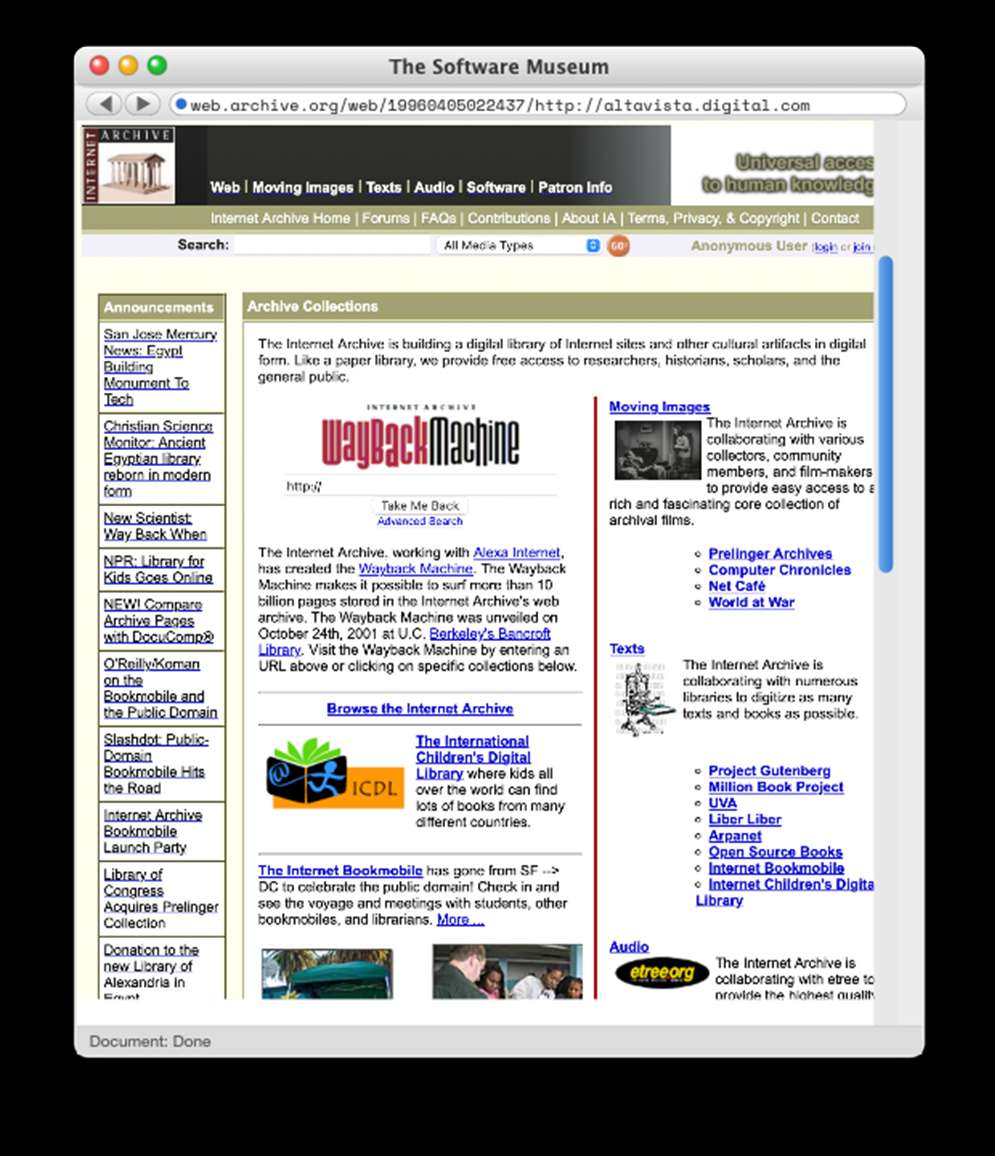
Kahle’s concern in the face of this ephemerality — where entire websites could vanish overnight when a domain expired or content was overwritten without any backup — was twofold: to safeguard this living trove humanity was creating on the go, and to make it accessible. To combat the web’s average 75-day lifespan and the dreaded “404 Document not found” error, the Internet Archive launched the Wayback Machine in 2001 and began taking snapshots of websites.
The Wayback Machine preserves the internet via automated web crawlers that browse and capture pages, links, images, and other resources, storing them as WARC (Web ARChive) files with timestamps. These files are then stored in the Archive’s proprietary Petabox clusters, spread across data centers in California. The Machine does not serve the internet in China, North Korea, Russia, or Iran, blocked by the Great Firewall and state internet controls. A joint effort between Internet Archive and Alexa Internet, it was named after the time-traveling “WABAC machine” from the 1960s Rocky and Bullwinkle cartoon segment “Mr. Peabody’s Improbable History.” In its 25 years, the Wayback Machine has made the Internet nearly permanent and searchable. It has archived over a trillion pages; its “Save Page Now” feature allows users to simply enter a URL and select a date from the calendar interface for on-demand captures. The archive serves historians, journalists, researchers, and everyday users alike. Its earliest and most widely cited capture dates to May 10, 1996, a landing page promoting Microsoft’s Internet Explorer.
As crawlers indexed the early internet, they kept encountering downloadable software; as the digital world expanded, software became integral to how people lived and worked. The same problem — ephemerality — that plagued the web applied even more strongly to software. Websites show what information people are sharing, but software reveals how people work, play, communicate, and create. The record runs from the productivity revolution of the 1980s (word processors, spreadsheets) to the creative explosion of the shareware era (Doom’s free episodes) to the first graphical user interfaces (Windows 3.1) that reshaped personal computing. Software programs, collections of code that tell a computer what to do, depend on an ecosystem: the specific hardware and operating systems they run on, both of which eventually become obsolete. And a digital artifact cannot be preserved like a physical artifact, behind glass in a museum. If any part of the ecosystem disappears, the software can become inaccessible — even if the original files still exist.
The first step in the preservation of software is acquisition: gathering the software files and the physical objects that make them work, including floppy disks, CDs, cartridges, and manuals from their original developers. These physical materials provide cultural context, showing how the software worked, and how people used and understood it at the time of its creation. Many early software programs were distributed on physical media that modern computers no longer support — a 5.25-inch floppy disk from the 1980s holding a spreadsheet program like VisiCalc, for example. The Archive’s acquisitions rely heavily on donations and targeted rescues. Its large stock of old hardware allows the Archive to run and experiment with software found online or on abandoned machines.
Digitization follows: converting physical software into accessible digital formats, typically bit-for-bit disk images (.img, .iso, for example). These images can be stored, duplicated, and protected from bit rot — the gradual, expected degradation of digital media — without damaging the original artifact. Digitization also curbs reliance on increasingly rare hardware and lets the Archive replicate software across its data centers. The Archive has digitized thousands of such items, often with help from volunteers and curators. It returns the digital copy to the original holder and makes its own copy available to patrons worldwide, one borrower at a time.
But a preserved file is not the same as a preserved experience; this is where the third step, emulation, becomes essential. Emulation recreates the environment that the software originally ran on, imitating the behavior of outdated hardware and operating systems, making it possible for modern users to interact with software in a way that resembles the original experience. A game built for an early home computer, for instance, needs specific graphics hardware. But an emulator can recreate that hardware in modern code, letting the game run decades after its original machinery has become obsolete.
The Internet Archive pioneered widespread in-browser emulation in 2013 with the Emularity framework and JavaScript ports of emulators such as MAME (Multiple Arcade Machine Emulator), which recreate classic arcade cabinets and vintage computer systems. The collection has since grown to accommodate more than 250,000 playable items, letting users run everything from Apple II titles and early Macintosh software to arcade games and console classics directly in a browser. The Archive’s “Console Living Room” houses games like Magnavox Odyssey² (1978) and the Atari 2600 (1977).
Emulation makes the difference between software preservation and simple data storage obvious. Saving a file or a webpage preserves its code and images; preserving software means preserving the entire system that made it run. A piece of software, then, is an artifact shaped by the time and culture around it.
The final part of software preservation is metadata and organization. Every program needs a record of its origins: who created it, when it was released, what systems it ran on, which versions existed, and what historical significance it holds. Archive entries include scanned manuals, box art, magazine ads, and curator notes to supply that context.
In retrospect, Kahle’s original question was deceptively simple: how do we make the human digital record last?
In a 2009 interview with Wired, Kahle said: “For the cost of 60 miles of highway, we can have a 10 million-book digital library available to a generation that is growing up reading on-screen. Our job is to put the best works of humankind within reach of that generation.”
The Internet Archive is housed in a former Christian Science church, a marble building with pillars and grand doorways at 300 Funston Avenue in San Francisco’s Richmond District. The building also holds vintage media objects like videocassettes and microfilms, and the Archive runs active collaborations for digital image and video preservation with institutes like the Metropolitan Museum and NASA. Its Open Library project, started by Kahle and the late Aaron Swartz, aims to create a simple webpage for “every book ever published.” Its Historical Software Collection spans millions of programs and terabytes of data; subcollections like MS-DOS Games make it the world’s largest vintage and historical software library, a living, playable museum of computing history. Curators like Jason Scott, along with countless contributors, have turned hard drives and Laser Discs into accessible cultural heritage. Today, the Archive is open to the public, with free tours most Friday afternoons — reportedly led, on occasion, by Kahle himself.
The work of the Internet Archive rests on the hard truth that the digital world we keep building was never meant to last. Much of what has made the Archive’s collection possible is donated, proof that preserving the human digital record is not a passive process but a continual act of stewardship.
Technology
•
A Memory Palace for Software
San Francisco’s Internet Archive.
In a 1996 essay for Scientific American, Brewster Kahle laid out his plan for preserving the Internet. He noted, “Where we can read the 400-year old books printed by Gutenberg, it is often difficult to read a 15 year-old computer disk.” At the time of his writing, web pages had an average lifespan of just 75 days — most sites lived on temporary personal accounts, university servers, small ISP hosting, or short-lived commercial setups — and storage hardware was “rare and specialized because of costs.” A webpage could vanish the moment a server shut down, or if a file format became obsolete — a single company’s collapse meant a webpage could be lost forever. The Internet was very quickly becoming a record of human knowledge and culture, yet there was no guarantee that this ever-increasing record would survive.
That same year, Brewster Kahle went on to found the Internet Archive, his Library of Alexandria for the digital age. Kahle, a computer science and engineering graduate, had spent his time at MIT immersed in the then nascent field of Artificial Intelligence. He graduated in 1981 and, only two years later, helped Daniel Hillis start the Thinking Machines Company (TMC) in 1983.
TMC was one of the first companies created solely for the purpose of creating artificial intelligence. Hillis’ idea was parallelism: rather than using one fast processor, computer scientists would be better off using thousands of simple processors working in parallel. This contrarian enterprise attracted the likes of Richard Feynman, Marvin Minsky and Stephen Wolfram, but its approach to AI never delivered. TMC filed for bankruptcy in 1994. Still, they showed that parallelism could work at mass scale, effectively laying the groundwork for GPUs and the subsequent AI revolution. During this time at TMC, Kahle also helped invent WAIS (Wide Area Information Server) in 1989 — one of the Internet’s earliest search and document retrieval systems, and a precursor to the modern web search.
After leaving TMC in 1989, Kahle founded WAIS Inc. with Bruce Gilliat to bring the search and document retrieval technology to market. The firm sold Internet publishing tools and services to clients like Encyclopaedia Britannica and The New York Times, helping bring their massive databases of billions of words to the Internet. WAIS Inc. was purchased by America Online in 1995 for $15 million.
In the book Founders at Work: Stories of Startups’ Early Days, Kahle reminisces, “My first startup upon leaving Thinking Machines was a bootstrap. We had no investment at all, and I had no savings, so it was self-funded from the beginning…It was sort of like going from the Roaring ‘20s, when champagne is coming from everywhere, into the depression, where you are washing your baggies and reusing twist ties.”
Kahle was driven by what he foresaw: the early Internet carried with it a looming risk of massive cultural loss, akin to the burning of the Library of Alexandria, the loss of early films (recycled for silver), and discarded early printed works. To keep it all from disappearing, he cofounded two organizations: Alexa Internet, and, again with Gilliat, the non-profit Internet Archive. Alexa crawled the web to provide traffic-based recommendations and was acquired by Amazon in 1999 for $250 million in stock.
The Internet Archive, headquartered in San Francisco, California, is today the world’s largest free public digital library. It preserves the history of the web through its archive of more than a trillion internet pages, and hosts millions of digitized books, texts, videos — along with one of the world’s largest collections of software, including rare, vintage, and obsolete programs.
Kahle’s concern in the face of this ephemerality — where entire websites could vanish overnight when a domain expired or content was overwritten without any backup — was twofold: to safeguard this living trove humanity was creating on the go, and to make it accessible. To combat the web’s average 75-day lifespan and the dreaded “404 Document not found” error, the Internet Archive launched the Wayback Machine in 2001 and began taking snapshots of websites.
The Wayback Machine preserves the internet via automated web crawlers that browse and capture pages, links, images, and other resources, storing them as WARC (Web ARChive) files with timestamps. These files are then stored in the Archive’s proprietary Petabox clusters, spread across data centers in California. The Machine does not serve the internet in China, North Korea, Russia, or Iran, blocked by the Great Firewall and state internet controls. A joint effort between Internet Archive and Alexa Internet, it was named after the time-traveling “WABAC machine” from the 1960s Rocky and Bullwinkle cartoon segment “Mr. Peabody’s Improbable History.” In its 25 years, the Wayback Machine has made the Internet nearly permanent and searchable. It has archived over a trillion pages; its “Save Page Now” feature allows users to simply enter a URL and select a date from the calendar interface for on-demand captures. The archive serves historians, journalists, researchers, and everyday users alike. Its earliest and most widely cited capture dates to May 10, 1996, a landing page promoting Microsoft’s Internet Explorer.
As crawlers indexed the early internet, they kept encountering downloadable software; as the digital world expanded, software became integral to how people lived and worked. The same problem — ephemerality — that plagued the web applied even more strongly to software. Websites show what information people are sharing, but software reveals how people work, play, communicate, and create. The record runs from the productivity revolution of the 1980s (word processors, spreadsheets) to the creative explosion of the shareware era (Doom’s free episodes) to the first graphical user interfaces (Windows 3.1) that reshaped personal computing. Software programs, collections of code that tell a computer what to do, depend on an ecosystem: the specific hardware and operating systems they run on, both of which eventually become obsolete. And a digital artifact cannot be preserved like a physical artifact, behind glass in a museum. If any part of the ecosystem disappears, the software can become inaccessible — even if the original files still exist.
The first step in the preservation of software is acquisition: gathering the software files and the physical objects that make them work, including floppy disks, CDs, cartridges, and manuals from their original developers. These physical materials provide cultural context, showing how the software worked, and how people used and understood it at the time of its creation. Many early software programs were distributed on physical media that modern computers no longer support — a 5.25-inch floppy disk from the 1980s holding a spreadsheet program like VisiCalc, for example. The Archive’s acquisitions rely heavily on donations and targeted rescues. Its large stock of old hardware allows the Archive to run and experiment with software found online or on abandoned machines.
Digitization follows: converting physical software into accessible digital formats, typically bit-for-bit disk images (.img, .iso, for example). These images can be stored, duplicated, and protected from bit rot — the gradual, expected degradation of digital media — without damaging the original artifact. Digitization also curbs reliance on increasingly rare hardware and lets the Archive replicate software across its data centers. The Archive has digitized thousands of such items, often with help from volunteers and curators. It returns the digital copy to the original holder and makes its own copy available to patrons worldwide, one borrower at a time.
But a preserved file is not the same as a preserved experience; this is where the third step, emulation, becomes essential. Emulation recreates the environment that the software originally ran on, imitating the behavior of outdated hardware and operating systems, making it possible for modern users to interact with software in a way that resembles the original experience. A game built for an early home computer, for instance, needs specific graphics hardware. But an emulator can recreate that hardware in modern code, letting the game run decades after its original machinery has become obsolete.
The Internet Archive pioneered widespread in-browser emulation in 2013 with the Emularity framework and JavaScript ports of emulators such as MAME (Multiple Arcade Machine Emulator), which recreate classic arcade cabinets and vintage computer systems. The collection has since grown to accommodate more than 250,000 playable items, letting users run everything from Apple II titles and early Macintosh software to arcade games and console classics directly in a browser. The Archive’s “Console Living Room” houses games like Magnavox Odyssey² (1978) and the Atari 2600 (1977).
Emulation makes the difference between software preservation and simple data storage obvious. Saving a file or a webpage preserves its code and images; preserving software means preserving the entire system that made it run. A piece of software, then, is an artifact shaped by the time and culture around it.
The final part of software preservation is metadata and organization. Every program needs a record of its origins: who created it, when it was released, what systems it ran on, which versions existed, and what historical significance it holds. Archive entries include scanned manuals, box art, magazine ads, and curator notes to supply that context.
In retrospect, Kahle’s original question was deceptively simple: how do we make the human digital record last?
In a 2009 interview with Wired, Kahle said: “For the cost of 60 miles of highway, we can have a 10 million-book digital library available to a generation that is growing up reading on-screen. Our job is to put the best works of humankind within reach of that generation.”
The Internet Archive is housed in a former Christian Science church, a marble building with pillars and grand doorways at 300 Funston Avenue in San Francisco’s Richmond District. The building also holds vintage media objects like videocassettes and microfilms, and the Archive runs active collaborations for digital image and video preservation with institutes like the Metropolitan Museum and NASA. Its Open Library project, started by Kahle and the late Aaron Swartz, aims to create a simple webpage for “every book ever published.” Its Historical Software Collection spans millions of programs and terabytes of data; subcollections like MS-DOS Games make it the world’s largest vintage and historical software library, a living, playable museum of computing history. Curators like Jason Scott, along with countless contributors, have turned hard drives and Laser Discs into accessible cultural heritage. Today, the Archive is open to the public, with free tours most Friday afternoons — reportedly led, on occasion, by Kahle himself.
The work of the Internet Archive rests on the hard truth that the digital world we keep building was never meant to last. Much of what has made the Archive’s collection possible is donated, proof that preserving the human digital record is not a passive process but a continual act of stewardship.
About the Author
Zaitoon Zafar is a junior editor at Arena Magazine. She can be found on X at: @zaitoonx.