tt
tt
tt
tt
tt
tt

Civilization
•
Treasure Hunting
Trillions of dollars of critical minerals are sitting on the sea floor. The US and China are racing to get them first.


Sometime in late April of this year, a coal-black rock the size of a potato was placed on the Resolute Desk in the Oval Office. Known as a polymetallic nodule, the rock had formed over millions of years as minerals accreted around an organic fragment — a shark tooth, a bone — and came to rest, loose and exposed, on the floor of the Pacific Ocean. Gerard Barron, the Australian CEO of The Metals Company, carried the rock in his jacket pocket and presented it to President Trump as a gift.
The Metals Company, based in Vancouver, British Columbia, was seeking permission from the US government to mine the 38 different elements contained in polymetallic nodules. Barron calls the nodules “batteries in a rock” because they contain many of the critical minerals needed to manufacture batteries, including nickel, cobalt, and manganese.
The target for this mining is a 104.5 million acre stretch of seabed between Mexico and Hawaii known as the Clarion-Clipperton Zone (CCZ), where US Geological Survey estimates suggest deposits contain more nickel, cobalt, and manganese than all known worldwide land-based reserves combined. The full CCZ is estimated to contain up to 30 billion metric tons of nodules — a deposit, at current valuations, worth up to $18.4 trillion.
The Metals Company plans to vacuum these nodules from the seafloor using robotic collector vehicles, haul them to the surface, and ship them to shore for processing into battery-grade metals for electric vehicles (EV) and battery energy storage systems (BESS), large-scale installations that store electricity for grid use. EV and BESS are the core hardware of electrification, the wholesale replacement of fossil fuel systems with electric ones.
Due to EV and BESS adoption, critical minerals demand is accelerating beyond what the existing supply system was designed to handle. The EV industry required 2.2 million tons of nickel, manganese, lithium, iron, graphite, and cobalt to supply newly sold EV batteries in 2024, when EVs comprised roughly 20% of global new car sales. By 2035, EVs could account for as much as 70% of global new car sales. The critical minerals supply system has no plausible path to keeping pace.
In the US alone there are 570 gigawatts of BESS projects in interconnection queues waiting to be added to the grid. That queued capacity is equivalent to enough to power roughly 513 million American homes. The International Energy Agency (IEA) has projected that demand for battery metals could grow by a factor of 30 by 2040 from 2024 levels.
A recently published report by the energy think tank Ember put the levelized cost of storage (LCOS) for utility-scale battery systems at $65 per megawatt-hour (MWh) in globally competitive markets. For comparison, new nuclear capacity in the United States runs between $130 and $230 MWh. New-build combined-cycle gas turbines have seen equipment prices rise sharply, driven in part by demand from AI data centers, pushing their global levelized cost to $102 per MWh, the highest on record, according to a Bloomberg New Energy Finance report published this year.
Meanwhile, battery storage is moving in the opposite direction. BNEF projects that BESS hardware costs will fall another 35–55% by 2035. At that level, the economic case for new gas-fired power plants collapses because storage can undercut gas on price while performing the same grid-balancing function. But this plummeting cost curve assumes a steady flow of raw materials, an assumption that currently rests on shaky ground.
The biggest risk to this energy transition is a lack of mines. The IEA estimates the world needs 80 new copper mines, 70 new lithium mines, and 70 new nickel mines to meet projected demand. Historically new copper mines take 15-20 years or longer to come online. Closing this gap through conventional mining alone is functionally impossible.
New battery chemistries are expected to reduce reliance on critical minerals, recycling is supposed to supply a growing share of demand, and substitution can ease pressure on constrained inputs. But none of it moves fast enough. Recycling cannot expand meaningfully until there is a large volume of end-of-life material — a large stock of dead batteries — to recycle.
Substitution brings performance tradeoffs, especially in applications where conductivity and energy density matter, and those limits show up quickly in practice. Demand forecasts for critical minerals may turn out to be somewhat overstated, but even conservative scenarios still imply a supply gap that is difficult to close with land-based mining alone. The problem is time.
The structural supply shortage of the materials we need to electrify our economies will redraw the map of global power. Instead of Saudi Arabia and other petrostates holding the world politically hostage, power could shift to what we might call electrostates that possess or control the critical minerals needed for electrification. The inversion is already underway. Argentina, Bolivia, Chile, and Brazil, which together hold roughly 65% of the world’s lithium reserves, have floated creating a “lithium OPEC” to control the market. Saudi Arabia has announced plans to invest $100 billion in critical minerals mining projects over the next decade.
The largest electrostate is China. Chinese companies control significant shares of global cobalt and manganese extraction in Africa and elsewhere and have locked up supply through overseas mining investments as part of a deliberate industrial strategy. A single Chinese company, CMOC, accounts for 24% of the world’s cobalt mining, while two Chinese firms, Isky New Minerals and Guizhou Dalong Huichen, each control more than 20% of the global manganese market China is also the dominant refiner for 19 of the 20 minerals analyzed in the IEA’s Global Critical Minerals Outlook 2025. The country manufactures more than 80% of the world’s finished batteries and controls over 98% of lithium iron phosphate battery cell production, the cobalt-free chemistry that has become the dominant and fastest-growing battery type globally.
What Barron was offering President Trump, in his own words, was “an amazing way of catching up from what is a very distant second place to China when it comes to critical minerals.” Four days after that Oval Office meeting, Trump signed an executive order directing the US government to expedite seabed mining licenses in international waters, unilaterally stepping outside the framework of the International Seabed Authority, the UN body that has ostensibly governed the ocean floor since 1994, and the Law of the Sea Convention that underpins it.
China’s foreign ministry condemned the move as a violation of international law, but this condemnation carried more than a little hypocrisy because Beijing has been more aggressive than any other national government in pursuing deep-sea mining. It is a bit like complaining someone is planning to rob the bank that your crew has already been casing.
Polymetallic nodules were first discovered in the Atlantic Ocean off the Canary Islands in 1873 by the British HMS Challenger expedition. The chief scientist on board wrote of the discovery in the scientific journal Nature, but the rocks were regarded as novelties and sent to the British Museum in London for display.
Deep-sea mining wasn’t seriously considered as a commercial proposition until 1965, when John Mero, a geologist at the University of California, published The Mineral Resources of the Sea. The book, combined with Cold War superpower resource competition and Space Age technological optimism, created widespread interest in deep-sea mining.
In 1967, Arvid Pardo, Malta’s ambassador to the UN, pushed for international regulations that would treat the deep seabed as the “common heritage of mankind” after learning about deep-sea mining at a cocktail party. In Pardo’s vision, deep-sea mineral extraction would finance utopian underwater cities where humans would be protected by air bubble curtains and farm fish, with trained dolphins acting as sheepdogs. He got something rather different. Due to Pardo’s efforts, the UN declared the seabed beyond national jurisdiction in 1970, with these principles codified in the 1982 UN Convention on the Law of the Sea — a treaty Pardo would later call “probably the most inequitable that has ever been signed in the world,” the common heritage of mankind having been reduced, in his words, to “a few fish and a little seaweed.”
Interest in deep-sea mining peaked during the 1973-1974 Arab oil embargo period, when commodities experienced a price “superspike.” Gasoline prices that had been hovering around 34 cents per gallon pre-embargo shot up to 84 cents per gallon, and the price of gold, freed from its fixed exchange rate after Nixon abandoned the gold standard, surged from $42 per troy ounce in 1973 toward $200 by mid-decade.
Aiming to increase supply, the defense contractor Lockheed and Standard Oil of Indiana (Amoco) began pilot mine testing in the CCZ (the nodule-rich stretch of Pacific seabed between Mexico and Hawaii) at that time; Lockheed still owns CCZ leases today. In 1970, the CIA recruited the eccentric billionaire Howard Hughes to provide a cover story that he was building a deep-sea mining vessel called the Hughes Glomar Explorer to explore the CCZ. The ship was actually built as part of Project Azorian to recover a Soviet ballistic missile sub that had sunk to 16,500 feet beneath the ocean near Hawaii. The Los Angeles Times uncovered the plot in 1975 and when journalists pressed the CIA, it issued the now famous response “it could neither confirm nor deny” the allegations.
The Howard Hughes scandal marked the high point of 20th-century interest in deep-sea mining, which would collapse along with the prices of metals in the post oil embargo period. Until recently, there was never enough of a sustained economic “why” to pursue it. The rise of electrostates and the US-China superpower competition is changing these dynamics. But economic and ecological risks remain constraints on development. The deep ocean is the largest habitat on earth and the least understood. Humans have mapped more of the surface of Mars than the floor of the Pacific.
At 13,000 feet underwater, in permanent cold and dark, ecosystems have organized themselves around the nodule fields over billions of years. Xenophyophores — single-celled organisms that can reach the size of a dinner plate and rank among the largest individual cells on earth — live on and around the nodule fields, many attached directly to the rocks themselves, using sediment to construct protective coverings. So do sea cucumbers, brittle stars, and fish species never formally catalogued. Of the estimated 10 million species thought to inhabit the deep sea, fewer than a quarter have been formally identified. Roughly 90% of the species that have been collected on surveys of the CCZ have been previously unknown.
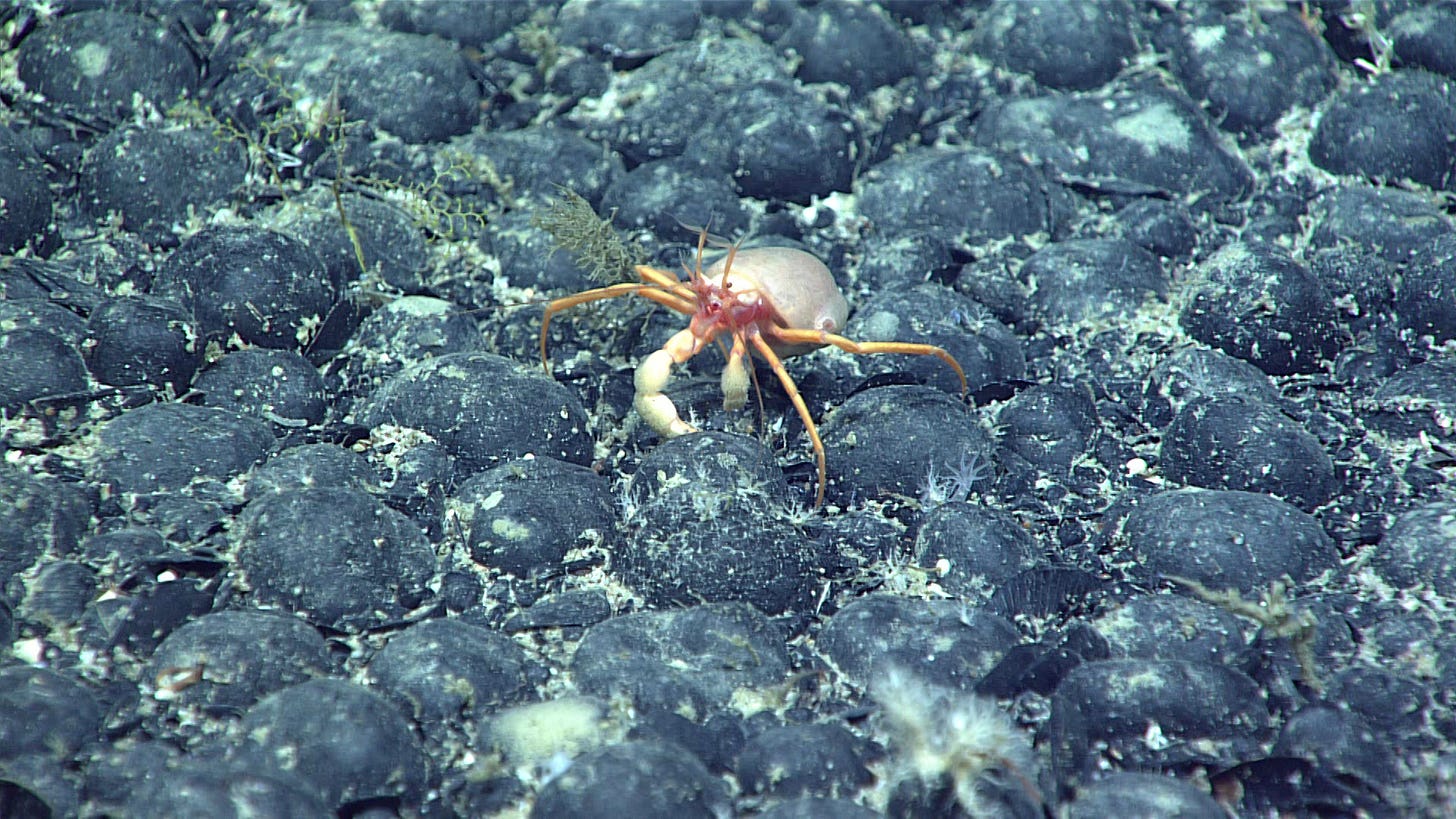
Parapagurus crabs with corals of the genus Epizoanthus on their backs. These “blanket-hermit crabs” were seen throughout Dive 16 of the 2021 North Atlantic Stepping Stones expedition. The more movable ferromanganese nodule field encountered during the dive also had a selection of smaller fauna, such as sponges, stalked and unstalked crinoids, isopods, stalked tunicates, worm tubes, and chitons. Source: NOAA
Many of these species exist in an environment once assumed to be incapable of supporting life. The hydrothermal vent ecosystems discovered in 1977 rewrote the basic biology of what life requires to survive, demonstrating that an ecosystem could run entirely on chemical energy rather than sunlight. Those same vent sites sit atop seafloor massive sulphides (SMS), deposits where heat from the vents precipitates copper, gold, zinc, nickel, and rare earths from the surrounding rock.
The extraction methods available to date have been ecologically destructive. Nodule collector vehicles are lowered from surface ships on umbilical cables stretching miles to the ocean floor, where they crawl under remote guidance, vacuuming up nodules and pumping them to the surface as slurry. The deep sea is a system built around near-total stability featuring creatures adapted over millions of years to an environment without disturbance, without light, almost without food. Mining vehicles run like underwater tanks across that floor, generating sediment plumes that travel hundreds of miles. When the plumes settle, they blanket the seafloor in fine particulate that smothers filter feeders and disrupts the “marine snow,” the slow drift of organic matter from ocean surface to floor, that sustains the deep-sea food system. Scars from a 1970 test off North Carolina are still visible today and nothing has grown back since.
Mining seafloor massive sulphides could look like demolition. Remote-operated machines would cut and grind the deposits, breaking apart chimney structures and surrounding rock, then pump the material to the surface as slurry through long riser pipes. In doing so, the miners would remove the physical foundation of vent ecosystems, which depend on those structures and exist nowhere else. The cutting process also stirs up sediment plumes, while discharge from the surface can spread finer particles through the water column over uncertain distances. Disturbing the deposits can also release dissolved metals into the surrounding water, changing local chemistry and ecosystems.
Any environmental concerns must be balanced with the reality that open-pit mining is more ecologically destructive than the methods proposed by Western deep-sea mining companies; open-pit mining projects are mostly located in countries with weaker environmental protections than the international frameworks governing the CCZ. The relevant comparison here is between different forms of mineral extraction, because extraction is necessary and environmental costs can only be mitigated, not eliminated.
Deep-sea mining’s economics have been equally challenging. A commercial-scale operation demands billions in upfront capital: specialized ships, seafloor robots, vertical lift systems, and processing infrastructure that, in most cases, has yet to be proven at scale. Even under favorable assumptions, production costs for nickel equivalents run $2,500 to $3,000 per tonne, which only works if commodity prices hold. They rarely do. Cobalt and manganese markets are thin enough that a single large operation could flood supply and crater the price of the metal it’s selling. The deposit rich enough to justify the capital cost may be too rich to sell into.
But the projected demand for critical minerals is so great, and the competition for control of these resources so intense, that the constraints which once foreclosed deep-sea mining may no longer hold.
“Copper is the new oil,” according to Robert Friedland, a legendary mining industry figure and one of the first investors in Apple. Copper is why the economics of deep-sea mining are becoming newly compelling.
As battery chemistry evolves, dependence on metals like cobalt and, to a lesser extent, manganese is already being engineered out. Copper, on the other hand, has no real substitute. It’s also embedded in virtually every system that carries an electrical current. Aluminum can displace it in some applications, particularly long-distance transmission, but its lower conductivity and higher losses limit its use in motors, electronics, and dense grid infrastructure. Copper remains what industry analysts call the “metal of electrification.”
By 2035, copper demand could exceed supply by 6 to 10 million tonnes a year, widening toward the mid-tens of millions by 2040 as demand approaches 50 million tonnes. Closing that gap through conventional mining alone would require 80 new mines and $500 billion or more in capital, with each mine taking 15 to 20 years to develop — a timeline that makes the math functionally impossible.
At sustained deficit levels, some commodity analysts project copper prices rising toward $15,000 per metric ton, against a historical range of $6,000 to $9,000. At those prices, sources of supply that were previously uneconomic begin to look different. Geological estimates suggest seafloor massive sulphide systems could contain over a billion tons of copper in-place, theoretically exceeding all known land-based reserves, with potential annual output from developed deposits exceeding 10 million tons.
The copper deficit is ultimately a problem of construction — enough mines, enough capital, enough time. Heavy rare earths are a problem of a different kind, one that no amount of new mining outside Chinese territory has yet solved. Dysprosium and terbium, the elements used in high-performance magnets for motors, wind turbines, and defense systems, have no substitutes and almost no supply chain outside Chinese control. The deposits exist elsewhere, mainly in Myanmar, but Myanmar’s output flows almost entirely into Chinese refineries. China controls roughly 91% of global separation and refining capacity for magnet rare earths, meaning material mined outside China typically must be sent there for processing.
Extracting even a modest volume of heavy rare earths from the seabed becomes compelling when the alternative is the shutdown of your country’s advanced manufacturing. Japan has been pushing this for years. Government-backed researchers identified large deposits near Minamitorishima, Japan’s easternmost territory, and a 2024 pilot-scale extraction program has since transitioned into a multi-year feasibility study, proving that heavy rare earth enrichment in deep-sea mud is technically, if not yet commercially, viable. The deposits are diffuse and require processing large volumes of sediment, but they offer a path to supply beyond China’s control.
China has leveraged REE as part of disputes with both the US and Japan and will do so again. As former Chinese supreme leader Deng Xiaoping put it: “The Middle East has oil; China has rare earths.”
Until recently, China’s strategy was to secure control over critical minerals through land-based investments, particularly in Africa. Since 2000, it has extended roughly $180 billion in loans across the continent, much of it tied to infrastructure and resource projects. It has since been forced to absorb tens of billions of dollars in losses, restructurings, and write-downs as projects underperformed or governments pushed to renegotiate terms.
In 2021, 3.5 million documents from the private Congolese bank BGFI were leaked to the French outlet Mediapart in an investigation known as the “Congo Hold-Up.” The documents showed that at least $138 million in public funds drawn from the central bank, the state mining company, and other institutions were funneled through networks linked to former DRC President Joseph Kabila and his family during the period when major resource deals were negotiated. The leak triggered a political and legal backlash in the DRC, with authorities reopening contracts and courts moving to assert greater state control over key assets — including one of the world’s largest cobalt deposits —while allegations involving the Chinese operators were investigated.
There is no hard evidence of CIA or other Western intelligence service involvement in the leak, but the access to this level of secret information and the fact that the leak was through the Western press is a strong indicator that intelligence services were involved. A year after the leak was published, China reversed course on deep-sea mining, a position it had resisted for decades. Beijing’s calculation had changed because land-based mineral strategies in Africa were proving expensive, politically unstable, and increasingly exposed.
China now holds more deep-sea exploration licenses than any other country and has built a large fleet of research and survey vessels operating across the Pacific and Indian Oceans. In June 2024, the survey ship Xiang Yang Hong 3 deployed the Kaituo II prototype mining vehicle for polymetallic crust and nodule tests at depths exceeding 4,000 meters in the western Pacific, in an area southeast of Taiwan where Chinese and Philippine continental-shelf claims overlap. Beijing Pioneer Hi-Tech Development Corporation, a state-owned enterprise under China’s Ministry of Natural Resources, has also announced a 2025 test collection in a western Pacific license area adjacent to Japan’s continental shelf near Minamitorishima.
China’s deep-sea mining push mirrors its approach to fishing, where it has been vacuuming up much of the world’s supply. The country operates the world’s largest distant-water fishing fleet, with estimates ranging into the thousands of vessels; between 2022 and 2024, Chinese vessels accounted for about 44% of global fishing activity and operated in over 90 countries’ waters, a scale that has fueled repeated accusations of illegal, unreported, and unregulated fishing, as well as environmental damage and labor abuses.
The appeal of deep-sea mining to China, which prizes self-sufficiency above all else, is apparent. The ocean asks nothing of you. Unlike developing nations, the ocean won’t attempt to nationalize your assets or default on a loan or hold elections with unpredictable consequences for your investments.
In the March 2026 issue of Qiushi, the Chinese Communist Party’s top theoretical journal, an editorial declared “The 21st century is the century of the ocean; whoever wins the ocean wins the future. China is one of the earliest nations in the world to develop and utilize the ocean ... We must deeply implement Xi Jinping’s vision to build a maritime power.”
Minerals are not the only thing China’s survey ships are looking for. In March, 2026, Admiral Mike Brookes of the US Office of Naval Intelligence told a congressional commission that Chinese research vessel activity provides data that “enables submarine navigation, concealment, and positioning of seabed sensors or weapons.” That same month, a CNN investigation found that eight Chinese state-owned vessels tied to deep-sea mining research spent relatively little time in China’s licensed mining blocks and considerably more time in the strategically sensitive waters around Taiwan, Guam, and elsewhere.
If the Chinese pursue deep-sea mining as part of an integrated strategy to control the world’s oceans, the US must treat it as a mandatory theatre of competition.
On the West Coast of North America, startups are attacking the dual problems of deep-sea mining’s economic and environmental challenges.
The Metals Company’s PATANIA III collector vehicle uses hydraulic suction to skim nodules from the seafloor rather than the bulldozing motion of earlier prototypes, reducing sediment disturbance by roughly 90%. TMC has also committed to preservation reference zones — areas of comparable seafloor left unmined — to maintain an ecological baseline and allow scientists to measure whether recovery is possible on any human timescale.
The Bay Area startup Impossible Metals, which announced plans to raise $1 billion last year, is working from a different premise. Its EUREKA vehicle hovers above the seafloor, using computer vision to identify individual nodules before retrieving them with a precision arm, one at a time, avoiding nodules with visible organisms attached. In trials it has operated with near-zero sediment contact. The tradeoff is throughput — selective collection cannot match the volume economics of hydraulic systems, and the company is betting advances in autonomy will close that gap.
Thomas Peacock, an MIT mechanical engineering professor, recently testified to Congress that sediment plume risk was minor or “roughly the equivalent to the grains of sand in a fishbowl.”
Both companies still introduce light, noise, and electromagnetic disturbance into environments dark and quiet for billions of years. The constraint is epistemological: there is no way of knowing what damage you are causing to an ecosystem nobody fully understands.
China isn’t asking these questions, and that asymmetry has a cost. Western deep-sea mining operates under public and regulatory scrutiny that Chinese state-backed operations do not face. If early commercial projects generate footage of sediment plumes blanketing the seafloor, the political backlash could produce moratoria that freeze the Western program for years while China continues unimpeded. The environmental methods TMC and Impossible Metals are pursuing are a condition of Western participation in deep-sea mining. Steamrolling the seafloor is a strategy available to Beijing but it is not obviously available to Washington.
The Trump administration is pushing forward regardless. NOAA and the Bureau of Ocean Management are accelerating permitting. In late March, the US and Japan signed a memorandum of cooperation to jointly advance deep-sea mining.
What happens next may not be decided by Barron or any of the entrepreneurs who spent a decade trying to convince the world the ocean floor was worth developing. Rio Tinto, Glencore, and BHP — the companies with the capital and operational scale to run deep-sea mining at volume — have watched from a careful distance. If the executive orders succeed in validating the legal framework and de-risking the first commercial licenses, the likely outcome is that major industrial players absorb or displace the startups that proved the concept.
Who extracts these minerals, and under what legal framework, will determine more about the next century than most of the decisions being made in Washington right now. A CCZ developed under American legal frameworks produces a different world than one developed under Chinese state direction, with output flowing into Chinese refineries, Chinese battery factories, and Chinese defense supply chains.
The floor of the Pacific is the last great untapped resource extraction prize on Earth. Gerard Barron had to carry a rock to the Oval Office to make that case. China will be mining the sea floor next to Japan’s continental shelf later this year.
Civilization
•
Treasure Hunting
Trillions of dollars of critical minerals are sitting on the sea floor. The US and China are racing to get them first.
Sometime in late April of this year, a coal-black rock the size of a potato was placed on the Resolute Desk in the Oval Office. Known as a polymetallic nodule, the rock had formed over millions of years as minerals accreted around an organic fragment — a shark tooth, a bone — and came to rest, loose and exposed, on the floor of the Pacific Ocean. Gerard Barron, the Australian CEO of The Metals Company, carried the rock in his jacket pocket and presented it to President Trump as a gift.
The Metals Company, based in Vancouver, British Columbia, was seeking permission from the US government to mine the 38 different elements contained in polymetallic nodules. Barron calls the nodules “batteries in a rock” because they contain many of the critical minerals needed to manufacture batteries, including nickel, cobalt, and manganese.
The target for this mining is a 104.5 million acre stretch of seabed between Mexico and Hawaii known as the Clarion-Clipperton Zone (CCZ), where US Geological Survey estimates suggest deposits contain more nickel, cobalt, and manganese than all known worldwide land-based reserves combined. The full CCZ is estimated to contain up to 30 billion metric tons of nodules — a deposit, at current valuations, worth up to $18.4 trillion.
The Metals Company plans to vacuum these nodules from the seafloor using robotic collector vehicles, haul them to the surface, and ship them to shore for processing into battery-grade metals for electric vehicles (EV) and battery energy storage systems (BESS), large-scale installations that store electricity for grid use. EV and BESS are the core hardware of electrification, the wholesale replacement of fossil fuel systems with electric ones.
Due to EV and BESS adoption, critical minerals demand is accelerating beyond what the existing supply system was designed to handle. The EV industry required 2.2 million tons of nickel, manganese, lithium, iron, graphite, and cobalt to supply newly sold EV batteries in 2024, when EVs comprised roughly 20% of global new car sales. By 2035, EVs could account for as much as 70% of global new car sales. The critical minerals supply system has no plausible path to keeping pace.
In the US alone there are 570 gigawatts of BESS projects in interconnection queues waiting to be added to the grid. That queued capacity is equivalent to enough to power roughly 513 million American homes. The International Energy Agency (IEA) has projected that demand for battery metals could grow by a factor of 30 by 2040 from 2024 levels.
A recently published report by the energy think tank Ember put the levelized cost of storage (LCOS) for utility-scale battery systems at $65 per megawatt-hour (MWh) in globally competitive markets. For comparison, new nuclear capacity in the United States runs between $130 and $230 MWh. New-build combined-cycle gas turbines have seen equipment prices rise sharply, driven in part by demand from AI data centers, pushing their global levelized cost to $102 per MWh, the highest on record, according to a Bloomberg New Energy Finance report published this year.
Meanwhile, battery storage is moving in the opposite direction. BNEF projects that BESS hardware costs will fall another 35–55% by 2035. At that level, the economic case for new gas-fired power plants collapses because storage can undercut gas on price while performing the same grid-balancing function. But this plummeting cost curve assumes a steady flow of raw materials, an assumption that currently rests on shaky ground.
The biggest risk to this energy transition is a lack of mines. The IEA estimates the world needs 80 new copper mines, 70 new lithium mines, and 70 new nickel mines to meet projected demand. Historically new copper mines take 15-20 years or longer to come online. Closing this gap through conventional mining alone is functionally impossible.
New battery chemistries are expected to reduce reliance on critical minerals, recycling is supposed to supply a growing share of demand, and substitution can ease pressure on constrained inputs. But none of it moves fast enough. Recycling cannot expand meaningfully until there is a large volume of end-of-life material — a large stock of dead batteries — to recycle.
Substitution brings performance tradeoffs, especially in applications where conductivity and energy density matter, and those limits show up quickly in practice. Demand forecasts for critical minerals may turn out to be somewhat overstated, but even conservative scenarios still imply a supply gap that is difficult to close with land-based mining alone. The problem is time.
The structural supply shortage of the materials we need to electrify our economies will redraw the map of global power. Instead of Saudi Arabia and other petrostates holding the world politically hostage, power could shift to what we might call electrostates that possess or control the critical minerals needed for electrification. The inversion is already underway. Argentina, Bolivia, Chile, and Brazil, which together hold roughly 65% of the world’s lithium reserves, have floated creating a “lithium OPEC” to control the market. Saudi Arabia has announced plans to invest $100 billion in critical minerals mining projects over the next decade.
The largest electrostate is China. Chinese companies control significant shares of global cobalt and manganese extraction in Africa and elsewhere and have locked up supply through overseas mining investments as part of a deliberate industrial strategy. A single Chinese company, CMOC, accounts for 24% of the world’s cobalt mining, while two Chinese firms, Isky New Minerals and Guizhou Dalong Huichen, each control more than 20% of the global manganese market China is also the dominant refiner for 19 of the 20 minerals analyzed in the IEA’s Global Critical Minerals Outlook 2025. The country manufactures more than 80% of the world’s finished batteries and controls over 98% of lithium iron phosphate battery cell production, the cobalt-free chemistry that has become the dominant and fastest-growing battery type globally.
What Barron was offering President Trump, in his own words, was “an amazing way of catching up from what is a very distant second place to China when it comes to critical minerals.” Four days after that Oval Office meeting, Trump signed an executive order directing the US government to expedite seabed mining licenses in international waters, unilaterally stepping outside the framework of the International Seabed Authority, the UN body that has ostensibly governed the ocean floor since 1994, and the Law of the Sea Convention that underpins it.
China’s foreign ministry condemned the move as a violation of international law, but this condemnation carried more than a little hypocrisy because Beijing has been more aggressive than any other national government in pursuing deep-sea mining. It is a bit like complaining someone is planning to rob the bank that your crew has already been casing.
Polymetallic nodules were first discovered in the Atlantic Ocean off the Canary Islands in 1873 by the British HMS Challenger expedition. The chief scientist on board wrote of the discovery in the scientific journal Nature, but the rocks were regarded as novelties and sent to the British Museum in London for display.
Deep-sea mining wasn’t seriously considered as a commercial proposition until 1965, when John Mero, a geologist at the University of California, published The Mineral Resources of the Sea. The book, combined with Cold War superpower resource competition and Space Age technological optimism, created widespread interest in deep-sea mining.
In 1967, Arvid Pardo, Malta’s ambassador to the UN, pushed for international regulations that would treat the deep seabed as the “common heritage of mankind” after learning about deep-sea mining at a cocktail party. In Pardo’s vision, deep-sea mineral extraction would finance utopian underwater cities where humans would be protected by air bubble curtains and farm fish, with trained dolphins acting as sheepdogs. He got something rather different. Due to Pardo’s efforts, the UN declared the seabed beyond national jurisdiction in 1970, with these principles codified in the 1982 UN Convention on the Law of the Sea — a treaty Pardo would later call “probably the most inequitable that has ever been signed in the world,” the common heritage of mankind having been reduced, in his words, to “a few fish and a little seaweed.”
Interest in deep-sea mining peaked during the 1973-1974 Arab oil embargo period, when commodities experienced a price “superspike.” Gasoline prices that had been hovering around 34 cents per gallon pre-embargo shot up to 84 cents per gallon, and the price of gold, freed from its fixed exchange rate after Nixon abandoned the gold standard, surged from $42 per troy ounce in 1973 toward $200 by mid-decade.
Aiming to increase supply, the defense contractor Lockheed and Standard Oil of Indiana (Amoco) began pilot mine testing in the CCZ (the nodule-rich stretch of Pacific seabed between Mexico and Hawaii) at that time; Lockheed still owns CCZ leases today. In 1970, the CIA recruited the eccentric billionaire Howard Hughes to provide a cover story that he was building a deep-sea mining vessel called the Hughes Glomar Explorer to explore the CCZ. The ship was actually built as part of Project Azorian to recover a Soviet ballistic missile sub that had sunk to 16,500 feet beneath the ocean near Hawaii. The Los Angeles Times uncovered the plot in 1975 and when journalists pressed the CIA, it issued the now famous response “it could neither confirm nor deny” the allegations.
The Howard Hughes scandal marked the high point of 20th-century interest in deep-sea mining, which would collapse along with the prices of metals in the post oil embargo period. Until recently, there was never enough of a sustained economic “why” to pursue it. The rise of electrostates and the US-China superpower competition is changing these dynamics. But economic and ecological risks remain constraints on development. The deep ocean is the largest habitat on earth and the least understood. Humans have mapped more of the surface of Mars than the floor of the Pacific.
At 13,000 feet underwater, in permanent cold and dark, ecosystems have organized themselves around the nodule fields over billions of years. Xenophyophores — single-celled organisms that can reach the size of a dinner plate and rank among the largest individual cells on earth — live on and around the nodule fields, many attached directly to the rocks themselves, using sediment to construct protective coverings. So do sea cucumbers, brittle stars, and fish species never formally catalogued. Of the estimated 10 million species thought to inhabit the deep sea, fewer than a quarter have been formally identified. Roughly 90% of the species that have been collected on surveys of the CCZ have been previously unknown.
Parapagurus crabs with corals of the genus Epizoanthus on their backs. These “blanket-hermit crabs” were seen throughout Dive 16 of the 2021 North Atlantic Stepping Stones expedition. The more movable ferromanganese nodule field encountered during the dive also had a selection of smaller fauna, such as sponges, stalked and unstalked crinoids, isopods, stalked tunicates, worm tubes, and chitons. Source: NOAA
Many of these species exist in an environment once assumed to be incapable of supporting life. The hydrothermal vent ecosystems discovered in 1977 rewrote the basic biology of what life requires to survive, demonstrating that an ecosystem could run entirely on chemical energy rather than sunlight. Those same vent sites sit atop seafloor massive sulphides (SMS), deposits where heat from the vents precipitates copper, gold, zinc, nickel, and rare earths from the surrounding rock.
The extraction methods available to date have been ecologically destructive. Nodule collector vehicles are lowered from surface ships on umbilical cables stretching miles to the ocean floor, where they crawl under remote guidance, vacuuming up nodules and pumping them to the surface as slurry. The deep sea is a system built around near-total stability featuring creatures adapted over millions of years to an environment without disturbance, without light, almost without food. Mining vehicles run like underwater tanks across that floor, generating sediment plumes that travel hundreds of miles. When the plumes settle, they blanket the seafloor in fine particulate that smothers filter feeders and disrupts the “marine snow,” the slow drift of organic matter from ocean surface to floor, that sustains the deep-sea food system. Scars from a 1970 test off North Carolina are still visible today and nothing has grown back since.
Mining seafloor massive sulphides could look like demolition. Remote-operated machines would cut and grind the deposits, breaking apart chimney structures and surrounding rock, then pump the material to the surface as slurry through long riser pipes. In doing so, the miners would remove the physical foundation of vent ecosystems, which depend on those structures and exist nowhere else. The cutting process also stirs up sediment plumes, while discharge from the surface can spread finer particles through the water column over uncertain distances. Disturbing the deposits can also release dissolved metals into the surrounding water, changing local chemistry and ecosystems.
Any environmental concerns must be balanced with the reality that open-pit mining is more ecologically destructive than the methods proposed by Western deep-sea mining companies; open-pit mining projects are mostly located in countries with weaker environmental protections than the international frameworks governing the CCZ. The relevant comparison here is between different forms of mineral extraction, because extraction is necessary and environmental costs can only be mitigated, not eliminated.
Deep-sea mining’s economics have been equally challenging. A commercial-scale operation demands billions in upfront capital: specialized ships, seafloor robots, vertical lift systems, and processing infrastructure that, in most cases, has yet to be proven at scale. Even under favorable assumptions, production costs for nickel equivalents run $2,500 to $3,000 per tonne, which only works if commodity prices hold. They rarely do. Cobalt and manganese markets are thin enough that a single large operation could flood supply and crater the price of the metal it’s selling. The deposit rich enough to justify the capital cost may be too rich to sell into.
But the projected demand for critical minerals is so great, and the competition for control of these resources so intense, that the constraints which once foreclosed deep-sea mining may no longer hold.
“Copper is the new oil,” according to Robert Friedland, a legendary mining industry figure and one of the first investors in Apple. Copper is why the economics of deep-sea mining are becoming newly compelling.
As battery chemistry evolves, dependence on metals like cobalt and, to a lesser extent, manganese is already being engineered out. Copper, on the other hand, has no real substitute. It’s also embedded in virtually every system that carries an electrical current. Aluminum can displace it in some applications, particularly long-distance transmission, but its lower conductivity and higher losses limit its use in motors, electronics, and dense grid infrastructure. Copper remains what industry analysts call the “metal of electrification.”
By 2035, copper demand could exceed supply by 6 to 10 million tonnes a year, widening toward the mid-tens of millions by 2040 as demand approaches 50 million tonnes. Closing that gap through conventional mining alone would require 80 new mines and $500 billion or more in capital, with each mine taking 15 to 20 years to develop — a timeline that makes the math functionally impossible.
At sustained deficit levels, some commodity analysts project copper prices rising toward $15,000 per metric ton, against a historical range of $6,000 to $9,000. At those prices, sources of supply that were previously uneconomic begin to look different. Geological estimates suggest seafloor massive sulphide systems could contain over a billion tons of copper in-place, theoretically exceeding all known land-based reserves, with potential annual output from developed deposits exceeding 10 million tons.
The copper deficit is ultimately a problem of construction — enough mines, enough capital, enough time. Heavy rare earths are a problem of a different kind, one that no amount of new mining outside Chinese territory has yet solved. Dysprosium and terbium, the elements used in high-performance magnets for motors, wind turbines, and defense systems, have no substitutes and almost no supply chain outside Chinese control. The deposits exist elsewhere, mainly in Myanmar, but Myanmar’s output flows almost entirely into Chinese refineries. China controls roughly 91% of global separation and refining capacity for magnet rare earths, meaning material mined outside China typically must be sent there for processing.
Extracting even a modest volume of heavy rare earths from the seabed becomes compelling when the alternative is the shutdown of your country’s advanced manufacturing. Japan has been pushing this for years. Government-backed researchers identified large deposits near Minamitorishima, Japan’s easternmost territory, and a 2024 pilot-scale extraction program has since transitioned into a multi-year feasibility study, proving that heavy rare earth enrichment in deep-sea mud is technically, if not yet commercially, viable. The deposits are diffuse and require processing large volumes of sediment, but they offer a path to supply beyond China’s control.
China has leveraged REE as part of disputes with both the US and Japan and will do so again. As former Chinese supreme leader Deng Xiaoping put it: “The Middle East has oil; China has rare earths.”
Until recently, China’s strategy was to secure control over critical minerals through land-based investments, particularly in Africa. Since 2000, it has extended roughly $180 billion in loans across the continent, much of it tied to infrastructure and resource projects. It has since been forced to absorb tens of billions of dollars in losses, restructurings, and write-downs as projects underperformed or governments pushed to renegotiate terms.
In 2021, 3.5 million documents from the private Congolese bank BGFI were leaked to the French outlet Mediapart in an investigation known as the “Congo Hold-Up.” The documents showed that at least $138 million in public funds drawn from the central bank, the state mining company, and other institutions were funneled through networks linked to former DRC President Joseph Kabila and his family during the period when major resource deals were negotiated. The leak triggered a political and legal backlash in the DRC, with authorities reopening contracts and courts moving to assert greater state control over key assets — including one of the world’s largest cobalt deposits —while allegations involving the Chinese operators were investigated.
There is no hard evidence of CIA or other Western intelligence service involvement in the leak, but the access to this level of secret information and the fact that the leak was through the Western press is a strong indicator that intelligence services were involved. A year after the leak was published, China reversed course on deep-sea mining, a position it had resisted for decades. Beijing’s calculation had changed because land-based mineral strategies in Africa were proving expensive, politically unstable, and increasingly exposed.
China now holds more deep-sea exploration licenses than any other country and has built a large fleet of research and survey vessels operating across the Pacific and Indian Oceans. In June 2024, the survey ship Xiang Yang Hong 3 deployed the Kaituo II prototype mining vehicle for polymetallic crust and nodule tests at depths exceeding 4,000 meters in the western Pacific, in an area southeast of Taiwan where Chinese and Philippine continental-shelf claims overlap. Beijing Pioneer Hi-Tech Development Corporation, a state-owned enterprise under China’s Ministry of Natural Resources, has also announced a 2025 test collection in a western Pacific license area adjacent to Japan’s continental shelf near Minamitorishima.
China’s deep-sea mining push mirrors its approach to fishing, where it has been vacuuming up much of the world’s supply. The country operates the world’s largest distant-water fishing fleet, with estimates ranging into the thousands of vessels; between 2022 and 2024, Chinese vessels accounted for about 44% of global fishing activity and operated in over 90 countries’ waters, a scale that has fueled repeated accusations of illegal, unreported, and unregulated fishing, as well as environmental damage and labor abuses.
The appeal of deep-sea mining to China, which prizes self-sufficiency above all else, is apparent. The ocean asks nothing of you. Unlike developing nations, the ocean won’t attempt to nationalize your assets or default on a loan or hold elections with unpredictable consequences for your investments.
In the March 2026 issue of Qiushi, the Chinese Communist Party’s top theoretical journal, an editorial declared “The 21st century is the century of the ocean; whoever wins the ocean wins the future. China is one of the earliest nations in the world to develop and utilize the ocean ... We must deeply implement Xi Jinping’s vision to build a maritime power.”
Minerals are not the only thing China’s survey ships are looking for. In March, 2026, Admiral Mike Brookes of the US Office of Naval Intelligence told a congressional commission that Chinese research vessel activity provides data that “enables submarine navigation, concealment, and positioning of seabed sensors or weapons.” That same month, a CNN investigation found that eight Chinese state-owned vessels tied to deep-sea mining research spent relatively little time in China’s licensed mining blocks and considerably more time in the strategically sensitive waters around Taiwan, Guam, and elsewhere.
If the Chinese pursue deep-sea mining as part of an integrated strategy to control the world’s oceans, the US must treat it as a mandatory theatre of competition.
On the West Coast of North America, startups are attacking the dual problems of deep-sea mining’s economic and environmental challenges.
The Metals Company’s PATANIA III collector vehicle uses hydraulic suction to skim nodules from the seafloor rather than the bulldozing motion of earlier prototypes, reducing sediment disturbance by roughly 90%. TMC has also committed to preservation reference zones — areas of comparable seafloor left unmined — to maintain an ecological baseline and allow scientists to measure whether recovery is possible on any human timescale.
The Bay Area startup Impossible Metals, which announced plans to raise $1 billion last year, is working from a different premise. Its EUREKA vehicle hovers above the seafloor, using computer vision to identify individual nodules before retrieving them with a precision arm, one at a time, avoiding nodules with visible organisms attached. In trials it has operated with near-zero sediment contact. The tradeoff is throughput — selective collection cannot match the volume economics of hydraulic systems, and the company is betting advances in autonomy will close that gap.
Thomas Peacock, an MIT mechanical engineering professor, recently testified to Congress that sediment plume risk was minor or “roughly the equivalent to the grains of sand in a fishbowl.”
Both companies still introduce light, noise, and electromagnetic disturbance into environments dark and quiet for billions of years. The constraint is epistemological: there is no way of knowing what damage you are causing to an ecosystem nobody fully understands.
China isn’t asking these questions, and that asymmetry has a cost. Western deep-sea mining operates under public and regulatory scrutiny that Chinese state-backed operations do not face. If early commercial projects generate footage of sediment plumes blanketing the seafloor, the political backlash could produce moratoria that freeze the Western program for years while China continues unimpeded. The environmental methods TMC and Impossible Metals are pursuing are a condition of Western participation in deep-sea mining. Steamrolling the seafloor is a strategy available to Beijing but it is not obviously available to Washington.
The Trump administration is pushing forward regardless. NOAA and the Bureau of Ocean Management are accelerating permitting. In late March, the US and Japan signed a memorandum of cooperation to jointly advance deep-sea mining.
What happens next may not be decided by Barron or any of the entrepreneurs who spent a decade trying to convince the world the ocean floor was worth developing. Rio Tinto, Glencore, and BHP — the companies with the capital and operational scale to run deep-sea mining at volume — have watched from a careful distance. If the executive orders succeed in validating the legal framework and de-risking the first commercial licenses, the likely outcome is that major industrial players absorb or displace the startups that proved the concept.
Who extracts these minerals, and under what legal framework, will determine more about the next century than most of the decisions being made in Washington right now. A CCZ developed under American legal frameworks produces a different world than one developed under Chinese state direction, with output flowing into Chinese refineries, Chinese battery factories, and Chinese defense supply chains.
The floor of the Pacific is the last great untapped resource extraction prize on Earth. Gerard Barron had to carry a rock to the Oval Office to make that case. China will be mining the sea floor next to Japan’s continental shelf later this year.
About the Author
Brian Balkus is a senior director of strategy at a power construction company. He can be found on X at: @bbalkus.