tt
tt
tt
tt
tt
tt

Civilization
•
A Private Matter
What think you of an American Fleet?


In October 1775, John Adams sat in Philadelphia, directing a rebellion. The British Empire commanded the most formidable fleet on the planet. The colonies possessed nothing resembling a navy, only a fleet of merchant vessels whose time at sea was limited to matters of commerce, a handful of schooners leased by George Washington, and some ships that, until then, had only been tasked with patrolling the waters off Rhode Island and Massachusetts. The colonists had not yet declared independence. And yet, Adams was already thinking like an American.
“What think you of an American Fleet,” Adams asked James Warren, paymaster of the American forces at Watertown. Adams knew the colonies would balk at bankrolling a navy, so he looked to the private sector. “A public Fleet as well as privateers,” he wrote, “might make prey enough of the Trade of our Enemies to make it worthwhile.” Adams argued that privateers — private ships manned by private citizens on behalf of the government — could sail at their own expense and take their pay from enemy prizes. He grasped the power of harnessing the private sector in service of the national interest.
Just a few months later, before the signing of the Declaration of Independence, the Continental Congress began issuing commissions for private ships of war and letters of marque and reprisal, authorizing private ship operators known as privateers to destroy enemy vessels and property. John Hancock later signed blank authorizations and dispatched them to the colonies. They came with exacting instructions: which enemy vessels could be seized, what cargo could be taken, which ports had jurisdiction to adjudicate prizes. Shipowners seeking commissions had to register their vessels and post bonds guaranteeing lawful conduct. Over the course of the Revolutionary War, Congress granted roughly 1,700 of these commissions. Nearly 800 privateer vessels went to sea, capturing or destroying some 2,300 British ships. Adjusted for inflation, the losses to British commerce were north of $300 million.
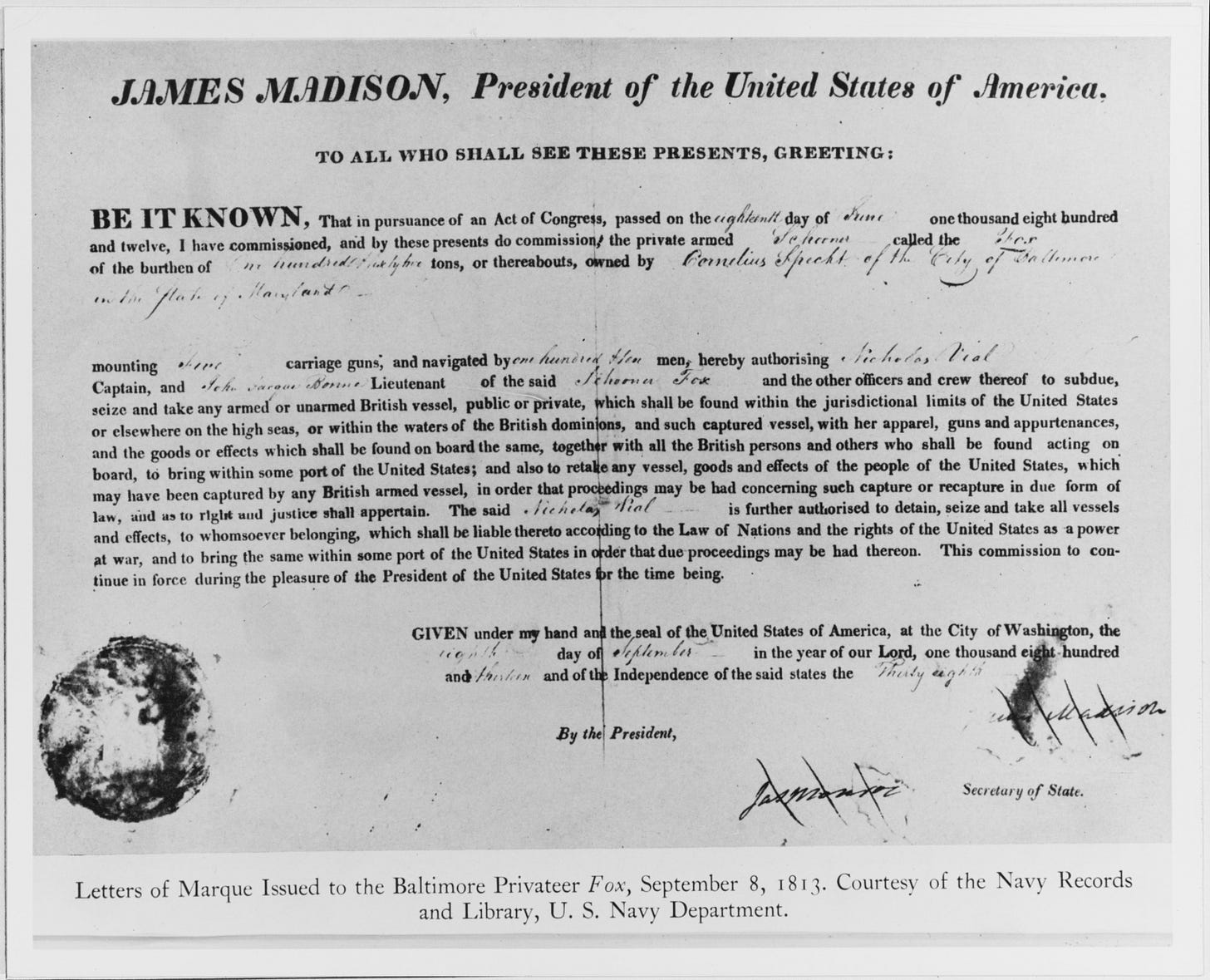
This motley fleet of naval vessels and private merchant ships was among the most novel powers the colonies had at their disposal. Private citizens, operating their own ships at their own expense, imposed enormous costs on the world’s preeminent naval empire. Their pay came from a share of whatever a prize court judged a seized vessel and its cargo to be worth. The Framers of the Constitution codified this authority in Article I, Section 8, placing the power to “grant Letters of Marque and Reprisal” alongside the powers of Congress to declare war and regulate captures on land and water.
Congress hasn’t invoked the marque and reprisal clause since the War of 1812, when several hundred privateers put to sea with letters of marque in hand. The United States later signaled its intent to abstain from privateering, but never bound itself to that position by joining the 1856 Declaration of Paris. Any modern revival of the framework would no doubt draw resistance, especially from those who see treaty commitments like the UN Convention on the High Seas and evolving norms of international law more broadly as constraints even on constitutionally enumerated congressional powers. That opposition should be engaged seriously, but not accepted uncritically. As the nation marks its 250th anniversary, the time has come to revive the authority that helped bring the republic into being. It’s time to bring back the American privateer.
Sanctions, as currently practiced, are a financial tool. They prohibit the provision of services to designated individuals or entities and, in effect, push banks to freeze those parties’ accounts — US banks by legal mandate, and increasingly foreign banks by fear of secondary sanctions that would cut them off from the dollar-clearing system. And still, sanctioned oil makes its way to market. Tankers registered to shell companies in offshore secrecy jurisdictions carry billions of dollars’ worth of Russian and Iranian crude across open water to willing buyers — often in full view of commercial satellite coverage. These illicit oil exports, overwhelmingly supported by China, India, and Turkey, fund Russia’s war against Ukraine and Iran’s attacks on US military bases and Gulf energy infrastructure. The gap between sanctions on paper and the vessels carrying millions of barrels of sanctioned oil at sea is one of the most consequential vulnerabilities undermining American economic statecraft today.
The Navy does interdict some of these shipments. But the Navy’s mandate spans the world’s oceans and runs from great-power deterrence to humanitarian assistance. Dedicating scarce ships and crews to chasing a fleet of tankers is neither sustainable nor strategically sound. Shadow fleet operators — the loose network of brokers, shell-company owners, and registries that move sanctioned oil — know it. They exploit the vastness of the ocean and the limited bandwidth of Western navies to move sanctioned cargo with near impunity.
And the problem is getting more dangerous. Sanctioned tankers departing Russia’s Baltic ports appear to have recently sailed with armed two-man teams with ties to the Kremlin-linked Wagner Group, Russian military intelligence, or Russian special forces. Meanwhile, Moscow is now going so far as to provide armed Russian navy escorts for sanctioned ships transiting the English Channel.
Consider the scope of the problem. More than a thousand shadow fleet vessels operated by Russia and Iran routinely move sanctioned crude and liquified natural gas around the world, generating billions in revenue for regimes hostile to the United States and its allies. That revenue pays for the thousands of Russian drones attacking Ukrainian soldiers and Iran’s years-long development of a rogue nuclear weapons program. Every barrel sold undermines the effectiveness of American sanctions. We must understand these vulnerabilities now — especially in preparation for a potential conflict with China, which operates the largest navy and commercial fleet in the world.
The scale of America’s maritime decline compounds the problem. The US Navy fleet has shrunk to 287 deployable ships, down from a 1987 peak nearly twice that size — and well below China’s 370-plus warships. The picture is even worse in terms of ships that can be drawn on from the commercial fleet. Fewer than 200 oceangoing ships fly the American flag today. In 1975, that number was 857. Meanwhile, a single Chinese state-owned shipbuilder produced more commercial tonnage in 2024 than the entire US industry has built since the end of World War II. According to the Office of Naval Intelligence, Chinese shipbuilding capacity exceeds America’s by a factor of 232. And China’s massive merchant fleet is capable of acting as an arm of the Chinese Communist Party at a moment’s notice.
America’s shipbuilding gap is not insurmountable. For privateers in particular, all that’s needed are ships fast enough to close on sanctioned tankers, large enough to carry a boarding team, and cheap enough to stand up a fleet with private capital alone.
Fortunately, that hull already exists in ready supply. The global fleet includes more than 5,000 offshore supply vessels that can be retrofitted with helicopter decks, dynamic surveillance systems, ample working deck space for fast boats, and accommodations for up to several dozen personnel. Designed to operate in harsh seas for weeks at a time, these vessels have been used to support offshore oil and gas platforms around the world. A used vessel of this class can trade for orders of magnitude below the cost of a Navy combatant, including the cost of conversion to accommodate necessary communications, intelligence, surveillance, and reconnaissance tools, as well as a light helicopter detachment. The operational know-how for applying these tools against maritime threats already exists. What is missing is the legal authority for private actors already engaged in anti-piracy and vessel protection services to enforce American sanctions at sea.
A modernized letter of marque framework would do just that by authorizing vetted firms to identify and board vessels carrying sanctioned cargo. Congress would pass legislation specifying which categories of activity trigger the authority, declaring specific categories of activity to be within the bounds of authorized conduct, establishing verification protocols, and licensing the firms permitted to board and inspect suspect ships.
The United Kingdom Maritime Trade Operations (UKMTO) offers a model. A Royal Navy organization, UKMTO maintains a presence in Dubai to provide situational awareness of commercial traffic and coordinate threat reporting for merchant vessels in contested waters. The US and its allies could build something similar to support privateers operating under letters of marque. A US-led Maritime Sanctions Intelligence Center could fuse satellite tracking, transponder and radio-frequency data, shipping registries, oil-trade records, and financial intelligence to identify sanctions evaders and push vetted intelligence to the firms authorized to act on it.
To make this framework viable, the United States will need to reckon with its geography. Most shadow fleet activity happens far from American waters — in the Strait of Malacca, the Persian Gulf, and the eastern Mediterranean. Privateers would need authority to operate from allied ports. That, in turn, would require the United States to negotiate basing and access agreements so that licensed vessels could refuel, resupply, and stage operations from forward positions. Without forward basing, enforcement would be tethered to the Western Hemisphere while sanctions evasion flourishes half a world away.
The United States could also modernize existing tools — starting with the Proliferation Security Initiative (PSI). Created after the September 11 attacks to counter the proliferation of weapons of mass destruction, PSI now includes 116 participating countries and facilitates bilateral ship-boarding agreements that permit participating naval forces to board foreign-flagged vessels suspected of transporting prohibited cargo. Repurposed for sanctions enforcement, it could provide a ready-made legal framework that privateers operating under letters of marque could strengthen.
Technology, meanwhile, can help close the gap between limited maritime reach and the need for persistent awareness of sanctions-evasion hotspots. Over the past few years, American defense technology firms have poured billions into autonomous maritime platforms. An entire industrial ecosystem is emerging — one that could provide the backbone for privatized sanctions enforcement without requiring a single additional Navy hull. Saronic Technologies, founded by a former SEAL Team Six operator, has raised close to a billion dollars, won a $392 million Navy production contract, and bought a shipyard in Louisiana where it built the hull of a 150-foot unmanned vessel in nine months — the fastest turnaround for a ship built in America since World War II. Saronic aims to build 200 autonomous vessels per year and is planning Port Alpha, a purpose-built shipyard for unmanned vessels at scale. Saronic has company. Blue Water Autonomy is building a 190-foot robot patrol craft designed for missions that last months without a crew aboard. HavocAI builds swarm-capable platforms controlled through software that lets a single operator coordinate dozens of assets across surveillance and interdiction tasks. These are real assets already being deployed and tested by the United States government.
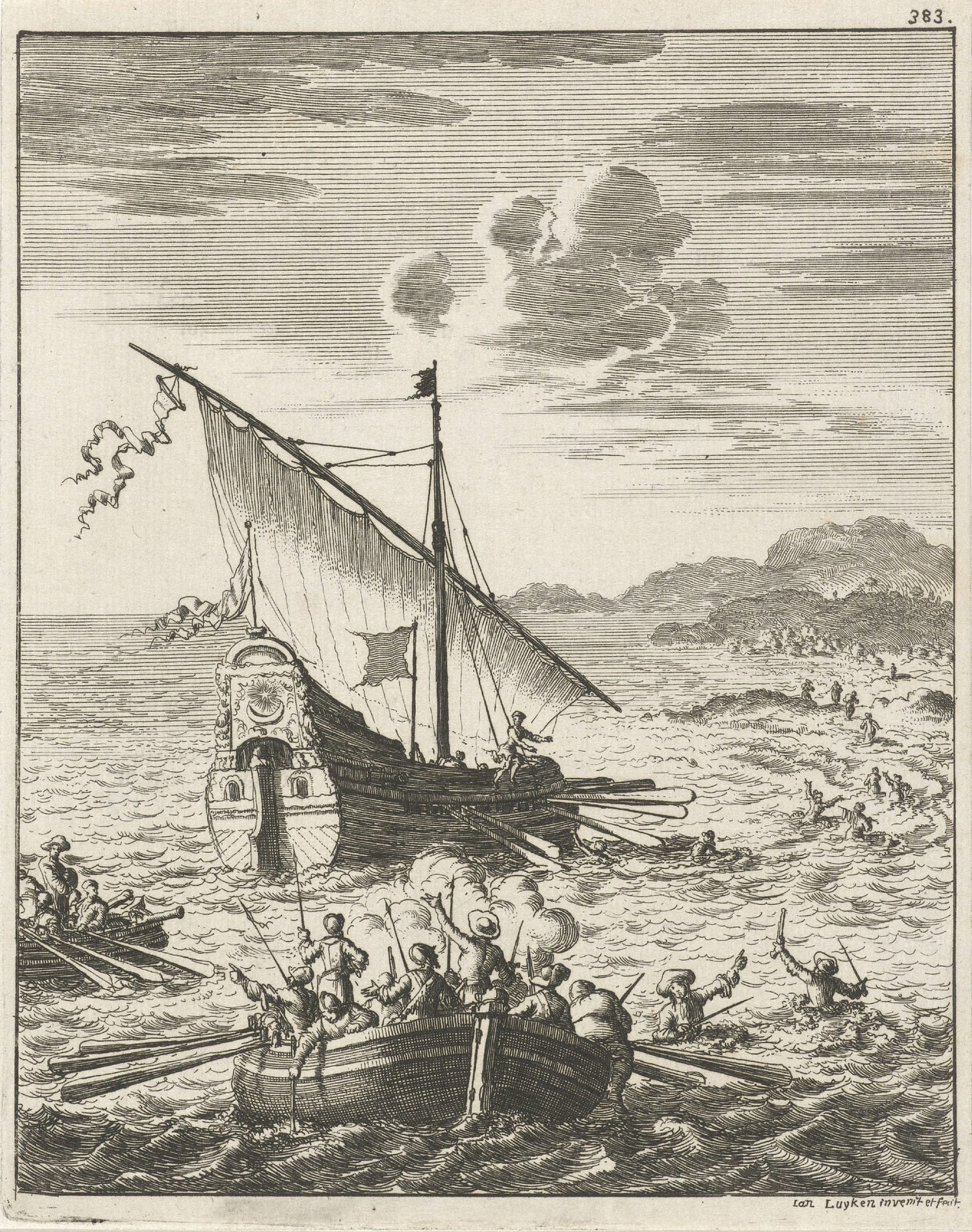
Their capabilities map directly onto the requirements of a modern letter of marque operation. Picture a licensed firm deploying a fleet of autonomous surface vessels across designated Maritime Sanctions Enforcement Zones — chokepoints and known handoff areas where sanctioned oil changes hands. Think waters off Southeast Asia, Mediterranean transit corridors, anchorages near the UAE where Iran has long conducted ship-to-ship transfers. Equipped with high-resolution optical and infrared cameras, radar, LiDAR, and AIS receivers (the transponders ships use to broadcast their identity and position), these unmanned vessels could maintain watch over enormous stretches of ocean at a fraction of the cost of manned patrols. They would fill the gaps that satellites alone cannot cover — including cloud cover and the deliberate timing of transfers to slip between overhead passes.
When an autonomous vessel, supported by a full suite of surveillance tools and signals, flags a suspect ship, the data would route to the Maritime Sanctions Intelligence Center. The center could cross-reference the target against its priority list and, if the match is confirmed, a manned interception team would move in to board, inspect, and, if warranted, seize the ship and its cargo. To make these efforts economical, however, the government must solve a problem that already plagues existing efforts to seize sanctioned oil at sea: slow judicial review.
A letter of marque framework depends on financial incentives. These incentives collapse if seized assets sit in legal limbo for months or years while costs mount. Consider the MT Skipper. After US forces seized the tanker and its 1.8 million barrels of Venezuelan crude in December 2025, the federal government spent at least $47 million repairing a vessel worth just $10 million. Storage alone for the offloaded oil runs $450,000 a month. Meanwhile, the Justice Department did not file a forfeiture complaint until late February 2026 — more than two months after the seizure — and by then prosecutors conceded that ongoing expenses threatened to consume the cargo’s entire value.
Some of the Skipper’s complications may be Venezuela-specific, including competing claims over the vessel and its crude in particular. But where the government can move faster, it should — whether by executive order, statutory reform, or regulatory action. No private firm will invest capital in autonomous fleets, manned enforcement vessels, and training boarding teams if the supposed financial reward is bogged down by years of legal disputes.
Any legislation establishing a letter of marque framework must therefore build in procedural reforms fast enough to keep private enforcement viable: statutory deadlines for judicial review of interdiction claims, authority to sell contraband cargo before forfeiture is finalized, and time-limited forfeiture proceedings measured in weeks rather than months or years. Without them, the system will fail.
With these foundations in place, one more authority could extend the framework’s reach even further: a sanctions qui tam — a private right of action modeled on one of the oldest enforcement mechanisms in American law.
Qui tam has deep roots in American legal tradition. The False Claims Act, signed by Abraham Lincoln during the Civil War, lets private citizens bring fraud cases on behalf of the federal government and collect a share of whatever is recovered — typically between 15 and 30 percent. Since Congress strengthened the statute in 1986, qui tam plaintiffs have driven the recovery of tens of billions of dollars in fraud against the government. The mechanism works because it aligns private financial incentives with public enforcement goals, building a self-sustaining system that does not compete for appropriations.
Congress ought to create a maritime sanctions version. A licensed firm could petition an expedited admiralty tribunal, presenting intelligence and physical evidence corroborated by the Maritime Sanctions Intelligence Center that a specific vessel is transporting sanctioned cargo. Upon authorization by the tribunal, the firm could then conduct the interdiction and file for forfeiture under the compressed timelines established by broader legislation. The enforcing firm would then receive a defined share of proceeds when the cargo and vessel are sold. A separate tranche of the recovered funds could also flow to the United States Victims of State Sponsored Terrorism Fund, which supports the families of Americans killed by groups such as Hamas, Hezbollah, and the Houthis — organizations funded in part by Iran’s illicit oil economy.
America’s founders recognized that national power does not belong to the state alone. The Revolution was fought, in significant part, by private shipowners who armed their own vessels, risked their own fortunes, and sailed under commissions issued by a government that barely existed. The Constitution preserved that authority because the Framers understood its strategic value.
The challenge today is structurally similar to the one our founders faced. Western navies cannot police every sea lane. But American industry — with autonomous ships, AI-driven surveillance networks, and renewed shipbuilding capacity — is already assembling the toolkit to close the enforcement gap. Two hundred and fifty years after the Continental Congress first armed private citizens to defend American interests at sea, it is time to bring back the American privateer.
Civilization
•
A Private Matter
What think you of an American Fleet?
In October 1775, John Adams sat in Philadelphia, directing a rebellion. The British Empire commanded the most formidable fleet on the planet. The colonies possessed nothing resembling a navy, only a fleet of merchant vessels whose time at sea was limited to matters of commerce, a handful of schooners leased by George Washington, and some ships that, until then, had only been tasked with patrolling the waters off Rhode Island and Massachusetts. The colonists had not yet declared independence. And yet, Adams was already thinking like an American.
“What think you of an American Fleet,” Adams asked James Warren, paymaster of the American forces at Watertown. Adams knew the colonies would balk at bankrolling a navy, so he looked to the private sector. “A public Fleet as well as privateers,” he wrote, “might make prey enough of the Trade of our Enemies to make it worthwhile.” Adams argued that privateers — private ships manned by private citizens on behalf of the government — could sail at their own expense and take their pay from enemy prizes. He grasped the power of harnessing the private sector in service of the national interest.
Just a few months later, before the signing of the Declaration of Independence, the Continental Congress began issuing commissions for private ships of war and letters of marque and reprisal, authorizing private ship operators known as privateers to destroy enemy vessels and property. John Hancock later signed blank authorizations and dispatched them to the colonies. They came with exacting instructions: which enemy vessels could be seized, what cargo could be taken, which ports had jurisdiction to adjudicate prizes. Shipowners seeking commissions had to register their vessels and post bonds guaranteeing lawful conduct. Over the course of the Revolutionary War, Congress granted roughly 1,700 of these commissions. Nearly 800 privateer vessels went to sea, capturing or destroying some 2,300 British ships. Adjusted for inflation, the losses to British commerce were north of $300 million.
This motley fleet of naval vessels and private merchant ships was among the most novel powers the colonies had at their disposal. Private citizens, operating their own ships at their own expense, imposed enormous costs on the world’s preeminent naval empire. Their pay came from a share of whatever a prize court judged a seized vessel and its cargo to be worth. The Framers of the Constitution codified this authority in Article I, Section 8, placing the power to “grant Letters of Marque and Reprisal” alongside the powers of Congress to declare war and regulate captures on land and water.
Congress hasn’t invoked the marque and reprisal clause since the War of 1812, when several hundred privateers put to sea with letters of marque in hand. The United States later signaled its intent to abstain from privateering, but never bound itself to that position by joining the 1856 Declaration of Paris. Any modern revival of the framework would no doubt draw resistance, especially from those who see treaty commitments like the UN Convention on the High Seas and evolving norms of international law more broadly as constraints even on constitutionally enumerated congressional powers. That opposition should be engaged seriously, but not accepted uncritically. As the nation marks its 250th anniversary, the time has come to revive the authority that helped bring the republic into being. It’s time to bring back the American privateer.
Sanctions, as currently practiced, are a financial tool. They prohibit the provision of services to designated individuals or entities and, in effect, push banks to freeze those parties’ accounts — US banks by legal mandate, and increasingly foreign banks by fear of secondary sanctions that would cut them off from the dollar-clearing system. And still, sanctioned oil makes its way to market. Tankers registered to shell companies in offshore secrecy jurisdictions carry billions of dollars’ worth of Russian and Iranian crude across open water to willing buyers — often in full view of commercial satellite coverage. These illicit oil exports, overwhelmingly supported by China, India, and Turkey, fund Russia’s war against Ukraine and Iran’s attacks on US military bases and Gulf energy infrastructure. The gap between sanctions on paper and the vessels carrying millions of barrels of sanctioned oil at sea is one of the most consequential vulnerabilities undermining American economic statecraft today.
The Navy does interdict some of these shipments. But the Navy’s mandate spans the world’s oceans and runs from great-power deterrence to humanitarian assistance. Dedicating scarce ships and crews to chasing a fleet of tankers is neither sustainable nor strategically sound. Shadow fleet operators — the loose network of brokers, shell-company owners, and registries that move sanctioned oil — know it. They exploit the vastness of the ocean and the limited bandwidth of Western navies to move sanctioned cargo with near impunity.
And the problem is getting more dangerous. Sanctioned tankers departing Russia’s Baltic ports appear to have recently sailed with armed two-man teams with ties to the Kremlin-linked Wagner Group, Russian military intelligence, or Russian special forces. Meanwhile, Moscow is now going so far as to provide armed Russian navy escorts for sanctioned ships transiting the English Channel.
Consider the scope of the problem. More than a thousand shadow fleet vessels operated by Russia and Iran routinely move sanctioned crude and liquified natural gas around the world, generating billions in revenue for regimes hostile to the United States and its allies. That revenue pays for the thousands of Russian drones attacking Ukrainian soldiers and Iran’s years-long development of a rogue nuclear weapons program. Every barrel sold undermines the effectiveness of American sanctions. We must understand these vulnerabilities now — especially in preparation for a potential conflict with China, which operates the largest navy and commercial fleet in the world.
The scale of America’s maritime decline compounds the problem. The US Navy fleet has shrunk to 287 deployable ships, down from a 1987 peak nearly twice that size — and well below China’s 370-plus warships. The picture is even worse in terms of ships that can be drawn on from the commercial fleet. Fewer than 200 oceangoing ships fly the American flag today. In 1975, that number was 857. Meanwhile, a single Chinese state-owned shipbuilder produced more commercial tonnage in 2024 than the entire US industry has built since the end of World War II. According to the Office of Naval Intelligence, Chinese shipbuilding capacity exceeds America’s by a factor of 232. And China’s massive merchant fleet is capable of acting as an arm of the Chinese Communist Party at a moment’s notice.
America’s shipbuilding gap is not insurmountable. For privateers in particular, all that’s needed are ships fast enough to close on sanctioned tankers, large enough to carry a boarding team, and cheap enough to stand up a fleet with private capital alone.
Fortunately, that hull already exists in ready supply. The global fleet includes more than 5,000 offshore supply vessels that can be retrofitted with helicopter decks, dynamic surveillance systems, ample working deck space for fast boats, and accommodations for up to several dozen personnel. Designed to operate in harsh seas for weeks at a time, these vessels have been used to support offshore oil and gas platforms around the world. A used vessel of this class can trade for orders of magnitude below the cost of a Navy combatant, including the cost of conversion to accommodate necessary communications, intelligence, surveillance, and reconnaissance tools, as well as a light helicopter detachment. The operational know-how for applying these tools against maritime threats already exists. What is missing is the legal authority for private actors already engaged in anti-piracy and vessel protection services to enforce American sanctions at sea.
A modernized letter of marque framework would do just that by authorizing vetted firms to identify and board vessels carrying sanctioned cargo. Congress would pass legislation specifying which categories of activity trigger the authority, declaring specific categories of activity to be within the bounds of authorized conduct, establishing verification protocols, and licensing the firms permitted to board and inspect suspect ships.
The United Kingdom Maritime Trade Operations (UKMTO) offers a model. A Royal Navy organization, UKMTO maintains a presence in Dubai to provide situational awareness of commercial traffic and coordinate threat reporting for merchant vessels in contested waters. The US and its allies could build something similar to support privateers operating under letters of marque. A US-led Maritime Sanctions Intelligence Center could fuse satellite tracking, transponder and radio-frequency data, shipping registries, oil-trade records, and financial intelligence to identify sanctions evaders and push vetted intelligence to the firms authorized to act on it.
To make this framework viable, the United States will need to reckon with its geography. Most shadow fleet activity happens far from American waters — in the Strait of Malacca, the Persian Gulf, and the eastern Mediterranean. Privateers would need authority to operate from allied ports. That, in turn, would require the United States to negotiate basing and access agreements so that licensed vessels could refuel, resupply, and stage operations from forward positions. Without forward basing, enforcement would be tethered to the Western Hemisphere while sanctions evasion flourishes half a world away.
The United States could also modernize existing tools — starting with the Proliferation Security Initiative (PSI). Created after the September 11 attacks to counter the proliferation of weapons of mass destruction, PSI now includes 116 participating countries and facilitates bilateral ship-boarding agreements that permit participating naval forces to board foreign-flagged vessels suspected of transporting prohibited cargo. Repurposed for sanctions enforcement, it could provide a ready-made legal framework that privateers operating under letters of marque could strengthen.
Technology, meanwhile, can help close the gap between limited maritime reach and the need for persistent awareness of sanctions-evasion hotspots. Over the past few years, American defense technology firms have poured billions into autonomous maritime platforms. An entire industrial ecosystem is emerging — one that could provide the backbone for privatized sanctions enforcement without requiring a single additional Navy hull. Saronic Technologies, founded by a former SEAL Team Six operator, has raised close to a billion dollars, won a $392 million Navy production contract, and bought a shipyard in Louisiana where it built the hull of a 150-foot unmanned vessel in nine months — the fastest turnaround for a ship built in America since World War II. Saronic aims to build 200 autonomous vessels per year and is planning Port Alpha, a purpose-built shipyard for unmanned vessels at scale. Saronic has company. Blue Water Autonomy is building a 190-foot robot patrol craft designed for missions that last months without a crew aboard. HavocAI builds swarm-capable platforms controlled through software that lets a single operator coordinate dozens of assets across surveillance and interdiction tasks. These are real assets already being deployed and tested by the United States government.
Their capabilities map directly onto the requirements of a modern letter of marque operation. Picture a licensed firm deploying a fleet of autonomous surface vessels across designated Maritime Sanctions Enforcement Zones — chokepoints and known handoff areas where sanctioned oil changes hands. Think waters off Southeast Asia, Mediterranean transit corridors, anchorages near the UAE where Iran has long conducted ship-to-ship transfers. Equipped with high-resolution optical and infrared cameras, radar, LiDAR, and AIS receivers (the transponders ships use to broadcast their identity and position), these unmanned vessels could maintain watch over enormous stretches of ocean at a fraction of the cost of manned patrols. They would fill the gaps that satellites alone cannot cover — including cloud cover and the deliberate timing of transfers to slip between overhead passes.
When an autonomous vessel, supported by a full suite of surveillance tools and signals, flags a suspect ship, the data would route to the Maritime Sanctions Intelligence Center. The center could cross-reference the target against its priority list and, if the match is confirmed, a manned interception team would move in to board, inspect, and, if warranted, seize the ship and its cargo. To make these efforts economical, however, the government must solve a problem that already plagues existing efforts to seize sanctioned oil at sea: slow judicial review.
A letter of marque framework depends on financial incentives. These incentives collapse if seized assets sit in legal limbo for months or years while costs mount. Consider the MT Skipper. After US forces seized the tanker and its 1.8 million barrels of Venezuelan crude in December 2025, the federal government spent at least $47 million repairing a vessel worth just $10 million. Storage alone for the offloaded oil runs $450,000 a month. Meanwhile, the Justice Department did not file a forfeiture complaint until late February 2026 — more than two months after the seizure — and by then prosecutors conceded that ongoing expenses threatened to consume the cargo’s entire value.
Some of the Skipper’s complications may be Venezuela-specific, including competing claims over the vessel and its crude in particular. But where the government can move faster, it should — whether by executive order, statutory reform, or regulatory action. No private firm will invest capital in autonomous fleets, manned enforcement vessels, and training boarding teams if the supposed financial reward is bogged down by years of legal disputes.
Any legislation establishing a letter of marque framework must therefore build in procedural reforms fast enough to keep private enforcement viable: statutory deadlines for judicial review of interdiction claims, authority to sell contraband cargo before forfeiture is finalized, and time-limited forfeiture proceedings measured in weeks rather than months or years. Without them, the system will fail.
With these foundations in place, one more authority could extend the framework’s reach even further: a sanctions qui tam — a private right of action modeled on one of the oldest enforcement mechanisms in American law.
Qui tam has deep roots in American legal tradition. The False Claims Act, signed by Abraham Lincoln during the Civil War, lets private citizens bring fraud cases on behalf of the federal government and collect a share of whatever is recovered — typically between 15 and 30 percent. Since Congress strengthened the statute in 1986, qui tam plaintiffs have driven the recovery of tens of billions of dollars in fraud against the government. The mechanism works because it aligns private financial incentives with public enforcement goals, building a self-sustaining system that does not compete for appropriations.
Congress ought to create a maritime sanctions version. A licensed firm could petition an expedited admiralty tribunal, presenting intelligence and physical evidence corroborated by the Maritime Sanctions Intelligence Center that a specific vessel is transporting sanctioned cargo. Upon authorization by the tribunal, the firm could then conduct the interdiction and file for forfeiture under the compressed timelines established by broader legislation. The enforcing firm would then receive a defined share of proceeds when the cargo and vessel are sold. A separate tranche of the recovered funds could also flow to the United States Victims of State Sponsored Terrorism Fund, which supports the families of Americans killed by groups such as Hamas, Hezbollah, and the Houthis — organizations funded in part by Iran’s illicit oil economy.
America’s founders recognized that national power does not belong to the state alone. The Revolution was fought, in significant part, by private shipowners who armed their own vessels, risked their own fortunes, and sailed under commissions issued by a government that barely existed. The Constitution preserved that authority because the Framers understood its strategic value.
The challenge today is structurally similar to the one our founders faced. Western navies cannot police every sea lane. But American industry — with autonomous ships, AI-driven surveillance networks, and renewed shipbuilding capacity — is already assembling the toolkit to close the enforcement gap. Two hundred and fifty years after the Continental Congress first armed private citizens to defend American interests at sea, it is time to bring back the American privateer.
About the Author
Max Meizlish is a research fellow at the Foundation for Defense of Democracies in the Center on Economic and Financial Power. He previously worked on sanctions licensing and enforcement at the US Treasury Department’s Office of Foreign Assets Control (OFAC). He is on X @maxmeizlish