tt
tt
tt
tt
tt
tt
Capitalism
•
The Triumph of the Geeks
How a new generation of entrepreneurs upgraded the most important software of all: the company.


At a conference about a decade ago in Silicon Valley, I ran into venture capitalist Steve Jurvetson during a break. “Hey, what’s new?” I asked. He responded with the zeal of a true believer. “Andy, I’ll tell you what’s new. What’s new is that SpaceX is going to bathe the world in cheap internet connectivity via satellite.” As near as I can recall, my response was, “Wow, that is so interesting. I need some more coffee.”
I got away as quickly as I could because Jurvetson’s few sentences had convinced me that he had lost all judgment. He was, after all, telling me about something that surely wasn’t going to happen. I’m no expert on the global aerospace industry, but I knew that it was large and lucrative and populated by well-established, well-capitalized, well-connected companies that had figured out how to do some of the most difficult things we humans have ever accomplished, like launching rockets capable of escaping Earth’s gravity and putting humans into space and then bringing them home safely. I also knew that satellite communications was not a new field. Telstar was launched in 1962.
So my immediate, reflexive reasoning as I fled Jurvetson’s company was something like “If what he’s saying is anywhere near possible, we would be seeing at least some of it already. Some of the incumbents in the industry would already be providing affordable Internet from space, or at least demonstrating that they were on that path. The fact that they’re not tells me that there’s a combination of physics, engineering, and inescapable cost that makes this vision I’m hearing a fantasy.”
The punch line here, of course, is that I am writing this on a laptop connected to the Internet via Starlink. I’m one of the service’s 12 million customers (and growing) around the world, and I’m delighted with it. Jurvetson, it turns out, was exactly right, and I was exactly wrong.
Once I got over my bruised ego, I got to thinking. I’m a business academic. For over 30 years I’ve been studying how technology progress changes the business world, first at Harvard Business School and now at MIT Sloan. In particular, I study how new technologies change the way that companies operate, perform, and compete.
My dismissal of Jurvetson’s spot-on prediction showed me how much I had to learn. From a standing start in 2002, SpaceX had delivered a new and important capability, accomplished marvelous feats of engineering not just in a lab but at orbital scale, and created a large and lucrative global market. While doing so, it made all the incumbents in the aerospace industry look bad at their own game on their own turf.
The Geeks Appear
I didn’t think this kind of breakthrough performance was possible, but it is. And it’s not just SpaceX. Here’s a short litany of other impressive recent accomplishments:
Netflix began as a DVD rental-by-mail company in 1997, and started streaming entertainment to our homes in 2007. Its most audacious move, though, came three years later, when it announced that it wasn’t just going to license entertainment from Hollywood studios. It was also going to become a Hollywood studio itself by creating “Netflix Originals.”
Mainline Hollywood didn’t see much ground for concern at this upstart’s incursion into their territory. Time Warner CEO Jeff Bewkes spoke for many in his industry when he responded in 2010 to a question about the threat posed by Netflix. “It’s a little bit like, ‘Is the Albanian army going to take over the world?’ I don’t think so,” he said. Fifteen years after that interview, Netflix announced that it had entered into an agreement to acquire Warner Bros. Discovery (the company later declined to match a higher all-cash bid from David Ellison’s Paramount).
The payments platform Stripe was founded in 2010 by brothers Patrick and John Collison when they were 21 and 19 years old, respectively. As Patrick explained in a 2018 interview, the insight behind the company was that anyone wanting to become an online entrepreneur could set up a web storefront “as fast as you could type” with one key exception: gaining the ability to accept a credit card from a customer could take days, and carried the prospective merchant backward in time to the era of faxes and mailed forms. Even though payment processing was a large global industry dominated by the behemoths Visa (founded in 1958) and MasterCard (1966), a credit card acceptance API didn’t yet exist.
Today, that’s amazing to consider. It was Stripe that built that API — and kept building. And now, Stripe processes online and in-person payments for customers ranging from embryonic startups to Amazon, Nvidia, and PepsiCo. It also provides revenue and billing services to merchants, lets them pay vendors around the world, and manages tax reporting, fraud detection, and anti-money laundering and know-your-customer requirements globally. In 2016 Stripe launched Atlas, a service that lets entrepreneurs around the world quickly establish a US corporate entity and bank account. Less than a decade later, one-quarter of all Delaware incorporations came from Atlas.
Defense tech startup Anduril was founded in 2017. Within five years it received its first billion-dollar contract. It was from the US Special Forces Command for a variant of the Anvil, a drone designed to autonomously destroy other uncrewed aerial vehicles. The Anvil project was born during a weekend brainstorming session in early 2019. Initial prototypes showed promise, and by summer Anduril was claiming a near-perfect success rate. By the end of that year, the company was shipping the Anvil to military clients. In early 2023, according to some reports, it was being used in Ukraine.
In early 2024 Anduril was awarded major contracts to build both undersea and airborne autonomous systems for the Pentagon. The company also beat out Boeing, Lockheed Martin, and Northrop Grumman to be named one of the two main suppliers to the Air Force’s Collaborative Combat Aircraft program to develop autonomous planes to accompany crewed fighter planes. A statement from the company stressed that “The Air Force’s decision marks the first time that a new company has won a fighter aircraft program since the 1970s.”
And of course, SpaceX has accomplished much more than Starlink. In 2017, just 15 years after its founding, the company successfully relaunched the first commercially viable orbital rocket. It has now executed more than six hundred such relaunches; Jeff Bezos’ Blue Origin has done one and the rest of the global aerospace industry combined, none. The huge cost advantages associated with rocket reuse, combined with SpaceX’s aggressive launch schedule, have made the company a near-monopolist in the business of putting payloads into space — including its own Starlink payloads.
And if SpaceX succeeds with its gigantic Starship rocket, which can carry four times the payload of its current rockets, its costs could fall a further 90% or more. Starship’s Flight 13, which took place in July of 2026, was encouraging; both the booster and upper stage successfully relit their engines in space, an important milestone for controlled descent and reuse. SpaceX also makes spacecraft for human flight. In 2020, its Crew Dragon vehicle passed a final test — a round-trip flight of astronauts to the International Space Station — and became the only American company certified by NASA to take US astronauts into space from American soil.
The industries in the examples above vary, but the story doesn’t: impressive achievements and growth in a short space of time by an upstart, and incumbents left well behind. The upstarts are all young, and all based on the West Coast. Most of them also have a clear Silicon Valley lineage. (Elon Musk came from PayPal, for example, and Anduril’s founders from Palantir and Oculus).
There were similar shake-ups earlier in this century. Several industries, including retail, recorded music, periodicals, advertising, urban transportation, and consumer electronics were profoundly transformed not by well-established incumbents, but by West Coast upstarts. And while Silicon Valley was serving as the cradle of many of these disruptors, it was also continuing to solidify its position as the center of the global high-tech industry.

The Early Stripe Office
A New Doctrine for Value Creation
Am I cherry-picking and overstating the case, or is concentrated value creation a broad trend?
In 2000, 15 of the top 100 most valuable public companies in the US were headquartered on the West Coast, representing 17% of the total market capitalization. Even then, there was a sizable cluster of high-tech companies in Northern California (plus Microsoft in Seattle) contributing to the West Coast’s share, but most of the value and most of America’s largest companies were elsewhere: financial services and pharmaceuticals in the Northeast, oil and gas in Texas, and so on.
A quarter century later in 2025, the West Coast had 35 of the top 100 companies — representing a whopping 64% of the total market capitalization of the top 100. And with the exception of Microsoft, all the biggest companies on the list — Apple, Nvidia, Alphabet, Amazon — were barely factors in 2000. Some, like Tesla and Meta, didn’t yet exist.
What’s going on? What’s behind this huge and unprecedented shift in the business landscape? My answer is straightforward. As I wrote in my 2023 book The Geek Way: “a bunch of geeks have figured out a better way to run a company.”
The geeks of Silicon Valley might not have wanted to become organizational innovators, but they found they had no choice. The principles and practices built up over the 20th century for running a large, successful company simply didn’t work in their ecosystem, which was characterized by the extraordinarily rapid rates of change summarized as Moore’s Law and by intense competition for new global markets.
So the geeks did what geeks do: they innovated, tinkered, and experimented, and kept at it until they came up with something that worked.
I call that something a new doctrine for business competition. The US Joint Chiefs of Staff define doctrine as “fundamental principles that guide the employment of US military forces in coordinated action toward a common objective and may include terms, tactics, techniques, and procedures.” Let’s tweak this definition a bit for our purposes: business doctrine consists of fundamental principles that guide people within an organization in coordinated action toward a common objective. Doctrine includes terms, tactics, procedures, and attitudes.
I see five broad principles that distinguish 21st century “geek doctrine” from what came before, which I’ll refer to as legacy doctrine. These are cadence, science, observability, modularity, and agency. Let’s take each in turn.
Cadence
One of the earliest and clearest expressions of geek doctrine, and a direct repudiation of what came before, was the Agile Manifesto, which was posted online in February of 2001 after 17 software engineers met over a weekend in Snowbird, Utah. They came together because of a shared frustration with the then-dominant waterfall method for managing software development projects.
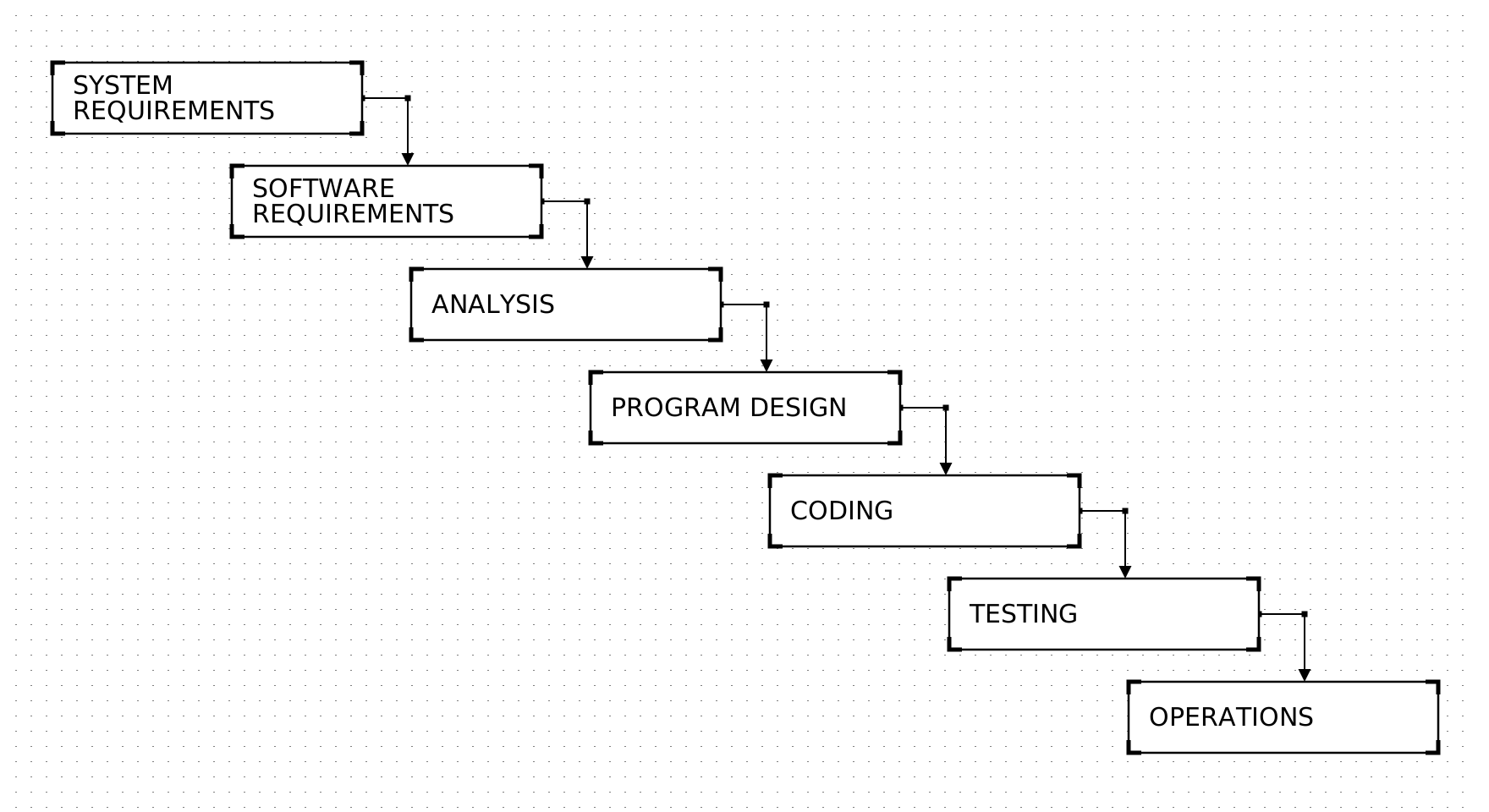
Waterfall consisted of a series of discrete sequential steps, starting with “system requirements” and “software requirements” and ending with “testing” and “operations.” The method got its name from a diagram showing them as a series of descending boxes connected by flowing arrows. Waterfall was linear, orderly, and rational; it gave its practitioners a sense of control and confidence.
The only problem was that this sense was false. Bitter experience revealed that the waterfall just didn’t work. The Department of Defense, for example, mandated waterfall approaches for its software projects throughout the 1980s and 1990s. It then had the excellent idea to see how well this approach was working. In one sample of projects, it found that fully 75 percent failed or were never used.
The software engineers gathered in Utah had enough of these kinds of projects and gathered around a whiteboard in a hotel conference room to come up with something better. The manifesto they wrote “turned the software world upside down,” according to one account. But I think that’s an understatement. The Agile Manifesto helped turn the entire world of managing large projects upside down.
It was a model of concision:
We are uncovering better ways of developing software by doing it and helping others do it. Through this work we have come to value: Individuals and interactions over processes and tools. Working software over comprehensive documentation. Customer collaboration over contract negotiation. Responding to change over following a plan. That is, while there is value in the items on the right, we value the items on the left more.
Writer Clay Shirky has a brutal summary of why waterfall projects fail so often. It’s because the method is, as he puts it, “a pledge by all parties not to learn anything while doing the actual work.” Agile methods avoid this failure mode by emphasizing interaction, collaboration, responding to change, and building things that work instead of writing documents about what is needed.
In the quarter century since the manifesto was written, the Agile development movement has grown, spawned a proliferation of techniques and tools, and subdivided into factions. It has also evolved to emphasize cadence: the speed with which a team can move through the cycle of building something that works, getting feedback on it, and incorporating that feedback.
The geeks believe that a fast cadence is essential for thriving in a fast-changing environment. As Jurvetson explained to me, “the agile way we’ve learned to build software is becoming the agile way we build everything. I sometimes feel like I have a sixth sense. I can see dead companies. They don’t know they’re dead, but they’re dead because they’re not responsive enough. And the companies that iterate more quickly will just run circles around them.”
Science
Another key date in the development of geek doctrine came just about a year before the weekend that yielded the Agile Manifesto. On February 27th, 2000, a team at Google conducted the first known A/B test when it showed different versions of a search results page to two randomly selected groups to determine if one version yielded significantly better engagement.
Since then, data-driven decision making, online experimentation, and causal inference have become rich disciplines, often led by the West Coast firms. As Google’s Chief Economist Hal Varian told me in 2017:
One of the things that we did at Google very early on, which is really important, is we built an experimental infrastructure. So we could do A/B testing of different ideas: different ideas on user interface, different ideas on ad ranking, different ideas on search ranking, and so on. And we could run actual experiments on little slices of the population, 1 percent or 2 percent, and see if they really improved our metrics. And if they did, then we can implement them more broadly. So having that experimental infrastructure available was really critical to Google’s success.
All these approaches sound very “scientific,” and reinforce our intuition that science involves running experiments and collecting data. This intuition is correct as far as it goes, but it’s too limited. Science is much more than number crunching. In fact, there has been vigorous debate for about four centuries around what science actually is.
We’re not going to settle that debate here, but I want to emphasize one recent contribution that I found helpful and clarifying, and that captures something fundamental about how geek companies are run. In his 2020 book The Knowledge Machine, philosopher Michael Strevens proposes that the scientific method can be boiled down to an Iron Rule:
1. Strive to settle all arguments by empirical testing.
2. To conduct an empirical test to decide between a pair of hypotheses, perform an experiment or measurement, one of whose possible outcomes can be explained by one hypothesis (and accompanying cohort) but not the other.
The iron rule posits that science is an endless argument about what’s going on, or to be a bit more precise, about the nature of reality. You’re doing science when you’re following a particular ground rule for settling that argument: best evidence wins. And you’re really doing science if you and your opponent in the argument can agree in advance about a test that will yield the evidence necessary to determine who’s right. I think customers will like version A of our shopping cart better. You think they’ll like version B? Let’s do an A/B test and see which leads to more completed checkouts.
Another key element of the iron rule is what it excludes. Within science, arguments are settled via evidence, full stop. Not seniority, not bluster or rhetoric, not charisma. Not hourly billing rate. Not position on the org chart. Not credentials, gender, or ethnicity.
Of course, we fallible and biased human beings don’t always follow the iron rule. We’re not wired to look dispassionately at evidence. We have strong dispositions to fall back on the factors listed above when engaging in the social activity of argumentation. The iron rule can’t force us to be objective, consistent evaluators of evidence any more than the golden rule can force us to do unto others as we would have them do unto us. The power of both rules is that they give us an ideal to strive for, and to refer to when we find ourselves or others straying from them.
Many geek companies’ mantras and leadership principles echo the iron rule. Some emphasize the importance and power of evidence. Netscape CEO Jim Barksdale’s famous (and perhaps apocryphal) guidance to his colleagues was “If we have data, let’s look at data. If all we have are opinions, ‘let’s go with mine.’”
Jeff Bezos once said that “The great thing about fact-based decisions is that they overrule the hierarchy.” At Amazon, “Leaders are obligated to respectfully challenge decisions when they disagree, even when doing so is uncomfortable or exhausting.”
The legendary evolutionary biologist Robert Trivers wrote “If you are trying to… transmit knowledge more quickly, you will be drawn to science itself, which is based on a series of increasingly sophisticated and remorseless anti-deceit and anti-self-deception mechanisms.”
Geeks believe the same holds true for generating new knowledge, and for figuring out what’s going on in a fast-changing world.
Observability
The geeks are measurement fanatics. Venture capitalist John Doerr wrote an entire book called Measure What Matters. And Stripe’s CEO Patrick Collison told me this:
I’m always pushing people, how will we measure that? How do we know whether it’s working? If you have the measurement, why is it increasing or why is it not increasing… for any area across Stripe we have our primary metrics. And we also try to choose counterbalancing metrics to control for or assess the most obvious kind of pathologies that could arise if you only optimized one of them. And we also have all sorts of secondary metrics that we just have to keep an eye on.
An obvious benefit of measurement is that it yields the data that’s essential to science, but there’s also a deeper reason the geeks are obsessed with it: Measurement contributes to observability, and observability is a powerful tool for shaping behavior.
It’s vital to observe not only outcomes of interest, but also people’s actions and contributions, the progress of individuals and teams — in short, what’s going on inside organizations.
To see why, let’s look at what can happen when observability is low. In 2003 researchers David Ford and John Sterman were investigating why big projects are so often late. They got insight into the phenomenon from a project team’s weekly meeting at a large defense contractor. The insight came not from anything that was said or done at the meeting, but from the team’s informal name: “the liar’s club.” Ford and Sterman describe the meeting’s ground rules:
Everyone withheld knowledge that their subsystem was behind schedule. Members of the liar’s club hoped someone else would be forced to admit problems first, forcing the schedule to slip and letting them escape responsibility for their own tardiness. Everyone in the liar’s club knew that everyone was concealing rework requirements and everyone knew that those best able to hide their problems could escape responsibility for the project failing to meet its targets.
The toxic Nash Equilibrium of the liar’s club was made possible by the lack of observability of teams’ actual progress. Over the long history of trying to get things done, managers have tried no end of solutions to the liar’s club, including inspirational speeches, threats, and appeals to team spirit and morality. But because none of these increase observability, they don’t change the fundamental game being played, or its outcome.
But operating at a fast cadence does. When large projects are divided up into short, agile sprints with observable outcomes, it’s much harder to hide the fact that your team is falling behind. Observation decreases plausible deniability, which is the technical term for wiggle room. People use that wiggle room in ways big and small to evade responsibility. There is good evidence that they even do this subconsciously, without conscious Machiavellian scheming.
The opposite of plausible deniability is non-repudiation — the complete lack of wiggle room. And its prime advocate is Elon Musk, who put it right at the top of the algorithm: a distillation of his key beliefs that he repeated, as he himself put it, “to an annoying degree.” As his biographer Walter Isaacson described: “At any given production meeting, whether at Tesla or SpaceX, there is a nontrivial chance that Musk will intone, like a mantra, what he calls the algorithm... His executives sometimes move their lips and mouth the words, like they would chant the liturgy along with their priest.” Here’s how the algorithm starts:
1. Question every requirement. Each should come with the name of the person who made it. You should never accept that a requirement came from a department, such as from “the legal department” or “the safety department.” You need to know the name of the real person who made that requirement.
Legacy organizations, especially large ones, have been described (without excessive cynicism, I believe), as “unaccountability machines” and “moral mazes” where unobservability and plausible deniability are pervasive — where, as one manager put it, “People try to cover themselves. They avoid putting things clearly in writing. They try to make group decisions so that responsibility is not always clearly defined.”
Observability is a key feature used by today’s business geeks to build and sustain very different organizations.

SpaceX, June 2002.
Modularity
By the end of the twentieth century, it had become almost an article of faith that the disparate elements of large corporations needed to be thoroughly integrated. Business Process Re-engineering — orienting the company around executing key workflows — was ascendant. It “had to be done,” according to no less an authority than management guru Peter Drucker. Large-scale software to support this work had recently become available. It was sold under different labels — enterprise resource planning, supply chain management, customer relationship management — but had a common purpose: tightly linking different functions so that they could act in concert.
Executives loved the idea of having a highly orchestrated company. In 1995, a group of CEOs in conversation on the Harvard Business School campus described the virtues of synchronized business processes:
PAUL ALLAIRE [CEO, XEROX]. After all, if you have processes that are in control, you know how the organization is working. There’s no guesswork, because variances are small and operating limits are well defined. You get quality output without a lot of checking…
CRAIG WEATHERUP [CEO AND PRESIDENT, PEPSI-COLA NORTH AMERICA]. I agree with you one thousand percent. A process approach is liberating. It helps us build reliability and winning consistency, and our people love to win. So over time, they’ve bought in completely.
JAN LESCHLY [CEO, SMITHKLINE BEECHAM]. People have a tough time understanding what it means for processes to be reliable, repeatable, and in control,… and it will take us years before we can honestly say that all 50,000 people at SmithKline Beecham understand what it means to standardize and improve a process.
Early in Amazon’s history, Bezos also believed in controlled, well-defined processes, even for creative work like innovation. In the 1990s, Amazon had a “new proposed initiative” (NPI) process. Groups wrote up their proposals, submitted them to a review board, and heard back with a yes or a no, or worst of all, a no accompanied by the news that they would have to support another group’s approved initiative while still being responsible for all of their existing work. As former Amazonian Colin Bryar recalled, “The NPI process was not beloved. If you mention NPI to any Amazonian who went through it, you’re likely to get a grimace and maybe a horror story or two… [It] was deflating for morale.”
Bezos eventually realized that the NPI process was impeding Amazon’s ability to succeed with new initiatives, so he changed course completely. A CEO who, in the words of former Amazon engineer Steve Yegge, “makes ordinary control freaks look like stoned hippies” decided to stop integrating his company and instead modularize it: to turn Amazon into a collection of teams that interacted with each other via a minimum set of well-defined interfaces and otherwise acted autonomously.
It took years to modularize Amazon’s technology infrastructure in support of this vision, but that effort succeeded so well that it birthed Amazon Web Services and today’s cloud computing sector. Making all the organizational and cultural changes necessary for modularization was also a huge effort, but it too succeeded. Technology analyst Benedict Evans describes the result:
Amazon is a machine to make a machine, and the machine it makes is more Amazon…
Amazon is hundreds of small, decentralized, atomized teams sitting on top of standardized common internal systems… The obvious advantage of a small team is that you can do things quickly within the team, but the structural advantage of them, in Amazon at least (and in theory, at least), is that you can multiply them. You can add new product lines without adding new internal structure or direct reports, and you can add them without meetings and projects and process in the logistics and e-commerce platforms. You don’t (in theory) need to fly to Seattle and schedule a bunch of meetings to get people to implement support for launching makeup in Italy, or persuade anyone to add things to their roadmap…
Modularity lets innovators move faster and implement their ideas with high fidelity. Bryar recalls, “In my tenure at Amazon, I heard [Bezos] say many times that if we wanted Amazon to be a place where builders can build, we needed to eliminate communication, not encourage it.”
At geek companies, leaders work to prevent excessive integration and process, or pare them back. Netflix’s leaders are well aware that employees are fond of business class travel, and have debated putting in place restrictions on when it’s allowed, but so far they haven’t. As the company’s website states:
Our expenses policy is just five words: “Act in Netflix’s best interests.” This (almost) no rules rule gives employees the freedom to exercise their judgment. It also prevents the process creep that typically happens when companies grow and try to dummy proof their organizations — stifling creativity and making it harder for businesses to adapt.
When Satya Nadella was announced as the next CEO of Microsoft in 2014, he inherited an organization where process creep and many other factors had taken hold. In his book Hit Refresh, he described a pivotal moment right before the start of his tenure:
In an intense prep session two days before the announcement [my chief of staff] Jill [Tracie Nichols] and I sparred on how to inspire this disheartened group of [employees]. In some ways, I was annoyed by what felt like lack of accountability and finger pointing. She stopped me mid-riff with “You’re missing it, they are actually hungry to do more, but things keep getting in their way.”
One of the ways Nadella enabled them to do more was to modularize by removing opportunities for gatekeeping. As he told me:
[Now], nobody can own code or data inside Microsoft… Any team can stand up and say, “Hey, I have an idea. I want to train a large-scale AI model to go do, for example, GitHub Copilot [an AI tool that generates computer code based on natural language instructions from a human]. I want all the code, I want all the data.” Yes, you absolutely can have it because no team can hoard it.
Agency
The legacy mania for orchestration was also a mania for ensuring that people stayed within their narrow job descriptions. “Variances are small, and operating limits are well defined” was a goal not just for processes, but also for the people executing them. For many if not most employees at legacy companies, a key tacit principle was “stay in your lane.”
A currently popular Silicon Valley mantra explicitly inverts this guidance. “You can just do things” is now a common refrain among the geeks. There are two complementary ways to interpret this principle.
The first is that it is a testament to the power of modern AI. The latest large language models are truly the stuff of science fiction. They give their users the ability to write code and build apps; do complicated data analyses and visualizations; conduct thorough, multi-step research; and write everything from mathematical proofs to dense technical reports. Modern AI gives people the ability to tackle work that is larger in scope and ambition than they previously thought possible. They’re far less limited by their existing knowledge and skills. They can just do things.
The second interpretation of the saying is as a permission slip. You are allowed to go outside the apparent boundaries of your job when you spot an opportunity, or something that needs to be fixed. Some geek companies enshrine this agency — this capacity to act independently, make purposeful choices, and take responsibility — in their leadership principles.
At Amazon, these principles include “Ownership” and a “Bias for Action.” In a 2018 talk, Bezos described how they’re put into practice:
At Amazon, one of the things we try to do is have multiple paths to “yes.”
In the typical kind of corporate hierarchy… let’s say you have an idea: You need to get your boss to greenlight that idea, and then your boss’s boss needs to greenlight that idea. And then your boss’s boss’s boss needs to greenlight that idea. There are probably five levels or more before that idea gets the go-ahead.
Assume instead that you’re an entrepreneur with a startup company idea, and you need venture capital. In [a] venture capital model, there are multiple paths to yes. There were 20 people who could give you a yes, and it didn’t matter how many gave you a no. So if you want innovative thinking, hire a large number of high judgment people empowered to greenlight ideas. You want multiple paths to yes… That’s a challenge that big organizations have to figure out.
Tech companies have made progress in figuring out how to encourage agency. In 2015, Netflix CEO Reed Hastings was convinced that it would not be a good use of engineering resources to build into the Netflix app the capability to download shows so that they could be watched later. He described downloading as a “1% use case” and said that “we are avoiding this approach.”
At a lot of legacy companies this would have been the end of the discussion. But not at Netflix. Even though Hastings and Neil Hunt, who was at the time the chief product officer, were against downloading, Todd Yellin, the vice president of product (who worked for Hunt), still thought it might be a good idea. He asked senior user experience researcher Zach Schendel to conduct interviews about downloading with users of streaming services in the US, Germany, and India.
As Schendel put it: “I thought, ‘Neil and Reed are against this idea. Is it okay to test it out?’ At any of my past employers, that would not have been a good move. But the lore at Netflix is all about lower-level employees accomplishing amazing things in the face of hierarchical opposition. With that in mind I went ahead.”
The interviews revealed that in all three countries people frequently used the download feature on all streaming services that included it. In fact, the lowest percentage of downloaders Schendel encountered in his interviews wasn’t anywhere near Hastings’ estimate of 1 percent; instead, it was 15 percent. When Hastings and Hunt saw the results of this research they realized that they had been wrong, and changed course. Netflix now includes a download feature.
The algorithm, endlessly repeated at Tesla and SpaceX, makes clear that Musk expects people at those companies to exercise a special kind of agency: simplification. As we’ve seen, the first of the algorithm’s five parts was about non-repudiation. Two and three are about taking things out that don’t need to be there.
2. Delete any part or process you can. You may have to add them back later. In fact, if you do not end up adding back at least 10% of them, then you didn’t delete enough.
3. Simplify and optimize. This should come after step two. A common mistake is to simplify and optimize a part or a process that should not exist.
A few 20th-century companies, such as Toyota, stressed simplification as an individual responsibility; Musk has elevated it to a commandment for organizations.

Jim Barksdale and Marc Andreessen
Cadence, science, observability, modularity, and agency are far from the final and complete set of principles describing how geek companies have moved beyond the legacy doctrine. But geek companies have surpassed legacy doctrine. As I wrote in The Geek Way:
“Companies that grew up during the industrial era have to throw away that era’s playbook if they want to stand a chance when the geeks come to town. The idea that companies following the old playbook can fight back effectively against the geek way by doing a major reorganization, embracing a bold new strategy, or shuffling the leadership is laughable. Incumbents did all of these things over the past twenty years; they didn’t halt the disruption, or even slow it down much. The industrial-era playbook yields companies that move too slowly, are wrong too often, miss too many important developments, don’t learn and improve quickly enough, and fail to give their people the autonomy, empowerment, purpose, and voice that they want and deserve.”
AI is red-hot now (as it should be!) and the leaders of successful 20th-century companies realize that they’ll need to focus on AI in the coming years to harness its power. When I work with executive teams, I reframe their challenge by defining AI-based business transformation as “a complicated, technology-heavy undertaking in an environment of high uncertainty and rapid change.” I then point out that the business geeks of the 21st century have developed a set of principles — a doctrine — that greatly improves their success rate with exactly such efforts. I am confident that as we move deeper into the AI era, adherents to this doctrine will outpace and outperform their legacy rivals.
Capitalism
•
The Triumph of the Geeks
How a new generation of entrepreneurs upgraded the most important software of all: the company.
At a conference about a decade ago in Silicon Valley, I ran into venture capitalist Steve Jurvetson during a break. “Hey, what’s new?” I asked. He responded with the zeal of a true believer. “Andy, I’ll tell you what’s new. What’s new is that SpaceX is going to bathe the world in cheap internet connectivity via satellite.” As near as I can recall, my response was, “Wow, that is so interesting. I need some more coffee.”
I got away as quickly as I could because Jurvetson’s few sentences had convinced me that he had lost all judgment. He was, after all, telling me about something that surely wasn’t going to happen. I’m no expert on the global aerospace industry, but I knew that it was large and lucrative and populated by well-established, well-capitalized, well-connected companies that had figured out how to do some of the most difficult things we humans have ever accomplished, like launching rockets capable of escaping Earth’s gravity and putting humans into space and then bringing them home safely. I also knew that satellite communications was not a new field. Telstar was launched in 1962.
So my immediate, reflexive reasoning as I fled Jurvetson’s company was something like “If what he’s saying is anywhere near possible, we would be seeing at least some of it already. Some of the incumbents in the industry would already be providing affordable Internet from space, or at least demonstrating that they were on that path. The fact that they’re not tells me that there’s a combination of physics, engineering, and inescapable cost that makes this vision I’m hearing a fantasy.”
The punch line here, of course, is that I am writing this on a laptop connected to the Internet via Starlink. I’m one of the service’s 12 million customers (and growing) around the world, and I’m delighted with it. Jurvetson, it turns out, was exactly right, and I was exactly wrong.
Once I got over my bruised ego, I got to thinking. I’m a business academic. For over 30 years I’ve been studying how technology progress changes the business world, first at Harvard Business School and now at MIT Sloan. In particular, I study how new technologies change the way that companies operate, perform, and compete.
My dismissal of Jurvetson’s spot-on prediction showed me how much I had to learn. From a standing start in 2002, SpaceX had delivered a new and important capability, accomplished marvelous feats of engineering not just in a lab but at orbital scale, and created a large and lucrative global market. While doing so, it made all the incumbents in the aerospace industry look bad at their own game on their own turf.
The Geeks Appear
I didn’t think this kind of breakthrough performance was possible, but it is. And it’s not just SpaceX. Here’s a short litany of other impressive recent accomplishments:
Netflix began as a DVD rental-by-mail company in 1997, and started streaming entertainment to our homes in 2007. Its most audacious move, though, came three years later, when it announced that it wasn’t just going to license entertainment from Hollywood studios. It was also going to become a Hollywood studio itself by creating “Netflix Originals.”
Mainline Hollywood didn’t see much ground for concern at this upstart’s incursion into their territory. Time Warner CEO Jeff Bewkes spoke for many in his industry when he responded in 2010 to a question about the threat posed by Netflix. “It’s a little bit like, ‘Is the Albanian army going to take over the world?’ I don’t think so,” he said. Fifteen years after that interview, Netflix announced that it had entered into an agreement to acquire Warner Bros. Discovery (the company later declined to match a higher all-cash bid from David Ellison’s Paramount).
The payments platform Stripe was founded in 2010 by brothers Patrick and John Collison when they were 21 and 19 years old, respectively. As Patrick explained in a 2018 interview, the insight behind the company was that anyone wanting to become an online entrepreneur could set up a web storefront “as fast as you could type” with one key exception: gaining the ability to accept a credit card from a customer could take days, and carried the prospective merchant backward in time to the era of faxes and mailed forms. Even though payment processing was a large global industry dominated by the behemoths Visa (founded in 1958) and MasterCard (1966), a credit card acceptance API didn’t yet exist.
Today, that’s amazing to consider. It was Stripe that built that API — and kept building. And now, Stripe processes online and in-person payments for customers ranging from embryonic startups to Amazon, Nvidia, and PepsiCo. It also provides revenue and billing services to merchants, lets them pay vendors around the world, and manages tax reporting, fraud detection, and anti-money laundering and know-your-customer requirements globally. In 2016 Stripe launched Atlas, a service that lets entrepreneurs around the world quickly establish a US corporate entity and bank account. Less than a decade later, one-quarter of all Delaware incorporations came from Atlas.
Defense tech startup Anduril was founded in 2017. Within five years it received its first billion-dollar contract. It was from the US Special Forces Command for a variant of the Anvil, a drone designed to autonomously destroy other uncrewed aerial vehicles. The Anvil project was born during a weekend brainstorming session in early 2019. Initial prototypes showed promise, and by summer Anduril was claiming a near-perfect success rate. By the end of that year, the company was shipping the Anvil to military clients. In early 2023, according to some reports, it was being used in Ukraine.
In early 2024 Anduril was awarded major contracts to build both undersea and airborne autonomous systems for the Pentagon. The company also beat out Boeing, Lockheed Martin, and Northrop Grumman to be named one of the two main suppliers to the Air Force’s Collaborative Combat Aircraft program to develop autonomous planes to accompany crewed fighter planes. A statement from the company stressed that “The Air Force’s decision marks the first time that a new company has won a fighter aircraft program since the 1970s.”
And of course, SpaceX has accomplished much more than Starlink. In 2017, just 15 years after its founding, the company successfully relaunched the first commercially viable orbital rocket. It has now executed more than six hundred such relaunches; Jeff Bezos’ Blue Origin has done one and the rest of the global aerospace industry combined, none. The huge cost advantages associated with rocket reuse, combined with SpaceX’s aggressive launch schedule, have made the company a near-monopolist in the business of putting payloads into space — including its own Starlink payloads.
And if SpaceX succeeds with its gigantic Starship rocket, which can carry four times the payload of its current rockets, its costs could fall a further 90% or more. Starship’s Flight 13, which took place in July of 2026, was encouraging; both the booster and upper stage successfully relit their engines in space, an important milestone for controlled descent and reuse. SpaceX also makes spacecraft for human flight. In 2020, its Crew Dragon vehicle passed a final test — a round-trip flight of astronauts to the International Space Station — and became the only American company certified by NASA to take US astronauts into space from American soil.
The industries in the examples above vary, but the story doesn’t: impressive achievements and growth in a short space of time by an upstart, and incumbents left well behind. The upstarts are all young, and all based on the West Coast. Most of them also have a clear Silicon Valley lineage. (Elon Musk came from PayPal, for example, and Anduril’s founders from Palantir and Oculus).
There were similar shake-ups earlier in this century. Several industries, including retail, recorded music, periodicals, advertising, urban transportation, and consumer electronics were profoundly transformed not by well-established incumbents, but by West Coast upstarts. And while Silicon Valley was serving as the cradle of many of these disruptors, it was also continuing to solidify its position as the center of the global high-tech industry.
The Early Stripe Office
A New Doctrine for Value Creation
Am I cherry-picking and overstating the case, or is concentrated value creation a broad trend?
In 2000, 15 of the top 100 most valuable public companies in the US were headquartered on the West Coast, representing 17% of the total market capitalization. Even then, there was a sizable cluster of high-tech companies in Northern California (plus Microsoft in Seattle) contributing to the West Coast’s share, but most of the value and most of America’s largest companies were elsewhere: financial services and pharmaceuticals in the Northeast, oil and gas in Texas, and so on.
A quarter century later in 2025, the West Coast had 35 of the top 100 companies — representing a whopping 64% of the total market capitalization of the top 100. And with the exception of Microsoft, all the biggest companies on the list — Apple, Nvidia, Alphabet, Amazon — were barely factors in 2000. Some, like Tesla and Meta, didn’t yet exist.
What’s going on? What’s behind this huge and unprecedented shift in the business landscape? My answer is straightforward. As I wrote in my 2023 book The Geek Way: “a bunch of geeks have figured out a better way to run a company.”
The geeks of Silicon Valley might not have wanted to become organizational innovators, but they found they had no choice. The principles and practices built up over the 20th century for running a large, successful company simply didn’t work in their ecosystem, which was characterized by the extraordinarily rapid rates of change summarized as Moore’s Law and by intense competition for new global markets.
So the geeks did what geeks do: they innovated, tinkered, and experimented, and kept at it until they came up with something that worked.
I call that something a new doctrine for business competition. The US Joint Chiefs of Staff define doctrine as “fundamental principles that guide the employment of US military forces in coordinated action toward a common objective and may include terms, tactics, techniques, and procedures.” Let’s tweak this definition a bit for our purposes: business doctrine consists of fundamental principles that guide people within an organization in coordinated action toward a common objective. Doctrine includes terms, tactics, procedures, and attitudes.
I see five broad principles that distinguish 21st century “geek doctrine” from what came before, which I’ll refer to as legacy doctrine. These are cadence, science, observability, modularity, and agency. Let’s take each in turn.
Cadence
One of the earliest and clearest expressions of geek doctrine, and a direct repudiation of what came before, was the Agile Manifesto, which was posted online in February of 2001 after 17 software engineers met over a weekend in Snowbird, Utah. They came together because of a shared frustration with the then-dominant waterfall method for managing software development projects.
Waterfall consisted of a series of discrete sequential steps, starting with “system requirements” and “software requirements” and ending with “testing” and “operations.” The method got its name from a diagram showing them as a series of descending boxes connected by flowing arrows. Waterfall was linear, orderly, and rational; it gave its practitioners a sense of control and confidence.
The only problem was that this sense was false. Bitter experience revealed that the waterfall just didn’t work. The Department of Defense, for example, mandated waterfall approaches for its software projects throughout the 1980s and 1990s. It then had the excellent idea to see how well this approach was working. In one sample of projects, it found that fully 75 percent failed or were never used.
The software engineers gathered in Utah had enough of these kinds of projects and gathered around a whiteboard in a hotel conference room to come up with something better. The manifesto they wrote “turned the software world upside down,” according to one account. But I think that’s an understatement. The Agile Manifesto helped turn the entire world of managing large projects upside down.
It was a model of concision:
We are uncovering better ways of developing software by doing it and helping others do it. Through this work we have come to value: Individuals and interactions over processes and tools. Working software over comprehensive documentation. Customer collaboration over contract negotiation. Responding to change over following a plan. That is, while there is value in the items on the right, we value the items on the left more.
Writer Clay Shirky has a brutal summary of why waterfall projects fail so often. It’s because the method is, as he puts it, “a pledge by all parties not to learn anything while doing the actual work.” Agile methods avoid this failure mode by emphasizing interaction, collaboration, responding to change, and building things that work instead of writing documents about what is needed.
In the quarter century since the manifesto was written, the Agile development movement has grown, spawned a proliferation of techniques and tools, and subdivided into factions. It has also evolved to emphasize cadence: the speed with which a team can move through the cycle of building something that works, getting feedback on it, and incorporating that feedback.
The geeks believe that a fast cadence is essential for thriving in a fast-changing environment. As Jurvetson explained to me, “the agile way we’ve learned to build software is becoming the agile way we build everything. I sometimes feel like I have a sixth sense. I can see dead companies. They don’t know they’re dead, but they’re dead because they’re not responsive enough. And the companies that iterate more quickly will just run circles around them.”
Science
Another key date in the development of geek doctrine came just about a year before the weekend that yielded the Agile Manifesto. On February 27th, 2000, a team at Google conducted the first known A/B test when it showed different versions of a search results page to two randomly selected groups to determine if one version yielded significantly better engagement.
Since then, data-driven decision making, online experimentation, and causal inference have become rich disciplines, often led by the West Coast firms. As Google’s Chief Economist Hal Varian told me in 2017:
One of the things that we did at Google very early on, which is really important, is we built an experimental infrastructure. So we could do A/B testing of different ideas: different ideas on user interface, different ideas on ad ranking, different ideas on search ranking, and so on. And we could run actual experiments on little slices of the population, 1 percent or 2 percent, and see if they really improved our metrics. And if they did, then we can implement them more broadly. So having that experimental infrastructure available was really critical to Google’s success.
All these approaches sound very “scientific,” and reinforce our intuition that science involves running experiments and collecting data. This intuition is correct as far as it goes, but it’s too limited. Science is much more than number crunching. In fact, there has been vigorous debate for about four centuries around what science actually is.
We’re not going to settle that debate here, but I want to emphasize one recent contribution that I found helpful and clarifying, and that captures something fundamental about how geek companies are run. In his 2020 book The Knowledge Machine, philosopher Michael Strevens proposes that the scientific method can be boiled down to an Iron Rule:
1. Strive to settle all arguments by empirical testing.
2. To conduct an empirical test to decide between a pair of hypotheses, perform an experiment or measurement, one of whose possible outcomes can be explained by one hypothesis (and accompanying cohort) but not the other.
The iron rule posits that science is an endless argument about what’s going on, or to be a bit more precise, about the nature of reality. You’re doing science when you’re following a particular ground rule for settling that argument: best evidence wins. And you’re really doing science if you and your opponent in the argument can agree in advance about a test that will yield the evidence necessary to determine who’s right. I think customers will like version A of our shopping cart better. You think they’ll like version B? Let’s do an A/B test and see which leads to more completed checkouts.
Another key element of the iron rule is what it excludes. Within science, arguments are settled via evidence, full stop. Not seniority, not bluster or rhetoric, not charisma. Not hourly billing rate. Not position on the org chart. Not credentials, gender, or ethnicity.
Of course, we fallible and biased human beings don’t always follow the iron rule. We’re not wired to look dispassionately at evidence. We have strong dispositions to fall back on the factors listed above when engaging in the social activity of argumentation. The iron rule can’t force us to be objective, consistent evaluators of evidence any more than the golden rule can force us to do unto others as we would have them do unto us. The power of both rules is that they give us an ideal to strive for, and to refer to when we find ourselves or others straying from them.
Many geek companies’ mantras and leadership principles echo the iron rule. Some emphasize the importance and power of evidence. Netscape CEO Jim Barksdale’s famous (and perhaps apocryphal) guidance to his colleagues was “If we have data, let’s look at data. If all we have are opinions, ‘let’s go with mine.’”
Jeff Bezos once said that “The great thing about fact-based decisions is that they overrule the hierarchy.” At Amazon, “Leaders are obligated to respectfully challenge decisions when they disagree, even when doing so is uncomfortable or exhausting.”
The legendary evolutionary biologist Robert Trivers wrote “If you are trying to… transmit knowledge more quickly, you will be drawn to science itself, which is based on a series of increasingly sophisticated and remorseless anti-deceit and anti-self-deception mechanisms.”
Geeks believe the same holds true for generating new knowledge, and for figuring out what’s going on in a fast-changing world.
Observability
The geeks are measurement fanatics. Venture capitalist John Doerr wrote an entire book called Measure What Matters. And Stripe’s CEO Patrick Collison told me this:
I’m always pushing people, how will we measure that? How do we know whether it’s working? If you have the measurement, why is it increasing or why is it not increasing… for any area across Stripe we have our primary metrics. And we also try to choose counterbalancing metrics to control for or assess the most obvious kind of pathologies that could arise if you only optimized one of them. And we also have all sorts of secondary metrics that we just have to keep an eye on.
An obvious benefit of measurement is that it yields the data that’s essential to science, but there’s also a deeper reason the geeks are obsessed with it: Measurement contributes to observability, and observability is a powerful tool for shaping behavior.
It’s vital to observe not only outcomes of interest, but also people’s actions and contributions, the progress of individuals and teams — in short, what’s going on inside organizations.
To see why, let’s look at what can happen when observability is low. In 2003 researchers David Ford and John Sterman were investigating why big projects are so often late. They got insight into the phenomenon from a project team’s weekly meeting at a large defense contractor. The insight came not from anything that was said or done at the meeting, but from the team’s informal name: “the liar’s club.” Ford and Sterman describe the meeting’s ground rules:
Everyone withheld knowledge that their subsystem was behind schedule. Members of the liar’s club hoped someone else would be forced to admit problems first, forcing the schedule to slip and letting them escape responsibility for their own tardiness. Everyone in the liar’s club knew that everyone was concealing rework requirements and everyone knew that those best able to hide their problems could escape responsibility for the project failing to meet its targets.
The toxic Nash Equilibrium of the liar’s club was made possible by the lack of observability of teams’ actual progress. Over the long history of trying to get things done, managers have tried no end of solutions to the liar’s club, including inspirational speeches, threats, and appeals to team spirit and morality. But because none of these increase observability, they don’t change the fundamental game being played, or its outcome.
But operating at a fast cadence does. When large projects are divided up into short, agile sprints with observable outcomes, it’s much harder to hide the fact that your team is falling behind. Observation decreases plausible deniability, which is the technical term for wiggle room. People use that wiggle room in ways big and small to evade responsibility. There is good evidence that they even do this subconsciously, without conscious Machiavellian scheming.
The opposite of plausible deniability is non-repudiation — the complete lack of wiggle room. And its prime advocate is Elon Musk, who put it right at the top of the algorithm: a distillation of his key beliefs that he repeated, as he himself put it, “to an annoying degree.” As his biographer Walter Isaacson described: “At any given production meeting, whether at Tesla or SpaceX, there is a nontrivial chance that Musk will intone, like a mantra, what he calls the algorithm... His executives sometimes move their lips and mouth the words, like they would chant the liturgy along with their priest.” Here’s how the algorithm starts:
1. Question every requirement. Each should come with the name of the person who made it. You should never accept that a requirement came from a department, such as from “the legal department” or “the safety department.” You need to know the name of the real person who made that requirement.
Legacy organizations, especially large ones, have been described (without excessive cynicism, I believe), as “unaccountability machines” and “moral mazes” where unobservability and plausible deniability are pervasive — where, as one manager put it, “People try to cover themselves. They avoid putting things clearly in writing. They try to make group decisions so that responsibility is not always clearly defined.”
Observability is a key feature used by today’s business geeks to build and sustain very different organizations.
SpaceX, June 2002.
Modularity
By the end of the twentieth century, it had become almost an article of faith that the disparate elements of large corporations needed to be thoroughly integrated. Business Process Re-engineering — orienting the company around executing key workflows — was ascendant. It “had to be done,” according to no less an authority than management guru Peter Drucker. Large-scale software to support this work had recently become available. It was sold under different labels — enterprise resource planning, supply chain management, customer relationship management — but had a common purpose: tightly linking different functions so that they could act in concert.
Executives loved the idea of having a highly orchestrated company. In 1995, a group of CEOs in conversation on the Harvard Business School campus described the virtues of synchronized business processes:
PAUL ALLAIRE [CEO, XEROX]. After all, if you have processes that are in control, you know how the organization is working. There’s no guesswork, because variances are small and operating limits are well defined. You get quality output without a lot of checking…
CRAIG WEATHERUP [CEO AND PRESIDENT, PEPSI-COLA NORTH AMERICA]. I agree with you one thousand percent. A process approach is liberating. It helps us build reliability and winning consistency, and our people love to win. So over time, they’ve bought in completely.
JAN LESCHLY [CEO, SMITHKLINE BEECHAM]. People have a tough time understanding what it means for processes to be reliable, repeatable, and in control,… and it will take us years before we can honestly say that all 50,000 people at SmithKline Beecham understand what it means to standardize and improve a process.
Early in Amazon’s history, Bezos also believed in controlled, well-defined processes, even for creative work like innovation. In the 1990s, Amazon had a “new proposed initiative” (NPI) process. Groups wrote up their proposals, submitted them to a review board, and heard back with a yes or a no, or worst of all, a no accompanied by the news that they would have to support another group’s approved initiative while still being responsible for all of their existing work. As former Amazonian Colin Bryar recalled, “The NPI process was not beloved. If you mention NPI to any Amazonian who went through it, you’re likely to get a grimace and maybe a horror story or two… [It] was deflating for morale.”
Bezos eventually realized that the NPI process was impeding Amazon’s ability to succeed with new initiatives, so he changed course completely. A CEO who, in the words of former Amazon engineer Steve Yegge, “makes ordinary control freaks look like stoned hippies” decided to stop integrating his company and instead modularize it: to turn Amazon into a collection of teams that interacted with each other via a minimum set of well-defined interfaces and otherwise acted autonomously.
It took years to modularize Amazon’s technology infrastructure in support of this vision, but that effort succeeded so well that it birthed Amazon Web Services and today’s cloud computing sector. Making all the organizational and cultural changes necessary for modularization was also a huge effort, but it too succeeded. Technology analyst Benedict Evans describes the result:
Amazon is a machine to make a machine, and the machine it makes is more Amazon…
Amazon is hundreds of small, decentralized, atomized teams sitting on top of standardized common internal systems… The obvious advantage of a small team is that you can do things quickly within the team, but the structural advantage of them, in Amazon at least (and in theory, at least), is that you can multiply them. You can add new product lines without adding new internal structure or direct reports, and you can add them without meetings and projects and process in the logistics and e-commerce platforms. You don’t (in theory) need to fly to Seattle and schedule a bunch of meetings to get people to implement support for launching makeup in Italy, or persuade anyone to add things to their roadmap…
Modularity lets innovators move faster and implement their ideas with high fidelity. Bryar recalls, “In my tenure at Amazon, I heard [Bezos] say many times that if we wanted Amazon to be a place where builders can build, we needed to eliminate communication, not encourage it.”
At geek companies, leaders work to prevent excessive integration and process, or pare them back. Netflix’s leaders are well aware that employees are fond of business class travel, and have debated putting in place restrictions on when it’s allowed, but so far they haven’t. As the company’s website states:
Our expenses policy is just five words: “Act in Netflix’s best interests.” This (almost) no rules rule gives employees the freedom to exercise their judgment. It also prevents the process creep that typically happens when companies grow and try to dummy proof their organizations — stifling creativity and making it harder for businesses to adapt.
When Satya Nadella was announced as the next CEO of Microsoft in 2014, he inherited an organization where process creep and many other factors had taken hold. In his book Hit Refresh, he described a pivotal moment right before the start of his tenure:
In an intense prep session two days before the announcement [my chief of staff] Jill [Tracie Nichols] and I sparred on how to inspire this disheartened group of [employees]. In some ways, I was annoyed by what felt like lack of accountability and finger pointing. She stopped me mid-riff with “You’re missing it, they are actually hungry to do more, but things keep getting in their way.”
One of the ways Nadella enabled them to do more was to modularize by removing opportunities for gatekeeping. As he told me:
[Now], nobody can own code or data inside Microsoft… Any team can stand up and say, “Hey, I have an idea. I want to train a large-scale AI model to go do, for example, GitHub Copilot [an AI tool that generates computer code based on natural language instructions from a human]. I want all the code, I want all the data.” Yes, you absolutely can have it because no team can hoard it.
Agency
The legacy mania for orchestration was also a mania for ensuring that people stayed within their narrow job descriptions. “Variances are small, and operating limits are well defined” was a goal not just for processes, but also for the people executing them. For many if not most employees at legacy companies, a key tacit principle was “stay in your lane.”
A currently popular Silicon Valley mantra explicitly inverts this guidance. “You can just do things” is now a common refrain among the geeks. There are two complementary ways to interpret this principle.
The first is that it is a testament to the power of modern AI. The latest large language models are truly the stuff of science fiction. They give their users the ability to write code and build apps; do complicated data analyses and visualizations; conduct thorough, multi-step research; and write everything from mathematical proofs to dense technical reports. Modern AI gives people the ability to tackle work that is larger in scope and ambition than they previously thought possible. They’re far less limited by their existing knowledge and skills. They can just do things.
The second interpretation of the saying is as a permission slip. You are allowed to go outside the apparent boundaries of your job when you spot an opportunity, or something that needs to be fixed. Some geek companies enshrine this agency — this capacity to act independently, make purposeful choices, and take responsibility — in their leadership principles.
At Amazon, these principles include “Ownership” and a “Bias for Action.” In a 2018 talk, Bezos described how they’re put into practice:
At Amazon, one of the things we try to do is have multiple paths to “yes.”
In the typical kind of corporate hierarchy… let’s say you have an idea: You need to get your boss to greenlight that idea, and then your boss’s boss needs to greenlight that idea. And then your boss’s boss’s boss needs to greenlight that idea. There are probably five levels or more before that idea gets the go-ahead.
Assume instead that you’re an entrepreneur with a startup company idea, and you need venture capital. In [a] venture capital model, there are multiple paths to yes. There were 20 people who could give you a yes, and it didn’t matter how many gave you a no. So if you want innovative thinking, hire a large number of high judgment people empowered to greenlight ideas. You want multiple paths to yes… That’s a challenge that big organizations have to figure out.
Tech companies have made progress in figuring out how to encourage agency. In 2015, Netflix CEO Reed Hastings was convinced that it would not be a good use of engineering resources to build into the Netflix app the capability to download shows so that they could be watched later. He described downloading as a “1% use case” and said that “we are avoiding this approach.”
At a lot of legacy companies this would have been the end of the discussion. But not at Netflix. Even though Hastings and Neil Hunt, who was at the time the chief product officer, were against downloading, Todd Yellin, the vice president of product (who worked for Hunt), still thought it might be a good idea. He asked senior user experience researcher Zach Schendel to conduct interviews about downloading with users of streaming services in the US, Germany, and India.
As Schendel put it: “I thought, ‘Neil and Reed are against this idea. Is it okay to test it out?’ At any of my past employers, that would not have been a good move. But the lore at Netflix is all about lower-level employees accomplishing amazing things in the face of hierarchical opposition. With that in mind I went ahead.”
The interviews revealed that in all three countries people frequently used the download feature on all streaming services that included it. In fact, the lowest percentage of downloaders Schendel encountered in his interviews wasn’t anywhere near Hastings’ estimate of 1 percent; instead, it was 15 percent. When Hastings and Hunt saw the results of this research they realized that they had been wrong, and changed course. Netflix now includes a download feature.
The algorithm, endlessly repeated at Tesla and SpaceX, makes clear that Musk expects people at those companies to exercise a special kind of agency: simplification. As we’ve seen, the first of the algorithm’s five parts was about non-repudiation. Two and three are about taking things out that don’t need to be there.
2. Delete any part or process you can. You may have to add them back later. In fact, if you do not end up adding back at least 10% of them, then you didn’t delete enough.
3. Simplify and optimize. This should come after step two. A common mistake is to simplify and optimize a part or a process that should not exist.
A few 20th-century companies, such as Toyota, stressed simplification as an individual responsibility; Musk has elevated it to a commandment for organizations.
Jim Barksdale and Marc Andreessen
Cadence, science, observability, modularity, and agency are far from the final and complete set of principles describing how geek companies have moved beyond the legacy doctrine. But geek companies have surpassed legacy doctrine. As I wrote in The Geek Way:
“Companies that grew up during the industrial era have to throw away that era’s playbook if they want to stand a chance when the geeks come to town. The idea that companies following the old playbook can fight back effectively against the geek way by doing a major reorganization, embracing a bold new strategy, or shuffling the leadership is laughable. Incumbents did all of these things over the past twenty years; they didn’t halt the disruption, or even slow it down much. The industrial-era playbook yields companies that move too slowly, are wrong too often, miss too many important developments, don’t learn and improve quickly enough, and fail to give their people the autonomy, empowerment, purpose, and voice that they want and deserve.”
AI is red-hot now (as it should be!) and the leaders of successful 20th-century companies realize that they’ll need to focus on AI in the coming years to harness its power. When I work with executive teams, I reframe their challenge by defining AI-based business transformation as “a complicated, technology-heavy undertaking in an environment of high uncertainty and rapid change.” I then point out that the business geeks of the 21st century have developed a set of principles — a doctrine — that greatly improves their success rate with exactly such efforts. I am confident that as we move deeper into the AI era, adherents to this doctrine will outpace and outperform their legacy rivals.
About the Author
Andrew McAfee is a Principal Research Scientist at MIT, the cofounder of MIT’s Initiative on the Digital Economy, and cofounder of the AI startup Workhelix. He is on X @amcafee.